
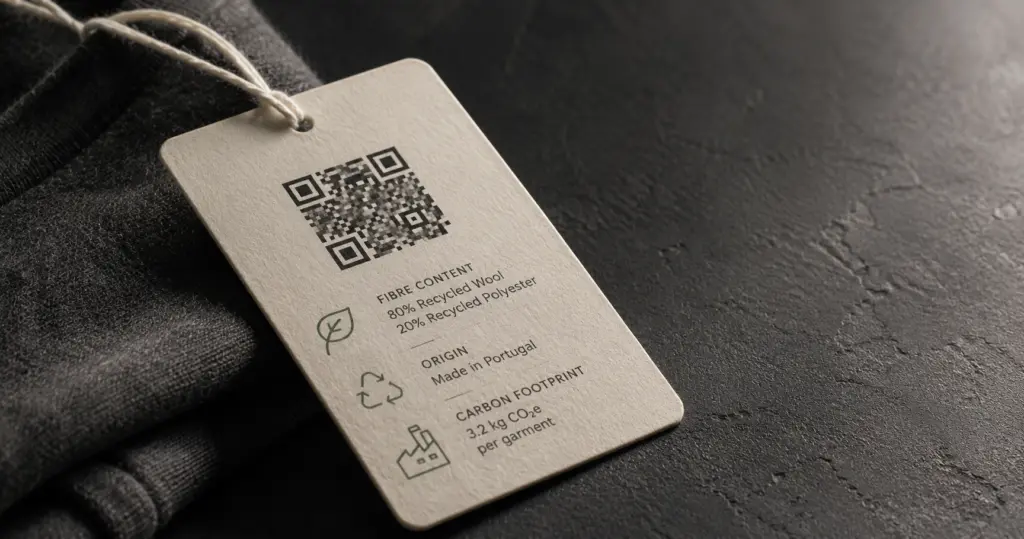
The EU Digital Product Passport is a digital record, linked to a scannable identifier on the product, that discloses a garment’s materials, origin, and environmental footprint. It comes from the Ecodesign for Sustainable Products Regulation (ESPR), which entered into force in July 2024. For fashion brands specifically, the Digital Product Passport is not optional paperwork. Instead, it works as a market access requirement. Once it applies to a product category, that product cannot legally sell in the EU without one.
Textiles have not reached that point yet. No delegated act has been adopted for apparel, footwear, or fashion accessories. As a result, the Digital Product Passport is not mandatory for clothing today. However, preparatory work is well underway. In May 2026, the EU Joint Research Centre published the first complete data specification for textile apparel. That specification is what brands should build against now, well before the compliance clock starts.
This guide covers what the Digital Product Passport actually requires for textiles. It also covers the realistic timeline fashion brands are working against, the likely cost, and where the underlying data already lives inside a connected PLM system.
What Is the EU Digital Product Passport for Fashion Brands?
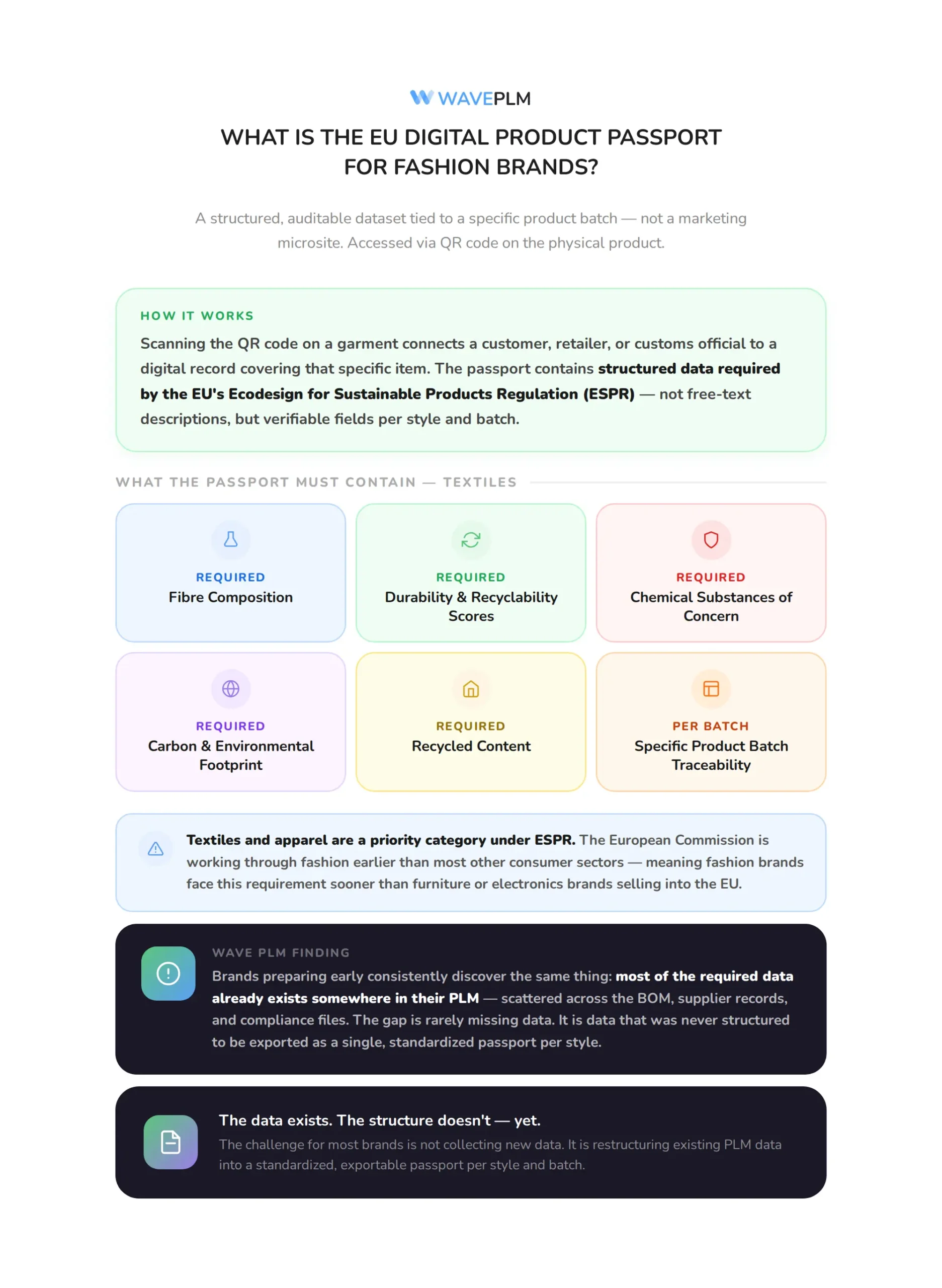
The Digital Product Passport works through a data carrier, typically a QR code or similar identifier attached to the physical product. Scanning it connects a customer, retailer, or customs official to a digital record covering that specific item. For textiles, this record needs fibre composition, durability and recyclability scores, recycled content, chemical substances of concern, and carbon and environmental footprint data. Consequently, the passport is not a marketing microsite. Instead, it is a structured, auditable dataset tied to a specific product batch.
The ESPR itself is broader than fashion. It applies, category by category, across nearly all physical products sold in the EU. Textiles and apparel sit among the priority categories the European Commission is working through first, alongside furniture and electronics. As a result, fashion brands selling into the EU face this requirement earlier than most other consumer sectors.
Our finding: Wave PLM customers preparing early for the Digital Product Passport consistently discover the same thing: most of the required data already exists somewhere in their PLM, scattered across the BOM, supplier records, and existing compliance files. The gap is rarely missing data. It is data that was never structured to be exported as a single, standardized passport per style.
When Does the Digital Product Passport Become Mandatory for Textiles?
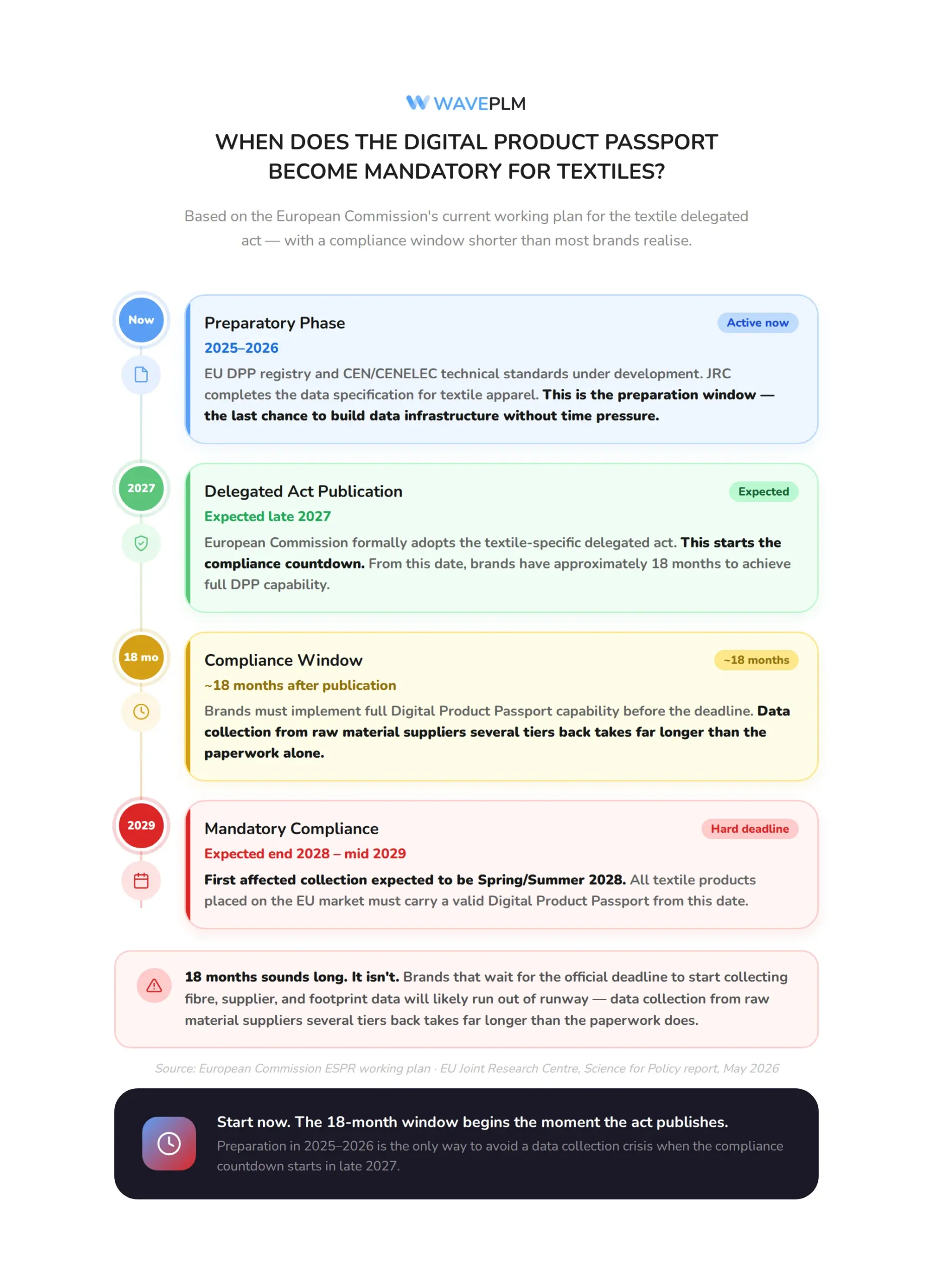
The table below maps the realistic timeline, based on the European Commission’s current working plan for the textile delegated act.
| Phase | Timing | What happens |
|---|---|---|
| Preparatory phase | 2025–2026 | EU DPP registry and CEN/CENELEC technical standards under development; JRC completes the data specification for textile apparel |
| Delegated act publication | Expected late 2027 | European Commission formally adopts the textile-specific delegated act, starting the compliance countdown |
| Compliance window | ~18 months after publication | Brands must implement full Digital Product Passport capability before the deadline |
| Mandatory compliance | Expected end 2028 – mid 2029 | First affected collection expected to be Spring/Summer 2028 |
Source: European Commission ESPR working plan; EU Joint Research Centre, Science for Policy report, May 2026.
Notice how short that 18-month compliance window really is once the delegated act publishes. Brands that wait for the official deadline to start collecting fibre, supplier, and footprint data will likely run out of runway. Data collection itself, especially from raw material suppliers several tiers back, simply takes far longer than the paperwork does.
How Much Does Digital Product Passport Compliance Cost?
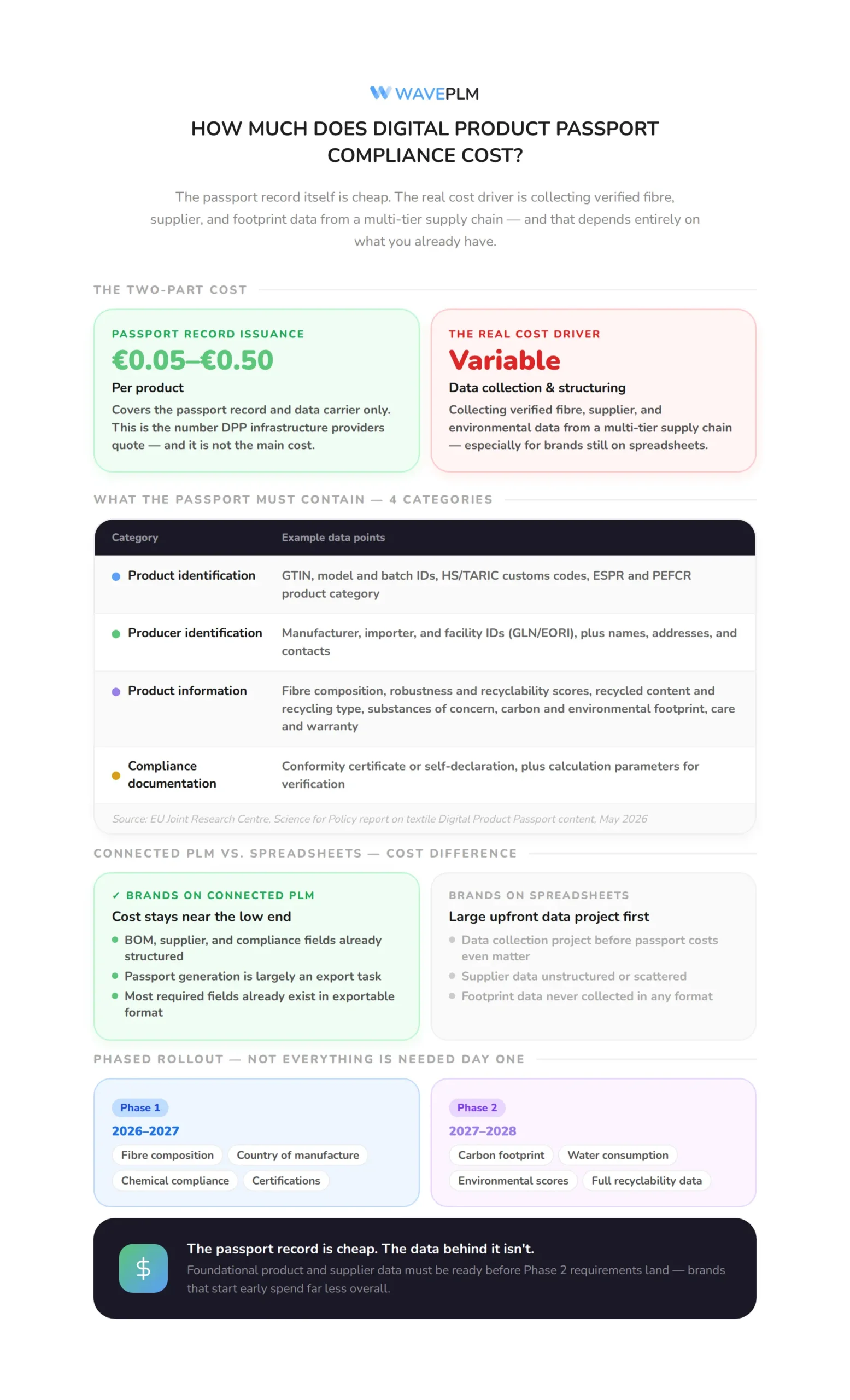
Early cost estimates from DPP infrastructure providers put the price of issuing a single passport at roughly €0.05 to €0.50 per product, depending on how much data verification each item requires. That figure, however, covers only the passport record and its data carrier. It does not include the larger cost driver: collecting verified fibre, supplier, and footprint data from a multi-tier supply chain in the first place.
For brands already tracking BOM and supplier data in a connected PLM, this cost curve looks very different than it does for a brand still running spreadsheets. Specifically, the passport-generation cost stays close to the low end of that range, since most of the required fields already exist in a structured, exportable format. Brands without that foundation, in contrast, face a much larger upfront data collection project before passport costs even become relevant.
| Category | Example data points |
|---|---|
| Product identification | GTIN, model and batch IDs, HS/TARIC customs codes, ESPR and PEFCR product category |
| Producer identification | Manufacturer, importer, and facility IDs (GLN/EORI), plus names, addresses, and contacts |
| Product information | Fibre composition, robustness and recyclability scores, recycled content and recycling type, substances of concern, carbon and environmental footprint, care and warranty |
| Compliance documentation | Conformity certificate or self-declaration, plus calculation parameters for verification |
Source: EU Joint Research Centre, Science for Policy report on textile Digital Product Passport content, May 2026.
Industry data: According to the JRC’s May 2026 report, the rollout is phased. Phase 1, covering 2026–2027, focuses on fibre composition, country of manufacture, chemical compliance, and certifications. Phase 2, covering 2027–2028, adds carbon footprint and water consumption data. In other words, brands do not need every data point finalized on day one. The foundational product and supplier data needs to be ready first.
How Is DPP Different from CPSIA, RSL, and UFLPA?
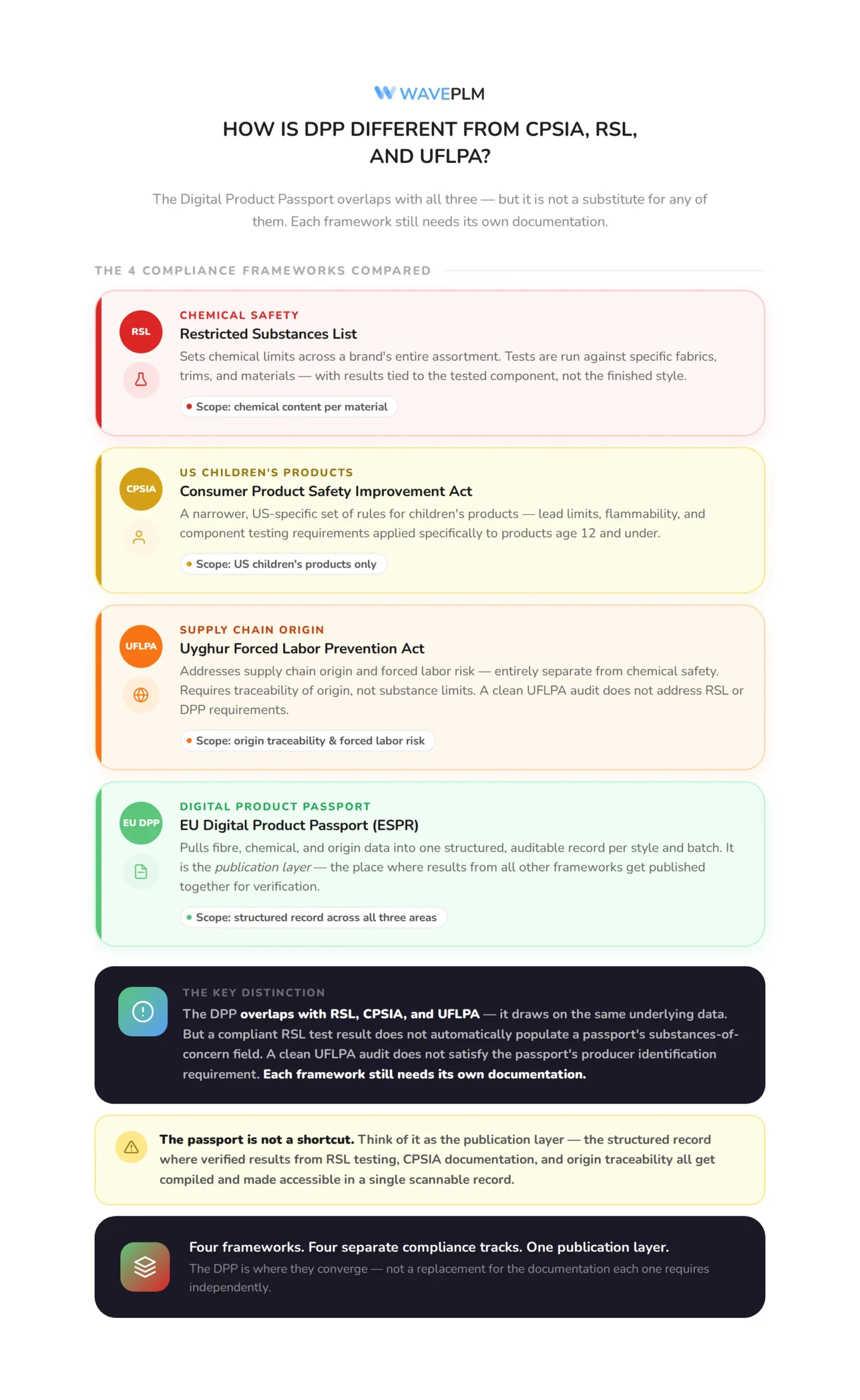
It helps to place the Digital Product Passport next to the other compliance frameworks a fashion brand already tracks. A Restricted Substances List sets chemical limits across a brand’s assortment. Meanwhile, our CPSIA compliance guide covers a narrower, US-specific set of rules for children’s products. UFLPA [INTERNAL-LINK: UFLPA certification → forced labor/origin compliance] addresses a third area entirely: supply chain origin and forced labor risk.
The Digital Product Passport overlaps with all three, since it pulls fibre, chemical, and origin data into one record. However, it is not a substitute for any of them. A compliant RSL test result, for example, does not automatically populate a passport’s substances-of-concern field. Similarly, a clean UFLPA audit does not satisfy the passport’s producer identification requirement on its own. Each framework still needs its own documentation. The passport simply becomes the place where results from all of them get published together.
What Mistakes Will Brands Make Preparing for the Digital Product Passport?
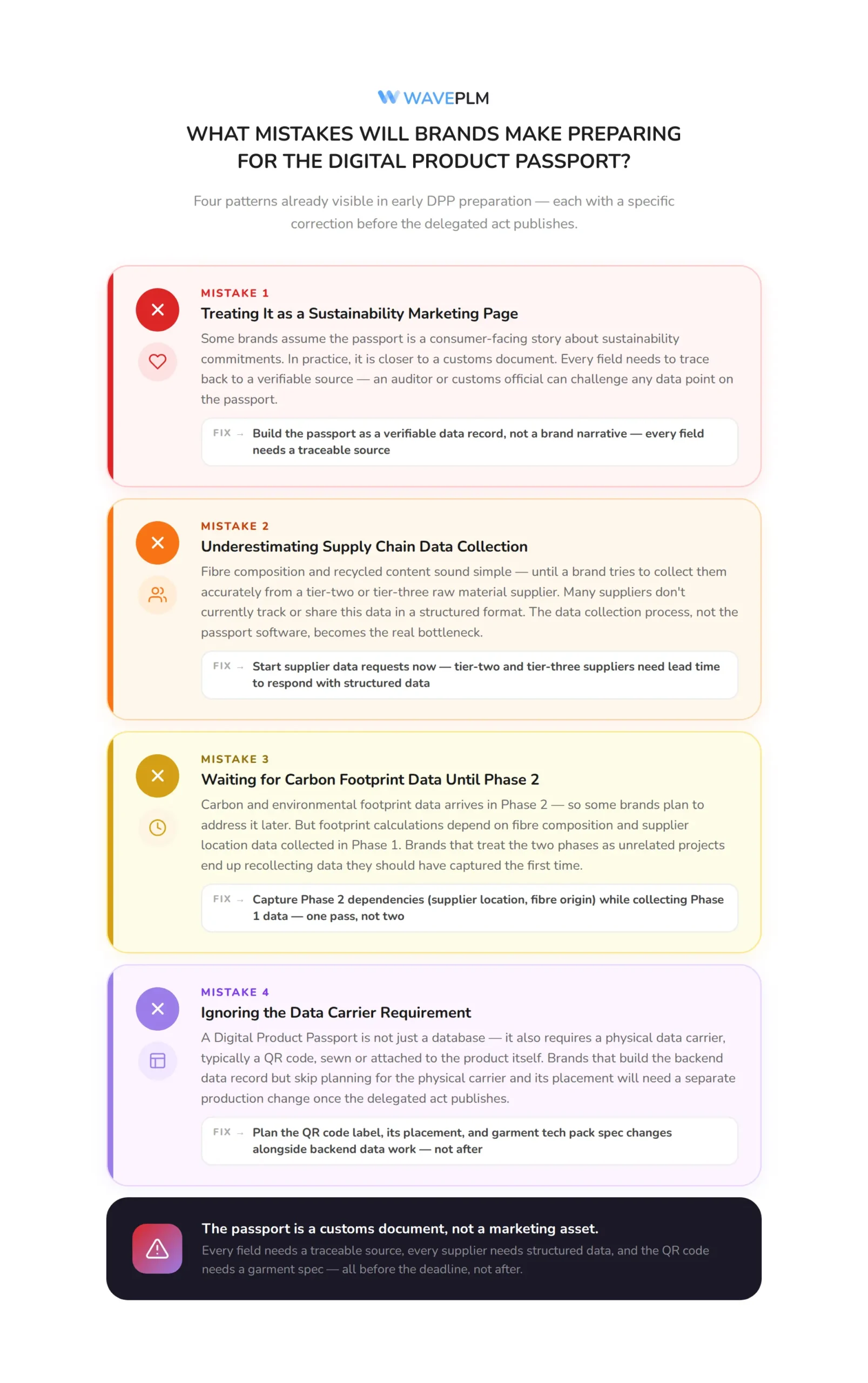
Treating It as a Sustainability Marketing Page
Some brands assume the passport is a consumer-facing story about their sustainability commitments. In practice, it is closer to a customs document. Every field needs to trace back to a verifiable source, not a brand narrative, and an auditor or customs official can challenge any data point on the passport.
Underestimating Supply Chain Data Collection
Fibre composition and recycled content data sound simple, until a brand tries to collect them accurately from a tier-two or tier-three raw material supplier. Many suppliers do not currently track or share this data in a structured format. As a result, the data collection process, not the passport software itself, becomes the real bottleneck.
Waiting for Carbon Footprint Data Until Phase 2
Since carbon and environmental footprint data arrive in Phase 2, some brands plan to address it later. However, footprint calculations depend on fibre composition and supplier location data collected in Phase 1. Brands that treat the two phases as unrelated projects tend to end up recollecting data they should have captured the first time.
Ignoring the Data Carrier Requirement
A Digital Product Passport is not just a database. It also requires a physical data carrier, typically a QR code, sewn or attached to the product itself. Brands that build the backend data record, but skip planning for the physical carrier and its placement, will need a separate production change once the delegated act publishes.
How Does Wave PLM Support Digital Product Passport Readiness?
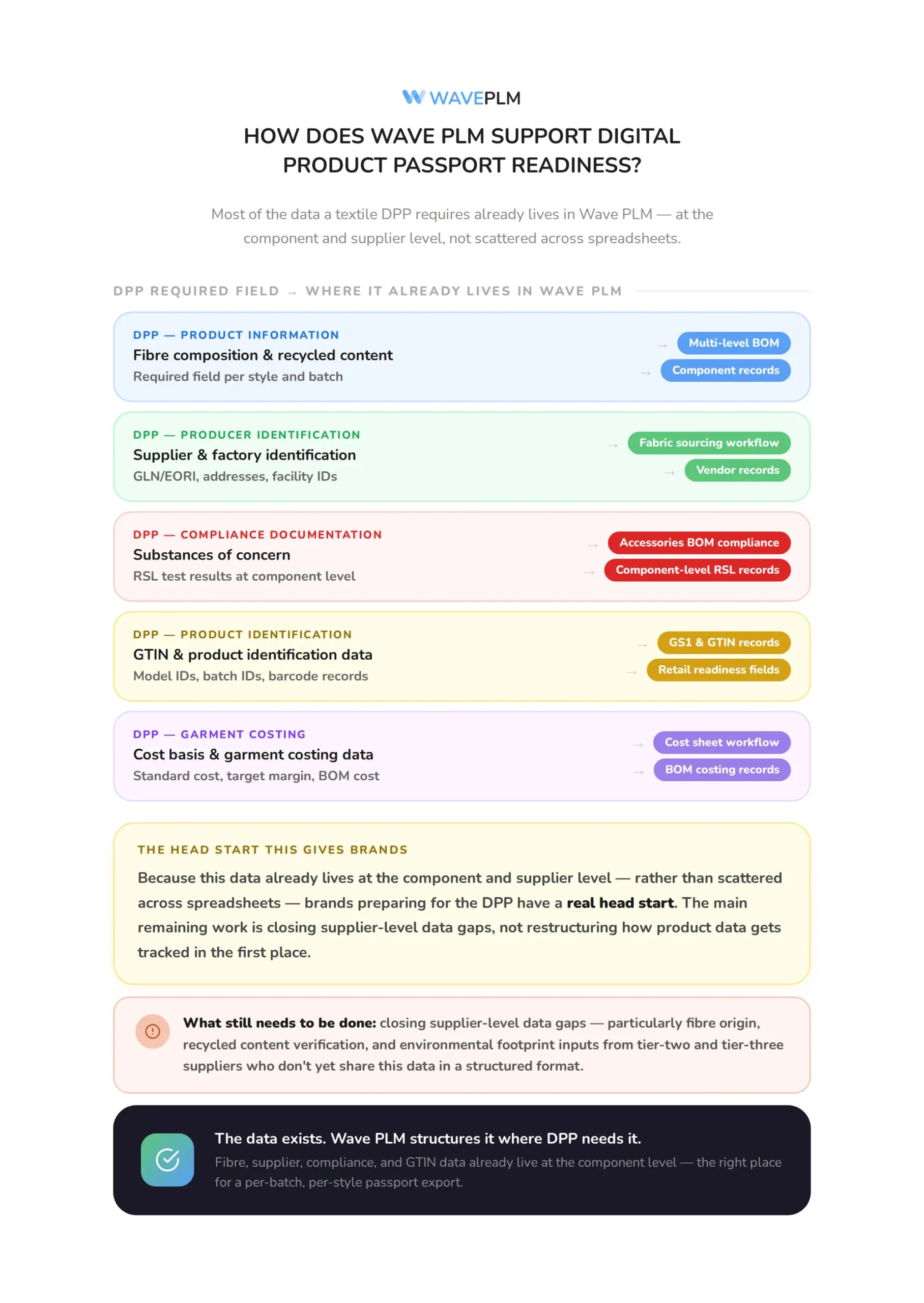
Wave PLM already structures most of the data categories a textile Digital Product Passport requires. Fibre composition and recycled content live in the multi-level BOM, alongside the same component records used for garment costing. Supplier and factory identification follows the fabric sourcing workflow already used across a collection. Similarly, substances-of-concern data attaches at the component level, the same structure covered in our accessories multi-material BOM guide. Product identification data, in turn, lines up with the GS1 and GTIN records brands already maintain for retail readiness.
Because this data already lives at the component and supplier level, rather than scattered across spreadsheets, brands preparing for the eventual delegated act have a real head start. Consequently, the main remaining work is closing supplier-level data gaps, not restructuring how product data gets tracked in the first place.
Frequently Asked Questions
What is the EU Digital Product Passport?
The Digital Product Passport is a digital record, linked to a scannable identifier on the product, disclosing a product’s materials, origin, and environmental footprint. It comes from the EU’s Ecodesign for Sustainable Products Regulation (ESPR), which entered into force in July 2024.
When does the Digital Product Passport become mandatory for clothing?
No delegated act has been adopted for textiles yet. The European Commission expects to publish the textile-specific delegated act in late 2027. An 18-month compliance window follows. Mandatory compliance is expected between end 2028 and mid 2029, likely starting with Spring/Summer 2028 collections.
What data does a textile Digital Product Passport require?
The EU Joint Research Centre’s May 2026 specification defines 49 data points across four categories. These are product identification, producer identification, product information (including fibre composition and carbon footprint), and compliance documentation.
Is the Digital Product Passport the same as a Restricted Substances List?
No. A Restricted Substances List sets chemical limits across a brand’s assortment. The Digital Product Passport is broader. It includes substances-of-concern data alongside fibre composition, origin, and carbon footprint, all published together in one record per product.
Does the Digital Product Passport require a physical QR code on garments?
Yes. The Digital Product Passport requires a physical data carrier, typically a QR code, attached to the product. Scanning it connects a customer, retailer, or customs official to the product’s digital record.
Should fashion brands start preparing before the delegated act publishes?
Yes. The 18-month compliance window is unlikely to be extended once the textile delegated act publishes. Supply chain data collection, especially from raw material suppliers, takes longer than most brands expect.
Whether a brand needs to act on the Digital Product Passport now or can reasonably wait comes down to one question: how scattered is your fibre, supplier, and compliance data today? Some brands can answer that question from memory. Others cannot say who owns the fibre content number for a given style, let alone whether it is current.
If that second description sounds familiar, the 18-month compliance window is going to feel a lot shorter than it looks on paper. Fibre composition, supplier records, and compliance data need to trace back to a verifiable source before any of it can go on a passport, and that groundwork takes months to assemble from scratch. Talk to the Wave PLM team about what DPP readiness actually looks like for a brand your size.







Leave a Reply