
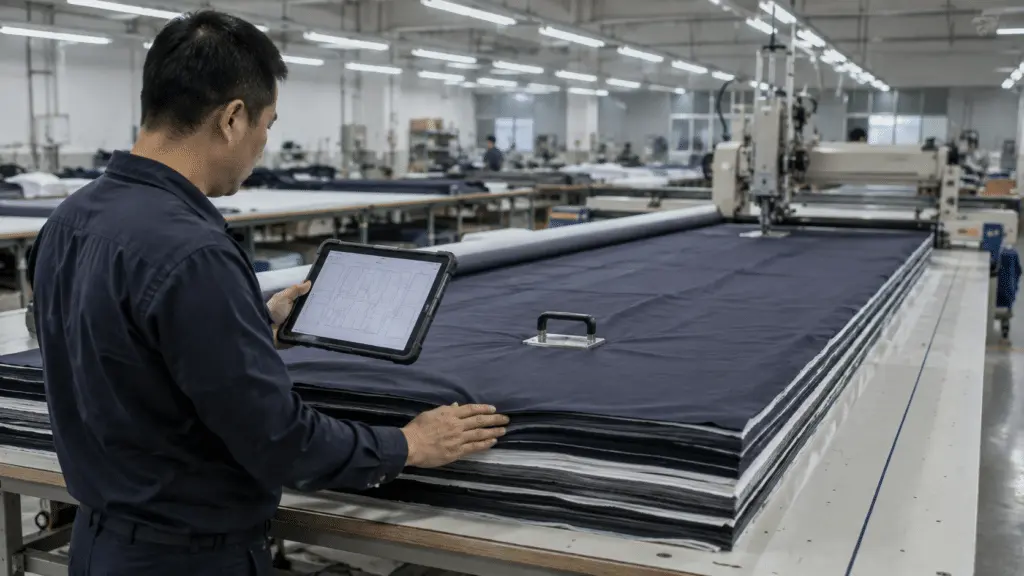
Cut order planning is the process of deciding how to group a purchase order’s sizes, colors, and quantities into fabric lays before cutting begins. Each lay follows one marker, the layout of pattern pieces arranged across the fabric width. Get that grouping wrong, and problems compound quickly. A factory either wastes fabric on every lay it cuts, or spends extra hours setting up more lays than the order actually needs. Get it right, however, and both problems shrink at once.
This guide covers how cut order planning actually works, and where the real trade-offs sit between fabric efficiency and cutting-room labor. It also covers the mistakes that quietly inflate fabric cost across a season. Finally, it covers where the underlying size and BOM data already lives inside a connected PLM system.
What Is Cut Order Planning?
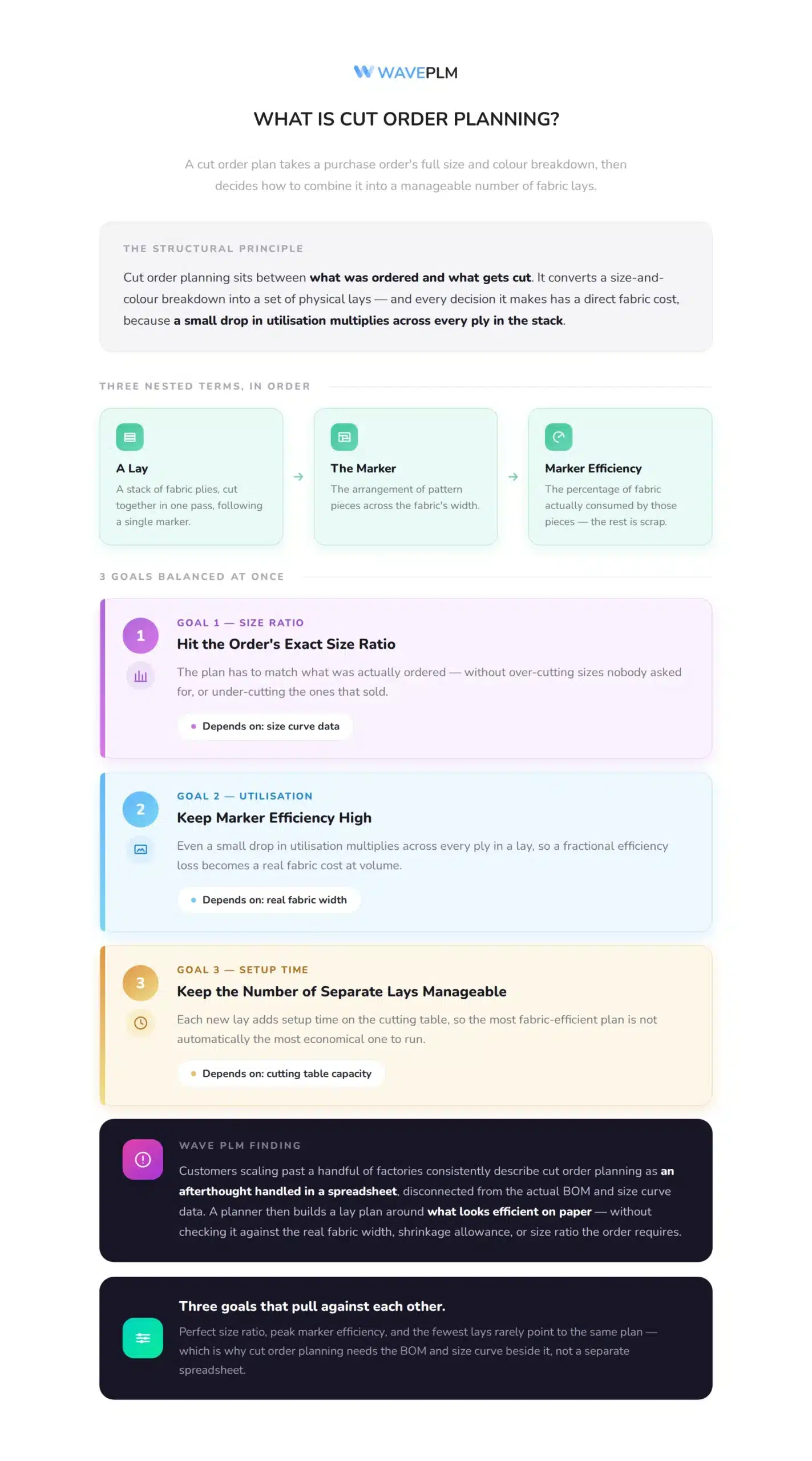
A cut order plan takes a purchase order’s full size and color breakdown. It then decides how to combine that breakdown into a manageable number of fabric lays. A lay is a stack of fabric plies, cut together in one pass, following a single marker. The marker itself is the arrangement of pattern pieces across the fabric’s width. Its efficiency is the percentage of fabric actually consumed by those pieces. That percentage, in turn, determines how much fabric a lay wastes as scrap.
Specifically, cut order planning has to balance three goals at once. It needs to hit the order’s exact size ratio, without over-cutting sizes nobody ordered or under-cutting ones that did. It needs to keep marker efficiency high, since even a small drop in utilization multiplies across every ply in a lay. Finally, it needs to keep the number of separate lays manageable, since each new lay adds setup time on the cutting table.
Our finding: Wave PLM customers scaling past a handful of factories consistently describe cut order planning as an afterthought, handled in a spreadsheet disconnected from the actual BOM and size curve data. As a result, a planner often builds a lay plan around what looks efficient on paper, without checking it against the real fabric width, shrinkage allowance, or size ratio the order requires.
How Does a Cut Order Plan Actually Work in Practice?
A planner starts with the order’s size and color breakdown. Additionally, similar ratios get grouped into shared lays, wherever the marker allows it. For example, sizes with a similar cut-piece shape can often share one marker, cut in the ratio the order requires. Colors, by contrast, almost always need separate lays. Specifically, each color typically runs on its own fabric roll. The planner then checks fabric width against the marker layout. This step accounts for shrinkage and known fabric defects, before finalizing how many plies each lay will stack.
What Trade-Offs Sit Between Marker Efficiency and Lay Count?
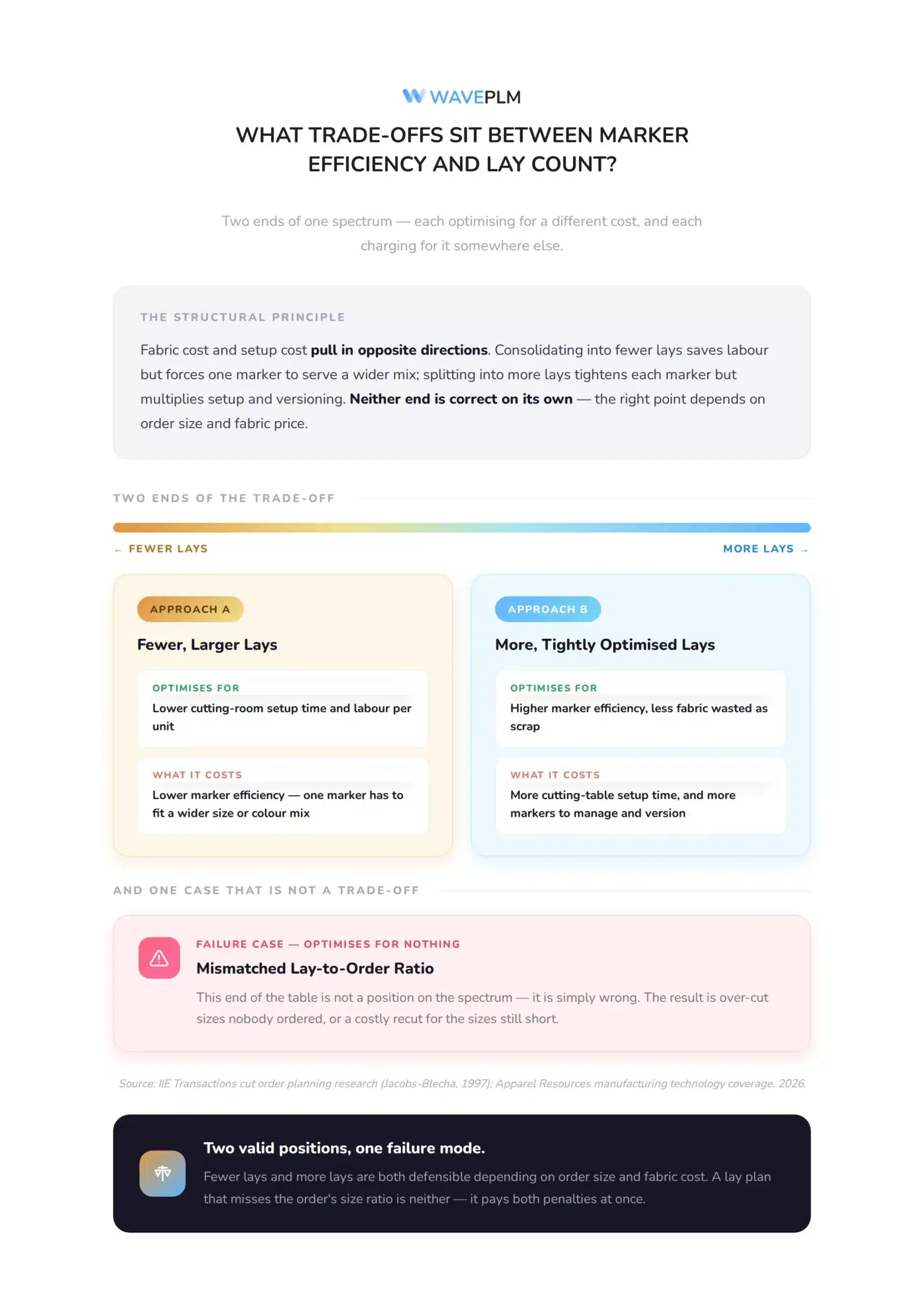
The table below maps the two ends of this trade-off, and what each approach costs a brand in practice.
| Approach | What it optimizes for | What it costs |
|---|---|---|
| Fewer, larger lays | Lower cutting-room setup time and labor per unit | Lower marker efficiency, since one marker has to fit a wider size or color mix |
| More, tightly optimized lays | Higher marker efficiency, less fabric wasted as scrap | More cutting-table setup time, and more markers to manage and version |
| Mismatched lay-to-order ratio | Nothing — this is the failure case, not a trade-off | Over-cut sizes nobody ordered, or a costly recut for sizes still short |
Source: IIE Transactions cut order planning research (Jacobs-Blecha, 1997); Apparel Resources manufacturing technology coverage, 2026.
Why Is Cut Order Planning Considered a Hard Optimization Problem?
Industry data: Academic operations-research literature has studied cut order planning since at least the late 1990s, and classifies it as a genuinely hard combinatorial optimization problem. That difficulty comes from balancing several competing constraints simultaneously: exact size ratios, marker efficiency, fabric width, and cutting-table labor. In practice, this means a manually built lay plan rarely reaches the same efficiency a systematic approach can find, particularly once an order spans several colors and a wide size curve.
How Should Brands Track Cut Order Planning Performance Over Time?
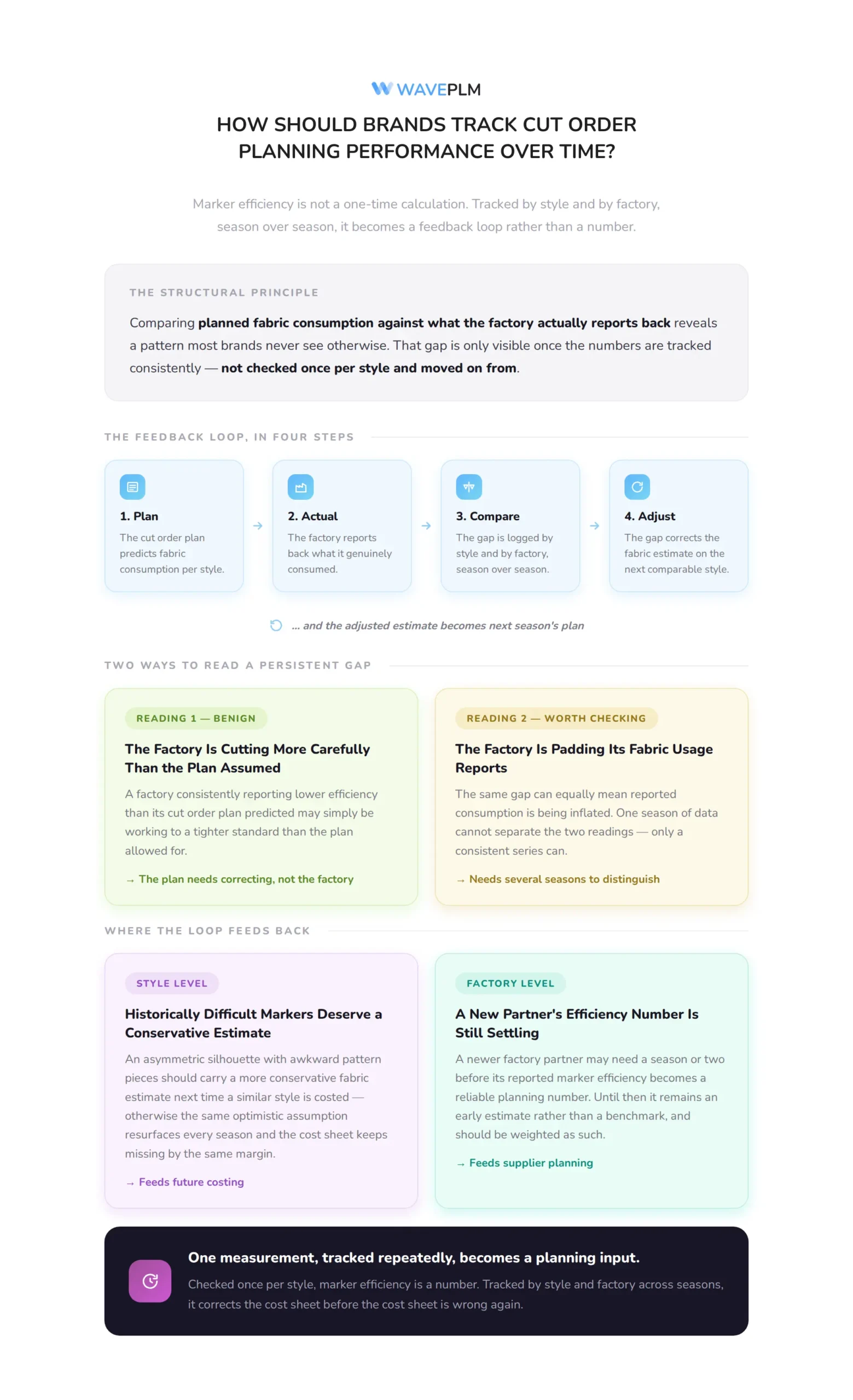
Marker efficiency is not a one-time calculation. It is worth tracking by style and by factory, season over season. Specifically, comparing the planned fabric consumption against what the factory actually reports back reveals a pattern most brands never see otherwise. A factory that consistently reports lower efficiency than its cut order plan predicted may be cutting more carefully than the plan assumed. Alternatively, it may simply be padding its fabric usage reports. Either way, that gap is only visible once a brand tracks the numbers consistently, rather than checking them once per style and moving on.
This tracking also feeds directly back into future costing. Consider a style with a historically difficult marker, for example an asymmetric silhouette with awkward pattern pieces. That style should carry a more conservative fabric estimate the next time a similar style gets costed. Otherwise, the same optimistic assumption resurfaces every season, and the cost sheet keeps missing by the same margin. Notably, this same feedback loop applies across factories, too. A newer factory partner may need a season or two before its reported marker efficiency becomes a reliable planning number. Until then, it remains an early estimate still settling in.
What Mistakes Do Brands Make With Cut Order Planning?
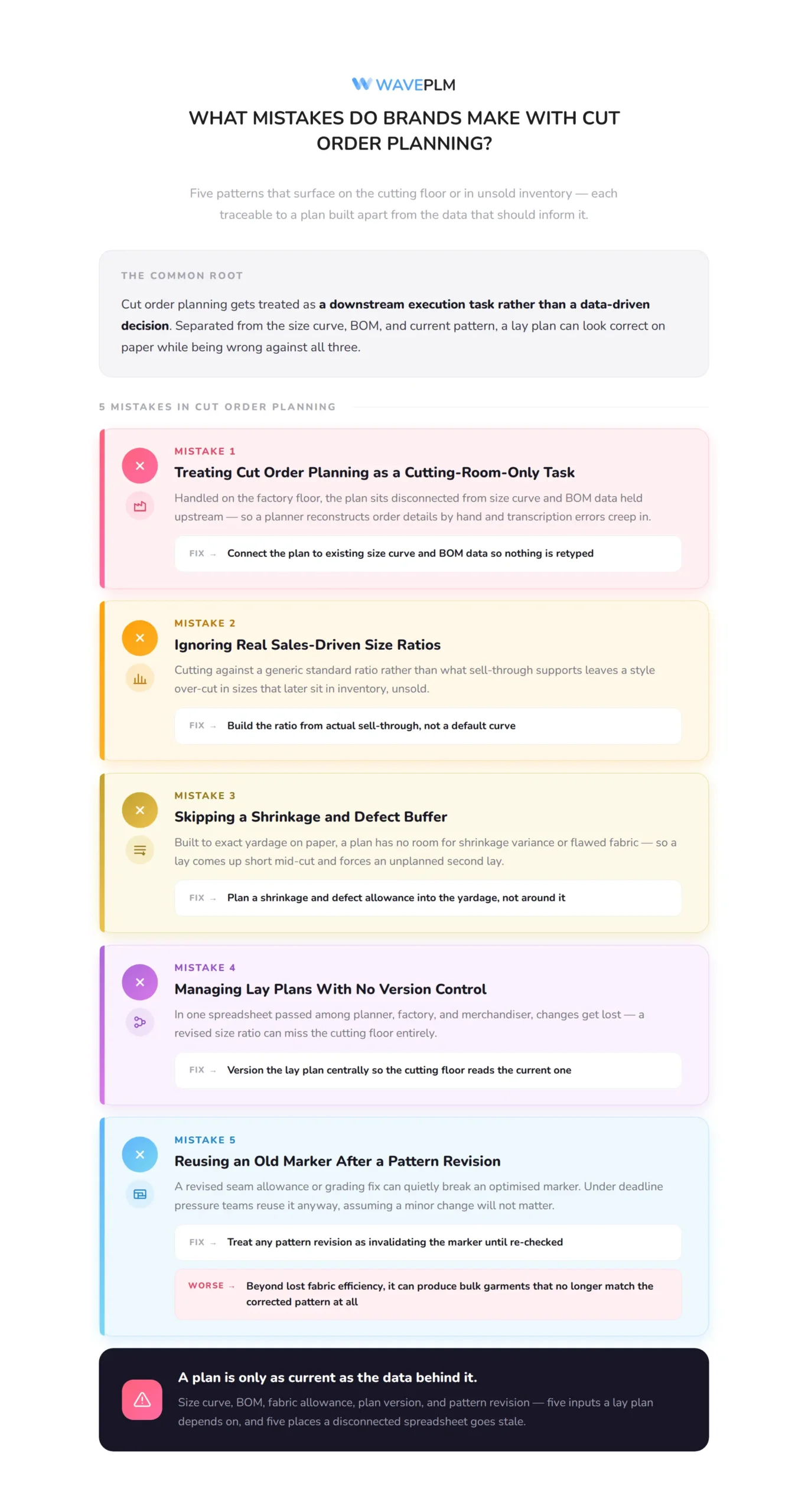
Treating Cut Order Planning as a Cutting-Room-Only Task
Cut order planning often gets handled entirely on the factory floor, disconnected from the size curve and BOM data a brand already holds upstream. That gap forces a planner to reconstruct order details manually, and small transcription errors creep in every time.
Ignoring Real Sales-Driven Size Ratios
Some brands cut every style against a generic, standard size ratio, rather than the ratio actual sell-through data supports. A style that consistently sells more in mid-range sizes ends up over-cut in sizes that later sit in inventory, unsold.
Skipping a Shrinkage and Defect Buffer
A cut order plan built to the exact fabric yardage on paper leaves no room for shrinkage variance or a flawed section of fabric. Consequently, a lay can come up short mid-cut, forcing an unplanned second lay with its own setup cost.
Managing Lay Plans With No Version Control
When a lay plan lives in a single spreadsheet passed among a planner, a factory, and a merchandiser, changes get lost easily. A revised size ratio from a late order change can miss the cutting floor entirely if the update never reaches the right version.
Reusing an Old Marker After a Pattern Revision
A small pattern correction, such as a revised seam allowance or a grading fix, can quietly break a marker that was previously optimized. Teams under deadline pressure sometimes reuse the old marker anyway, assuming a minor pattern change will not matter. In practice, that assumption often costs fabric efficiency. Worse, it can produce bulk garments that no longer match the corrected pattern at all.
What Should Brands Set Up for Better Cut Order Planning?
A few practical habits keep cut order planning connected to the rest of a brand’s production data. First, pull the size ratio directly from confirmed order data, not a generic default. Second, build in a shrinkage and defect buffer before finalizing ply count, rather than cutting to the exact theoretical yardage. Third, track marker efficiency by style over time, so a factory’s actual performance is visible, not just assumed. Finally, keep lay plans versioned and tied to the specific purchase order they belong to, rather than living in a standalone file with no clear owner.
How Does Wave PLM Support Cut Order Planning?
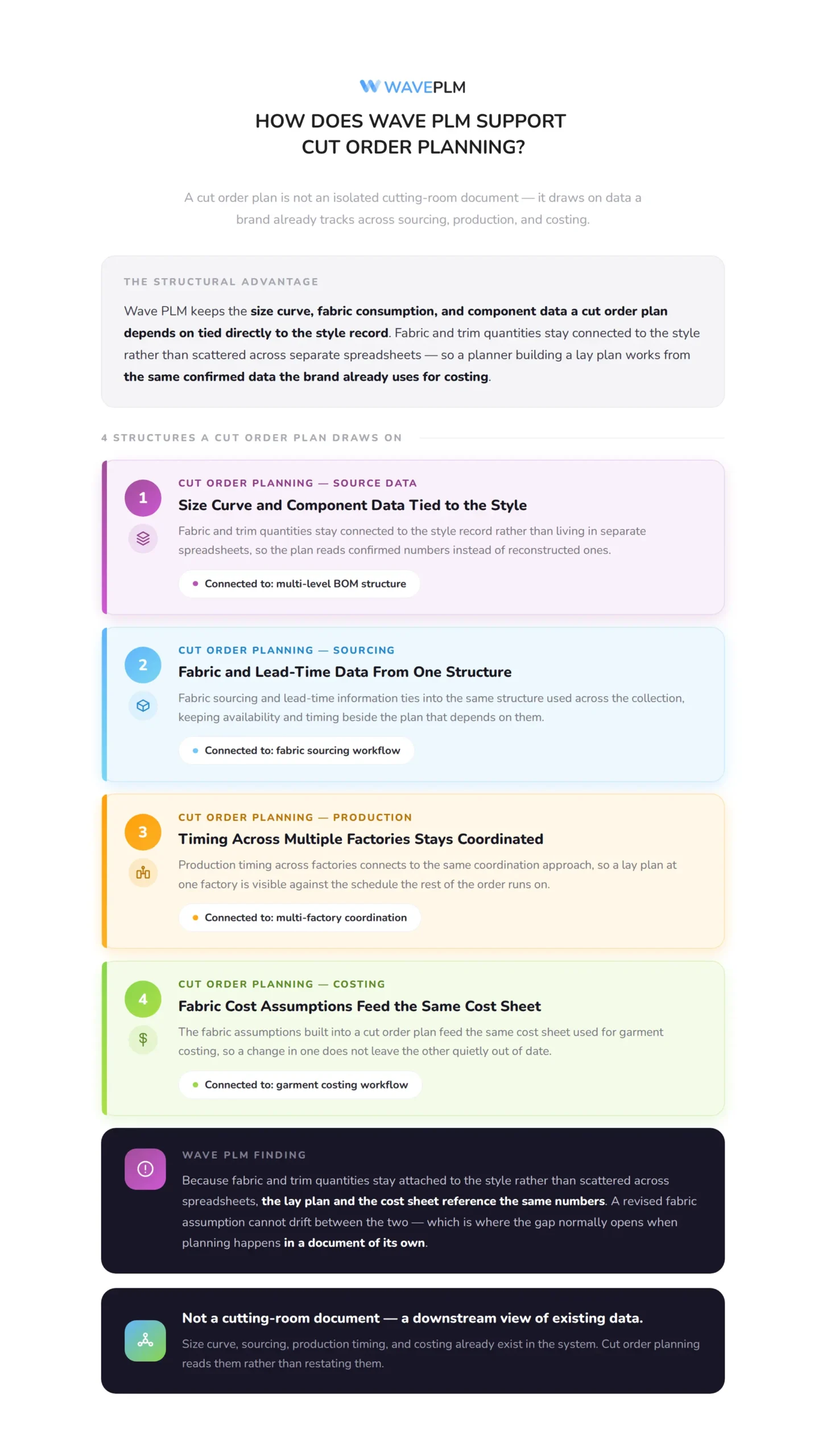
Wave PLM keeps the size curve, fabric consumption, and component data a cut order plan depends on tied directly to the style record. This follows the same structure covered in our guide to multi-level BOM in fashion. There, fabric and trim quantities stay connected to the style, rather than scattered across separate spreadsheets. As a result, a planner building a lay plan is working from the same confirmed data a brand already uses for costing.
Fabric sourcing and lead-time data, similarly, ties into the same structure covered in our fabric sourcing guide. Production timing across multiple factories connects to the coordination approach in our guide to multi-factory production coordination. Fabric cost assumptions built into a cut order plan, in turn, feed the same cost sheet covered in our garment costing guide. A cut order plan, in other words, is not an isolated cutting-room document. It draws on data a brand already tracks across sourcing, production, and costing.
Frequently Asked Questions
What is cut order planning in apparel manufacturing?
Cut order planning is the process of grouping a purchase order’s sizes, colors, and quantities into fabric lays before cutting. Each lay follows a marker, the pattern layout across the fabric width, and its efficiency determines how much fabric gets wasted.
What is a marker in cut order planning?
A marker is the layout of pattern pieces arranged across a fabric’s width for one lay. Marker efficiency measures the percentage of fabric actually consumed by those pieces, with the remainder lost as cutting scrap.
Why is cut order planning considered difficult to optimize?
Cut order planning has to balance exact size ratios, marker efficiency, fabric width, and cutting-table labor simultaneously. Academic operations-research literature classifies it as a genuinely hard combinatorial optimization problem, particularly for orders spanning several colors and a wide size range.
Should every size share the same fabric lay?
Sizes with a similar cut-piece shape can often share one marker, cut in the ratio the order requires. Colors almost always need separate lays instead, since each color typically runs on its own fabric roll.
What happens if a cut order plan does not account for fabric shrinkage?
A lay plan built to the exact theoretical yardage, with no shrinkage or defect buffer, can come up short mid-cut. That shortfall forces an unplanned second lay, adding setup cost the original plan did not budget for.
How does cut order planning connect to garment costing?
Marker efficiency directly determines how much fabric a style actually consumes per unit. That consumption figure feeds the fabric cost line on a garment’s cost sheet. As a result, a less efficient cut order plan raises the real cost of a style beyond its original estimate.
Most brands only notice a weak cut order plan once a fabric invoice runs higher than the cost sheet predicted. Alternatively, a reorder comes up short in a size that quietly got under-cut. By then, the fabric is already gone. The real leverage sits earlier. It comes down to whether the lay plan was built from the same confirmed size ratio and BOM data a brand already tracks. That beats a plan assembled from scratch on the cutting-room floor. See how Wave PLM keeps that data connected from size curve through cutting.






Leave a Reply