
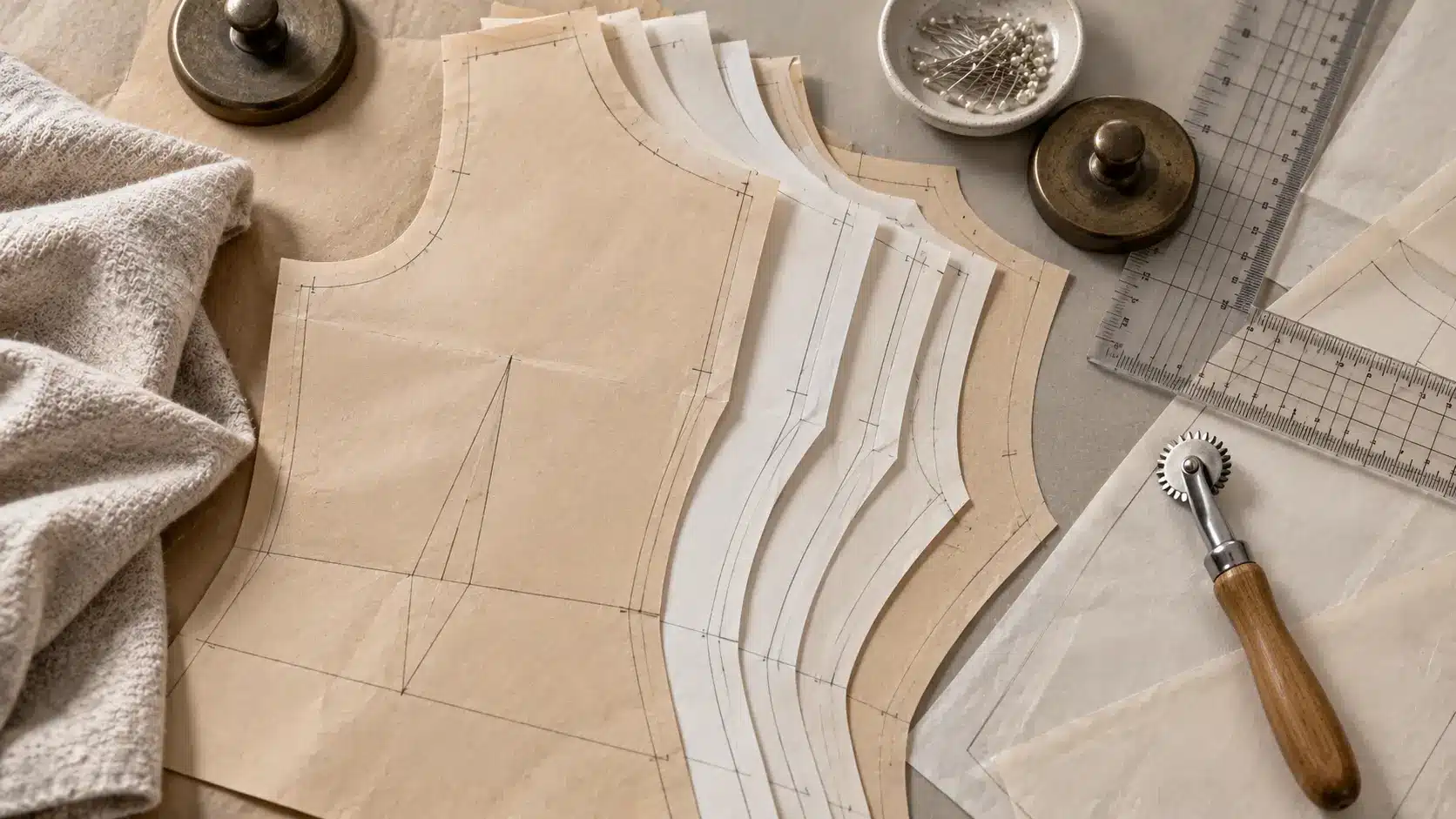
Pattern grading is the process of turning one approved sample-size pattern into every other size in the range. Specifically, it works by moving points on the pattern by set amounts, called grade rules. For example, a women’s knit top fitted in size M might grow by 2 inches at the chest for each size up to XL. Done well, every size fits like the sample. Done badly, the sample fits and the bulk order comes back as returns.
This guide explains how grade rules work, the three grading methods, and a sample grade rule table you can adapt. In addition, it covers the six mistakes that most often break fit between the sample and production. It also shows where grade rules should live, so every new style does not start from scratch.
What Is Pattern Grading?
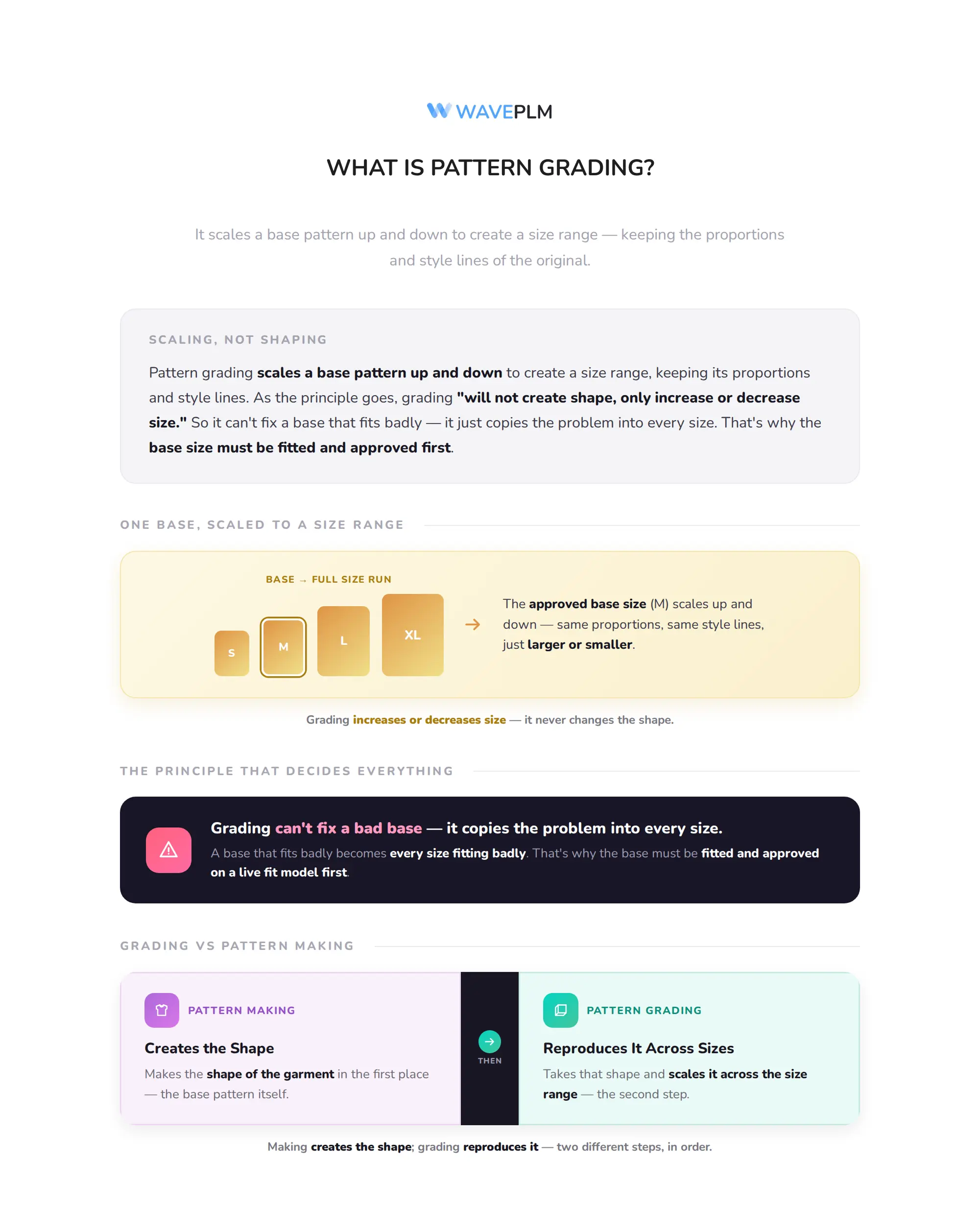
Pattern grading scales a base pattern up and down to create a size range. Importantly, it keeps the proportions and style lines of the original. As the Wikipedia entry on pattern grading puts it, “grading will not create shape, but will only increase or decrease size of original shape.”
That principle matters in practice. In other words, grading cannot fix a base pattern that fits badly. It will simply copy the problem into every size. That is why the base size must be fitted and approved first, usually on a live fit model. Our guide to choosing a sample size in fashion covers how to pick that base size.
Notably, grading is different from pattern making. Pattern making creates the shape of the garment. Grading then reproduces that shape across sizes. Our article on the craft of pattern making covers the first step.
How Do Grade Rules Work?
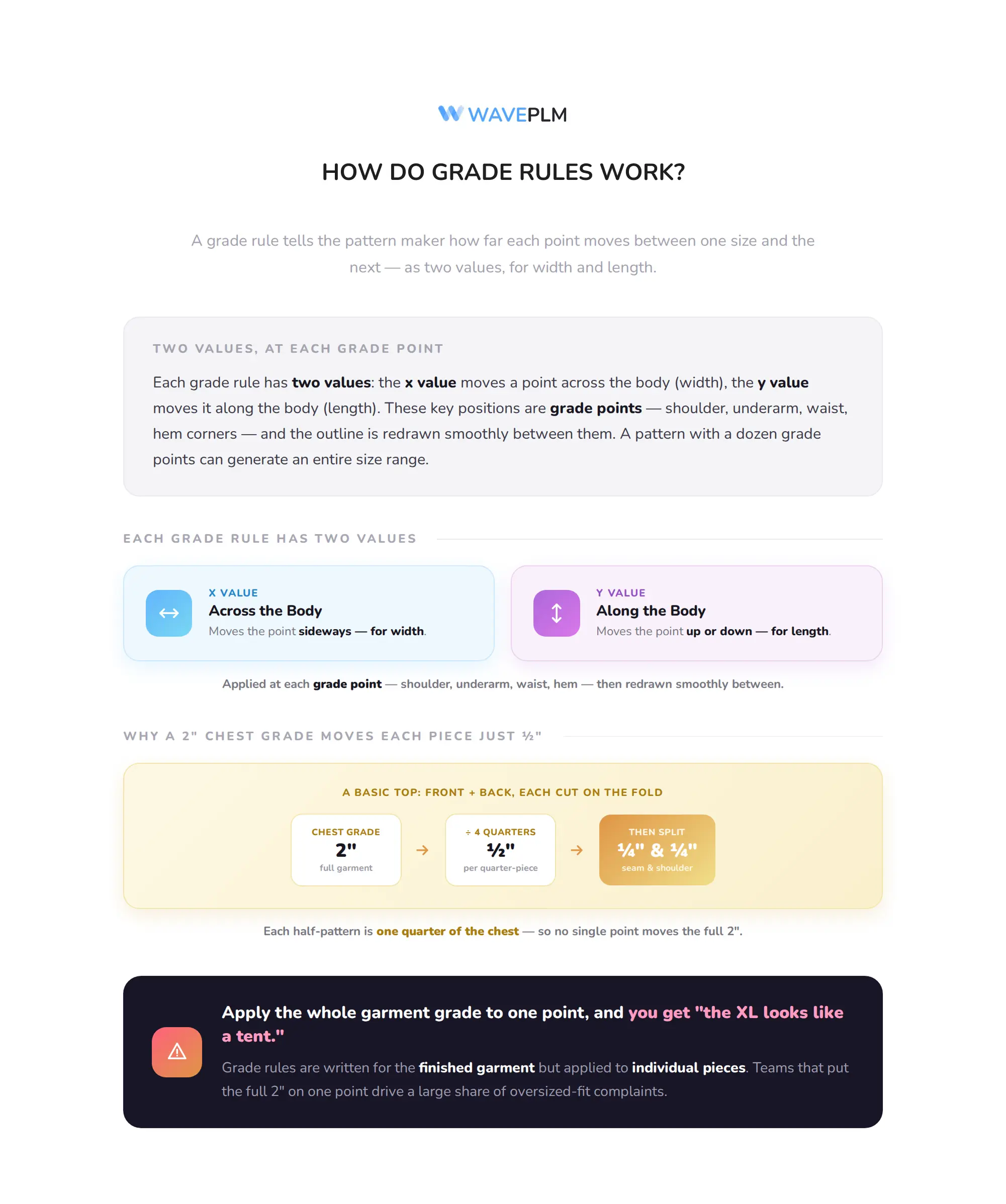
A grade rule tells the pattern maker how far each point on a pattern moves between one size and the next. Specifically, each rule has two values. The x value moves the point across the body, for width. The y value moves it along the body, for length.
Together, these key positions are called grade points or cardinal points. For example, typical grade points are the high point shoulder, the underarm, the waist at the side seam, and the hem corners. Between grade points, the pattern outline is redrawn smoothly. As a result, a pattern with a dozen grade points can generate an entire size range.
Why a 2-Inch Chest Grade Moves Each Piece Only Half an Inch
Grade rules are written for the finished garment, yet they are applied to individual pattern pieces. For instance, a basic top has a front and a back, each usually cut on the fold. Therefore, each half-pattern piece represents one quarter of the chest circumference.
Our finding: A 2-inch chest grade between sizes adds only 1/2 inch to each quarter-pattern piece. That half inch is then usually split between the side seam and the shoulder area, so no single point moves the full amount. Teams that apply the whole garment grade to one point are behind a large share of “the XL looks like a tent” fit complaints.
What Does a Grade Rule Table Look Like?
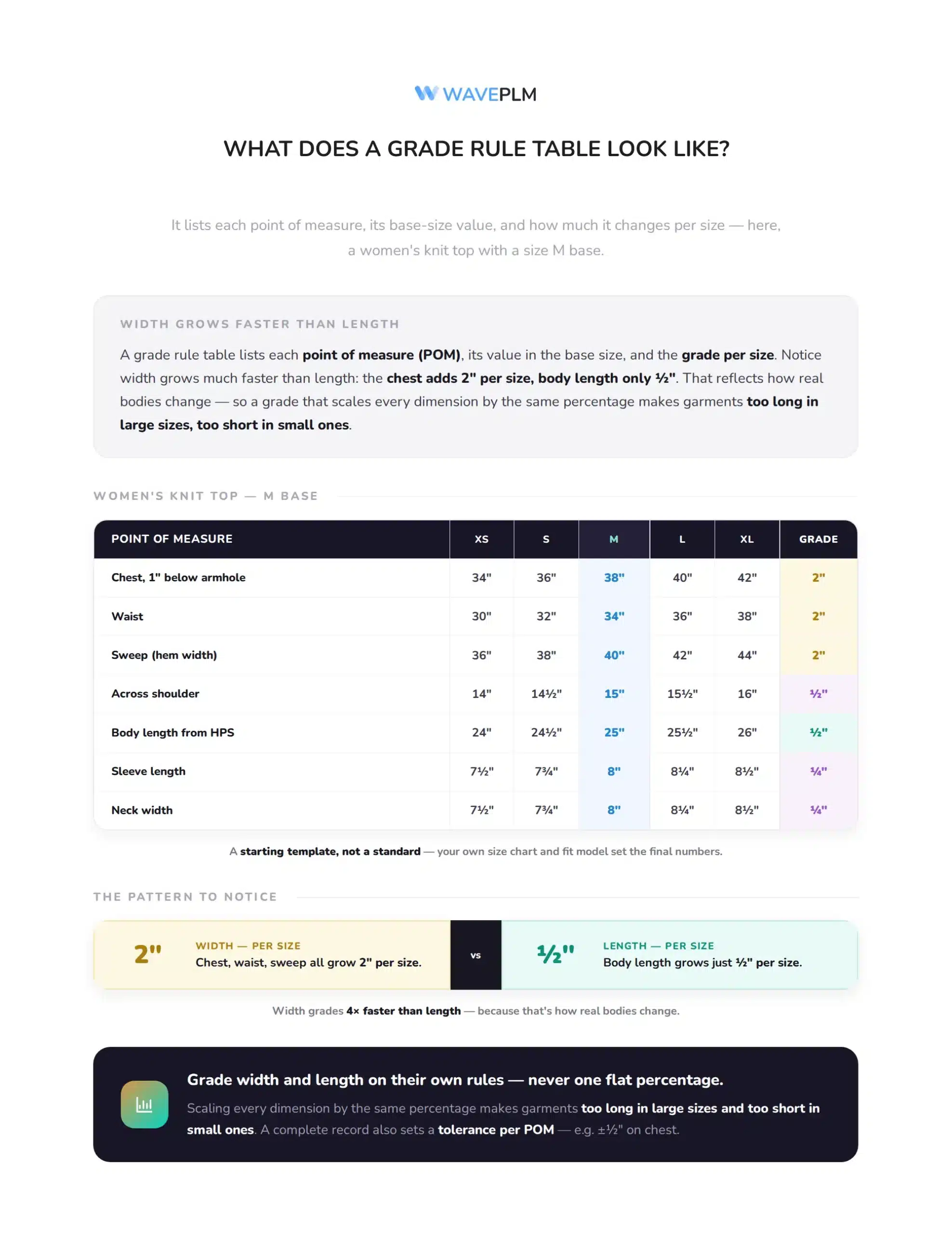
A grade rule table lists each point of measure (POM), its value in the base size, and how much it changes per size. The example below is for a women’s knit top with a size M base. In short, treat it as a starting template, not a standard. Your own size chart and fit model should set the final numbers.
| Point of measure (finished garment) | XS | S | M (base) | L | XL | Grade per size |
|---|---|---|---|---|---|---|
| Chest, 1″ below armhole | 34″ | 36″ | 38″ | 40″ | 42″ | 2″ |
| Waist | 30″ | 32″ | 34″ | 36″ | 38″ | 2″ |
| Sweep (hem width) | 36″ | 38″ | 40″ | 42″ | 44″ | 2″ |
| Across shoulder | 14″ | 14 1/2″ | 15″ | 15 1/2″ | 16″ | 1/2″ |
| Body length from HPS | 24″ | 24 1/2″ | 25″ | 25 1/2″ | 26″ | 1/2″ |
| Sleeve length | 7 1/2″ | 7 3/4″ | 8″ | 8 1/4″ | 8 1/2″ | 1/4″ |
| Neck width | 7 1/2″ | 7 3/4″ | 8″ | 8 1/4″ | 8 1/2″ | 1/4″ |
Notice that width grows much faster than length. Here, the chest adds 2 inches per size, while body length adds only 1/2 inch. That reflects how real bodies change between sizes. Consequently, a grade that scales every dimension by the same percentage produces garments that are too long in large sizes and too short in small ones.
Additionally, a complete grade record includes tolerances for each POM. Tolerance is the acceptable deviation in production, such as ±1/2 inch on chest. For more on building that document, see our guide to creating a measurement sheet.
What Are the Three Pattern Grading Methods?
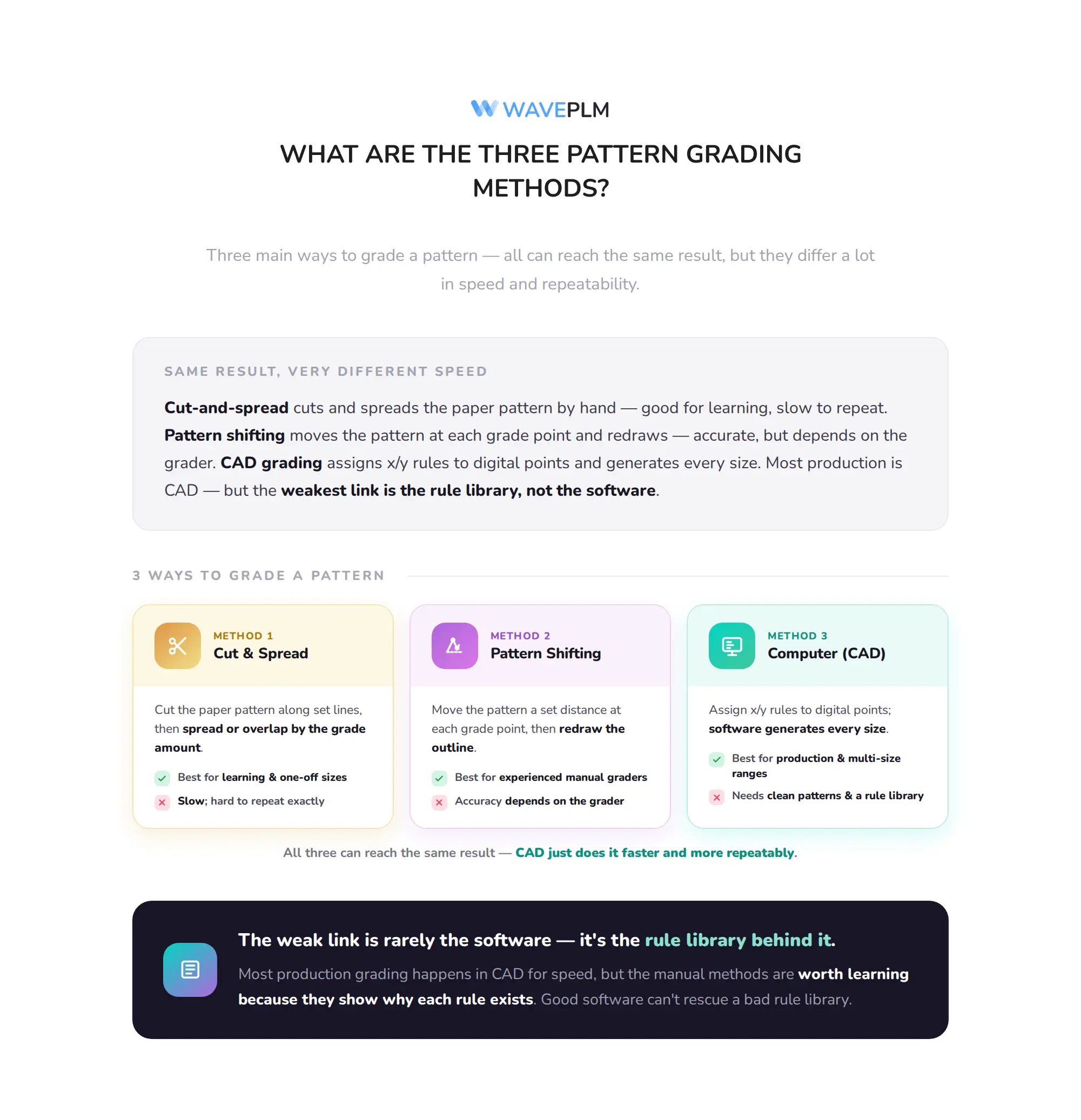
In general, there are three main ways to grade a pattern. All three can produce the same result. However, they differ a lot in speed and repeatability.
| Method | How it works | Best for | Main drawback |
|---|---|---|---|
| Cut and spread | Cut the paper pattern along set lines, then spread or overlap the pieces by the grade amount | Learning, one-off sizes, simple shapes | Slow; hard to repeat exactly |
| Pattern shifting (track grading) | Move the pattern a set distance at each grade point and redraw the outline | Manual grading by an experienced grader | Accuracy depends on the grader |
| Computer (CAD) grading | Assign x/y grade rules to digital grade points; software generates every size | Production patterns and multi-size ranges | Needs clean digital patterns and a rule library |
Today, most production pattern grading happens in CAD, for obvious speed reasons. Even so, the manual methods are still worth learning, because they show why each rule exists. Meanwhile, the weakest link is rarely the software. Instead, it is the rule library behind it.
What Are Break Points and Jump Grades?
A single grade rule rarely works across a wide size range. For that reason, many brands use a break point, where the increment changes. For example, sizes XS to L might grade 2 inches at the chest, while L to 3X grade 2 1/2 or 3 inches. That change is often called a jump grade.
Similarly, some categories need different rules entirely. Extended sizes, maternity, and children’s wear all break the simple linear model in different ways. We cover these in our articles on extended size grading, maternity belly-panel grading, and kids’ apparel sizing.
What Mistakes Break Fit Between Sample and Bulk?
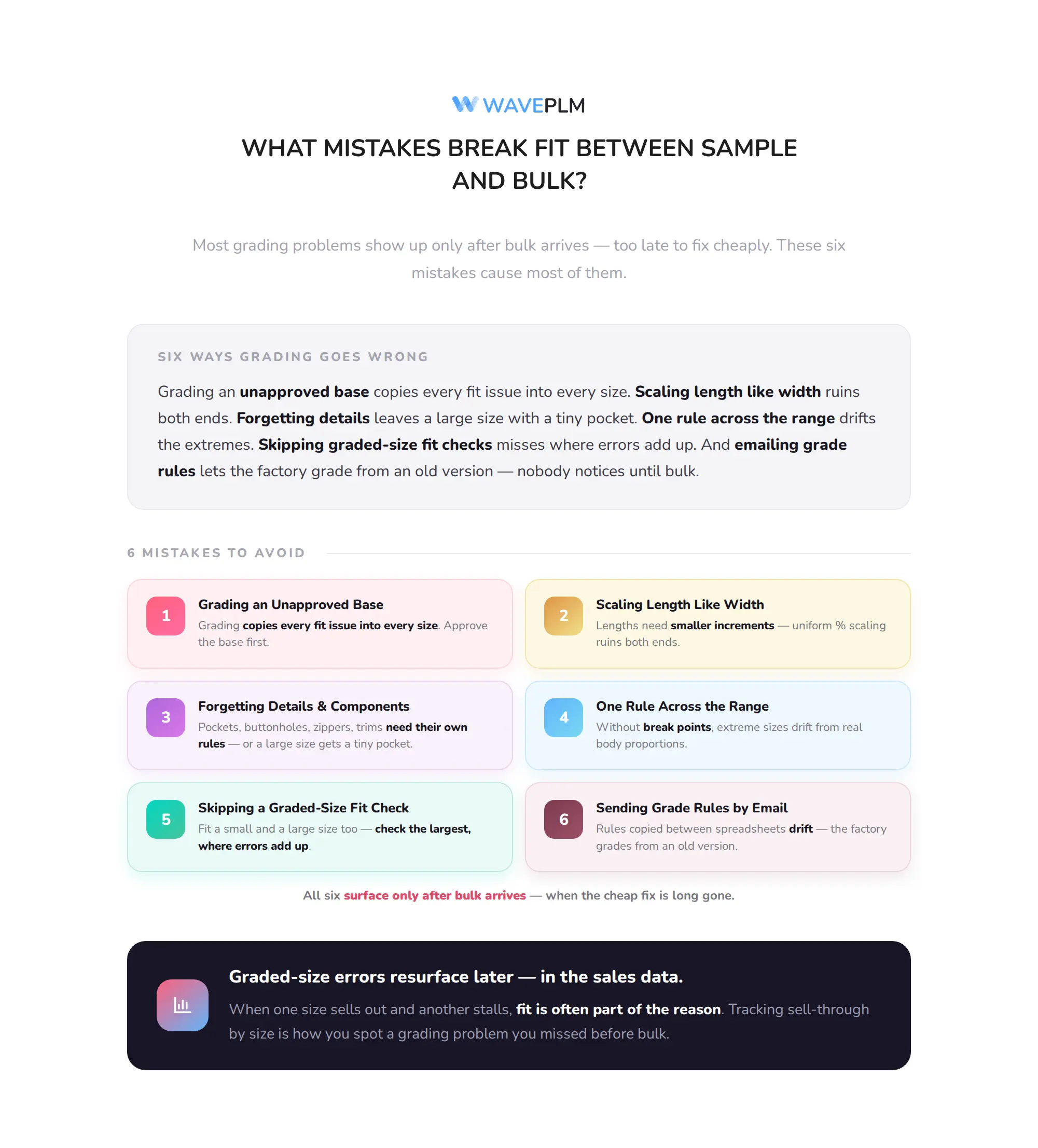
Unfortunately, most grading problems show up only after bulk arrives, when it is too late to fix them cheaply. These six mistakes cause most of them.
- Grading an unapproved base. First, grading copies every fit issue into every size. Approve the base size before any grading starts.
- Scaling length like width. Next, lengths need much smaller increments than circumferences. Uniform percentage scaling ruins both ends of the range.
- Forgetting details and components. Pocket placement, buttonhole spacing, zipper length, and trims all need their own rules. Otherwise, a large size ends up with a tiny pocket placed too high.
- Using one rule across the whole range. Without break points, extreme sizes drift away from real body proportions.
- Skipping a graded-size fit check. Fit at least one small and one large size, not just the base. In particular, check the largest size, where errors add up.
- Sending grade rules by email. Finally, rules copied between spreadsheets drift. The factory then grades from an old version, and nobody notices until bulk.
Furthermore, graded-size errors show up in sales data later. When one size sells out and another stalls, fit is often part of the reason. Our guide to sell-through rate by size shows how to spot that pattern.
Where Should Grade Rules Live?
Above all, grade rules are product data, not a pattern maker’s private notes. Ideally, they sit next to the size chart, the POM list, and the tolerances for each block or category. That way, a new style can inherit a proven rule set instead of starting from zero.
In practice, this is where a PLM system helps. It can store grade rule libraries by category, link them to each style’s measurement specs, and keep the factory working from the current version. For example, version history shows exactly which rule set a production order used. Our article on tech pack version control explains why that matters. For the bigger picture, read our fashion PLM software guide.
Our finding: The most reusable asset in a small brand’s product library is usually not a pattern. Instead, it is a tested grade rule set for each block. Once a knit top block grades correctly from XS to XL, every new top built on it starts with a working size range.
Frequently Asked Questions
What is pattern grading in fashion?
Pattern grading is the process of scaling an approved base-size pattern into a full size range. The process moves specific grade points by set increments, called grade rules, while keeping the style’s shape and proportions. However, the design itself stays unchanged.
What is a typical grade between sizes?
It depends on the brand and category. Many women’s alpha-sized knit tops grade around 2 inches at chest, waist, and hip per size, with length grading only about 1/2 inch. Numeric sizes often use smaller increments, and many ranges switch to larger jumps above a break point.
What is the difference between pattern making and pattern grading?
First, pattern making creates the pattern for one size and defines the garment’s shape. Pattern grading then reproduces that pattern in other sizes. A grader should not change the design; any shape change belongs in the base pattern.
Which size should be the base for grading?
Usually a middle size, such as M or 8, because grading errors grow with distance from the base. A middle base keeps the smallest and largest sizes closer to the fitted original. Wide ranges sometimes use two bases, one for core sizes and one for extended sizes.
Can pattern grading be done automatically?
Yes. In fact, CAD software grades patterns automatically once grade rules are assigned to each grade point. However, the output is only as good as the rule library, so the rules still need testing on real fit samples.
How many sizes should I fit before production?
At minimum, fit the base size plus one small and one large graded size. For extended ranges, fit a size on each side of every break point, because that is where grading errors appear most often.
Getting Every Size Right
Pattern grading is where a great sample either becomes a great size run or quietly falls apart. Approve the base first, grade width and length separately, and test at the edges of the range. Above all, keep grade rules in one shared, versioned place. If you want grade rules, size charts, and POM specs tied to every style, see how Wave PLM organizes size and fit data.






Leave a Reply