
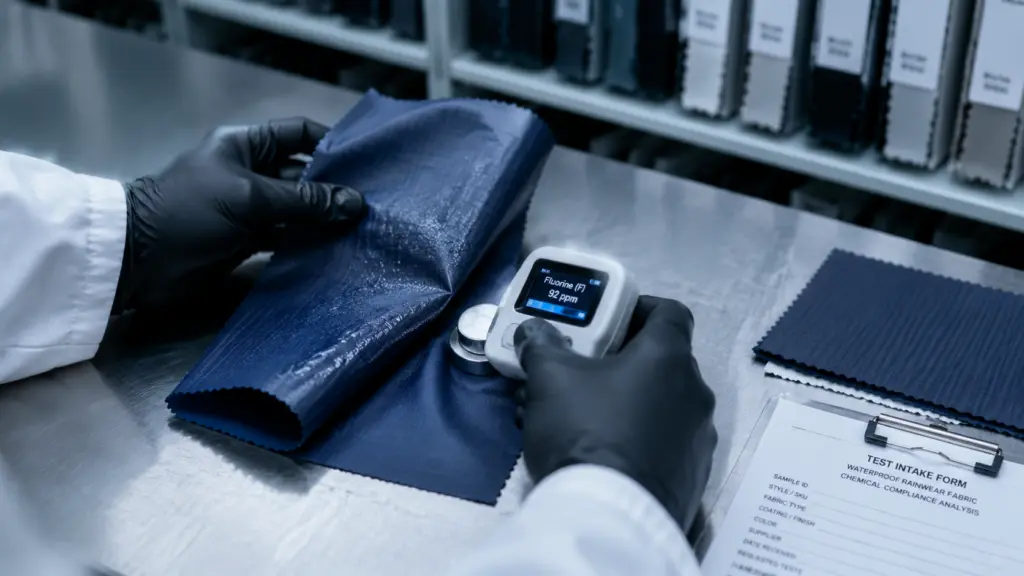
PFAS in clothing means per- and polyfluoroalkyl substances. Specifically, these are synthetic “forever chemicals” used in durable water repellent (DWR) finishes, stain-resistant coatings, and some moisture-wicking treatments. At least eight U.S. states now restrict PFAS in clothing, and the rules are not aligned. For example, California’s threshold drops from 100 ppm to 50 ppm of total organic fluorine in 2027. In contrast, New York’s rule already covers all apparel. Meanwhile, Maine is heading toward an outright ban on PFAS in most consumer products by 2032. Overall, a brand selling nationally cannot treat this as one law with one deadline.
This guide covers which states restrict PFAS in clothing right now. It also compares how California’s rule differs from New York’s and Maine’s. Additionally, it explains where the EU’s own PFAS restriction stands today. From there, it walks through how brands actually test a garment for PFAS. It also covers why 2026 brought a real spike in demand letters over this exact issue. Finally, it shows how PFAS compliance relates to the Restricted Substances List work a brand may already track, and where that data should live.
What Is PFAS, and Why Are Regulators Targeting Clothing Specifically?
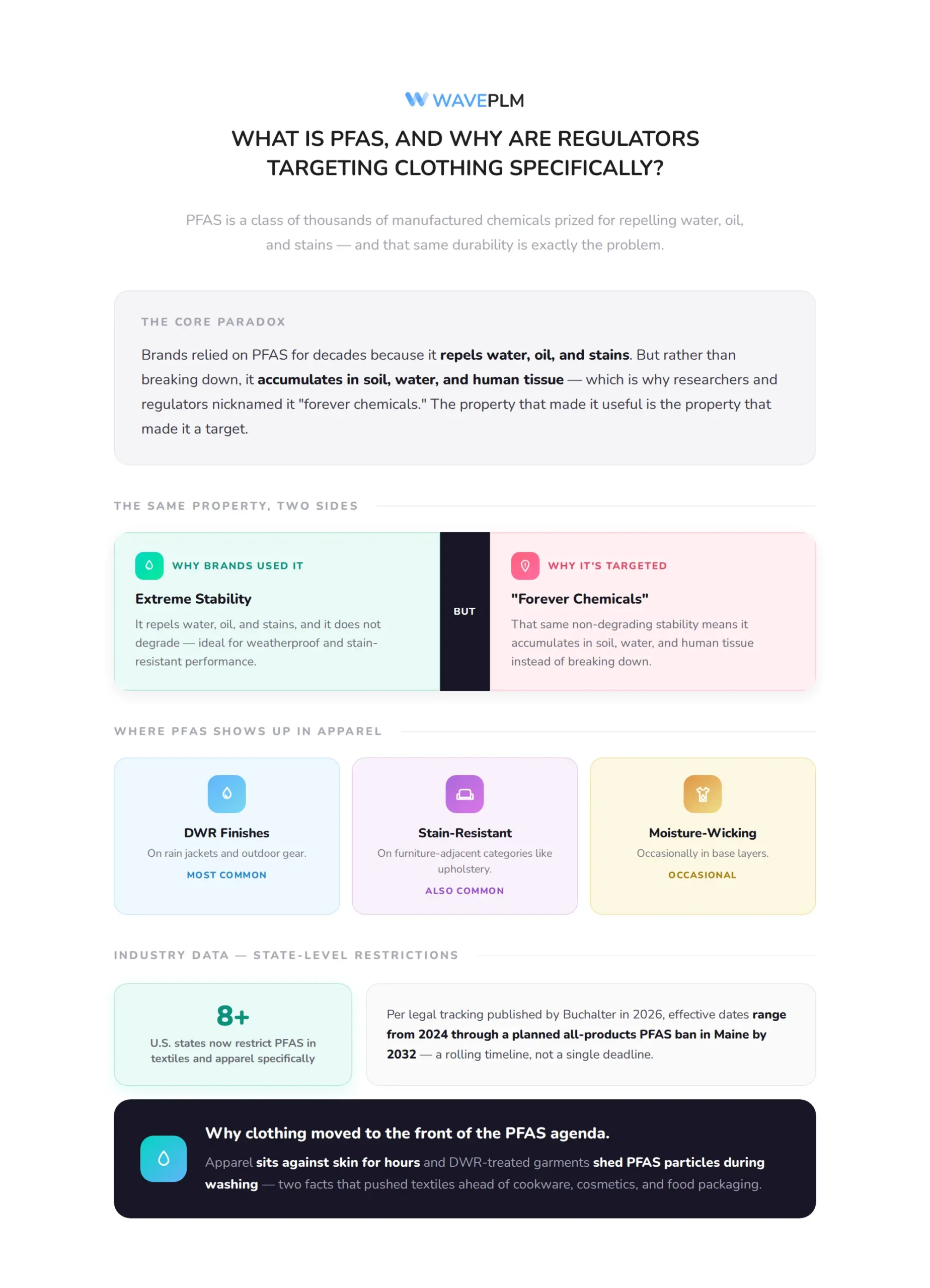
PFAS is a class of thousands of manufactured chemicals. In fact, brands have relied on it for decades because it repels water, oil, and stains. That same stability, however, is the problem. Rather than breaking down, PFAS accumulates in soil, water, and human tissue. This is exactly why researchers and regulators nicknamed it “forever chemicals.” In apparel, PFAS most often shows up in DWR finishes on rain jackets and outdoor gear. It also turns up in stain-resistant treatments on furniture-adjacent categories like upholstery, and occasionally in moisture-wicking base layers.
Industry data: According to legal tracking published by Buchalter in 2026, at least eight U.S. states now restrict PFAS in textiles and apparel specifically. Effective dates range from 2024 through a planned all-products PFAS ban in Maine by 2032.
Regulators moved on clothing before many other product categories for a practical reason. Specifically, apparel sits close to skin for hours at a time. Additionally, DWR-treated garments shed PFAS particles during normal washing. Together, these two facts pushed textiles to the front of a much longer state-level PFAS agenda, one that also covers cookware, cosmetics, and food packaging.
Which U.S. States Restrict PFAS in Clothing in 2026?
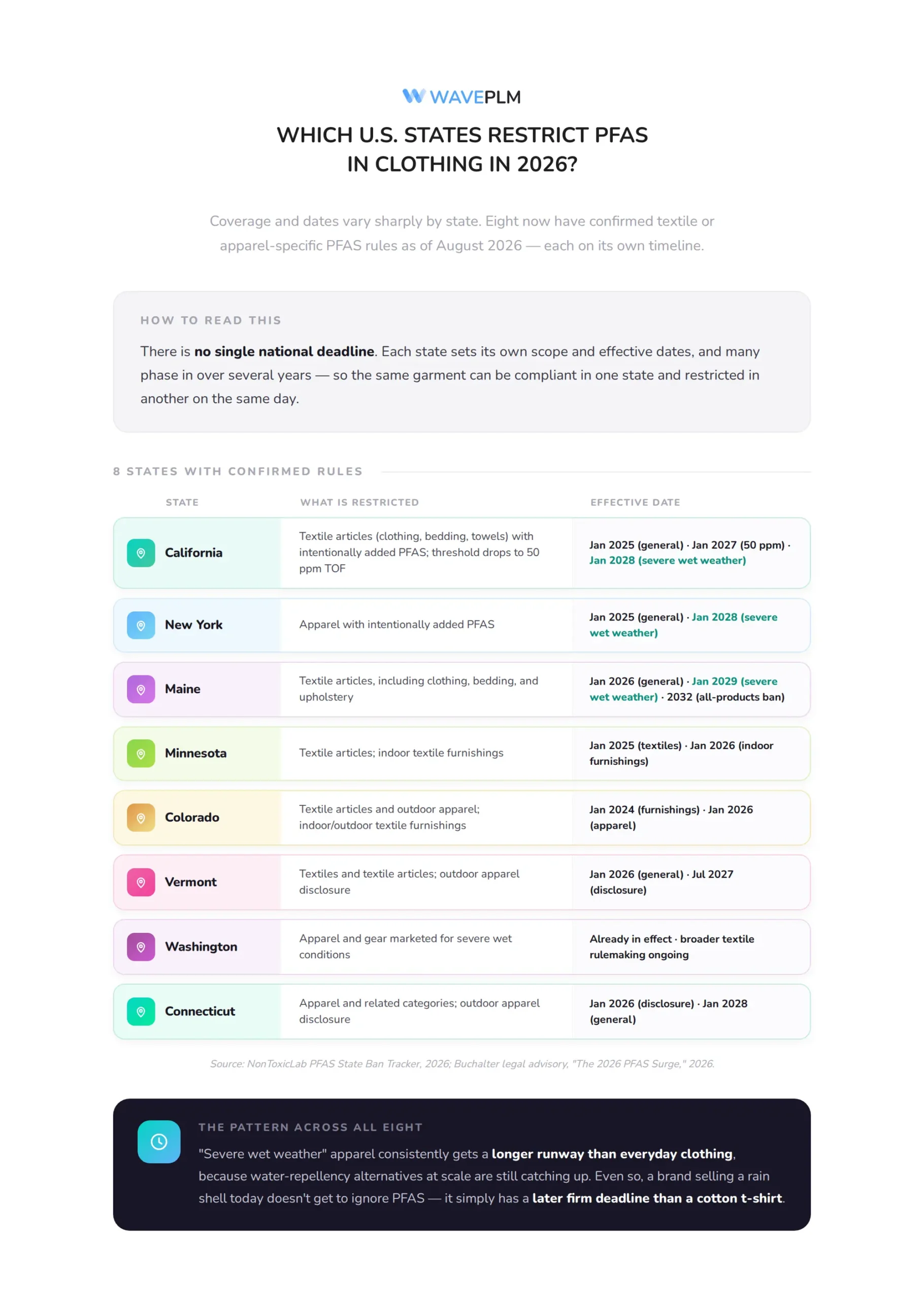
Coverage and dates vary sharply by state. The table below lists the eight states with confirmed textile or apparel-specific PFAS rules as of August 2026.
| State | What is restricted | Effective date |
|---|---|---|
| California | Textile articles (clothing, bedding, towels) with intentionally added PFAS; threshold drops to 50 ppm TOF | Jan 1, 2025 (general); Jan 1, 2027 (50 ppm); Jan 1, 2028 (severe wet weather apparel) |
| New York | Apparel with intentionally added PFAS | Jan 1, 2025 (general); Jan 1, 2028 (severe wet weather apparel) |
| Maine | Textile articles, including clothing, bedding, and upholstery | Jan 1, 2026 (general); Jan 1, 2029 (severe wet weather apparel); 2032 (planned all-products ban) |
| Minnesota | Textile articles; indoor textile furnishings | Jan 1, 2025 (textiles); Jan 1, 2026 (indoor furnishings) |
| Colorado | Textile articles and outdoor apparel; indoor/outdoor textile furnishings | Jan 1, 2024 (furnishings); Jan 1, 2026 (apparel) |
| Vermont | Textiles and textile articles; outdoor apparel disclosure | Jan 1, 2026 (general); Jul 1, 2027 (disclosure) |
| Washington | Apparel and gear marketed for severe wet conditions | Already in effect; broader textile rulemaking ongoing |
| Connecticut | Apparel and related categories; outdoor apparel disclosure | Jan 1, 2026 (disclosure); Jan 1, 2028 (general) |
Source: NonToxicLab PFAS State Ban Tracker, 2026; Buchalter legal advisory, “The 2026 PFAS Surge,” 2026.
Notably, “severe wet weather” apparel consistently gets a longer runway than everyday clothing. Most technical outerwear and rain gear fall into this bucket. That grace period exists because functional water-repellency alternatives at scale are still catching up in that specific category. Even so, a brand selling a rain shell today does not get to ignore PFAS. It simply has a later firm deadline than a cotton t-shirt does.
How Does California’s PFAS Threshold Actually Work?
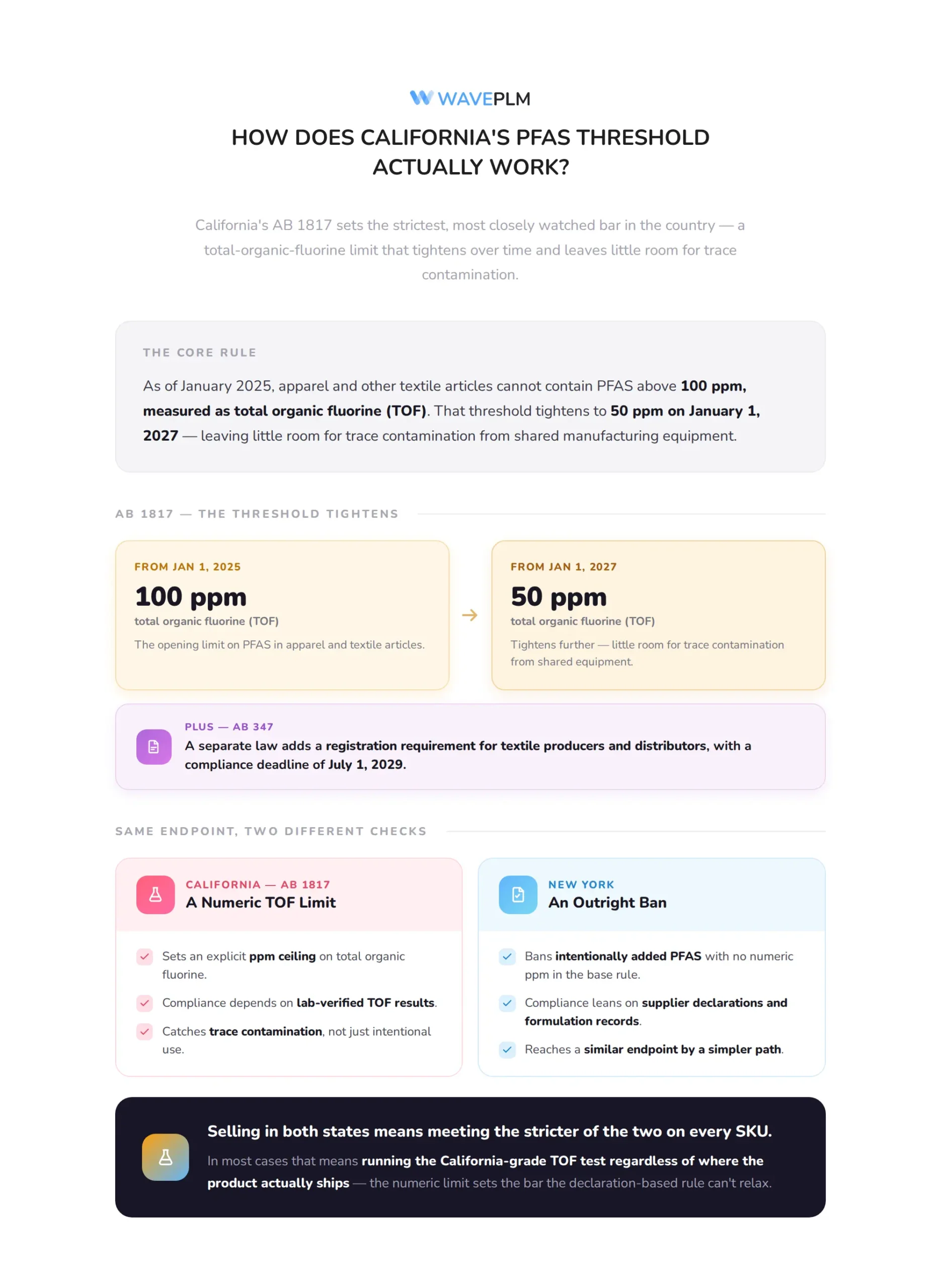
California’s AB 1817 sets the strictest and most closely watched bar. As of January 1, 2025, apparel and other textile articles cannot contain PFAS above 100 ppm, measured as total organic fluorine (TOF). That threshold tightens to 50 ppm on January 1, 2027. As a result, this leaves little room for trace contamination from shared manufacturing equipment. In addition, a related law, AB 347, adds a separate registration requirement for textile producers and distributors, with a compliance deadline of July 1, 2029.
New York’s rule reaches a similar endpoint through a simpler path. It bans intentionally added PFAS in apparel outright, without a numeric ppm threshold in the base rule. In practice, a New York-focused compliance check depends more on supplier declarations and formulation records. A California check, by contrast, depends more on lab-verified TOF results. As a result, a brand selling in both states needs to satisfy the stricter of the two on every SKU. In most cases, that means running the California-grade test regardless of where the product actually ships.
Where Does the EU’s PFAS Restriction Stand for Apparel Exporters?
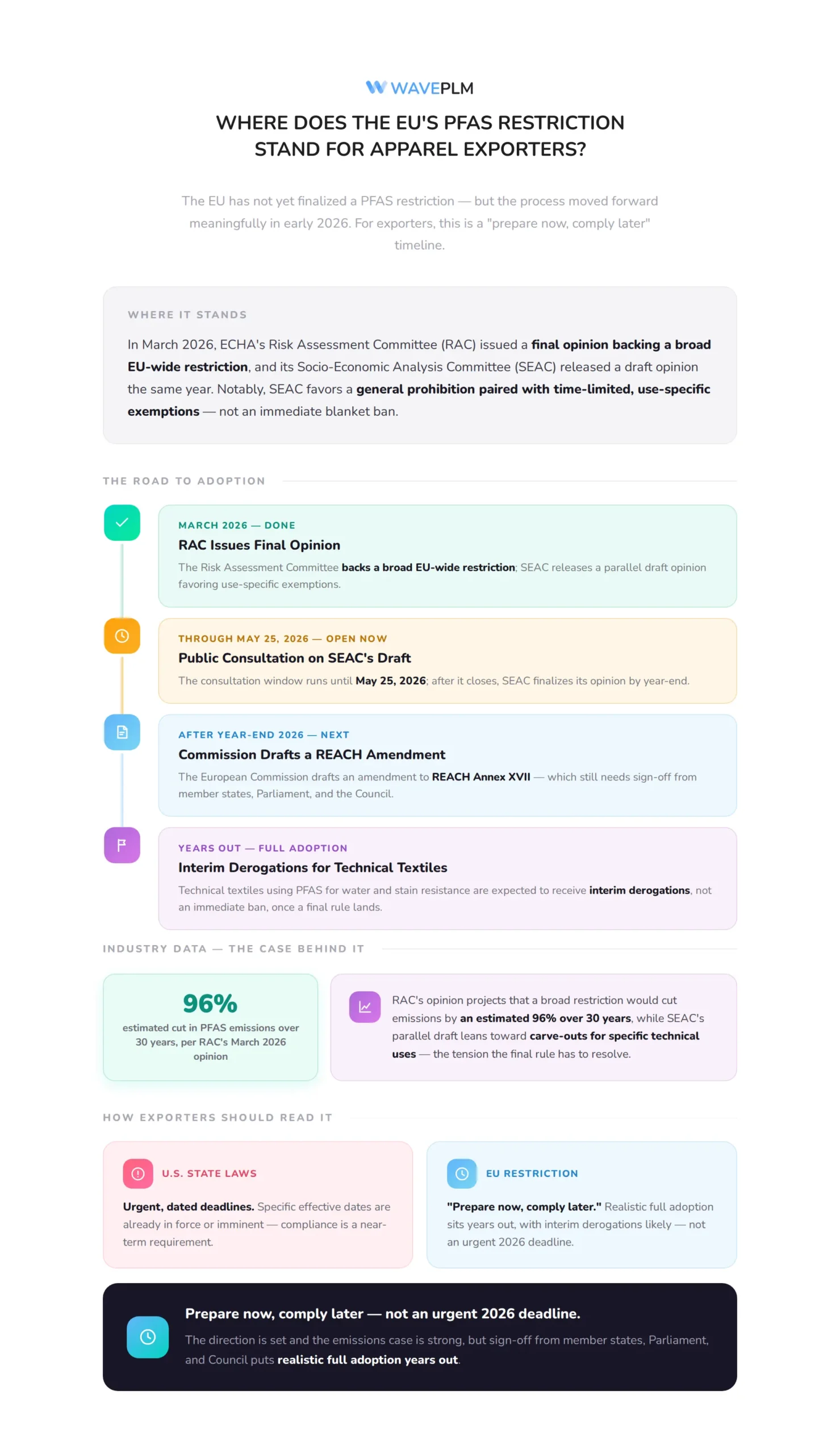
The EU has not yet finalized a PFAS restriction. That said, the process moved forward meaningfully in early 2026. Specifically, in March 2026, ECHA’s Risk Assessment Committee (RAC) issued a final opinion backing a broad EU-wide restriction. Its Socio-Economic Analysis Committee (SEAC) released a draft opinion the same year. Notably, SEAC favors a general prohibition paired with time-limited, use-specific exemptions, rather than an immediate blanket ban.
Industry data: ECHA’s Risk Assessment Committee concluded in its March 2026 opinion that a broad EU-wide PFAS restriction would cut PFAS emissions by an estimated 96% over 30 years. Meanwhile, SEAC’s parallel draft opinion leans toward carve-outs for specific technical uses.
Public consultation on SEAC’s draft runs through May 25, 2026. After that, the committee finalizes its opinion by the end of the year. The European Commission then drafts an amendment to REACH Annex XVII. That amendment still needs sign-off from member states, the Parliament, and the Council. As a result, realistic full adoption sits years out. Technical textiles using PFAS for water and stain resistance are currently expected to receive interim derogations, rather than an immediate ban, once a final rule does land. In practice, an EU-facing brand should treat this as a “prepare now, comply later” timeline, not an urgent 2026 deadline the way the U.S. state laws are.
How Do Brands Actually Test a Garment for PFAS in Clothing?
Two distinct testing approaches cover most compliance needs, and brands frequently confuse them. Total organic fluorine (TOF) testing is the industry-standard screening method. Notably, it is what most state ppm thresholds, including California’s, are built around. TOF measures overall fluorine content as a proxy for PFAS presence. This makes it fast and relatively affordable to run across a full seasonal line.
In contrast, targeted PFAS analysis works differently. It identifies specific compounds, such as PFOA or PFOS. This method is reserved mainly for Proposition 65 verification, rather than general state ppm compliance. A brand only needs targeted analysis in two situations: when a specific listed chemical is suspected, or when a TOF screen flags a result close to a state threshold.
A practical testing program generally follows four steps, based on current guidance from testing labs like Eurofins and Hohenstein. First, map the full product portfolio against the strictest applicable threshold. Today, that is California’s 50 ppm rule taking effect in 2027. Second, require PFAS compliance declarations and finish-process documentation from every supplier, not only the ones known to use water-repellent treatments. Third, run baseline TOF testing on priority SKUs. That means anything with a coating, laminate, or stain-resistant claim. Fourth, retain every test report and supplier declaration in a format that supports California’s AB 347 registration deadline in 2029. That paperwork trail becomes a compliance asset later, not just a one-time check.
Why Are PFAS Demand Letters a New Risk for Fashion Brands?
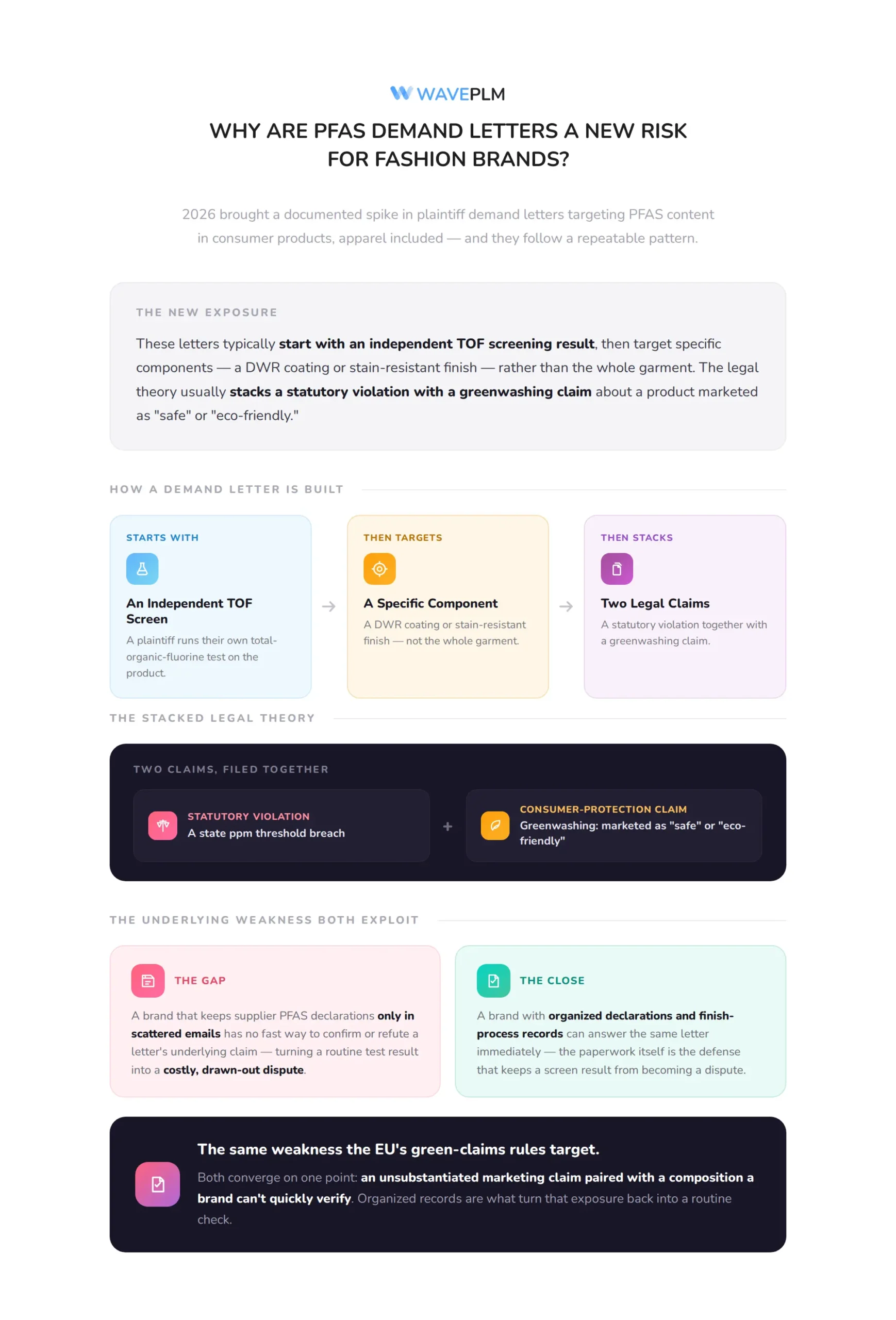
2026 brought a documented spike in plaintiff demand letters targeting PFAS content in consumer products, apparel included. Specifically, these letters typically start with an independent TOF screening result. From there, they target specific components, like a DWR coating or a stain-resistant finish, rather than the whole garment. Often, the legal theory stacks a statutory violation, such as a state ppm threshold breach, together with a consumer-protection or greenwashing claim about a product marketed as “safe” or “eco-friendly.”
That combination is worth flagging alongside our guide to the EU’s green claims rules. In particular, both frameworks now converge on the same underlying weakness. Specifically, an unsubstantiated marketing claim, paired with a chemical composition a brand cannot immediately verify, creates real exposure. A brand that keeps supplier PFAS declarations only in scattered emails has no fast way to confirm or refute a demand letter’s underlying claim. That gap alone can turn a routine test result into a costly, drawn-out dispute.
Is PFAS the Same Thing as the Restricted Substances List (RSL)?
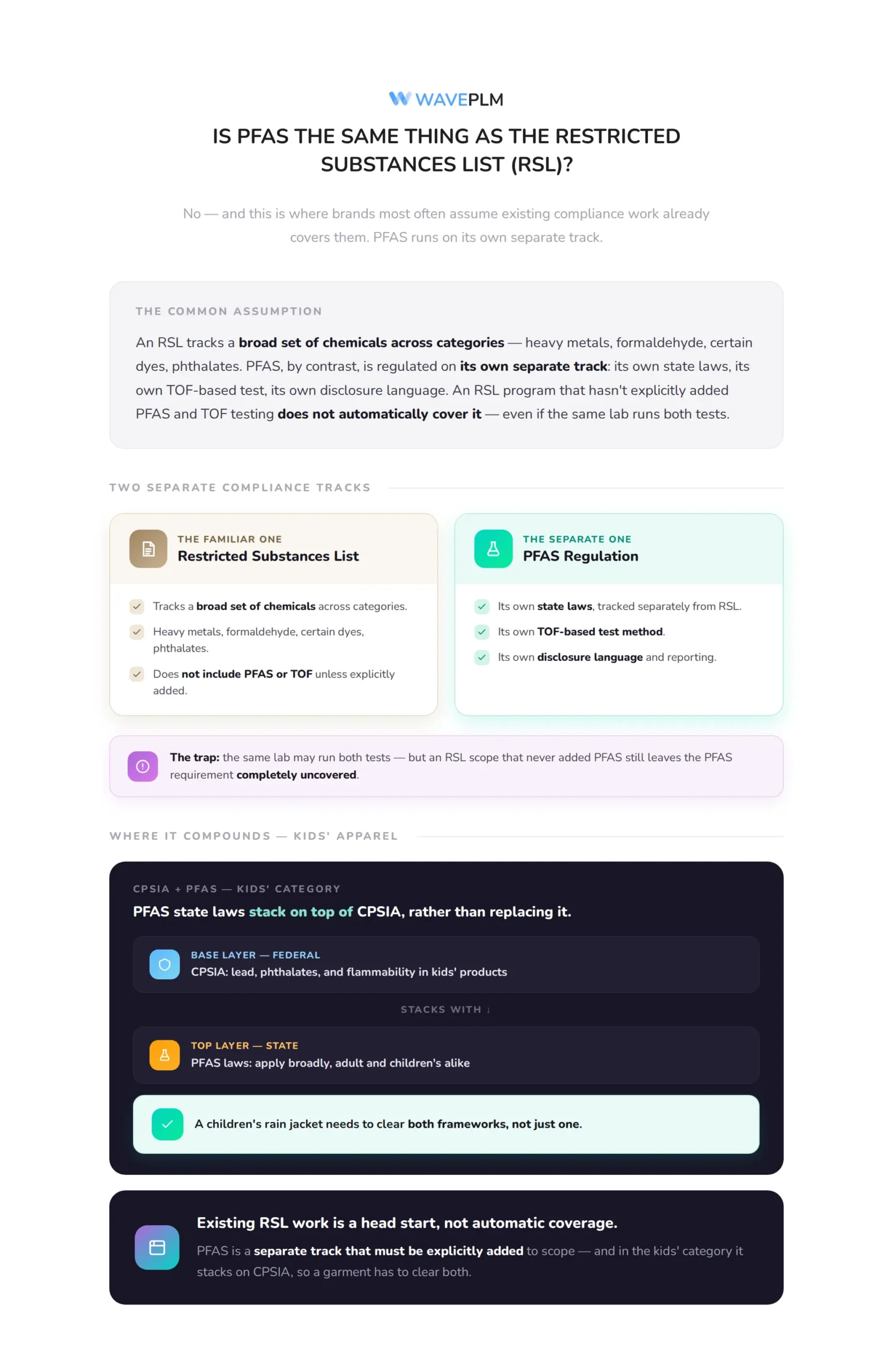
No, and this is where brands most often assume existing compliance work already covers them. A Restricted Substances List typically tracks a broad set of chemicals across categories. Heavy metals, formaldehyde, certain dyes, and phthalates are common examples. PFAS, however, is being regulated on its own separate track, with its own state laws, its own TOF-based test method, and its own disclosure language. So an RSL program that has not explicitly added PFAS and TOF testing to its scope does not automatically cover this requirement, even if the same lab runs both tests.
The same logic applies to CPSIA compliance for children’s apparel. CPSIA is a federal law focused specifically on lead, phthalates, and flammability in kids’ products. PFAS state laws, by contrast, apply broadly across most apparel categories, adult and children’s alike. In addition, they stack directly on top of CPSIA requirements for anything sold in the kids’ category. A children’s rain jacket, for example, needs to clear both frameworks, not just one.
How Should Fashion Brands Track PFAS Compliance Without Losing Data Across Spreadsheets?
Every step above ties back to the same underlying data: which fabrication and finish was actually used on which style. Specifically, this includes supplier declarations, finish-treatment records, TOF test results, and state-by-state deadlines. Wave PLM keeps that information at the component level inside a style’s multi-level BOM. It stays tied to the specific supplier and treatment applied, not buried in a separate compliance spreadsheet someone updates after the fact.
Our finding: Wave PLM customers who already track finish treatments like DWR coatings at the component level can generate a PFAS test-priority list for an entire season in under a day. By contrast, teams still working from disconnected spreadsheets often spend a full week just reconstructing which styles used a water-repellent or stain-resistant finish in the first place. That same structured material record also supports the broader documentation trail this guide’s testing section covers, all the way from RSL declarations through California’s AB 347 registration deadline.
Frequently Asked Questions
What is PFAS in clothing?
PFAS in clothing refers to per- and polyfluoroalkyl substances used in durable water repellent (DWR) finishes, stain-resistant coatings, and some moisture-wicking treatments. These “forever chemicals” resist breaking down, which is why regulators now restrict them in apparel.
Which states ban PFAS in clothing in 2026?
At least eight U.S. states restrict PFAS in clothing as of 2026: California, New York, Maine, Minnesota, Colorado, Vermont, Washington, and Connecticut. Notably, effective dates and thresholds vary significantly by state, so a national brand needs to track each one separately.
What is California’s PFAS testing threshold?
California’s AB 1817 currently caps PFAS in textile articles at 100 ppm of total organic fluorine (TOF), effective since January 1, 2025. That threshold drops to 50 ppm on January 1, 2027, and a related law, AB 347, adds a producer registration requirement by July 1, 2029.
Is PFAS the same as the Restricted Substances List (RSL)?
No. An RSL typically covers a broad set of chemicals like heavy metals and phthalates. PFAS is regulated separately, with its own state laws and its own total organic fluorine testing method, so an existing RSL program needs to add PFAS explicitly rather than assume it is already covered.
Does the EU restrict PFAS in apparel yet?
Not yet. ECHA’s Risk Assessment Committee backed a broad restriction in March 2026, but full adoption still requires a finalized SEAC opinion, a European Commission draft amendment, and approval from EU member states, so realistic enforcement remains years away.
What triggers a PFAS demand letter against a fashion brand?
Most 2026 demand letters start with an independent total organic fluorine test on a specific component, such as a DWR coating, then pair a state ppm violation with a consumer-protection or greenwashing claim about how the product was marketed.
How can brands test for PFAS in clothing before shipping?
Most brands screen with total organic fluorine (TOF) testing across priority SKUs, then run targeted PFOA/PFOS analysis only when a screen flags a result near a state threshold. Supplier PFAS declarations and finish-process documentation should back up every test result.
A demand letter citing a PFAS test result does not wait for a brand to get organized first. Legal costs start the moment it lands, and by then it is too late to figure out which supplier used which finish. Book time with the Wave PLM team to map which of your current styles already carry a DWR or stain-resistant treatment, before a lab result does that mapping for you.



Leave a Reply