
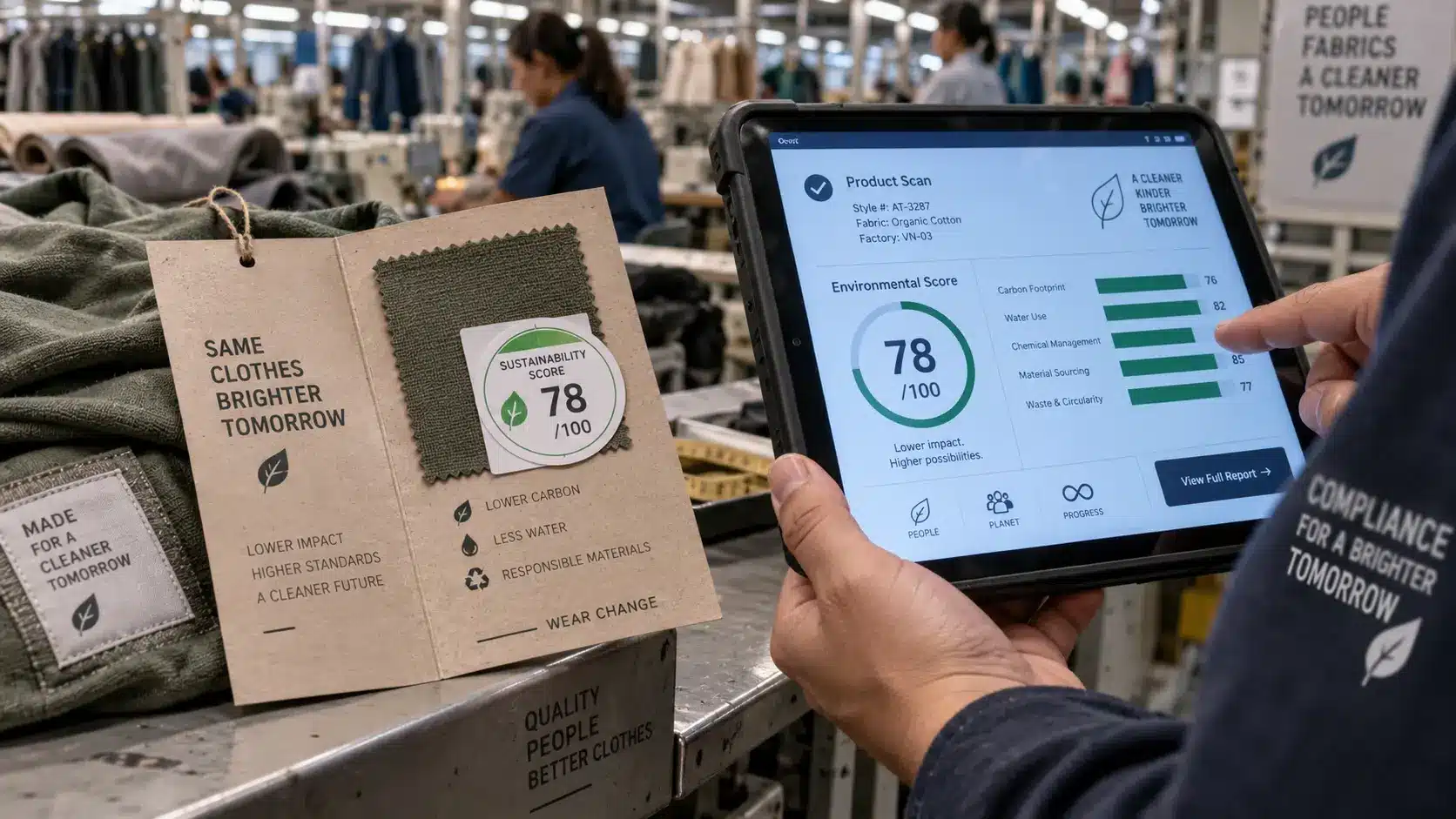
More than 40,000 organizations across 33-plus countries now use some version of the Higg Index (Cascale). For most apparel brands, though, that data still lives in someone’s inbox. Specifically, it sits in a PDF exported from a supplier’s Higg Facility Environmental Module assessment. Usually, that PDF gets filed away until next year’s renewal comes due. The Higg Index itself does not decide where that data should live. A brand’s own systems do. This guide covers what the Higg Index measures. It also covers what changed in the 2025 update. Additionally, it shows how a Higg score can sit inside the same vendor record a brand already uses for costing and quality.
The Higg Index is not one test. Instead, it is five separate tools built by Cascale, the nonprofit formerly known as the Sustainable Apparel Coalition. Each tool covers a different slice of the supply chain. Two modules score individual manufacturing facilities. One scores a brand’s own corporate performance, and two score materials and finished products. As a result, a single supplier can appear in a brand’s records with a Higg score, yet share almost nothing in common with how that brand scores itself.
What Is the Higg Index, Exactly?
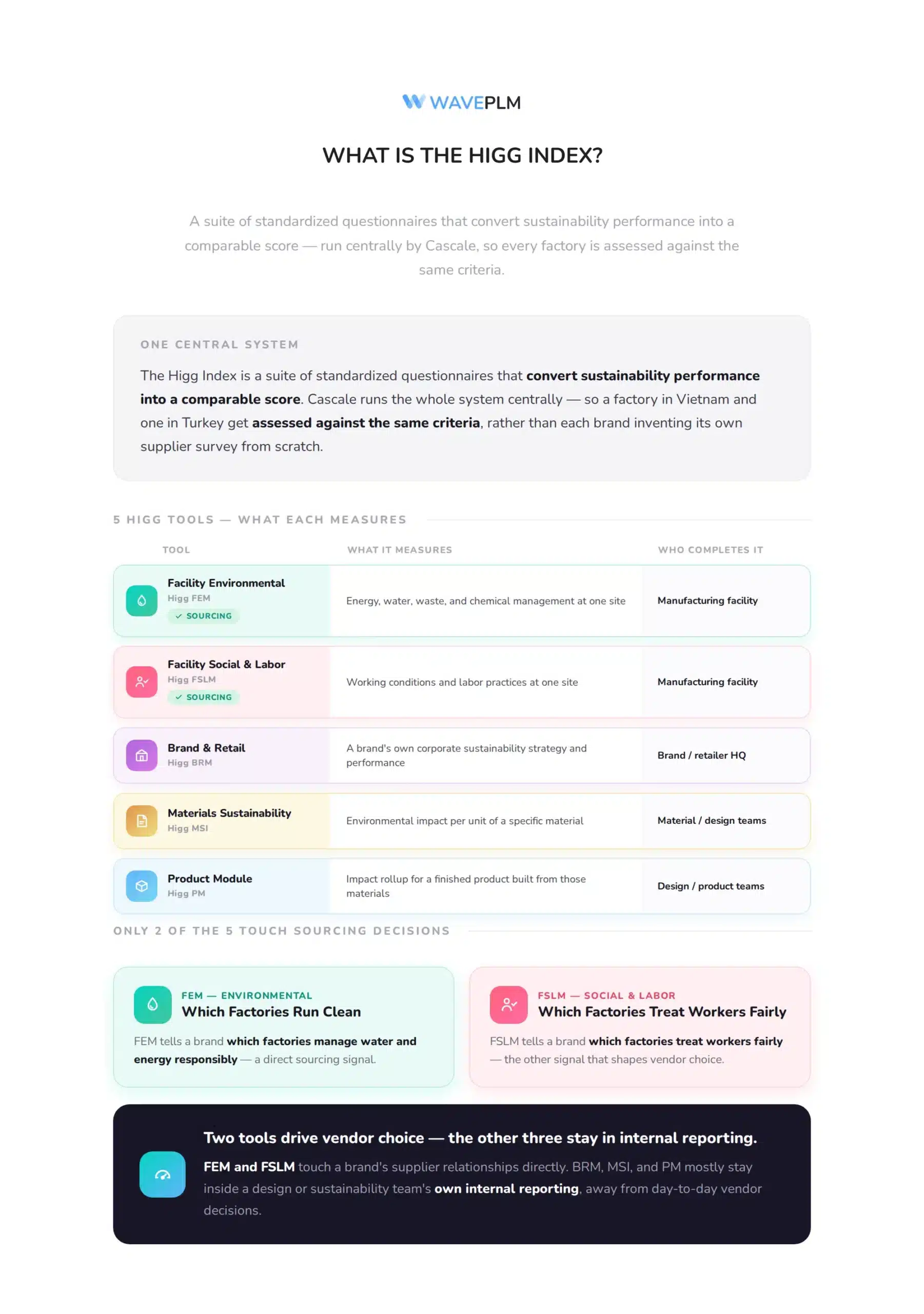
The Higg Index is a suite of standardized questionnaires. Together, they convert sustainability performance into a comparable score. Cascale runs the whole system centrally. This means a factory in Vietnam and a factory in Turkey get assessed against the same criteria, rather than each brand inventing its own supplier survey from scratch. The table below breaks down which tool measures what, and who actually fills it out.
| Tool | What It Measures | Who Completes It |
|---|---|---|
| Higg Facility Environmental Module (FEM) | Energy, water, waste, and chemical management at one site | Manufacturing facility |
| Higg Facility Social & Labor Module (FSLM) | Working conditions and labor practices at one site | Manufacturing facility |
| Higg Brand & Retail Module (BRM) | A brand’s own corporate sustainability strategy and performance | Brand or retailer headquarters |
| Higg Materials Sustainability Index (MSI) | Environmental impact per unit of a specific material | Material or design teams |
| Higg Product Module (PM) | Impact rollup for a finished product built from those materials | Design or product teams |
Notably, only two of these five tools ever touch a brand’s own supplier relationships in a way that matters for sourcing decisions. FEM tells a brand which factories manage water and energy responsibly. FSLM, similarly, tells a brand which factories treat workers fairly. The other three tools mostly stay inside a design or sustainability team’s own internal reporting, away from day-to-day vendor decisions.
How Many Brands Actually Use the Higg Index?
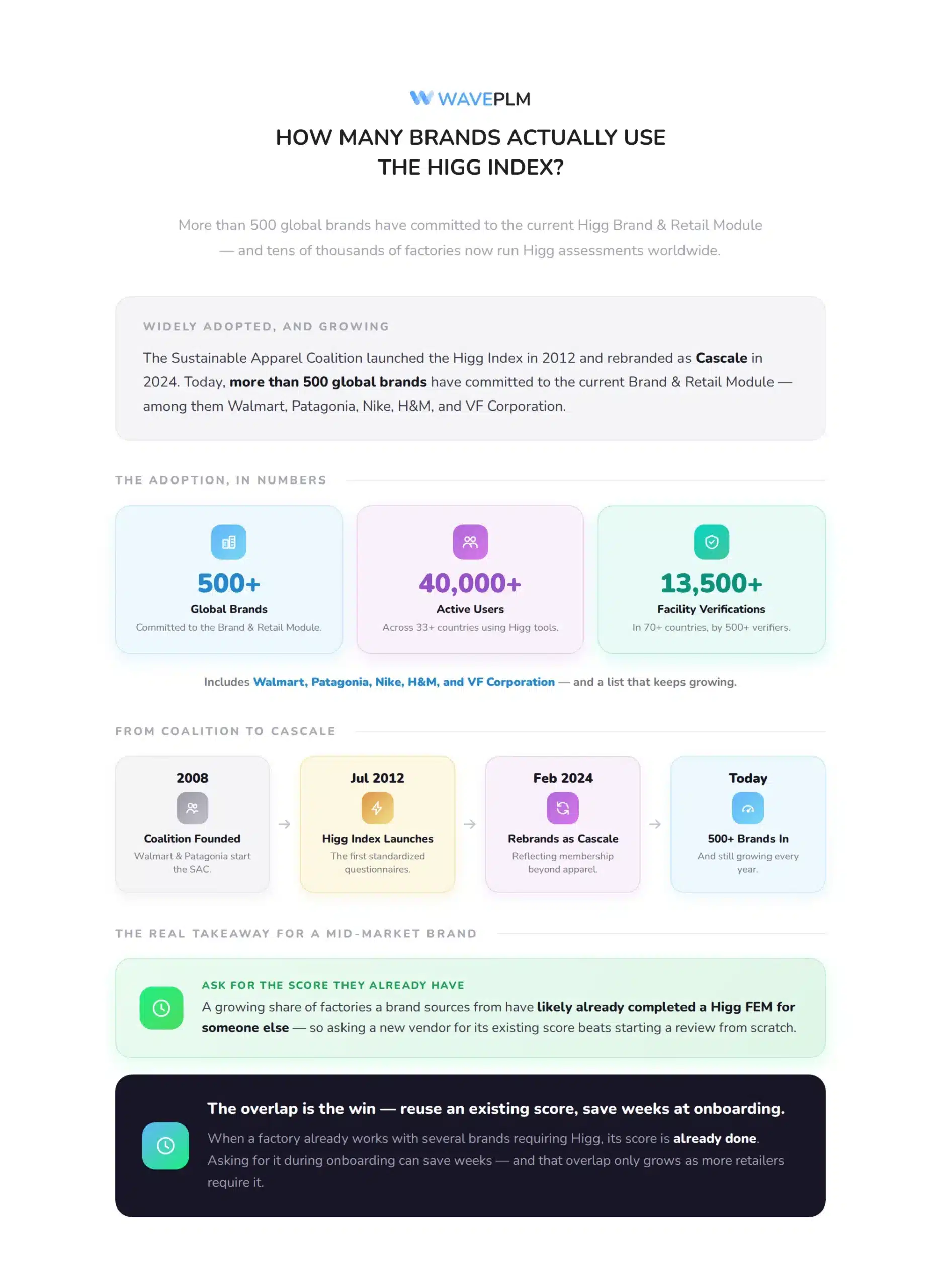
The Sustainable Apparel Coalition launched the Higg Index in July 2012. That happened four years after Walmart and Patagonia founded the coalition itself. In February 2024, the organization rebranded as Cascale to reflect a broader membership beyond apparel alone (Businesswire). Today, more than 500 global brands have committed to using the current Higg Brand & Retail Module. Among them: Walmart, Patagonia, Nike, H&M, and VF Corporation (Worldly).
Industry data: Cascale reports more than 40,000 active users of Higg Index tools across 33-plus countries. Its verification program, meanwhile, has completed over 13,500 facility verifications in more than 70 countries through a network of 500-plus approved verifiers (Cascale).
For a mid-market apparel brand, the practical takeaway is not the total user count. Instead, it is this: a growing share of factories a brand already sources from have likely completed a Higg FEM assessment for someone else already. As a result, asking a new vendor for its existing Higg score during onboarding is often faster than starting a sustainability review from scratch. In practice, this can save weeks during a busy onboarding season, particularly when a factory already works with several other brands that require the same assessment. Notably, that overlap only keeps growing as more retailers add a Higg score to their own vendor requirements each year.
What Changed in the Higg FEM 2025 Update?
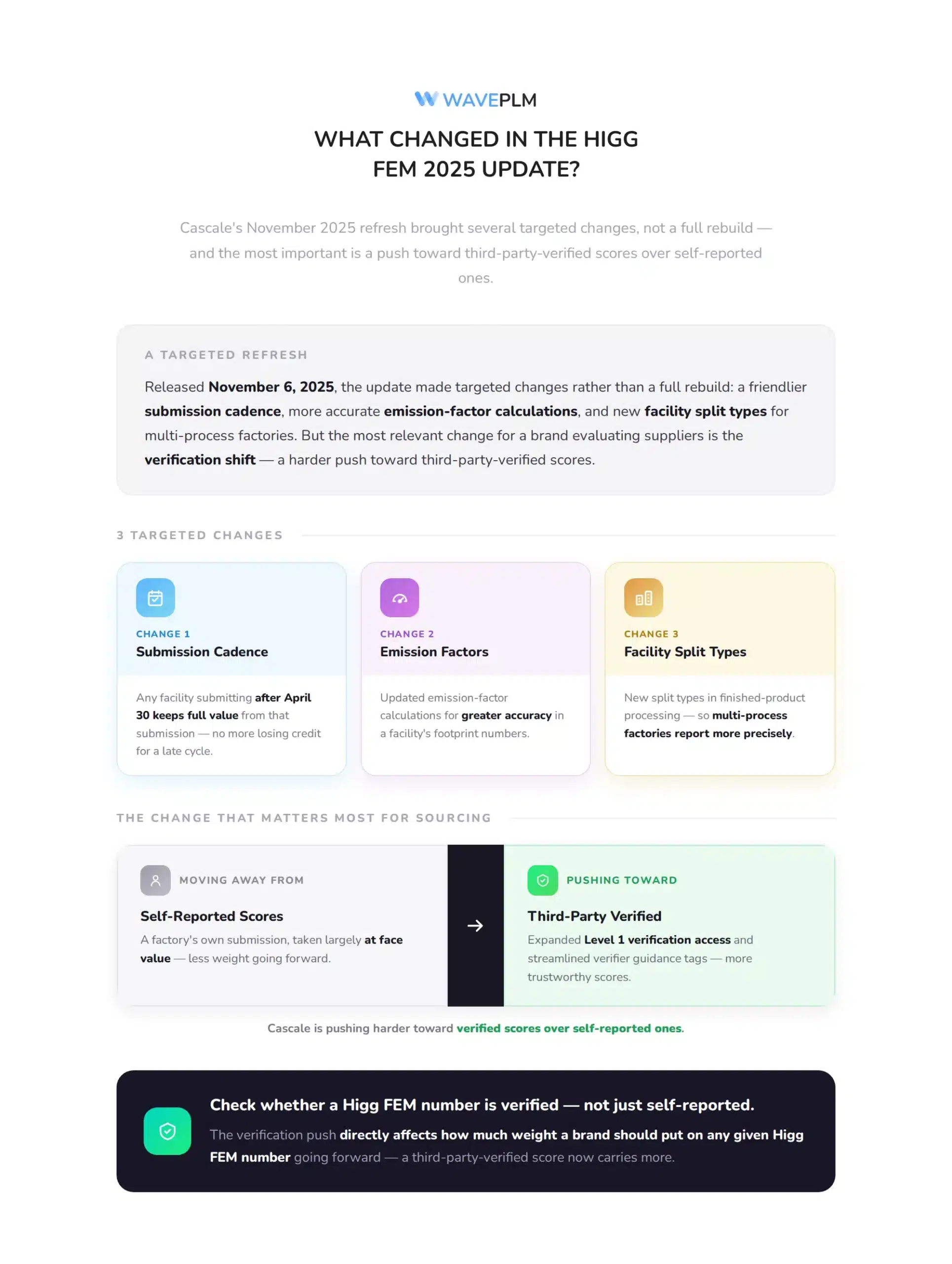
Cascale released an updated Higg FEM on November 6, 2025. The refresh brought several targeted changes rather than a full rebuild. First, the assessment cadence shifted. Now, any facility submitting after April 30 keeps full value from that submission, instead of losing credit for a late cycle. Second, Cascale updated the emission factor calculations for greater accuracy. Third, Cascale added new facility split types within finished product processing, which improves how multi-process factories report their data (Cascale).
Perhaps most relevant for a brand evaluating suppliers is the verification change. The 2025 update expanded Level 1 verification access. It also streamlined the guidance tags that verifiers use to check a factory’s submission. In other words, Cascale is pushing harder toward third-party-verified scores, rather than self-reported ones. That shift directly affects how much weight a brand should put on any given Higg FEM number going forward.
Is the Higg Index Actually Reliable?
Not automatically, and Cascale itself has had to address that gap publicly. In June 2022, the Norwegian Consumer Authority notified the Sustainable Apparel Coalition, H&M, and Norrøna. Consumer-facing sustainability labels built on Higg MSI data, the notice said, were potentially misleading. The core complaint: the tool compared materials using data that consumers could not verify themselves (FashionUnited). On June 27, 2022, the coalition paused consumer-facing Higg MSI labels worldwide in response.
That episode explains why the gap between a self-reported Higg score and a verified one matters so much. A supplier can complete a Higg FEM assessment in an afternoon, without a verifier ever visiting the site. Our guide to green claims compliance covers the broader marketing risk of citing an unverified sustainability number in customer-facing copy. The safest internal rule: treat a self-reported Higg score as the start of a supplier conversation, not as a finished audit result.
Why Do Brands Struggle to Track Higg Data Internally?
Higg data usually arrives as a PDF, or as a login to Cascale’s own platform, tied to one supplier at a time. Meanwhile, a sourcing team is already tracking that same supplier’s on-time delivery rate somewhere else entirely. It tracks the factory’s AQL inspection history and its RSL testing status in yet another place. As a result, Higg scores tend to sit in a folder that only the sustainability team opens. That folder stays disconnected from the vendor evaluation that actually drives which factory gets the next order.
Our supplier scorecard guide covers a similar KPI-tracking problem. A vendor’s quality and delivery performance is only useful when it lives next to every other decision a brand makes about that vendor. A Higg FEM score, an AQL defect rate, and a restricted substances list pass rate all describe the same factory. Treating them as three separate systems, however, means a sourcing manager checks three separate places before making one decision.
How Does Higg Index Data Fit Into a PLM Workflow?
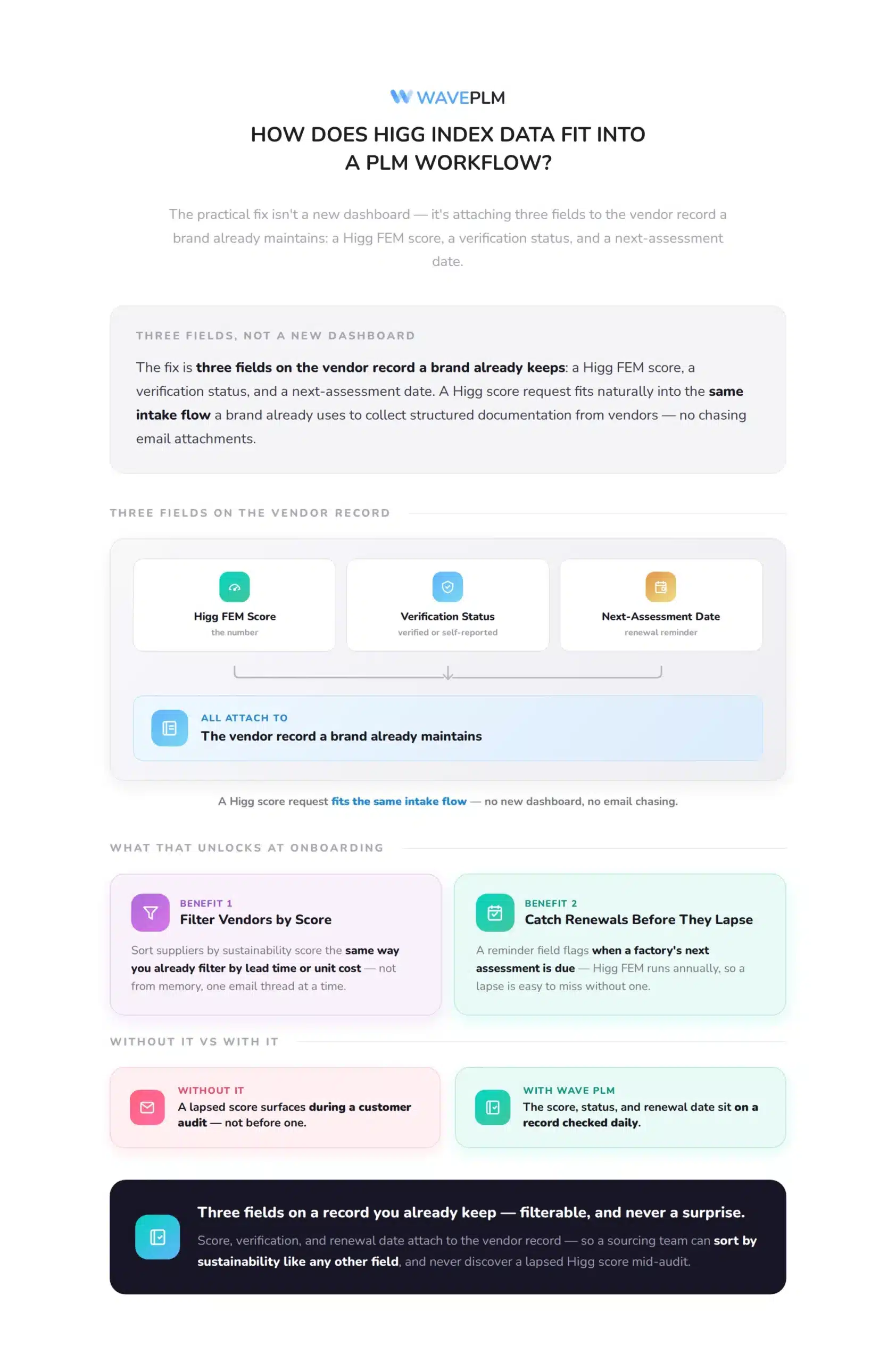
The practical fix is not a new dashboard. Rather, it means attaching three fields to the vendor record a brand already maintains: a Higg FEM score, a verification status, and a next-assessment date. Our supplier portal guide covers how brands already collect structured documentation directly from vendors, instead of chasing email attachments. A Higg score request fits naturally into that same intake flow.
Specifically, a brand that already asks new factories for onboarding paperwork through a structured onboarding process has a natural place to also request an existing Higg score. Alternatively, it can flag a factory that still owes Cascale a finished assessment. From there, a sourcing team can filter or sort vendors by sustainability score the same way it already filters by lead time or unit cost. Otherwise, that comparison happens from memory, one email thread at a time.
Renewal timing matters too. Because Higg FEM runs on an annual cycle, a vendor record needs a simple reminder field: when is this factory’s next assessment due? Otherwise, a brand typically discovers a lapsed Higg score the same way it discovers a lapsed RSL test. That is, during a customer audit, not before one.
Wave PLM and Higg Index Tracking
Wave PLM keeps vendor and material records tied to each style a brand produces. Adding a Higg FEM score, a verification date, or a renewal reminder to a supplier’s existing record does not require a separate sustainability system. Instead, that data sits next to the cost sheets, AQL results, and compliance documents a sourcing team already checks before placing an order. For a small sourcing team juggling dozens of vendors, that single source of truth matters. Specifically, it is often the difference between catching a lapsed assessment early and finding out about it during a customer audit.
Frequently Asked Questions
What is the Higg Index?
The Higg Index is a suite of five standardized sustainability assessment tools built by Cascale. Together, they cover facility environmental performance, facility labor conditions, brand-level strategy, material impact, and product-level impact.
What is the difference between Higg FEM and Higg BRM?
Higg FEM (Facility Environmental Module) is completed by a manufacturing facility to score its own energy, water, and waste management. Higg BRM (Brand & Retail Module) is completed by a brand or retailer to score its own corporate sustainability strategy, not any single factory.
Who created the Higg Index?
Walmart and Patagonia founded the Sustainable Apparel Coalition in 2009. That coalition launched the Higg Index in July 2012, then rebranded as Cascale in February 2024.
Is the Higg Index mandatory for fashion brands?
No. Higg Index participation is voluntary. However, a growing number of large retailers and brands now require suppliers to complete a Higg FEM assessment. This usually happens as part of their own vendor qualification process, well before a purchase order gets placed.
Why was the Higg Index criticized in 2022?
In June 2022, the Norwegian Consumer Authority found that consumer-facing labels based on Higg MSI data were potentially misleading, since shoppers could not independently verify the underlying comparisons. The Sustainable Apparel Coalition paused consumer-facing Higg MSI labels worldwide that same month.
How often do factories need to complete Higg FEM?
Higg FEM runs on an annual assessment cycle. The 2025 update adjusted the cadence so that assessments submitted after April 30 keep full value, instead of losing credit for a late cycle.
The Higg Index will not tell a brand which factory to choose. It only tells a brand what a factory reported and, increasingly, whether that report was verified. Treating a Higg FEM score as one more field on a vendor’s record changes that equation. It then sits next to a cost sheet and an RSL status, in the same place a sourcing manager already looks. That placement makes the number useful for an actual sourcing decision. Otherwise, it stays a line item in a sustainability report nobody reads until next year. Wave PLM keeps that vendor data in one place, so a Higg score update means editing one record, not searching for a spreadsheet someone else built.







Leave a Reply