
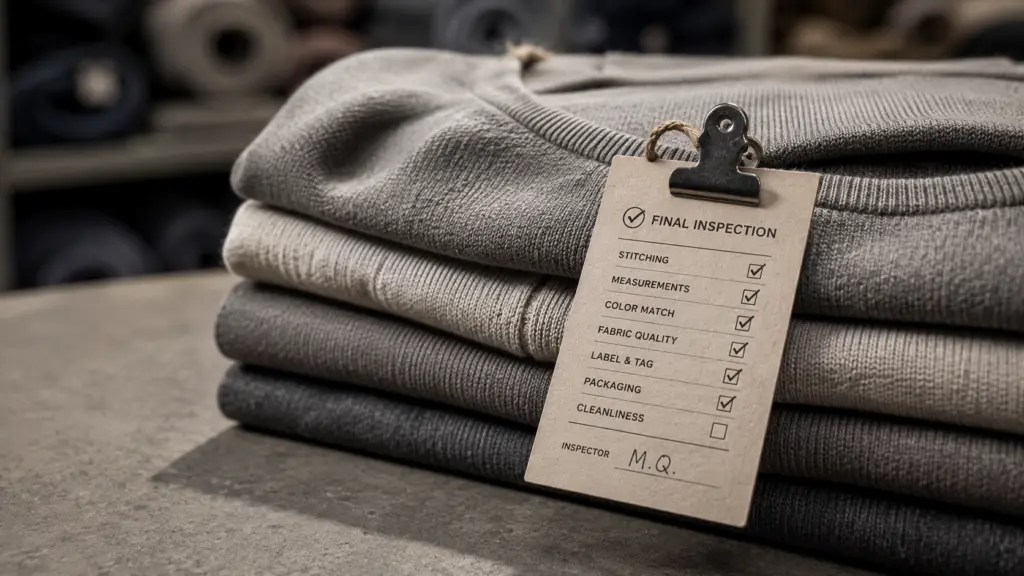
Supplier scorecard software tracks how a factory actually performs after onboarding, not just how it looked on paper before the first order. Most apparel brands vet a new factory carefully, then stop measuring it once production starts. In fact, a scorecard tracking as few as five to eight KPIs can catch most vendor risk long before a shipment slips. That works best when it is weighted toward on-time delivery and defect rate (Ramp, 2026). This guide covers which KPIs actually matter for apparel. It also covers how real fashion brands weight them, and how that scorecard data should connect to the same records a brand already keeps for sourcing and costing.
What Is Supplier Scorecard Software for Apparel Brands?
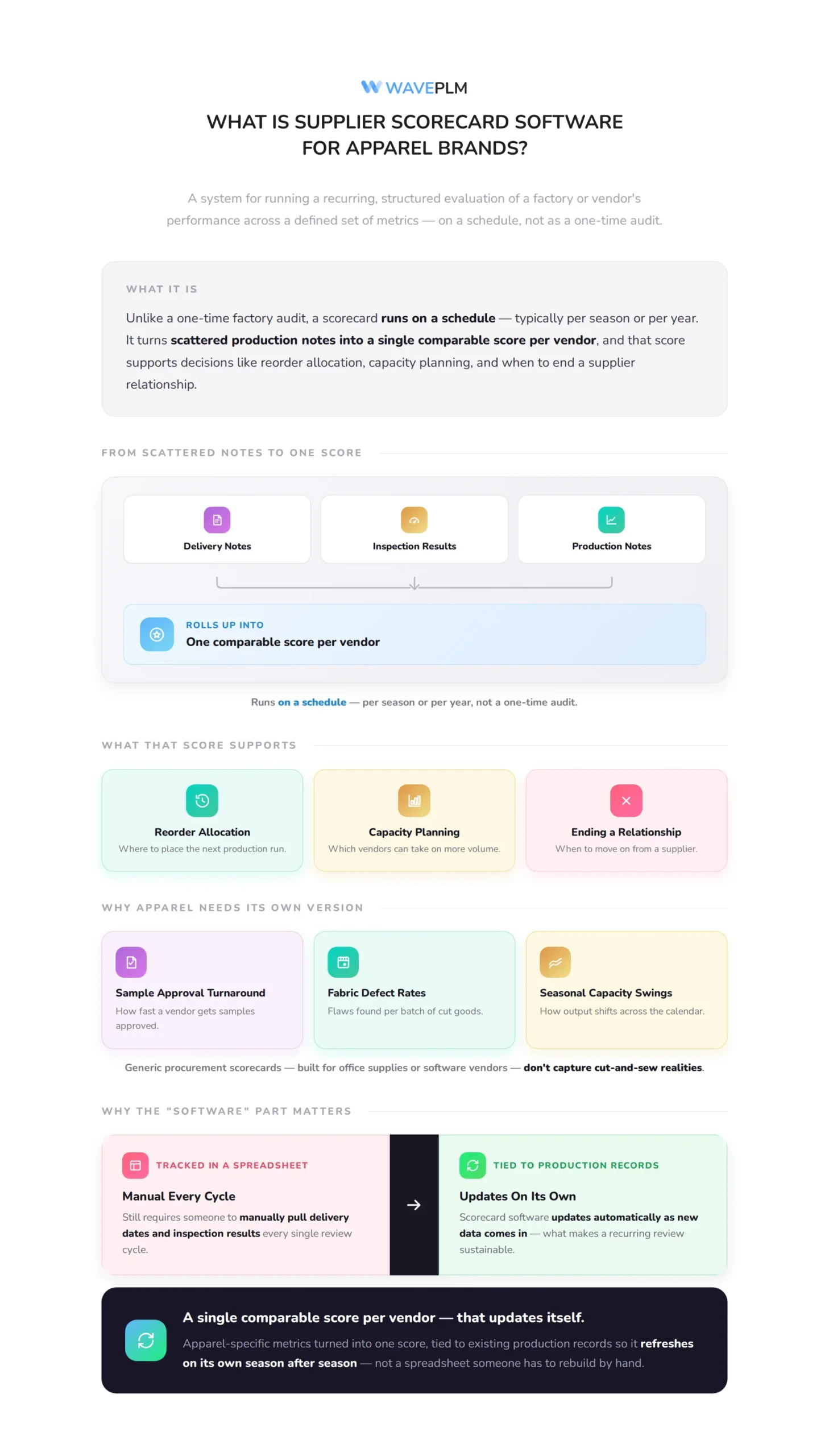
Supplier scorecard software is a system for running a recurring, structured evaluation of a factory or vendor’s performance across a defined set of metrics. Unlike a one-time factory audit, it runs on a schedule. Typically that means per season or per year. Notably, a scorecard turns scattered production notes into a single comparable score per vendor. That score then supports decisions like reorder allocation, capacity planning, and when to end a supplier relationship.
For apparel specifically, supplier scorecard software needs to reflect how garment production actually breaks down. Generic procurement scorecards, built for office supplies or software vendors, do not capture cut-and-sew realities. Instead, sample approval turnaround, fabric defect rates, and seasonal capacity swings all belong on an apparel-specific version.
Notably, the “software” part matters as much as the metrics themselves. A scorecard tracked in a spreadsheet still requires someone to manually pull delivery dates and inspection results every review cycle. In contrast, scorecard software tied to existing production records updates on its own as new data comes in. That is what actually makes a recurring review sustainable season after season.
Why Track Vendor Performance After Onboarding, Not Just Before?
Vendor vetting answers one question: can this factory handle the order. A scorecard answers a different one: is this factory still performing the way it did on day one. Our vendor onboarding guide covers document collection, compliance verification, and capability testing before the first production run. A scorecard picks up right where that process ends.
In practice, a factory’s performance drifts over time. Ownership changes, a key line supervisor leaves, or capacity gets overbooked during peak season. Without an ongoing scorecard, a brand usually finds out about that drift only after a shipment misses its date. By then, the fix costs far more than catching the trend two seasons earlier would have.
Which KPIs Actually Belong on an Apparel Supplier Scorecard?
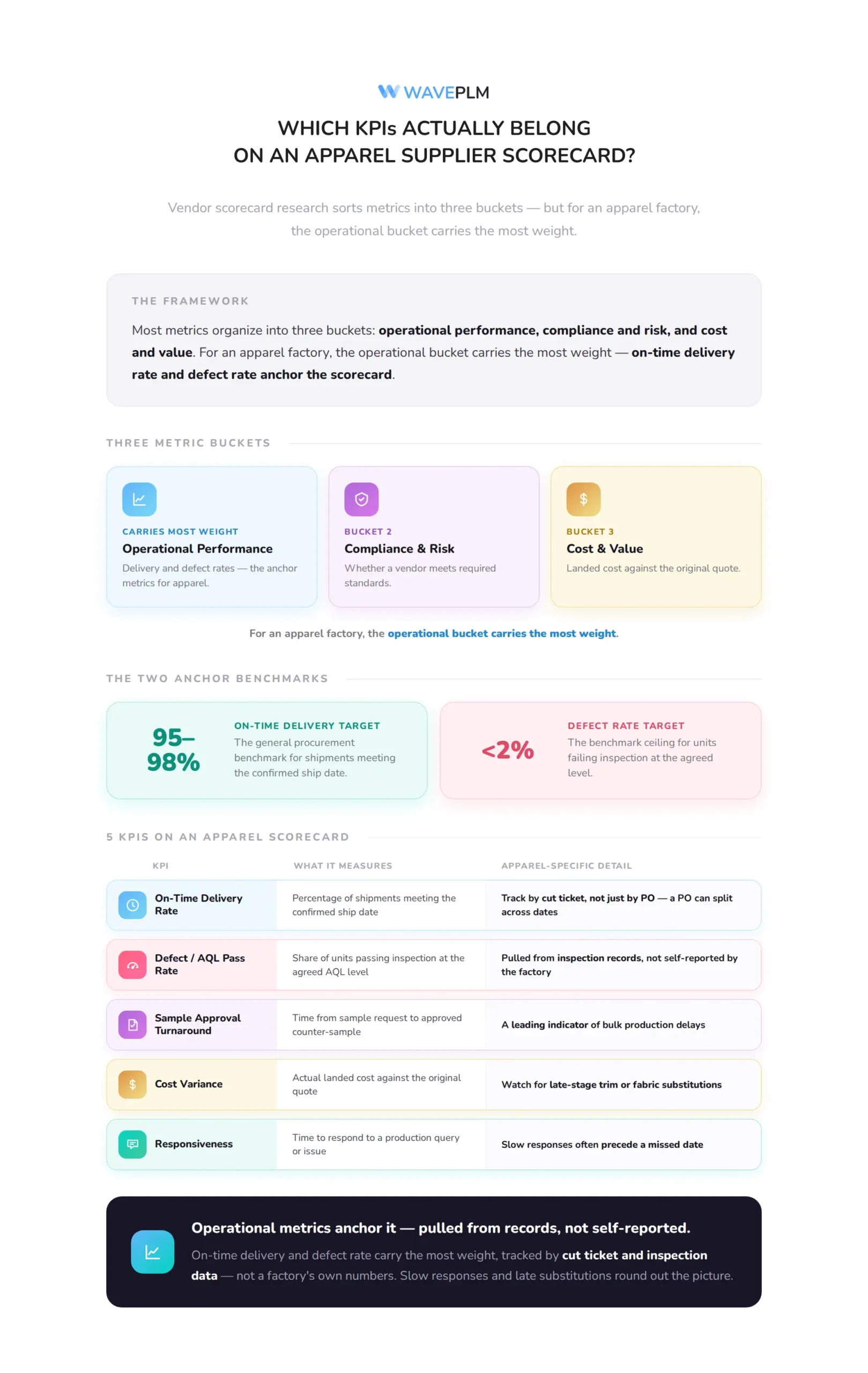
Vendor scorecard research organizes most metrics into three buckets: operational performance, compliance and risk, and cost and value (Ramp, 2026). For an apparel factory, the operational bucket carries the most weight. On-time delivery rate and defect rate typically anchor the scorecard. General procurement benchmarks cite a 95 to 98% delivery target and a defect rate under 2%.
| KPI | What it measures | Apparel-specific detail |
|---|---|---|
| On-time delivery rate | Percentage of shipments meeting the confirmed ship date | Track by cut ticket, not just by PO, since a single PO can split across dates |
| Defect / AQL pass rate | Share of units passing inspection at the agreed AQL level | Pulled directly from inspection records, not self-reported by the factory |
| Sample approval turnaround | Time from sample request to approved counter-sample | A leading indicator of bulk production delays |
| Cost variance | Actual landed cost against the original quote | Watch for late-stage trim or fabric substitutions |
| Responsiveness | Time to respond to a production query or issue | Slow responses often precede a missed date |
Our AQL inspection guide covers how to set defect thresholds that then feed directly into this defect-rate metric. Similarly, our fabric sourcing guide covers the lead-time data that a cost-variance KPI should reference.
How Should Each KPI Be Weighted on the Scorecard?
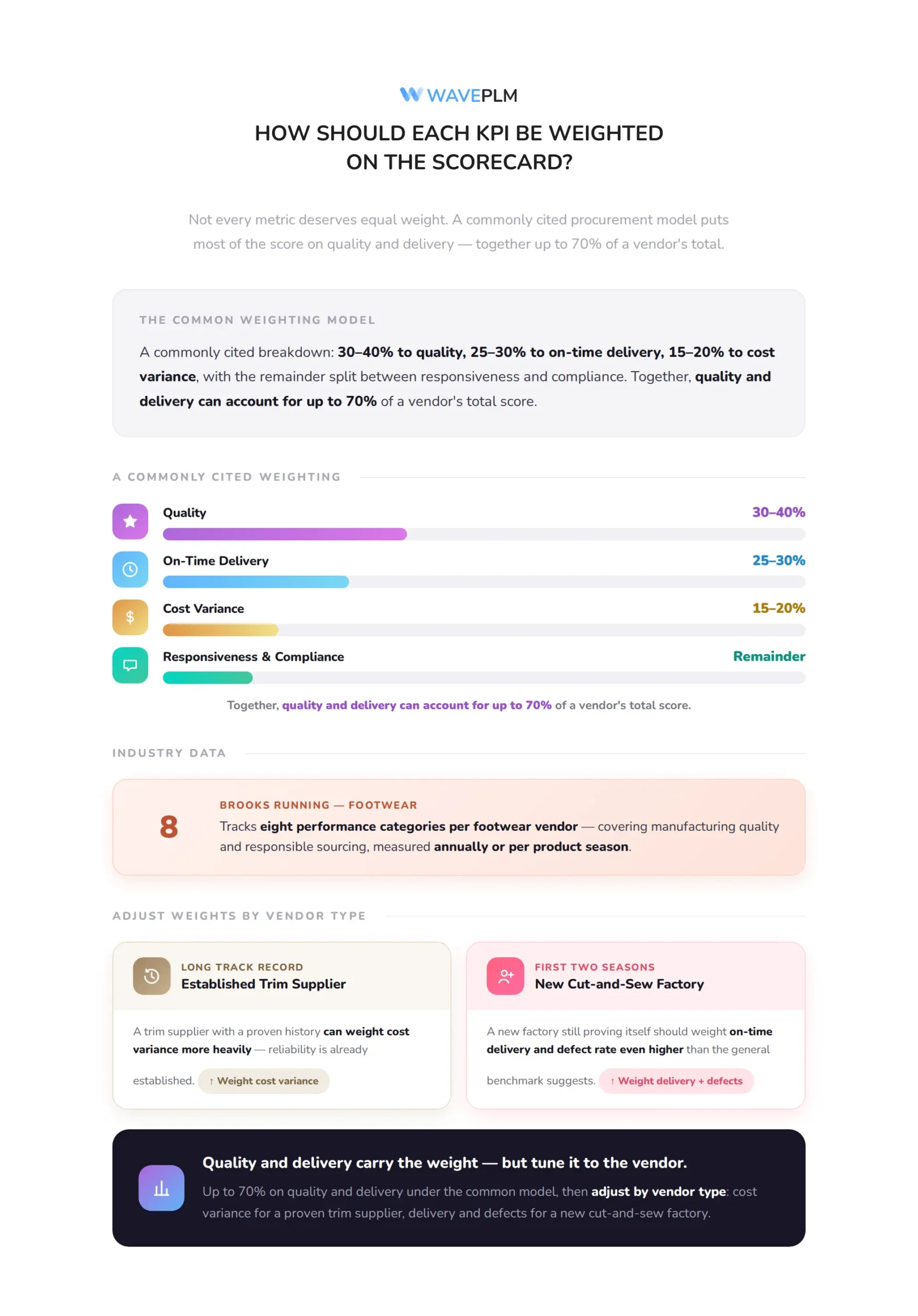
Not every metric deserves equal weight. A commonly cited procurement weighting looks like this: 30 to 40% to quality, 25 to 30% to on-time delivery, 15 to 20% to cost variance. The remainder splits between responsiveness and compliance (Ramp, 2026). Together, quality and delivery can account for up to 70% of a vendor’s total score under that model.
Industry data: Brooks Running tracks eight performance categories per footwear vendor. That covers manufacturing quality and responsible sourcing, measured annually or per product season (Supply Chain Dive, Oct 2024).
In practice, a brand should adjust these weights by vendor type. A trim supplier with a long track record might weight cost variance more heavily. A new cut-and-sew factory still in its first two seasons should weight on-time delivery and defect rate even higher than the general benchmark suggests.
How Do Real Fashion Brands Actually Use Supplier Scorecards?
Patagonia evaluates suppliers across production, product quality, and social and environmental impact. Notably, it tracks on-time delivery, defective rates, and audit results together, rather than in separate silos (Supply Chain Dive, Oct 2024). Notably, Patagonia also runs a two-way feedback loop, letting suppliers flag issues on the brand’s side as well.
Estée Lauder takes a similar structured approach. It measures quality, service, innovation, and sustainability. From there, the team works backward from business needs. That process identifies which supplier-side metrics actually correlate with those outcomes (Supply Chain Dive, Oct 2024). Across all three brands, the common thread is consistency. The same metrics get tracked the same way, every season, rather than an ad hoc review only when a problem already surfaced.
Generic Vendor Scorecard Tools vs Apparel-Specific PLM Tracking
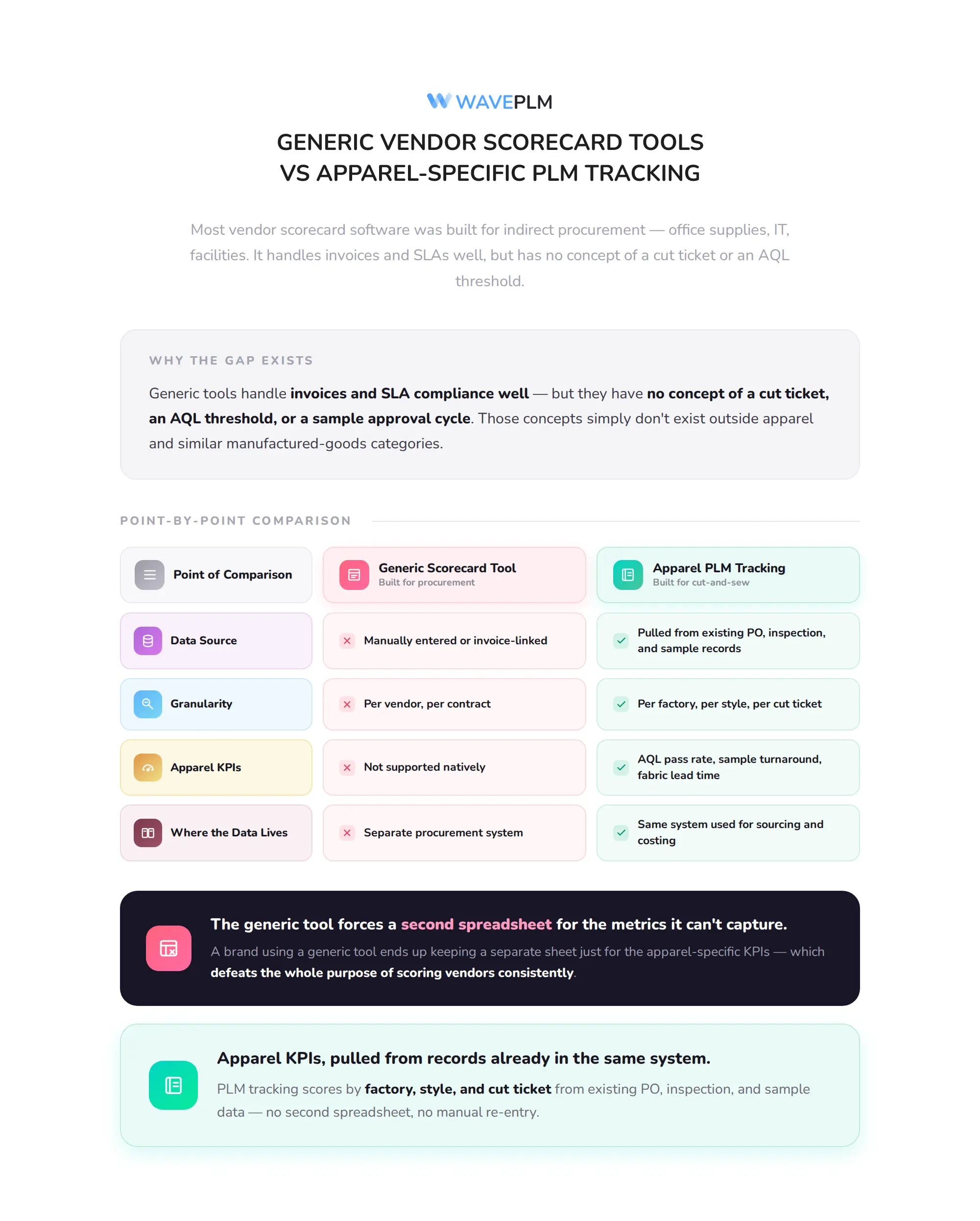
Most vendor scorecard software on the market was built for indirect procurement: office supplies, IT services, facilities contracts. That software handles invoices and SLA compliance well. However, it has no concept of a cut ticket, an AQL threshold, or a sample approval cycle. Those concepts simply do not exist outside apparel and similar manufactured-goods categories.
| Point of comparison | Generic vendor scorecard tool | Apparel PLM scorecard tracking |
|---|---|---|
| Data source | Manually entered or invoice-linked | Pulled from existing PO, inspection, and sample records |
| Granularity | Per vendor, per contract | Per factory, per style, per cut ticket |
| Apparel-specific KPIs | Not supported natively | AQL pass rate, sample turnaround, fabric lead time |
| Where the data lives | Separate procurement system | Same system used for sourcing and costing |
As a result, a brand using a generic tool often ends up keeping a second spreadsheet just to track the apparel-specific metrics the software cannot capture natively. That defeats the purpose of scoring vendors consistently in the first place.
What Should a Brand Look For When Choosing Supplier Scorecard Software?
Not all supplier scorecard software fits an apparel workflow. A tool built for general procurement usually expects invoice-level data, not cut tickets or AQL results. Before adopting one, a brand should confirm three things. First, whether the software can pull data automatically from existing PO and inspection records, instead of requiring manual entry every cycle. Second, whether it supports apparel-specific fields like AQL pass rate and sample turnaround, rather than only generic delivery and cost metrics. Third, whether factories themselves can see their own score, since a scorecard hidden entirely from the vendor rarely drives improvement.
In practice, the software question matters less than the underlying data model. Supplier scorecard software bolted onto a separate procurement system tends to drift out of sync with the sourcing team’s actual records. A brand evaluating options should weigh how much duplicate data entry a tool creates, not just which dashboard looks the cleanest in a demo.
How Often Should an Apparel Supplier Scorecard Be Reviewed?
Most fashion brands review scorecards annually or per season, matching Brooks Running’s cadence for footwear vendors (Supply Chain Dive, Oct 2024). That said, a brand running frequent reorders benefits from checking on-time delivery and defect rate more often. Otherwise, a single bad month can disappear inside an annual average.
In practice, a quarterly pulse check on the two highest-weighted KPIs helps. Pairing it with a full annual review across every metric catches problems earlier, without turning scorecard review into a full-time job. The annual review still matters for allocation decisions like reorder share and new-season capacity commitments.
Wave PLM and Supplier Scorecard Tracking
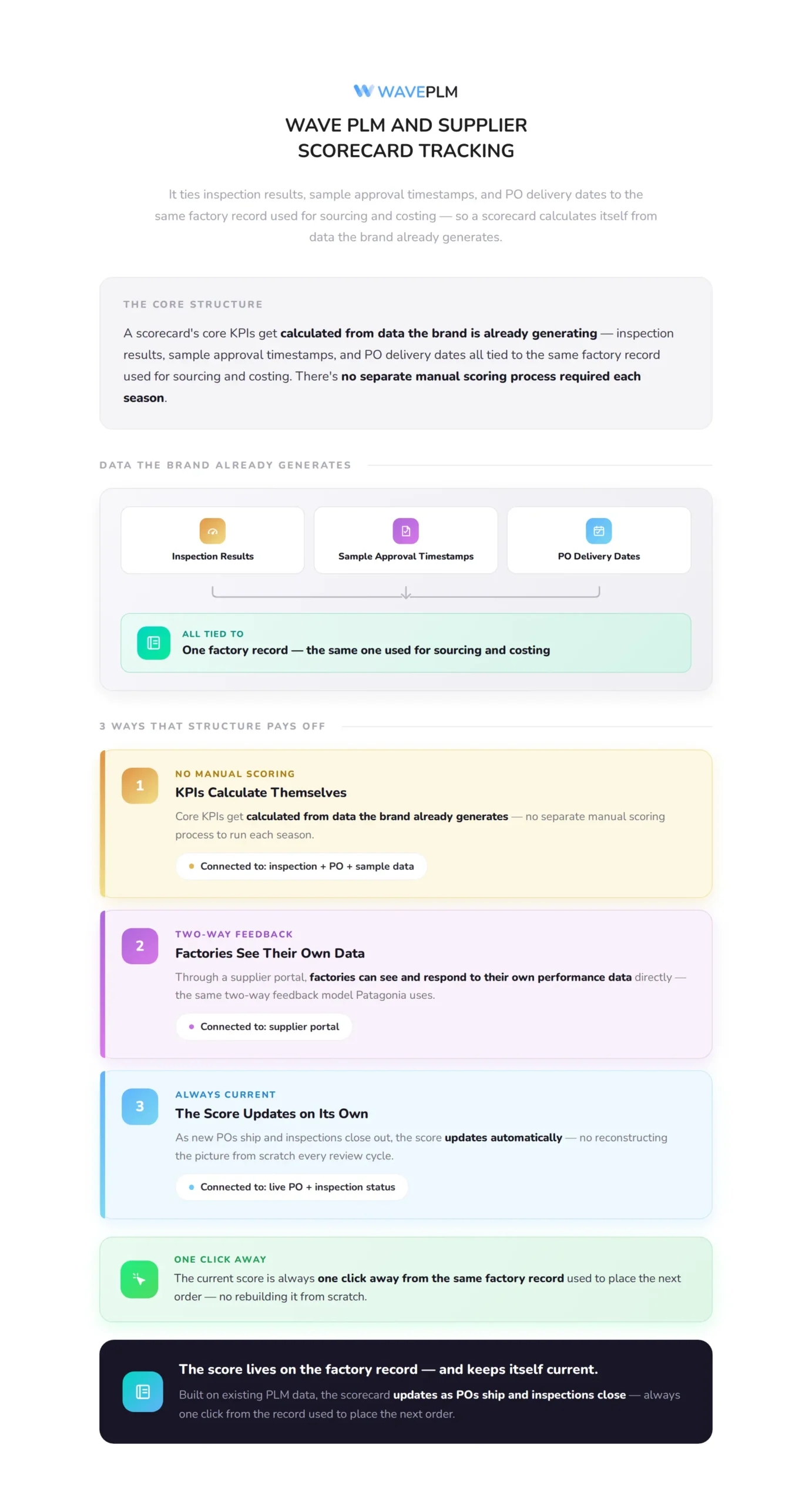
Wave PLM ties inspection results, sample approval timestamps, and PO delivery dates to the same factory record used for sourcing and costing. That means a scorecard’s core KPIs get calculated from data the brand is already generating. There is no separate manual scoring process required each season. Our supplier portal guide covers how factories can see and respond to their own performance data directly. That supports the same two-way feedback model Patagonia uses.
Building a scorecard on top of existing PLM records also means the score updates automatically as new POs ship and new inspections close out. A brand does not have to reconstruct the picture from scratch every review cycle. Instead, the current score is always one click away from the same factory record used to place the next order.
Frequently Asked Questions
What is supplier scorecard software used for in apparel?
It tracks a factory’s ongoing performance after onboarding, using a recurring set of KPIs such as on-time delivery, defect rate, and sample approval turnaround. That structured score supports decisions like reorder allocation and when to end a supplier relationship.
Which KPIs matter most on an apparel supplier scorecard?
On-time delivery rate and defect or AQL pass rate typically carry the most weight. Together, they can account for up to 70% of the score under common procurement weighting models. Sample approval turnaround, cost variance, and responsiveness round out the rest.
How often should a fashion brand review its supplier scorecards?
Most brands review scorecards annually or per season. A brand with frequent reorders benefits from a quarterly check on its highest-weighted KPIs. Otherwise, a single bad month can disappear inside an annual average.
Can generic vendor scorecard software work for apparel factories?
Generic procurement scorecard tools handle invoices and SLA compliance well. But they typically have no concept of a cut ticket, an AQL threshold, or a sample approval cycle. Brands often end up tracking those apparel-specific metrics in a separate spreadsheet instead.
How do fashion brands like Patagonia use supplier scorecards?
Patagonia evaluates production, product quality, and social and environmental impact together, rather than scoring them in separate silos. It also runs a two-way feedback process, so suppliers can flag issues on the brand’s side too.
Should scorecard weighting be the same for every vendor?
No. A long-standing trim supplier might weight cost variance more heavily. A new cut-and-sew factory in its first two seasons should weight on-time delivery and defect rate above the general benchmark instead.
Most brands can name their best factory from memory. Fewer can say, with actual data, which factory is quietly drifting toward a missed date this season. Which of your vendors would fail an on-time delivery review right now, if you actually ran the numbers instead of relying on memory? Wave PLM keeps that scorecard data attached to the same records your team already updates every PO.






Leave a Reply