
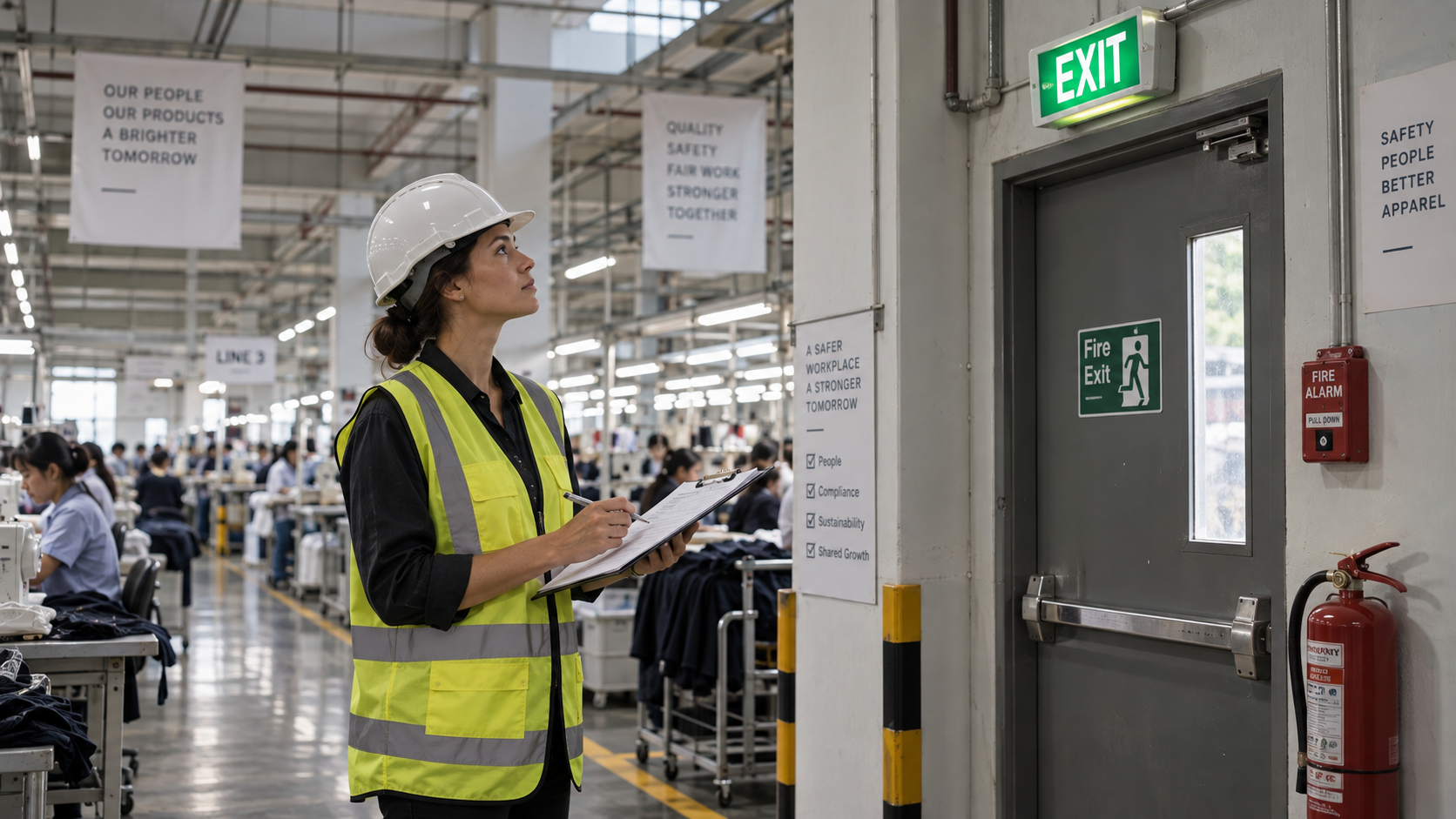
A factory audit is a structured, on-site review of a factory’s labor practices, safety conditions, and production capability. Most brands run one before placing a first order. Many also repeat it on a regular schedule after that. Even so, plenty of brands skip this step. They assume a factory is fine simply because it has a website and a sales contact. In practice, that assumption fails often. In one 2024-2025 review of 312 apparel factories, 38% failed on excessive overtime alone. Almost a quarter had inadequate emergency exits. This guide covers the four types of factory audits, what each one checks, and what a brand should do before placing a production order.
Industry data: Across 312 audited factories, 38% failed due to excessive overtime, 24% had inadequate emergency exits, 19% lacked chemical safety data sheets, and 14% showed undocumented subcontracting (OneAim Apparel).
What Are the Four Main Types of Factory Audits?
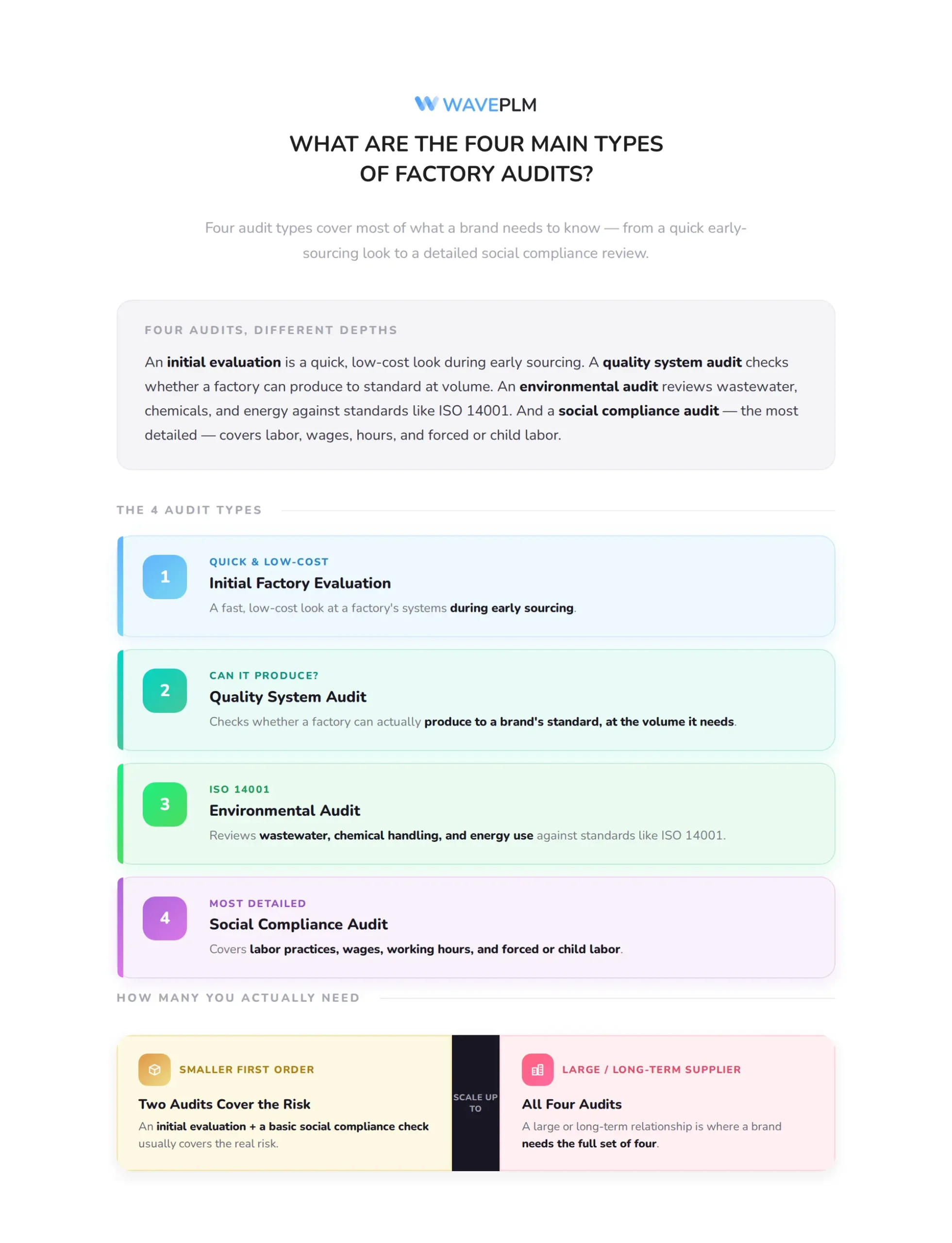
Four audit types cover most of what a brand needs to know. First, an initial factory evaluation. This is a quick, low-cost look at a factory’s systems during early sourcing. Second, a quality system audit. This checks whether a factory can actually produce to a brand’s standard, at the volume it needs. Third, an environmental audit. This reviews wastewater, chemical handling, and energy use against standards like ISO 14001. Fourth, and most detailed, a social compliance audit. It covers labor practices, wages, working hours, and forced or child labor (Quality Inspection).
Most brands only need all four for a large or long-term supplier relationship. For a smaller first order, an initial evaluation plus a basic social compliance check usually covers the real risk.
What Does a Social Compliance Audit Actually Cover?
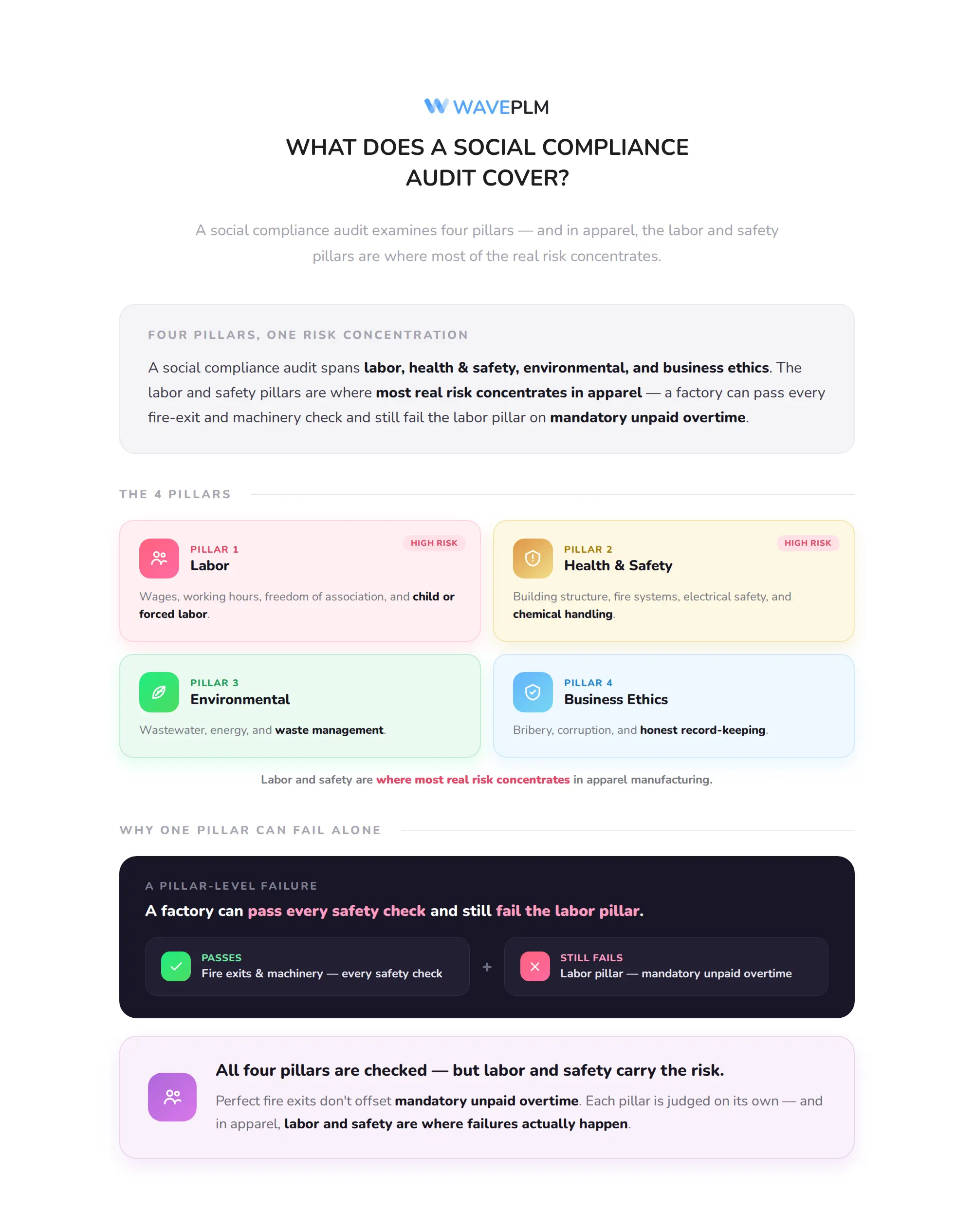
A social compliance audit examines four pillars. The labor pillar covers wages, working hours, freedom of association, and child or forced labor. Health and safety reviews building structure, fire systems, electrical safety, and chemical handling. Environmental checks cover wastewater, energy, and waste management. Business ethics covers bribery, corruption, and honest record-keeping (OneAim Apparel).
These four pillars explain why the overtime and emergency-exit failures above matter so much. Both sit inside the labor and safety pillars. That is exactly where most real risk concentrates in apparel manufacturing.
For instance, a factory that runs mandatory unpaid overtime fails the labor pillar. That holds true even if its fire exits and machinery pass every safety check.
How Much Does a Factory Audit Cost?
Cost scales with how thorough the audit needs to be. A remote self-audit costs nothing but time, and takes one to two weeks. Stepping up, a basic third-party audit runs $400 to $1,200, over five to fourteen days. Beyond that, a full SMETA or BSCI four-pillar audit runs $1,200 to $3,500, over two to four weeks. At the top tier, a full SA8000 certification runs $5,000 to $12,000, over six to twelve weeks (OneAim Apparel).
As a rule of thumb, a first order under $10,000 rarely justifies more than a self-audit. Once an order passes $25,000, a third-party audit becomes worth the cost. In fact, the downside of an unvetted factory simply grows with order size. For example, a $5,000 trial order can reasonably rely on a free self-audit and the factory’s own paperwork. Once that relationship scales toward six-figure annual volume, the math changes fast. The cost of a full SMETA audit becomes small next to the risk of one failed shipment.
What Red Flags Should a Brand Watch for Before Ordering?
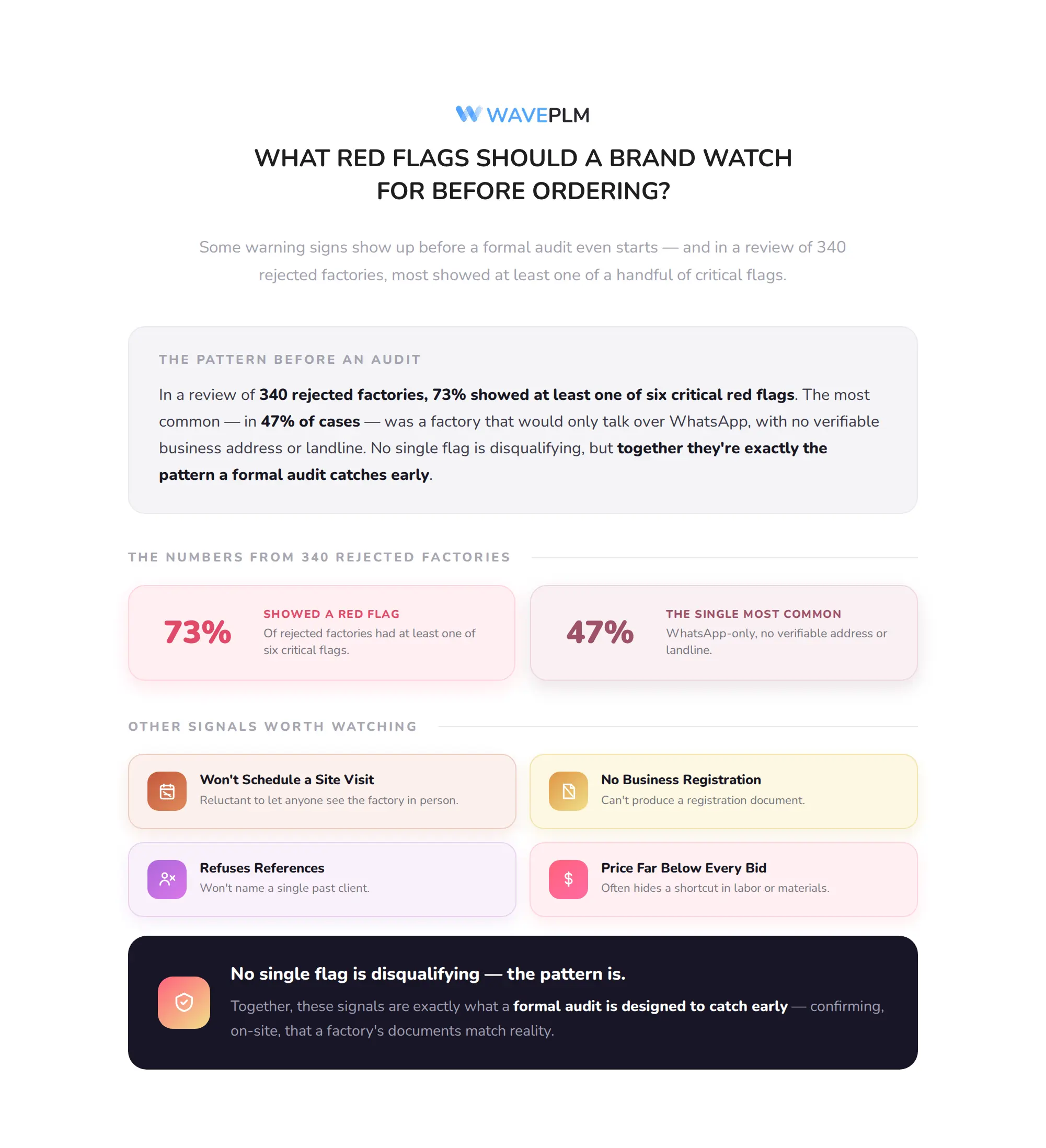
Some warning signs show up before a formal audit even starts. In a review of 340 rejected factories, 73% showed at least one of six critical red flags. The single most common flag, appearing in 47% of cases, was a factory that would only communicate over WhatsApp. It had no verifiable business address or landline (OneAim Apparel). That signal alone is not disqualifying. Still, combined with a reluctance to schedule a site visit, it usually means a bigger problem underneath.
A few other signals are worth watching too. One is a factory that cannot produce a business registration document. Another is a factory that refuses to name a single past client for reference. Similarly, a quoted price far below every other bid on the same order often hides a shortcut somewhere in labor cost, material quality, or both. None of these signals proves a factory is unsafe to work with. Together, though, they are exactly the pattern a formal audit is designed to catch early.
Our vendor onboarding guide covers the full document and compliance checklist a brand should collect before a factory relationship goes any further. A factory audit confirms, on-site, that those documents match reality.
Who Should Run the Factory Audit?
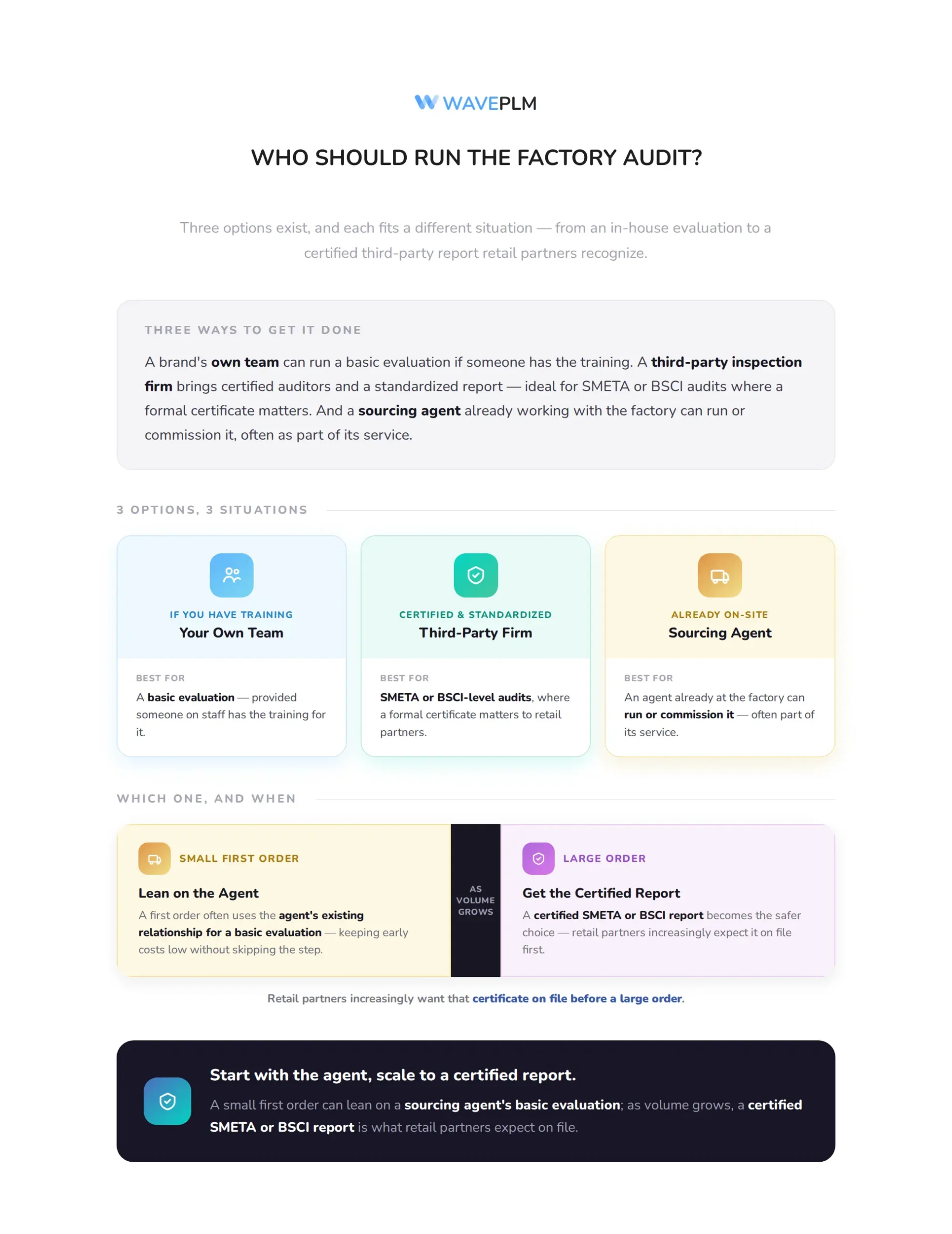
Three options exist, and each fits a different situation. A brand’s own team can run a basic evaluation, provided someone on staff has the training for it. Otherwise, a third-party inspection firm brings certified auditors and a standardized report. That option works well for SMETA or BSCI-level audits, where a formal certificate matters to retail partners. A sourcing agent already working with the factory can also run or commission the audit, often as part of its standard service. Our sourcing agent guide covers exactly what to ask an agent about audit scope, instead of assuming it is already covered.
For example, a small factory’s first order often relies on the sourcing agent’s existing relationship for a basic evaluation. In practice, that keeps early costs low without skipping the audit step. As order volume grows, a certified SMETA or BSCI report becomes the safer choice. Notably, retail partners increasingly expect to see that certificate on file before placing a large order.
How Often Should a Brand Re-Audit an Existing Factory?
An audit is not a one-time event for an ongoing supplier relationship. Most brands re-run a social compliance audit annually, since labor conditions and staffing can shift within a single year. A change in ownership, a new production line, or a sudden jump in order volume are all reasons to re-audit sooner than the annual schedule. Meanwhile, a factory that already holds a current SMETA or BSCI certificate from another buyer can often share that report, which saves a brand the cost of a duplicate audit for the same period.
For example, a factory that adds a night shift to meet a rush order needs a fresh look. That holds regardless of when the last audit happened, since conditions can shift fast under new schedules.
What Happens After a Factory Fails an Audit?
A failed audit does not automatically end the relationship. In practice, most findings fall into one of two categories. Critical issues, such as child labor or a blocked fire exit, typically require the brand to walk away right away. Correctable issues, such as missing documentation or an overtime policy that needs updating, usually go into a corrective action plan instead. The factory gets a fixed window, often 30 to 90 days, to fix the issue and schedule a follow-up audit. Meanwhile, a brand can still place a small trial order during that window. Even so, it should hold off on a large production order until the follow-up audit confirms the fix. Otherwise, a brand risks discovering the exact same problem again, at a much larger scale.
How Does a Factory Audit Relate to an AQL Inspection?
A factory audit and an AQL inspection check different things, and a brand needs both. A factory audit happens once, or on a recurring schedule. It asks whether a factory is fit to work with at all. An AQL inspection happens on every production run instead. It asks whether this specific shipment meets an agreed defect threshold. Our AQL inspection guide covers how those thresholds get set. Notably, a factory can pass every AQL inspection for a season and still fail a social compliance audit, since the two measure entirely different risks.
How Does Factory Audit Data Fit Into a Broader PLM Workflow?
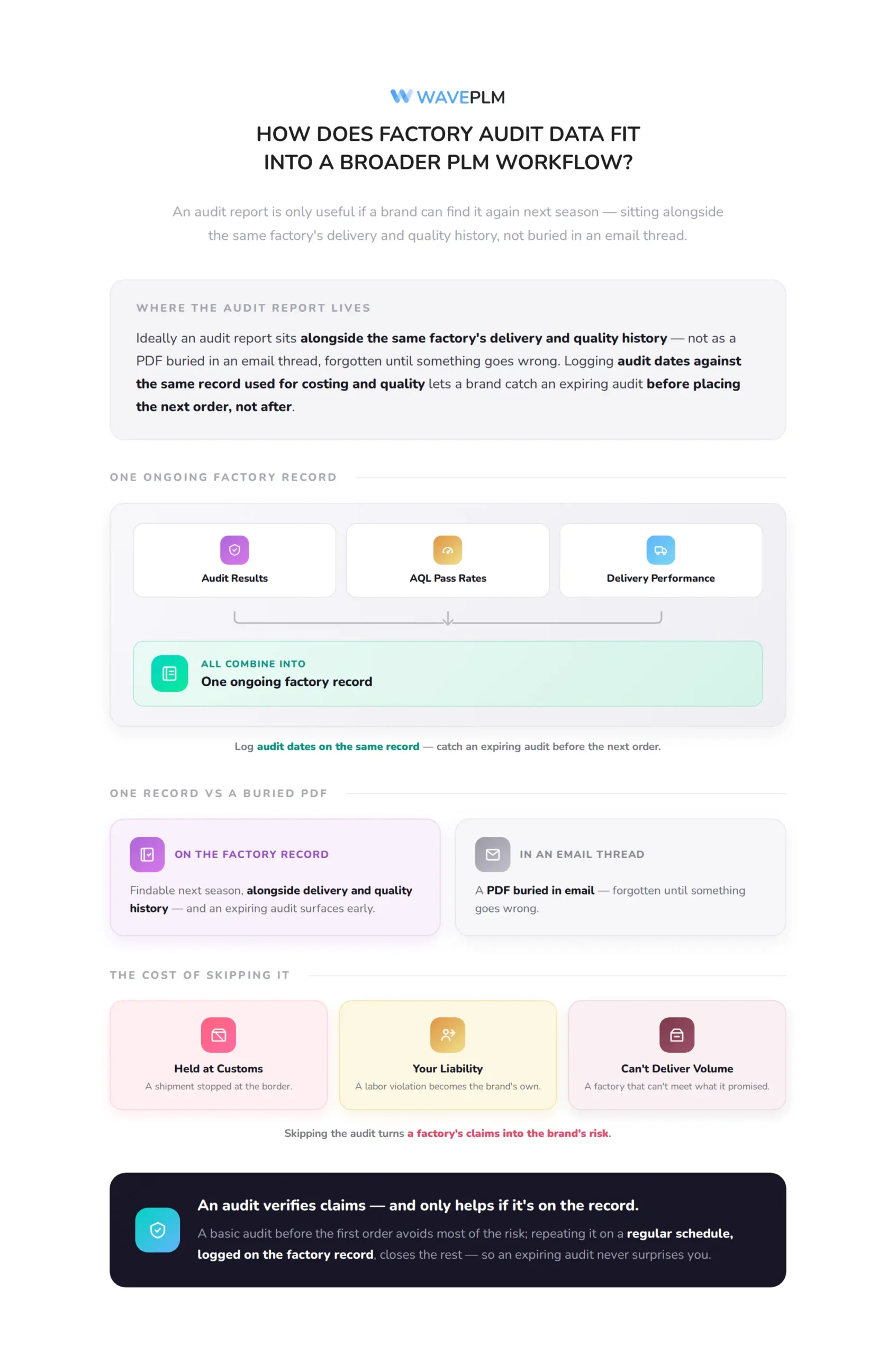
An audit report is only useful if a brand can find it again next season. Ideally, it sits alongside the same factory’s delivery and quality history. Otherwise, it becomes a PDF buried in an email thread, forgotten until something goes wrong. Our supplier scorecard guide covers how audit results, AQL pass rates, and delivery performance combine into one ongoing factory record. Our finding: Wave PLM customers who log audit dates against the same factory record used for costing and quality catch an expiring audit early. They catch it before placing the next order, not after.
Our quality control management software guide covers the inspection side of that same record, from the first pre-production check through final shipment.
In short, a factory audit is not a one-time formality. Instead, it is the step that turns a factory’s own claims about its labor practices, safety, and capability into something a brand has actually verified. The cost of skipping it shows up later. It can mean a shipment held at customs, a labor violation that becomes the brand’s own liability, or a factory that simply cannot deliver at the volume it promised. A brand that budgets for at least a basic audit before its first order avoids most of that risk. Repeating it on a regular schedule after that closes the rest of the gap.
Frequently Asked Questions
What is a factory audit for apparel brands?
A factory audit is a structured, on-site review of a factory’s labor practices, safety conditions, and production capability. Brands typically run one before the first order.
What are the main types of factory audits?
The four main types are an initial factory evaluation, a quality system audit, an environmental audit, and a social compliance audit covering labor, wages, and working hours.
How much does a factory audit cost?
Costs range from free for a remote self-audit to $400-$1,200 for a basic third-party audit, $1,200-$3,500 for a SMETA or BSCI audit, and $5,000-$12,000 for SA8000 certification.
What is the most common factory audit failure?
In one review of 312 apparel factories, 38% failed due to excessive overtime. Notably, that made it the single most common audit failure, ahead of emergency exits and chemical safety documentation.
Is a factory audit the same as an AQL inspection?
No. A factory audit checks whether a factory is fit to work with at all. An AQL inspection checks whether one specific production run meets an agreed defect threshold.
Who should run a factory audit?
A brand’s own trained staff, a certified third-party inspection firm, or a sourcing agent already working with the factory can all run a factory audit, depending on scope needed.
Most apparel brands can describe a factory’s price and lead time in detail. Far fewer can say when that factory was last audited, or what the audit actually found. If a factory audit is not attached to the same record a brand already uses for costing and quality, Wave PLM keeps every audit date and finding next to the style and supplier record a team checks every day.





Leave a Reply