

A minimum advertised price, or MAP, policy sets the lowest price a retailer can advertise for a brand’s products. Without one, a single retailer can slash prices online, and every other retailer carrying the line feels pressure to match. For a wholesale apparel brand, that race to the bottom can wreck margins across an entire retail network within a season. Overall, a clear MAP policy is one of the few tools a brand has to prevent it.
What Is a Minimum Advertised Price (MAP) Policy?
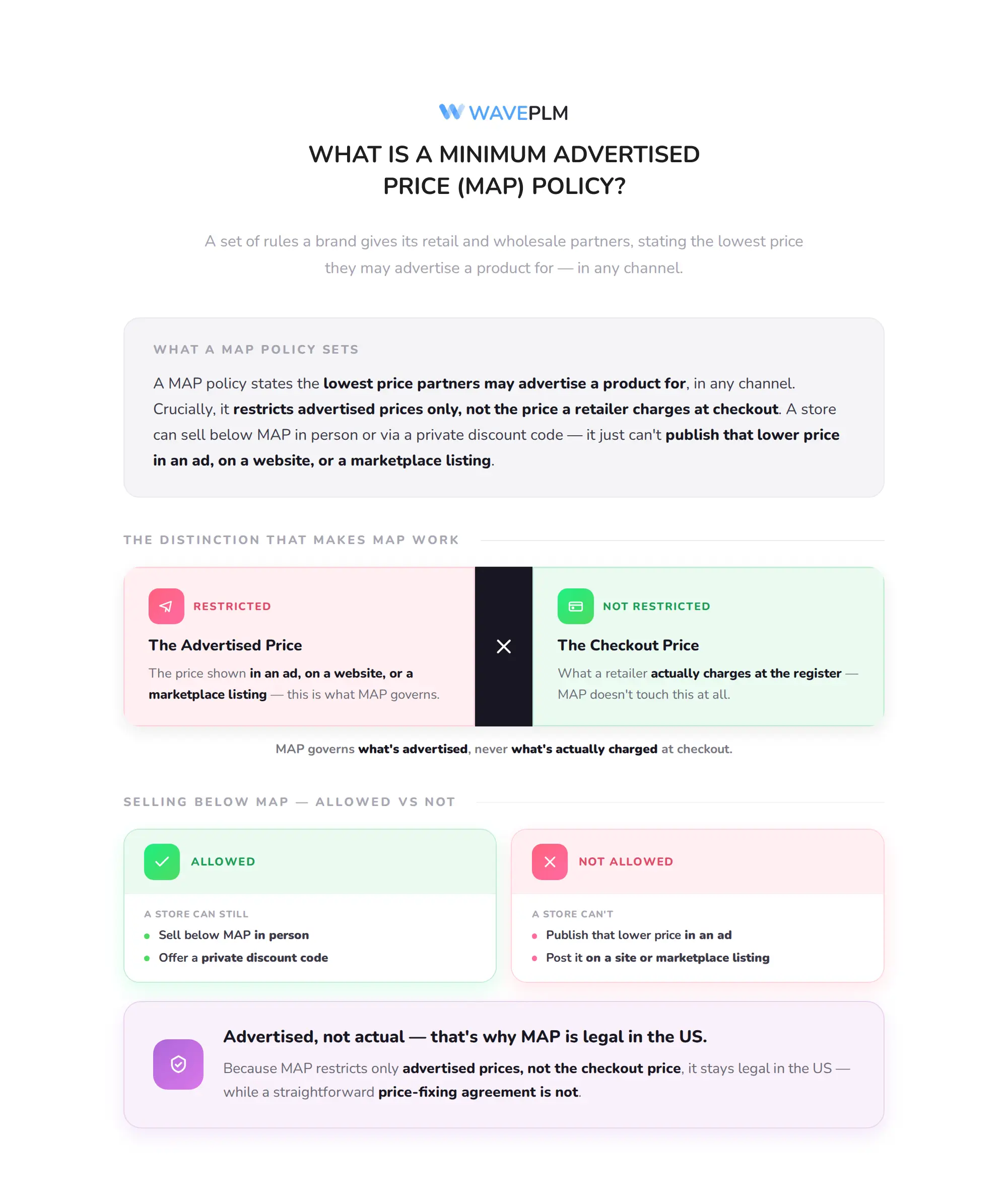
A MAP policy is a set of rules a brand gives its retail and wholesale partners. It states the lowest price they may advertise a product for, in any channel. Importantly, MAP restricts advertised prices only, not the price a retailer actually charges at checkout. For instance, a store can still sell below MAP in person or through a private discount code. Still, what it can’t do is publish that lower price in an ad, on a website, or on a marketplace listing.
That distinction matters a lot in practice. It’s also the reason MAP policies are legal in the US, while a straightforward price-fixing agreement is not.
MAP vs. MSRP: What’s the Difference?
First, MSRP, or manufacturer’s suggested retail price, is just a recommendation. Notably, a retailer can ignore it and price however it likes, in ads or at the register. MAP is different: it’s an enforceable floor on advertised pricing, even if the retailer disagrees with it. In other words, MSRP suggests a number; MAP restricts one specific use of a lower number. Brands typically publish both — an MSRP for general reference, and a MAP for retailers to follow in their advertising.
Why Do Apparel Brands Use MAP Policies?
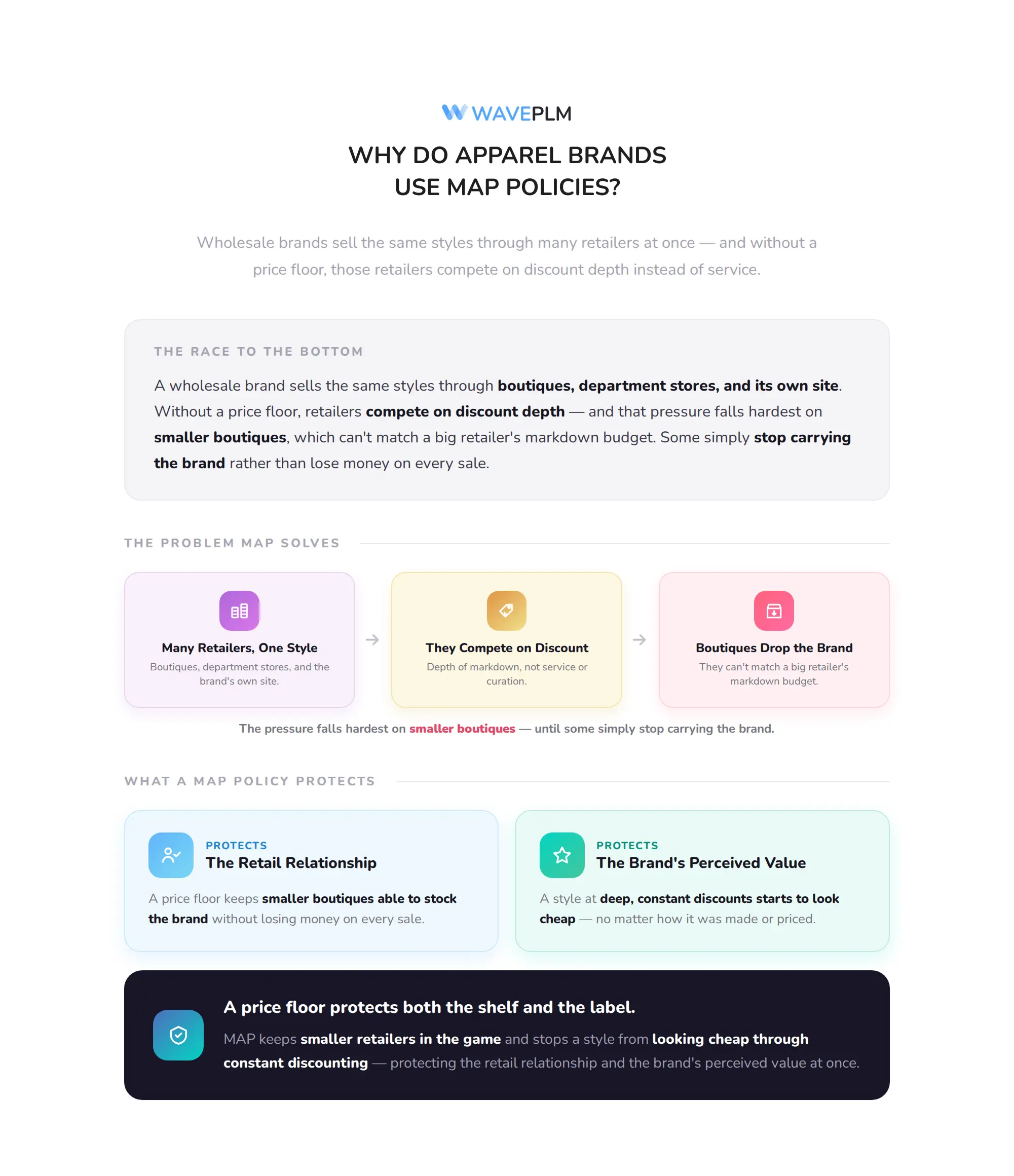
Wholesale apparel brands sell the same styles through many retailers at once — boutiques, department stores, and their own site. Without a price floor, retailers compete on discount depth instead. Service and curation stop mattering as much. Notably, that pressure tends to fall hardest on smaller boutiques, which can’t match a big retailer’s markdown budget. Eventually, some simply stop carrying the brand rather than lose money on every sale.
A MAP policy protects that retail relationship. It also protects the brand’s own perceived value. A style advertised at deep, constant discounts starts to look cheap. That happens regardless of how it was actually made or priced to cost.
Is a MAP Policy Legal?
Yes, when it’s structured correctly. In the US, a brand can set a MAP policy unilaterally and simply stop supplying retailers who violate it — that’s settled antitrust law. However, a brand cannot negotiate MAP with retailers, or get retailers to agree to it with each other. Doing either shifts the policy into price-fixing territory. Instead, the policy has to be presented as a condition of doing business, not a negotiated agreement.
This is a genuinely legal-adjacent area, and the details vary by jurisdiction and by how a policy is worded and enforced. Nothing here is legal advice — a brand rolling out its first MAP policy should have a lawyer review the actual document before sending it to retailers.
How Do You Set Up a MAP Policy for a Wholesale Apparel Brand?
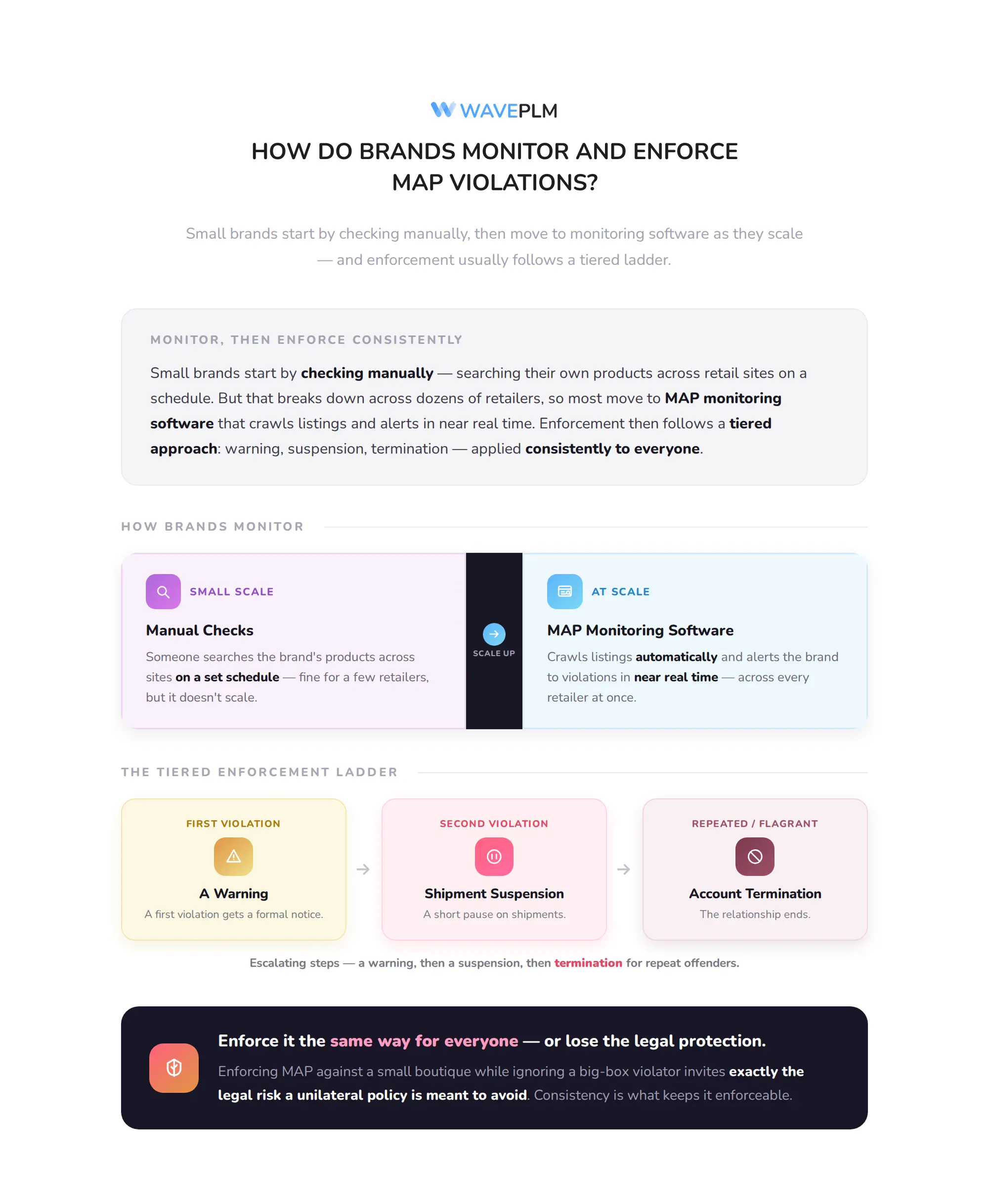
In practice, a workable MAP policy usually covers a few specific things.
- Which products it applies to — often everything, though some brands exclude past-season or clearance styles.
- The actual MAP price for each style, or a formula (for example, no more than 20% off MSRP in any ad).
- Which channels count as “advertised” — typically websites, email, social ads, and marketplace listings, but not in-store signage or private offers.
- How violations are identified and what happens next, in plain language retailers can’t misread.
Once the policy is written, it needs to reach every retailer in writing. Ideally, that happens before the first order ships. A policy nobody has seen isn’t enforceable in any practical sense. That’s true whatever it says on paper.
Industry data: MAP violations concentrate heavily on marketplace listings — particularly third-party sellers on Amazon, who resell inventory sourced from other retailers and aren’t always aware a MAP policy even exists for that product.
How Do Brands Monitor and Enforce MAP Violations?
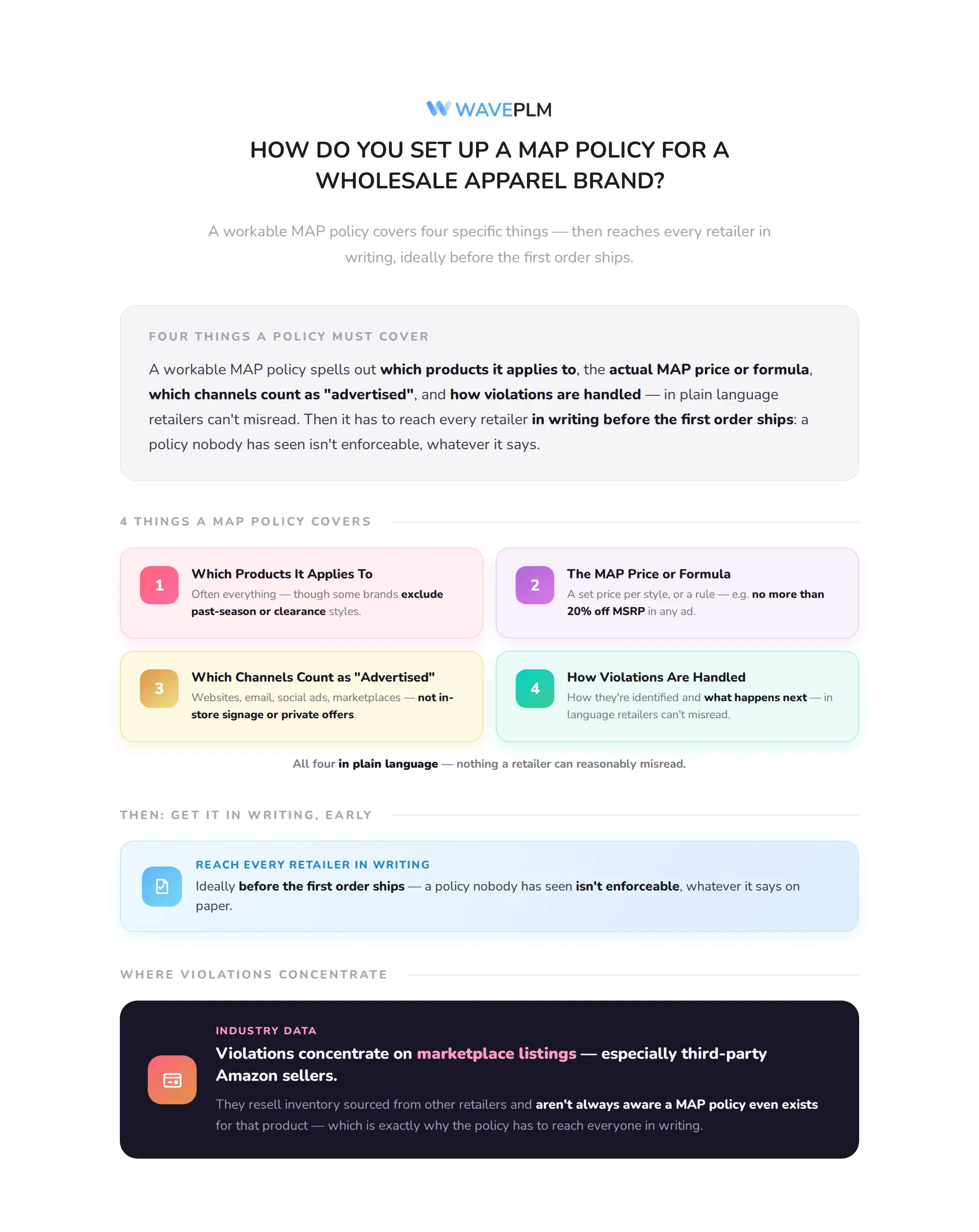
Typically, small brands start by checking manually. Someone on the team searches the brand’s own products across major retail sites and marketplaces on a set schedule, and flags anything below the floor. This works at a small scale. However, it doesn’t hold up once a brand sells through dozens of retailers and several marketplaces at once.
At that point, most brands move to MAP monitoring software, which crawls listings automatically and alerts the brand to violations in near real time. Either way, enforcement usually follows a tiered approach. A first violation gets a warning. A second gets a short suspension of shipments. Repeated or flagrant violations lead to account termination. Consistency matters here — enforcing MAP against a small boutique while ignoring a big-box violator invites exactly the legal risk a unilateral policy is meant to avoid.
Does a MAP Policy Cover Marketplaces Like Amazon?
It should. In fact, this is where most violations actually happen. Third-party sellers on Amazon frequently buy inventory through unauthorized channels. They then list it below MAP, often without realizing a policy applies at all. Brands enrolled in Amazon’s Brand Registry get some direct tools to report and remove these listings. Without that registration, a brand is largely stuck contacting sellers individually. The alternative — Amazon’s general seller-complaint process — moves far more slowly.
Does MAP Work the Same Way Outside the US?
No, and this trips up brands expanding internationally. In the US, a unilaterally set and unilaterally enforced MAP policy is legal under what’s known as the Colgate doctrine. The EU and UK take a much stricter line. There, resale price maintenance is treated differently. Any attempt by a supplier to fix or floor a retailer’s resale price — including through advertised-price restrictions — is usually a serious competition-law violation. The “unilateral policy” defense that works in the US carries far less weight there.
For an apparel brand selling wholesale in both the US and Europe, one MAP policy doesn’t necessarily translate. A US-style MAP letter sent to EU retailers could create real competition-law exposure. Instead of protecting margin, it could invite a regulatory problem. Brands operating across both regions should have counsel review the policy separately for each market, not assume a single US template covers everything.
Where PLM Fits Into MAP Enforcement
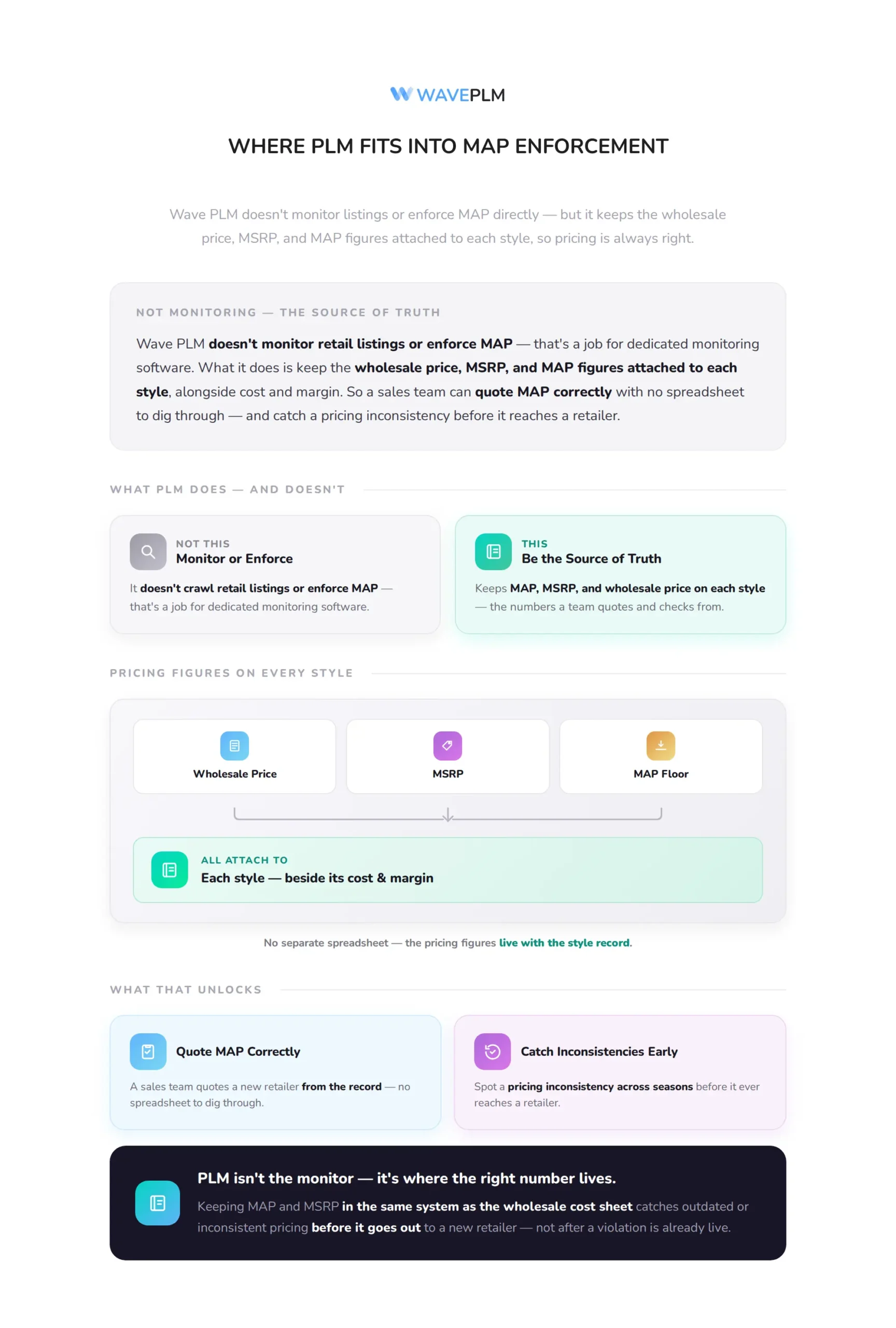
Wave PLM doesn’t monitor retail listings or enforce MAP directly — that’s a job for dedicated monitoring software, not a product lifecycle system. What PLM does do is keep the wholesale price list, MSRP, and MAP figures attached to each style alongside the rest of its cost and margin data. That way, a sales or merchandising team can quote MAP correctly to a new retailer. There’s no separate spreadsheet to dig through. It also helps catch a pricing inconsistency across seasons before it ever reaches a retailer.
Our finding: brands that keep MAP and MSRP figures in the same system as their wholesale cost sheets catch outdated or inconsistent pricing before it goes out to a new retailer, rather than after a violation is already live.
What Mistakes Do Brands Make With Their First MAP Policy?
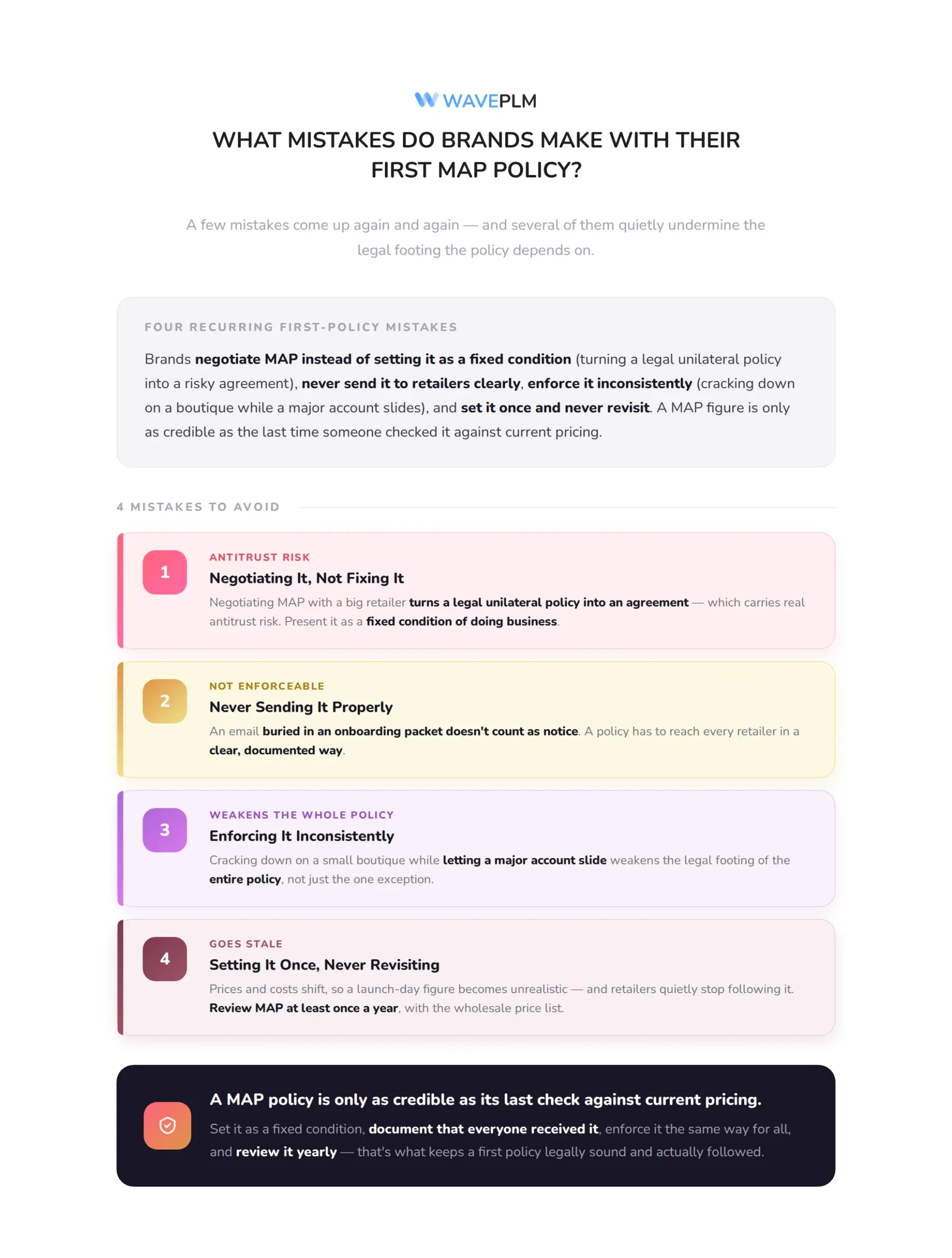
A few mistakes come up again and again with a brand’s first MAP policy. First, brands often negotiate MAP directly with a large retailer instead of presenting it as a fixed condition of doing business. That single step can turn a legal unilateral policy into a negotiated agreement, which carries real antitrust risk.
Second, many brands write a policy but never send it to retailers in a clear, documented way. An email buried in an onboarding packet doesn’t count as notice in any meaningful sense. Third, brands enforce MAP inconsistently — cracking down on a small boutique while letting a major account slide. That kind of selective enforcement weakens the legal footing of the whole policy, not just the one exception.
Finally, some brands set MAP once and never revisit it. Prices, costs, and competitive pressure all shift over a few seasons. A MAP figure that made sense at launch can become unrealistic. When that happens, retailers quietly stop following a policy they see as out of date. Reviewing MAP figures at least once a year, alongside a normal wholesale price-list update, catches this before it becomes a pattern across an entire retail network. Ultimately, a MAP policy is only as credible as the last time someone actually checked it against current pricing.
Frequently Asked Questions
What does MAP mean in retail pricing?
MAP stands for minimum advertised price. It’s the lowest price a brand allows a retailer to advertise a product for, across any channel. It doesn’t restrict the actual sale price, only the advertised one.
Is MAP the same as MSRP?
No. MSRP is a suggested price with no enforcement behind it. MAP is a floor on advertised pricing that a brand can enforce by cutting off retailers who violate it.
Is a minimum advertised price policy legal?
Yes, when a brand sets it unilaterally and enforces it by refusing to supply violators, rather than negotiating it directly with retailers. The exact legal treatment varies by jurisdiction, so brands should have a lawyer review their policy before rolling it out.
Can a retailer sell below MAP in person?
Usually, yes. MAP restricts advertised prices, not the price charged at checkout. A retailer can often sell below MAP in-store or through a private offer, as long as it doesn’t advertise that price publicly.
How do brands catch MAP violations on Amazon?
Brands enrolled in Amazon’s Brand Registry can report and remove violating listings directly. Without that registration, most brands rely on manual checks or third-party MAP monitoring software instead.
What happens if a retailer violates MAP repeatedly?
Most brands use a tiered response: a warning first, then a temporary hold on shipments, and finally account termination for repeated violations. Enforcing this consistently across all retailers matters for keeping the policy legally sound.
A MAP policy only works if the numbers behind it stay consistent — the same MSRP, the same floor, the same terms, every season and every retailer. That’s easier when pricing data lives in one place, not scattered across spreadsheets. Supporting that is part of what Wave PLM is built to do for growing wholesale brands. It won’t chase down a violator on Amazon, but it will keep the underlying numbers straight and consistent, so a brand’s own team can act on a violation quickly once one is found. For the sourcing and compliance side of that same margin equation, see our related guides to minimum order quantities, garment costing, and retail chargebacks and vendor compliance.








Leave a Reply