
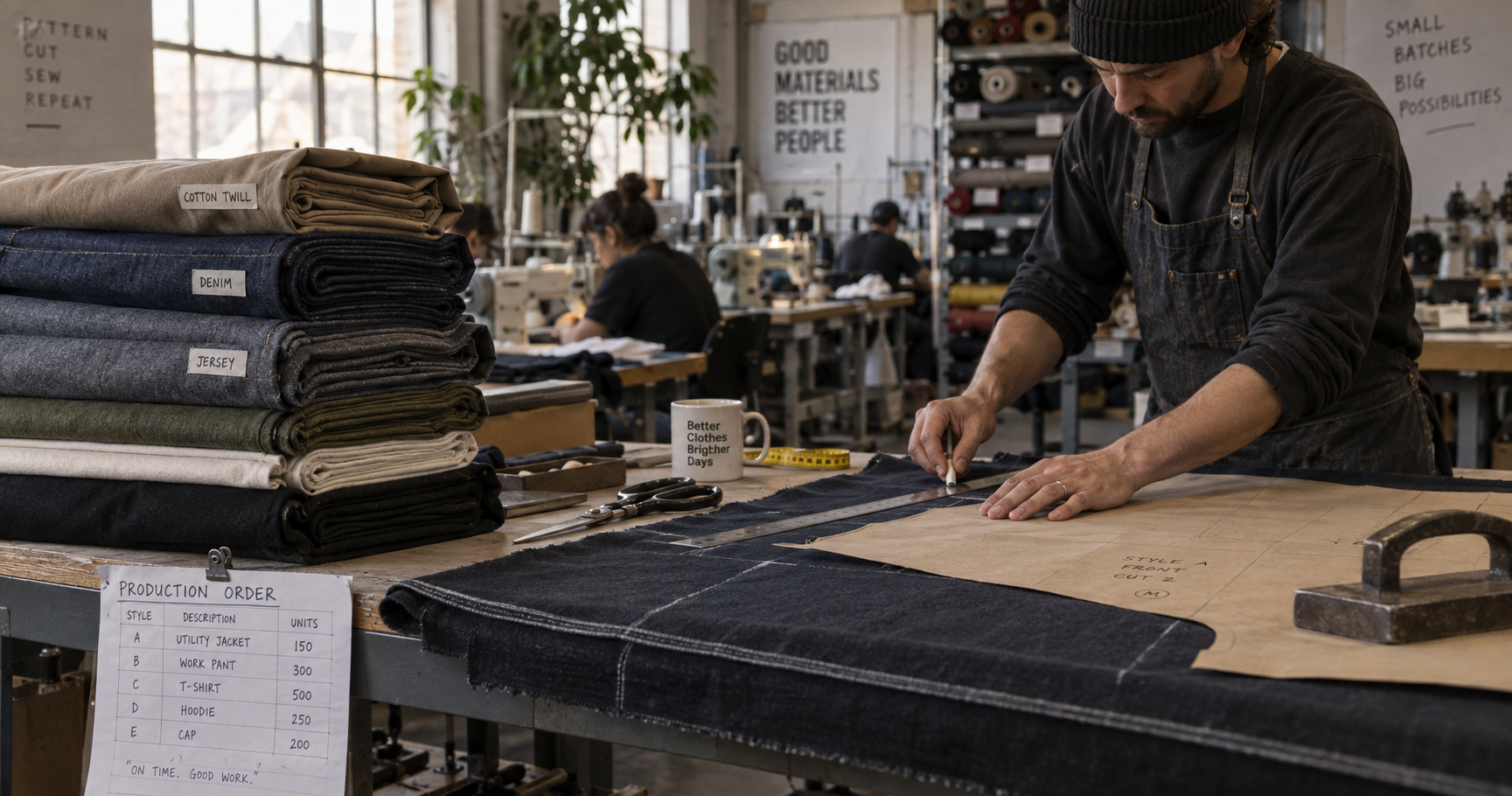
Minimum order quantity, or MOQ, is the smallest number of units a factory or fabric mill will accept per order. For apparel brands, that single number decides which factories are even reachable. A 500-unit MOQ is routine for an established label. For a founder testing a first collection, it can be completely out of reach. So understanding how the minimum order quantity works, and where it actually bends, matters before placing a real production order.
What Is a Minimum Order Quantity (MOQ)?
The concept of minimum order quantity (MOQ) is crucial in the apparel industry. Knowing how to navigate MOQs can make or break a brand’s success.
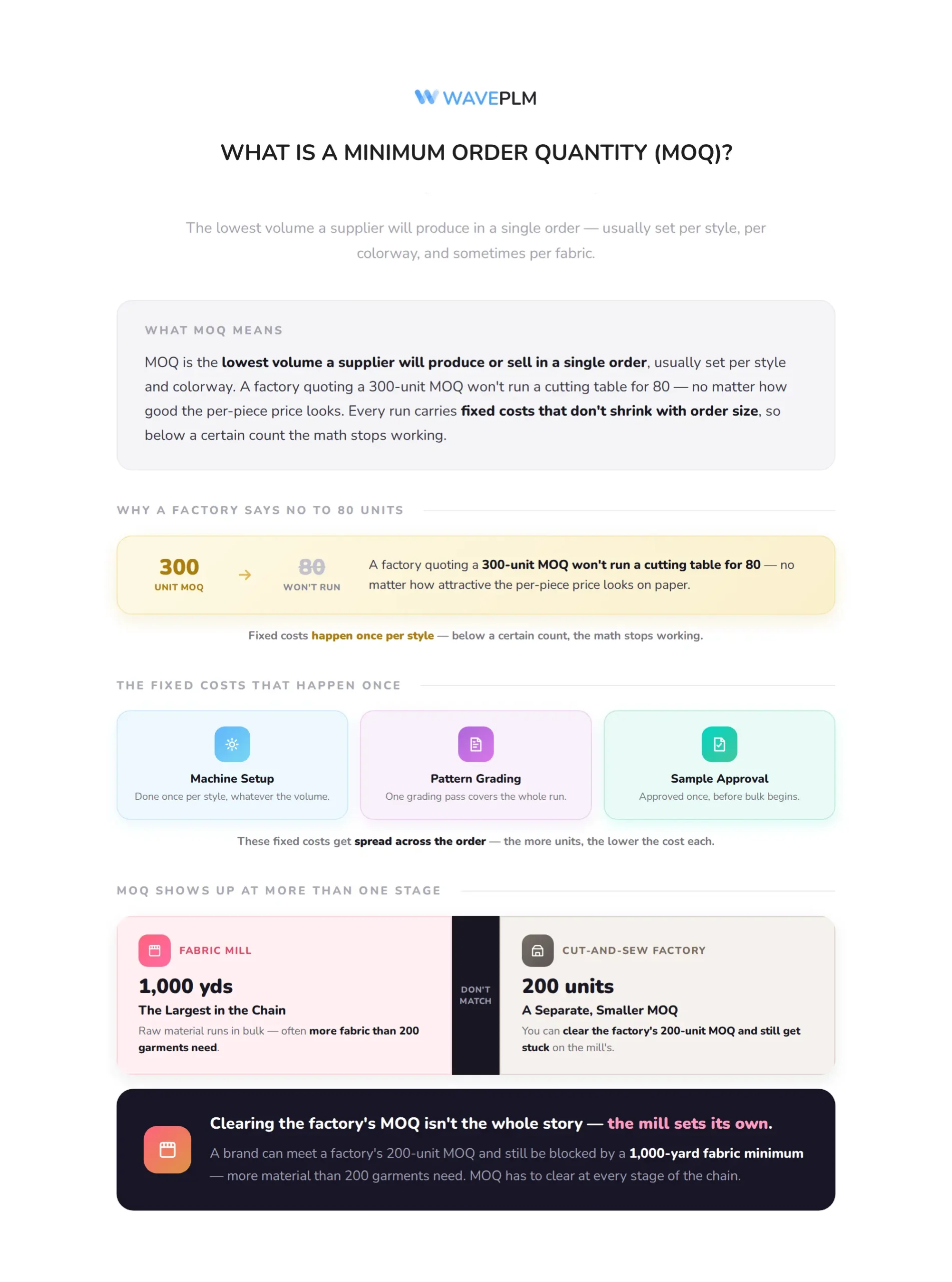
Minimum order quantity is the lowest volume of product a supplier will produce or sell in a single order. In other words, it’s usually set per style, per colorway, and sometimes per fabric. For instance, a factory quoting a 300-unit MOQ won’t run a cutting table for 80 units. That’s true no matter how attractive the price per piece looks on paper. The reason is simple: every production run carries fixed costs that don’t shrink with order size. Indeed, machine setup, pattern grading, and sample approval all happen once per style, regardless of volume. As a result, a factory spreads that fixed cost across the order. Below a certain unit count, the math simply stops working.
Importantly, MOQ shows up at more than one stage of getting a garment made. Notably, a fabric mill sets its own MOQ. This is often the largest number in the chain, since raw material runs in bulk. Meanwhile, the cut-and-sew factory sets a separate, usually smaller, MOQ for finished units. So a brand can clear a factory’s 200-unit MOQ and still get stuck. That happens if its fabric mill requires a 1,000-yard minimum — more fabric than 200 garments need.
Why Do Factories and Fabric Mills Set MOQs?
Brands must also consider how minimum order quantity can impact their product pricing structure.
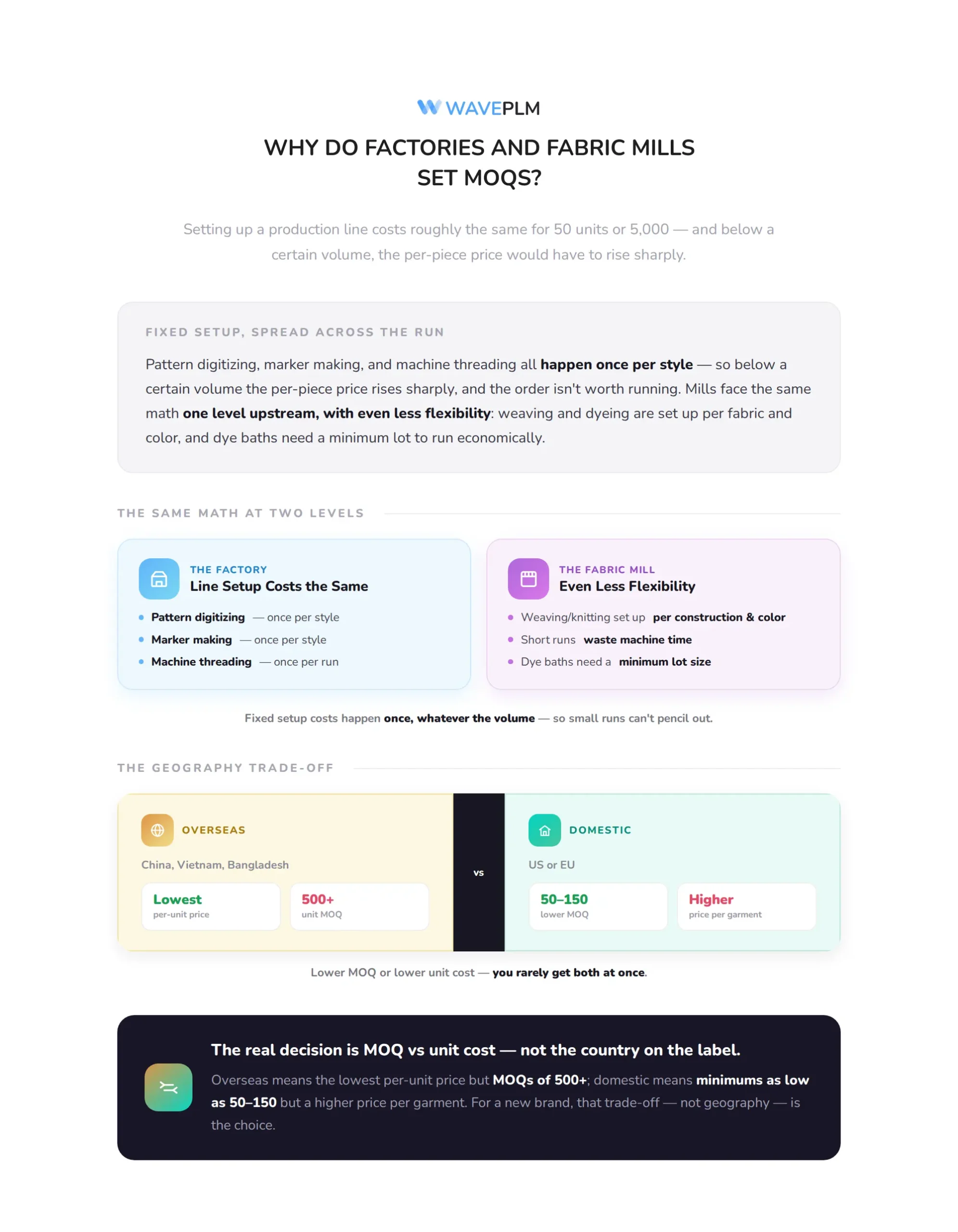
Setting up a production line costs roughly the same whether it runs 50 units or 5,000. Overall, pattern digitizing, marker making, and machine threading all happen once per style. Below a certain volume, the per-piece price would have to rise sharply. At that point, the order simply isn’t worth running. That’s why many factories decline small orders outright, rather than quote an unworkably high price.
Fabric mills face the same math one level upstream, with even less flexibility. Weaving and knitting equipment is set up per fabric construction and color. Changing it for a short run wastes machine time. Meanwhile, dyeing adds another constraint: most dye houses run at a minimum lot size, because the dye bath needs a certain fabric volume to process economically.
Geography plays a role too. Overseas factories, particularly in China, Vietnam, and Bangladesh, generally offer the lowest per-unit prices, but at higher MOQs — often 500 units or more. Domestic manufacturers in the US or EU, in contrast, tend to run smaller lines and accept lower minimums, sometimes 50 to 150 units. However, that flexibility usually comes at a noticeably higher price per garment. For a brand just starting out, the real decision is often that trade-off between MOQ and unit cost, not simply the country on the label.
Typical MOQ Ranges by Production Stage
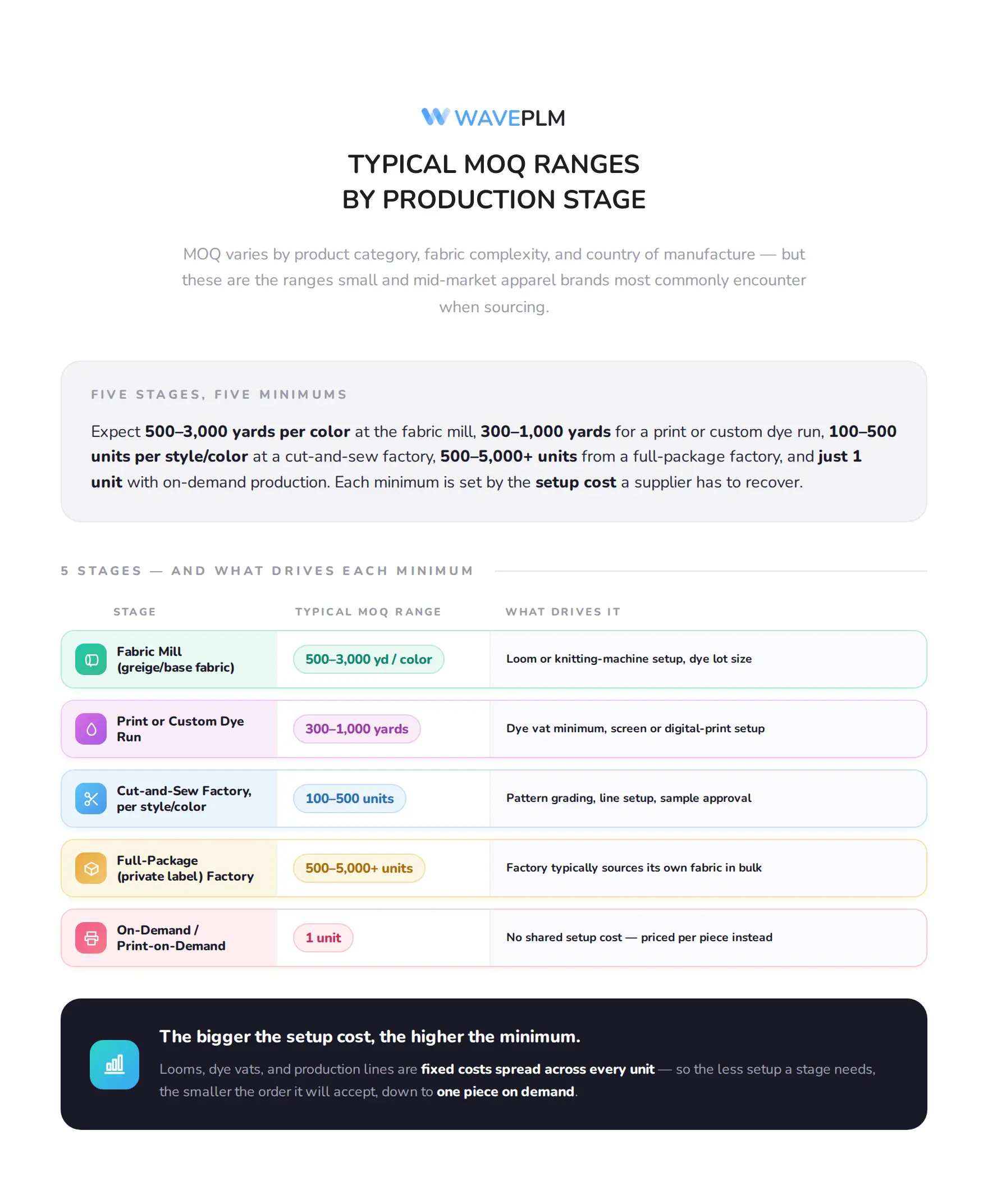
MOQ varies by product category, fabric complexity, and country of manufacture. That said, the ranges below reflect what small and mid-market apparel brands most commonly encounter when sourcing.
| Stage | Typical MOQ range | What drives it |
|---|---|---|
| Fabric mill (greige/base fabric) | 500–3,000 yards per color | Loom or knitting-machine setup, dye lot size |
| Print or custom dye run | 300–1,000 yards | Dye vat minimum, screen or digital-print setup |
| Cut-and-sew factory, per style/color | 100–500 units | Pattern grading, line setup, sample approval |
| Full-package (private label) factory | 500–5,000+ units | Factory typically sources its own fabric in bulk |
| On-demand / print-on-demand production | 1 unit | No shared setup cost — priced per piece instead |
Industry data: most trims suppliers — zippers, buttons, labels — set MOQs of 500 to 1,000 pieces per design. In practice, this is often the real binding constraint on a first small run.
Sample MOQ vs. Bulk Production MOQ: What’s the Difference?
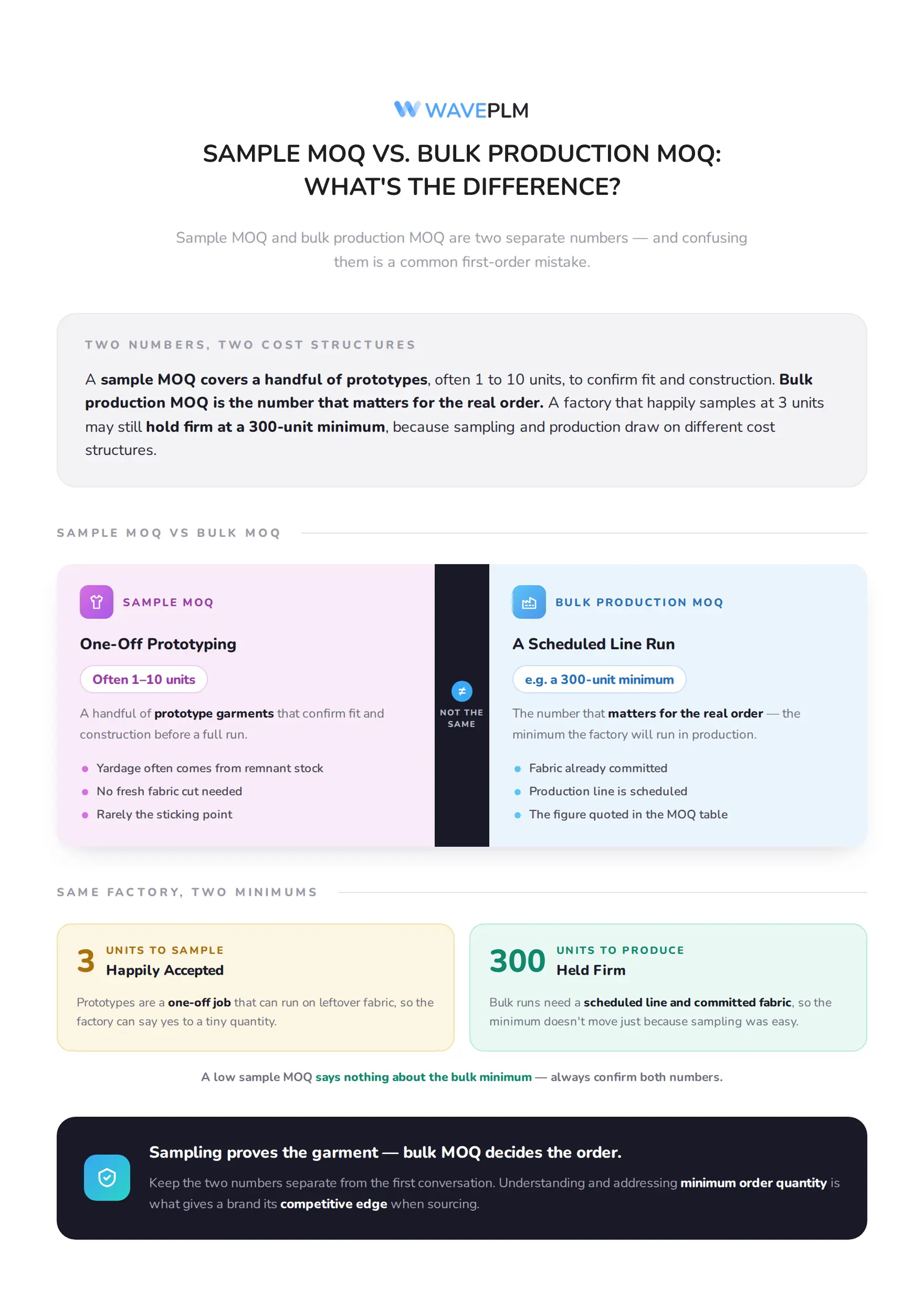
Sample MOQ and bulk production MOQ are two separate numbers. Confusing them is a common first-order mistake. Specifically, a sample MOQ covers a handful of prototype garments, often 1 to 10 units. These confirm fit and construction before a full run. For example, sample yardage often comes from a factory’s remnant stock, not a fresh cut. So sample MOQ is rarely the sticking point.
Bulk production MOQ, in contrast, is the number that matters for the real order. It’s the figure quoted in the table above. A factory that happily samples at 3 units may still hold firm at a 300-unit minimum. That’s because sampling and production draw on different cost structures. One is one-off prototyping. The other is a scheduled line run with fabric already committed.
Ultimately, understanding and addressing minimum order quantity will enhance a brand’s competitive edge.
How Can a New Apparel Brand Negotiate a Lower MOQ?
MOQ is negotiable more often than new brands assume. Rarely, though, by simply asking for a lower number. In practice, a few approaches tend to work:
- Choose in-stock, or “greige,” fabric the factory already holds. Avoid a custom color or print, since that requires its own dye or print minimum.
- Combine several small styles into one larger cut order on the same base fabric. That way, the fabric MOQ is met even though each style stays small.
- Work with a factory that specializes in small-batch production, rather than one built around large wholesale accounts. This usually comes at a higher per-unit cost.
- Offer a per-unit surcharge instead of hitting the full MOQ. Some factories accept this to fill otherwise-idle line time.
- Build a track record. Factories are generally more willing to lower MOQ once a brand has proven it pays on time.
None of these approaches remove MOQ entirely. Instead, they shift which minimum a brand actually faces, and by how much.
What Happens If a Brand Can’t Meet MOQ?
Sometimes a brand can’t clear a factory’s minimum. When that happens, it usually has three realistic options. First, it can pay a small-order surcharge, if the factory offers one. That means accepting a higher per-unit cost for a smaller run. Second, it can switch to on-demand production for that style. This trades a higher unit price for the freedom to order any quantity. Third, it can hold the design for a later season. Combining it with other styles on the same fabric base can clear the mill’s minimum, even if no single style does alone.
None of these options is free. Each one trades cost, speed, or flexibility for a smaller order than a factory would normally accept.
Should a Brand Use a Sourcing Agent to Help With MOQ?
Specifically, sourcing agents spend their time matching brands to factories that fit their order size. That makes them useful specifically for the MOQ problem. Also, a good agent already knows which factories in their network run smaller batches. So a brand doesn’t have to cold-contact dozens of manufacturers on its own. Our guide to sourcing agents for apparel brands covers how they’re paid and how to vet one.
That said, a sourcing agent’s commission adds cost to every order. The trade-off only makes sense once the time saved outweighs that fee. This is usually true for a brand’s first one or two production runs. It’s less true once a brand has direct factory relationships of its own.
Does MOQ Differ Between Private Label, Cut-and-Sew, and On-Demand Manufacturing?
Yes, and the difference is large enough to shape which manufacturing model fits an order size. Private label, or full-package, factories typically carry the highest MOQs. That’s often 500 to 5,000+ units. The reason is simple: they source and hold their own fabric inventory, and price that risk into the minimum. Similarly, cut-and-sew manufacturers, where the brand supplies its own fabric, usually set a lower MOQ. That’s commonly 100 to 500 units, since the factory only carries labor and line-time cost.
On-demand and print-on-demand production sit at the opposite end, with no meaningful MOQ at all. Instead, each unit is priced and produced individually, at a cost well above bulk pricing. That trade-off makes on-demand a reasonable way to validate a design first. For a fuller comparison, see our guide to private label clothing manufacturing.
How PLM Software Helps Brands Manage MOQ Across Multiple Factories
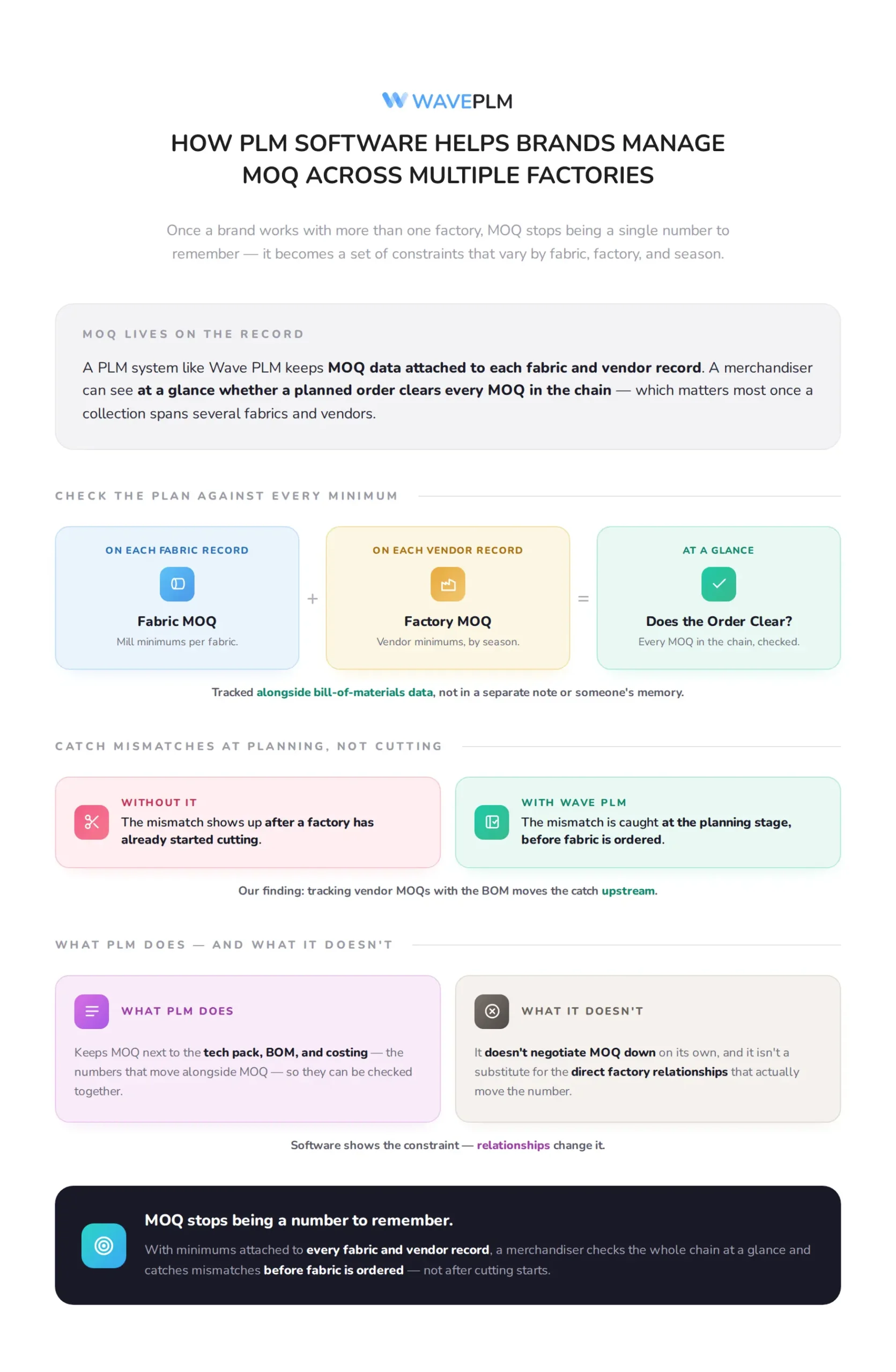
Once a brand works with more than one factory, MOQ stops being a single number to remember. Instead, it becomes a set of constraints that vary by fabric, factory, and season. Here, a PLM system like Wave PLM keeps MOQ data attached to each fabric and vendor record. As a result, a merchandiser can see at a glance whether a planned order clears every MOQ in the chain.
Our finding: brands that track vendor MOQs alongside bill-of-materials data catch mismatches at the planning stage. That’s before fabric is ordered, not after a factory has already started cutting.
Specifically, this matters most once a collection spans several fabrics and vendors. Getting the tech pack and bill of materials right beforehand helps too — see our notes on reducing sample rounds in apparel development and our garment costing guide for the numbers that move alongside MOQ. Still, PLM software doesn’t negotiate MOQ down on its own. It isn’t a substitute for building the direct factory relationships that actually move the number.
Frequently Asked Questions
What does MOQ mean in clothing manufacturing?
MOQ stands for minimum order quantity. It’s the smallest number of units a factory or mill will produce or sell per order. It applies separately at the fabric, trim, and cut-and-sew stages, and each can set a different minimum.
What is a typical MOQ for a new clothing brand?
Cut-and-sew factories commonly set MOQs between 100 and 500 units per style, when the brand supplies its own fabric. Private label factories usually require 500 units or more. On-demand production has no meaningful minimum.
Can minimum order quantity be negotiated?
Yes, though rarely by asking outright. Using in-stock fabric, combining styles on one fabric base, working with a small-batch factory, or paying a surcharge are all common ways to lower the effective minimum.
Is sample MOQ the same as production MOQ?
No. Sample MOQ usually covers 1 to 10 prototype units, made from remnant fabric. Bulk production MOQ applies to the full sellable order, and it’s almost always a much higher number.
Why do fabric mills have higher MOQs than cut-and-sew factories?
Weaving, knitting, and dyeing equipment is set up per fabric construction and color. That setup cost only makes sense at a certain volume. Cut-and-sew factories receive finished fabric from the brand, so they don’t carry that upstream cost.
Does on-demand manufacturing avoid MOQ entirely?
Effectively, yes. On-demand production prices and produces each unit individually, so there’s no shared setup cost to spread across a minimum. The trade-off is a higher per-unit cost.
Whatever MOQ a factory quotes, the number is easier to plan around when it’s tracked in one place. That beats spreading it across separate spreadsheets and email threads. This is the specific gap Wave PLM is built to close for growing apparel brands. Even so, no software replaces the relationship work of finding factories willing to work at a brand’s real order size.




Leave a Reply