

Keystone pricing sets a retail price at exactly double the wholesale cost. Specifically, a $20 wholesale garment becomes a $40 retail price, no other math involved at all. It’s the oldest, simplest markup rule in retail. Apparel brands still lean on it constantly. However, it doesn’t fit every product or every channel, and knowing where it breaks down matters as much as knowing the formula itself.
What Is Keystone Pricing?
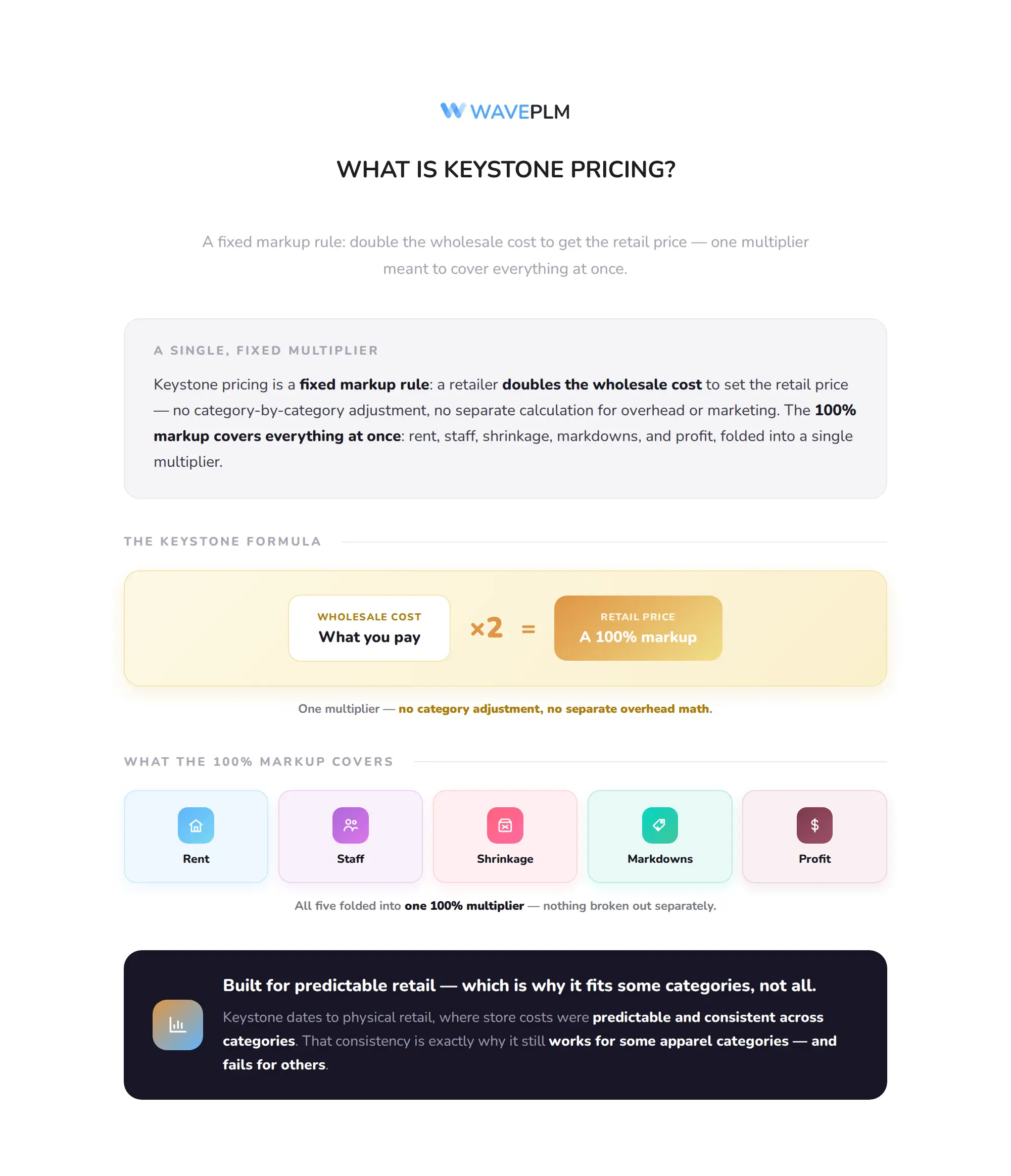
Keystone pricing is a fixed markup rule. Simply put, a retailer or brand doubles the wholesale cost of a product to arrive at the suggested retail price. In other words, there’s no category-by-category adjustment, and no separate calculation for overhead or marketing spend. Essentially, the 100% markup is meant to cover everything at once: rent, staff, shrinkage, markdowns, and profit, all folded into a single multiplier.
Historically, the rule dates back to physical retail, where store operating costs were fairly predictable and consistent across most product categories. That consistency is exactly why keystone pricing still works well for some apparel categories. It’s also exactly why the same rule fails for others.
How Do You Calculate a Keystone Price?
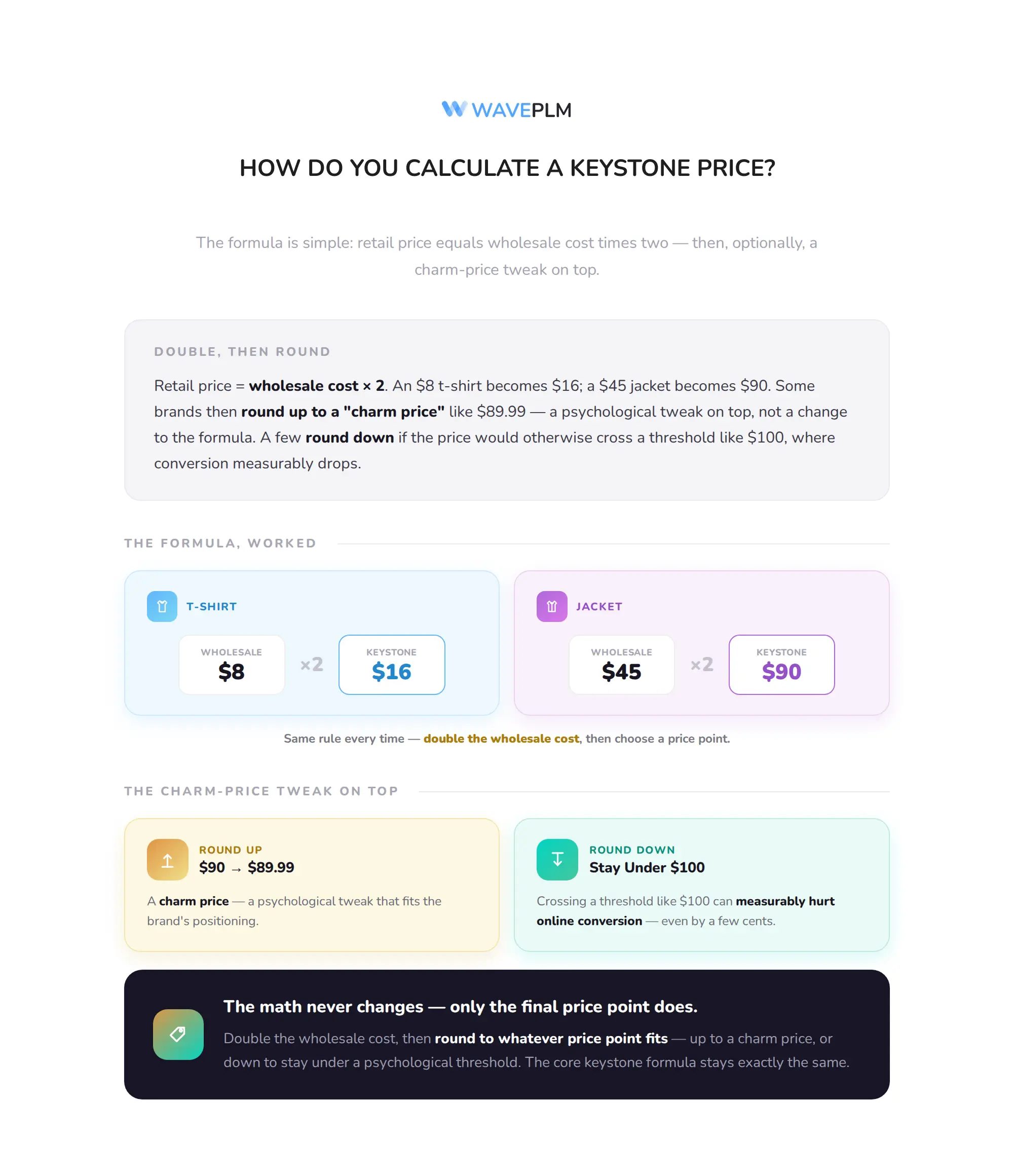
The formula is simple: retail price equals wholesale cost multiplied by two. For example, if a factory sells a t-shirt to a brand at $8 per unit, the keystone retail price is $16. If a jacket costs $45 wholesale, its keystone price is $90.
Some brands adjust slightly from there, rounding up to a “charm price” like $89.99 instead of a flat $90. In other words, that’s a psychological pricing tweak on top of keystone, not a change to the underlying formula. The core math stays the same: double the wholesale cost, then round to whatever price point fits the brand’s positioning. A handful of brands round down slightly instead. This happens if the resulting price would otherwise land just above a psychological threshold like $100. Crossing that line can measurably hurt online conversion rates, even when the actual difference is only a few cents.
Why Do Apparel Brands Use Keystone Pricing?
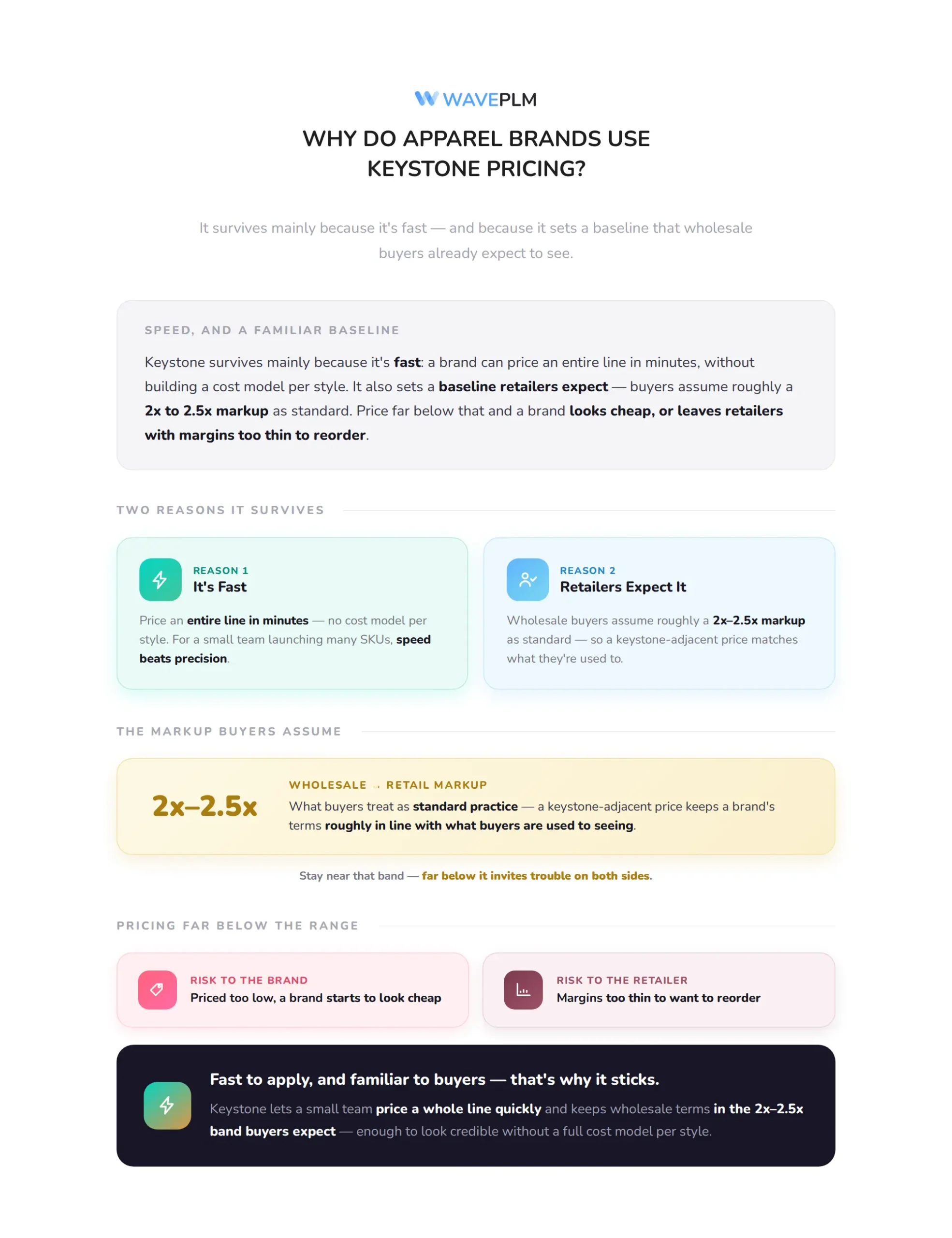
Keystone pricing survives mainly because it’s fast. A brand can price an entire line in minutes, without building a cost model for every single style. For a small team launching several SKUs at once, speed often matters more than precision.
Beyond that, it also sets a baseline that retailers expect. Generally, wholesale buyers assume roughly a 2x to 2.5x markup from wholesale to retail as standard practice. A brand pricing far below that range risks looking cheap. Alternatively, it leaves retailers with margins too thin to want to reorder. Overall, setting a keystone-adjacent price keeps a brand’s wholesale terms roughly in line with what buyers are used to seeing.
When Does Keystone Pricing Not Work for Apparel?
Keystone pricing breaks down whenever costs vary a lot between styles, which happens constantly in apparel. For instance, a basic cotton tee and a heavily embellished jacket rarely carry the same overhead, freight, and markdown risk, even at similar wholesale costs. Still, doubling both the same way ignores that difference entirely.
Additionally, it fails for direct-to-consumer brands with high paid-acquisition costs. A DTC brand spending heavily on ads needs that cost baked into its margin somewhere, and a flat 2x multiplier rarely covers it on its own. Similarly, fast-fashion and value categories often can’t sustain a full keystone markup at all. Competitive pressure caps the retail price well below double the wholesale cost. The result is thinner margins by necessity, not by choice.
What Does Keystone Pricing Look Like Across a Real Collection?
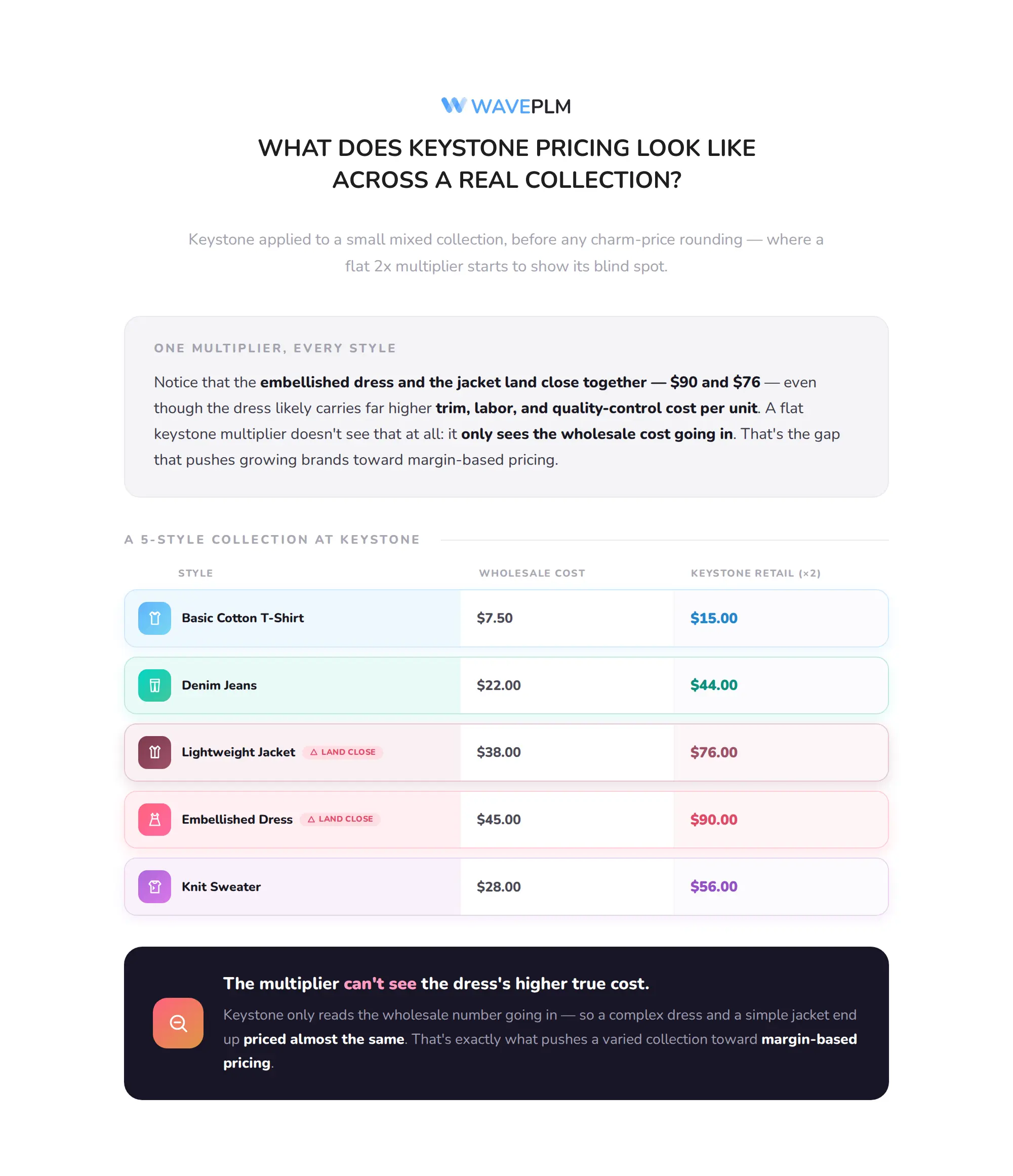
The table below shows keystone pricing applied to a small mixed collection, before any charm-price rounding.
| Style | Wholesale cost | Keystone retail price |
|---|---|---|
| Basic cotton t-shirt | $7.50 | $15.00 |
| Denim jeans | $22.00 | $44.00 |
| Lightweight jacket | $38.00 | $76.00 |
| Embellished dress | $45.00 | $90.00 |
| Knit sweater | $28.00 | $56.00 |
Notice that the embellished dress and the jacket land close together, at $90 and $76, even though the dress likely carries far higher trim, labor, and quality-control cost per unit. A flat keystone multiplier doesn’t see that difference at all. It only sees the wholesale cost going in. This is exactly the kind of gap that pushes growing brands toward margin-based pricing once a collection gets this varied.
Keystone vs. Margin-Based Pricing: What’s the Difference?
Keystone pricing applies one fixed multiplier to everything. Margin-based pricing instead targets a specific gross margin percentage, and lets the multiplier float to hit it. As an example, a brand using margin-based pricing might target a 60% gross margin on every style. Depending on the wholesale cost, that can land above or below a strict keystone 2x.
In practice, margin-based pricing simply handles cost variation across styles better. That’s specifically why most mid-sized and larger apparel brands eventually move away from a strict keystone rule. Instead, they shift toward margin targets set by category, once their line grows complex enough to need it.
Does Keystone Pricing Work the Same Way for Direct-to-Consumer Brands?
Not quite. A DTC brand doesn’t sell to a separate wholesale customer, so there’s no wholesale price to double in the first place. Instead, cost for a DTC brand usually means landed unit cost — fabric, cut-and-sew, trims, and freight, all combined. Some DTC brands still apply a keystone-style 2x to 3x multiplier over that landed cost, since marketing, fulfillment, and returns have to come out of the same margin a wholesale markup would normally cover.
Others skip keystone-style multipliers entirely and move straight to margin-based pricing. That’s because DTC cost structures vary so much by acquisition channel — a style sold mostly through paid social carries a very different real cost than the same style sold through organic search or email. A flat multiplier struggles to capture that difference well.
How Does MAP Interact With Keystone Pricing?
Keystone pricing and a minimum advertised price policy solve two different problems, though brands often set them together. Keystone pricing decides the retail price a brand suggests in the first place. MAP then protects that suggested price from being advertised below a certain floor by retailers, once it’s set. Without a MAP policy, a keystone-based retail price is just a suggestion retailers can discount into oblivion in their own ads.
Industry data: wholesale apparel buyers commonly plan around a keystone-range markup when budgeting open-to-buy, which is part of why brands pricing significantly below that range often get pushed to raise wholesale cost instead — retailers still expect their usual margin.
How PLM Software Supports Keystone and Margin-Based Pricing
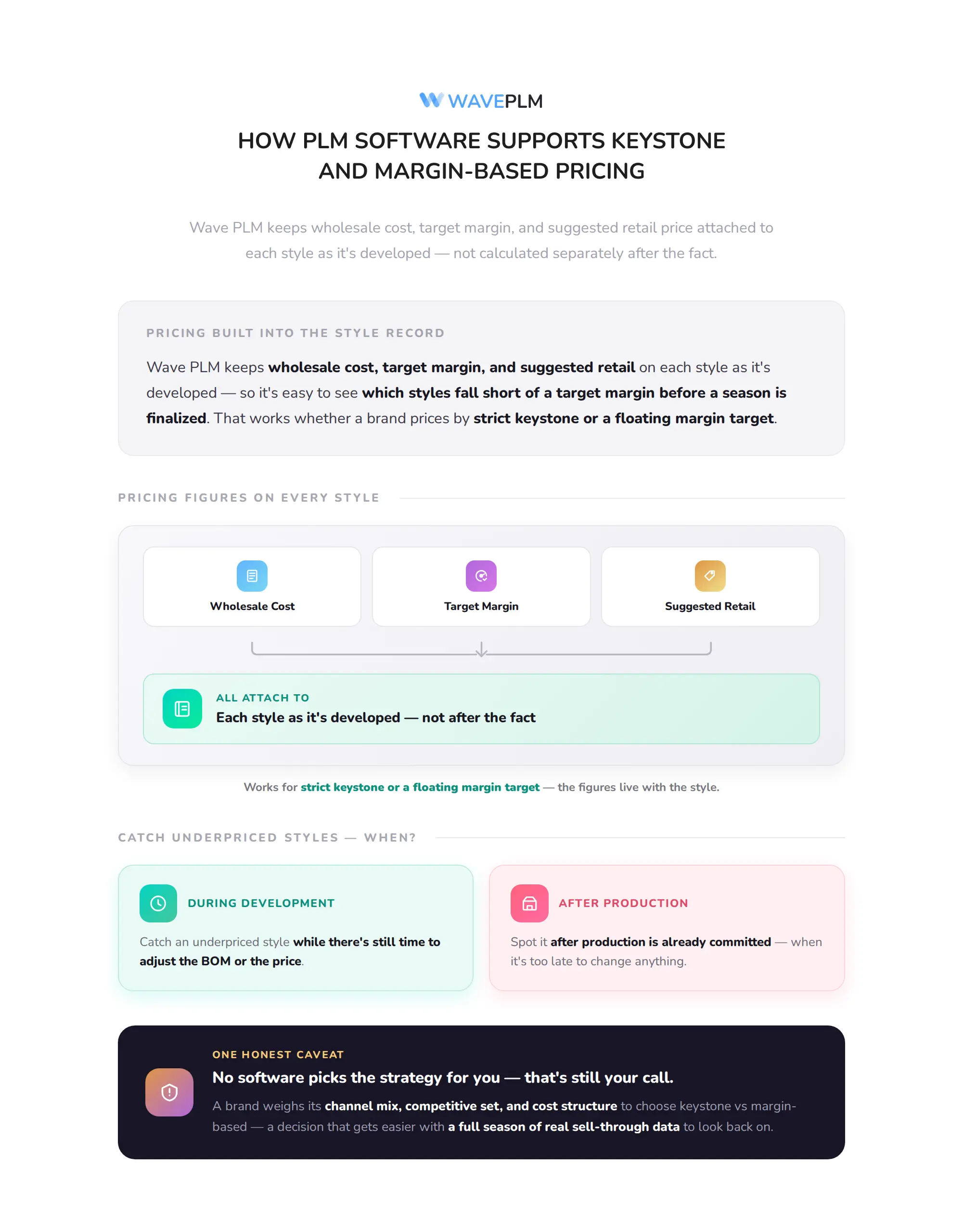
For example, a PLM system like Wave PLM keeps wholesale cost, target margin, and suggested retail price attached to each style as it’s developed, not calculated separately after the fact. That makes it easy to see which styles fall short of a target margin before a season is finalized. This holds whether a brand prices by strict keystone or by a floating margin target.
Our finding: brands that track margin targets alongside bill-of-materials costs catch underpriced styles during development, while there’s still time to adjust the BOM or the price — rather than after production is already committed.
That said, no software decides the right pricing strategy on its own. A brand still has to weigh its channel mix, competitive set, and cost structure to choose between keystone and margin-based pricing in the first place. That decision usually gets easier with a full season of real sell-through data to look back on, rather than guesswork at the pricing stage alone. For the cost side of that decision, see our garment costing guide, and for how factory minimums factor into per-unit cost, our guide to minimum order quantities.
What Mistakes Do Brands Make With Keystone Pricing?
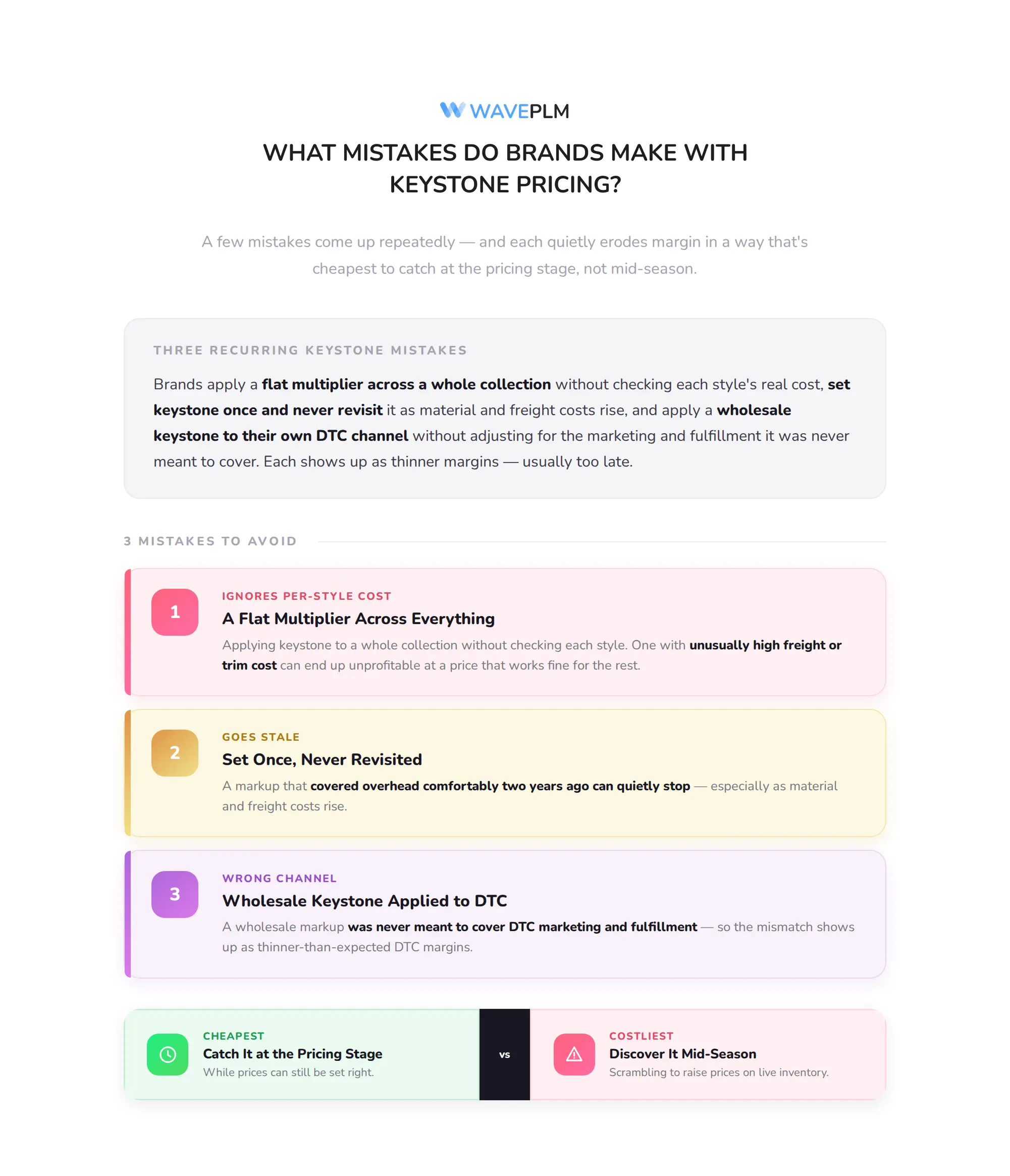
A few mistakes come up repeatedly. First, brands apply a flat keystone multiplier across a whole collection without checking whether it actually covers each style’s real cost. A style with unusually high freight or trim cost can end up unprofitable at a keystone price that works fine for everything else.
Second, some brands set keystone pricing once at launch and never revisit it as material and freight costs rise. A markup that covered overhead comfortably two years ago can quietly stop covering it, especially in a period of rising input costs. Finally, brands sometimes apply keystone pricing to their own direct-to-consumer channel without adjusting for the marketing and fulfillment costs a wholesale markup was never meant to cover in the first place. That mismatch usually shows up as thinner-than-expected DTC margins, discovered well after the season is already priced and selling. Catching it earlier, during the pricing stage itself, is far cheaper than discovering it mid-season. By then, a brand is often scrambling to raise prices on inventory that’s already live.
Frequently Asked Questions
What is keystone pricing in retail?
Keystone pricing is a markup rule that sets the retail price at exactly double the wholesale cost. It’s a fixed 100% markup, meant to cover overhead, markdowns, and profit in one step.
How do you calculate a keystone price?
Multiply the wholesale cost by two. A product that costs $15 wholesale gets a keystone retail price of $30. Some brands round that up slightly to a charm price, like $29.99.
Is keystone pricing still used in apparel?
Yes, especially by smaller brands pricing a line quickly or setting a baseline wholesale-to-retail expectation. Larger brands more often move to margin-based pricing once their product mix gets complex.
Why doesn’t keystone pricing work for every apparel category?
Costs, freight, and markdown risk vary a lot between styles. A flat 2x multiplier treats a basic tee the same as a heavily embellished jacket, which ignores real differences in overhead and risk between them.
What’s the difference between keystone and margin-based pricing?
Keystone pricing applies one fixed multiplier to every style. Margin-based pricing instead targets a specific gross margin percentage, and lets the actual multiplier vary by style to hit that target.
Does a MAP policy replace keystone pricing?
No, they solve different problems. Keystone pricing sets the suggested retail price itself, based on wholesale cost. A MAP policy then protects that already-set price from being advertised below a certain floor by retailers, once it exists.
Keystone pricing is a reasonable starting point for a brand pricing its first few styles. It stops being enough once a line grows complex, margins get squeezed, or channels multiply. At that point, a fixed 2x rule starts hiding real profitability problems rather than solving them, and a brand needs visibility into actual cost and margin by style, not just by collection average. Either way, the multiplier only means something when it’s tracked alongside real wholesale cost, not set once and forgotten. That’s the specific gap Wave PLM is built to close for growing apparel brands, season after season, as costs and channels keep shifting under them.








Leave a Reply