
The de minimis tariff exemption no longer protects small apparel shipments entering the United States. Since August 29, 2025, a parcel worth $800 or less pays the same duties as a full container. Moreover, CBP made that suspension indefinite on June 24, 2026. Congress has also repealed the exemption outright from July 1, 2027. For an apparel brand, every DTC parcel, courier sample, and replacement shipment from overseas now carries a duty bill. The end of the de minimis tariff has significant implications.
This guide explains what changed and what a typical small order pays now. It also lists six practical moves to make before the October 22, 2026 postal deadline. In addition, it shows why fiber content and country of origin now decide the landed cost of every parcel. Most brands still treat those two fields as label trivia.
Brands must revisit their shipping strategies in light of the de minimis tariff modifications. For brands, adapting to the de minimis tariff changes is essential for maintaining profit margins. The de minimis tariff exemption has shifted the landscape for apparel shipping. Previously, the de minimis tariff allowed for cost-effective shipping of small orders. The rising volume of shipments under the de minimis tariff prompted regulatory scrutiny.
What Is the De Minimis Tariff Exemption?
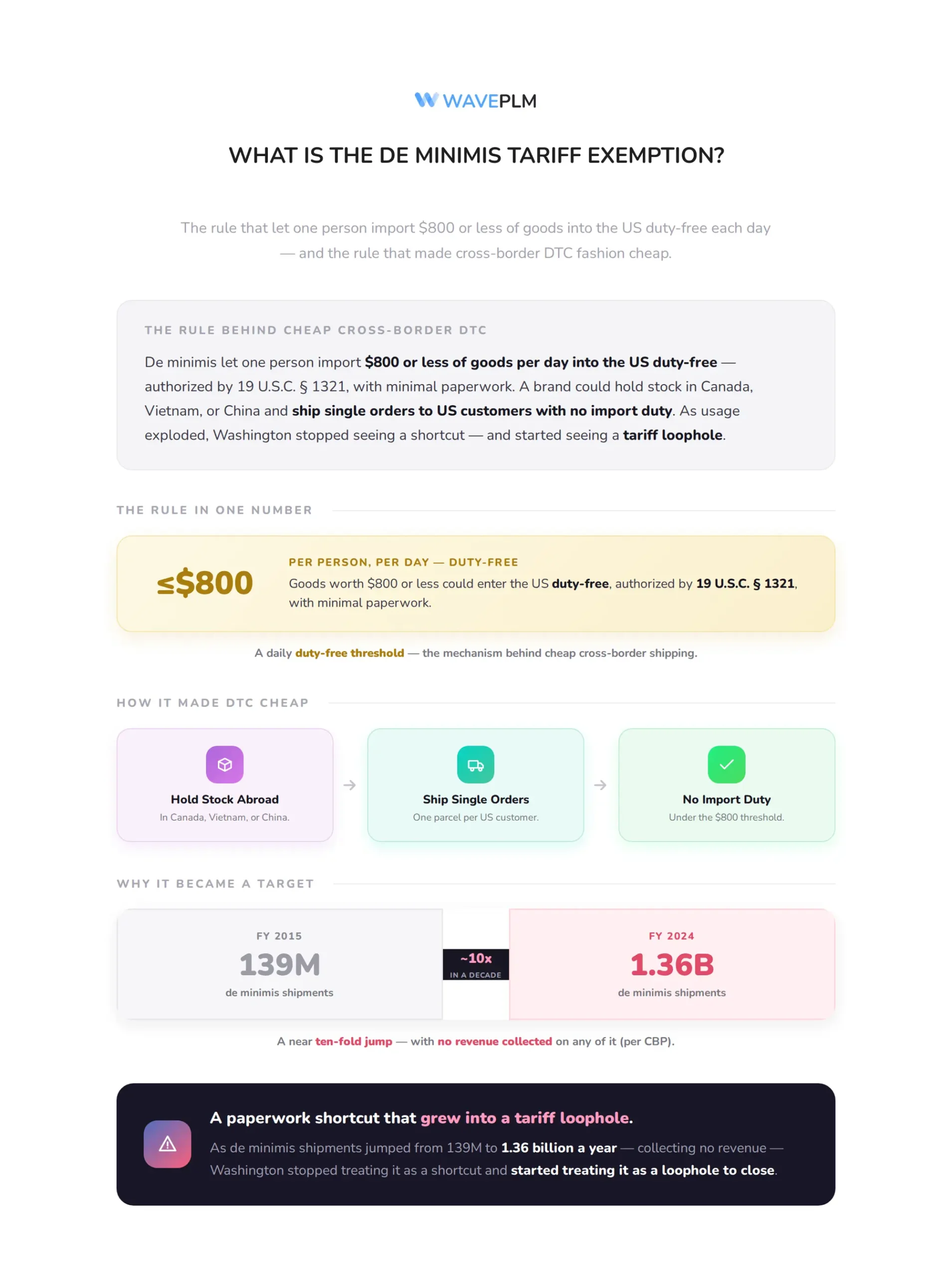
The data shows the extent of reliance on the de minimis tariff exemption in the apparel industry.
The de minimis tariff exemption let one person import goods worth $800 or less per day into the US duty-free. It is authorized by 19 U.S.C. § 1321 and required minimal paperwork. In practice, it was the rule that made cross-border DTC fashion cheap. A brand could hold stock in Canada, Vietnam, or China. It could then ship single orders to US customers without paying any import duty.
The shift in de minimis tariff policy presents both challenges and opportunities for apparel brands.
Over the last decade, usage exploded. According to CBP, the agency processed over 1.36 billion de minimis shipments in fiscal year 2024. In 2015, the figure was 139 million. Consequently, the exemption stopped looking like a paperwork shortcut. Instead, Washington came to treat it as a tariff loophole.
Industry data: CBP processed over 1.36 billion de minimis shipments in fiscal year 2024, an almost ten-fold increase from 139 million in 2015, while “collecting no revenue” on them (Federal Register, June 24, 2026).
Logistics teams must understand the new duties replacing the de minimis tariff exemption.
What Changed, and When?
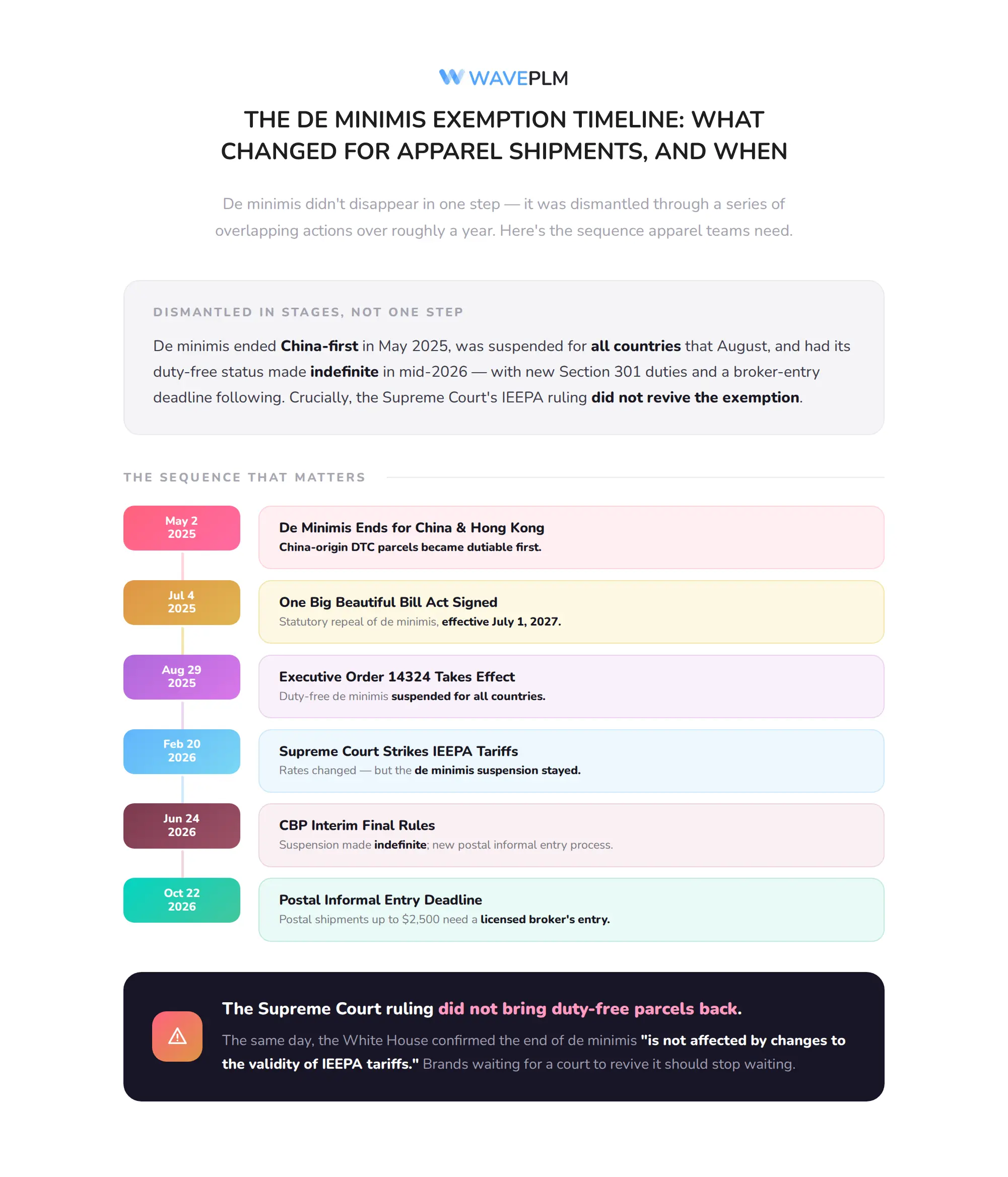
For many brands, the de minimis tariff was a mainstay of their shipping strategy. The exemption did not disappear in one step. Instead, it was dismantled through five separate actions over roughly a year, and several of them overlapped. The table below lays out the sequence apparel teams actually need to know.
| Date | Action | What it meant for apparel shipments |
|---|---|---|
| May 2, 2025 | De minimis ended for goods from China and Hong Kong | China-origin DTC parcels became dutiable first |
| July 4, 2025 | One Big Beautiful Bill Act signed | Statutory repeal of de minimis effective July 1, 2027 |
| August 29, 2025 | Executive Order 14324 (signed July 30) takes effect | Duty-free de minimis suspended for all countries |
| February 20, 2026 | Supreme Court strikes down IEEPA tariffs; E.O. 14388 continues the suspension | Tariff rates changed, but the de minimis suspension stayed |
| February 24 – July 24, 2026 | Temporary 10% Section 122 global tariff | Replaced IEEPA rates on most imports for 150 days |
| June 24, 2026 | CBP interim final rules | Suspension made indefinite; new postal informal entry process |
| July 24, 2026 | New Section 301 tariffs (10%–12.5%) on 60 economies | Standard duties now apply to postal and courier parcels |
| October 22, 2026 | Postal informal entry compliance deadline | Postal shipments up to $2,500 need a licensed broker’s entry |
Notably, the Supreme Court ruling did not revive the exemption. On the same day, the White House issued a new order. It stated that the end of de minimis “is not affected by changes to the validity of IEEPA tariffs,” as Supply Chain Dive reported. In other words, brands waiting for a court to bring back duty-free parcels should stop waiting.
How Much Duty Does a Small Apparel Shipment Pay Now?
Without the de minimis tariff exemption, a parcel pays the normal HTS duty rate for the garment. Any country-specific tariff then stacks on top. For apparel, those base rates are among the highest in the US tariff schedule. Furthermore, the rate changes with fiber content. Two T-shirts that look identical online can carry very different duty bills.
Understanding the core elements of the de minimis tariff will be crucial moving forward.
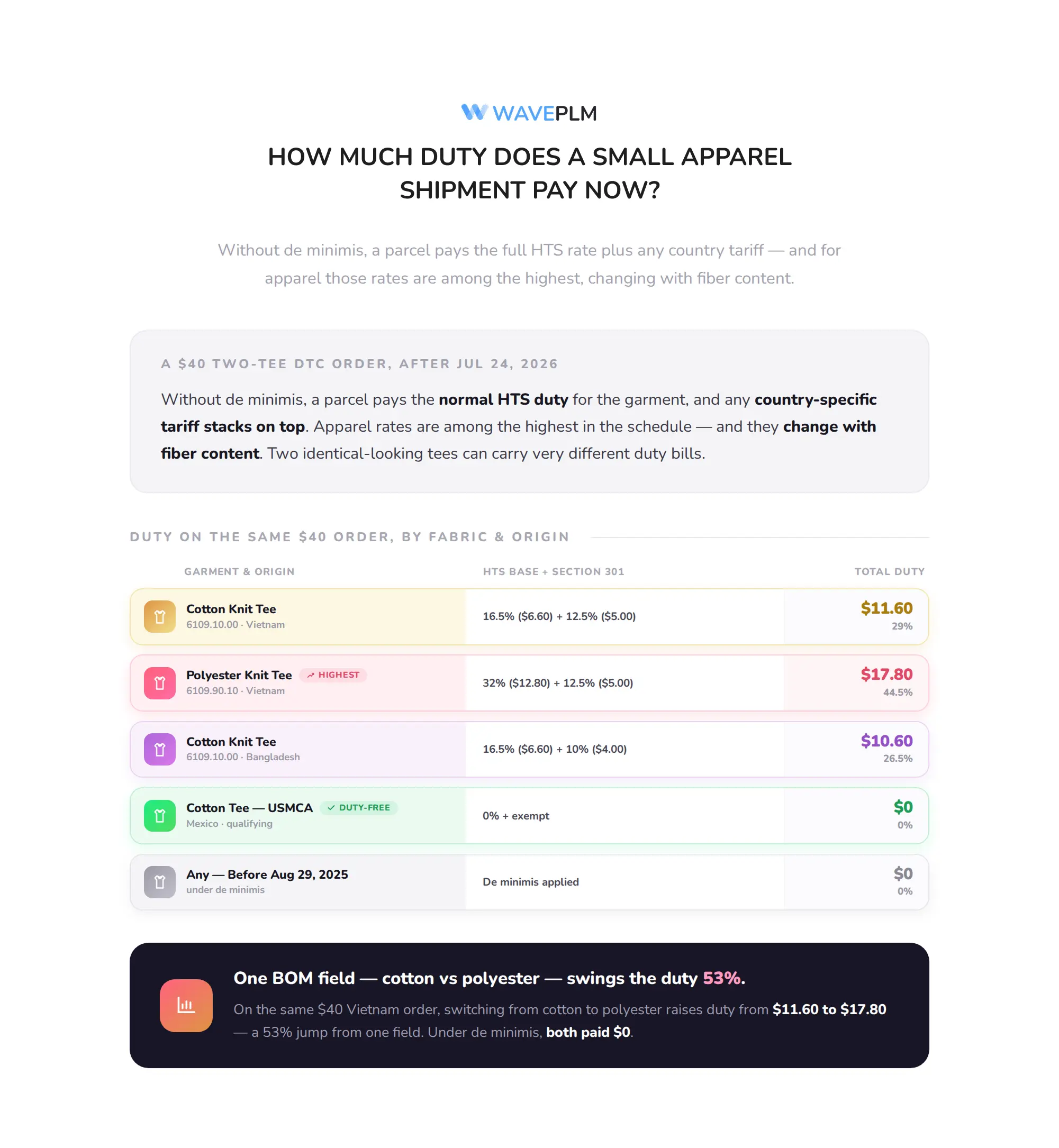
For example, consider a two-T-shirt DTC order declared at $40. It ships to a US customer after July 24, 2026. The table uses general HTS rates and the new Section 301 tiers reported by Honigman.
| Garment and origin | HTS base duty | Section 301 add-on | Total duty on $40 | Share of order value |
|---|---|---|---|---|
| Cotton knit tee (6109.10.00), Vietnam | 16.5% = $6.60 | 12.5% = $5.00 | $11.60 | 29% |
| Polyester knit tee (6109.90.10), Vietnam | 32% = $12.80 | 12.5% = $5.00 | $17.80 | 44.5% |
| Cotton knit tee (6109.10.00), Bangladesh | 16.5% = $6.60 | 10% = $4.00 | $10.60 | 26.5% |
| Cotton knit tee, USMCA-qualifying, Mexico | 0% | Exempt | $0 | 0% |
| Any of the above, before August 29, 2025 | De minimis applied | $0 | 0% | |
Our finding: On a $40 two-tee DTC order shipped from Vietnam, switching the fabric from cotton to polyester raises the duty from $11.60 to $17.80, a 53% jump caused by one field on the bill of materials. Under the de minimis tariff exemption, both orders paid $0.
What Clearance Fees Add on Top
Monitoring the implications of the de minimis tariff is essential for continuous improvement. Brands that adapt quickly to the changes in the de minimis tariff will have an advantage. All brands must align their strategies for the reality of the de minimis tariff landscape.
Additionally, these numbers exclude clearance costs. Carriers and brokers typically charge a per-entry fee. On a $40 parcel, that fee can rival the duty itself. As a result, a low-value parcel now costs more like a small wholesale shipment. It no longer behaves like the “free” DTC order many brands built their margins around. For the full formula, see our guide on how to calculate landed cost for apparel imports.
The obligation to navigate the ends of the de minimis tariff exemption now lies with the brands. The transition from the de minimis tariff exemption requires strategic foresight from apparel brands.
Which Apparel Brands Feel It Most?
The impact is uneven. Specifically, four business models absorbed most of the change:
- Cross-border DTC brands that ship single orders from an overseas warehouse. Every order is now a customs entry with a duty bill.
- Print-on-demand and made-to-order labels that produce abroad and ship one unit at a time. Here, duty and clearance fees hit every single piece.
- Small brands buying samples and trims by courier. Lab dips, fit samples, and trim cards used to arrive untaxed; now many do not.
- Marketplace sellers competing with ultra-low-price platforms. The price gap narrowed, although it did not close.
By contrast, some brands already import in bulk by ocean freight and ship from a US warehouse. They see little direct change. For them, the de minimis tariff shift mostly affects returns, samples, and occasional air shipments. Meanwhile, the broader tariff layers matter far more. Our guide to US customs tariffs and duties in fashion covers them in depth.
What About Samples, Returns, and Replacement Parts?
Samples are where small brands get surprised first. In general, a courier sample from a factory is dutiable merchandise now, even if it will never be sold. However, HTS heading 9811.00.60 allows duty-free entry for samples valued at $1 or less each. It also covers samples marked, torn, or perforated so they are unsuitable for sale. Therefore, ask factories to mark development samples “SAMPLE – NOT FOR SALE” before shipping. Cutting or punching fit samples can remove the duty entirely.
Returns work differently. Returned goods that you then export or destroy may qualify for unused merchandise drawback. Drawback can recover up to 99% of the duty paid. That said, it requires records linking each export back to the original import entry. So it only pays off if your product and shipment data are clean.
Replacement shipments, such as a missing button kit or a reshipped damaged item, also count as new dutiable imports. Consequently, holding a small buffer of spare trims and replacement units in the US is usually cheaper. Sending them one by one from the factory adds a duty bill each time.
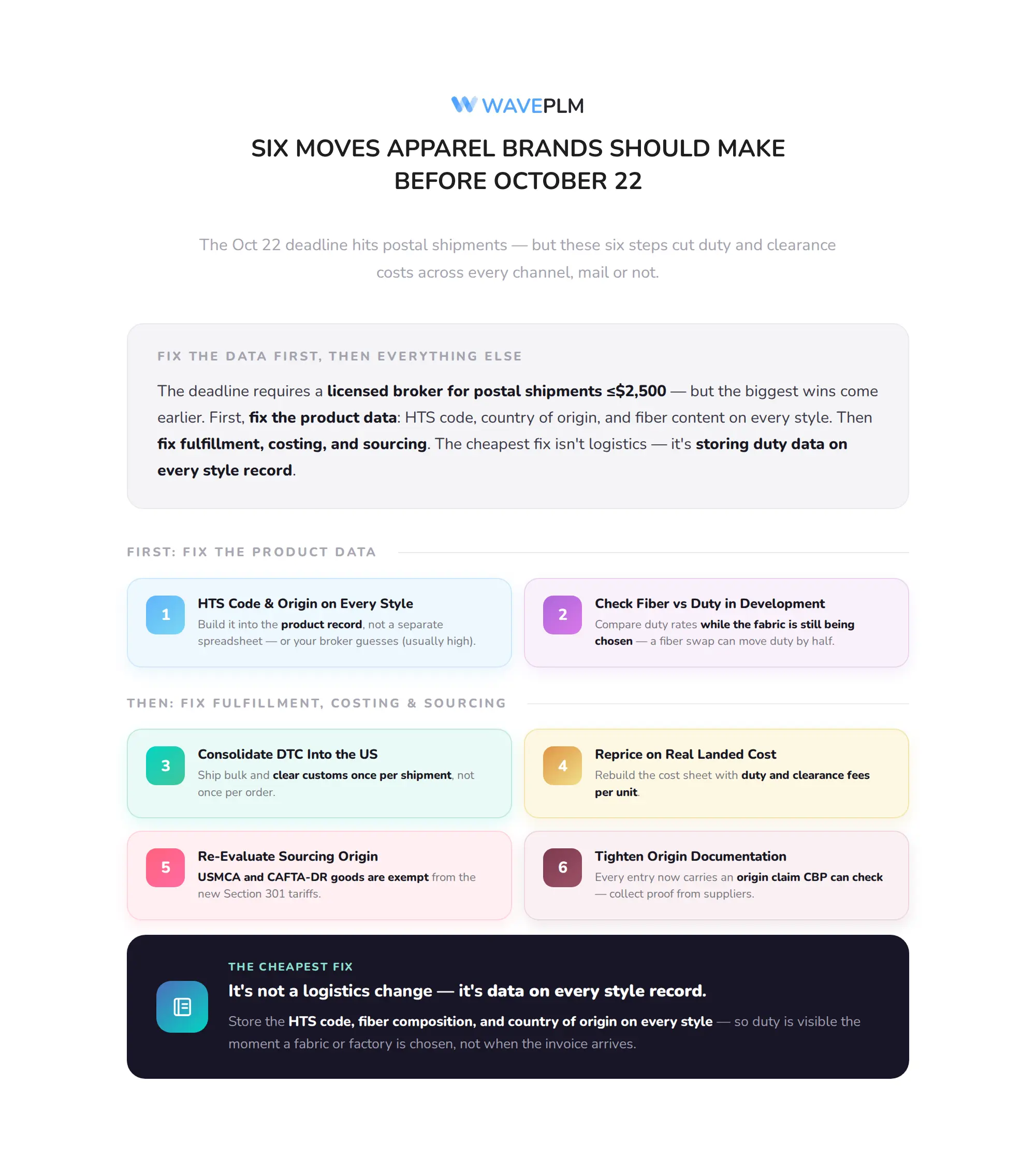
Six Moves Apparel Brands Should Make Before October 22
The October 22, 2026 deadline applies to the new postal informal entry process. Under it, postal operators must use a licensed US customs broker for shipments valued at $2,500 or less. Even if you never ship by mail, the six steps below cut duty and clearance costs across every channel.
The end of the de minimis tariff presents a new era for apparel shipping practices. Ultimately, the de minimis tariff exemption’s end signifies a major shift in trade dynamics.
Fix the Product Data First
- Assign an HTS code and country of origin to every style. First, build this into the product record, not a spreadsheet the logistics team keeps separately. Without it, your broker guesses, and guesses usually land on the higher rate.
- Check fiber content against duty rates during development. Next, compare duty rates while the fabric is still being chosen. As the table above shows, a fiber swap can move duty by more than half.
For brands, aligning with the de minimis tariff guidelines will be paramount. Tracking information related to the de minimis tariff is vital for compliance.
Then Fix Fulfillment, Costing, and Sourcing
- Consolidate DTC inventory into the US. Then, ship bulk to a US warehouse and clear customs once per shipment instead of once per order. Our keystone pricing guide explains why margins built on duty-free parcels rarely survive this change.
- Reprice styles with real landed cost. Similarly, rebuild the cost sheet with duty and clearance fees per unit, using the method in our garment costing guide.
- Re-evaluate sourcing origin for fast replenishment styles. USMCA-qualifying goods from Mexico and CAFTA-DR goods are exempt from the new Section 301 tariffs. Our analysis of nearshoring to Mexico in 2026 covers the yarn-forward rules that decide whether a garment qualifies.
- Tighten origin documentation with suppliers. Finally, every entry now carries an origin claim that CBP can check. Documentation that supports UFLPA compliance also supports correct origin and rate claims. A sourcing agent can help collect it from factories.
Our finding: The single cheapest de minimis tariff fix for most small brands is not a logistics change. Instead, it is storing the HTS code, fiber composition, and country of origin on every style record, so that duty is visible at the moment a fabric or factory is chosen rather than when the invoice arrives.
How Does PLM Help When Every Parcel Is Dutiable?
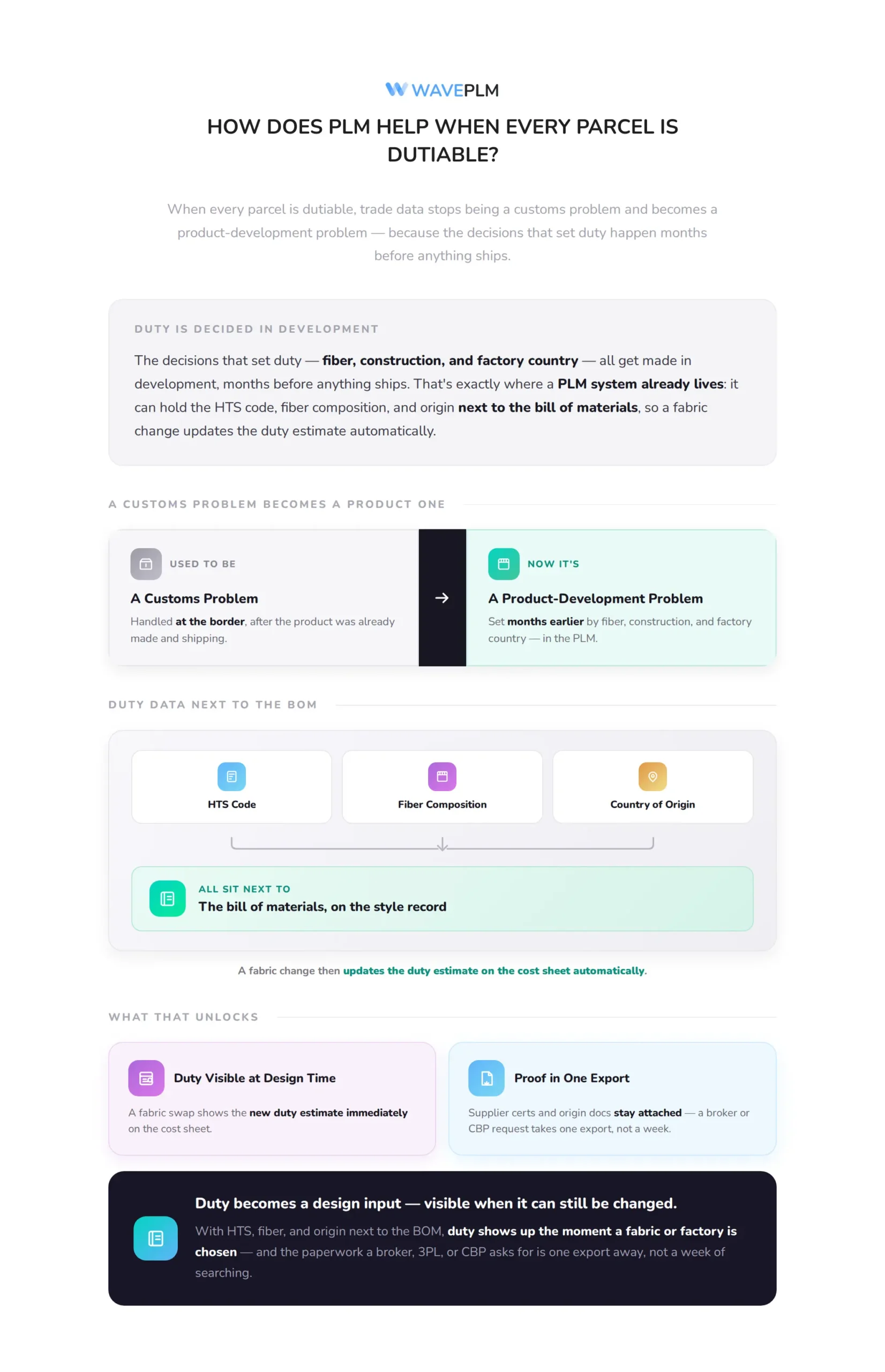
When every parcel is dutiable, trade data stops being a customs problem and becomes a product development problem. In other words, the decisions that set duty are made months before anything ships. Fiber, construction, and factory country all get chosen in development. Fashion PLM software is where those decisions already live.
In practice, a PLM system can hold the HTS code, fiber composition, and origin next to the bill of materials. A fabric change then updates the duty estimate on the cost sheet automatically. It also keeps supplier certificates and origin documents attached to the style instead of lost in email. As a result, a request for proof from a broker, 3PL, or CBP takes one export. It no longer takes a week of searching. For a broader view of how brands set this up, read our fashion PLM software guide.
Frequently Asked Questions
Is the de minimis tariff exemption coming back?
Almost certainly not. The suspension survived the February 2026 Supreme Court ruling on IEEPA tariffs. CBP then made it indefinite in June 2026. Finally, the One Big Beautiful Bill Act repeals the exemption by statute from July 1, 2027. Reversing it would take new legislation.
What was the de minimis threshold for US imports?
The de minimis threshold was $800 per person per day. Shipments at or below that value entered the United States free of duties and taxes. That threshold still appears in the statute, but duty-free treatment under it has been suspended for all countries since August 29, 2025.
Do clothing samples from factories pay duty now?
Generally yes, because the de minimis tariff exemption no longer covers them. However, samples valued at $1 or less each, or marked, torn, or perforated so they cannot be sold, can enter duty-free under HTS 9811.00.60. Ask factories to mark and mutilate development samples before shipping.
How is duty calculated on a small apparel parcel?
Duty equals the declared value multiplied by the HTS rate for the garment, plus any country-specific tariff such as the Section 301 rates that took effect on July 24, 2026. For example, a $40 cotton-tee order from Vietnam pays roughly 16.5% plus 12.5%, or $11.60, before clearance fees.
Does the end of de minimis affect brands that import by container?
Only slightly. Brands that import in bulk and ship domestically already pay duty on each ocean shipment. The change mainly affects their samples, air shipments, replacements, and any DTC orders fulfilled directly from overseas warehouses.
What happens on October 22, 2026?
October 22, 2026 is the compliance deadline for CBP’s new postal informal entry process. From then, postal shipments valued at $2,500 or less must be entered through a licensed US customs broker, with duties collected based on the arrival date.
The Bottom Line for Apparel Teams
The de minimis tariff era rewarded brands that shipped small and often. Now, the advantage shifts to brands that know the duty on a style before they approve the fabric, and that can prove origin on demand. That work starts in product development, not at the warehouse door. Want HTS codes, fiber content, and origin on every style record, next to the BOM and cost sheet? see how Wave PLM keeps trade data in the product record.







Leave a Reply