

OEKO-TEX is a family of independent textile certifications. Its best-known label, STANDARD 100, confirms that an independent lab tested every component of a product for more than 1,000 harmful substances. However, OEKO-TEX is not one label. Brands can choose between product labels, facility certifications, and a traceability label, and each one proves something different.
For an apparel brand, the practical questions are simple. Which OEKO-TEX label fits your product? Does buying certified fabric make your garment certified? And how does OEKO-TEX compare with GOTS? This guide answers all three. In addition, it covers the product classes, the 2026 rule changes, and how to keep certificates attached to the right styles.
What Is OEKO-TEX?
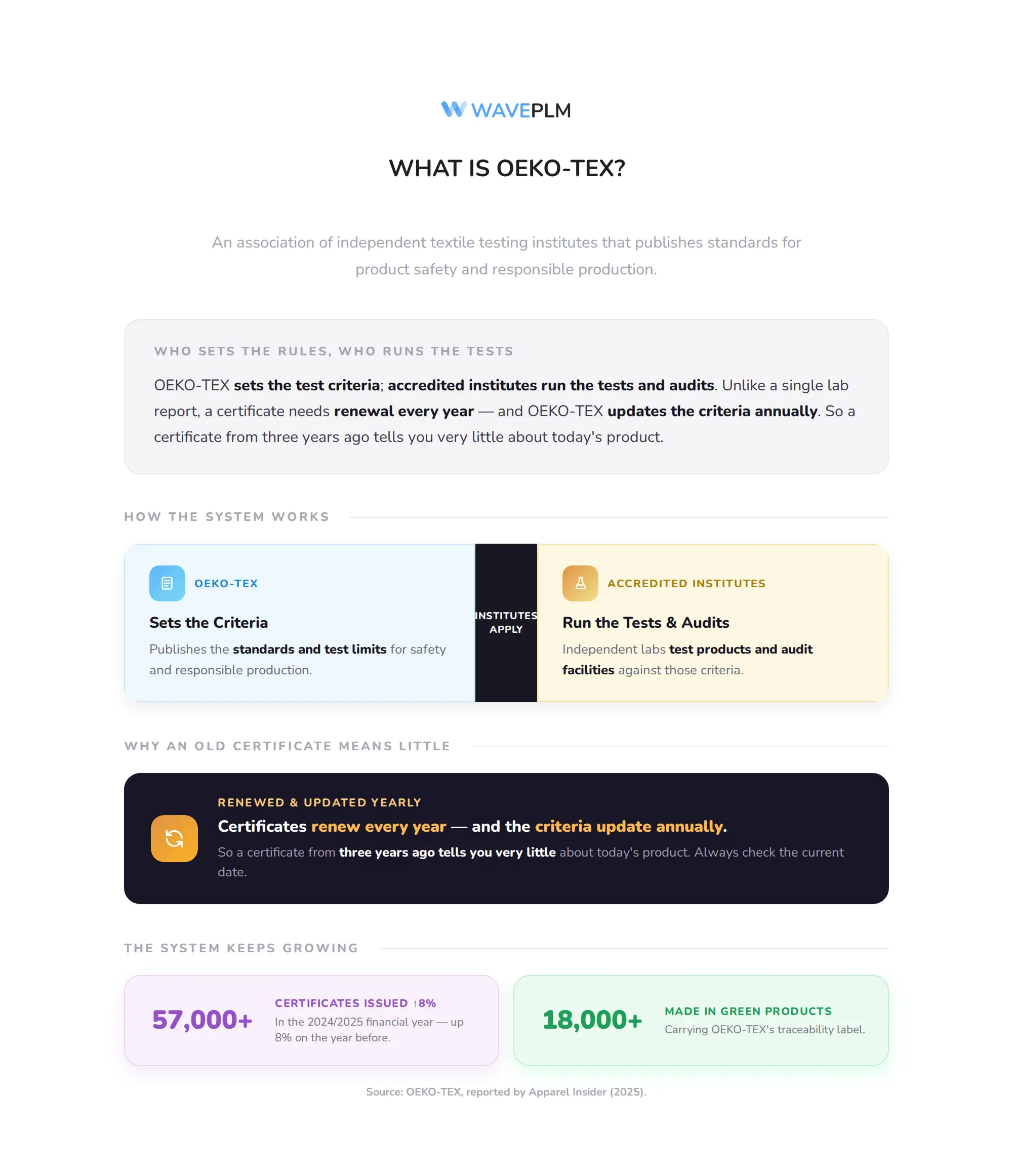
OEKO-TEX is an association of independent textile testing institutes that publishes standards for product safety and responsible production. In other words, it sets the test criteria, and accredited institutes run the tests and audits. The system has grown steadily. According to OEKO-TEX, it issued more than 57,000 certificates in its 2024/2025 financial year, up 8% on the year before.
Unlike a single lab report, however, the certificate needs renewal every year. Meanwhile, OEKO-TEX updates the criteria themselves annually. As a result, a certificate from three years ago tells you very little about today’s product.
Industry data: OEKO-TEX reported more than 57,000 certificates issued in its 2024/2025 financial year, an 8% increase, and more than 18,000 products carrying its MADE IN GREEN traceability label (Apparel Insider, 2025).
Which OEKO-TEX Label Does Your Brand Actually Need?
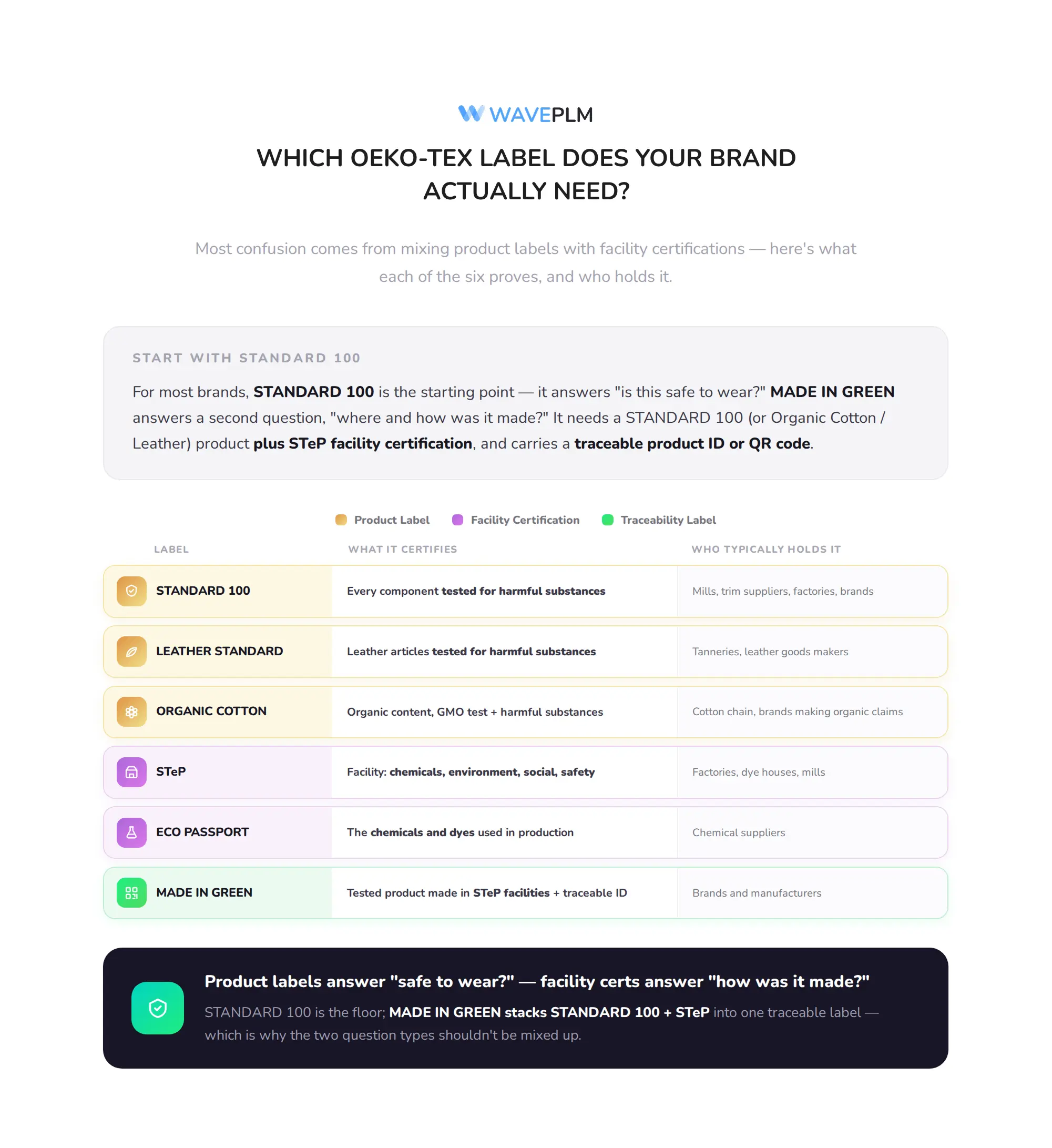
Most confusion comes from mixing product labels with facility certifications. In short, here is what each label proves:
| Label | What it certifies | Who typically holds it |
|---|---|---|
| STANDARD 100 | Product tested for harmful substances, every component | Mills, trim suppliers, factories, brands |
| LEATHER STANDARD | Leather articles tested for harmful substances | Tanneries, leather goods makers |
| ORGANIC COTTON | Organic cotton content and GMO testing, plus harmful substances | Cotton chain and brands making organic claims |
| STeP | Production facility: chemicals, environment, social, safety | Factories, dye houses, mills |
| ECO PASSPORT | Chemicals and dyes used in production | Chemical suppliers |
| MADE IN GREEN | Tested product made in STeP-certified facilities, with a traceable product ID | Brands and manufacturers |
For most apparel brands, STANDARD 100 is the starting point because it answers the customer question “is this safe to wear?” By contrast, MADE IN GREEN answers a second question: “where and how was it made?” It requires a STANDARD 100, ORGANIC COTTON, or LEATHER STANDARD product, plus STeP certification for the production facilities. Furthermore, it carries a unique product ID or QR code that shows the production countries and facilities.
What Are the OEKO-TEX STANDARD 100 Product Classes?
STANDARD 100 sorts products into four classes. Notably, the closer a product sits to skin, and the younger the wearer, the stricter the limit values.
| Product class | Covers | Apparel examples |
|---|---|---|
| Class I | Babies and toddlers up to 3 years | Bodysuits, baby sleepwear, bibs |
| Class II | Direct skin contact | T-shirts, underwear, leggings, shirts |
| Class III | No or little skin contact | Jackets, coats, outer shells |
| Class IV | Decoration materials | Curtains, upholstery (home textiles) |
Choosing the class is a commercial decision too. For instance, you cannot use a Class II fabric certificate to cover a Class I baby product. Therefore, if a mill supplies both your adult and baby lines, ask for Class I certification on shared fabrics. That one choice saves a second round of testing. For children’s lines in the US, OEKO-TEX also sits alongside legal requirements, which our guide to CPSIA compliance for children’s apparel explains.
Does Certified Fabric Make Your Garment OEKO-TEX Certified?
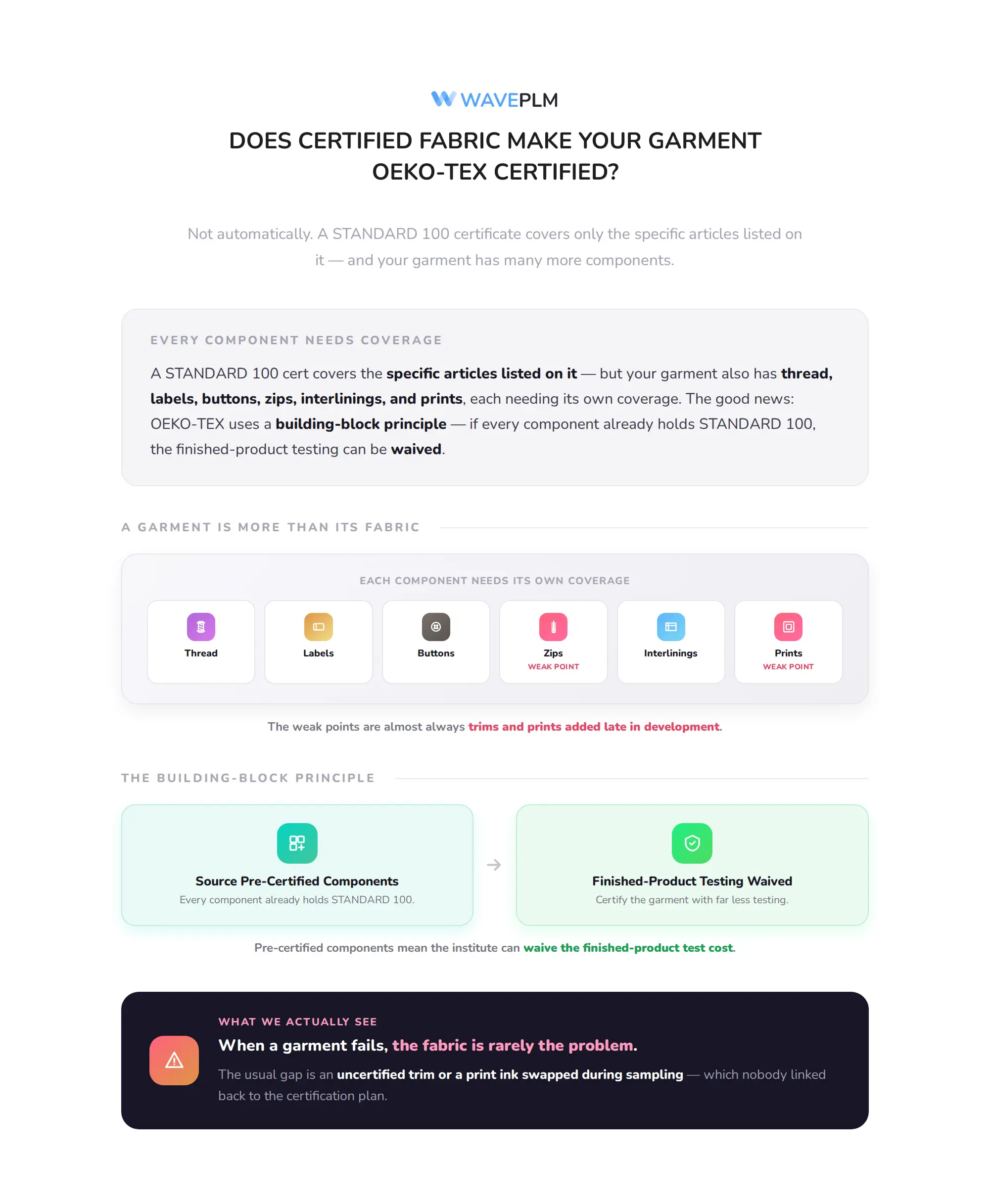
Not automatically. A STANDARD 100 certificate covers the specific articles listed on it. Your garment, however, also contains thread, labels, buttons, zips, interlinings, and prints. Each of those is a component, and each one needs coverage.
Fortunately, OEKO-TEX uses a building-block principle. If every component already holds STANDARD 100 certification, the institute can waive testing costs for the finished product. Consequently, the smart path is to source pre-certified components and then certify the finished article with far less testing. In practice, the weak points are almost always trims and prints added late in development.
Our finding: When a garment fails to qualify for STANDARD 100, the fabric is rarely the problem. The usual gap is an uncertified trim or a print ink swapped during sampling, which nobody linked back to the certification plan.
Our apparel product testing guide shows where chemical testing fits next to colorfastness and shrinkage. Similarly, if you specify fabric weight in the same record, our fabric GSM guide covers how to write it.
What Changed in OEKO-TEX Rules in 2026?
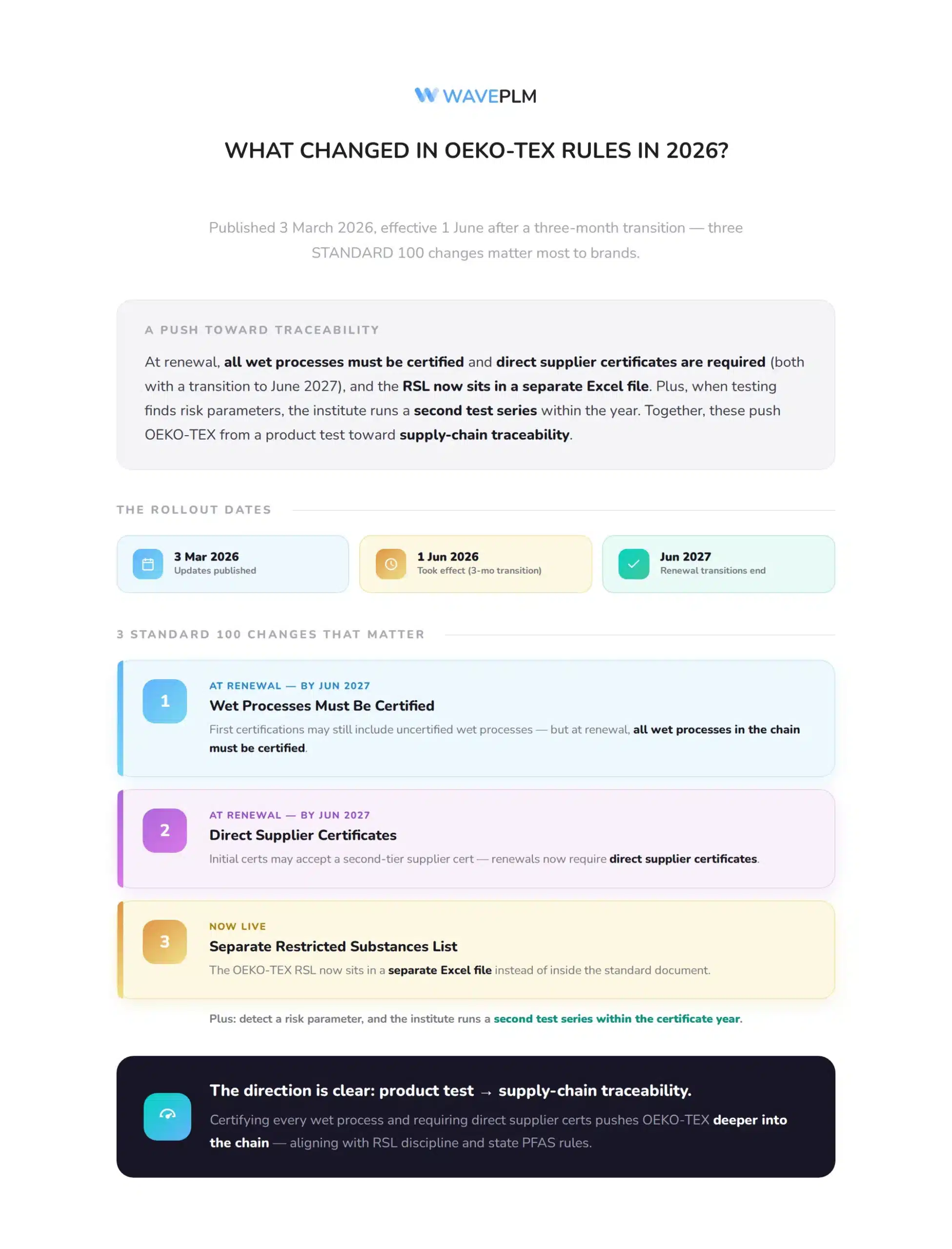
OEKO-TEX published its 2026 updates on 3 March 2026, and they took effect on 1 June 2026 after a three-month transition. For STANDARD 100, three changes matter most to brands:
- Wet processes must be certified at renewal. First certifications may still include uncertified wet processes. At renewal, however, all wet processes in the supply chain must be certified, with a transition until June 2027.
- Direct supplier certificates. Initial certifications may accept a second-tier supplier certificate. Renewals, by contrast, require direct supplier certificates, again with a transition until June 2027.
- Separate restricted substances list. The OEKO-TEX RSL now sits in a separate Excel file instead of the standard document.
In addition, when testing detects risk parameters, the institute now runs a second test series within the certificate year. Taken together, the changes push OEKO-TEX from a product test toward supply chain traceability. That fits closely with your own restricted substances list and with state rules on PFAS in clothing.
OEKO-TEX vs. GOTS: Which Does Your Brand Need?
OEKO-TEX and GOTS answer different questions, so many brands hold both. Put simply, STANDARD 100 says a lab tested the product for harmful substances. GOTS, on the other hand, says the fibre is organic and that every company in the chain met its environmental and social criteria.
| Question | STANDARD 100 | GOTS |
|---|---|---|
| Is the fibre organic? | No requirement | Yes, at least 70% or 95% |
| Is the product tested for harmful substances? | Yes, every component | Yes, plus restrictions on chemical inputs |
| Are factories audited for social criteria? | Not in STANDARD 100 (covered by STeP) | Yes, along the whole chain |
| Works for synthetics? | Yes | Only as a limited minority share |
| Certificate validity | 1 year | 1 year, plus Transaction Certificates per shipment |
So, which one should you pick? If your range is mostly polyester or blends, STANDARD 100 is the realistic choice. If you sell organic cotton and want to make organic claims, GOTS certification is the stronger proof. Our guide to GOTS certification for apparel brands covers its label grades, costs, and the Version 8.0 changes.
Finally, keep EU claims law in mind. Since 27 September 2026, the Empowering Consumers Directive allows sustainability labels only if they rest on a certification scheme or come from public authorities. Both OEKO-TEX and GOTS are certification schemes, whereas a self-made “non-toxic” badge is not. For the wider context, see our article on the EU Green Claims Directive.
How Do You Get OEKO-TEX STANDARD 100 for a Product?
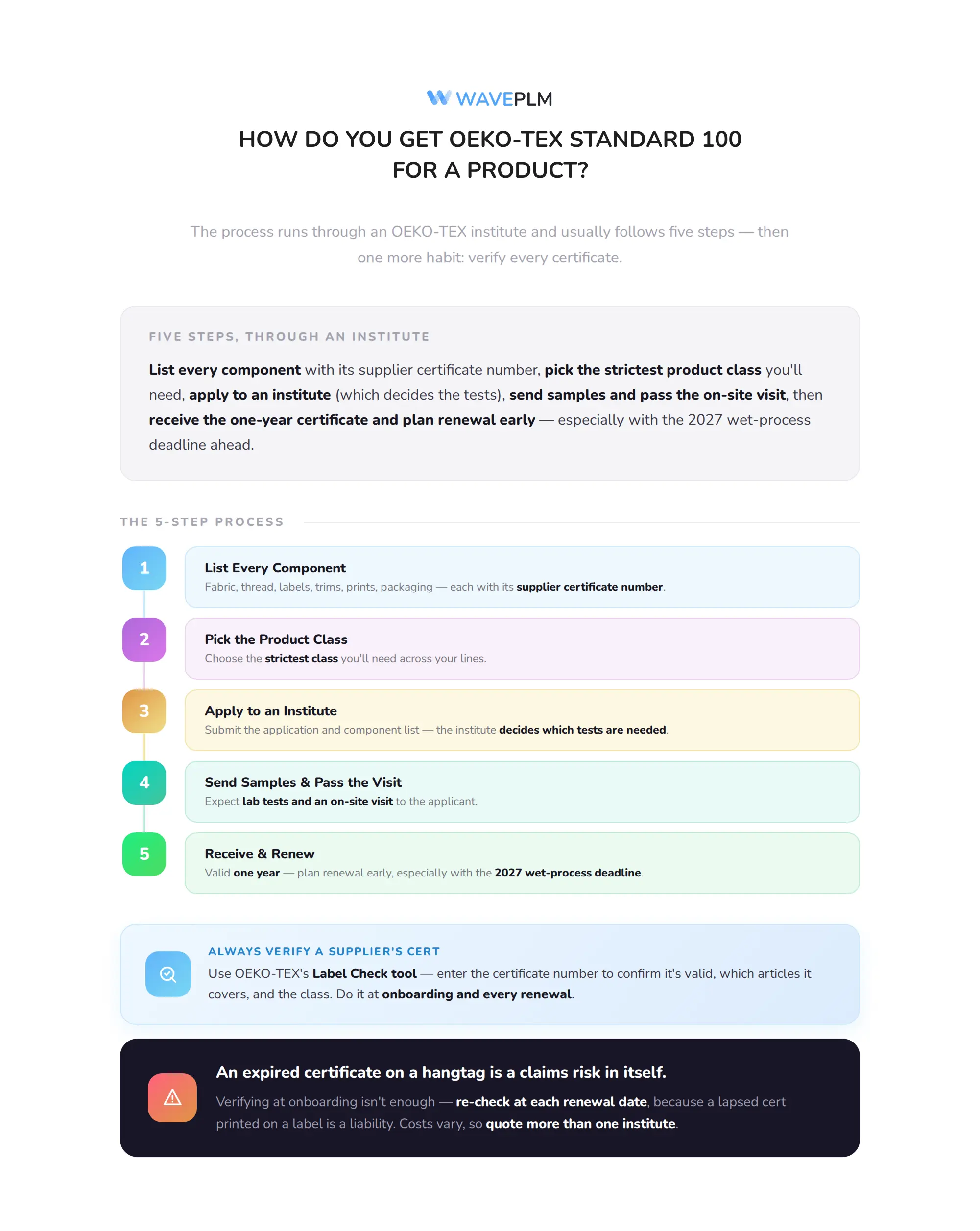
The process runs through an OEKO-TEX institute and usually follows five steps:
- List every component. Note fabric, thread, labels, trims, prints, and packaging that touches the product, with each supplier’s certificate number if it has one.
- Pick the product class. Choose the strictest class you will need across your lines.
- Apply to an institute. Submit the application and component list. The institute decides which tests are still needed.
- Send samples and pass the visit. Expect laboratory tests and an on-site visit to the applicant.
- Receive and renew. The certificate is valid for one year. Then plan renewal early, especially with the 2027 wet-process deadline ahead.
Costs depend on the number of articles, components already certified, and the tests required, so request quotes from more than one institute.
Before you rely on a supplier’s certificate, also verify it. OEKO-TEX offers a Label Check tool on its website where you enter the certificate or label number. As a result, you can confirm that the certificate is valid, which articles it covers, and which product class applies. Do this at onboarding and again at each renewal date, because an expired certificate printed on a hangtag is a claims risk in itself. Our factory audit checklist lists the other documents worth collecting at the same time.
Keeping Certificate Numbers Attached to Every Component
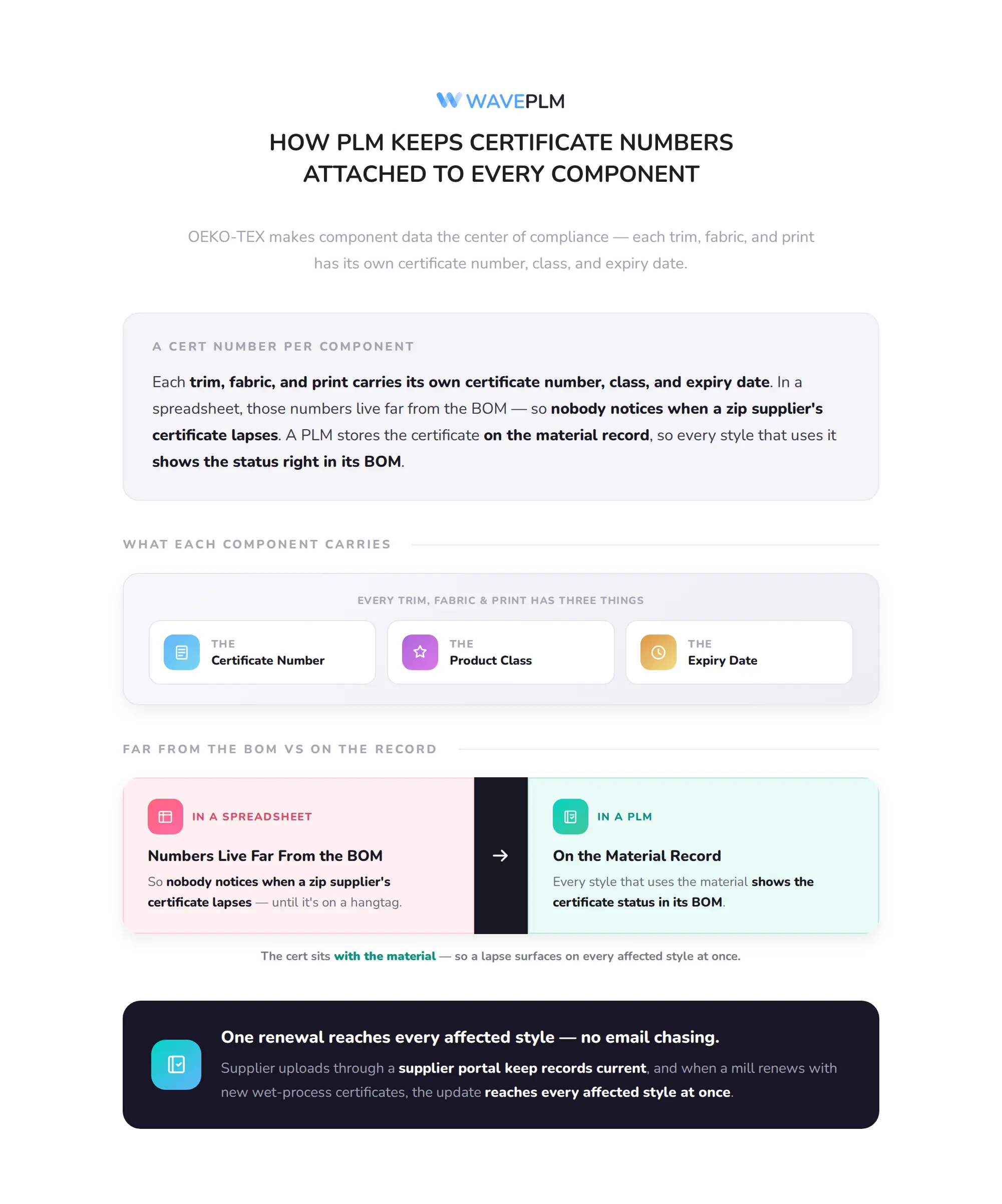
OEKO-TEX makes component data the center of compliance. Each trim, fabric, and print has its own certificate number, class, and expiry date. In a spreadsheet workflow, those numbers live far from the bill of materials, so nobody notices when a zip supplier’s certificate lapses. A PLM system instead stores the certificate on the material record. As a result, every style that uses that material shows the status in its BOM.
Supplier uploads through a supplier portal keep those records current without email chasing. Likewise, when a mill renews with new wet-process certificates, the update reaches every affected style at once.
Frequently Asked Questions
What does OEKO-TEX certified mean?
OEKO-TEX certified usually means a product carries the STANDARD 100 label. In that case, an independent institute tested every component for more than 1,000 harmful substances, using limit values set for its product class.
Is OEKO-TEX the same as organic?
No. OEKO-TEX STANDARD 100 tests for harmful substances and says nothing about whether the fibre is organic. For organic claims, brands use GOTS or the separate OEKO-TEX ORGANIC COTTON certification.
Which is better, OEKO-TEX or GOTS?
Neither is better in general, because they prove different things. STANDARD 100 proves that a lab tested the product for harmful substances. GOTS proves organic fibre content and responsible processing across the chain. Many organic brands hold both.
How long is an OEKO-TEX certificate valid?
An OEKO-TEX STANDARD 100 certificate is valid for one year. The criteria are also updated every year, so renewal includes checking the product against the latest limit values.
Does OEKO-TEX fabric make my garment OEKO-TEX certified?
No. The garment also contains thread, labels, trims, and prints, and each component needs its own coverage. If every component is already certified, the building-block principle can waive most testing costs for the finished product.
What is OEKO-TEX Class 1?
Class I is the strictest STANDARD 100 product class. It covers articles for babies and toddlers up to three years old, such as bodysuits and baby sleepwear, and applies the tightest limit values.
One Question Before Your Next Renewal
Which of your best-selling styles would lose its OEKO-TEX status if a single zip or thread supplier’s certificate lapsed tomorrow? If your team cannot answer that in a minute, the problem is not the certificate but where it lives. Wave PLM attaches certificate numbers, classes, and expiry dates to each material, so every BOM shows its status at a glance. Check whether your component data is audit-ready.






Leave a Reply