

GOTS certification is independent proof that a textile product contains certified organic fibre. It also shows that certified companies processed it under the Global Organic Textile Standard’s environmental and social rules. Crucially, it covers the whole chain. Every company that spins, knits, dyes, sews, or trades the goods must hold its own certificate. A brand cannot put the GOTS label on a garment just because it bought GOTS fabric.
In practice, that chain rule is where most apparel brands get stuck. This guide explains who needs GOTS certification and what the two label grades mean. It also covers GOTS Version 8.0, the process, the costs, and the labeling mistakes that trigger problems. In addition, it covers why the topic became more urgent in Europe on 27 September 2026.
What Is GOTS Certification?
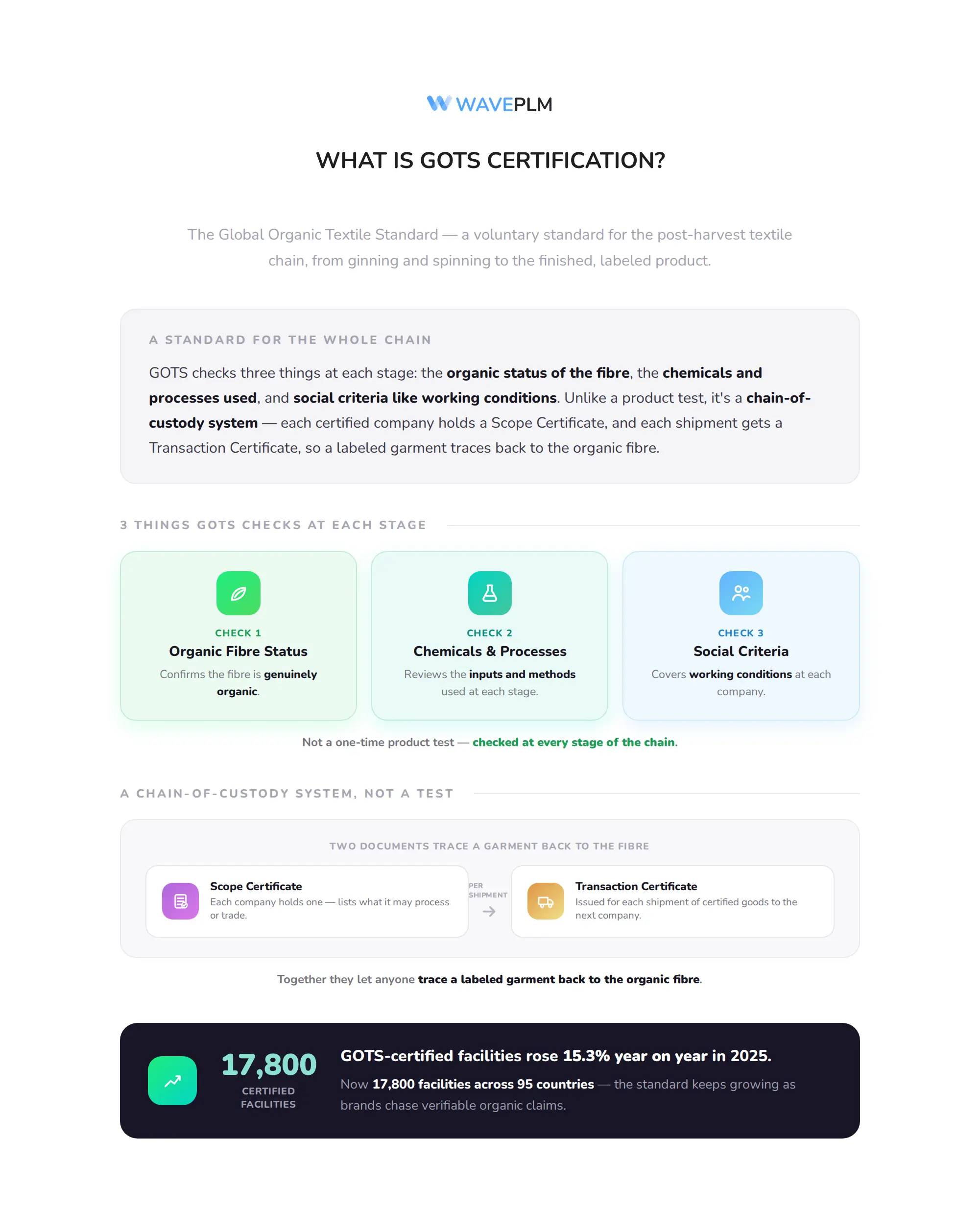
GOTS stands for the Global Organic Textile Standard. In other words, it is a voluntary standard for the post-harvest textile chain, from ginning and spinning through to the finished, labeled product. Specifically, GOTS certification checks three things at each stage. First, the organic status of the fibre. Second, the chemicals and processes used. Third, social criteria such as working conditions.
Unlike a product test, however, GOTS certification is a chain-of-custody system. First, each certified company holds a Scope Certificate, which lists what it may process or trade. Then, when certified goods move to the next company, an approved certifier issues a Transaction Certificate (TC) for that shipment. Together, these documents let anyone trace a labeled garment back to the organic fibre.
Industry data: The number of GOTS-certified facilities rose 15.3% year on year to 17,800 in 2025, across 95 countries, according to GOTS’s annual figures reported by Apparel Insider in April 2026.
Who Needs GOTS Certification in an Apparel Supply Chain?
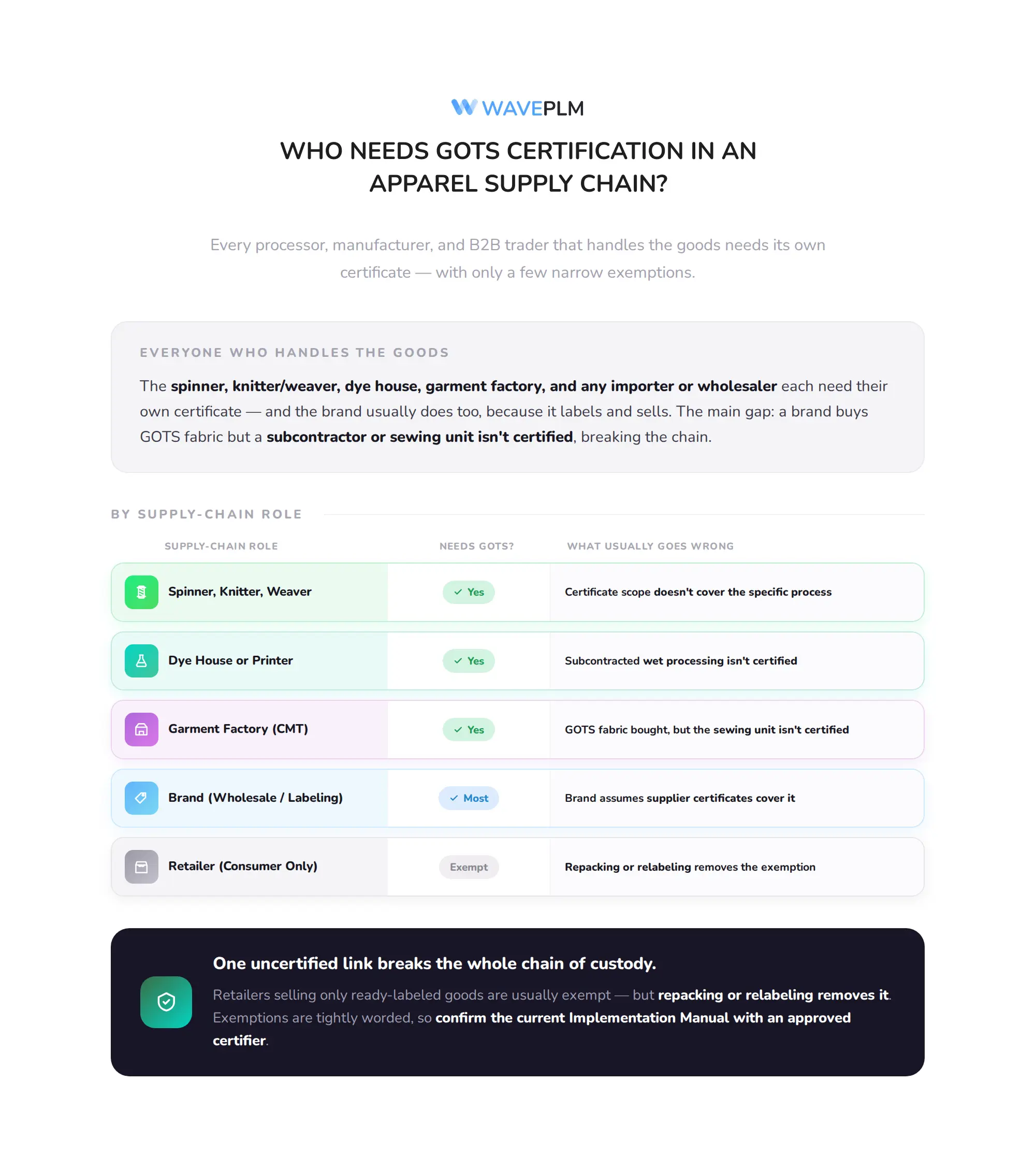
As a rule, every processor, manufacturer, and B2B trader that handles the goods needs its own certificate. In practice, that means the spinner, the knitter or weaver, and the dye house. It also means the garment factory and any importer or wholesaler in between. The brand is usually certified too, because it sells to retailers and applies its own labels.
There are, however, narrow exemptions. GOTS guidance exempts retailers that only sell ready-labeled goods to consumers, without repacking or relabeling. Likewise, guidance has exempted very small traders below €5,000 of annual GOTS turnover. However, they still have to register with an approved certifier. Even so, check the current Implementation Manual with your certifier, because exemptions are tightly worded.
| Supply chain role | Needs GOTS certification? | What usually goes wrong |
|---|---|---|
| Spinner, knitter, weaver | Yes | Certificate scope does not cover the specific process |
| Dye house or printer | Yes | Subcontracted wet processing is not certified |
| Garment factory (cut, make, trim) | Yes | Brand buys GOTS fabric, but the sewing unit is not certified |
| Brand selling wholesale or labeling goods | Yes, in most cases | Brand assumes supplier certificates cover it |
| Retailer selling only to consumers | Usually exempt | Retailer repacks or relabels, which removes the exemption |
What Do the “Organic” and “Made With Organic” Label Grades Mean?
GOTS has two label grades. In short, the grade depends on how much certified organic fibre the product contains. Notably, the remaining fibre is also restricted, so you cannot fill the gap with anything you like.
| Label grade | Certified organic fibre | Other fibres allowed (GOTS 8.0) |
|---|---|---|
| “Organic” | At least 95% | Up to 5% other fibres |
| “Made with organic” | At least 70% | Up to 30%, of which recycled synthetics up to 20% and virgin synthetics up to 10% |
For example, a 95% organic cotton, 5% elastane legging can qualify for the “organic” grade. In contrast, a 60% organic cotton, 40% recycled polyester hoodie cannot carry either grade. Consequently, your team has to lock in fibre composition during development, not discover it at labeling.
What Changes With GOTS Version 8.0?
GOTS released Version 8.0 in March 2026. It becomes effective for all certified entities on 1 March 2027, so the next few months are the transition window. The main changes for apparel brands are:
- Mandatory due diligence. Certified entities must run due diligence processes aligned with the OECD Due Diligence Guidance for responsible supply chains.
- Tighter chemistry. There is now a dedicated Manufacturing Restricted Substances List, stronger PFAS controls, and clarified limits for free aniline in indigo dyes.
- Circularity. Certified products can stay within GOTS through repair and resale models, and microfibre management is addressed.
- Stronger environmental controls. Air emissions and waste management requirements are tighter.
In practice, the due diligence and chemistry changes overlap with work many brands already do for other regulations. For instance, the new chemical rules sit close to your restricted substances list and to state rules on PFAS in clothing.
How Do You Get GOTS Certification?
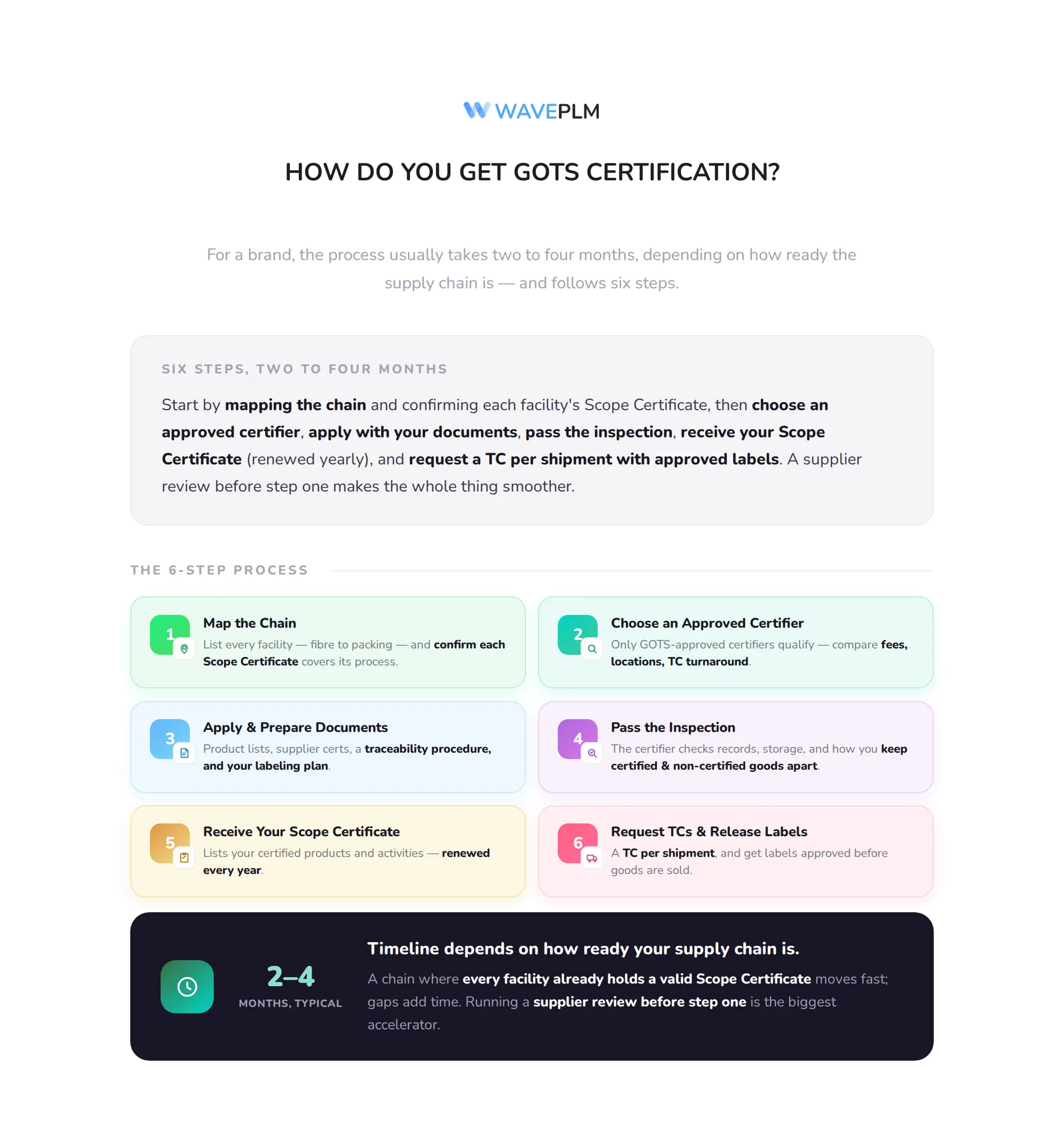
The process for a brand typically takes two to four months, depending on how ready the supply chain is. Generally, it follows six steps:
- Map the chain. List every facility for each product: fibre, yarn, fabric, dyeing, printing, sewing, trims, and packing. Then confirm each one holds a valid GOTS Scope Certificate that covers its actual process.
- Choose an Approved Certifier. Only certifiers approved by GOTS can certify you. Compare their fees, inspection locations, and TC turnaround times.
- Apply and prepare documents. You will need product lists, supplier certificates, a traceability procedure, and your labeling plan.
- Pass the inspection. The certifier checks your records, storage, and how you keep certified and non-certified goods apart.
- Receive your Scope Certificate. It lists the products and activities you are certified for, and it must be renewed every year.
- Request TCs and label release. For each shipment, request a TC; meanwhile, get your labels approved before goods are sold.
Before step one, it helps to run a supplier review. Our factory audit checklist covers the documents to request from each facility.
How Much Does GOTS Certification Cost?
Costs vary by certifier, country, and sales volume. For example, the Soil Association, a UK certifier, publishes its 2026/27 fees for brands and traders:
| Fee | Amount (excl. VAT) |
|---|---|
| Application and first year of certification | £2,554 |
| Annual renewal, core fee (certified organic sales up to £435,427) | £1,733 |
| Transaction Certificate | £3 per TC, plus £42 per shipment |
| GOTS entity annual fee | £82 per site |
| Additional inspection day | £656 |
On top of fees, also budget for internal time. Collecting supplier certificates and requesting TCs for every shipment is the hidden cost. Also remember that your suppliers carry their own certification costs, which often show up in a higher fabric price.
Where Do Brands Get GOTS Claims Wrong?
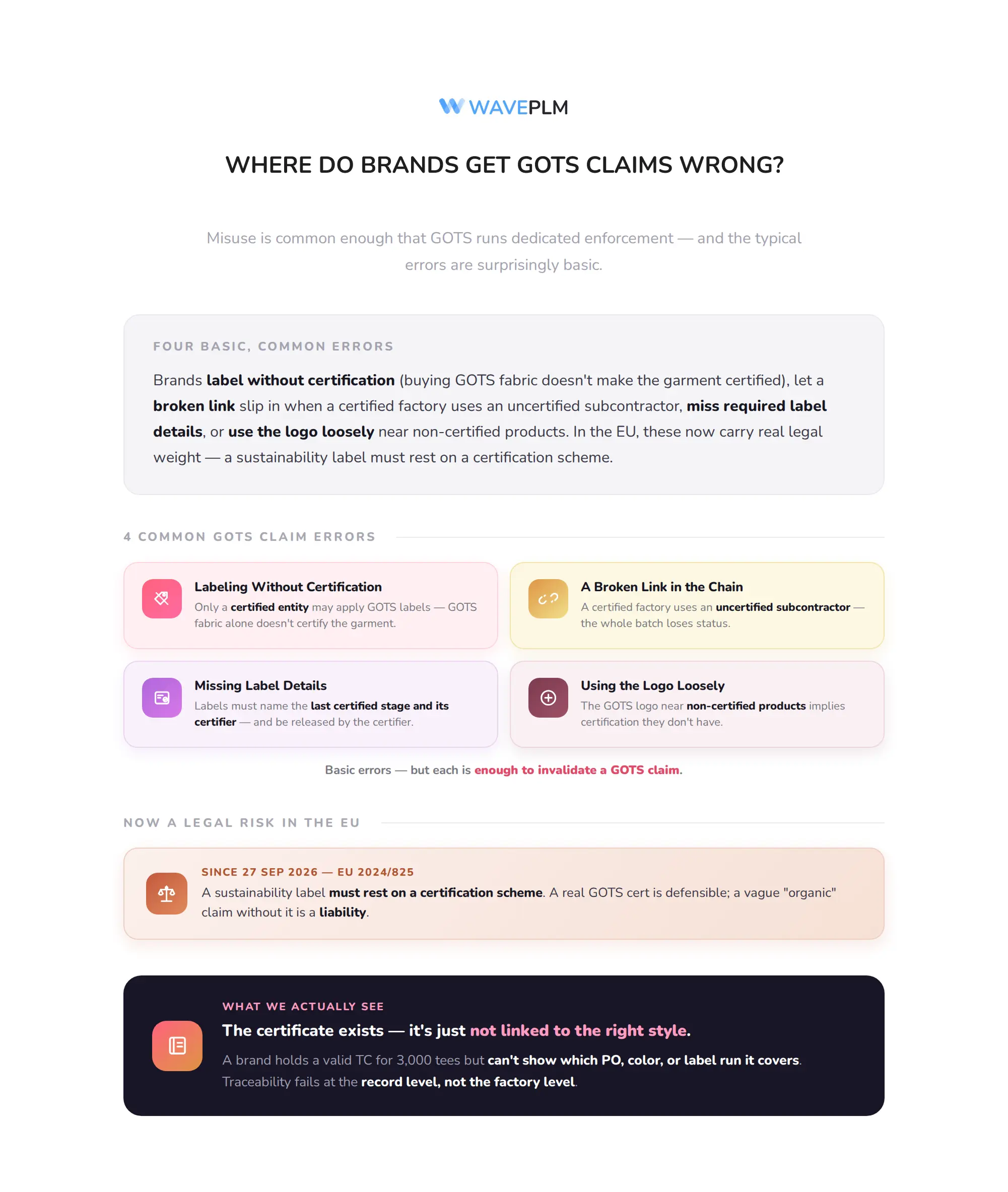
Notably, misuse of GOTS claims is common enough that GOTS runs dedicated enforcement on it. The typical errors are surprisingly basic:
- Labeling without certification. Only a GOTS-certified entity may apply GOTS labelling to a product. Buying GOTS fabric does not make the finished garment GOTS certified.
- A broken link in the chain. A certified factory quietly sends printing to an uncertified subcontractor. As a result, the whole batch loses its status.
- Missing label details. Product labels must reference the last certified stage and its Approved Certifier, and labels must be released by the certifier.
- Using the logo loosely. Placing the GOTS logo in marketing next to non-certified products implies certification they do not have.
In Europe, these errors now carry more weight. Since 27 September 2026, the Empowering Consumers Directive (EU 2024/825) has applied. Under it, a sustainability label must rest on a certification scheme or come from public authorities. Therefore, a real GOTS certification is a defensible label, while a vague “organic” claim without it is a liability. Our guide to the EU Green Claims Directive covers the wider claims landscape.
Our finding: In most GOTS problems we see, the certificates existed but were not linked to the right style. A brand holds a valid TC for 3,000 tees, yet cannot show which purchase order, color, or label run it covers. Traceability fails at the record level, not the factory level.
GOTS vs. OEKO-TEX: Two Different Promises
Brands often treat GOTS certification and OEKO-TEX as interchangeable. However, they are not. GOTS certifies organic fibre content plus processing and social criteria along the whole chain. OEKO-TEX Standard 100, by comparison, tests materials and products for harmful substances. Whether the fibre is organic does not matter to it. Many organic brands hold both, and each answers a different customer question. Beyond these two, scoring tools such as the Higg Index measure facility performance rather than certifying a product.
Keeping Transaction Certificates Tied to Styles
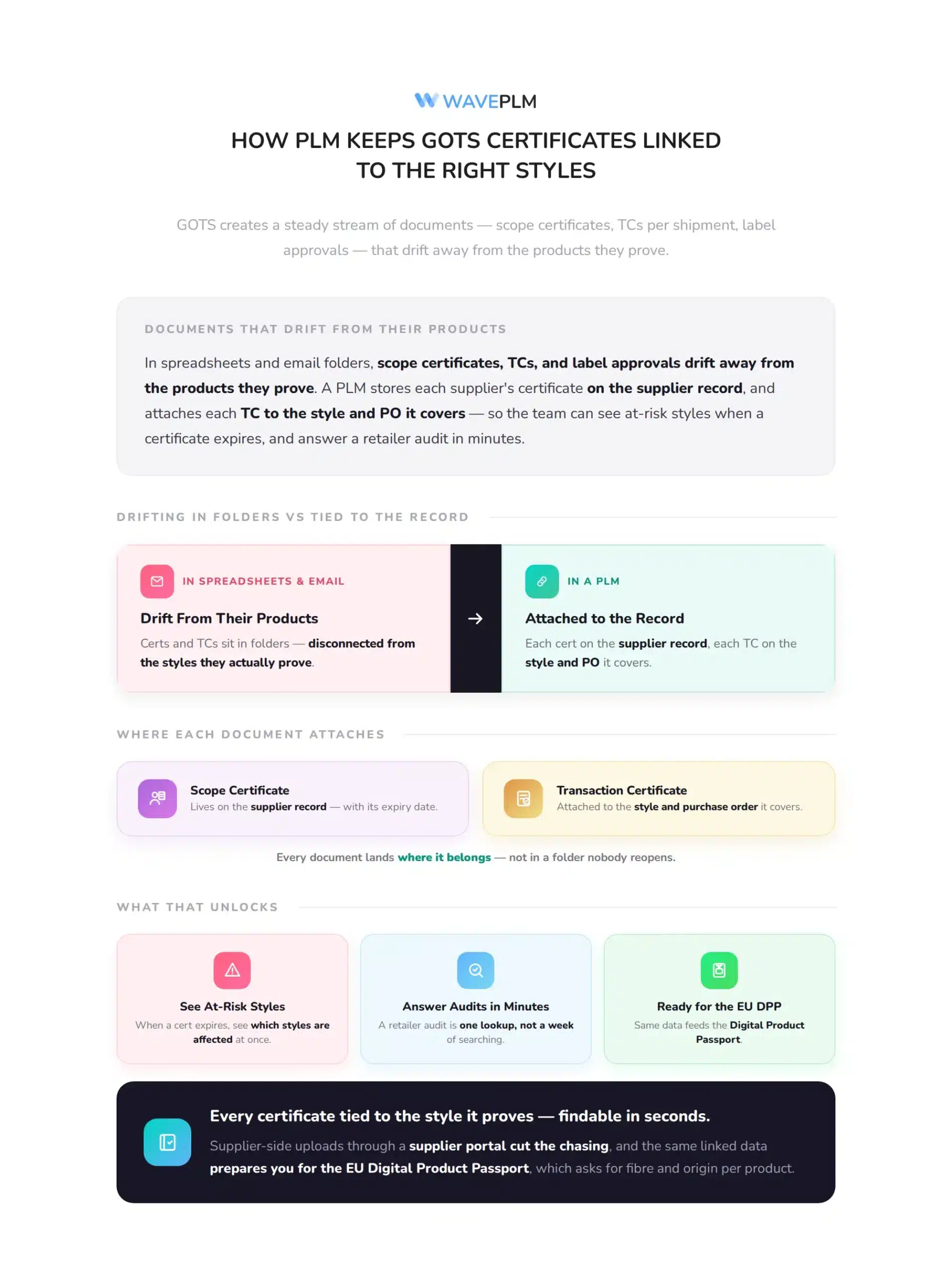
GOTS certification creates a steady stream of documents: supplier scope certificates with expiry dates, TCs per shipment, and label approvals. In spreadsheets and email folders, these drift away from the products they prove. A PLM system, by contrast, stores each supplier’s certificate on the supplier record. Similarly, it attaches each TC to the style and purchase order it covers.
As a result, the team sees which styles are at risk when a dye house certificate expires. It can also answer a retailer audit in minutes. Supplier-side uploads through a supplier portal reduce the chasing even further. In addition, the same data prepares you for the EU Digital Product Passport, which will ask for fibre and origin data per product.
Frequently Asked Questions
What does GOTS certification mean?
GOTS certification means a textile product contains certified organic fibre. In addition, certified companies processed it under the standard’s environmental and social criteria. It covers the full chain from fibre processing to the final labeled product.
Can a brand use the GOTS label if it buys GOTS fabric?
No. Only GOTS-certified entities may apply GOTS labelling to a product. If the garment factory or the brand lacks a required certificate, the finished garment cannot carry the GOTS label. That holds even when the fabric itself was certified.
How long does GOTS certification take?
For a brand, GOTS certification usually takes two to four months. The main variable is speed of supplier checks. In particular, you must confirm that every supplier holds a valid Scope Certificate for its actual process.
How much does GOTS certification cost?
Costs depend on the certifier and sales volume. For example, the Soil Association charges £2,554 for application and the first year. After that, renewal starts at £1,733 per year, plus TC and site fees.
How long is a GOTS certificate valid?
A GOTS Scope Certificate lasts one year, and an annual inspection renews it. Meanwhile, certifiers issue a Transaction Certificate per shipment to prove that a specific batch came from the certified chain.
When does GOTS Version 8.0 take effect?
GOTS published Version 8.0 in March 2026, and it becomes effective for all certified entities on 1 March 2027. It adds mandatory due diligence, a Manufacturing Restricted Substances List, stronger PFAS controls, and circularity provisions.
Your First 30 Days Toward GOTS Certification
First of all, start small and concrete. In week one, pick the two or three styles you most want to label and map every facility behind them. In week two, collect and check each supplier’s Scope Certificate, including the exact processes it covers. By week four, shortlist two Approved Certifiers and compare fees and TC turnaround. Finally, decide where certificates and TCs will live. That choice decides whether your GOTS certification survives its first retailer audit. If you want those records attached to the styles they prove, Wave PLM can hold them in one place.







Leave a Reply