
By Tatiana Kochergina · Updated April 30, 2026 · 8 min read
The right bag design software shrinks sample rounds, keeps designers and factories aligned, and turns a sketch into a sellable handbag faster. This guide covers what features to look for, how PLM for accessories fits in, leading tools compared, a 7-step workflow you can copy, FAQs, and a quick glossary.
Designing bags is both a creative journey and a complex technical process. While imagination and artistic direction bring the initial spark, it’s structure, workflow, and precise communication that shape a sketch into a finished product. That’s why selecting the right bag design software is no longer optional—it’s a competitive advantage. These tools let designers and brands create bag designs that are both visually compelling and technically accurate.
In today’s fashion landscape, consumers expect innovation, sustainability, and speed. Digital tools are now essential for managing every step—from creative ideation to sample approval and supplier collaboration. With the right design platform, brands can streamline workflows, minimize errors, and bring high-quality bags to market faster than ever before.
This guide explores how to:
- Use software to simplify and strengthen your bag design process
- Identify essential features in handbag development tools
- Enable better teamwork with PLM for accessories
- Compare leading solutions for different stages and bag types
- Create bag designs that reflect brand values and customer needs
- Answer key industry questions about tools, machines, and profits
Let’s explore how digital solutions are transforming the future of bag design.
Why is bag design software a game changer for accessory brands?
The market for bags—ranging from fashion handbags to utility backpacks—is fast-moving and consumer-driven. As expectations grow, traditional design methods no longer offer the speed or precision needed to stay competitive.
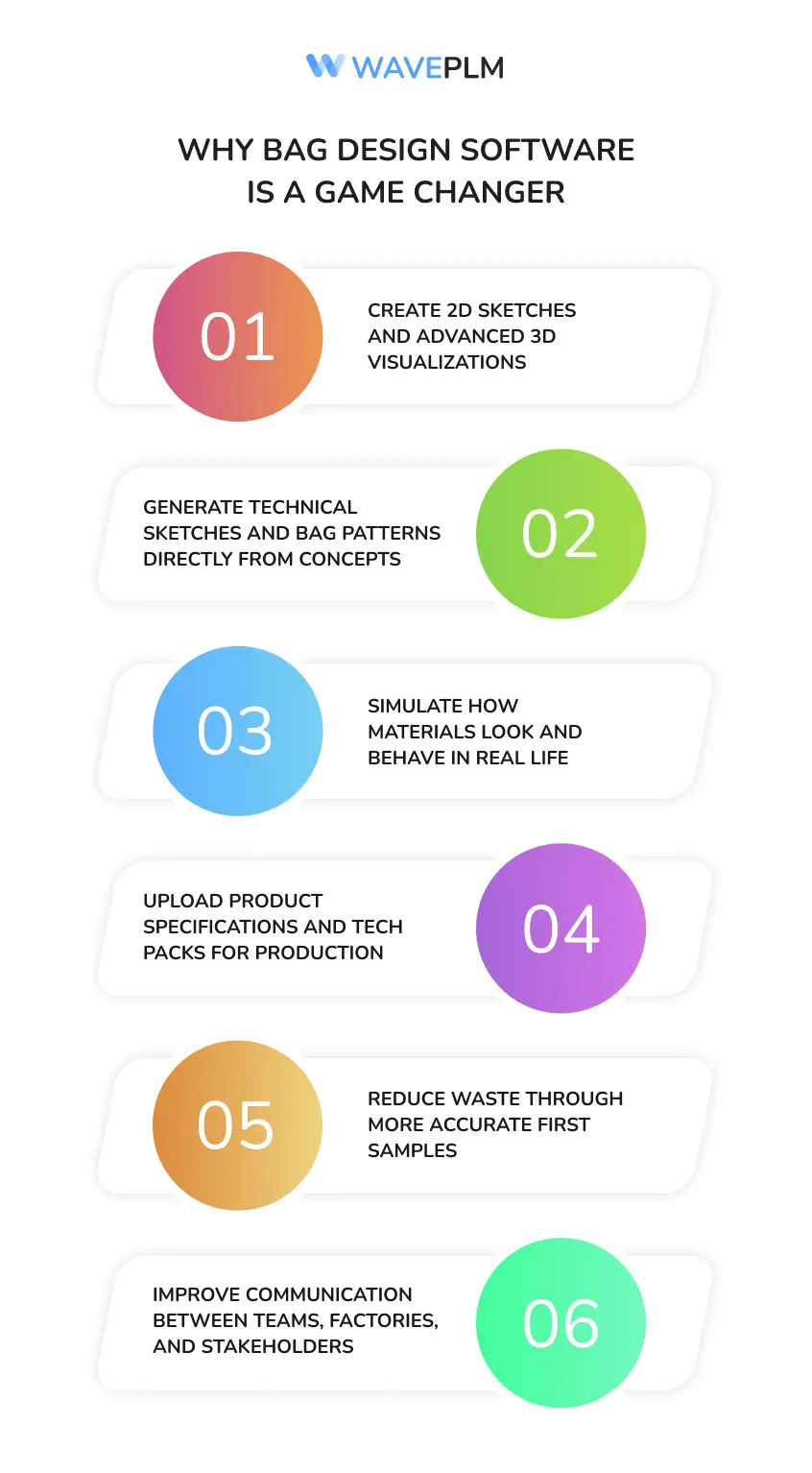
Bag design software gives designers, developers, and manufacturers a shared, digital space to:
- Create 2D sketches and advanced 3D bag visualizations
- Generate technical sketches and bag patterns directly from concepts
- Simulate how materials look and behave in real life
- Upload product specifications and tech packs for production
- Reduce waste through more accurate first samples
- Improve communication between teams, factories, and stakeholders
By using these tools, brands can focus on creativity while ensuring their designs are production-ready. A good solution eliminates guesswork and replaces it with clear, measurable design intent.
What features should you look for in bag design software?
Not all fashion design software is made for accessories. Designing bags involves distinct challenges—structural complexity, material layering, and hardware fitting. Here are key features you should prioritize:
| Feature | What It Enables |
|---|---|
| 2D & 3D Design Capabilities | Sketch, shape, and simulate bag forms in real-life scale |
| Customizable Templates | Save time by modifying base styles for totes, satchels, backpacks, and more |
| Fabric, Material & Color Libraries | Use consistent finishes, colors, and accessories across collections |
| Technical Specification Tools | Add seams, hardware, components, and precise measurements |
| Seamless PLM Integration | Real-time syncing between creative, technical, and sourcing teams |
| Easy Upload & Export Options | Click-to-export patterns, sketches, and tech packs |
The best design software for handbags helps teams collaborate across regions, disciplines, and time zones. It ensures that what’s drawn gets made right the first time.
Why does PLM for accessories matter?
PLM for accessories (Product Lifecycle Management built for handbags, footwear, and small leather goods) offers more than just data storage. For accessory brands, it functions as a digital command center.
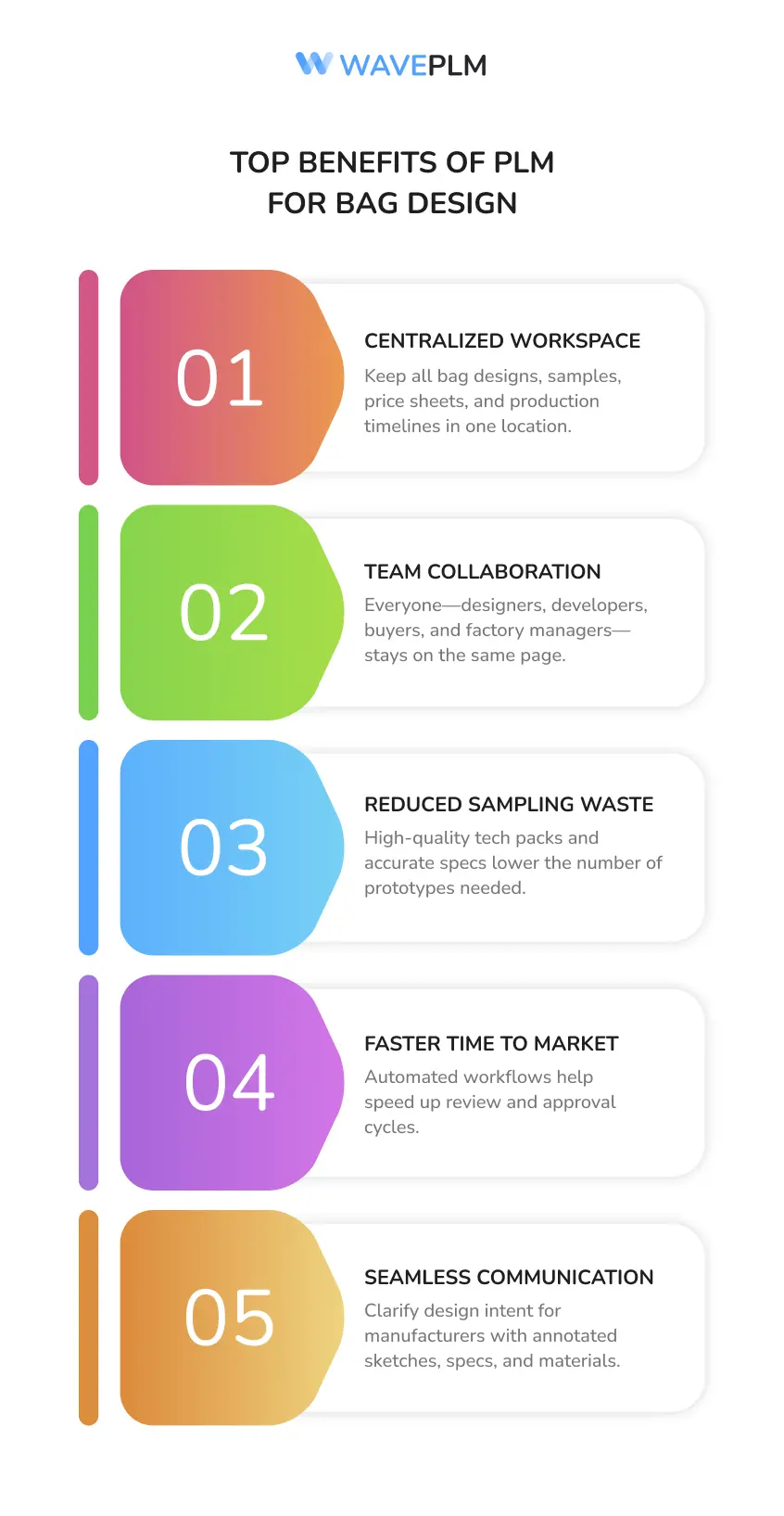
Top benefits of PLM for bag design
- Centralized workspace: Keep all bag designs, samples, price sheets, and production timelines in one location.
- Team collaboration: Everyone—designers, developers, buyers, and factory managers—stays on the same page.
- Reduced sampling waste: High-quality tech packs and accurate specs lower the number of prototypes needed.
- Faster time to market: Automated workflows speed up review and approval cycles.
- Seamless communication: Clarify design intent for manufacturers with annotated sketches, specs, and materials.
When bag design software is integrated with PLM, accessory product development becomes more agile and scalable.
Which bag design software tools are best in 2026?
Every stage of bag development needs different tools. Some are best for sketching; others for 3D rendering or manufacturing specs. Below is a comparison of the leading options:
| Software | Best for | Key features |
|---|---|---|
| Adobe Illustrator + plugins | Initial sketches & tech packs | Familiar interface, plugin support, easy mockups |
| Clo 3D | Realistic 3D bag simulation | Motion, texture, stitching simulation in real time |
| CorelDRAW | Precision vector & pattern drafting | Accurate panel cutting, color blocking, layouts |
| Rhino | Structural modeling for bags | Advanced 3D surfaces and details like buckles, frames |
| Wave PLM | Full accessory workflow management | Combines PLM, sketches, upload tools, and technical documentation |
Each tool contributes to the overall design process. Many brands use two or three in tandem to complete their collections—often pairing a 2D vector tool, a 3D simulator for virtual prototyping, and a PLM platform that ties everything together.
How do you master technical bag design?
Technical bag design means turning an idea into blueprints. It includes:
- Creating technical sketches with side, top, and inside views
- Adding annotations for seam types, piping, and closures
- Uploading spec sheets and a handbag tech pack with real-life measurements
- Modifying existing patterns for material or size changes
- Reviewing design intent with the factory before sampling
The accuracy of your technical sketches determines how close the sample will be to your original vision.
How do you create bag designs that reflect brand identity?
No matter your market—luxury, sports, streetwear—bag designs should reflect your brand personality and values.
Design software helps you:
- Start from scratch or import sketches to build new styles
- Choose materials and colors that support seasonal concepts
- Customize bag types for gender, activity, or trend category
- Modify older patterns to build capsule collections
- Maintain consistency in stitching, hardware, and finishes
Tools also enable a unified look across collections, increasing customer recognition and loyalty.
What does a real-life bag design workflow look like?
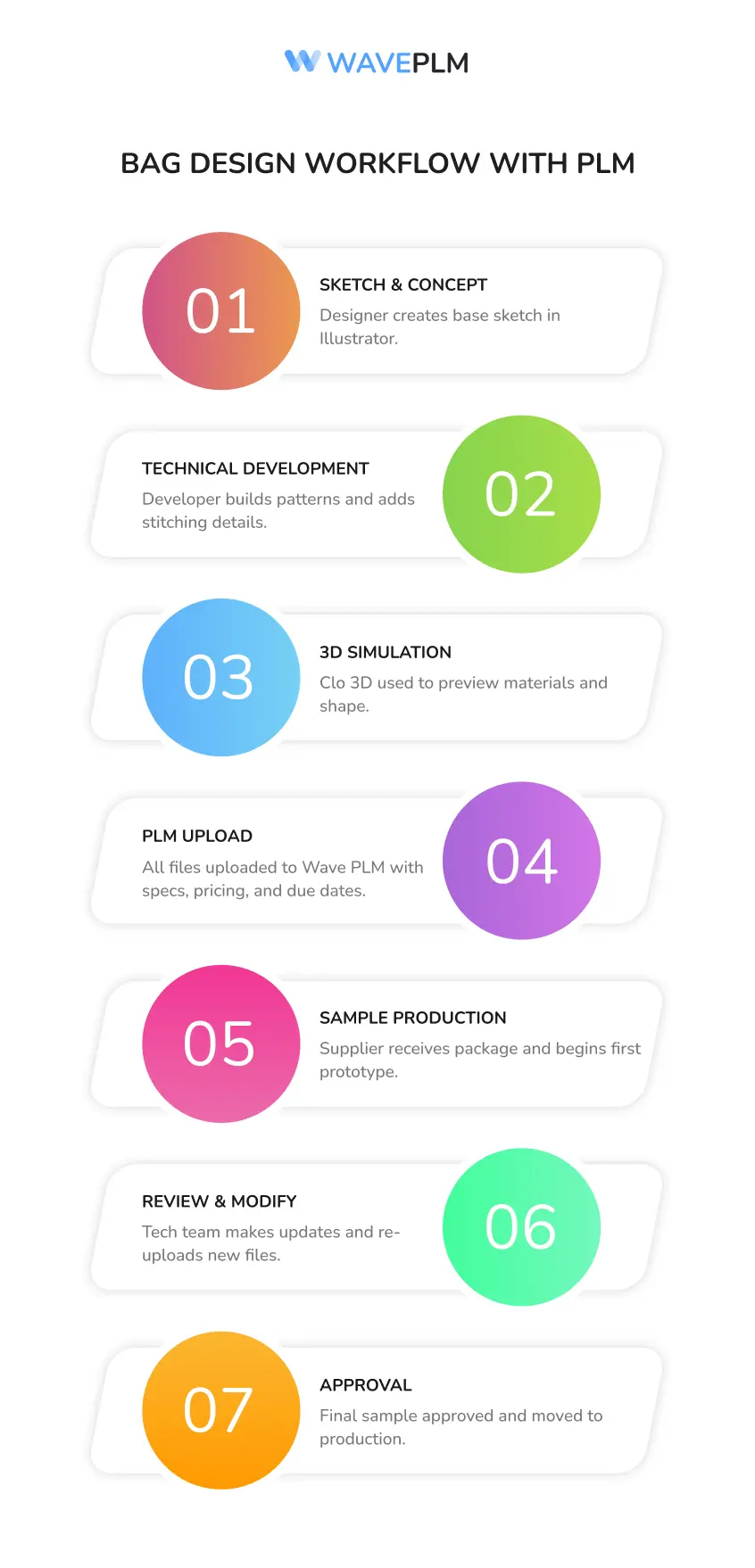
Here’s how a modern accessory company might use bag design software and PLM end to end:
- Sketch & concept: Designer creates the base sketch in Illustrator.
- Technical development: Developer builds patterns and adds stitching details.
- 3D simulation: Clo 3D used to preview materials and shape.
- PLM upload: All files uploaded to Wave PLM with specs, pricing, and due dates.
- Sample production: Supplier receives package and begins first prototype.
- Review & modify: Tech team makes updates and re-uploads new files.
- Approval: Final sample approved and moved to production.
This workflow streamlines everything—from creation to commercialization.
Bag design software: frequently asked questions
What is the best free software for fashion or bag design?
Blender (for 3D modeling) and Inkscape (for vector art) are free, open-source options. They require more learning but offer flexibility. For pattern drafting, Seamly2D is also free and accessory-friendly.
What machines are needed to make bags?
You’ll need industrial sewing machines (typically a walking-foot or post-bed machine for thicker leathers), pattern plotters, cutting tables or laser cutters, riveting machines, and hardware-attachment presses depending on the bag type.
Is it profitable to make bags?
Yes—especially if you carve out a niche. Profit depends on sourcing cost, brand price point, and how efficiently you manage the design-to-production process. Brands using PLM for accessories typically cut sampling rounds by 30–50%, which is where margin lives.
What’s the difference between bag design software and PLM?
Bag design software is where you sketch, pattern, and visualize. PLM is where you store, version, cost, and share those files with your factory. Modern accessory brands use both—and the value comes from connecting them.
What’s on the ultimate bag design software checklist?
Use this checklist to evaluate your current bag design software and decide whether it’s time to upgrade:
- ✔ Allows sketching and pattern creation for various bag types
- ✔ Supports 3D bag design with realistic materials and motion
- ✔ User-friendly interface for both creative and technical teams
- ✔ Enables uploading and real-time syncing with PLM platforms
- ✔ Stores and reuses design templates, material libraries, and color palettes
- ✔ Optimized specifically for accessories—not just general fashion
- ✔ Exports complete tech packs and specification sheets in one click
If your current solution doesn’t meet at least 5 of these requirements, consider switching to a more robust system to streamline your accessory product development process.
Bag design glossary: 6 terms every accessory team should know
- Bag design software — Digital tools used to sketch, pattern, and visualize handbags and other accessories before production.
- PLM (Product Lifecycle Management) — A central system that stores designs, BOMs, tech packs, samples, costs, and approvals across the design-to-delivery process.
- Tech pack — The technical specification document a factory needs to make your bag: measurements, materials, hardware, stitching, and construction notes.
- BOM (Bill of Materials) — The structured list of every component in a bag (lining, zipper, rivets, label) with supplier and quantity per unit.
- 3D simulation — Virtual prototyping that previews how a bag will look, drape, and behave before a physical sample is sewn.
- Panel — A single cut piece of material (front, back, gusset, strap) that combines with others to form the finished bag.
Final thoughts: bringing bag designs to life
The art of designing bags is evolving. Today, success means being able to start with a sketch, develop it digitally, test it virtually, and manufacture it reliably. From concept to store shelf, every step matters—and every tool you use should serve your brand’s creative and commercial goals.
With a combination of powerful tools and smart workflows, you can:
- Create beautiful, functional bags that customers love
- Streamline the process from idea to factory
- Enable your teams to collaborate globally
- Bring new collections to market faster and with fewer errors
Ready to start?
Wave PLM for accessories is a powerful and user-friendly platform tailored to handbag, footwear, and small-leather-goods brands. You can:
- Upload bag sketches, patterns, and files in one place
- Manage collections, suppliers, and approvals
- Automate workflows and reduce back-and-forth
Whether you’re a startup or a large company, Wave PLM helps you design with speed, confidence, and quality.
👉 Book a demo today and see how we can support your accessory product development.




Leave a Reply