

Scaling fashion brand operations from 20 to 100 styles per season is not simply doing more of the same. It is a phase transition. The informal systems that work at 20 styles — shared spreadsheets, email approvals, one person tracking everything — break down at predictable points as volume grows. Specifically, they break before most founders expect them to.
When scaling fashion brand operations, the creative side rarely fails. What fails is the infrastructure around it: how product data is managed, how sourcing is coordinated, how samples are approved, and how factories are briefed. Consequently, brands that scale cleanly are the ones that formalize these processes before the pressure forces them to — not after a season goes wrong.
This guide covers the key operational breakpoints between 20 and 100 styles, what to change at each stage, and when PLM software moves from optional to essential.
What Changes When Scaling Fashion Brand Operations from 20 to 100 Styles?
At 20 styles, one experienced person can hold most product knowledge in their head. They know which factory makes what, which supplier has the shortest lead time, and which styles are behind schedule. In contrast, at 100 styles, no single person can track all of it. Information must live in systems — not in someone’s memory or inbox.
The shift is also organizational. At 20 styles, teams communicate informally and resolve issues quickly. At 100 styles, you likely work with multiple factories, multiple categories, and a larger team. Furthermore, more decision-makers means more chances for information to diverge — and more costly consequences when it does.
| Scale | Typical Catalog | Team Structure | Main Operational Risk |
|---|---|---|---|
| 20 styles | 1–2 categories, 1 factory | Founder-led, 2–4 people | Founder as single point of failure |
| 40–60 styles | 2–3 categories, 2–3 factories | Small ops team, first hires | Spreadsheets diverge, sourcing errors compound |
| 80–100 styles | 3–5 categories, 3+ factories | Dedicated ops, sourcing, design leads | Approval chains break, margin visibility lost |
Additionally, the cost of errors scales with the catalog. A BOM mistake on one style at 20 styles is painful but contained. The same mistake across five styles at 100 styles — each with multiple colorways and sizes — can affect an entire season’s margin. Therefore, the operational discipline required at 100 styles is qualitatively different from what worked at 20.
When Does Complexity Become a Growth Bottleneck?
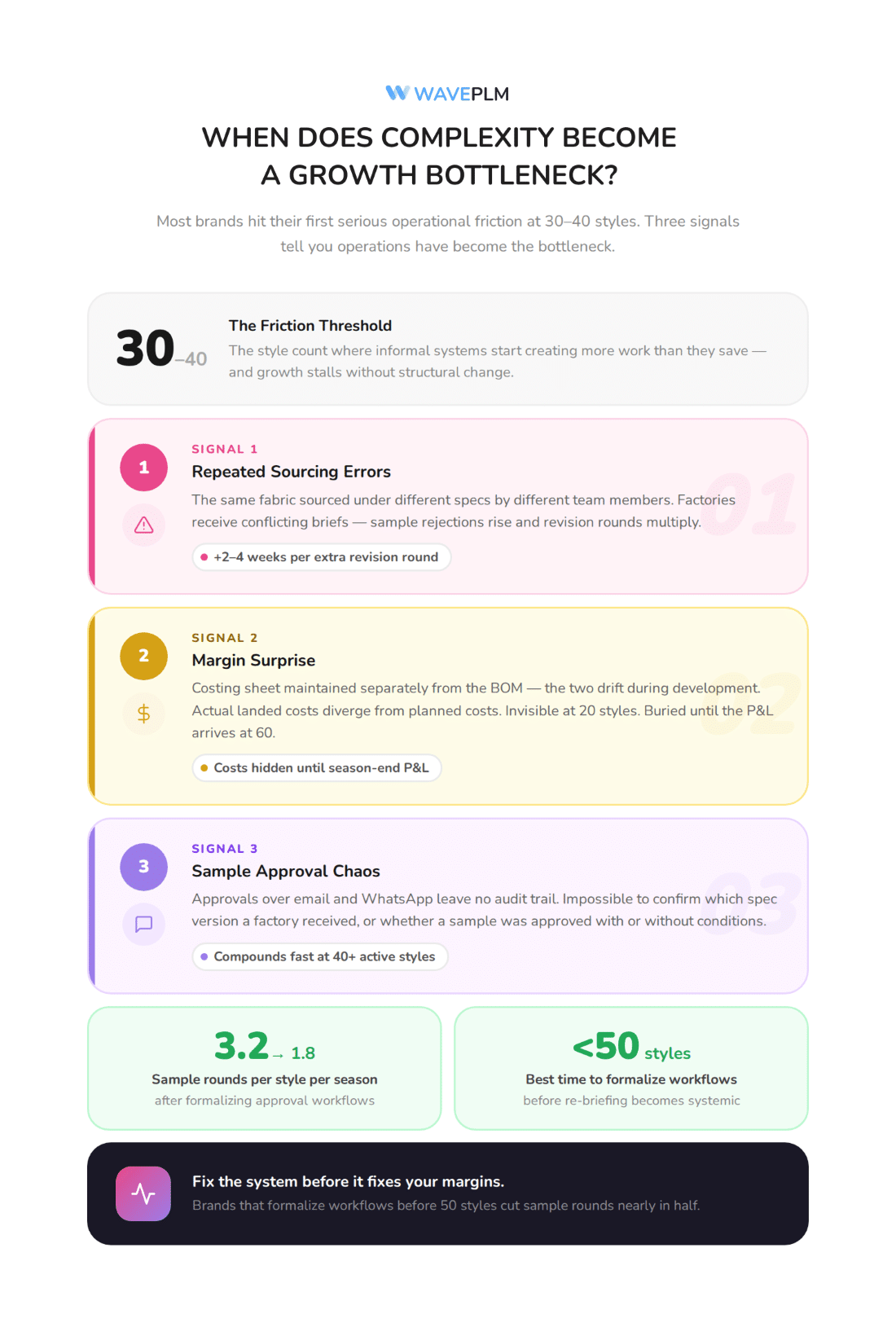
Most brands hit their first serious operational friction at 30–40 styles. This is when informal systems start creating more work than they save. Specifically, a few patterns signal that operations have become the bottleneck.
The first signal is repeated sourcing errors. When the same fabric is sourced under different specs by different team members, factories receive conflicting briefs. As a result, sample rejections increase and revision rounds multiply. Each additional revision costs two to four weeks and a factory slot.
The second signal is margin surprise. When a costing sheet is maintained separately from the BOM, the two drift apart during development. Consequently, actual landed costs at season end differ from planned costs. At 20 styles, this drift is visible. At 60 styles, it is buried until the P&L arrives.
The third signal is sample approval chaos. When approvals happen over email and WhatsApp, there is no audit trail. Specifically, it becomes impossible to confirm which version of a spec a factory received, or whether a sample was approved with or without conditions. Furthermore, this lack of traceability compounds fast when a product manager handles 40+ active styles simultaneously.
Our finding: Wave PLM customers who formalize approval workflows before reaching 50 styles reduce average sample rounds from 3.2 to 1.8 per style per season. The primary driver is eliminating re-briefing when factories receive outdated specs.
What Product Data Challenges Emerge When Scaling Fashion Brand Operations?
Product data management is the first domain to break during scaling fashion brand growth. At 20 styles, a shared spreadsheet is workable. At 60 styles, it becomes the root cause of most production problems.
BOM and Spec Fragmentation
The core problem is fragmentation. Design maintains one version of a spec. Sourcing has a different version with updated fabric costs. Production has a third version with factory modifications. In contrast, a single-source product record — where all teams work from the same file — eliminates the divergence entirely.
For brands without structured bill of materials management, the move from 20 to 60 styles is when multi-level BOM structure becomes necessary. Specifically, a flat material list becomes unmanageable when the same components appear across 30 styles. For a detailed guide on structuring product data at scale, see our article on multi-level BOM in fashion.
Tech Pack Version Control
Additionally, tech pack version control becomes critical at 40+ styles. Without versioning, factories cannot distinguish the current spec from a previous one. The result is production built to outdated measurements. Moreover, when a defect occurs, there is no way to confirm which spec version the factory used — making root cause analysis impossible.
The solution is straightforward: every tech pack needs a version number, a date, and an approval record. However, maintaining this discipline manually across 60 styles and several factories requires a system. Typically, this is when PLM software transitions from optional to essential.

How Does Sourcing Change When You Scale to 100 Styles?
Sourcing complexity grows faster than catalog size. At 20 styles with one factory, coordination is straightforward. At 100 styles across four factories and 15 fabric suppliers, it becomes a full-time operational function.
Supplier Proliferation and MOQ Management
More categories mean more suppliers. Furthermore, more suppliers mean more MOQ negotiations, more lead time variability, and more single-source risk. Brands that do not track supplier data centrally spend significant time re-establishing context at the start of each season.
Consequently, a formal vendor onboarding process and a centralized supplier database become essential by 50 styles. Without them, sourcing decisions are based on whoever the buyer remembered to call — not on supplier performance history.
Fabric Sourcing Across Multiple Factories
At 80–100 styles, the same fabric often feeds multiple factories. Sourcing it centrally — rather than letting each factory source independently — reduces MOQ risk and enables volume consolidation. However, this requires your fabric sourcing workflow to be managed at the brand level, not delegated to factories.
Additionally, lead time management becomes a critical planning function. With 100 styles in development simultaneously, a single fabric delivery delay cascades across five dependent styles. Therefore, a formal production calendar that maps every material lead time to dependent styles is essential — not a mental model or a spreadsheet tab.

How Do Approval Workflows Need to Change as You Scale?
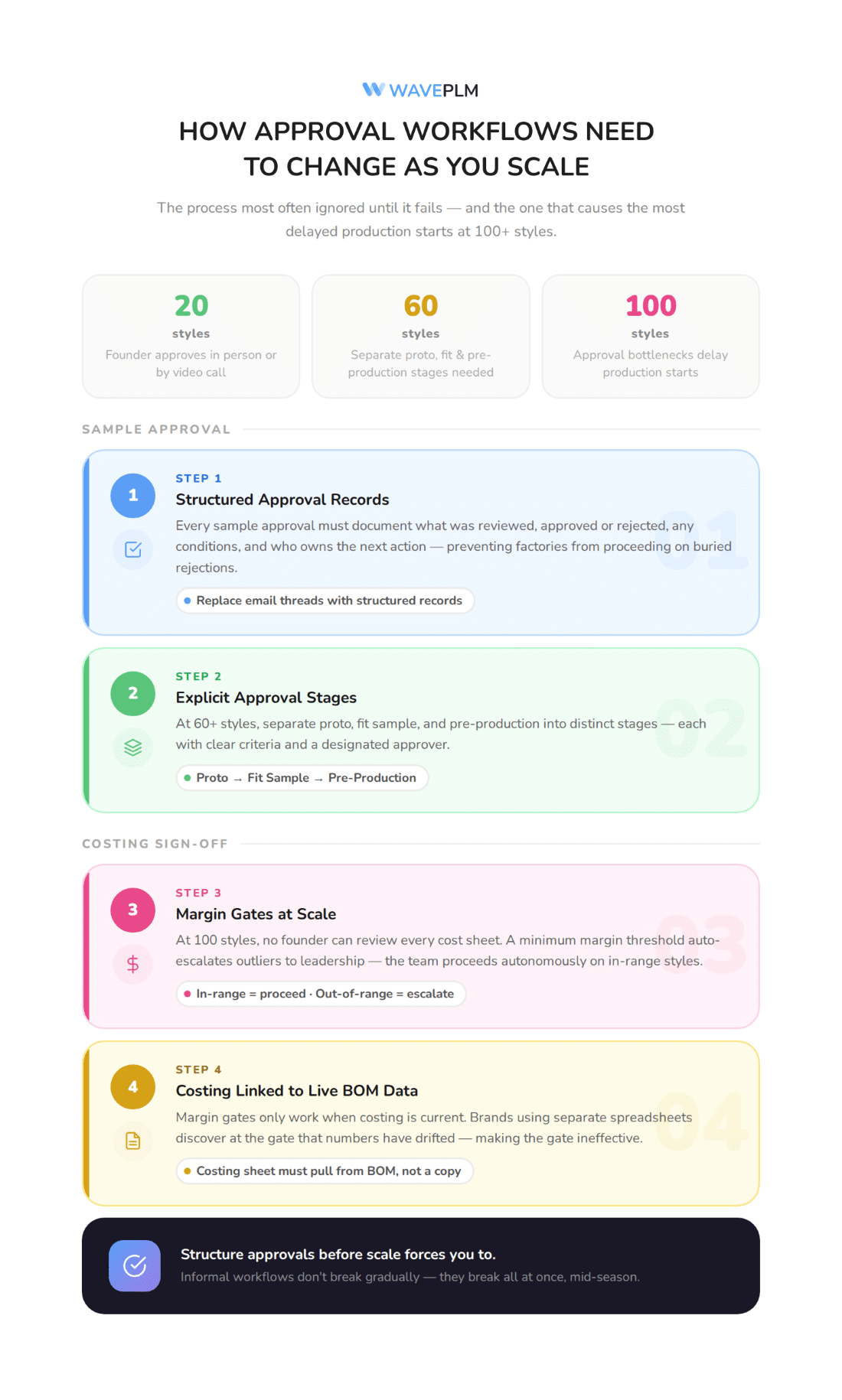
Approval workflows are the process most often ignored until they fail. At 20 styles, a founder approves samples in person or by video call. At 100 styles, approval bottlenecks are one of the most common causes of delayed production starts.
Sample Approval Formalization
The key change is moving from informal to structured approval. Specifically, each sample approval should document what was reviewed, what was approved or rejected, what conditions were attached, and who owns the next action. In contrast to email approvals, a structured record prevents the common scenario where a factory proceeds with a rejected sample because the rejection was buried in a thread.
Furthermore, approval stages should be defined explicitly. Most brands at 60+ styles benefit from separating proto, fit sample, and pre-production approval into distinct stages — each with clear criteria and a designated approver.
Costing Sign-Off and Margin Gates
Similarly, costing approvals become critical at scale. At 100 styles, a founder cannot review every cost sheet. Instead, a margin gate — a minimum acceptable margin that triggers automatic escalation if not met — allows the team to proceed autonomously on in-range styles and flag outliers for leadership review.
Notably, this requires costing data to be current and linked to real BOM data. Brands that maintain garment costing in separate spreadsheets typically discover at the margin gate that numbers have drifted from reality — making the gate ineffective.
When Is It Time to Move from Spreadsheets to PLM?
The honest answer is earlier than most brands make the move. The typical pattern is to wait until a failed season forces the decision. However, by that point, the cost of migrating data and retraining the team compounds an already stressful recovery.
PLM software becomes the right investment when two or more of the following are true. First, the same data exists in more than one file and those files regularly conflict. Second, sample revision rounds average more than two per style. Third, costing surprises at season end exceed 10% of planned costs. Fourth, onboarding a new factory takes weeks of manual document preparation rather than days. Fifth, a key team member leaving would take critical product knowledge with them.
Our finding: Wave PLM customers who implement PLM before reaching 60 styles report a smoother transition than those who wait. The primary reason is data volume — fewer styles means less historical data to migrate and fewer entrenched workarounds to unlearn.
Furthermore, the supplier portal functionality in PLM delivers compounding returns as the supplier base grows. At 20 styles with two suppliers, email is manageable. At 100 styles with 15 suppliers, a portal that centralizes spec delivery and approval tracking saves 8–12 hours per week per team member.

How Do Successful Brands Structure Their Operations Team at Scale?
Team structure is often the last thing brands formalize — but it significantly affects how well operational changes stick. Without clear ownership, even good systems fail because no one is accountable for maintaining them.
Role Clarity at 40–60 Styles
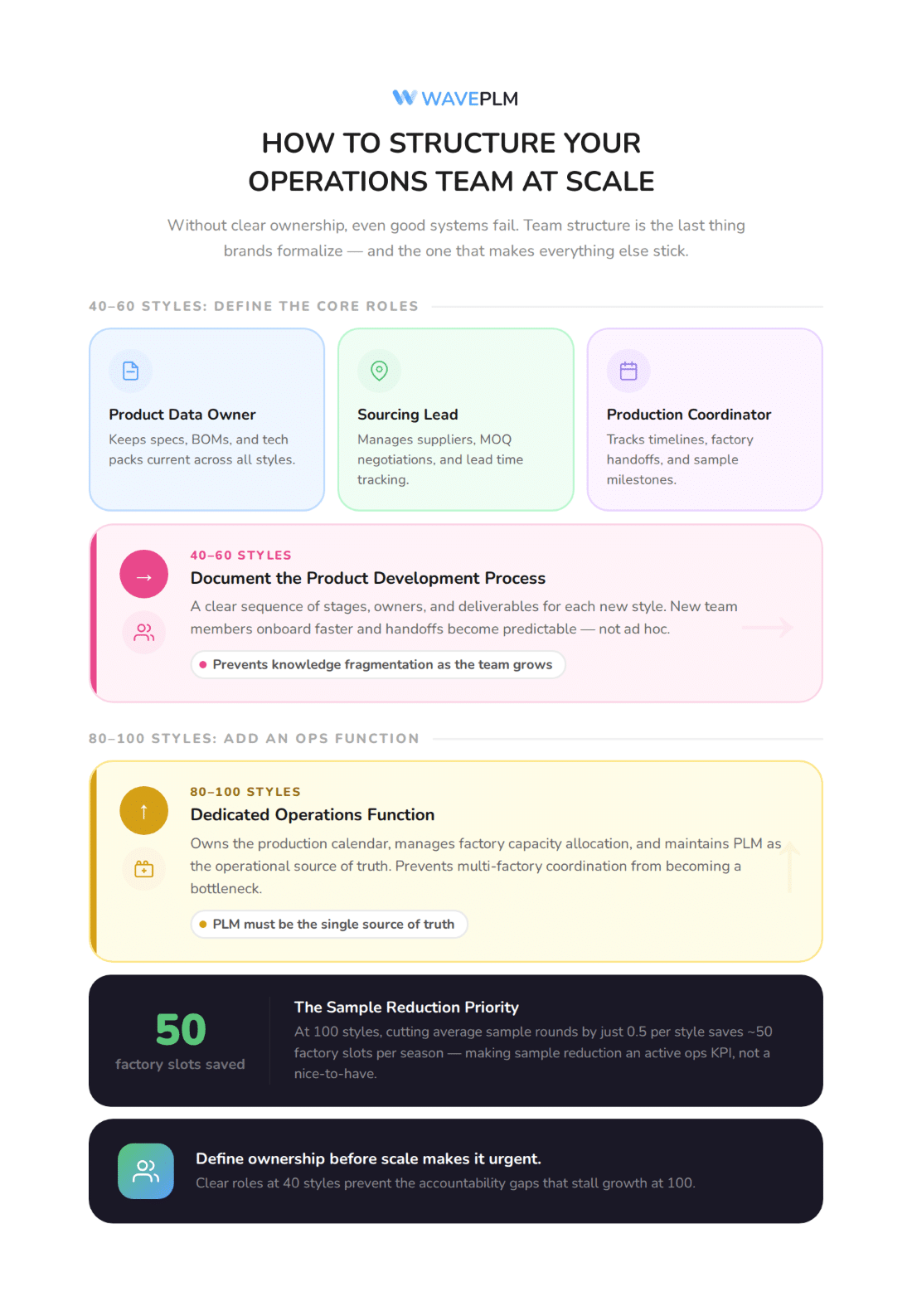
At 40–60 styles, the critical roles to define are product data owner, sourcing lead, and production coordinator. The product data owner ensures specs, BOMs, and tech packs are current. The sourcing lead manages supplier relationships, MOQ negotiations, and lead time tracking. In contrast to a founder-managed model, these dedicated roles prevent the knowledge fragmentation that causes most scaling failures.
Additionally, the product development process should be documented at this stage — a clear sequence of stages, owners, and deliverables for each new style. Consequently, new team members can be onboarded quickly and handoffs become predictable rather than ad hoc.
Role Clarity at 80–100 Styles
At 80–100 styles, brands typically need a dedicated operations function above individual category teams. This role owns the production calendar, manages factory capacity allocation, and maintains the PLM system as the operational source of truth. Specifically, this ensures that multi-factory coordination does not become a bottleneck as volume grows.
Furthermore, a formal sample reduction strategy becomes an active operations priority at this scale. With 100 styles, reducing average sample rounds by 0.5 per style saves approximately 50 factory slots per season.
Common Mistakes When Scaling Fashion Brand Operations
Most operational failures in growing apparel brands follow recognizable patterns. Understanding these in advance is the most effective way to avoid them.
Process and Data Mistakes
Scaling headcount before scaling systems. Adding team members before fixing broken processes creates more people working inefficiently. Therefore, the right sequence is to stabilize the process first — even with the current team — then hire into defined roles with clear systems already in place.
Treating PLM as an IT project. Brands that delegate PLM implementation to a technical team, without operations and sourcing leadership driving requirements, build systems that no one uses. Specifically, PLM adoption succeeds when the people who own product data define what the system must do before implementation begins.
Keeping a flat BOM format beyond 40 styles. A flat spreadsheet BOM does not support multi-factory allocation, shared component tracking, or level-by-level cost rollup. Consequently, brands that do not migrate to structured BOM management before reaching 60 styles spend entire seasons manually reconciling data a proper system would maintain automatically.
Team and Supplier Mistakes
Letting one person own all supplier relationships. When a single sourcing person holds all factory contacts informally, their departure creates an immediate operational crisis. In contrast, a centralized supplier record — maintained in a PLM or ERP system — ensures that relationship context survives team changes.
Adding factories without adding coordination capacity. Moving from one factory to three triples the coordination workload for spec delivery, sample tracking, and QC. Notably, brands that expand their factory base without implementing supplier portal and production calendar tools typically see on-time delivery rates drop in the following season.
Frequently Asked Questions
When does scaling fashion brand operations require formal systems?
Most brands hit their first serious operational friction at 30–40 styles per season. Specifically, this is when informal systems start generating more errors than they prevent. Formalizing product data management, approval workflows, and sourcing documentation before this point is significantly easier than doing so after a season has gone wrong.
What is the biggest operational challenge at 60–100 styles?
Product data fragmentation is the most common root cause of scaling failures. When specs, BOMs, and cost sheets live in separate files maintained by different team members, divergence is inevitable. Consequently, factories receive conflicting briefs, sample rejection rates rise, and costing surprises accumulate at season end.
How many styles per season requires PLM software?
Most apparel brands find spreadsheet-based management unsustainable between 40 and 60 styles per season. Specifically, PLM becomes the right investment when the same data exists in more than one file and those files regularly conflict, or when sample revision rounds average more than two per style.
How does multi-factory production change operations?
Moving from one factory to multiple factories multiplies coordination complexity. Each factory needs the same spec data, but receives different style allocations and has different lead times. Furthermore, when the same fabric feeds multiple factories, centralized sourcing becomes necessary to consolidate MOQs and manage delivery timing across facilities.
What team roles does a scaling fashion brand need at 40–60 styles?
At 40–60 styles, the critical roles to define are product data owner, sourcing lead, and production coordinator. Each role needs a clear mandate and a defined handoff protocol with the others. Additionally, a documented product development process — covering stages, owners, and deliverables — allows new team members to be onboarded without disrupting active seasons.
When should a fashion brand implement PLM during scaling?
The optimal time to implement PLM is before the pain becomes acute — typically at 30–50 styles. Brands that wait until 80+ styles implement PLM under pressure, with more data to migrate and more established workarounds to unlearn. Moreover, early implementation means the team grows into the system rather than having to change existing habits while managing a full season simultaneously.
Scaling fashion brand operations requires the same intentionality as product design — it just happens behind the scenes. The brands that build scalable systems early move faster, make fewer errors, and keep more margin as they grow.
Wave PLM is built for apparel brands at exactly this stage — scaling beyond spreadsheets, not yet ready for enterprise ERP. Book a demo to see how Wave PLM supports scaling fashion brand operations from 20 styles to 200.








Leave a Reply