

A fit session is a working meeting where a designer or technical designer evaluates a physical sample on a fit model against the spec sheet. The team then records what needs to change before the next round of sampling. In other words, it is the single checkpoint where a garment stops being a paper spec. Instead, it becomes a garment that actually fits a body. Skipping this step, or running it loosely, is one of the most common reasons brands burn through extra sample rounds and miss their production window.
This guide covers how to prepare for a fit session and who should be in the room. It also covers how to write fit comments a factory can actually act on, plus the fit issues that come up most often. Finally, it explains how PLM software replaces the scattered photos and email threads most brands still use to track fit feedback.
What Is a Fit Session?
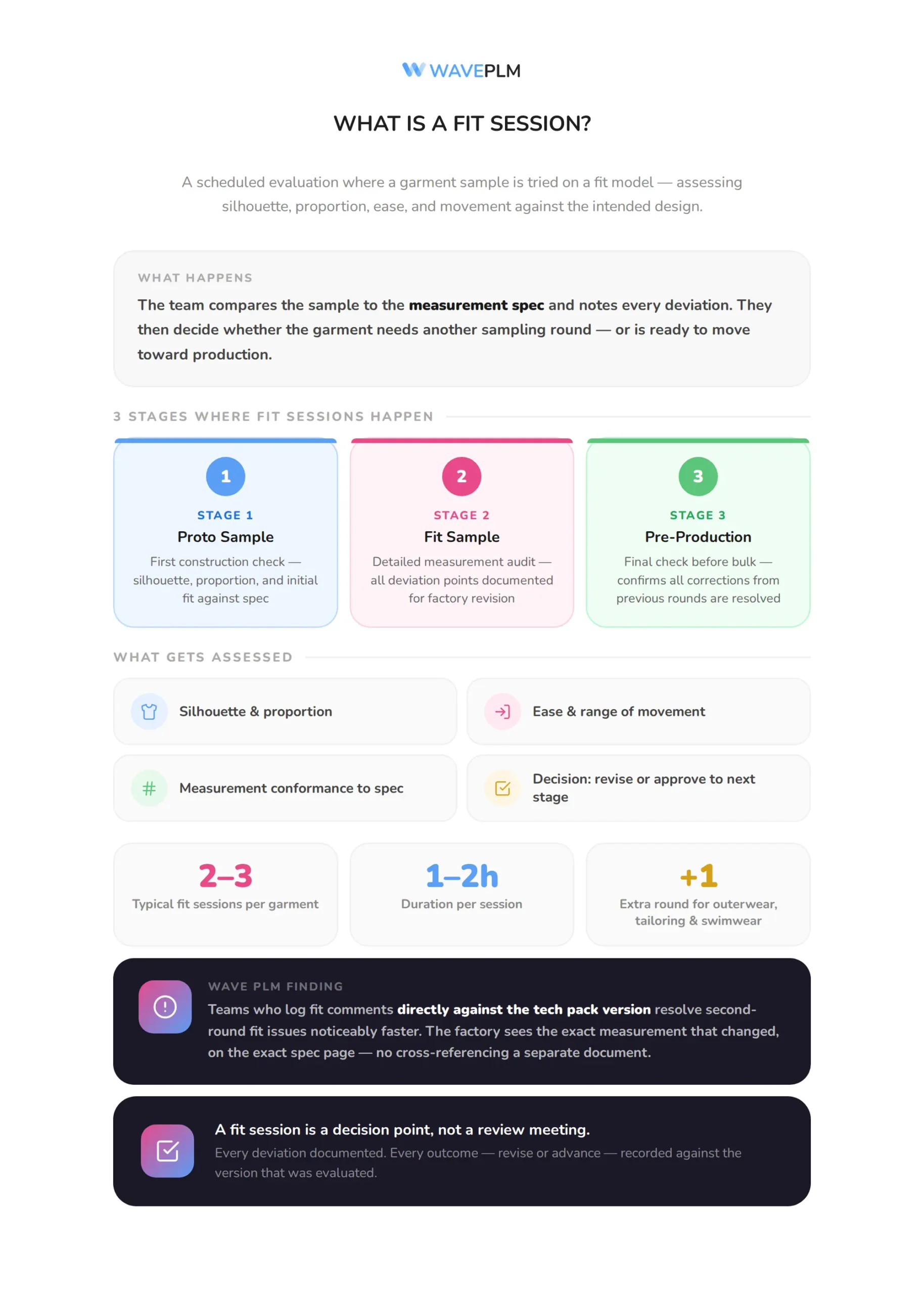
A fit session is a scheduled evaluation where a garment sample is tried on a fit model. The design and technical team assess silhouette, proportion, ease, and movement against the intended design. Specifically, the team compares the sample to the measurement spec and notes every deviation. They then decide whether the garment needs another sampling round or is ready to move toward production. Typically, fit sessions happen at three points: the proto sample stage, the second or “fit” sample stage, and once more at pre-production for a final check.
Researchers at the University of Minnesota have analyzed fit sessions across the apparel industry. According to their findings, garments typically go through two to three fit sessions. Each session usually lasts one to two hours. That timeline holds for most woven and knit categories. However, highly structured or fitted garments — outerwear, tailoring, swimwear — often need an additional round.
Our finding: Wave PLM customers who log fit comments directly against the tech pack version resolve second-round fit issues noticeably faster than teams using email or a shared spreadsheet. The reason is simple. The factory sees the exact measurement that changed, on the exact spec page it changed on. No one needs to cross-reference a separate document.
Why Are Fit Sessions Important in Apparel Development?
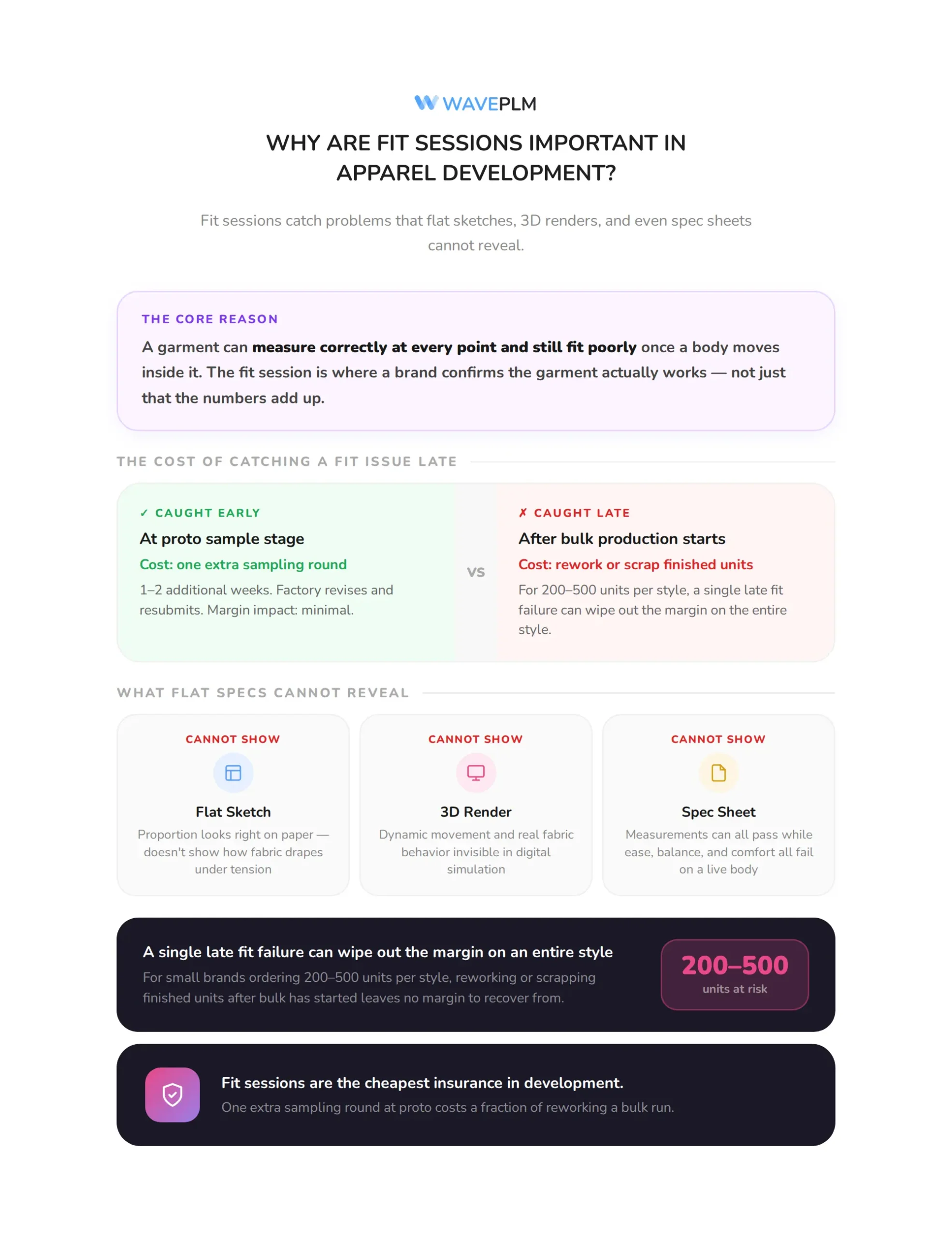
Fit sessions catch problems that flat sketches, 3D renders, and even spec sheets cannot reveal. Specifically, a garment can measure correctly at every point and still fit poorly once a body moves inside it. As a result, the fit session is where a brand confirms the garment actually works — not just that the numbers add up.
Skipping or rushing this step has a direct cost. For example, a fit issue caught at the proto sample stage costs one extra sampling round. By contrast, the same issue caught after bulk production has started means reworking or scrapping finished units. Consequently, for a small brand ordering 200–500 units per style, a single fit failure discovered late can wipe out the margin on an entire style.
How Do You Prepare for a Fit Session?
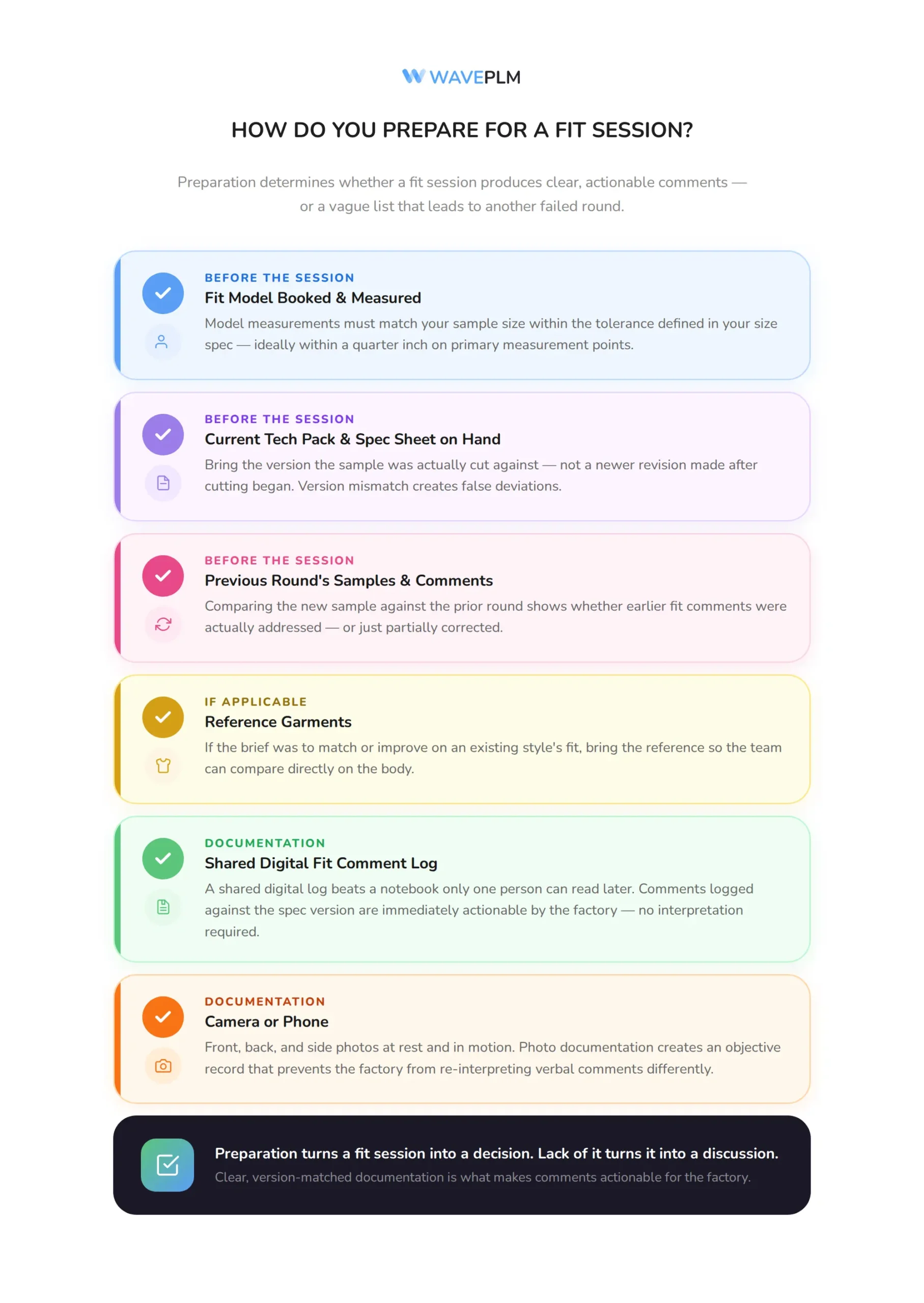
Preparation determines whether a fit session produces clear, actionable comments or a vague list that leads to another failed round. Before the session, confirm the following:
- Fit model booked and measured. The model’s measurements should match your sample size within the tolerance defined in your size spec — ideally within a quarter inch on primary measurement points.
- Current tech pack and spec sheet on hand. Bring the version the sample was actually cut against, not a newer revision made after cutting began.
- Previous round’s samples and comments. Comparing the new sample against the prior round shows whether earlier fit comments were actually addressed.
- Reference garments, if the brief was to match or improve on an existing style’s fit.
- A consistent way to record comments — a shared digital fit comment log beats a notebook that only one person can read later.
- A camera or phone for front, back, and side photos at rest and in motion.
Who Should Attend a Fit Session?
At minimum, a fit session needs a technical designer to assess measurements and construction. It also needs a designer to confirm the silhouette matches design intent. Larger teams additionally include a merchandiser or product manager, who weighs fit trade-offs against cost and timeline. Sometimes a QC lead also joins, flagging construction issues that could become defects at scale. Importantly, one person should always own the final written comments. Otherwise, comments get duplicated, contradicted, or lost between the meeting and the factory email.
How Do You Run a Fit Session Step by Step?
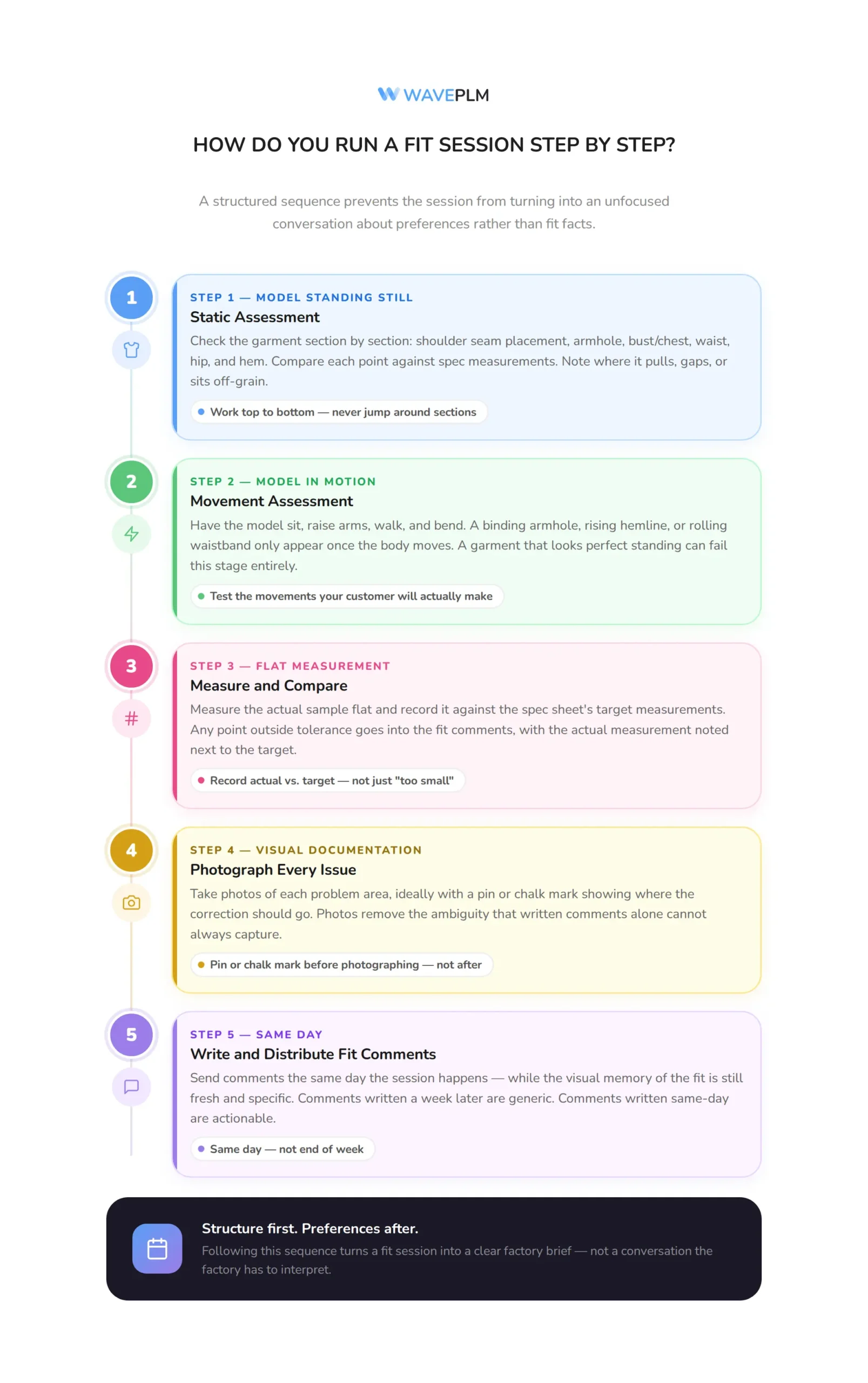
A structured sequence prevents the session from turning into an unfocused conversation about preferences rather than fit facts.
1. Static Assessment
With the model standing still, check the garment section by section: shoulder seam placement, armhole, bust or chest, waist, hip, and hem. Compare each point against the spec measurements. Note any point where the garment pulls, gaps, or sits off-grain.
2. Movement Assessment
Next, have the model sit, raise their arms, walk, and bend. Many fit issues — a binding armhole, a rising hemline, a waistband that rolls — only appear once the body moves. In fact, a garment that looks perfect standing still can fail this stage entirely.
3. Measure and Compare
Then measure the actual sample flat and record it against the spec sheet’s target measurements. Any point outside tolerance goes into the fit comments, with the actual measurement noted next to the target.
4. Photograph Every Issue
Take photos of each problem area, ideally with a pin or chalk mark showing where the correction should go. This step matters because photos remove ambiguity that written comments alone cannot always capture.
5. Write and Distribute Fit Comments
Finally, send comments out the same day the session happens, while the visual memory of the fit is still fresh and specific.
What Should a Good Fit Comment Include?
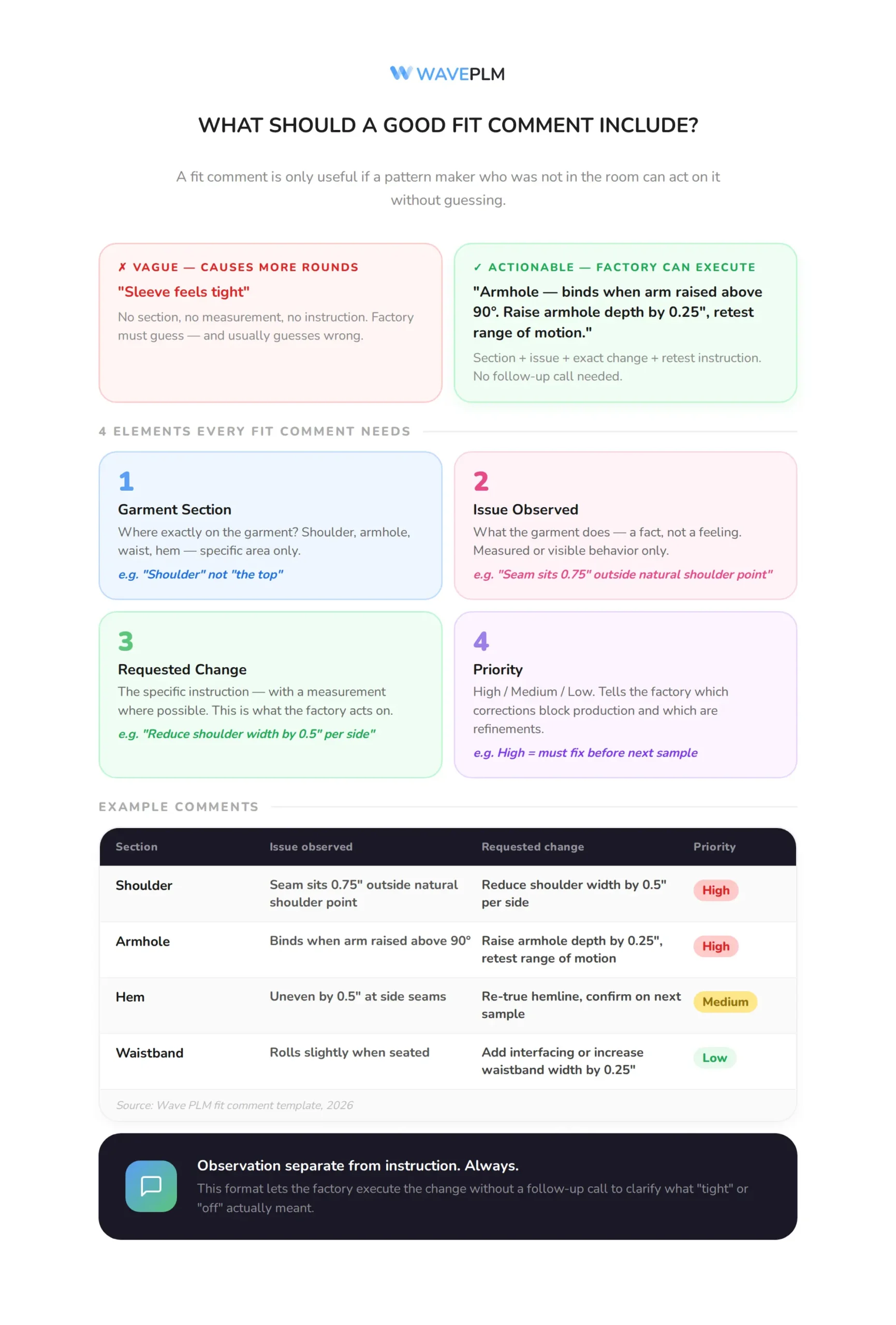
A fit comment is only useful if a pattern maker who was not in the room can act on it without guessing. For instance, vague notes like “sleeve feels tight” cause more revision rounds than they prevent. Instead, a complete fit comment states the garment section, the specific problem, the measurement change needed, and the priority.
| Garment section | Issue observed | Requested change | Priority |
|---|---|---|---|
| Shoulder | Seam sits 0.75″ outside natural shoulder point | Reduce shoulder width by 0.5″ per side | High |
| Armhole | Binds when arm raised above 90° | Raise armhole depth by 0.25″, retest range of motion | High |
| Hem | Uneven by 0.5″ at side seams | Re-true hemline, confirm on next sample | Medium |
| Waistband | Rolls slightly when seated | Add interfacing or increase waistband width by 0.25″ | Low |
Notably, this format works because it separates observation from instruction. As a result, a factory pattern maker can execute the change without a follow-up call to clarify what “tight” or “off” actually meant.
What Are the Most Common Fit Issues Fashion Brands Encounter?
Certain fit problems recur across nearly every category. Moreover, most trace back to the same handful of causes.
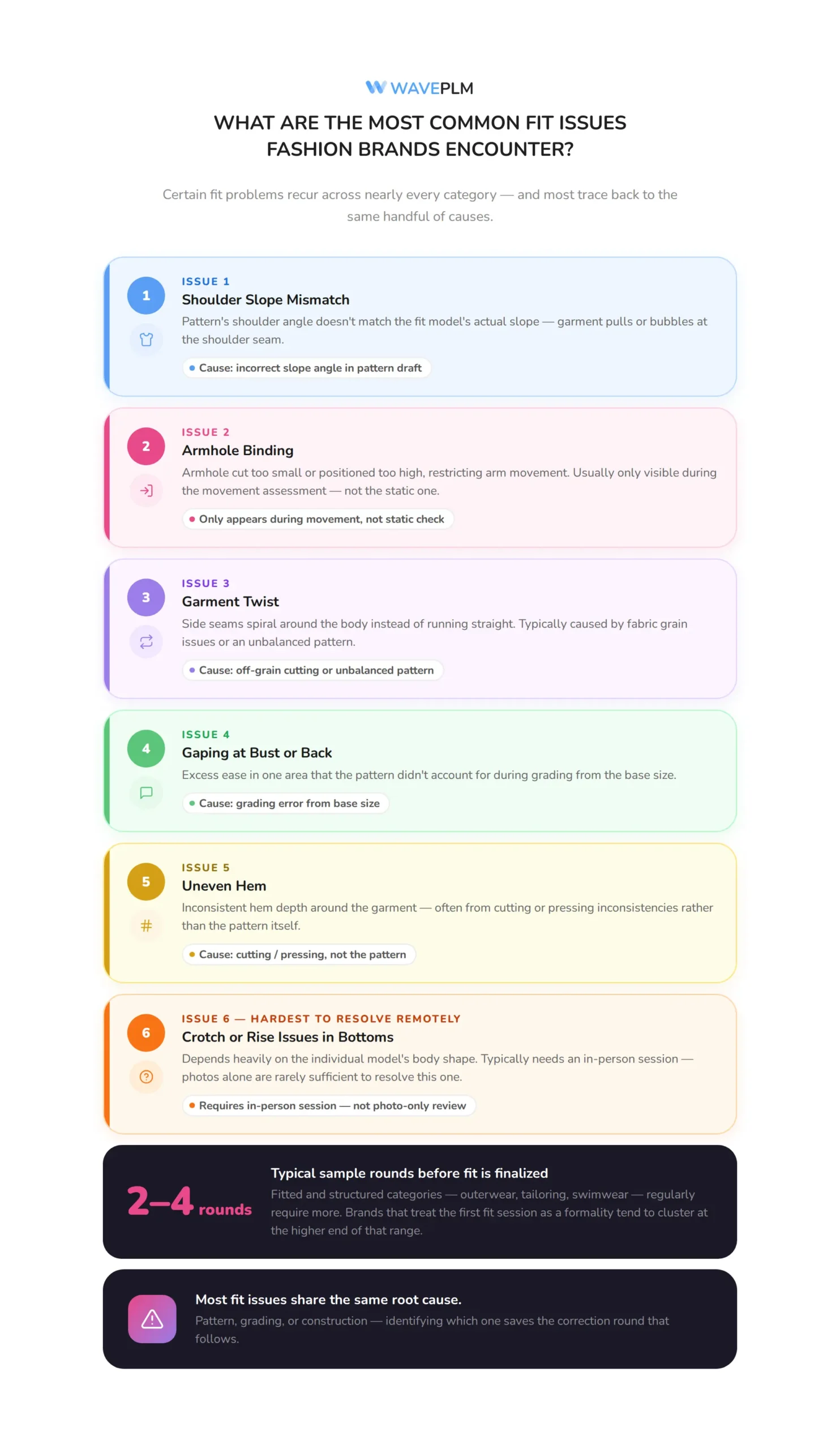
- Shoulder slope mismatch. The pattern’s shoulder angle does not match the fit model’s actual slope, causing the garment to pull or bubble at the shoulder seam.
- Armhole binding. The armhole is cut too small or positioned too high, restricting arm movement. Notably, this issue is usually only visible during the movement assessment, not the static one.
- Garment twist. Side seams spiral around the body instead of running straight. This is typically caused by fabric grain issues or an unbalanced pattern.
- Gaping at the bust or back. Excess ease in one area that the pattern did not account for during grading from the base size.
- Uneven hem. Inconsistent hem depth around the garment, often from cutting or pressing inconsistencies rather than the pattern itself.
- Crotch or rise issues in bottoms. This is one of the hardest fit problems to resolve remotely, since it depends heavily on the individual model’s body shape. Consequently, it typically needs an in-person session rather than photos alone.
Industry data: Apparel development research consistently finds that most styles need two to four sample rounds before a fit is finalized. Fitted or structured categories — outerwear, tailoring, swimwear — regularly require more. Notably, brands that treat the first fit session as a formality rather than a diagnostic step tend to cluster at the higher end of that range.
How Many Fit Sessions Does a Garment Typically Need?
In general, most styles need two to three fit sessions: an initial proto fit, a second fit confirming corrections, and a final pre-production check. Simple knit categories sometimes clear in two rounds. Meanwhile, complex or fitted categories — outerwear, structured dresses, swimwear, tailored bottoms — regularly need four or more rounds. That said, a style still generating major fit comments after three rounds usually points to a deeper problem. Specifically, the root cause is often the base pattern or the size spec itself, not the sample maker’s execution. In that case, it is worth revisiting the pattern before ordering another round.
How Does PLM Software Improve Fit Session Management?
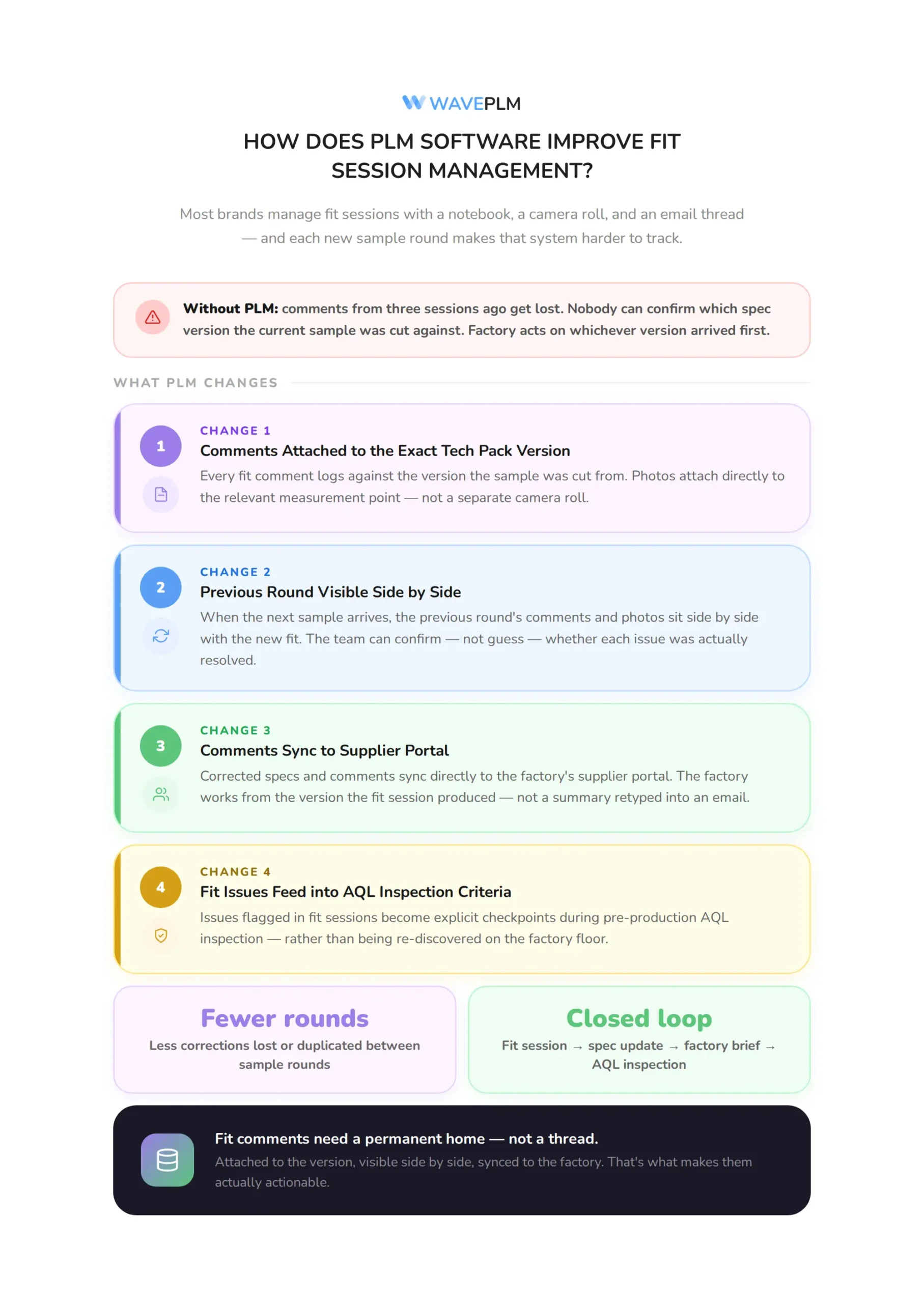
Most brands manage fit sessions through some combination of a paper notebook, a phone camera roll, and an email thread. However, each new sample round makes that system harder to track. For example, comments from three sessions ago get lost, and nobody can confirm which spec version the current sample was actually cut against. In some cases, two people write down slightly different versions of the same comment, so the factory acts on whichever one arrived first.
PLM software fixes this by giving fit comments a permanent home attached to the actual product record, not a side document. Specifically, in Wave PLM, every fit comment logs against the exact tech pack version the sample was cut from. Photos attach directly to the relevant measurement point. As a result, when the next sample arrives, the previous round’s comments and photos sit side by side with the new fit. This means the team can confirm, instead of guess, whether each issue was actually resolved. Furthermore, comments and corrected specs sync straight to the supplier portal. The factory then works from the same version the fit session produced, not a summary retyped into an email.
This also connects directly to tech pack version control. Specifically, a fit comment that changes a measurement should update the spec sheet immediately, not after someone remembers to edit the master document days later. Brands that centralize this process report meaningfully fewer sample rounds overall, largely because fewer corrections get lost or duplicated between rounds. Additionally, fit data feeding into quality inspection criteria at the pre-production stage closes the loop. Issues flagged in fit sessions therefore become explicit checkpoints during AQL inspection, rather than being re-discovered on the factory floor.
What Mistakes Do Brands Make Managing Fit Sessions?
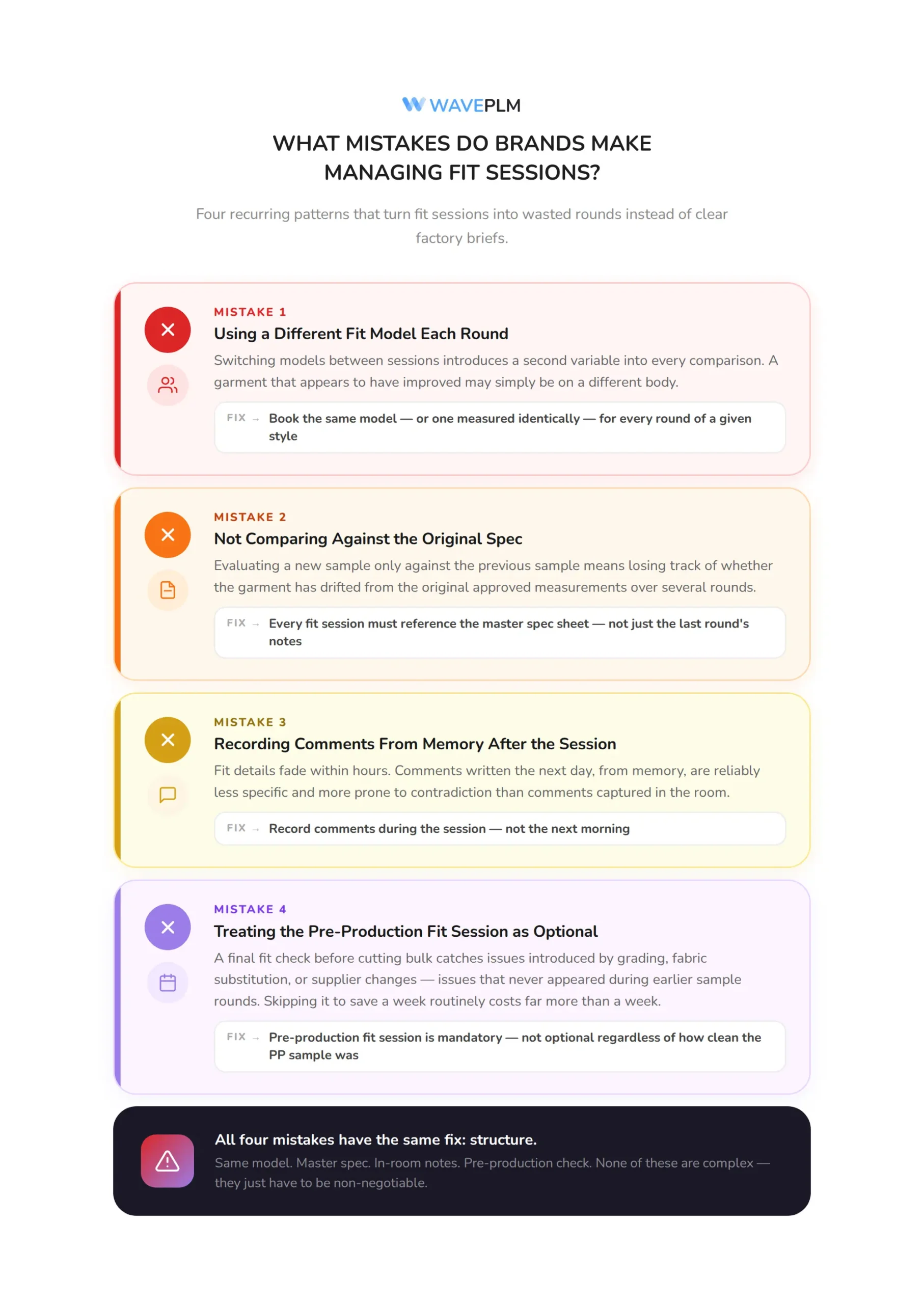
Using a Different Fit Model Each Round
Switching fit models between sessions introduces a second variable into every comparison. Specifically, a garment that appears to have improved may simply be on a different body. For this reason, book the same model, or one measured identically, for every round of a given style.
Not Comparing Against the Original Spec
Teams sometimes evaluate a new sample only against the previous sample. As a result, they lose track of whether the garment has drifted from the original approved measurements over several rounds. Instead, every fit session should reference the master spec sheet, not just the last round’s notes.
Recording Comments From Memory After the Session
Fit details fade within hours. Consequently, comments written the next day, from memory, are reliably less specific and more prone to contradiction than comments captured in the room.
Treating Fit Sessions as Optional at Pre-Production
A final fit check before cutting bulk fabric catches issues introduced by grading, fabric substitution, or supplier changes. These issues never appeared during earlier sample rounds. Skipping this step to save a week routinely costs far more than a week. That cost only shows up once a fit problem reaches finished goods, a risk covered further in our guide to sample sizing for quality decisions.
Frequently Asked Questions
What is a fit session in fashion?
A fit session is a meeting where a design and technical team evaluate how a garment sample fits on a fit model. They compare it against the spec sheet and design intent. The team records every deviation as a fit comment, then decides whether the garment needs another sampling round or is ready for production. Most styles go through two to three fit sessions before the fit is finalized.
Who should attend a fit session?
At minimum, a technical designer and a designer should attend every fit session. Larger teams often add a merchandiser or product manager, who weighs fit trade-offs against cost and timeline. A QC lead sometimes joins too, flagging construction issues before they reach scale. Importantly, one person should always be designated to own and distribute the final written comments.
How do you write a good fit comment?
A good fit comment names the exact garment section, describes the specific problem observed, states the measurement change needed, and assigns a priority. Comments like “sleeve feels tight” are too vague to act on. Instead, a usable comment names the issue directly: armhole binds above a 90-degree arm raise. It then gives the fix: increase armhole depth by 0.25 inches, then retest range of motion.
How many fit sessions does a garment need before production?
Most styles need two to three fit sessions: an initial proto fit, a second fit confirming prior corrections, and a final pre-production check. Simple knit styles sometimes clear in two rounds. Fitted or structured categories, such as outerwear, tailoring, and swimwear, often need four or more. Notably, a style still generating major fit issues after three rounds usually has a base pattern problem rather than a sampling execution problem.
What is the difference between a fit session and a fit comment?
A fit session is the live meeting where the sample is evaluated on a fit model. By contrast, a fit comment is the written output of that session: a specific, actionable note describing a fit problem, the correction needed, and its priority. Typically, one fit session generates multiple fit comments, one for each issue identified.
How does PLM software help manage fit sessions?
PLM software gives fit comments a permanent record attached to the exact tech pack version. This replaces scattering comments across email and photo libraries. For example, Wave PLM lets teams compare fit comments and photos side by side across rounds. It also syncs corrected specs straight to the supplier portal. Unresolved fit issues then carry forward into pre-production quality checklists automatically.
A fit session only prevents extra sample rounds when its comments are specific and consistently recorded. They also need to be easy for a factory to act on without guesswork. However, most brands lose that consistency the moment fit feedback moves from the fitting room into scattered emails and photo folders.
Wave PLM keeps fit comments, tech pack versions, and supplier communication in one system. As a result, every sampling round starts from the current spec instead of a summary someone remembers. See how Wave PLM supports sampling and fit management →







Leave a Reply