
The EU Green Claims Directive was a proposed law requiring companies to independently verify voluntary environmental claims. In June 2025, however, the European Commission withdrew the proposal entirely. It cited concerns about the administrative burden on smaller businesses. That withdrawal does not, in fact, mean unproven “eco-friendly” labels are now safe in the EU. A separate, already-adopted law still applies here: the Empowering Consumers for the Green Transition Directive. It bans vague and unsubstantiated green claims starting September 27, 2026. Importantly, fashion brands selling into the EU need to prepare for that date, regardless of what happened to the standalone Green Claims Directive.
This guide covers what the Green Claims Directive actually was, and why it was withdrawn. It also explains which rules genuinely apply to a fashion brand’s marketing claims right now. Next, it compares this to the EU Digital Product Passport and California’s textile EPR law. Finally, it covers where the underlying substantiation data already lives inside a connected PLM system.
What Was the EU Green Claims Directive?
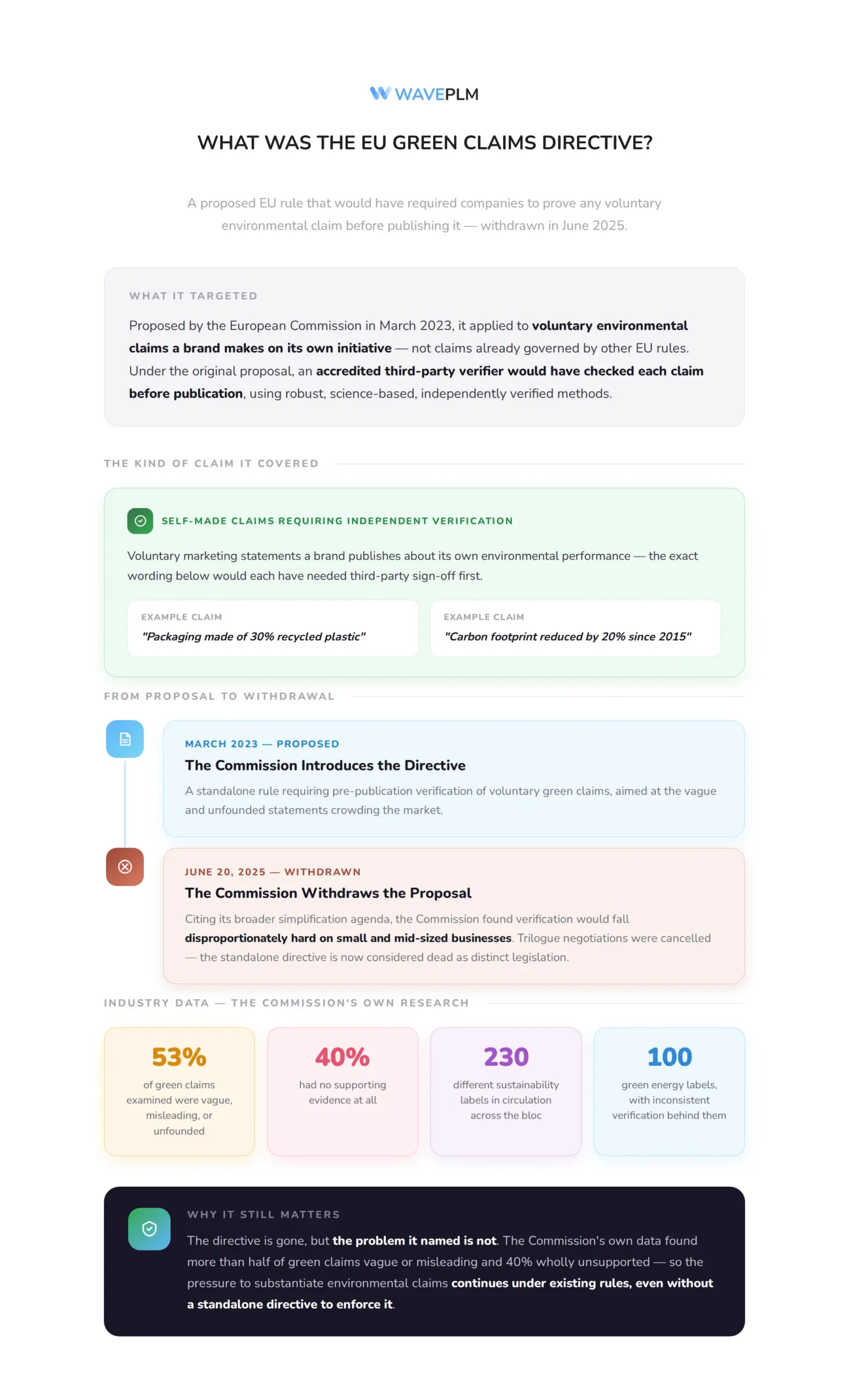
The Green Claims Directive was proposed by the European Commission in March 2023. It would have required companies to prove any voluntary environmental claim using robust, science-based, and independently verified methods before publishing it. Specifically, the proposal targeted claims such as “packaging made of 30% recycled plastic” or “carbon footprint reduced by 20% since 2015.” These are, in other words, statements a brand makes on its own initiative, not ones already governed by other EU rules. Under the original proposal, an accredited third-party verifier would have checked each claim before a brand could publish it.
The European Commission withdrew this proposal on June 20, 2025. Legal analysis published at the time points to the Commission’s broader simplification agenda. Verification requirements, the Commission found, would fall disproportionately hard on small and mid-sized businesses. Trilogue negotiations between the EU Parliament and Council were cancelled as a result. The standalone Green Claims Directive is now considered dead as a distinct piece of legislation.
Industry data: The European Commission’s own research, published alongside the original proposal, found that 53% of green claims examined across the EU gave vague, misleading, or unfounded information. 40% had no supporting evidence at all. The Commission also identified 230 different sustainability labels and 100 green energy labels in circulation across the bloc, with wildly inconsistent levels of verification behind them.
What Green Claims Rules Actually Apply to Fashion Brands Right Now?
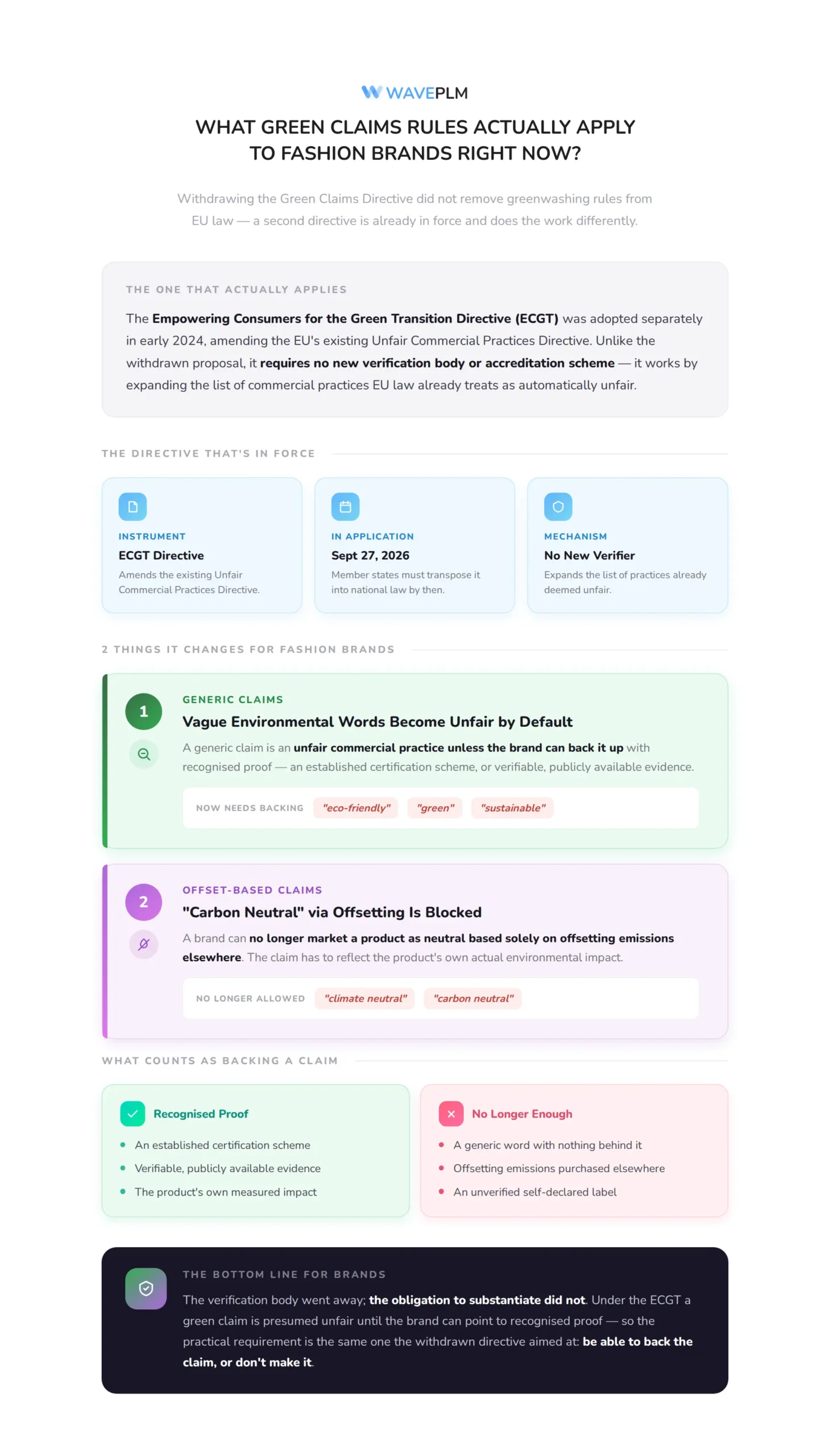
Withdrawing the Green Claims Directive did not remove greenwashing rules from EU law. A second directive, the Empowering Consumers for the Green Transition Directive, was adopted separately in early 2024. It amends the EU’s existing Unfair Commercial Practices Directive directly. Consequently, member states must transpose it into national law, with the rules entering into application on September 27, 2026. Unlike the withdrawn Green Claims Directive, the ECGT is fully in force. It does not require a new verification body or accreditation scheme. Instead, it works by expanding the list of commercial practices EU law already treats as automatically unfair.
Under the ECGT, a generic environmental claim such as “eco-friendly,” “green,” or “sustainable” becomes an unfair commercial practice unless the brand can back it up. That backing needs to be recognized proof: an established certification scheme, or verifiable, publicly available evidence. The rule also blocks a specific and common industry shortcut. A brand can no longer market a product as “climate neutral” or “carbon neutral” based solely on offsetting its emissions elsewhere. The claim has to reflect the product’s own actual environmental impact.
Do Brand Names and Logos Count as Environmental Claims?
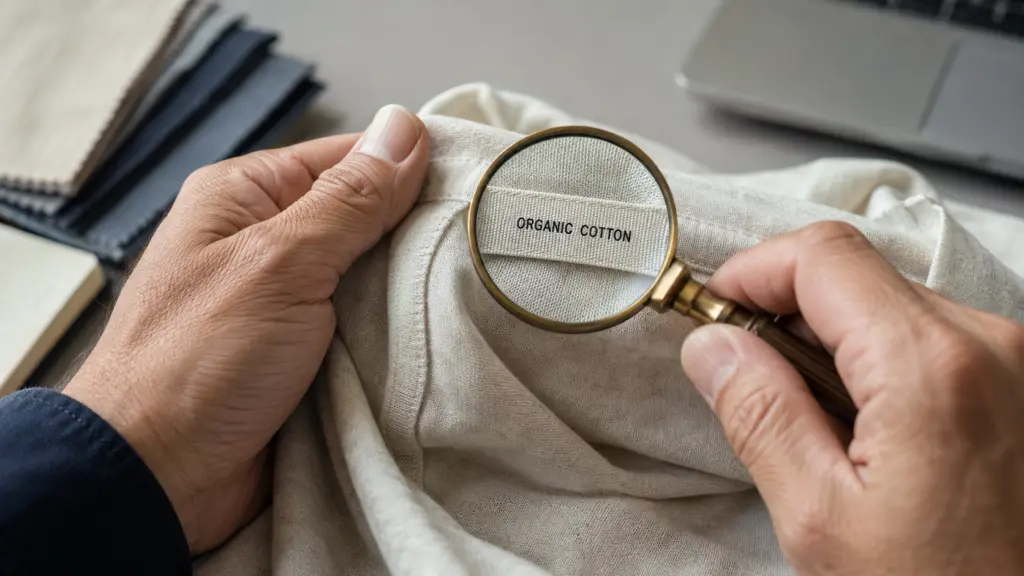
Yes. The ECGT’s scope covers any explicit environmental claim made in business-to-consumer commercial practices. Notably, that scope extends beyond a product description or hangtag copy. A brand name, logo, or trademark falls within scope too, if it implies an environmental message a consumer would notice. Similarly, a sub-label or collection name built around words like “eco,” “green,” or “conscious” needs the same underlying substantiation. That is, in fact, the same bar a line of marketing copy making the identical claim would have to clear.
What Environmental Claims Get Restricted Under the New Rules?
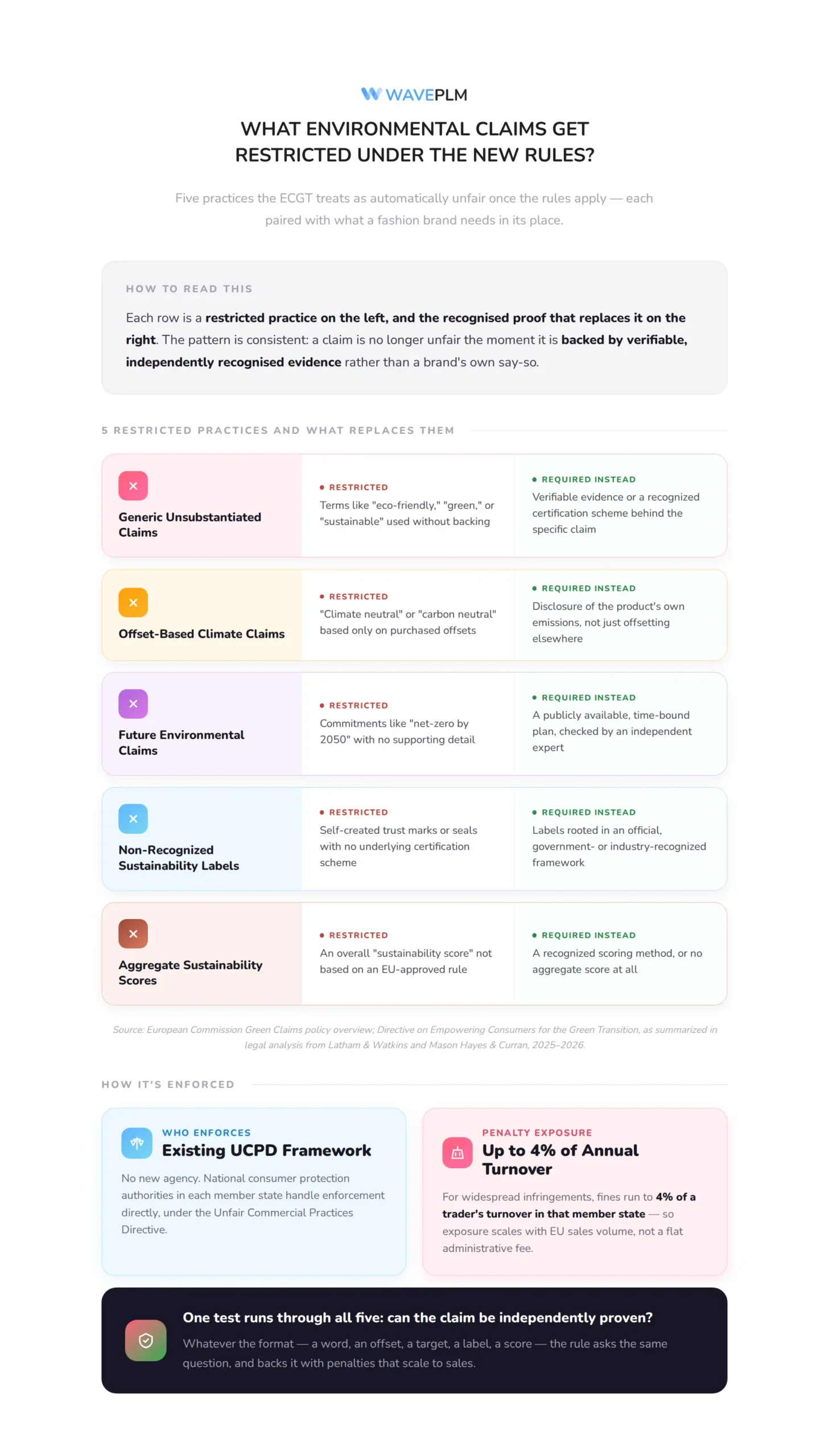
The table below maps the practices the ECGT treats as automatically unfair once the rules apply, alongside what a brand needs instead.
| Restricted practice | What it means for a fashion brand | What is required instead |
|---|---|---|
| Generic unsubstantiated claims | Terms like “eco-friendly,” “green,” or “sustainable” used without backing | Verifiable evidence or a recognized certification scheme behind the specific claim |
| Offset-based climate claims | “Climate neutral” or “carbon neutral” claims based only on purchased offsets | Disclosure of the product’s own emissions, not just offsetting activity elsewhere |
| Future environmental claims | Commitments such as “net-zero by 2050” with no supporting detail | A publicly available, time-bound implementation plan, checked by an independent expert |
| Non-recognized sustainability labels | Self-created trust marks or seals with no underlying certification scheme | Labels rooted in an official, government- or industry-recognized certification framework |
| Aggregate sustainability scores | An overall “sustainability score” for a product not based on an EU-approved rule | A recognized scoring method, or no aggregate score at all |
Source: European Commission Green Claims policy overview; Directive on Empowering Consumers for the Green Transition, as summarized in legal analysis from Latham & Watkins and Mason Hayes & Curran, 2025–2026.
Notably, enforcement runs through the existing Unfair Commercial Practices Directive framework, not a new agency. National consumer protection authorities in each member state handle enforcement directly. The underlying UCPD penalty structure allows fines of up to 4% of a trader’s annual turnover in that member state, for widespread infringements. As a result, a brand’s exposure scales with its EU sales volume. It is not capped at a flat administrative fee.
How Is This Different from the EU Digital Product Passport and California SB 707?
It helps to place this alongside the other major textile regulations a brand is likely already tracking. Our guide to the EU Digital Product Passport covers a market-access requirement. That requirement ties to a scannable product record disclosing materials and origin. Our guide to California SB 707 covers a different obligation: funding end-of-life recycling. The ECGT’s green claims rules are different again. They govern what a brand is allowed to say in its own marketing, not what data must travel with a physical product, or who pays for its disposal.
That said, the three frameworks share an underlying dependency. A brand cannot substantiate a “made from recycled materials” claim under the ECGT without solid fiber-composition data. That same data feeds a Digital Product Passport record or an SB 707 report. A brand that structures this data once, at the style and material level, gains a real advantage across all three obligations at the same time.
What Mistakes Will Fashion Brands Make With Green Claims Compliance?
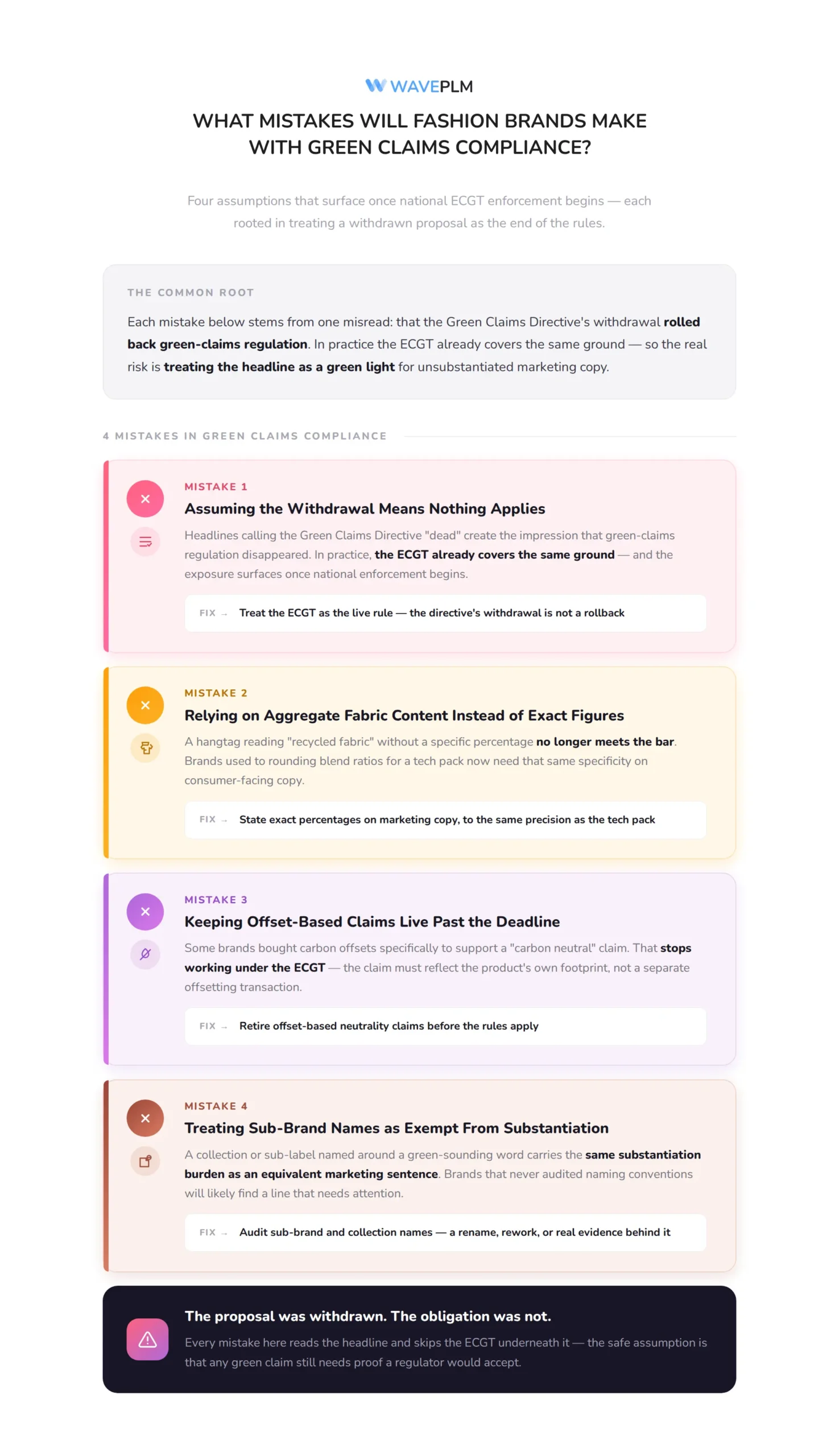
Assuming the Withdrawal Means Nothing Applies
Headlines describing the Green Claims Directive as “dead” understandably create the impression that green-claims regulation itself disappeared. In practice, the ECGT already covers the same ground for the specific claim types it targets. A brand that treats the withdrawal as a green light on unsubstantiated marketing copy takes a real risk. That exposure surfaces once national enforcement begins.
Relying on Aggregate Fabric Content Instead of Exact Figures
A hangtag reading “recycled fabric” without a specific percentage no longer meets the bar the ECGT sets. Brands accustomed to rounding blend ratios for a tech pack will need that same specificity elsewhere. Consumer-facing marketing copy now faces the same bar regulators expect internally.
Keeping Offset-Based Claims Live Past the Deadline
Some brands purchased carbon offsets specifically to support a “carbon neutral” product claim. That approach stops working under the ECGT once the rules apply. The claim must reflect the product’s own footprint, not a separate offsetting transaction.
Treating Sub-Brand Names as Exempt from Substantiation
A collection or sub-label named around a green-sounding word carries the same substantiation burden as an equivalent marketing sentence. Brands that never audited their naming conventions for this exposure are likely to find at least one line that needs attention. That line will need a rename, a rework, or real evidence behind it.
What Should Fashion Brands Check Before September 27, 2026?
A few concrete steps, done now, cover most of the exposure described above. First, audit every product page, hangtag, and packaging line for generic environmental terms. Flag which ones currently have no supporting evidence attached. Second, review any “carbon neutral” or “climate neutral” claim tied to purchased offsets. That specific claim type is squarely targeted. Third, check collection and sub-brand names for green-sounding language that was never formally substantiated. Finally, confirm which third-party sustainability labels sit on a recognized certification scheme, rather than a self-designed seal created in-house.
How Does Wave PLM Support Green Claims Readiness?
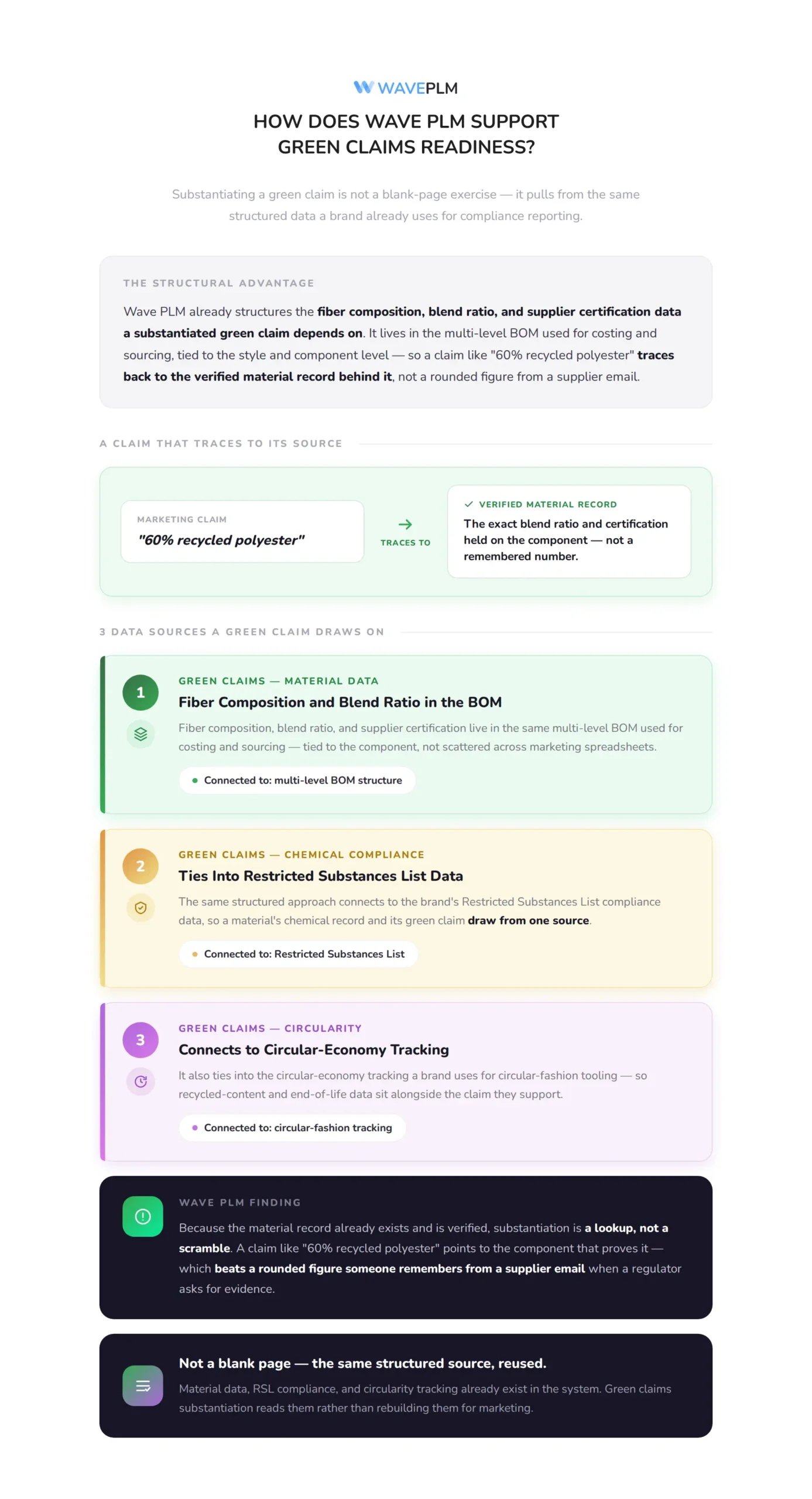
Wave PLM already structures the fiber composition, blend ratio, and supplier certification data a substantiated green claim depends on. This data lives in the same multi-level BOM used for costing and sourcing. It stays tied to the style and component level, not scattered across marketing spreadsheets. As a result, a claim like “60% recycled polyester” traces directly back to the verified material record behind it. That beats a rounded figure someone remembers from a supplier email.
This same structured approach connects to the Restricted Substances List compliance data. It also ties to the circular-economy tracking covered in our guide to technology and tools for circular fashion. A brand preparing green claims substantiation, in other words, is not starting from a blank page. It is pulling from the same structured source already used for compliance reporting elsewhere.
Frequently Asked Questions
What was the EU Green Claims Directive?
The Green Claims Directive was a proposed EU law that would have required companies to independently verify voluntary environmental claims before publishing them. Specifically, it was proposed by the European Commission in March 2023, then withdrawn in June 2025.
Was the Green Claims Directive withdrawn?
Yes. The European Commission announced its intention to withdraw the Green Claims Directive proposal on June 20, 2025, citing concerns about the administrative burden on small businesses. Trilogue negotiations were cancelled as a result.
What EU law regulates green claims now?
The Empowering Consumers for the Green Transition Directive, adopted separately in 2024, amends the EU’s existing Unfair Commercial Practices Directive to restrict unsubstantiated environmental claims. It applies starting September 27, 2026.
What environmental claims does the ECGT ban?
It bans generic terms like “eco-friendly” or “green” without supporting evidence, “climate neutral” claims based solely on carbon offsets, unsupported future commitments like “net-zero by 2050,” and sustainability labels not rooted in a recognized certification scheme.
Do brand names and logos count as green claims under EU rules?
Yes. The ECGT’s scope covers any brand name, logo, or trademark that implies an environmental message to consumers, not only marketing copy or hangtag text. A sub-label named around a green-sounding word needs the same substantiation as a written claim.
What are the penalties for greenwashing violations in the EU?
Enforcement runs through national consumer protection authorities under the Unfair Commercial Practices Directive framework, which allows fines of up to 4% of a trader’s annual turnover in the member state concerned for widespread infringements.
Is the EU Digital Product Passport the same as the Green Claims rules?
No. The Digital Product Passport is a market-access requirement disclosing a product’s materials and origin. The ECGT’s green claims rules instead govern what a brand can say in its own marketing, though both depend on similar underlying material data.
Whether a brand needs to act on this right now comes down to one question. Does any current marketing claim, hangtag, or sub-brand name use environmental language that was never formally substantiated? The standalone Green Claims Directive is gone, but the September 27, 2026 deadline under the Empowering Consumers Directive is not. Brands preparing for the EU Digital Product Passport are already assembling much of the same fiber and sourcing data. This same substantiation work draws on it too. Talk to the Wave PLM team about structuring that data once, for green claims, DPP, and SB 707 readiness together.






Leave a Reply