
The New York Fashion Act is a proposed state law, not an active one. It would require large apparel, footwear, and handbag companies to map their supply chains. It would also require those companies to disclose their environmental impact publicly. As of March 2025, the bill is still moving through committee. It is not sitting on a shelf, and that single fact changes how a brand should treat it right now.
Fashion brands just spent last week’s post working through the EU CSDDD’s tier-1 supplier due diligence rules. Naturally, the next question follows: does the United States have anything similar? Not yet, but the New York Fashion Act is the closest thing currently in active discussion. This guide covers what the bill says, where it stands today, and how it compares to the EU due diligence directive most brands already track.
What Is the New York Fashion Act?
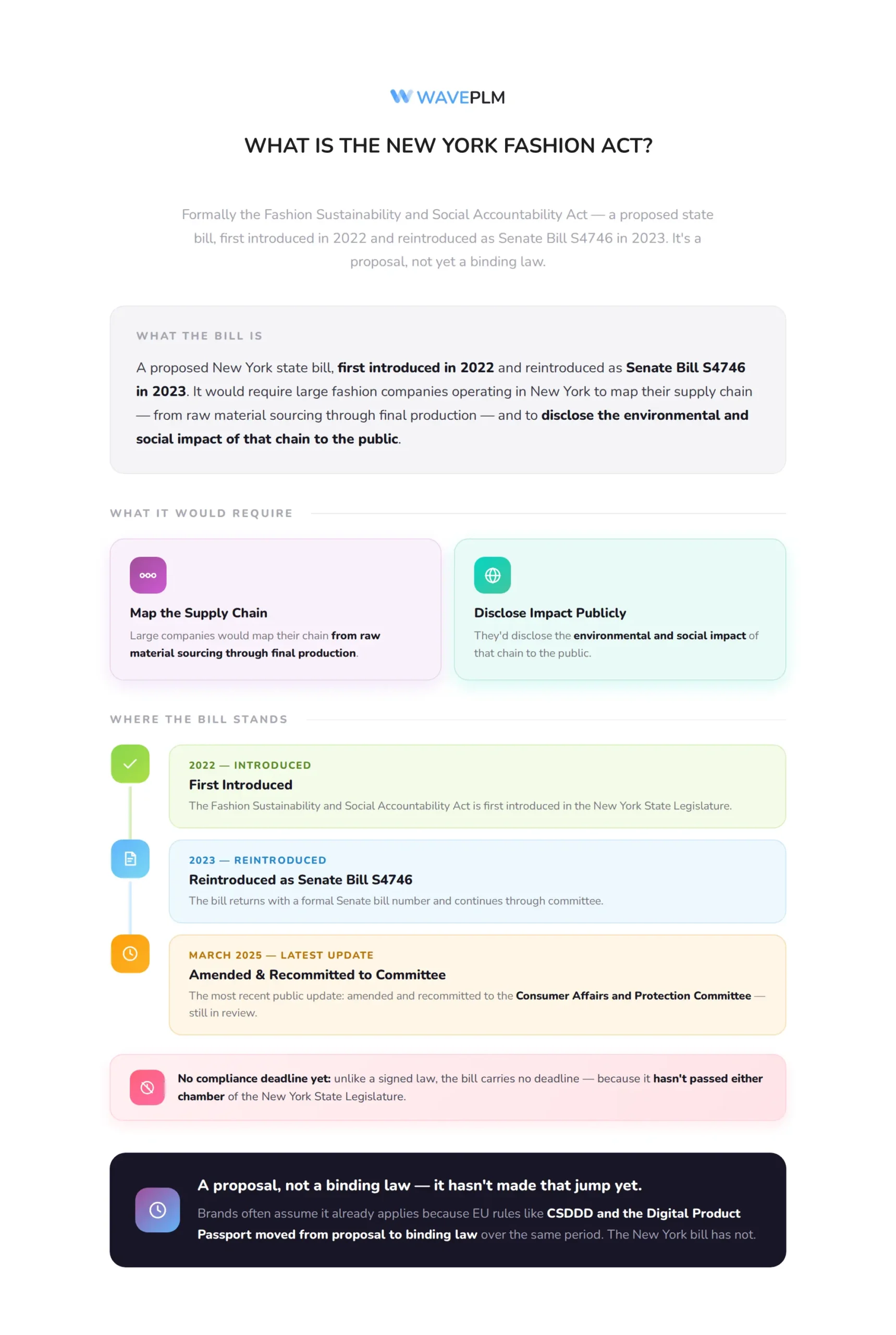
The New York Fashion Act, formally the Fashion Sustainability and Social Accountability Act, is a proposed state bill. It was first introduced in 2022 and reintroduced as Senate Bill S4746 in 2023. The bill would require large fashion companies operating in New York to map their supply chain. That map would run from raw material sourcing through final production. In addition, those companies would need to disclose the environmental and social impact of that supply chain to the public.
Unlike a signed law, the bill carries no compliance deadline yet. That is because it has not passed either chamber of the New York State Legislature. Instead, it has moved through several rounds of committee review and amendment since 2022. Specifically, the most recent public update shows the bill amended and recommitted to the Consumer Affairs and Protection Committee. That happened in March 2025 (HeyFashion.org legislation tracker, accessed Aug 2026).
Our finding: Brands searching for the New York Fashion Act often assume it already applies, because EU rules like CSDDD and the Digital Product Passport moved from proposal to binding law over roughly the same period. The New York bill has not made that jump yet.
Has the New York Fashion Act Passed Into Law?
No, the New York Fashion Act has not passed. It remains under legislative review as of the most recent tracked update. That said, “not passed” does not mean dormant. The bill has stayed alive through several legislative sessions since 2022. Many proposals at this stage simply die quietly in committee and never resurface. This one has not.
An earlier legal analysis noted something worth flagging. The New York State Assembly did not vote on the bill before a prior legislative session concluded, leaving its near-term path unclear (Katten Muchin Rosenman, 2024). Since then, the bill returned with amendments instead of disappearing for good. As a result, brands tracking US fashion regulation should treat the New York Fashion Act as pending, not settled. Revisit its status every legislative session, rather than checking once and moving on.
Which Fashion Brands Would Fall Under the New York Fashion Act?
The New York Fashion Act would apply to apparel, footwear, and accessory companies doing business in New York State. Specifically, it targets companies with global annual revenue over $100 million. In fact, that threshold catches large global brands and major retailers. Notably, it does not reach small or mid-sized labels selling a few thousand units a season.
Notably, the revenue test looks at global revenue, not just New York sales. A brand headquartered outside New York still falls in scope under two conditions. First, it must do business in the state. Second, its worldwide revenue must clear $100 million. This mirrors how the EU CSDDD’s non-EU threshold works. Physical headquarters location does not exempt a company from a market’s due diligence rules.
What Would the New York Fashion Act Require From Covered Brands?
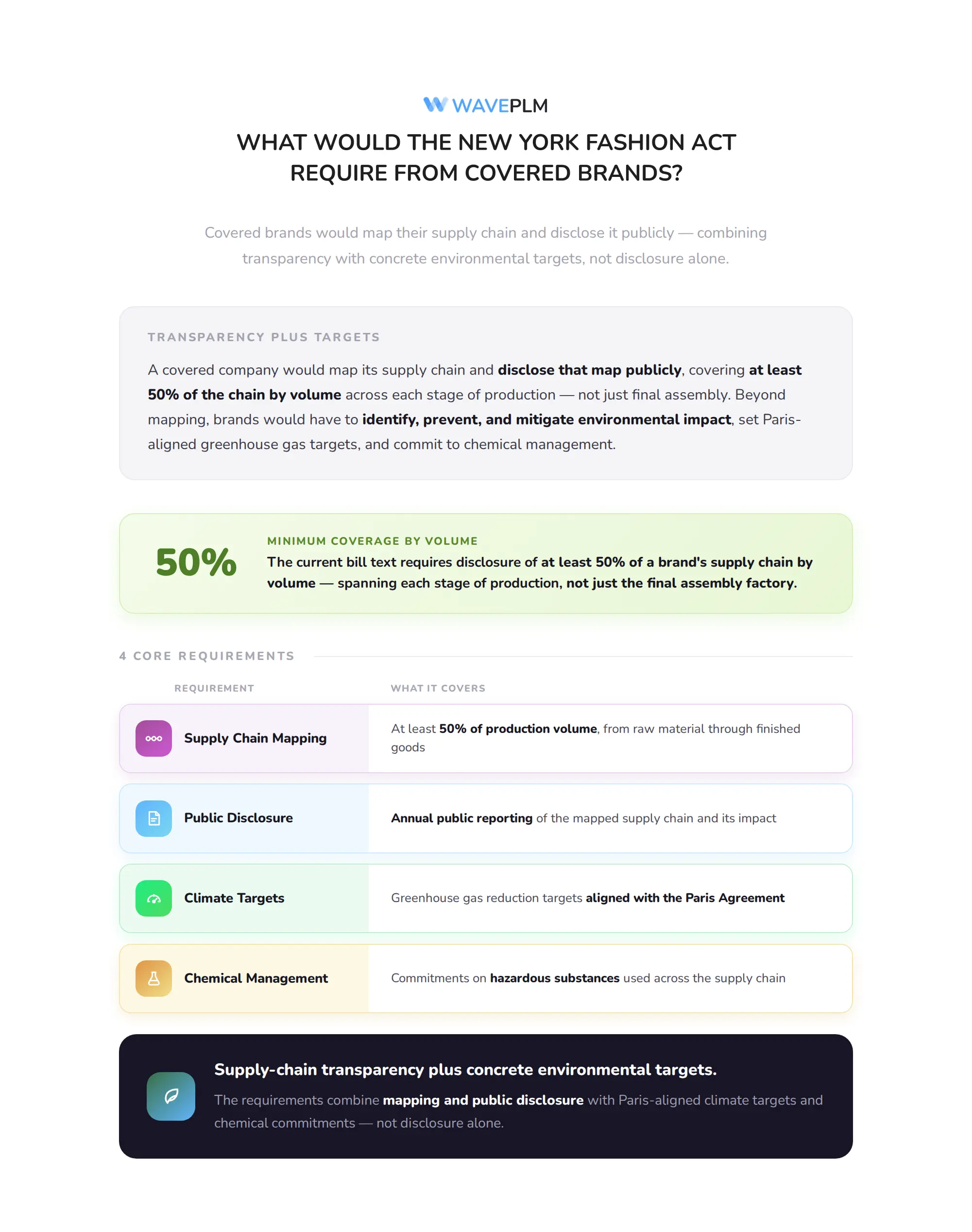
A covered company under the New York Fashion Act would need to map its supply chain and disclose that map publicly. In turn, that map would run from raw material sourcing through final production. Specifically, the current bill text requires disclosure of at least 50% of a brand’s supply chain by volume. That coverage spans each stage of production, not just the final assembly factory.
Beyond mapping, the bill would require covered brands to identify, prevent, and mitigate their environmental impact. It also calls for greenhouse gas reduction targets aligned with the Paris Agreement. On top of that, it asks for chemical management commitments covering hazardous substances used in production. In short, the requirements combine supply chain transparency with concrete environmental targets, not disclosure alone.
| Requirement | What it covers |
|---|---|
| Supply chain mapping | At least 50% of production volume, from raw material through finished goods |
| Public disclosure | Annual public reporting of the mapped supply chain and its impact |
| Climate targets | Greenhouse gas reduction targets aligned with the Paris Agreement |
| Chemical management | Commitments on hazardous substances used across the supply chain |
What Penalties Does the New York Fashion Act Propose?
The current version of the New York Fashion Act sets fines of up to $15,000 per day for non-compliance. That figure is notably lower than the bill’s original design. The earlier draft proposed fines of up to 2% of a company’s annual revenue, plus a dedicated fashion remediation fund (Katten Muchin Rosenman, 2024).
This reduction matters for how seriously brands should weigh the bill today. A 2%-of-revenue penalty structure would have made non-compliance genuinely dangerous for a large company. However, a capped daily fine is a real cost, though a far more predictable one by comparison. Even so, predictable does not mean safe to ignore. A $15,000-per-day fine compounds fast once a violation goes unaddressed.
How Does the New York Fashion Act Compare to the EU CSDDD?
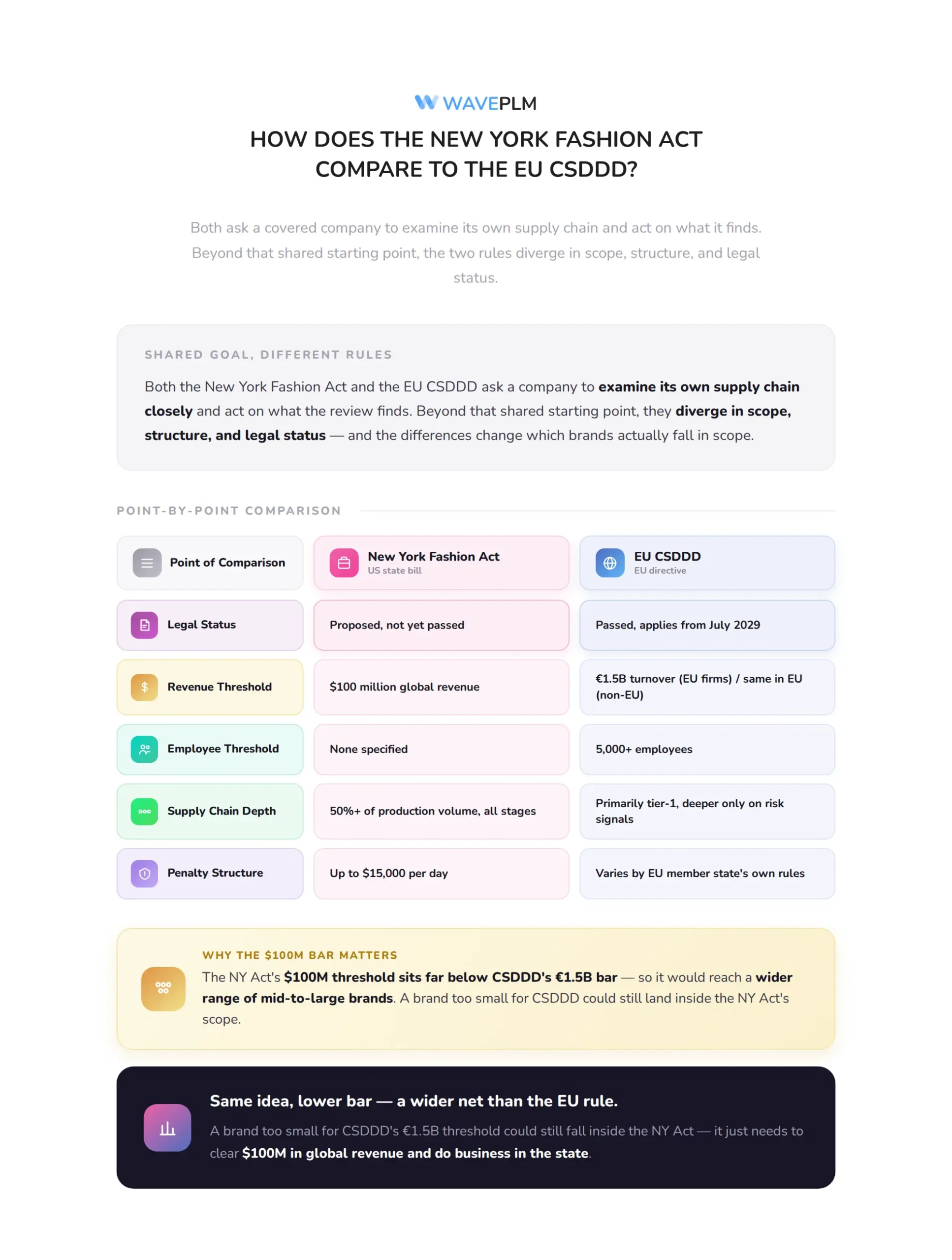
Both the New York Fashion Act and the EU CSDDD ask a covered company to examine its own supply chain closely. Similarly, both expect a company to act on what that review finds. Beyond that shared starting point, the two rules diverge in scope, structure, and legal status.
| Point of comparison | New York Fashion Act | EU CSDDD |
|---|---|---|
| Legal status | Proposed, not yet passed | Passed, applies from July 2029 |
| Revenue threshold | $100 million global revenue | €1.5 billion turnover (EU firms) / same generated in EU (non-EU firms) |
| Employee threshold | None specified | 5,000+ employees |
| Supply chain depth | 50%+ of production volume, all stages | Primarily tier-1, deeper only when risk signals appear |
| Penalty structure | Up to $15,000 per day | Varies by EU member state’s own rules |
In practice, the New York Fashion Act’s $100 million threshold sits far below the CSDDD’s revenue bar. As a result, it would reach a wider range of mid-to-large brands than the EU rule does after its 2026 Omnibus revision. Consequently, a brand too small for CSDDD’s 1.5-billion-euro threshold could still land inside the New York Fashion Act’s scope. It just needs to clear $100 million in global revenue and do business in the state.
Why Smaller Brands Should Track the New York Fashion Act Anyway
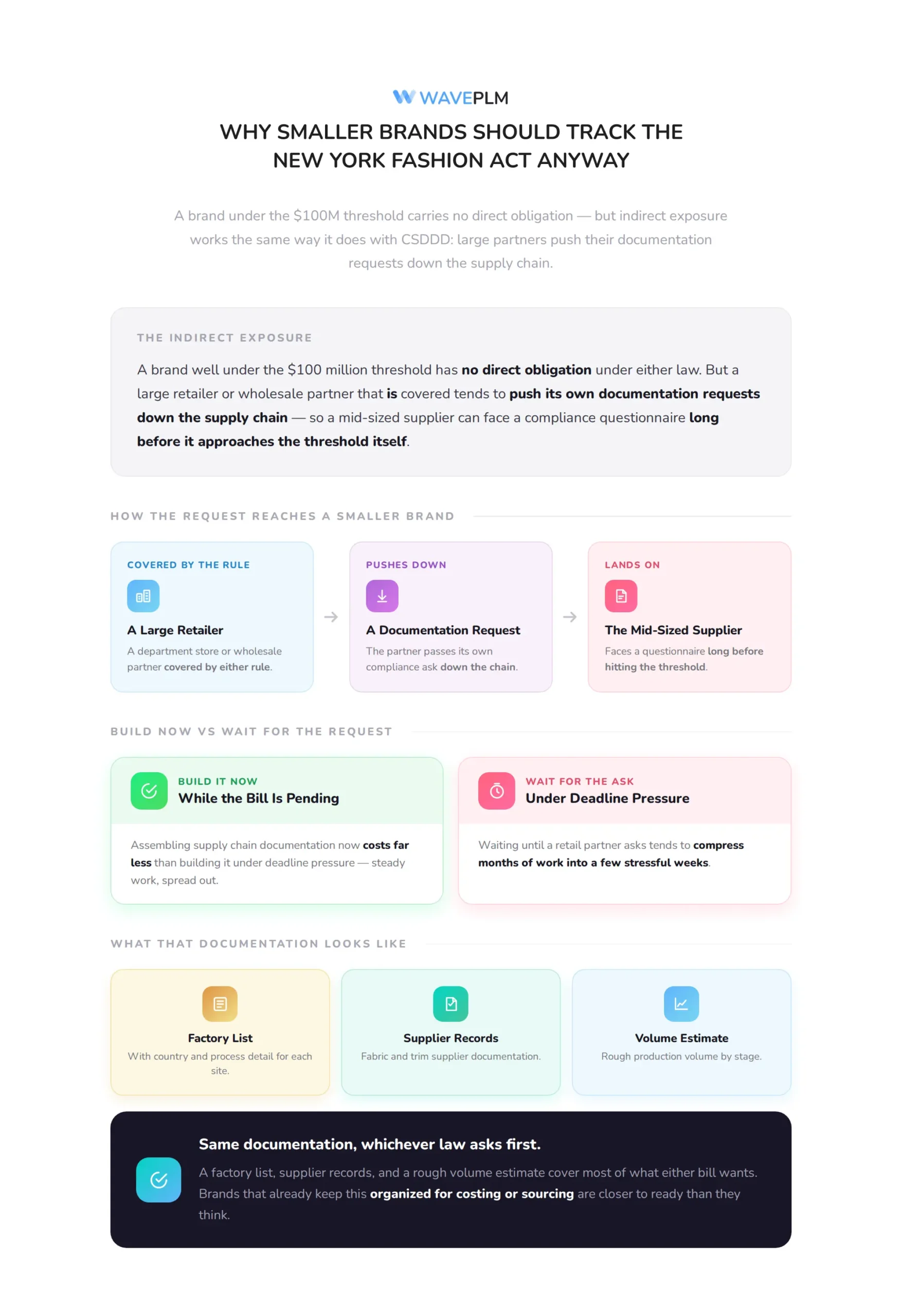
A brand well under the $100 million threshold carries no direct obligation under either law. That said, indirect exposure still works the same way it does with CSDDD. A large retailer or wholesale partner covered by either rule tends to push its own documentation requests down the supply chain. Consequently, a mid-sized supplier can face a compliance questionnaire long before it ever approaches the threshold itself.
For example, a brand supplying a department store chain with global revenue above $100 million should expect sourcing questions eventually. That holds true even without a direct New York Fashion Act obligation of its own. Building supply chain documentation now, while the bill is still pending, costs far less than assembling it under deadline pressure. Waiting until a retail partner actually asks tends to compress months of work into a few stressful weeks.
In practice, that documentation looks the same regardless of which law eventually asks for it first. Overall, a factory list with country and process detail, fabric and trim supplier records, and a rough estimate of production volume by stage cover most of what either bill would want to see. Brands that already keep this data organized for costing or sourcing purposes are closer to ready than they might assume.
Wave PLM and New York Fashion Act Readiness
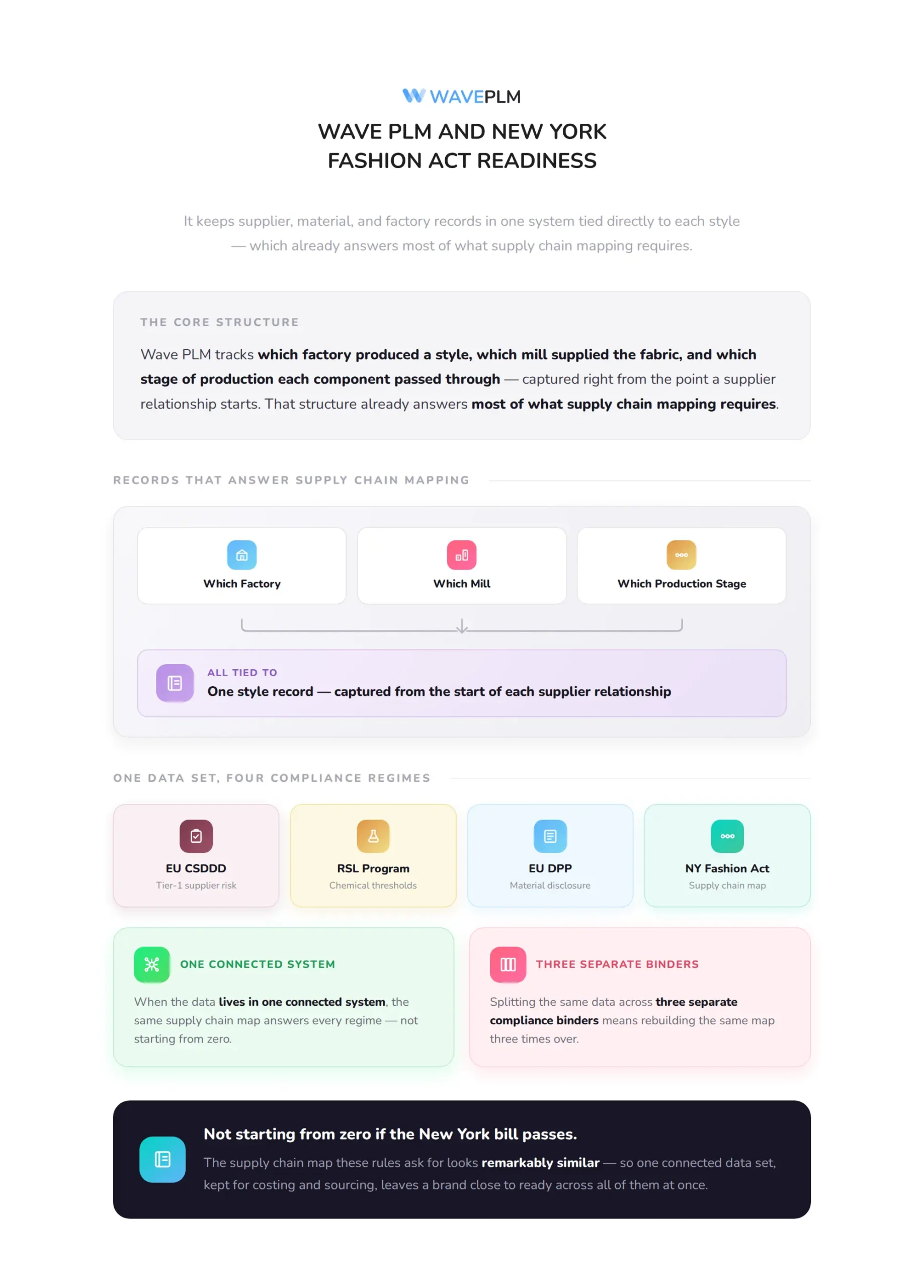
Wave PLM keeps supplier, material, and factory records in one system tied directly to each style. That structure already answers most of what supply chain mapping requires. Specifically, it tracks which factory produced a style, which mill supplied the fabric, and which stage of production each component passed through. Our vendor onboarding guide covers how that factory and mill data gets captured, right from the point a supplier relationship starts.
The same underlying data set supports more than one compliance regime at once. Consider a brand already tracking tier-1 risk for EU CSDDD, chemical thresholds for its RSL program, or material disclosure for the EU Digital Product Passport. That brand is not starting from zero if the New York Fashion Act eventually passes. The supply chain map most of these rules ask for looks remarkably similar. That holds especially true once the underlying data lives in one connected system, instead of three separate compliance binders.
Frequently Asked Questions
Is the New York Fashion Act currently law?
No. The New York Fashion Act is a proposed state bill, not a passed law. As of the most recent tracked update in March 2025, it remains under review in the Consumer Affairs and Protection Committee.
Which companies would the New York Fashion Act cover?
The bill would apply to apparel, footwear, and accessory companies doing business in New York State. Specifically, the threshold is global annual revenue over $100 million, regardless of where the company is headquartered.
What penalties does the New York Fashion Act propose?
The current version proposes fines of up to $15,000 per day for non-compliance. That figure replaced an earlier proposal of fines up to 2% of annual company revenue.
How is the New York Fashion Act different from the EU CSDDD?
The New York Fashion Act has not passed. It would apply at a $100 million global revenue threshold with no employee count requirement. The EU CSDDD has passed, applies from July 2029, and requires both 5,000 or more employees and 1.5 billion euros in turnover.
Should a brand under $100 million in revenue prepare anyway?
It depends on the brand’s retail partners. A smaller supplier to a large covered retailer should expect supply chain documentation requests, even without a direct obligation under the New York Fashion Act itself.
What percentage of the supply chain would need mapping?
The current bill text requires disclosure of at least 50% of a brand’s supply chain by production volume. That coverage spans raw material sourcing through finished goods.
Most brands do not need to act on the New York Fashion Act today, since the bill still has not cleared the Legislature. But if a retail partner is already sending EU CSDDD-style supplier questionnaires, take note. The supply chain map the New York Fashion Act would eventually require is largely the same map. Wave PLM keeps that map current in one place, ready for whichever compliance letter lands first.








Leave a Reply