
A California Prop 65 clothing claim almost never starts with a government inspector at your warehouse door. Instead, it starts with a certified letter. That letter usually comes from a private citizen’s law firm, one you have likely never heard of. In fact, the brand then gets exactly 60 days to respond. After that, litigation risk starts compounding at up to $2,500 per violation, per day. Notably, private enforcers filed over 5,000 of these notices in 2025 alone (Greenberg Traurig, Feb 2026), and apparel remains one of their recurring targets.
Fashion brands already track chemical limits through RSL testing and state-level PFAS bans. Naturally, the next question follows: isn’t Prop 65 just another chemical threshold to add to that list? Not quite. Prop 65 is a warning law. It gets enforced through private lawsuits, not a manufacturing specification. This guide covers how the notice-and-lawsuit mechanism actually works. It also covers what triggers a warning for apparel specifically, and how that risk differs from the chemical rules a brand may already track.
What Is California Prop 65 and Why Does It Cover Clothing?
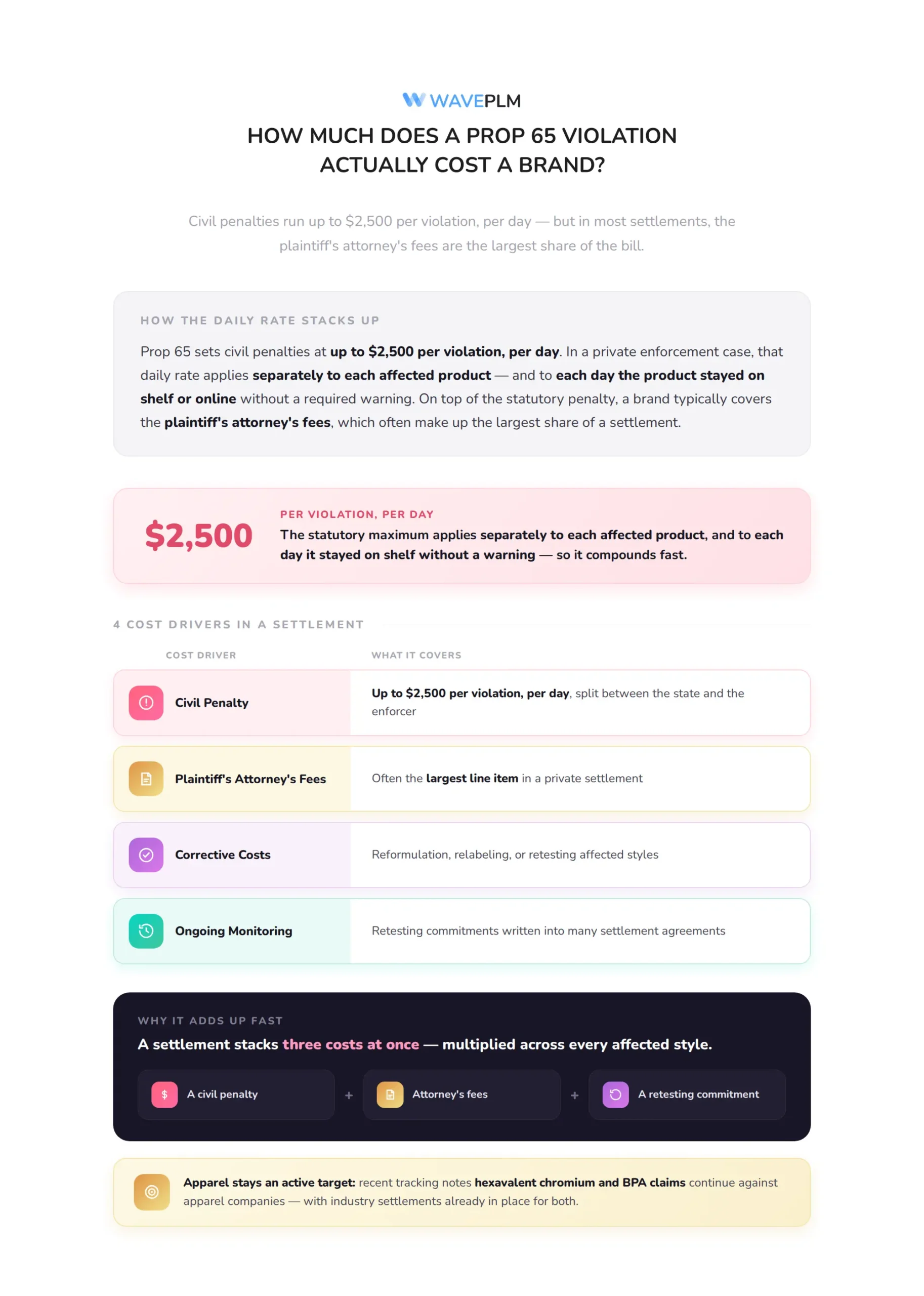
California Prop 65, formally the Safe Drinking Water and Toxic Enforcement Act of 1986, requires a business to warn Californians before exposing them to a listed chemical. Specifically, that warning applies once exposure crosses a defined safety threshold. The state maintains a running list of chemicals known to cause cancer or reproductive harm. Clothing falls under Prop 65 because finished garments, trims, and printed graphics can carry several listed chemicals. That list includes lead, certain phthalates, and hexavalent chromium used in some dyeing and tanning processes.
Unlike a chemical ban, Prop 65 does not prohibit these substances outright. Instead, it requires a “clear and reasonable” warning past a set exposure level. For carcinogens, that level is the No Significant Risk Level (NSRL). For reproductive toxicants, it is the Maximum Allowable Dose Level (MADL) (California Attorney General, Prop 65 FAQ). In short, a brand can legally sell a garment containing a listed chemical. It just has to warn the buyer first, at the right exposure level.
How Does a Prop 65 Notice Actually Reach a Clothing Brand?
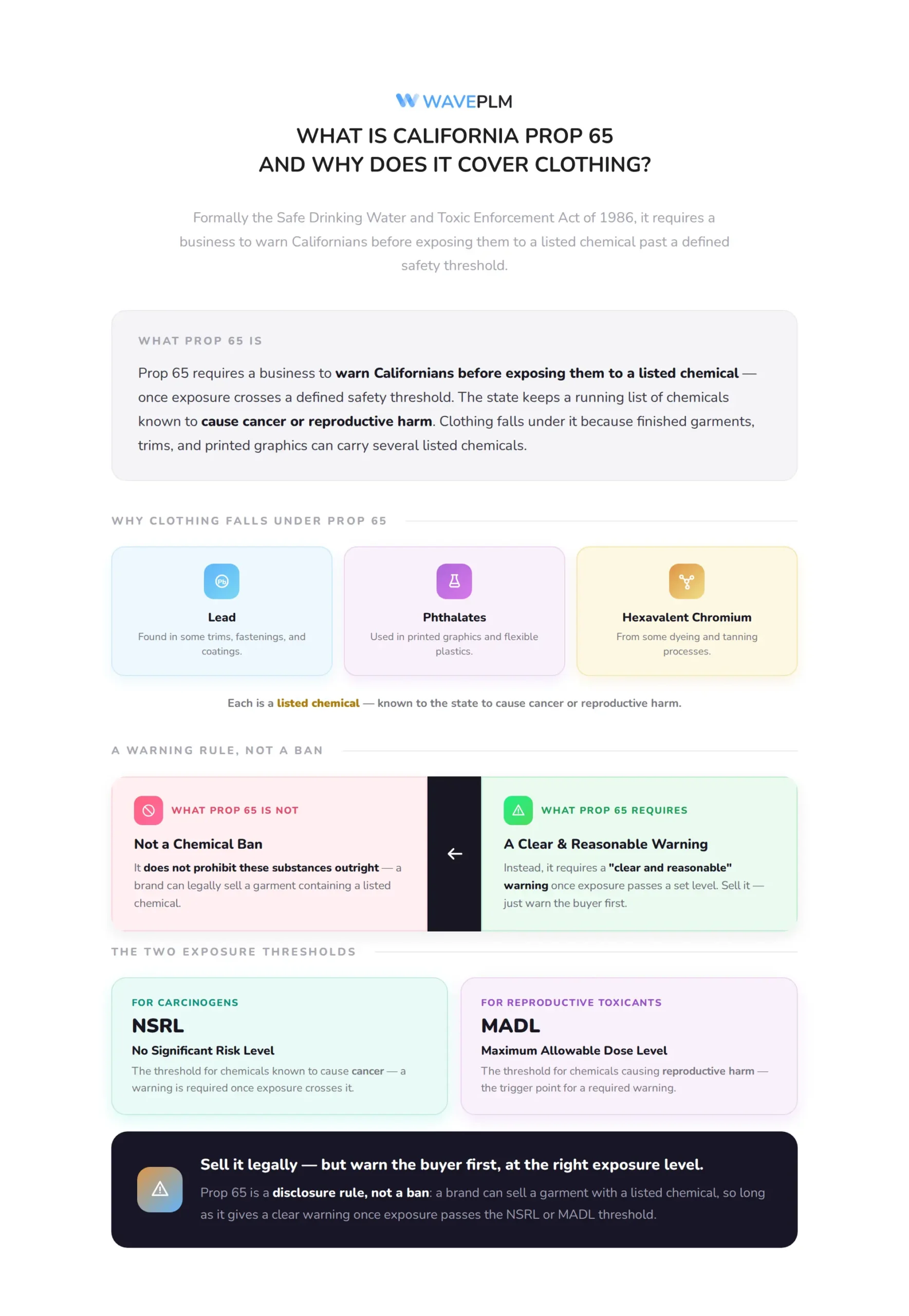
A Prop 65 case begins with a 60-day notice, not a courtroom filing. The notice goes to the business. At the same time, copies go to the California Attorney General and the relevant city or district attorney. That 60-day window exists for a reason. It gives a business, or a public prosecutor, a chance to act before a private lawsuit moves forward (California Attorney General, Prop 65 FAQ).
Our finding: Brands searching for California Prop 65 clothing rules often expect a regulator-driven process, similar to how RSL or CPSIA testing works. In practice, most apparel notices come from private law firms working on a per-case basis, not from a state inspection.
In practice, that 60-day window is short. A brand needs to confirm several things fast. First, whether the flagged product actually contains the named chemical. Second, at what concentration. Third, whether an existing warning already covers it. Overall, waiting until day 55 to start that investigation leaves almost no room to negotiate. By then, a lawsuit becomes the default next step.
Who Can Actually File a Prop 65 Notice Against a Fashion Brand?
Three categories of enforcer can bring a Prop 65 action. First, the California Attorney General. Second, any city attorney or district attorney with jurisdiction. Third, a private citizen acting “in the public interest” (California Attorney General, Prop 65 FAQ). Notably, that third category is what makes Prop 65 unusual compared to most compliance regimes a fashion brand tracks. A private individual, represented by a law firm, can issue a notice without ever working for the state.
This structure is why the law is often nicknamed a “bounty hunter” statute. In turn, a successful private enforcement action can recover attorney’s fees and a share of any civil penalty for the plaintiff’s side. As a result, that financial structure supports firms that file large volumes of notices across many product categories. Apparel is one of them, rather than a single government agency reviewing every garment on the market.
How Much Does a Prop 65 Violation Actually Cost a Brand?
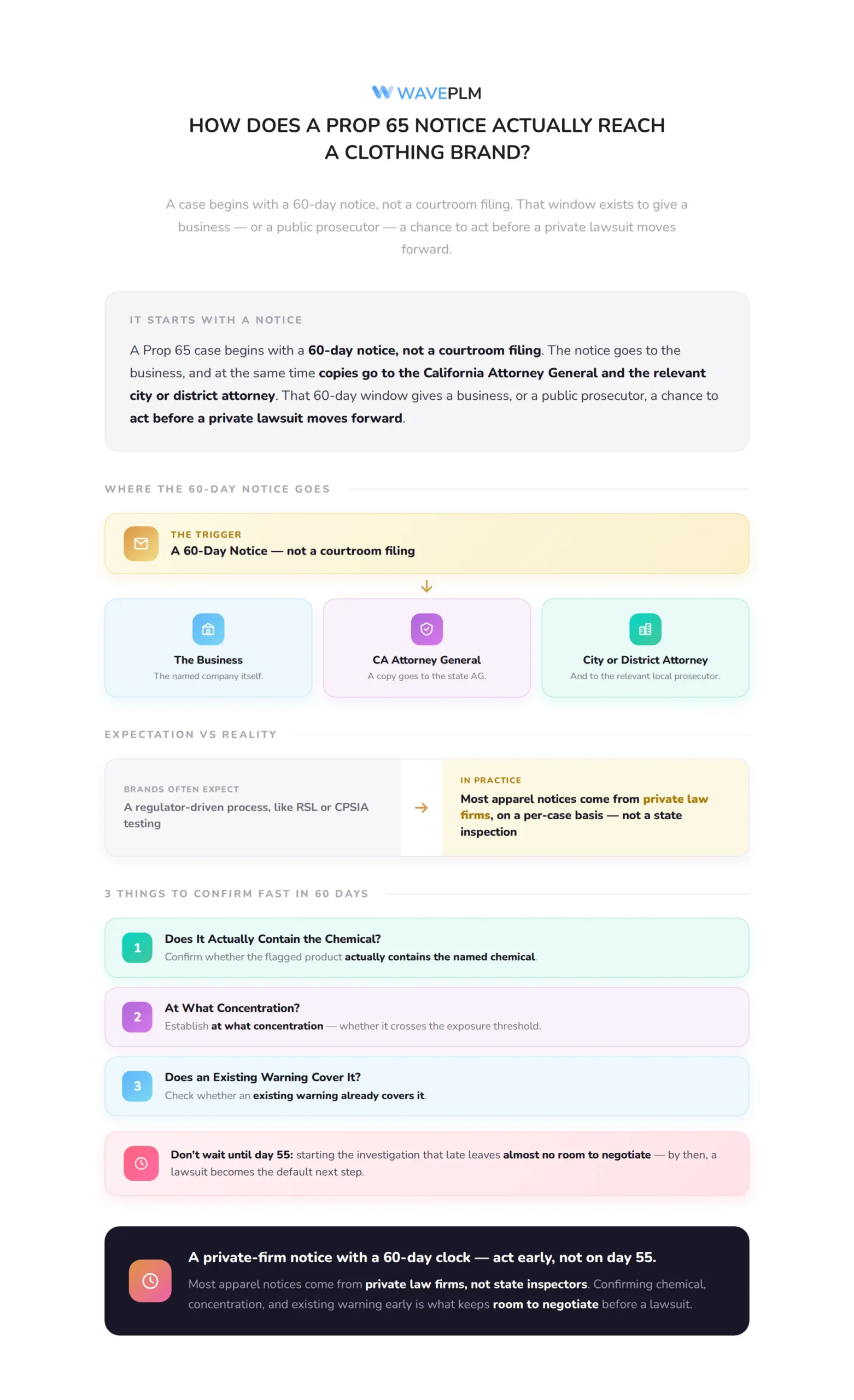
California Prop 65 sets civil penalties at up to $2,500 per violation, per day. In a private enforcement case, that daily rate applies separately to each affected product. It also applies to each day the product stayed on shelf or online without a required warning. On top of the statutory penalty, a responding brand typically covers the plaintiff’s attorney’s fees. In fact, those fees often make up the largest share of a settlement.
| Cost driver | What it covers |
|---|---|
| Civil penalty | Up to $2,500 per violation, per day, split between the state and the enforcer |
| Plaintiff’s attorney’s fees | Often the largest line item in a private settlement |
| Corrective costs | Reformulation, relabeling, or retesting affected styles |
| Ongoing monitoring | Retesting commitments written into many settlement agreements |
Most private cases settle well before trial. Settlement figures rarely reach the full statutory maximum. Even so, a settlement covering attorney’s fees, a civil penalty, and a retesting commitment adds up fast across several styles. That is especially true for a brand carrying dozens of SKUs in a single garment category. Textile and apparel companies remain an active target: recent enforcement tracking notes that hexavalent chromium and BPA claims continue against apparel companies, with existing industry settlements already in place for both chemicals (Greenberg Traurig, Feb 2026).
Which Chemicals Trigger California Prop 65 Clothing Warnings?
Lead, certain phthalates, and hexavalent chromium account for a large share of apparel-related Prop 65 notices. Lead shows up in printed graphics, trims, and some dyed components. Phthalates appear in plasticized prints and certain synthetic coatings. Meanwhile, hexavalent chromium turns up in leather tanning and some metal-dyeing processes used on hardware and trims.
Notably, each listed chemical carries its own NSRL or MADL threshold, not a single blanket limit. As a result, a trim supplier’s material can pass one chemical’s safe harbor level. At the same time, that same material can still trigger a warning for a different listed substance in the same component. That is why a Prop 65 compliance check has to run chemical-by-chemical, not as a single pass or fail test on the finished garment.
California Prop 65 vs RSL and PFAS Rules: What Is Actually Different?
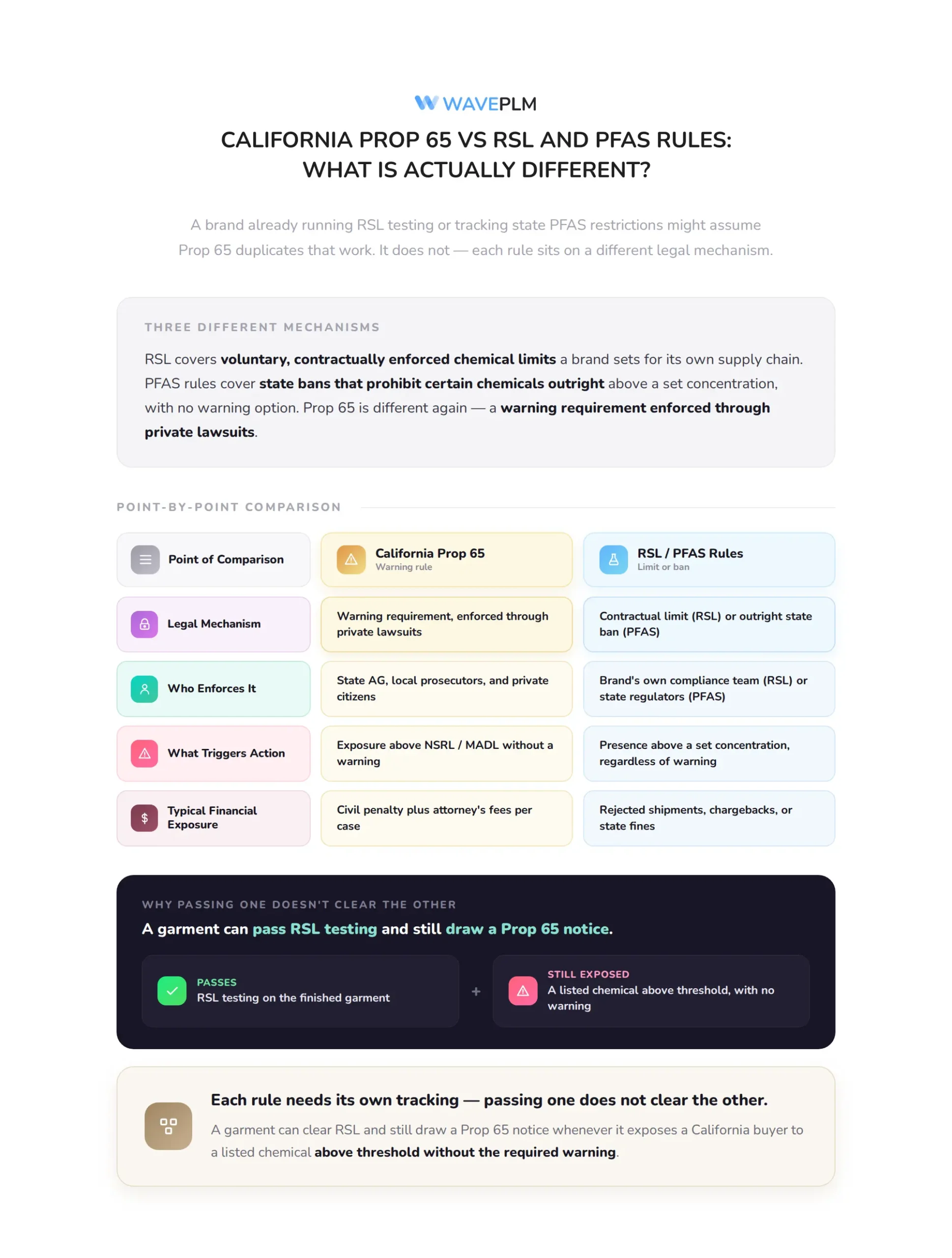
A brand already running RSL testing or tracking state PFAS restrictions might assume Prop 65 duplicates that work. It does not. Our RSL compliance guide covers voluntary, contractually enforced chemical limits that a brand sets for its own supply chain. In contrast, our PFAS guide covers state bans that prohibit certain chemicals outright above a set concentration, with no warning option available.
| Point of comparison | California Prop 65 | RSL / PFAS rules |
|---|---|---|
| Legal mechanism | Warning requirement, enforced through private lawsuits | Contractual limit (RSL) or outright state ban (PFAS) |
| Who enforces it | State AG, local prosecutors, and private citizens | Brand’s own compliance team (RSL) or state regulators (PFAS) |
| What triggers action | Exposure above NSRL/MADL without a warning | Presence above a set concentration, regardless of warning |
| Typical financial exposure | Civil penalty plus attorney’s fees per case | Rejected shipments, chargebacks, or state fines |
In other words, a garment can pass RSL testing and still draw a Prop 65 notice. That happens whenever it exposes a California buyer to a listed chemical above the relevant threshold without the required warning language. In short, each rule needs its own tracking. Passing one does not clear the other.
What Should a Compliant Prop 65 Warning Label Actually Say?
California’s safe harbor warning language names the specific chemical. It also states the type of harm associated with it, and directs the reader to the state’s warning website. A typical apparel warning reads along these lines: “WARNING: This product can expose you to [chemical name], which is known to the State of California to cause cancer [or reproductive harm]. For more information go to www.P65Warnings.ca.gov.” Overall, using the state’s safe harbor wording, placed clearly enough for a reasonable consumer to notice before purchase, gives a brand its strongest defense if a notice ever arrives.
In contrast, a generic warning naming no specific chemical carries far less protection. The same holds for one buried in fine print alongside unrelated care instructions. In practice, the safe harbor language has to match the actual chemical present, not a vague catch-all phrase copied from an unrelated product category.
How Can Fashion Brands Reduce Prop 65 Litigation Risk?
Reducing Prop 65 exposure starts with knowing which components in a style could carry a listed chemical. That means tracking at the material and trim level, rather than the finished garment alone. In fact, a brand that already documents fabric and trim sourcing for RSL purposes is closer to Prop 65-ready than it might assume, since much of the same supplier and material data applies. Our vendor onboarding guide covers how that supplier and material data gets captured from the first point of contact with a factory or trim supplier.
From there, a brand should decide in advance which categories carry higher Prop 65 risk. Printed graphics, faux leather trims, and metal hardware are common candidates. Those components should then get routed through targeted testing before bulk production. Otherwise, waiting for a notice letter to identify the risky component is the most expensive way to find out.
Wave PLM and Prop 65 Readiness
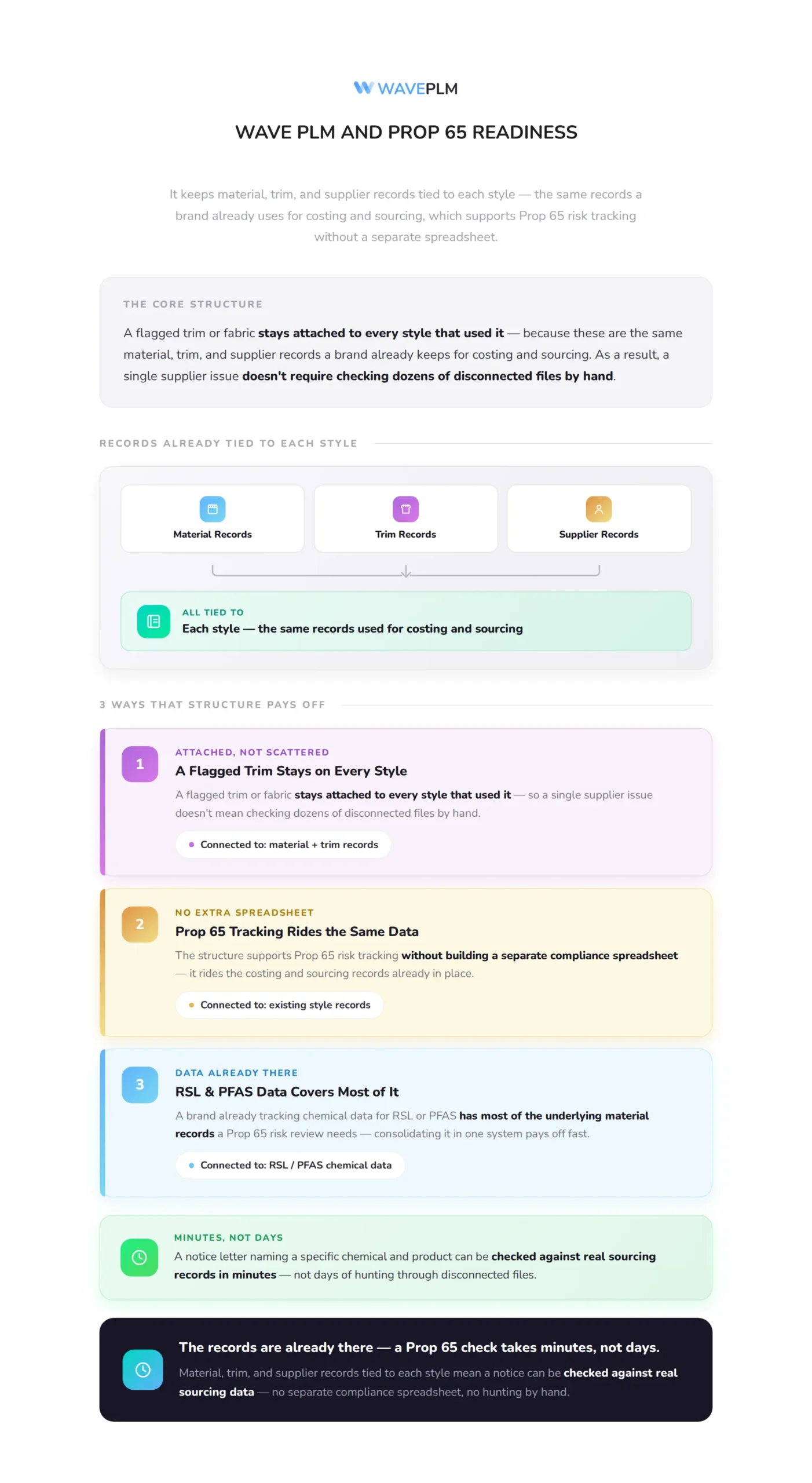
Wave PLM keeps material, trim, and supplier records tied to each style. These are the same records a brand already uses for costing and sourcing. That structure supports Prop 65 risk tracking without building a separate compliance spreadsheet. Specifically, a flagged trim or fabric stays attached to every style that used it. As a result, a single supplier issue does not require checking dozens of disconnected files by hand.
A brand tracking chemical data for RSL or PFAS already has most of the underlying material records a Prop 65 risk review needs. In turn, consolidating that data in one system pays off fast. A notice letter naming a specific chemical and product can be checked against real sourcing records in minutes, not days.
Frequently Asked Questions
What is California Prop 65 and does it really apply to clothing?
Yes. California Prop 65 requires a business to warn consumers before exposing them to a listed chemical above a set safety threshold. Clothing, trims, and printed graphics can carry listed chemicals such as lead, certain phthalates, and hexavalent chromium, which brings apparel within the law’s scope.
How much can a Prop 65 violation cost a fashion brand?
Civil penalties run up to $2,500 per violation, per day. In a private enforcement case, a responding brand typically also covers the plaintiff’s attorney’s fees, which often make up the largest share of a settlement.
Who can file a Prop 65 notice against a clothing company?
Three categories of enforcer can bring a case: the California Attorney General, a city or district attorney, and a private citizen acting in the public interest. Most apparel notices come from private enforcers rather than a government inspection.
How is Prop 65 different from RSL or PFAS restrictions?
Prop 65 is a warning requirement enforced through lawsuits, not a chemical ban. RSL limits are contractual standards a brand sets for its own supply chain, and PFAS rules are outright state bans above a set concentration. A garment can pass RSL testing and still draw a Prop 65 notice if it lacks a required warning.
How long does a brand have to respond to a Prop 65 notice?
The law builds in a 60-day notice period before a private lawsuit can proceed. That window gives a business, or a public prosecutor, a chance to act first, though confirming the underlying facts and negotiating a resolution within 60 days requires moving quickly.
What should a compliant Prop 65 warning label say?
The state’s safe harbor language names the specific chemical, states the associated harm, and directs the reader to www.P65Warnings.ca.gov. A generic or vague warning that does not name the actual chemical present offers much weaker legal protection.
Most brands never think about California Prop 65 clothing rules until a notice letter with an unfamiliar law firm’s letterhead shows up. By then, the 60-day clock is already running. However, brands that track material and trim data at the component level are in a different position. Using the same records already built for RSL and PFAS compliance, they can confirm or rule out a claim in days, instead of scrambling to reconstruct sourcing history under deadline pressure. Notably, a single settled Prop 65 case often costs more than testing an entire season’s trim library up front. Wave PLM keeps that material data in one place, ready before the letter ever arrives.




Leave a Reply