

Most mid-market fashion brands no longer have to comply with the Corporate Sustainability Reporting Directive. That is a direct result of the 2026 Omnibus simplification, which narrowed the rule’s scope substantially. Specifically, only companies above both 1,000 employees and 450 million euros in annual turnover remain in mandatory scope. However, a handful of large fashion groups already report under it today, including Zalando, Adidas, and LVMH. This guide covers who actually has to comply, what a brand must disclose, and how the Corporate Sustainability Reporting Directive differs from the due diligence directive most compliance teams already track.
A reporting directive, at its core, is a disclosure rule. Notably, it does not tell a company what to do differently. Instead, it forces a company to measure and publish specific sustainability data. That data gets audited, the same way financial statements are. The Corporate Sustainability Reporting Directive, known as CSRD, requires exactly that: standardized, assured disclosures on climate, labor, and governance topics, filed alongside a company’s annual report.
What Is the Corporate Sustainability Reporting Directive?
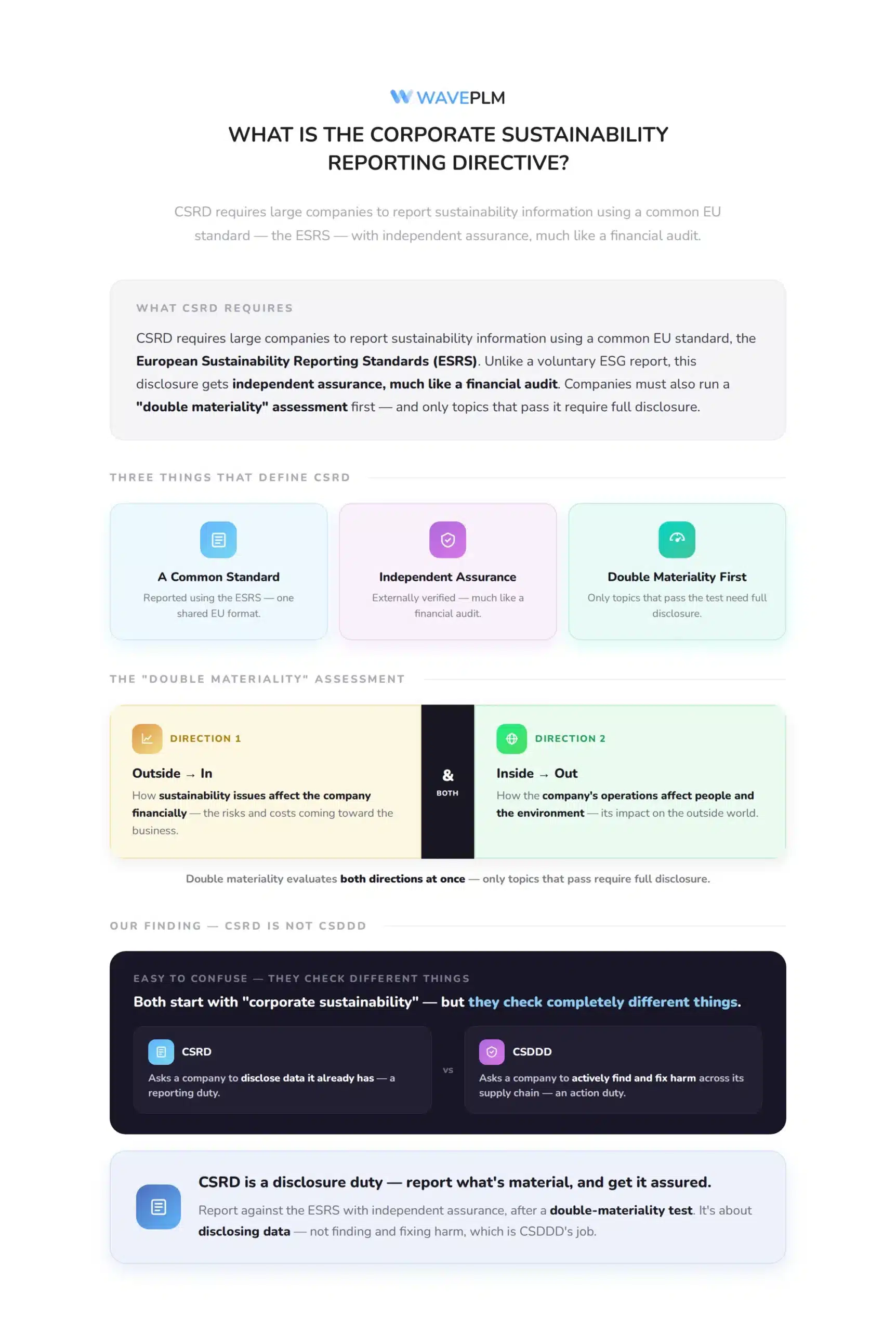
CSRD requires large companies to report sustainability information using a common EU standard. That standard is called the European Sustainability Reporting Standards, or ESRS. Unlike a voluntary ESG report, this disclosure gets independent assurance, much like a financial audit. Companies must also run a “double materiality” assessment first. Specifically, that means evaluating two things at once: how sustainability issues affect the company financially, and how the company’s operations affect people and the environment (IntegrityNext). In the end, only topics that pass this materiality test require full disclosure.
Our finding: Wave PLM customers researching the Corporate Sustainability Reporting Directive often confuse it with CSDDD, since both start with “corporate sustainability” and trace back to the same EU agenda. In practice, they check completely different things. CSRD asks a company to disclose data it already has. CSDDD asks a company to actively find and fix harm across its supply chain.
Who Actually Has to Report Under CSRD Now?
Post-Omnibus, mandatory scope covers only companies with more than 1,000 employees and over 450 million euros in annual net turnover. A brand with 900 employees and 600 million euros in turnover falls outside that scope entirely (Carbonfact). Instead, reporting rolls out in stages, not all at once.
| Wave | Who reports | First report |
|---|---|---|
| Wave 1 | Former NFRD companies (already under prior EU rules) | 2025, for FY2024 |
| Wave 2 | Large EU brands meeting the new thresholds | 2028, for FY2027 |
| Wave 3 | Listed SMEs | Removed from mandatory scope; voluntary VSME standard instead |
| Wave 4 | Non-EU parent companies with 450m+ euros in EU turnover | 2029 |
Zalando, Adidas, and LVMH already sit in Wave 1. Each has already published a double materiality assessment (Carbonfact). Overall, for most other fashion brands, 2026 is not a reporting year at all. Instead, it functions as a planning year, one focused on materiality assessment and data readiness ahead of the 2028 deadline.
Wave 4 deserves a specific note for US-headquartered brands. A company does not need to be based in the EU to fall into mandatory scope. Instead, what matters is EU turnover through subsidiaries. For example, a US group with 450 million euros or more in EU sales, common among larger denim, outerwear, and footwear groups with a substantial European retail footprint, faces the same 2029 deadline as an EU-based competitor of similar size.

What Must a Fashion Brand Actually Disclose?
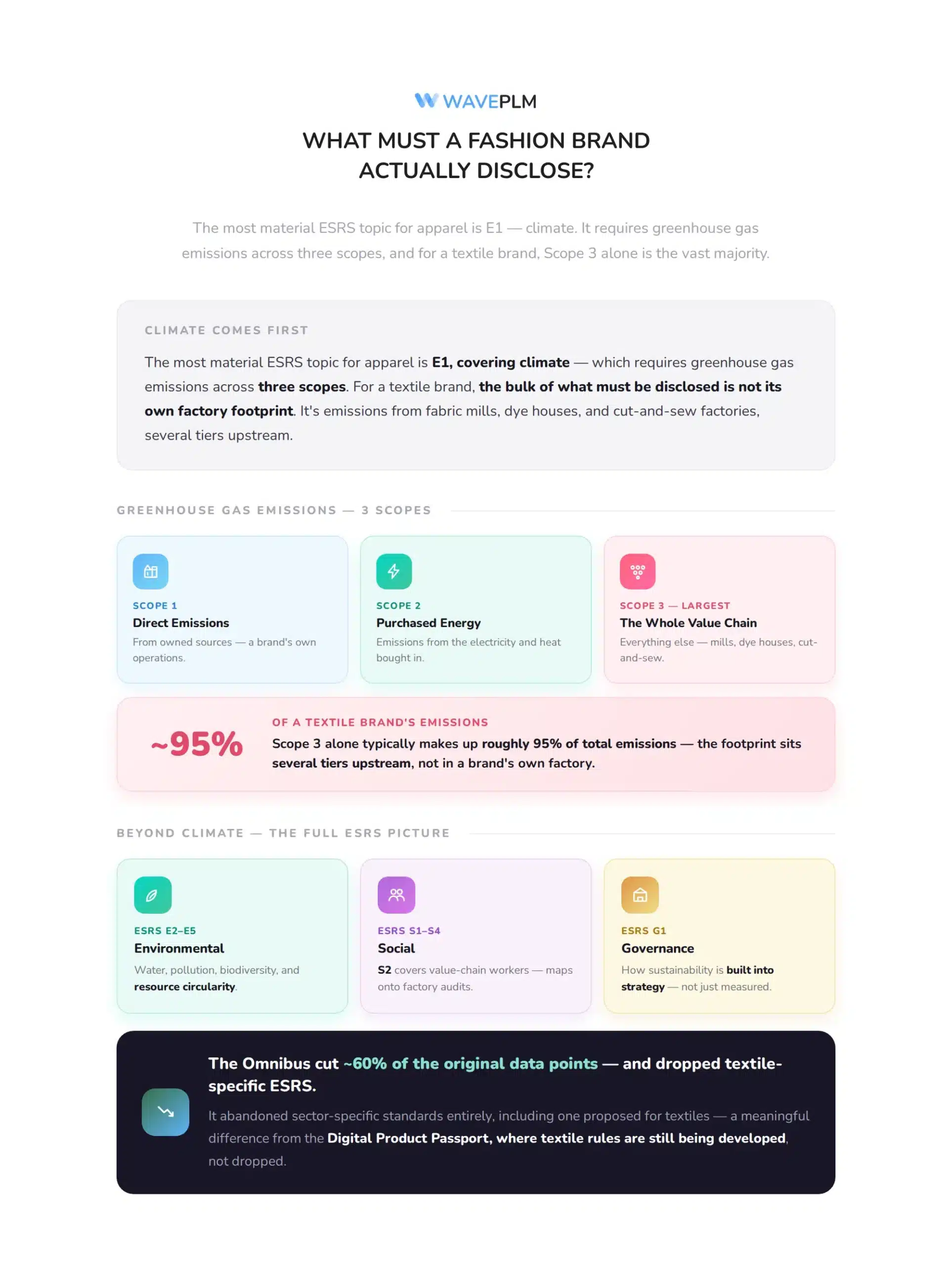
The most material ESRS topic for apparel is E1, covering climate. That standard requires greenhouse gas emissions across three scopes. Scope 1 covers direct emissions from owned sources. Purchased energy falls under Scope 2 instead. Everything else in the value chain counts as Scope 3, the largest category by far for apparel. For a textile brand, Scope 3 alone typically makes up roughly 95 percent of total emissions (Carbonfact). In other words, the bulk of what a fashion brand must disclose is not its own factory footprint. It is emissions from fabric mills, dye houses, and cut-and-sew factories, several tiers upstream.
Beyond climate, brands also disclose water use, pollution, biodiversity impact, and resource circularity under ESRS E2 through E5. Labor conditions and human rights fall under ESRS S1 through S4, with S2 specifically covering workers in the value chain rather than a brand’s own direct employees, a topic that maps closely onto factory audits many sourcing teams already run. Finally, governance disclosures under ESRS G1 round out the picture, covering how sustainability gets built into corporate strategy and oversight, not just measured after the fact.
Notably, the Omnibus simplification cut roughly 60 percent of the original data points. It also dropped plans for sector-specific ESRS standards entirely, including one that had been proposed for textiles (IntegrityNext). That is a meaningful difference from the EU Digital Product Passport, where textile-specific rules are still being actively developed, not abandoned.
How Is CSRD Different From CSDDD?
CSRD and CSDDD get confused often, partly because Omnibus revised both at the same time. Our EU CSDDD guide covers the due diligence directive: a legal requirement to identify, prevent, and remedy actual human rights and environmental harm across a value chain, backed by potential civil liability. CSRD asks for something different. It requires disclosing sustainability data through an audited annual report, not fixing anything directly.
A useful way to separate them: CSRD is a reporting exercise, checked by an auditor. CSDDD is an operational obligation, enforceable through national authorities and, in some cases, courts. A company can, in theory, comply fully with CSRD’s disclosure requirements while still falling short on CSDDD’s due diligence obligations. That is because the two rules check entirely different things.
What Happens If a Company Skips CSRD Reporting?
Unlike the EU deforestation regulation’s single EU-wide penalty figure, CSRD enforcement is decentralized. Each member state sets its own fines. Germany allows up to 10 million euros, or 2 percent of group turnover, whichever is higher. France caps corporate fines at 5 million euros, plus a separate 500,000 euro penalty for individual directors. The Netherlands, Sweden, Poland, and Ireland each set their own separate thresholds (ESG Master).
Beyond direct fines, a material breach can trigger exclusion from public tenders across the EU. It can also mean losing access to European Investment Bank or EU cohesion funding. Enforcement action against Wave 1 companies, covering their FY2024 reports, began in 2026. So far, regulators have prioritized systemic non-compliance over minor technical errors. In practice, that gives most brands a short grace period to fix genuine gaps before facing the harshest penalties, though nobody should count on that leniency lasting indefinitely.
How Should Fashion Brands Prepare for 2026?
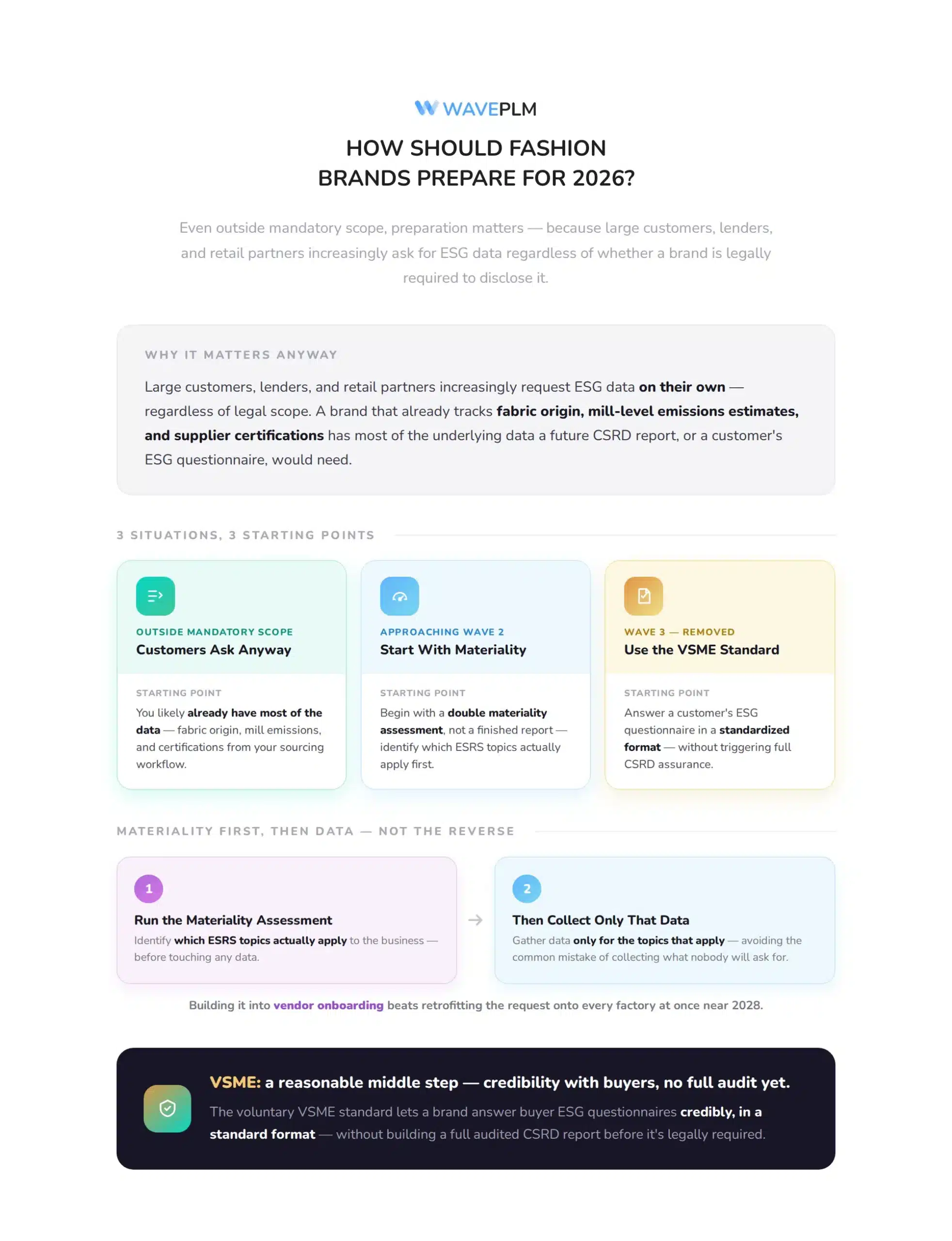
For a brand outside mandatory scope, preparation still matters. Large customers, lenders, and retail partners increasingly request ESG data on their own, regardless of whether a supplier is legally required to disclose it. In practice, a brand that already tracks fabric origin, mill-level emissions estimates, and supplier certifications through its fabric sourcing workflow has most of the underlying data a future CSRD report, or a customer’s ESG questionnaire, would need.
For brands approaching the Wave 2 threshold, the practical starting point is a double materiality assessment, not a finished report. First, that assessment identifies which ESRS topics actually apply. Only then does data collection start, which avoids the common mistake of gathering information nobody will ask for. Building supplier data collection into a vendor onboarding process from the start also avoids retrofitting that request onto every existing factory relationship at once, closer to the 2028 deadline.
Brands that now fall outside mandatory scope entirely, following Wave 3’s removal from the rule, are not necessarily off the hook either. The voluntary VSME standard exists precisely for this group. Specifically, a supplier or brand can use it to answer a large customer’s ESG questionnaire in a standardized format, without triggering full CSRD-level assurance requirements. In practice, that makes VSME a reasonable middle step for a brand that wants credibility with buyers, but does not want to build a full audited report before it is legally required.
Wave PLM and CSRD Readiness
Wave PLM keeps supplier, material, and sourcing records tied to each style. That is the same data a Scope 3 emissions estimate, or a double materiality assessment, eventually needs. A brand collecting this information through a supplier portal already has a running head start on the Corporate Sustainability Reporting Directive. In the end, that holds true whether the brand ends up in mandatory scope, or simply responds to a customer’s ESG request first. Either way, nobody wants to discover a data gap the week before an audit deadline.

Frequently Asked Questions
Which fashion brands must comply with the Corporate Sustainability Reporting Directive?
Only companies with more than 1,000 employees and over 450 million euros in annual net turnover fall under mandatory CSRD scope after the 2026 Omnibus simplification. Zalando, Adidas, and LVMH already report as Wave 1 companies.
When do mid-market fashion brands need to report under CSRD?
Wave 2 companies, those meeting the new thresholds for the first time, must publish their first report in 2028, covering fiscal year 2027. Listed SMEs were removed from mandatory scope entirely, with a voluntary simplified standard available instead.
How is CSRD different from CSDDD?
CSRD requires disclosing audited sustainability data in an annual report. CSDDD requires actively identifying, preventing, and remedying human rights and environmental harm across a supply chain. A company can meet one obligation without automatically meeting the other.
What emissions data must a fashion brand disclose under CSRD?
ESRS E1 requires Scope 1, 2, and 3 greenhouse gas emissions. For a textile brand, Scope 3 alone typically accounts for roughly 95% of total emissions, since most impact sits upstream at fabric mills and factories rather than the brand’s own operations.
What is the penalty for not complying with CSRD?
Penalties are set by each EU member state rather than at the EU level. Germany allows fines up to 10 million euros or 2% of group turnover, while France caps corporate fines at 5 million euros. Non-monetary consequences can include exclusion from public tenders.
Are there sector-specific CSRD rules for textiles?
No. The Omnibus simplification discontinued sector-specific ESRS standards entirely, including one that had been proposed for textiles. Fashion brands report under the same general standards as every other industry.
The Corporate Sustainability Reporting Directive now touches a much smaller group of fashion brands than originally planned, but that group already includes some of the industry’s largest names. For everyone else, the pressure to disclose sustainability data is shifting from regulators to customers and lenders instead. Either way, the underlying data is the same: fabric origin, supplier emissions, and factory conditions. That is what a brand needs for CSRD, for a buyer’s ESG questionnaire, or simply to run its supply chain well. Wave PLM keeps that data in one place, ready before either one asks for it.








Leave a Reply