

A sourcing agent finds, vets, and manages factories on behalf of an apparel brand. In exchange, the agent earns a commission on the order value. Most agents charge 5 to 10% of the FOB price. However, the rate shifts with order size. A small trial order often pays more. A large repeat order often pays less. That fee buys real work: factory vetting, sample coordination, quality inspections, and shipment logistics. It can also hide a real risk. An undisclosed agent can quietly mark up the factory price before a brand ever sees it. This guide covers what a sourcing agent actually does. It also covers how much one costs, and when working with one makes sense instead of sourcing direct.
Industry data: Sourcing agent commissions typically range from 3% to 10% of total order value, with smaller trial orders sitting at the upper end and high-volume repeat orders commanding lower rates (Bo Asia).
What Does a Sourcing Agent Do for an Apparel Brand?
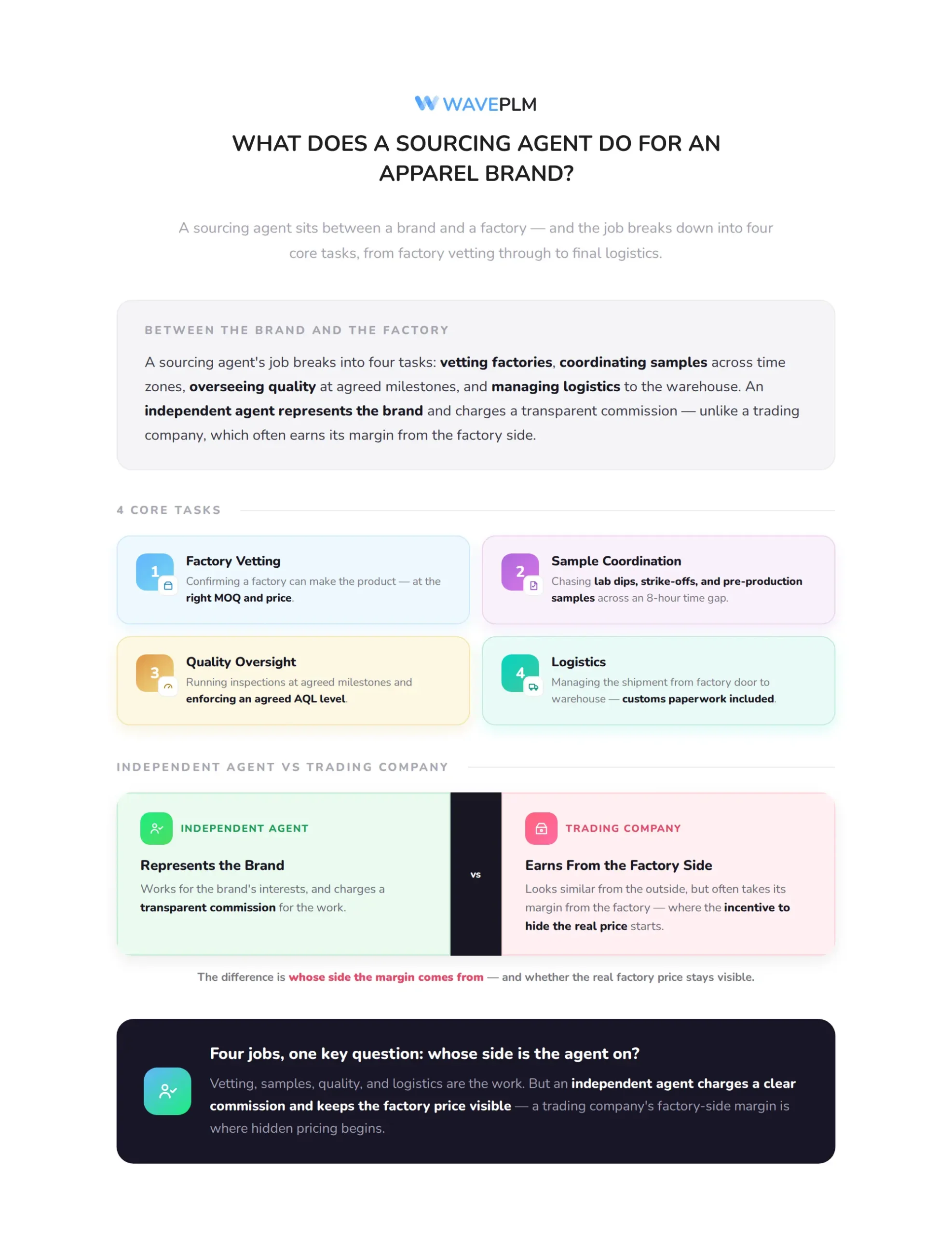
A sourcing agent sits between a brand and a factory. In practice, the job breaks down into four core tasks. First, factory vetting: confirming a factory can make the product, at the right minimum order quantity and price. Second, sample coordination: chasing lab dips, strike-offs, and pre-production samples. This way, a brand does not have to email a factory directly across an eight-hour time difference. Third, quality oversight: running inspections at agreed milestones and enforcing an agreed AQL level. Fourth, logistics: managing the shipment from the factory door to the brand’s warehouse, customs paperwork included.
Independent agents typically represent the brand’s interests, not the factory’s. As a result, they charge a transparent commission for that work. A trading company can look similar from the outside. Often, though, it earns its margin from the factory side instead. That is exactly where the incentive to hide the real factory price starts.
How Is a Sourcing Agent Different From a Trading Company?
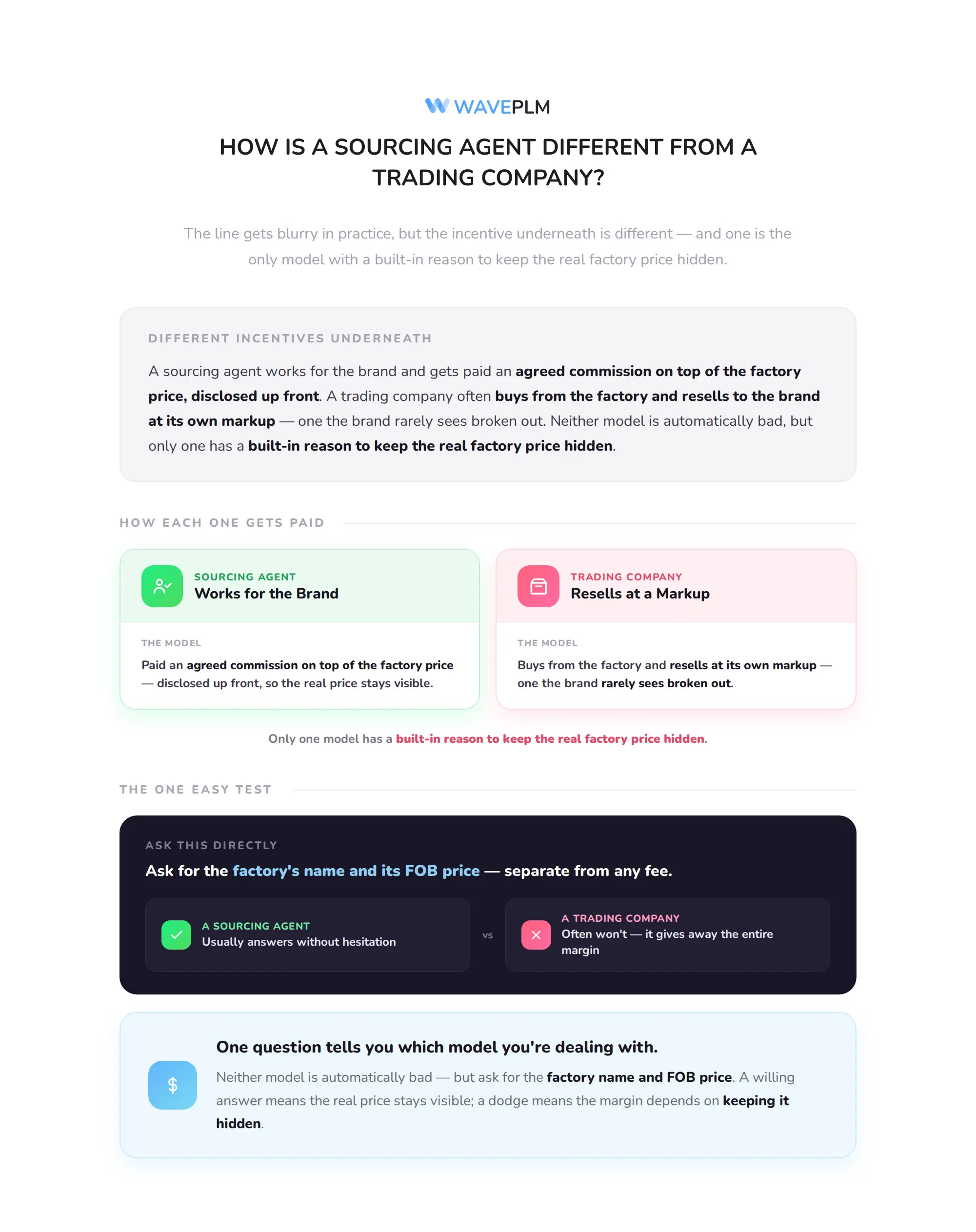
The line between the two gets blurry in practice, but the incentive underneath is different. A sourcing agent works for the brand and gets paid an agreed commission on top of the factory price, disclosed up front. A trading company, by contrast, often buys from the factory and resells to the brand at its own markup, one the brand rarely sees broken out. Neither model is automatically bad. Still, a brand should know which one it is actually dealing with, since only one of them has a built-in reason to keep the real factory price hidden.
One easy test: ask directly for the factory’s name and its FOB price, separate from any fee. A sourcing agent representing the brand’s interests will usually answer without hesitation. A trading company acting as a reseller often will not, since disclosing that number gives away its entire margin.
How Much Does an Apparel Sourcing Agent Cost?
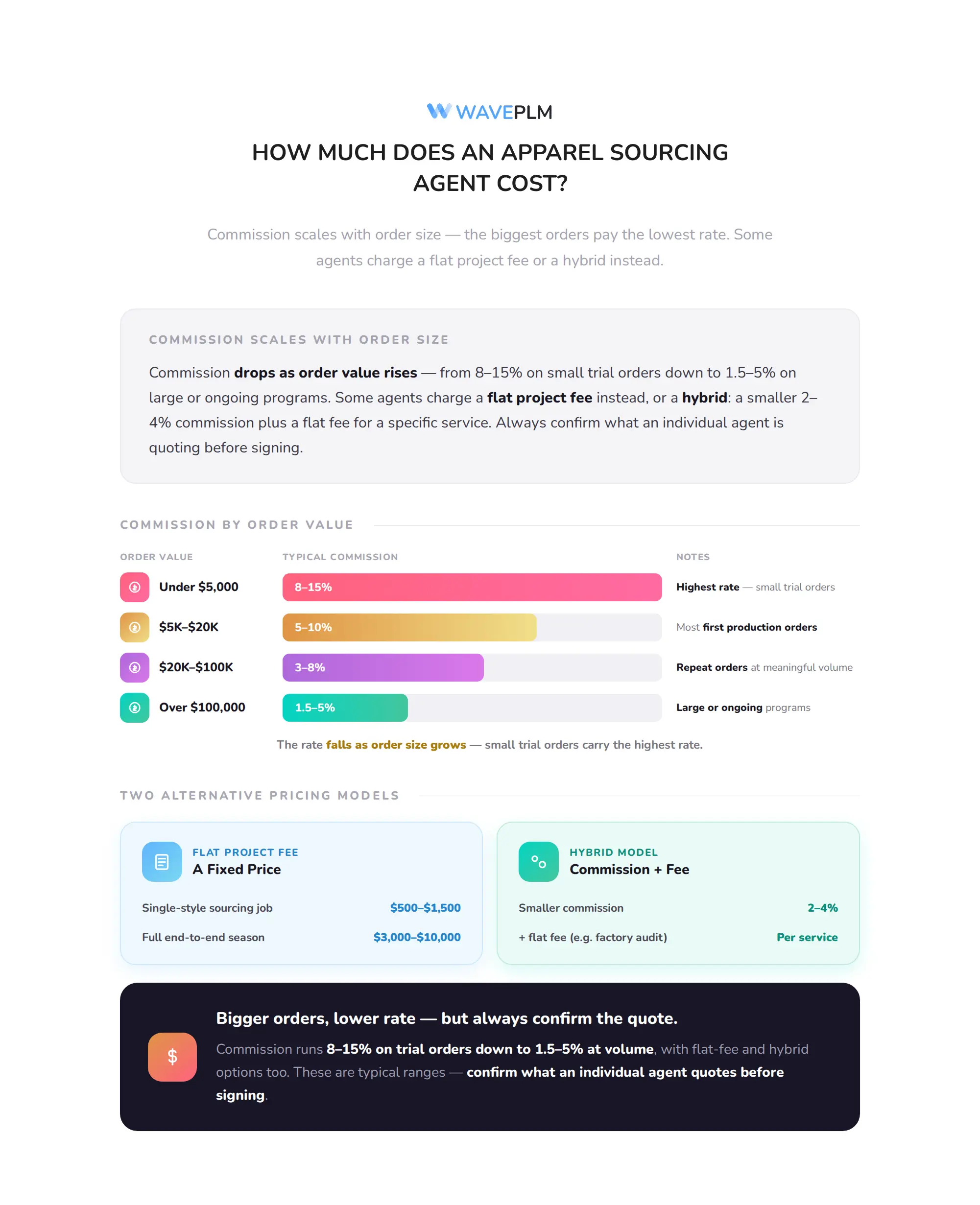
Commission scales with order size. The table below shows a typical range. Even so, a brand should always confirm what an individual agent is quoting before signing anything.
| Order value | Typical commission | Notes |
|---|---|---|
| Under $5,000 | 8-15% | Small trial orders carry the highest rate |
| $5,000-$20,000 | 5-10% | Most first production orders fall here |
| $20,000-$100,000 | 3-8% | Repeat orders at meaningful volume |
| Over $100,000 | 1.5-5% | Large or ongoing programs |
Some agents charge a flat project fee instead. That typically runs $500 to $1,500 for a single-style sourcing job. For full end-to-end management of a season, it runs $3,000 to $10,000. A hybrid model also exists: a smaller commission of 2 to 4%, plus a flat fee for a specific service like a factory audit (Epic Sourcing).
What Is the Real Risk of Using a Sourcing Agent?
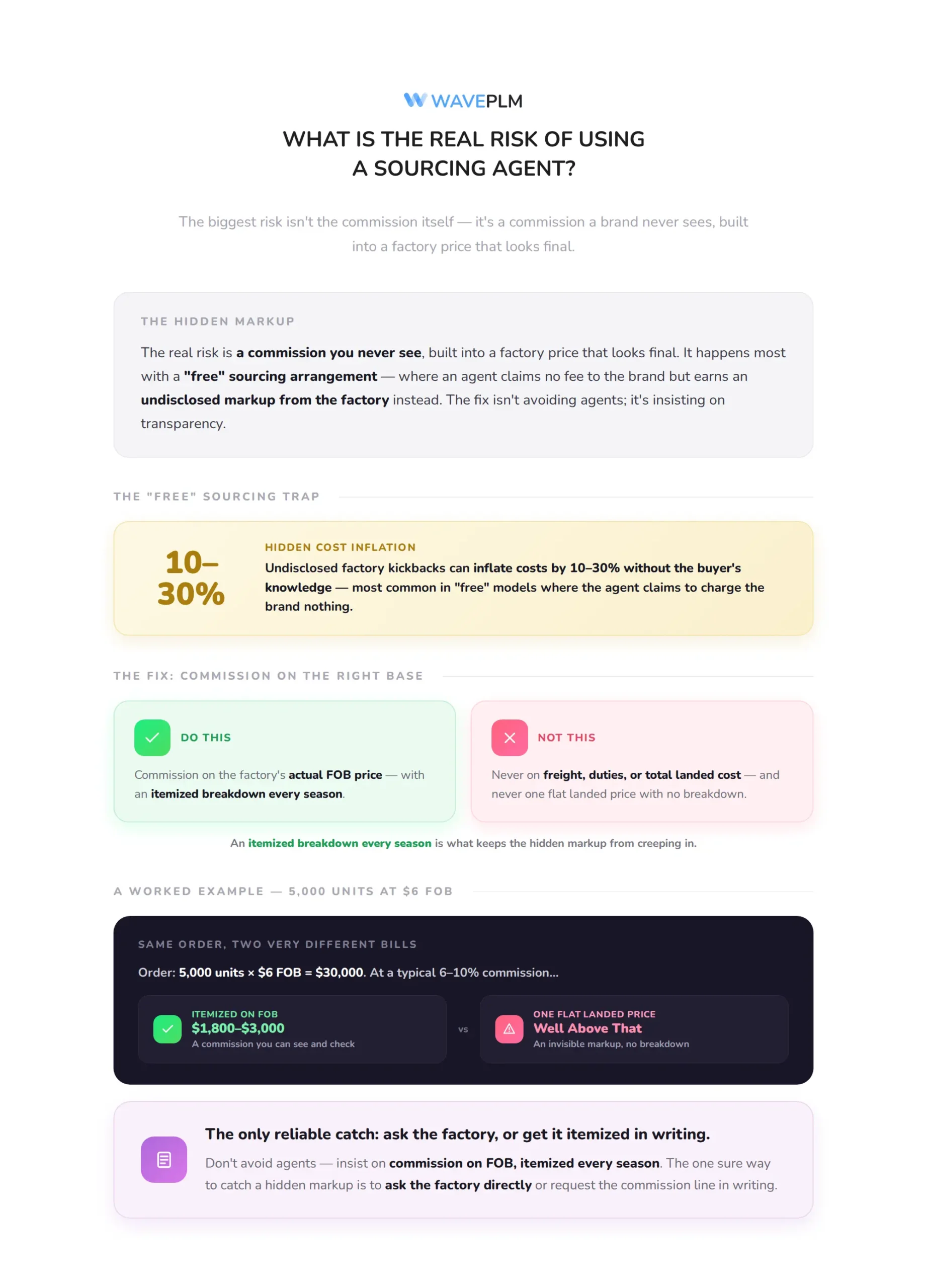
The biggest risk is not the commission itself. It is a commission a brand never sees, built into a factory price that looks final. That happens most often with a “free” sourcing arrangement. There, an agent claims no fee to the brand, but earns an undisclosed markup from the factory instead.
Industry data: Undisclosed factory kickbacks can inflate costs by 10 to 30% without the buyer’s knowledge, a pattern most common in “free” sourcing models where the agent claims to charge the brand nothing (Bo Asia).
The fix is not avoiding agents altogether. Instead, ask for commission structured on the factory’s actual FOB price. It should never be calculated on freight, duties, or the total landed cost. A brand that gets an itemized breakdown from its agent every season rarely runs into this problem. For example, a brand ordering 5,000 units at a $6 FOB price expects to pay roughly $1,800 to $3,000 in commission at a typical 6 to 10% rate. If an agent instead quotes one flat landed price with no breakdown, that same order can carry an invisible markup well above that range. In fact, the only reliable way to catch the difference is to ask the factory directly, or to request the commission line itemized in writing.
When Does It Make Sense to Use a Sourcing Agent Instead of Sourcing Direct?
Order volume is the clearest signal. Below roughly $10,000 a year in apparel orders, independent sourcing usually makes more sense. Otherwise, the commission eats too much of the savings. Between $10,000 and $50,000, it depends on product complexity. Above $50,000, and up to about $500,000 a year, a sourcing agent almost always delivers a positive return. Mainly, that comes from negotiation leverage a small brand does not have on its own (Epic Sourcing). Past $500,000 a year, most brands are better served by a dedicated in-house sourcing hire instead.
Our guide to finding a clothing manufacturer covers the direct-sourcing path in detail. That includes how to evaluate a factory’s certifications and sample quality, agent or no agent.
How Does a Sourcing Agent Handle Quality Control?
A good agent runs inspections at agreed points in production, not only at the end. Usually, that means an in-line check partway through the run. It also means a final random inspection before a shipment leaves the factory. Both get measured against an agreed AQL level. Most commonly, that means AQL 1.5 for major defects and 0% for critical defects (Epsilon GS). Our AQL inspection guide covers how those thresholds get set by product type.
In practice, a brand should ask exactly which stage an agent’s fee covers. Some agents include inspection in their standard commission. Meanwhile, others bill it separately. A brand that assumes otherwise can end up with no inspection at all, on a run that badly needed one. Our quality control management software guide covers how a brand logs every inspection in one place, whether an in-house team or an agent runs it.
How Should a Brand Vet a Sourcing Agent Before Signing?
Three questions matter most. First, will the agent disclose the actual factory FOB price, not just a bundled total? An agent who refuses is usually hiding a markup. Second, can the agent name the specific factories it plans to use, with references from other apparel brands? Similarly, a vague answer here is a warning sign. Third, does the agent’s fee structure match the order size a brand is actually placing? It should land close to the commission ranges above. Our vendor onboarding guide covers similar due-diligence questions for a factory relationship. Most of them apply just as directly to vetting the agent standing in between.
How Does Sourcing Agent Work Fit Into a Broader PLM Workflow?
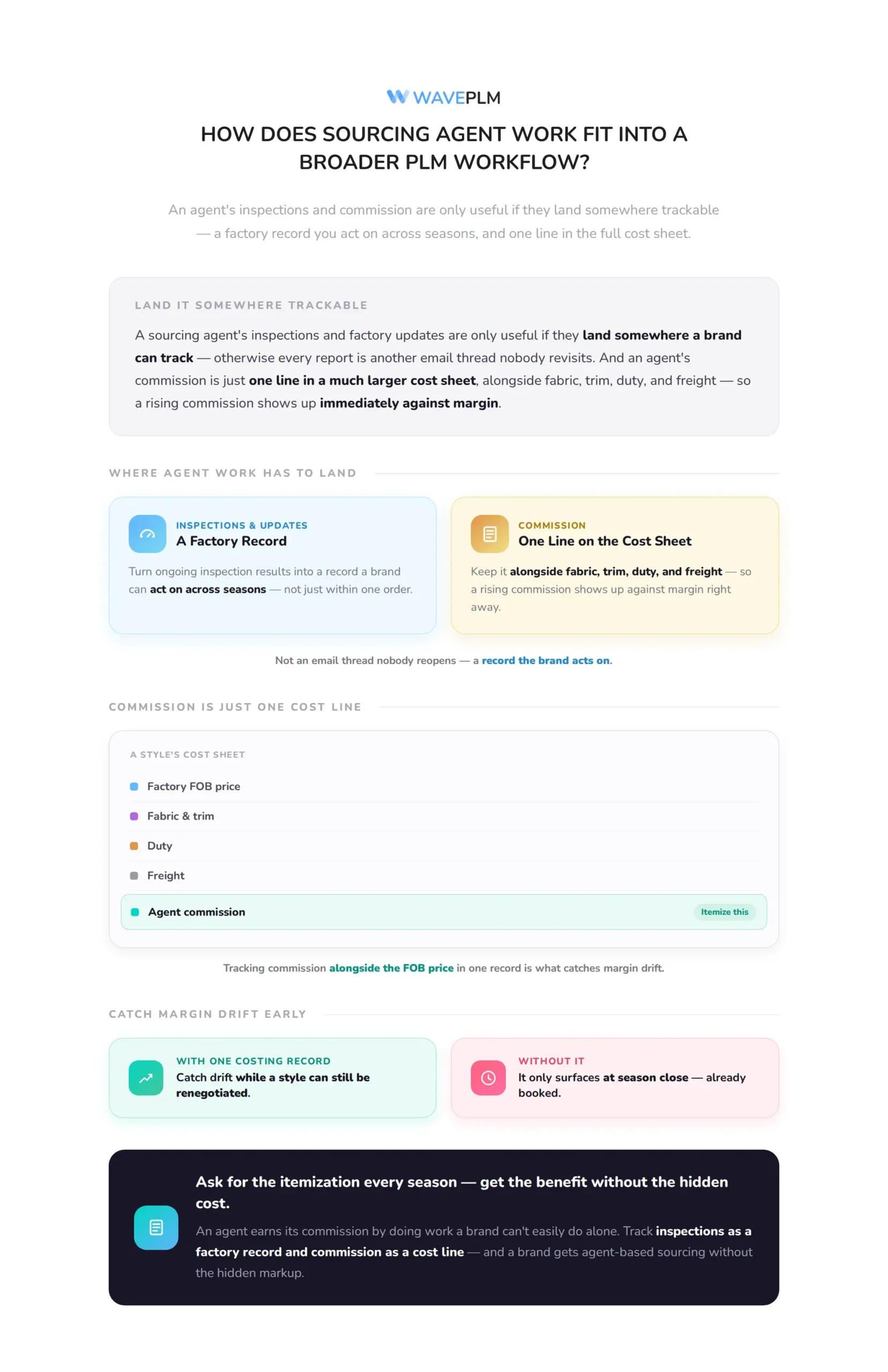
A sourcing agent’s inspections and factory updates are only useful if they land somewhere a brand can actually track. Otherwise, every agent report becomes another email thread nobody revisits once a shipment ships. Our supplier scorecard guide covers how a brand turns an agent’s ongoing inspection results into a factory record it can act on across seasons, not just within one order.
That same record connects to cost. An agent’s commission is one line in a much larger cost sheet, alongside fabric, trim, duty, and freight. Our garment costing guide covers how to keep that full picture in one place. That way, a rising agent commission shows up immediately against margin, instead of surfacing only at season close. Our finding: Wave PLM customers who track agent commission alongside factory FOB price in one costing record catch margin drift early. Notably, they catch it while a style can still be renegotiated, not after the season is already booked.
In short, a sourcing agent earns its commission by replacing work a brand cannot easily do alone. That means vetting an unfamiliar factory base, running inspections in a country a brand cannot visit every month, and negotiating a price a first-time buyer could not get on its own. The real risk is not the agent model itself. Instead, it is an agent who will not show the real factory price. It is also an agent who quietly folds inspection costs into a commission a brand never itemized. A brand that asks for that itemization every season gets the real benefit of agent-based sourcing, without the hidden cost.
Frequently Asked Questions
What does a sourcing agent do for an apparel brand?
A sourcing agent vets factories, coordinates samples, runs quality inspections, and manages shipping logistics. In exchange, it earns a commission on the order value.
How much commission does a sourcing agent charge?
Most sourcing agents charge 5 to 10% of the factory FOB price. Small trial orders often run 8 to 15%. Large repeat orders over $100,000 can fall to 1.5 to 5%.
Can a sourcing agent hide extra costs in the factory price?
Yes. An undisclosed markup can add 10 to 30% to a factory’s real price. This happens most often under a “free” sourcing arrangement, where the agent claims to charge the brand nothing directly.
When should a brand use a sourcing agent instead of sourcing direct?
Above roughly $50,000 a year in orders, a sourcing agent usually delivers a positive return through negotiation leverage. Below $10,000 a year, independent sourcing is typically the better option.
Does a sourcing agent handle quality inspections?
A good agent runs an in-line inspection during production, plus a final random inspection before shipment. Both get measured against an agreed AQL level, such as AQL 1.5 for major defects.
How does a brand vet a sourcing agent before signing?
Ask for the actual factory FOB price, references from other apparel brands the agent has sourced for, and a commission structure that matches the brand’s real order size.
Most apparel brands can say what they pay a factory. Far fewer can say, with real numbers, what they are actually paying an agent on top of it. If a sourcing agent will not itemize its commission separately, Wave PLM keeps every cost line, agent commission included, attached to the same style and cost record a brand already tracks every season.







Leave a Reply