

Knowing how to find a clothing manufacturer is the most consequential operational decision a small apparel brand makes. A clothing manufacturer is a production facility that cuts, sews, and finishes garments from your approved specifications and materials. Finding the right one, however, takes considerably more than a directory search. The real work is qualification: verifying that a factory can deliver your product at your quality standard, on your timeline, at a cost that protects your margin. This guide covers every stage — what to prepare, where to look, how to vet, and how to manage manufacturer relationships as your brand scales. Understanding how to find a clothing manufacturer can streamline your production process.
Our finding: Wave PLM customers who complete a formal manufacturer qualification before their first production order report 55% fewer sample correction rounds compared to brands that selected factories from directory listings alone.
Our finding: Wave PLM customers who complete a formal manufacturer qualification before their first production order report 55% fewer sample correction rounds compared to brands that selected factories from directory listings alone.
What Is a Clothing Manufacturer?
To enhance your knowledge of how to find a clothing manufacturer, consider attending trade shows where you can meet potential partners face-to-face.
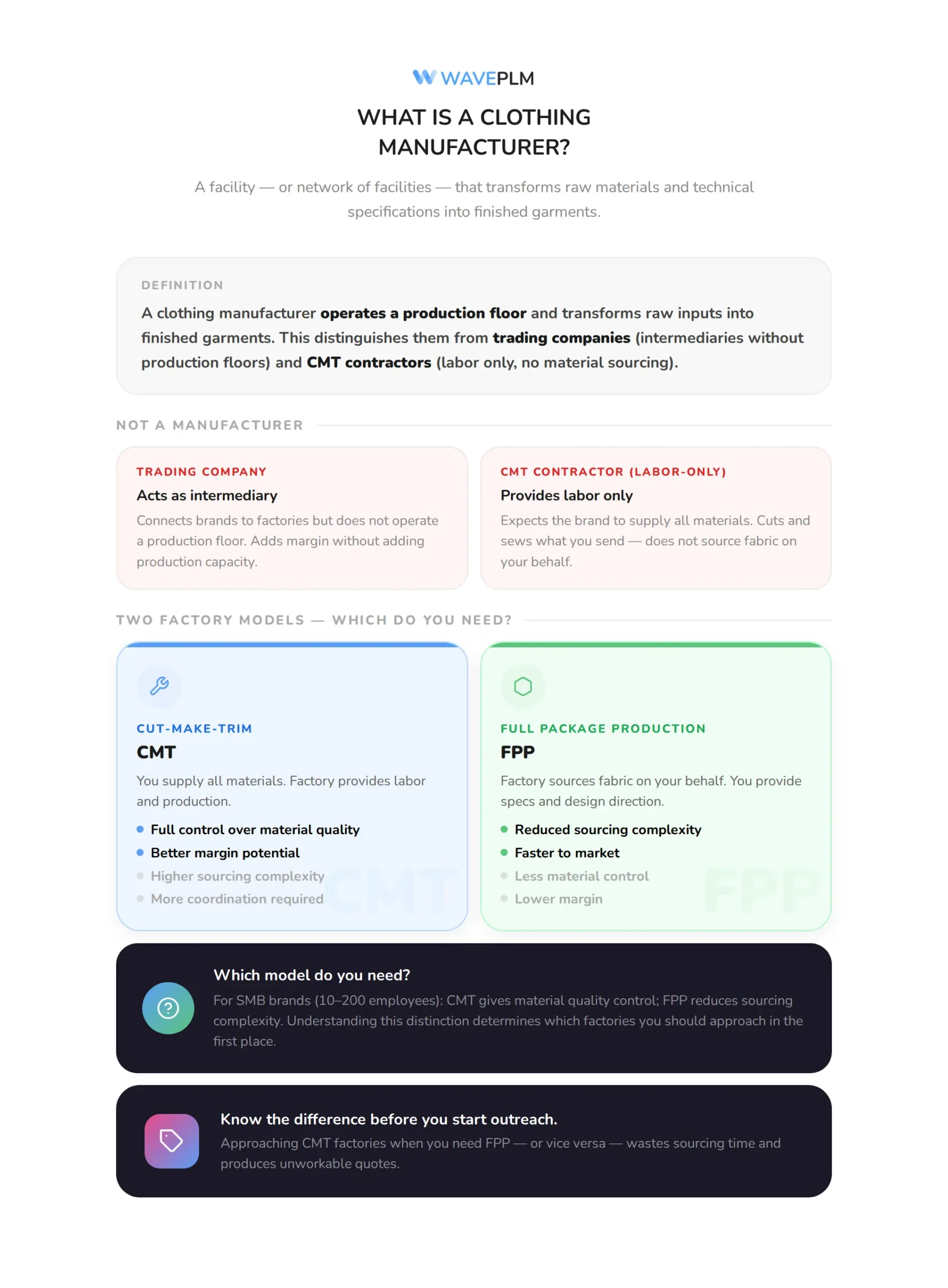
A clothing manufacturer is a facility — or network of facilities — that transforms raw materials and technical specifications into finished garments. Manufacturers are distinct from trading companies, which act as intermediaries but do not operate production floors. Additionally, manufacturers differ from cut-make-trim (CMT) contractors. CMT facilities provide labor only and expect you to supply all materials. Full-package (FPP) factories, in contrast, source fabric on your behalf.
If you’re wondering how to find a clothing manufacturer that suits your needs, consider reaching out to industry peers for recommendations.
For SMB apparel brands in the 10–200 employee range, this distinction matters. Specifically, CMT arrangements give brands more control over material quality. FPP arrangements, in contrast, reduce sourcing complexity at the cost of some margin. Understanding which model you need determines which factories you should approach in the first place.
To improve your chances of success when learning how to find a clothing manufacturer, ensure you have a clear vision of your brand’s identity and product goals.
What Do You Need Before Approaching Any Manufacturer?
Manufacturers evaluate brands in reverse. A factory receiving an inquiry without a technical package will deprioritize or ignore it entirely. Therefore, before reaching out to a single factory, prepare the following four items.
Tech Pack
A technical specification document defines construction sketches, graded measurements, seam and stitch specs, Pantone references, material callouts, and label placement. No professional factory quotes or produces samples without one. Sending a mood board in place of a tech pack signals inexperience and raises your quoted sampling cost.
Bill of Materials
Your BOM lists every component — shell fabric, lining, trims, labels, thread, hardware — with sourcing references where available. FPP factories use it to quote material costs. CMT factories need it to confirm they can source or accept the materials you plan to supply.
Target MOQ and Annual Volume
Be honest about your first-order quantity and your projected annual volume across all styles. Factories allocate production capacity based on total business potential, not individual POs. Consequently, a brand that places 200-unit orders but grows to 2,000 units over two seasons is more attractive than one that places a single large order and goes quiet.
Price Targets and Delivery Windows
Know your cost-of-goods target before quoting begins. Similarly, know your in-market date for each delivery. Factories that cannot meet your price or timeline requirements are filtered out early, which saves weeks of back-and-forth that leads nowhere.
How to Find a Clothing Manufacturer: Sourcing Channels Compared
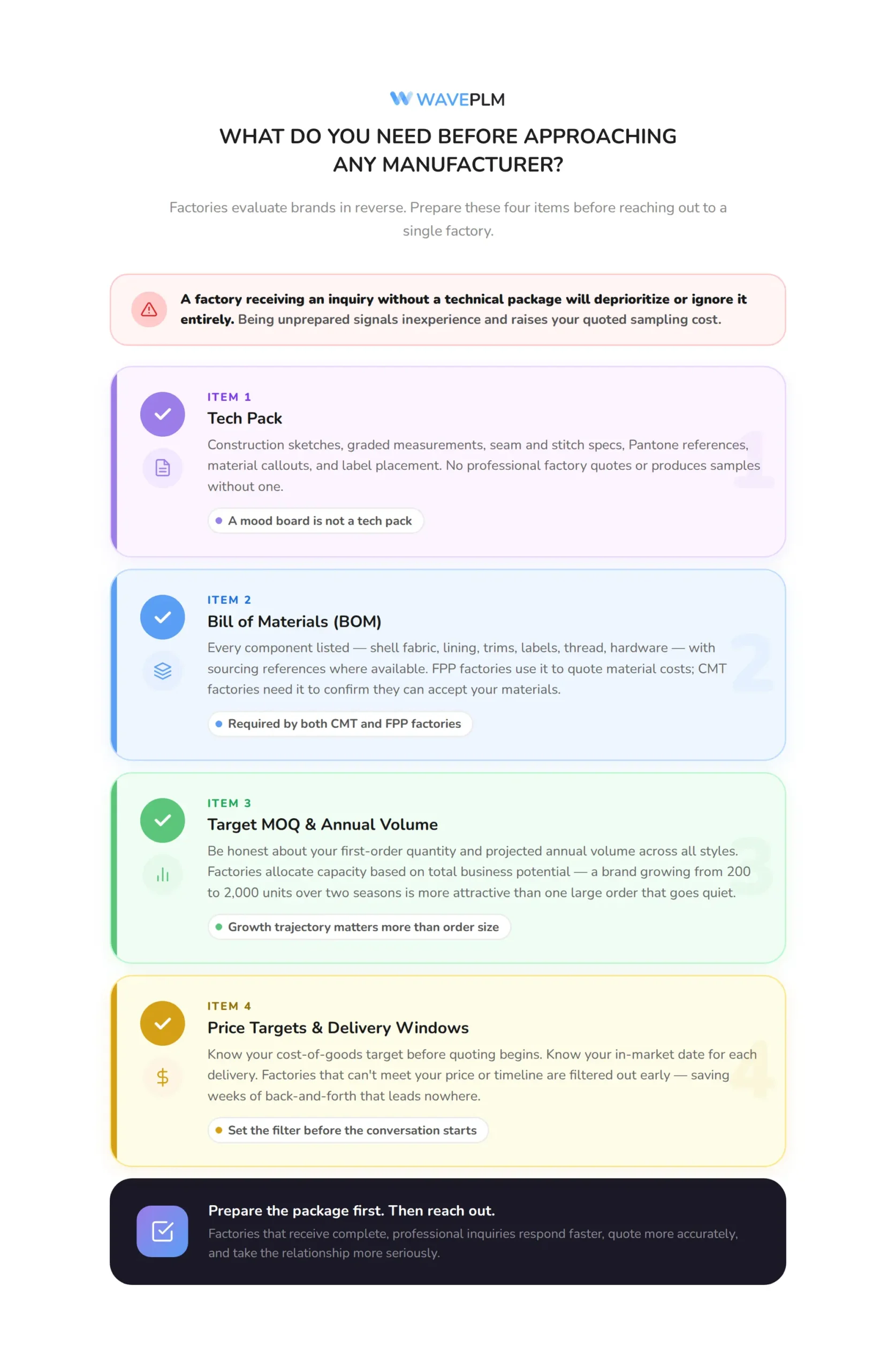
Sourcing channels vary significantly in lead quality. The table below compares the most reliable options for brands at different stages. Notably, referrals from fabric suppliers and industry peers consistently produce the highest-quality factory introductions — because the referring brand has already completed the qualification work.
| Channel | Best for | Geography | Key consideration |
|---|---|---|---|
| Maker’s Row | Early-stage US brands | United States | Verified US factories; paid plans unlock direct contact |
| Sewport | Low-MOQ projects | US, UK, EU | Good for brands needing under 100 units per style |
| Alibaba / 1688 | Scaling brands, 200+ units | Asia (primarily China) | Verify factory vs. trading company before quoting |
| Trade shows (MAGIC, Première Vision) | All stages | Global | Face-to-face vetting; highest quality leads |
| Fabric supplier referrals | All stages | Matches your sourcing region | Mills refer trusted factories; very high signal quality |
| Sourcing agents | Brands new to overseas sourcing | Asia, Eastern Europe | Typically 5–10% of FOB cost; reduces risk for first-timers |
| Industry referrals | All stages | Any | Best quality leads; ask peers in non-competing categories |
Understanding how to find a clothing manufacturer that aligns with your brand values is critical for long-term success.
How Do You Qualify a Clothing Manufacturer? A 5-Point Framework
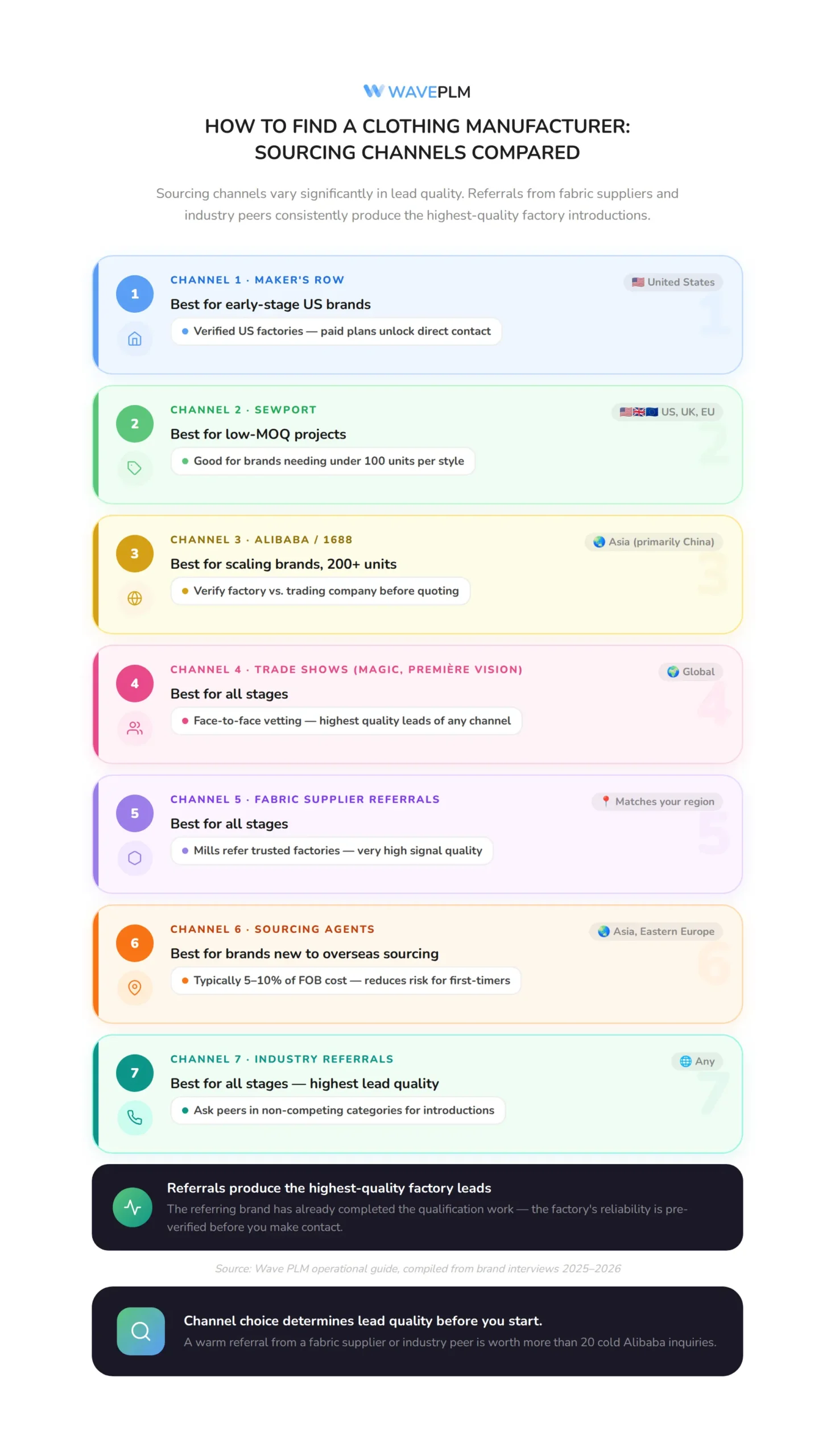
A shortlist of factories is meaningless without structured evaluation. The following five criteria — applied consistently across every candidate — produce a defensible qualification decision rather than a gut-feel choice. Furthermore, working through all five points before your first sample request saves weeks of correction cycles with a factory that was never the right fit.
1. Production Capacity Fit
When considering how to find a clothing manufacturer, prioritize quality and reliability over cost alone.
A factory optimized for 50,000-unit fast-fashion runs is structurally misaligned with a 300-unit small-brand order. Therefore, ask for their typical order range, lead time per style, and current capacity utilization. Factories running at 90%+ utilization will deprioritize small POs when larger clients need floor space.
2. Certifications and Compliance
For US and EU market entry, minimum compliance in 2026 includes three certifications. These are SA8000 (social accountability), OEKO-TEX Standard 100 (chemical safety), and BSCI or WRAP. Additionally, brands targeting European retail should prepare for EU Digital Product Passport requirements phasing in from 2026. These require full material traceability. PLM systems manage this natively.
3. Sample Quality Assessment
Never qualify a factory on price alone. Instead, request a proto sample from your tech pack before committing to a production agreement. Evaluate construction accuracy, seam consistency, color matching against your Pantone callout, and measurement conformance. According to standard AQL inspection methodology, factories producing proto samples with major defect rates above 2.5% rarely improve significantly at bulk.
4. Communication Speed and Clarity
Researching how to find a clothing manufacturer should include evaluating their previous work to ensure it aligns with your quality expectations.
Test communication during the RFQ stage itself. Specifically, send your tech pack and request a quote with a five-business-day response window. Factories that respond within two days with detailed questions about your specs are demonstrating the operational discipline you need during production. In contrast, factories that respond in three weeks with a vague price range are showing you exactly how bulk production will be managed.
5. Client References
Request two or three references from current brand clients in a similar product category. Specifically ask: did deliveries arrive on time, how were quality issues resolved, and would they place another order with this factory? A factory that cannot provide references — or provides only references from affiliated businesses — should move to the bottom of your shortlist immediately.
Industry data: FIT’s 2024 manufacturing survey shows that formal factory audits reduce on-time delivery failures by 38%. This improvement is measured in year one of the vendor relationship.
Industry data: FIT’s 2024 manufacturing survey shows that formal factory audits reduce on-time delivery failures by 38%. This improvement is measured in year one of the vendor relationship.
Domestic vs. Overseas Manufacturing: How Do Brands Decide?
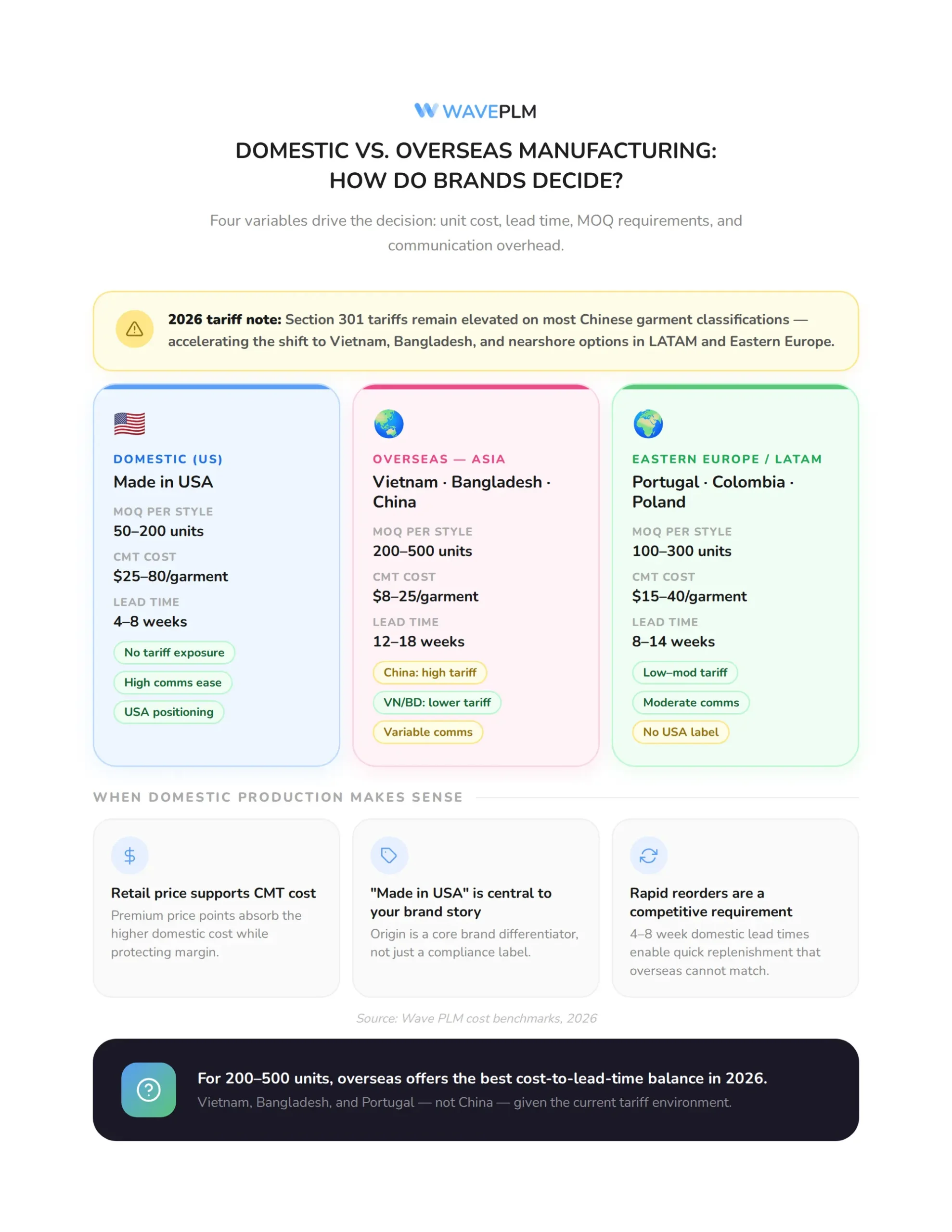
The domestic versus overseas decision involves four variables: unit cost, lead time, MOQ requirements, and communication overhead. Furthermore, the 2026 US tariff environment has shifted the calculation for some categories. Notably, Section 301 tariffs remain elevated on most Chinese garment classifications, which has accelerated the shift to Vietnam, Bangladesh, and nearshore options in LATAM and Eastern Europe.
| Factor | Domestic (US) | Overseas (Asia) | Overseas (Eastern Europe / LATAM) |
|---|---|---|---|
| Typical MOQ per style | 50–200 units | 200–500 units | 100–300 units |
| CMT cost range | $25–80/garment | $8–25/garment | $15–40/garment |
| Lead time (from approved sample) | 4–8 weeks | 12–18 weeks | 8–14 weeks |
| Communication ease | High | Variable | Moderate |
| Tariff exposure (2026) | None | High (China); lower for Vietnam, Bangladesh | Low to moderate |
| “Made in USA” positioning | Yes (if eligible) | No | No |
For brands producing 200–500 units per style, overseas manufacturing in Vietnam, Bangladesh, or Portugal typically offers the best cost-to-lead-time balance in 2026. Domestic production makes sense in three specific cases. Use it when your retail price supports the higher CMT cost. It also works when “Made in USA” is central to your brand story, or when rapid reorders are a competitive requirement.
In your journey on how to find a clothing manufacturer, you will learn the importance of persistence and adaptability in your approach.
What Are Realistic MOQ and Cost Expectations in 2026?
MOQ expectations vary by garment category, not just geography. Specifically, technical categories such as outerwear and performance knits carry higher MOQs than basics because pattern complexity limits factory yield per hour. The table below reflects current market benchmarks for the categories most relevant to SMB apparel brands.
| Category | Overseas MOQ (units/style/color) | Domestic MOQ (units/style/color) | Sampling cost (overseas) |
|---|---|---|---|
| T-shirts / basic knits | 300–500 | 100–200 | $150–400 per proto |
| Woven tops / shirts | 200–400 | 50–150 | $200–500 per proto |
| Outerwear / jackets | 300–500 | 100–200 | $400–800 per proto |
| Activewear / performance | 200–400 | 50–150 | $250–500 per proto |
| Swimwear / lingerie | 200–400 | 50–150 | $200–450 per proto |
Sampling costs are rarely credited against production cost on a first order. Therefore, budget $1,500–3,500 per style for proto, fit sample, and pre-production sample stages before your first bulk PO. Additionally, factor in courier costs of $200–400 per style for international sample rounds.
As you learn how to find a clothing manufacturer, keep in mind the importance of building strong communication lines from the beginning.
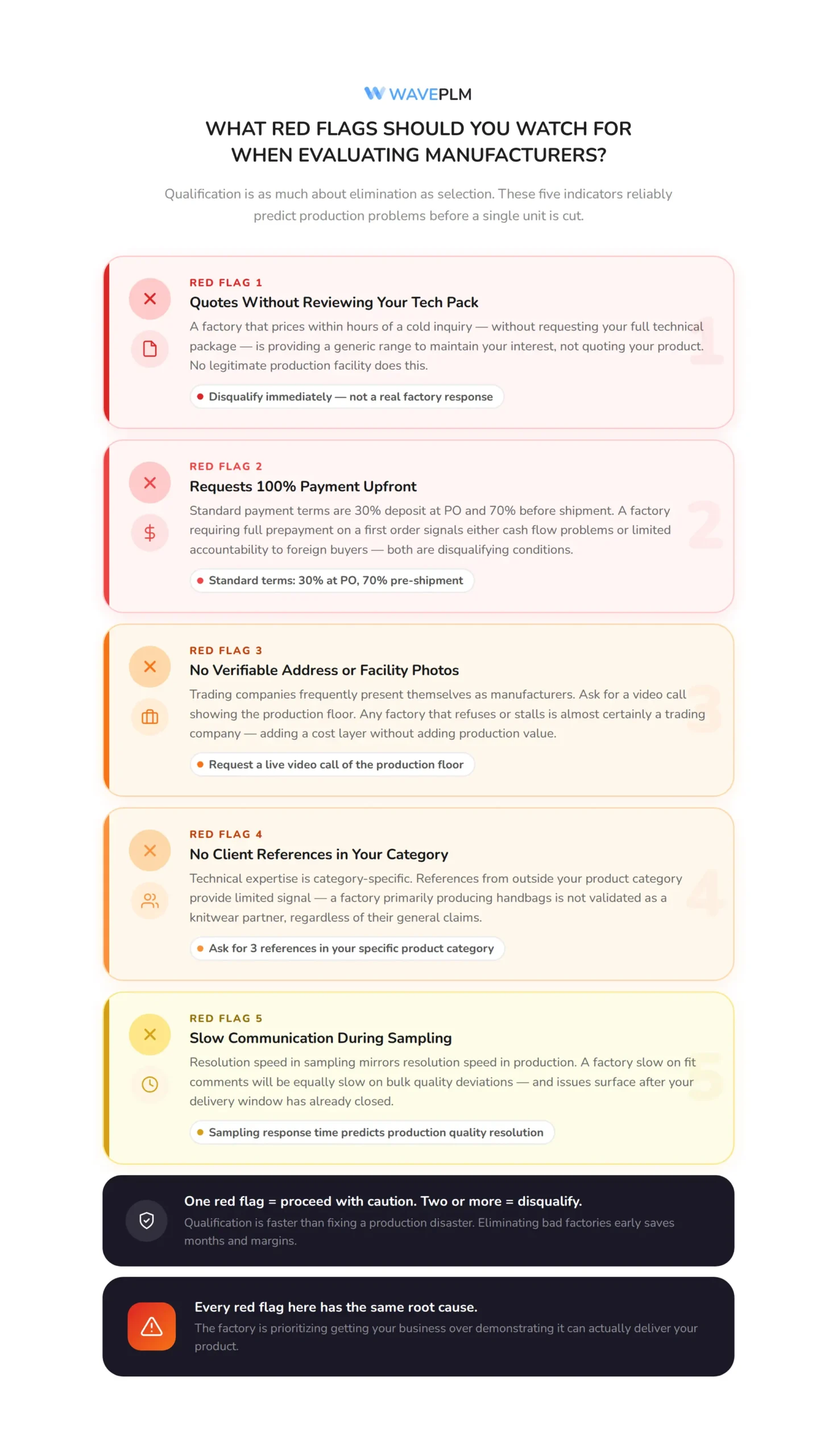
What Red Flags Should You Watch for When Evaluating Manufacturers?
Qualification is as much about elimination as selection. In fact, the following indicators reliably predict production problems before a single unit is cut.
Quotes without reviewing your tech pack. A factory that provides a price before seeing your specifications is not quoting your product — they are providing a generic range to maintain your interest. Specifically, any factory that sends a price within hours of a cold inquiry, without requesting your full technical package first, is unlikely to be a legitimate production facility.
Requests for full payment upfront. Standard payment terms for a first production order are 30% deposit at PO and 70% before shipment. A factory requiring 100% prepayment on a first order signals either cash flow problems or limited accountability to foreign buyers. As a result, both are disqualifying conditions.
No verifiable address or facility photos. Trading companies frequently present themselves as manufacturers. Therefore, ask for a video call showing the production floor. Any factory that refuses or stalls on this request is almost certainly a trading company. These intermediaries add a cost layer without adding production value.
As you research how to find a clothing manufacturer, take note of the types of materials and garments that interest you most.
No client references in your category. Technical expertise is category-specific, and consequently, references from brands outside your product category provide limited signal. A factory primarily producing handbags is not validated as a knitwear partner, regardless of their general claims.
Slow communication during sampling. Resolution time for quality issues in production correlates directly with how quickly a factory responds to non-routine requests. Furthermore, resolution speed in sampling mirrors resolution speed in production. A factory slow on fit comments will be equally slow on bulk quality deviations. Consequently, issues often surface after your delivery window has already closed.
How Do Growing Brands Manage Multiple Manufacturer Relationships?
Single-factory dependency is one of the highest operational risks in small-brand manufacturing. McKinsey & Company’s State of Fashion 2024 report found a clear pattern. Supply chain disruptions affected 72% of apparel brands with fewer than 200 employees in the prior year. Moreover, brands with two or more active production partners resolved disruptions 60% faster than single-factory operations.
For brands in the 20–100 style range, the practical model is straightforward. Assign 70% of your volume to a primary factory. Additionally, qualify a secondary factory that has already completed at least one production run with your brand. That secondary partner does not need to run every season. It simply needs to stay active enough to accept urgent capacity when your primary factory has a conflict.
Our finding: Wave PLM customers managing three or more active manufacturer relationships report that centralized vendor documentation reduces production errors by 45% compared to teams managing the same complexity via email and shared drives.
Our finding: Wave PLM customers managing three or more active manufacturer relationships report that centralized vendor documentation reduces production errors by 45% compared to teams managing the same complexity via email and shared drives.
How Does PLM Help Apparel Brands Work with Manufacturers More Effectively?
Managing one manufacturer with email is workable. Managing three factories across two countries is not. Tech pack revisions, BOM updates, sample approvals, and compliance documentation running simultaneously create consistent failure modes: version control errors, broken approval chains, and compliance gaps. A product lifecycle management system addresses each of these directly.
Version-Controlled Tech Packs
Every revision is timestamped and traceable. Consequently, the factory always works from the approved version — not from an email attachment sent before the most recent fit correction. This single capability eliminates the most common source of sample rejection at the proto stage.

Supplier Portals
A supplier portal gives factories direct, read-only access to approved documentation: tech packs, BOMs, trim callouts, and quality standards. As a result, factories always reference current files rather than outdated email attachments from previous seasons.
Effective communication is key when you are trying to figure out how to find a clothing manufacturer that meets your standards.
Sample Approval Workflows
Ultimately, mastering how to find a clothing manufacturer involves being well-prepared and knowledgeable about your specific production needs.
In summary, knowing how to find a clothing manufacturer is essential for any small brand looking to succeed in the competitive apparel market.
PLM tracks each sample round — Proto, Fit, Pre-production — with approval status, structured comments, and required corrections. This is why sample rounds are reduced when brands use PLM: comments are complete and traceable, not fragmented across email threads.
Compliance Certificate Tracking
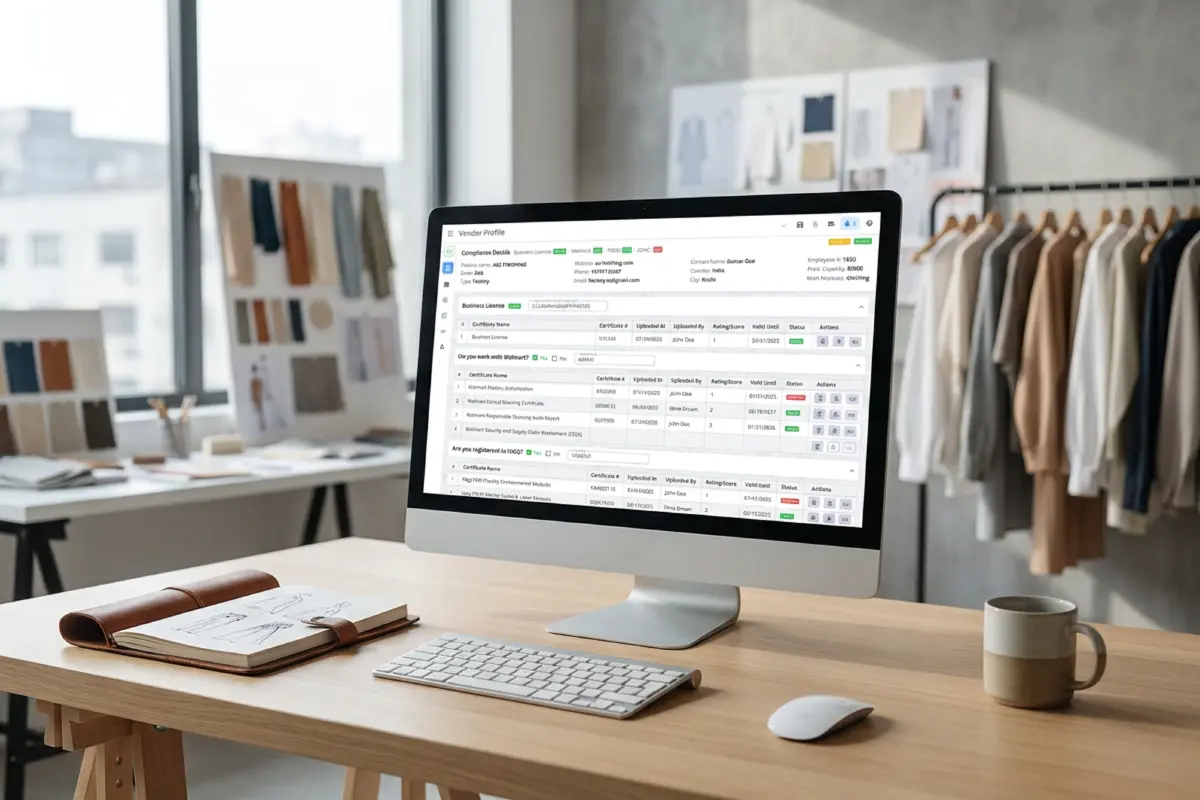
Factory certifications (SA8000, OEKO-TEX, BSCI) expire. PLM systems track renewal dates and flag approaching expirations, ensuring that your vendor compliance program stays current without manual calendar management.
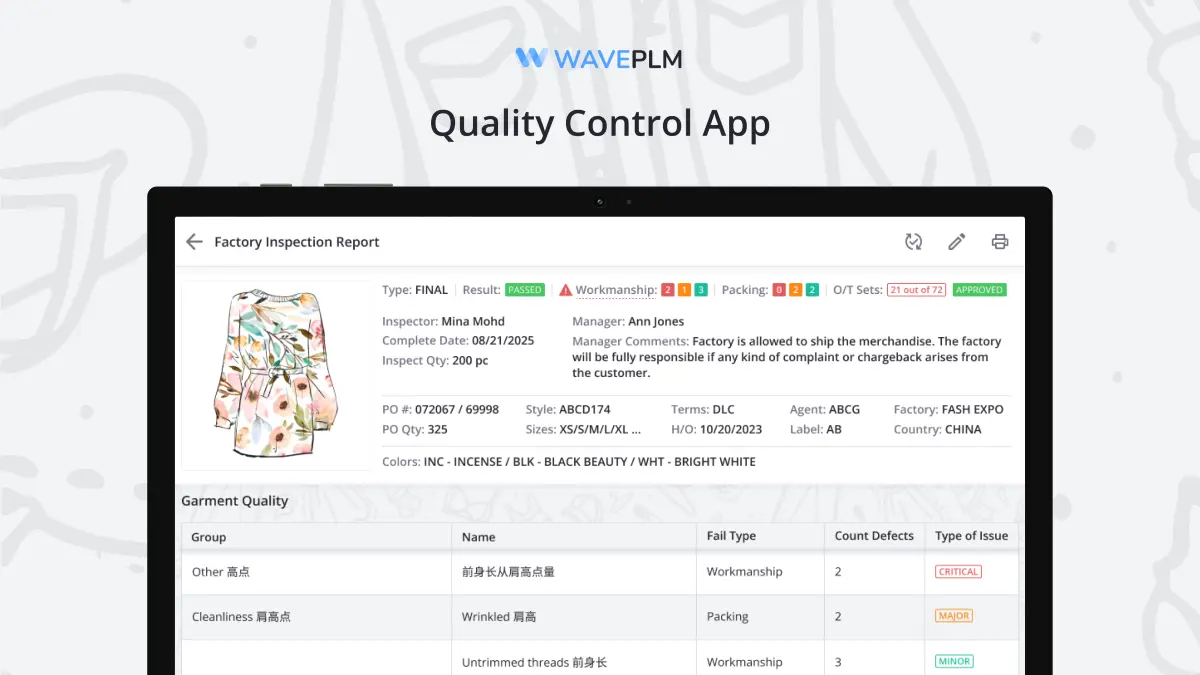
AQL and Quality Integration
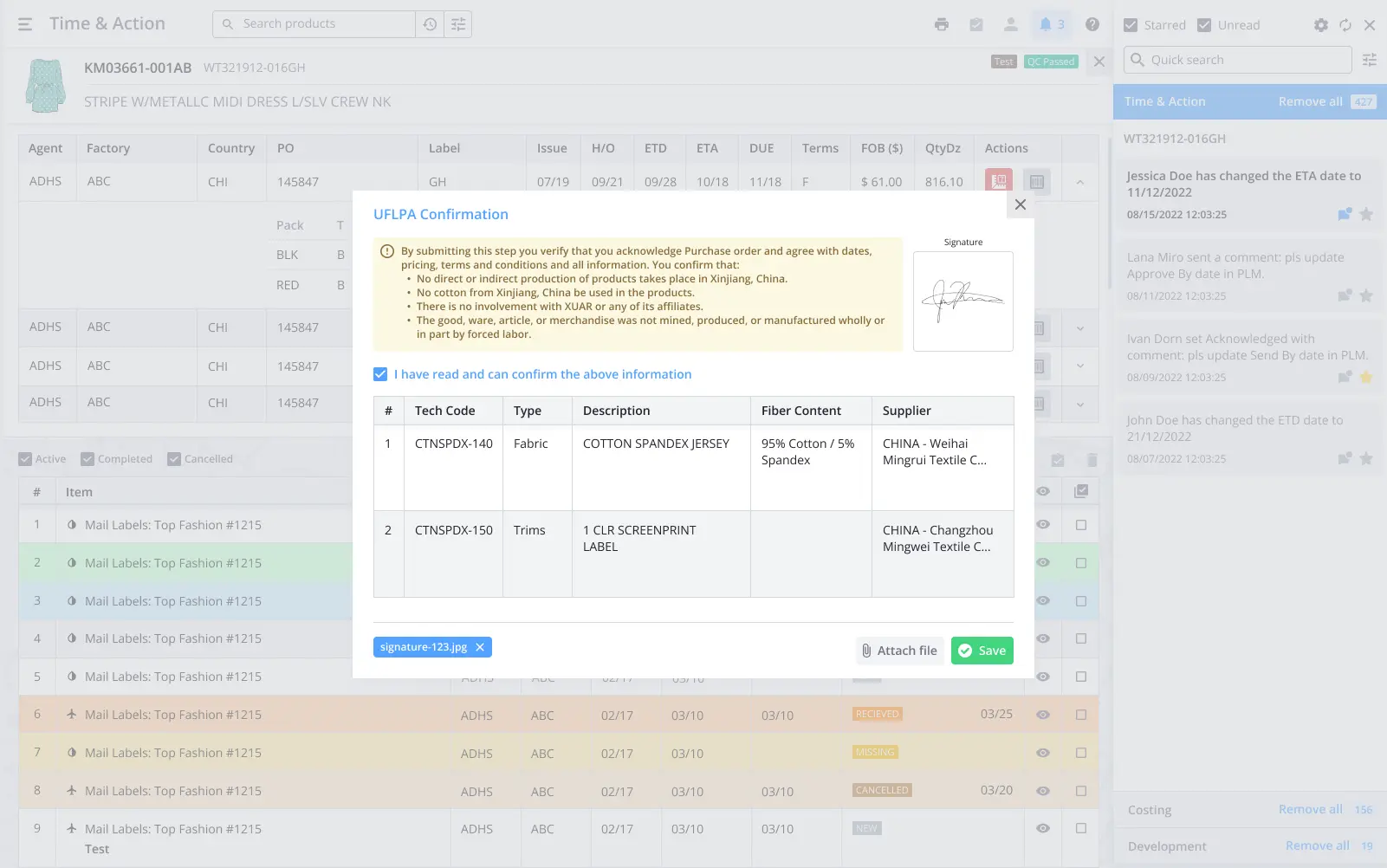
Additionally, quality control checkpoints can be linked directly to production milestones. This gives your team real-time visibility into where each PO stands. Specifically, it flags when a factory is running behind on inspection approvals before the delivery date is at risk.
Frequently Asked Questions
How do I find a clothing manufacturer for a small brand?
For small brands, start with sourcing directories. Maker’s Row covers US domestic factories; Sewport covers US and EU options with low MOQs. For overseas manufacturing, Alibaba is the most common starting point. Verify that contacts are factory representatives, not trading companies. Referrals from fabric suppliers and industry peers consistently produce higher-quality leads than directory searches alone.
What is a typical MOQ for clothing manufacturers in 2026?
Typical MOQ for overseas manufacturers (Asia) is 200–500 units per style per colorway. Domestic US factories generally work at 50–200 units per style, at higher CMT costs. Some specialist low-MOQ factories in Europe and the US accept orders below 50 units. Their per-unit cost is substantially higher than standard CMT rates for comparable garments.
What documents do I need before approaching a clothing manufacturer?
You need three documents before approaching a factory: a complete tech pack (construction sketches, graded measurements, Pantone callouts, material specs), a bill of materials, and your target MOQ and delivery window. Without a tech pack, no professional factory will provide an accurate quote. Sending a mood board in place of a tech pack typically results in inflated sampling costs and inaccurate pricing.
How do I verify an Alibaba contact is a factory and not a trading company?
Request the factory’s business license and physical address, then verify it using Google Maps satellite view or a third-party audit service. Additionally, ask for a video call showing the production floor — a genuine factory can arrange this within one to two days. Trading companies typically stall on this request or provide facility photos that don’t match their business registration address. Alibaba Gold Supplier status provides a baseline check but is not a substitute for direct confirmation.
How many clothing manufacturers should a brand work with?
A brand producing 20–60 styles per season should maintain a minimum of two active manufacturing partners. Single-factory dependency creates significant delivery risk. If your primary factory has a capacity conflict, labor disruption, or quality failure mid-season, you have no fallback option. The recommended model: a primary factory handles 60–70% of volume. Your secondary factory should have completed at least one production run with your brand before a conflict arises.
What certifications should a clothing manufacturer have?
Three certifications are baseline for US and EU retail in 2026: SA8000, OEKO-TEX Standard 100, and either BSCI or WRAP. SA8000 covers social accountability; OEKO-TEX covers chemical safety; BSCI and WRAP are factory social audit programs. Brands targeting European retailers face an additional requirement. EU Digital Product Passport rules are phasing in from 2026 and will mandate full material traceability from all production partners. Always request current certificates and track renewal dates in your vendor management system.
How does PLM software help manage clothing manufacturers?
A product lifecycle management system centralizes tech pack version control, sample approval workflows, BOM management, compliance certificate tracking, and supplier communication in one platform. This eliminates the most common failure modes of email-based vendor management. Factories stop receiving outdated specs; approval gaps gain an audit trail; compliance certificates no longer expire unnoticed. For brands managing three or more factories, PLM reduces production errors and sample correction rounds significantly compared to spreadsheet and email workflows.
Learning how to find a clothing manufacturer that is genuinely right for your brand takes four to eight weeks from initial outreach to a qualified, sample-approved production partner. That investment, however, front-loads the work that would otherwise surface as expensive corrections mid-production. A structured qualification process — combined with centralized PLM documentation — is what separates brands that scale their manufacturer relationships from those that restart the search every other season.
Wave PLM helps apparel brands manage manufacturer relationships, tech pack versions, sample approvals, and compliance documentation in one place. Learn how Wave PLM works for growing brands.





Leave a Reply