
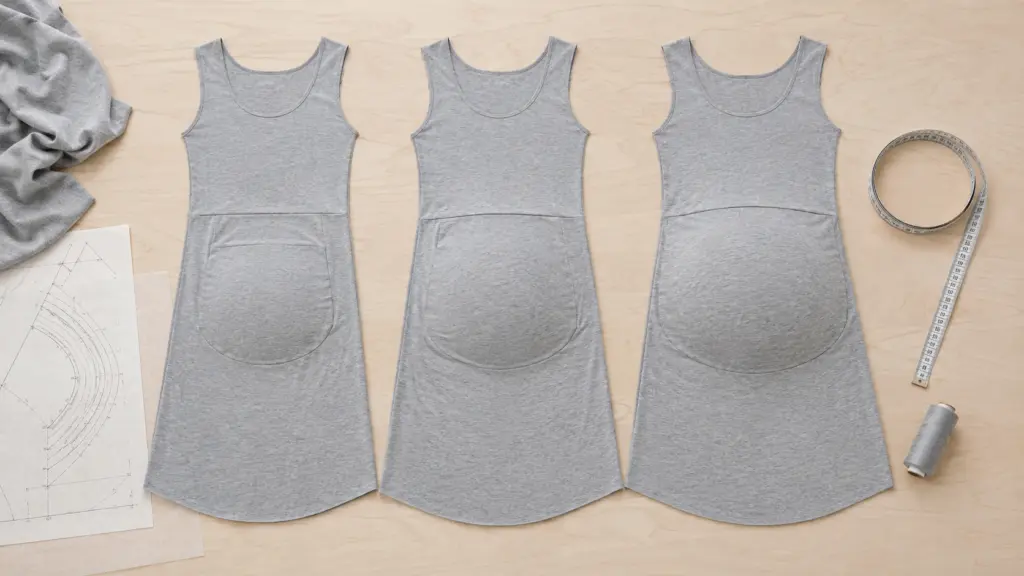
Maternity apparel PLM software has to manage a body that changes shape every few weeks, not once a season. The global maternity apparel market reached an estimated $10.4 billion in 2025. It is projected to grow to $15.6 billion by 2035 (Global Market Insights, 2025). Even so, most PLM tools still grade a maternity line the same way they grade a regular one.
That mismatch shows up fastest in grading, fit testing, and drop timing. In practice, a belly panel does not grow the same way a standard size run does. A fit model’s body shifts across a single testing cycle instead of staying fixed. On top of that, a customer only needs the garment for roughly nine months. A seasonal drop calendar rarely matches when she is actually shopping. This guide covers what maternity apparel PLM software needs to track differently. It also covers where a generic fashion-focused system falls short.
What Does Maternity Apparel PLM Software Need to Handle Differently?
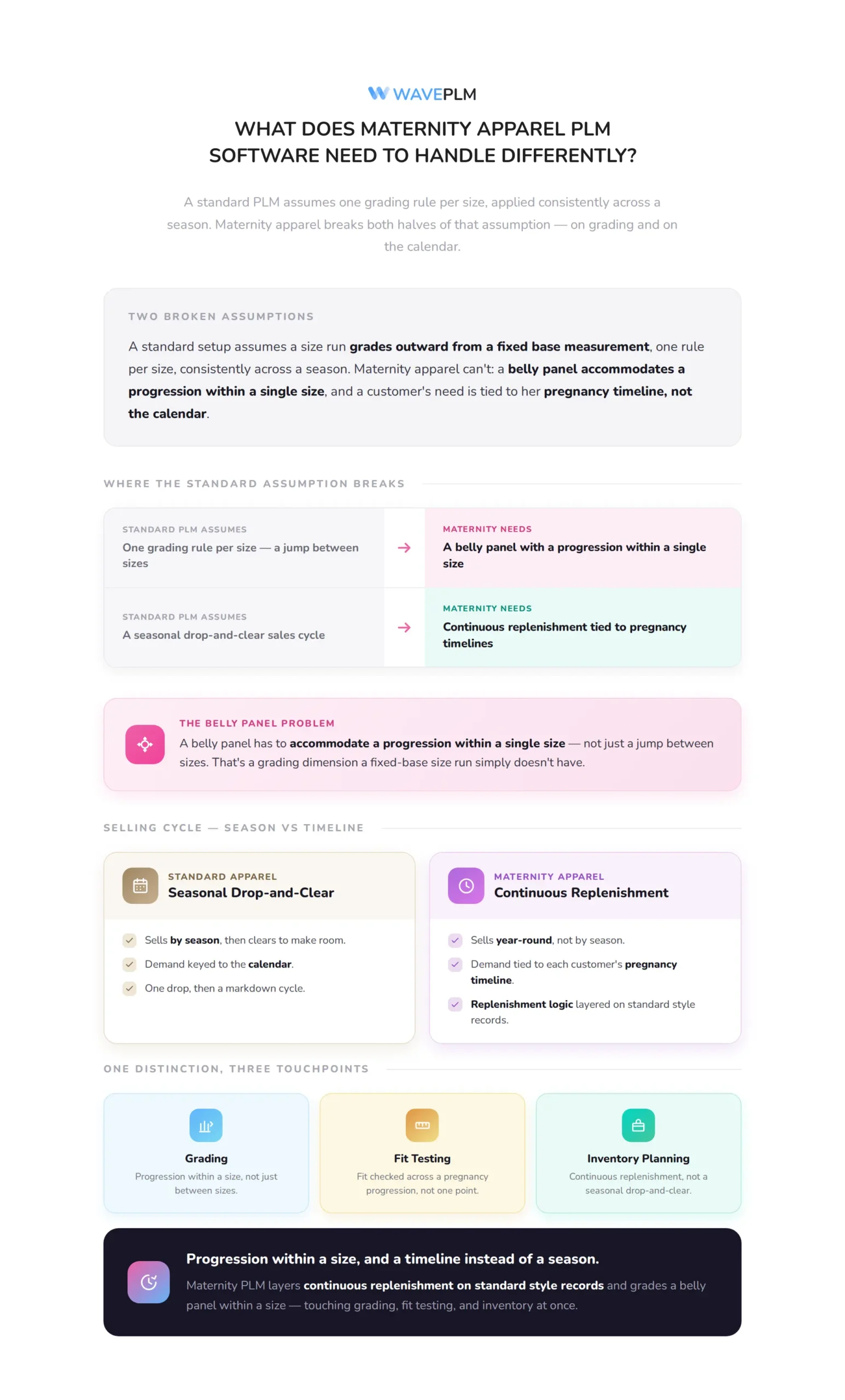
A standard PLM setup assumes a size run grades outward from a fixed base measurement. One grading rule applies per size, consistently across a season. Maternity apparel PLM software cannot use that same assumption. Specifically, a belly panel has to accommodate a progression within a single size, not just a jump between sizes.
In addition, most maternity brands sell year-round rather than by season. In practice, a customer’s need for the garment is tied to her pregnancy timeline, not the calendar. As a result, maternity apparel PLM software needs continuous replenishment logic layered on top of standard style records. That logic replaces a seasonal drop-and-clear cycle. This distinction touches grading, fit testing, and inventory planning at the same time.
Why Does Belly Panel Grading Work Differently Than Standard Size Grading?
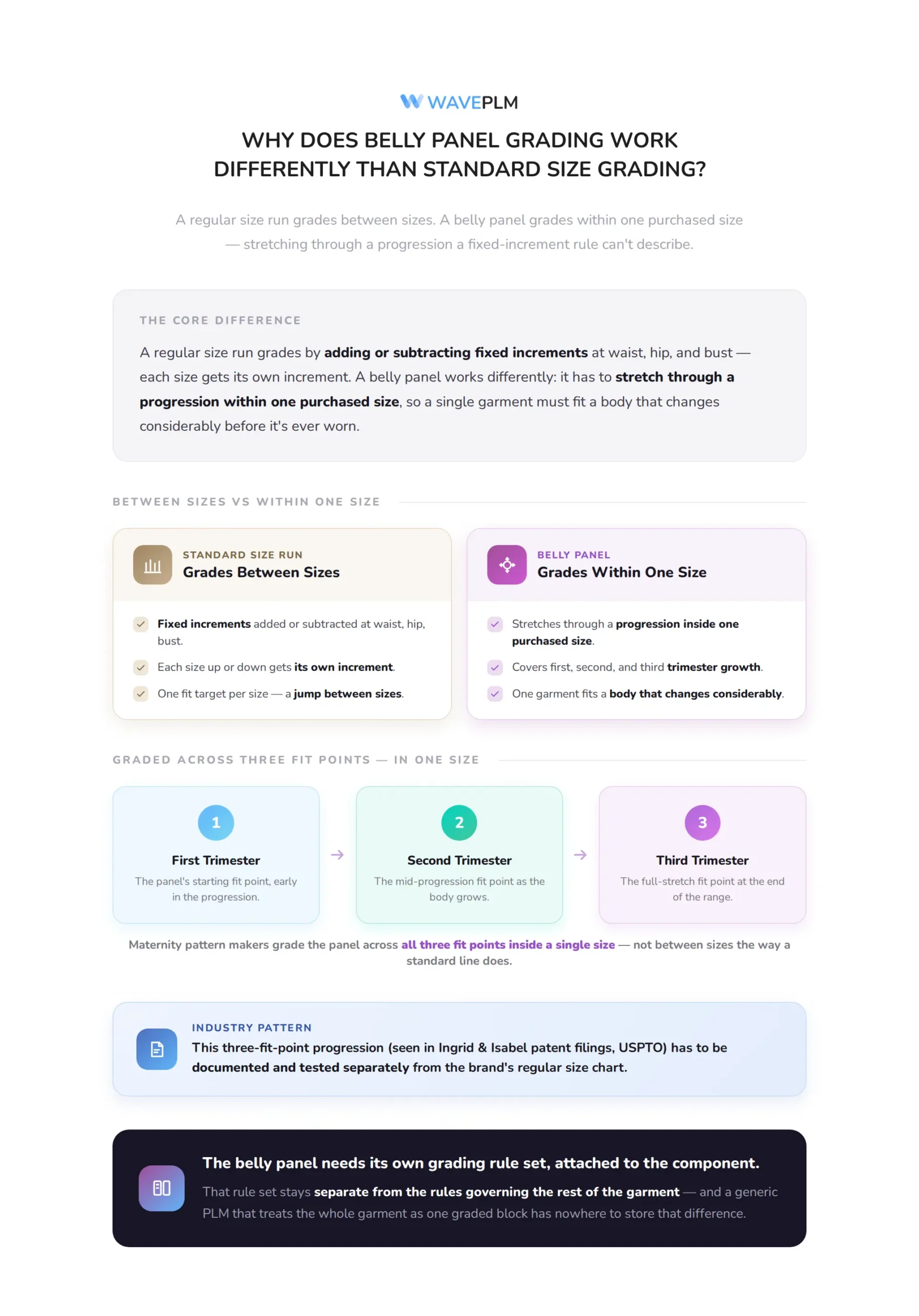
A regular size run grades by adding or subtracting fixed increments at the waist, hip, and bust. Each size up or down gets its own increment. A belly panel works differently. It has to stretch through a progression within one purchased size, typically covering first, second, and third trimester growth. Consequently, a single garment has to fit a body that changes considerably before it is ever worn again.
Industry pattern: Maternity pattern makers commonly grade a belly panel across three fit points inside a single size. That differs from grading between sizes the way a standard line does (Ingrid & Isabel patent filings, USPTO). This progression has to be documented and tested separately from the brand’s regular size chart.
Because of this, a maternity style record needs a distinct grading rule set attached to the belly panel component. That rule set stays separate from the grading rules governing the rest of the garment. Ultimately, a generic PLM setup that treats the whole garment as one graded block has no natural place to store that difference.
How Should Fit Testing Work When a Fit Model’s Body Changes Every Few Weeks?
A standard fit model stays roughly the same size across an entire development cycle. As a result, one fit session usually confirms the pattern. A maternity fit model’s body changes measurably within that same window. In practice, a single fit session cannot confirm how the garment performs across the full pregnancy. Our fit session management guide covers how fit comments and iteration rounds get tracked for a standard style.
For maternity apparel PLM software, that same fit-tracking structure needs multiple checkpoints logged against one style. Each checkpoint ties to a specific stage of belly growth, not a single final approval. Skipping a mid-progression checkpoint produces the most common maternity fit complaint. Often, a garment fits well early on, then pulls or gaps by month seven.
Why Don’t Maternity Brands Run Seasonal Drop Calendars Like Regular Apparel?
Fashion apparel generally launches on a spring and fall calendar, timed to weather and trend cycles. Maternity apparel does not follow that pattern. A shopper’s need for the product depends on where she is in a roughly nine-month window. That window can start in any month of the year. In practice, a maternity brand loses sales if a core style falls out of stock. It has to wait for the next seasonal drop instead of restocking right away.
Meanwhile, maternity brands still need some seasonality. A customer due in January still wants a warm layer, not a linen dress. In turn, the practical result is a hybrid model. Continuous replenishment covers core silhouettes, layered with lighter seasonal fabric swaps instead of full seasonal collection resets. A maternity apparel PLM software setup has to support both patterns on the same style calendar at once.
What Functional Design Features Do Nursing and Postpartum Styles Need PLM to Track?
Nursing-friendly maternity styles add functional openings. Most often, that means a hidden clip-down panel, a crossover wrap, or a discreet zip access point at the chest. These are functional design elements, not purely decorative ones. A spec sheet needs to document how the mechanism opens and closes, not just where a seam sits. Otherwise, a factory can produce a technically correct silhouette that still fails a nursing-access test.
Increasingly, brands also extend a maternity line into postpartum recovery wear, sometimes called fourth-trimester apparel. These styles use lower waistbands designed to sit below a C-section incision (Kindred Bravely, 2026). That extension adds a distinct functional requirement: incision clearance. A regular waistband spec was never built to track it. Consequently, a maternity style record increasingly needs to flag which functional features apply pre-birth, post-birth, or both.
Why Do Maternity Brands Need Different Sourcing for Stretch and Support Fabrics?
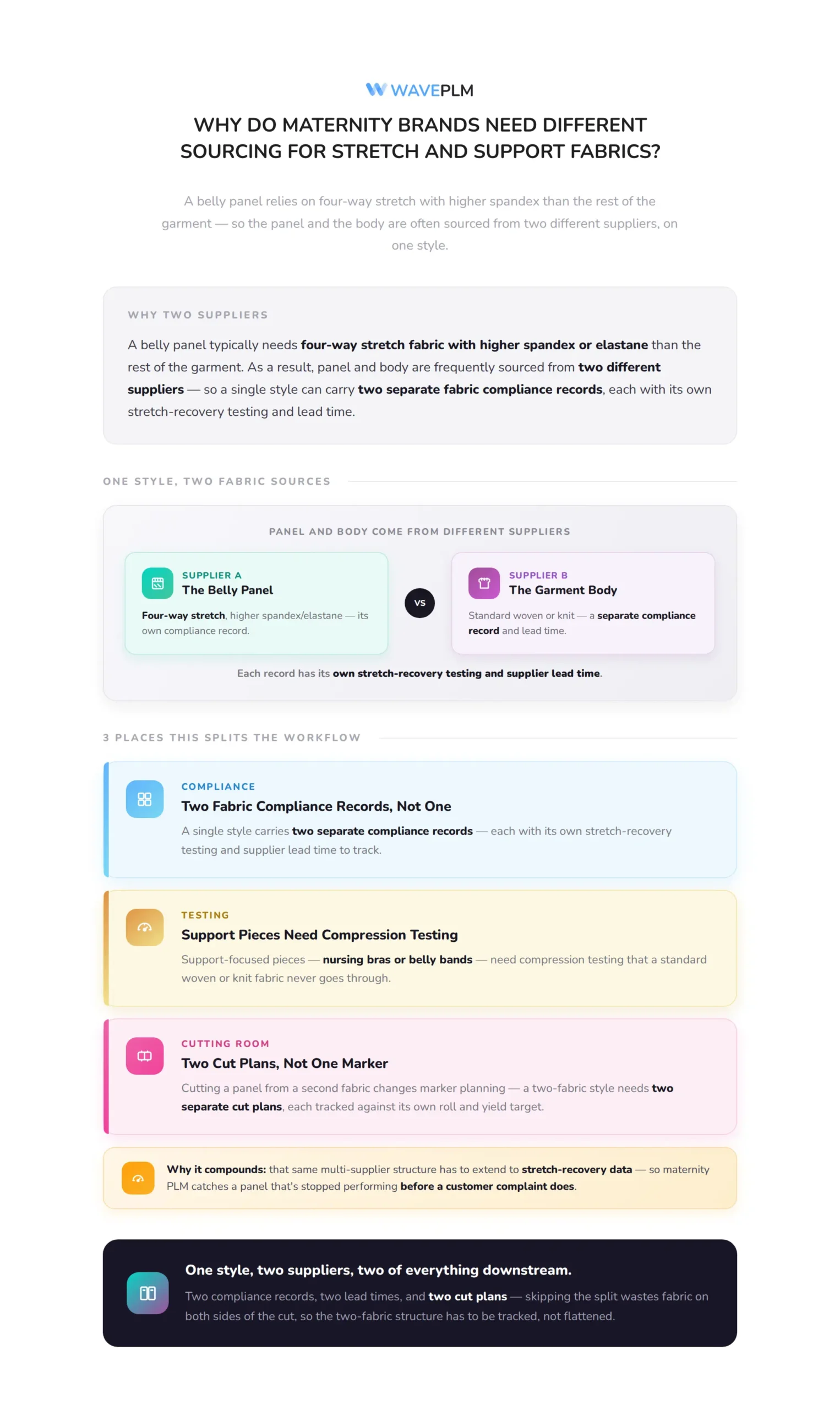
A belly panel typically relies on four-way stretch fabric with a higher spandex or elastane content than the rest of the garment. As a result, the panel and the body of the garment are frequently sourced from two different fabric suppliers. A single style can carry two separate fabric compliance records instead of one. Each record has its own stretch recovery testing and supplier lead time.
On top of that, support-focused pieces such as nursing bras or belly bands need compression testing. A standard woven or knit fabric never goes through that testing. Our fabric sourcing workflow guide covers how lead time and MOQ tracking work across multiple suppliers on one style. That same structure has to extend to stretch-recovery data. Maternity apparel PLM software then catches a panel that has stopped performing before a customer complaint does.
Cutting a belly panel from a second fabric also changes marker planning on the cutting room floor. Our cut order planning guide covers how marker efficiency works when a style pulls from one fabric roll. A two-fabric maternity style needs two separate cut plans instead of one, each tracked against its own roll and yield target. Skipping that split wastes fabric on both sides of the cut.
What Should a Maternity Style Record Track?
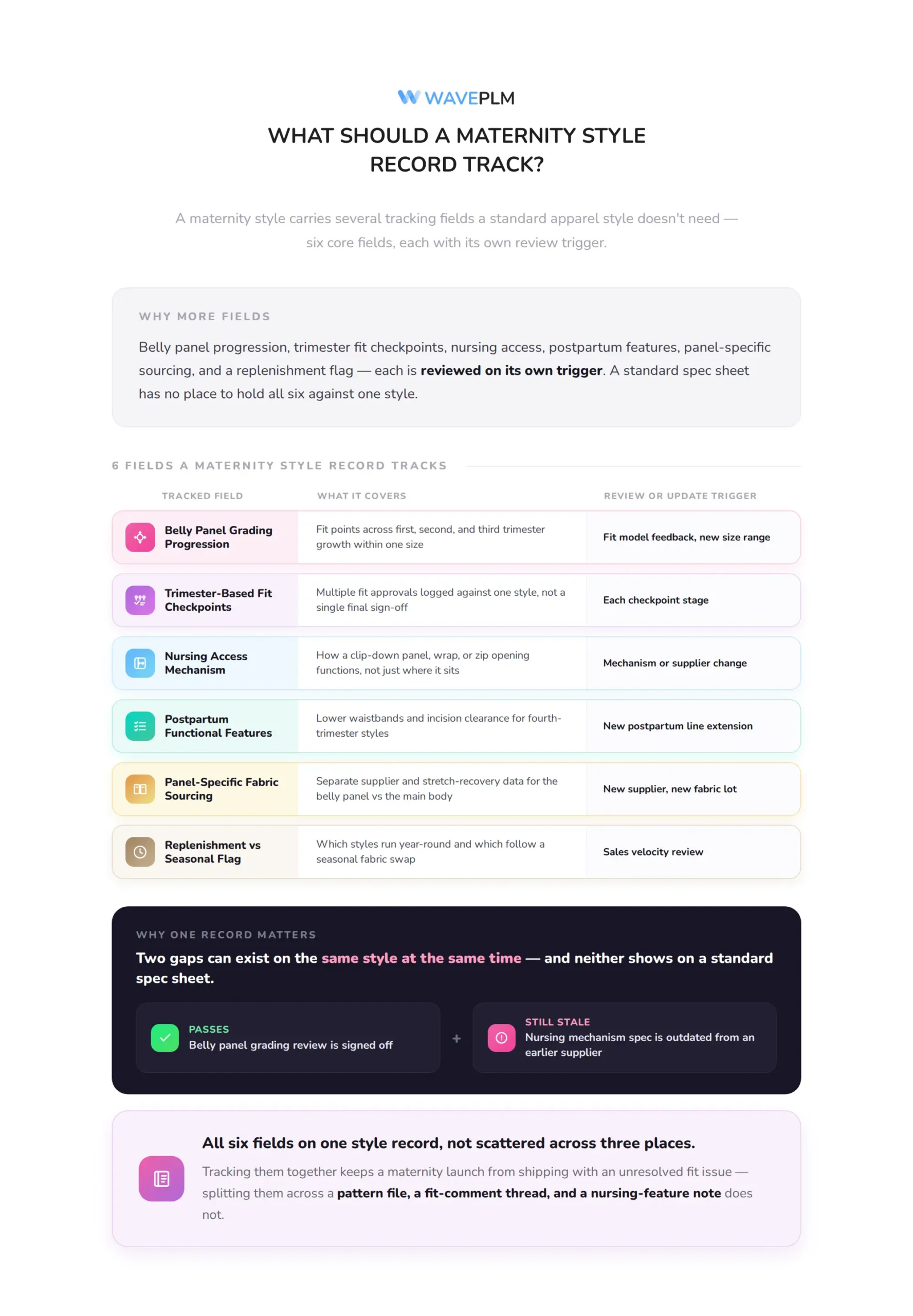
Pulling the requirements above together, a maternity style carries several tracking fields a standard apparel style does not need. The table below summarizes the core fields and what triggers a review of each one.
| Tracked field | What it covers | Review or update trigger |
|---|---|---|
| Belly panel grading progression | Fit points across first, second, and third trimester growth within one size | Fit model feedback, new size range |
| Trimester-based fit checkpoints | Multiple fit approvals logged against one style, not a single final sign-off | Each checkpoint stage |
| Nursing access mechanism | How a clip-down panel, wrap, or zip opening functions, not just where it sits | Mechanism or supplier change |
| Postpartum functional features | Lower waistbands and incision clearance for fourth-trimester styles | New postpartum line extension |
| Panel-specific fabric sourcing | Separate supplier and stretch-recovery data for the belly panel versus the main body | New supplier, new fabric lot |
| Replenishment versus seasonal calendar flag | Which styles run year-round and which follow a seasonal fabric swap | Sales velocity review |
Notably, a style can pass its belly panel grading review while its nursing mechanism spec stays outdated from an earlier supplier. In fact, both gaps can exist on the same style at the same time. Neither one is visible from a standard spec sheet. Tracking all six fields against one style record keeps a maternity launch from shipping with an unresolved fit issue. Splitting them across a pattern file, a fit-comment thread, and a separate nursing-feature note does not.
How Does Wave PLM Support Maternity Apparel Brands?
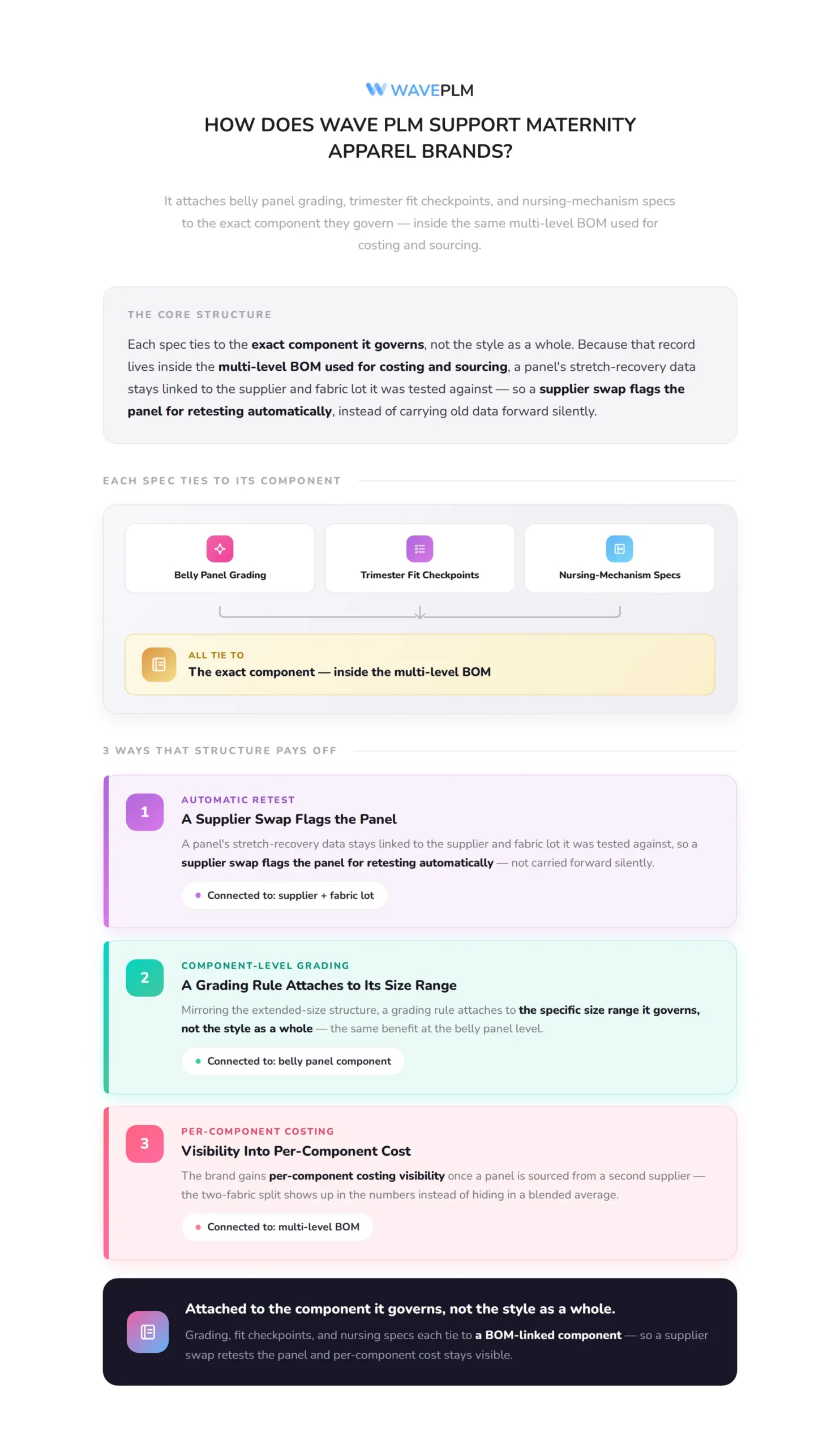
Wave PLM attaches belly panel grading, trimester fit checkpoints, and nursing-mechanism specs to the exact component they govern. That structure lives inside the same multi-level BOM used for costing and sourcing. Specifically, a panel’s stretch-recovery data stays linked to the supplier and fabric lot it was tested against. A supplier swap flags the panel for retesting automatically, instead of carrying the old data forward silently.
This mirrors the component-level structure covered in our extended size PLM software guide. There, a grading rule attaches to the specific size range it governs, not to the style as a whole. A maternity brand gets the same benefit at the belly panel level. It also gains visibility into per-component costing once a panel is sourced from a second supplier.
Frequently Asked Questions
What does maternity apparel PLM software need to handle differently?
Maternity apparel PLM software needs belly panel grading that progresses within one size. It also needs fit checkpoints tied to trimester stages instead of a single approval. On top of that, it needs a mix of year-round replenishment and seasonal fabric swaps on the same style calendar.
How is belly panel grading different from standard size grading?
Standard grading adds or subtracts fixed increments between sizes. Belly panel grading instead stretches across a progression of fit points inside a single purchased size. That progression typically covers first, second, and third trimester growth. As a result, it needs its own grading rule set, separate from the rest of the garment.
Why do maternity brands need multiple fit checkpoints instead of one fit session?
A maternity fit model’s body changes measurably within a single development cycle. One fit session cannot confirm how a garment performs across a full pregnancy. Logging checkpoints at each trimester stage catches fit problems, such as pulling or gapping late in pregnancy. A single approval would miss those problems.
What functional features do nursing-friendly styles need tracked in PLM?
Nursing styles add functional openings such as clip-down panels, crossover wraps, or zip access points. These need to be documented as how the mechanism opens and closes, not just where a seam sits. Otherwise, a factory can produce a style that looks correct but fails a nursing-access test.
Why do maternity brands extend into postpartum or fourth-trimester apparel?
Postpartum recovery wear, sometimes called fourth-trimester apparel, uses lower waistbands designed to sit below a C-section incision. That adds an incision-clearance requirement a regular waistband spec was never built to track. As a result, a maternity style record needs to flag which features apply before birth, after birth, or both.
Why does a belly panel need separate fabric sourcing from the rest of the garment?
A belly panel typically uses four-way stretch fabric with higher spandex content. Often, that panel comes from a different supplier than the main body of the garment. As a result, one style can carry two fabric compliance records instead of one. Each record has separate stretch-recovery testing and lead times.
Wave PLM customers running maternity lines catch a failing belly panel supplier before a fit complaint reaches customer service. That is possible because the stretch-recovery data stays attached to the exact panel and lot it came from. Start a conversation with the Wave PLM team about how that structure would work for your current maternity or postpartum line.







Leave a Reply