
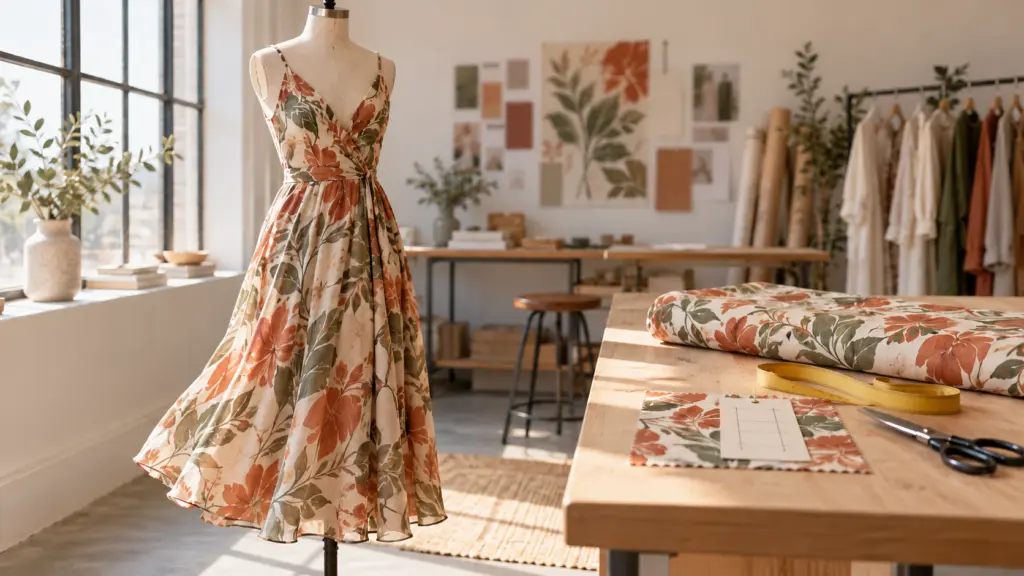
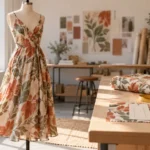
Viscose fabric is a regenerated cellulose textile made by dissolving wood pulp and spinning it back into fibre. In practice, it gives apparel brands the drape and softness of silk at a fraction of the price, which is why it dominates dresses, blouses, linings, and summer shirting. For a brand, however, viscose fabric raises three practical questions: where the pulp originated, how much the fabric will shrink, and what the label is allowed to say.
This guide answers all three from the sourcing desk’s point of view. Specifically, it covers how viscose differs from rayon, modal, and lyocell, which supplier documents to ask for, how to write shrinkage into a tech pack, and where the US and EU labeling rules catch brands out.
What Is Viscose Fabric?
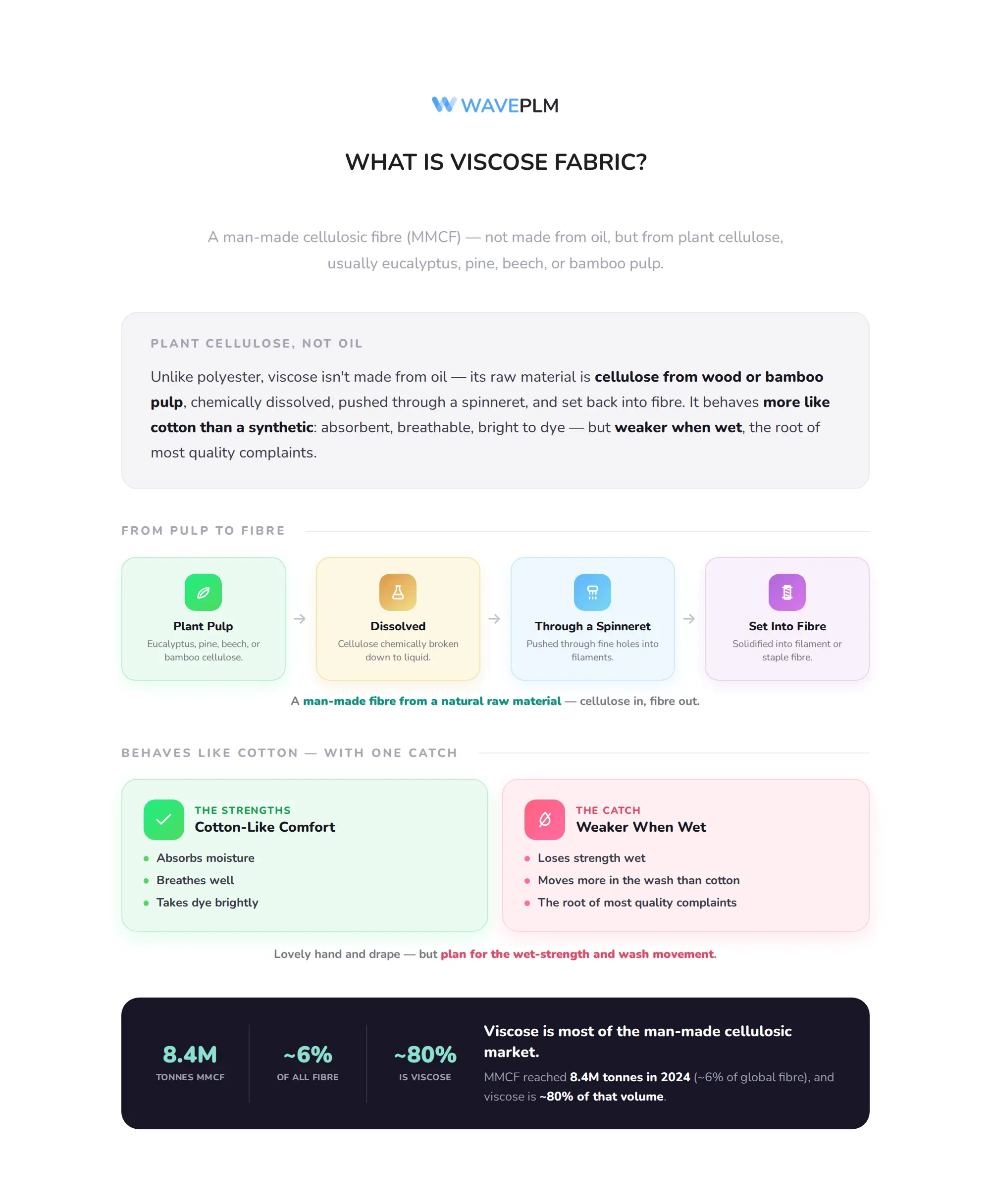
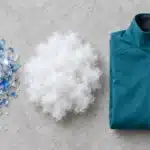
Viscose fabric is woven or knitted from viscose fibre, a man-made cellulosic fibre (MMCF). Unlike polyester, it is not made from oil. Instead, the raw material is cellulose, usually from eucalyptus, pine, beech, or bamboo pulp. The cellulose is chemically dissolved, pushed through a spinneret, and set back into solid filaments or staple fibre.
As a result, viscose behaves more like cotton than like a synthetic. It absorbs moisture, breathes well, and takes dye brightly. That said, it is weaker when wet and moves more in the wash than cotton, which is the root of most quality complaints.
Industry data: Man-made cellulosic fibres reached about 8.4 million tonnes in 2024, roughly 6% of global fibre production, and viscose accounts for around 80% of that volume (Textile Exchange, Materials Market Report 2025).
How Is Viscose Fabric Made, and Why Does the Pulp Source Matter?
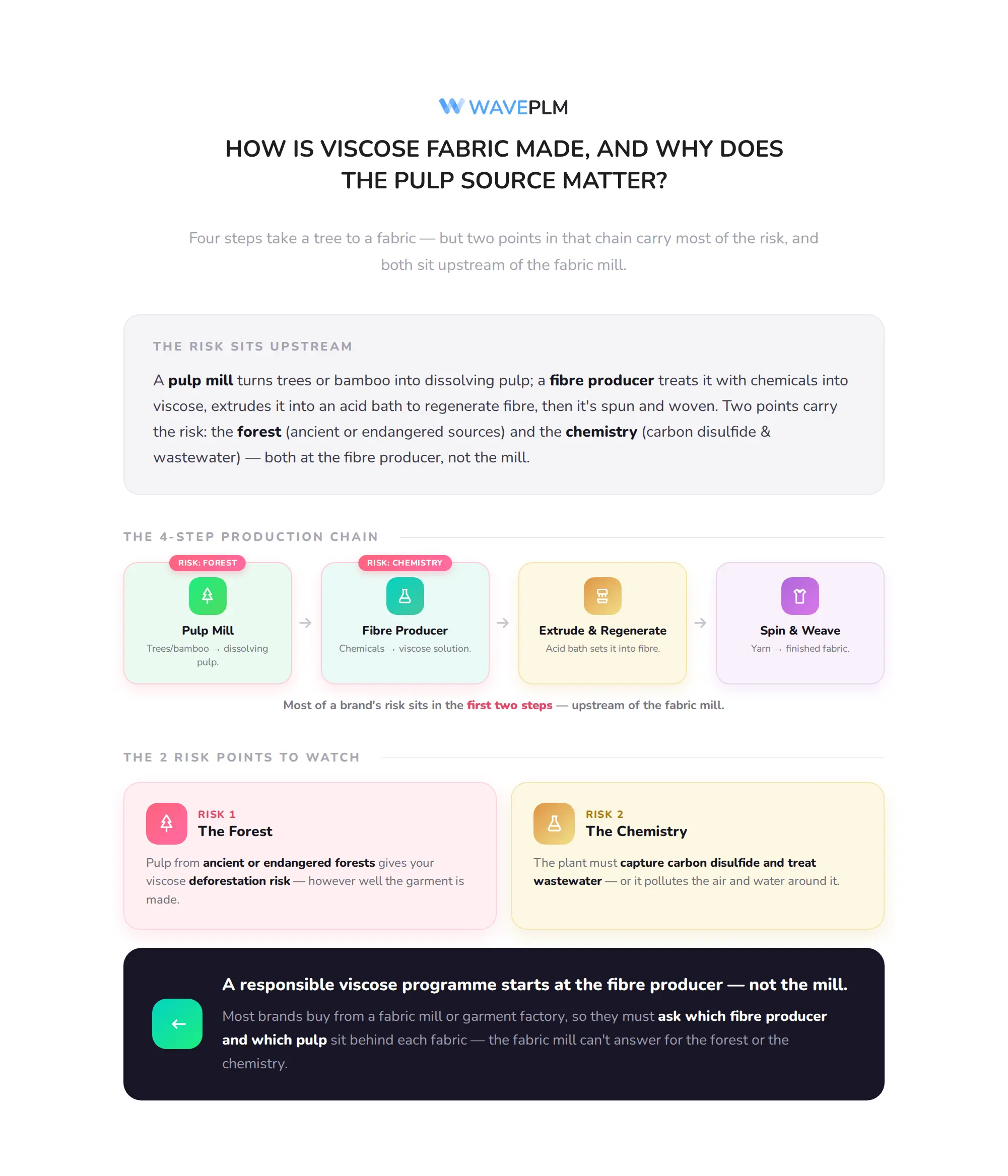
First, a pulp mill turns trees or bamboo into high-purity dissolving pulp. Next, the fibre producer treats the pulp with caustic soda and carbon disulfide, which turns it into a thick solution called viscose. That solution is then extruded into an acid bath, where it regenerates into fibre. Finally, the fibre is spun into yarn and woven or knitted into fabric.
Two parts of this chain carry most of the risk for a brand. The first is the forest. If the pulp comes from ancient or endangered forests, your viscose fabric inherits that deforestation risk, regardless of how well the garment is made. The second is the chemistry. In addition, the plant must capture carbon disulfide and treat its wastewater; otherwise, it pollutes the air and water around it.
Consequently, a responsible viscose programme starts upstream, at the fibre producer, not at the fabric mill. Because most brands buy from a fabric mill or a garment factory, they need to ask which fibre producer and which pulp sit behind each fabric.
Viscose vs Rayon vs Modal vs Lyocell: What Is the Difference?
Admittedly, these names cause more confusion than any other part of the topic. In short, rayon is the umbrella term used in the US for regenerated cellulose fibres. Viscose is the most common production process, and in Europe “viscose” is the legal fibre name. Modal and lyocell are related fibres with different properties.
| Fibre | How it is made | Wet strength and shrinkage | Typical use |
|---|---|---|---|
| Viscose (rayon) | Viscose process with carbon disulfide | Lowest wet strength; shrinks most | Dresses, blouses, linings, prints |
| Modal | Modified viscose process, high wet modulus | Higher wet strength; more stable | Underwear, loungewear, jersey tees |
| Lyocell | Direct solvent process with solvent recovery | Highest wet strength; most stable | Shirting, denim blends, bedding |
| Cupro | Cuprammonium process from cotton linter | Moderate; delicate in the wash | Linings, premium blouses |
In other words, if a style keeps failing shrinkage or seam slippage tests, switching from viscose fabric to modal or a lyocell blend is often a faster fix than reworking the finish. However, both alternatives usually cost more per metre.
Does Viscose Fabric Shrink?
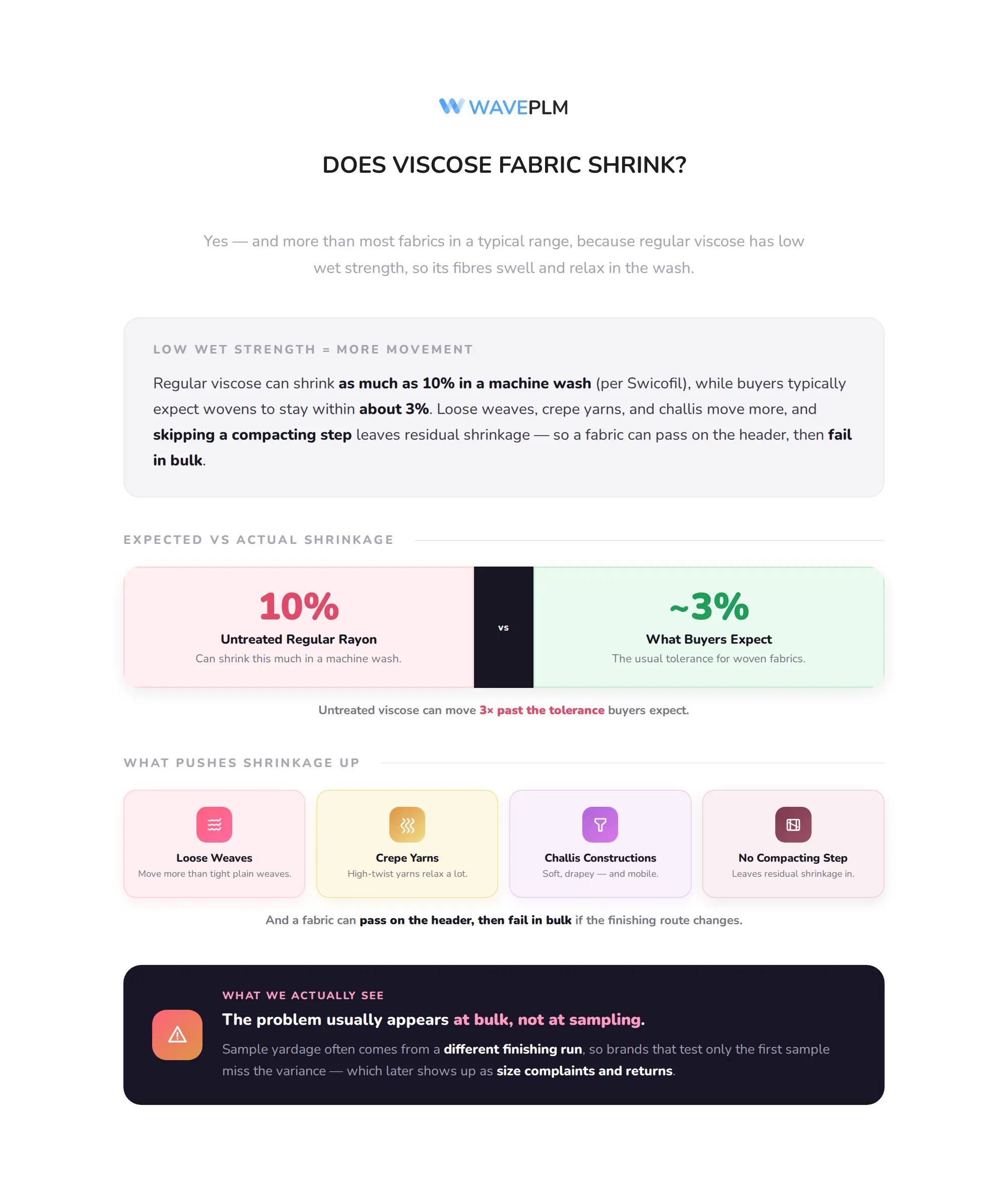
Yes, and more than most fabrics in a typical range. Regular viscose has low wet strength, so its fibres swell and relax when washed. According to fibre supplier Swicofil, untreated regular rayon can shrink by as much as 10% in a machine wash. By comparison, many buyers expect woven fabrics to stay within about 3% after laundering.
In addition, several factors push shrinkage up. For example, loose weaves, crepe yarns, and challis constructions move more than tight plain weaves. Likewise, skipping a compacting or pre-shrinking step at the mill leaves residual shrinkage in the fabric. Notably, a fabric can pass on the header and then fail in bulk if the finishing route changes between lots.
Our finding: On viscose styles, the shrinkage problem usually appears at bulk, not at sampling. The sample yardage often comes from a different finishing run, so brands that test only the first sample miss the variance that later shows up as size complaints and returns.
How Should You Spec Viscose Fabric in a Tech Pack?
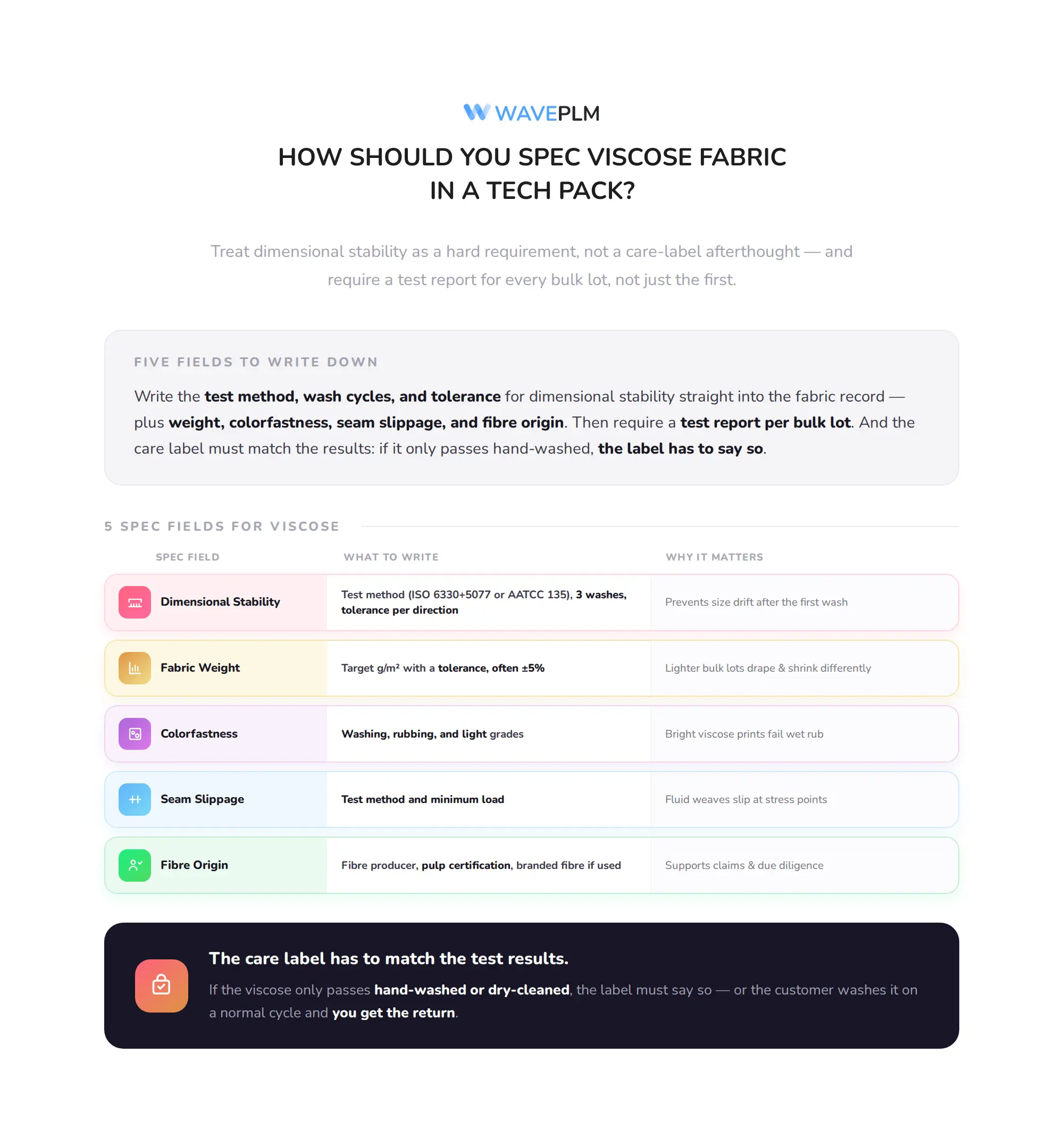
The safest approach is to treat dimensional stability as a hard requirement, not a care-label afterthought. In particular, write the test method, the number of wash cycles, and the tolerance directly into the fabric record and the tech pack. Then require a test report for each bulk lot, not just the first one.
| Spec field | What to write | Why it matters |
|---|---|---|
| Dimensional stability | Test method (for example ISO 6330 with ISO 5077, or AATCC 135), 3 washes, tolerance per direction | Prevents size drift after the first wash |
| Fabric weight | Target g/m² with a tolerance, often ±5% | Lighter bulk lots drape and shrink differently |
| Colorfastness | Washing, rubbing, and light grades | Bright viscose prints are prone to wet rub failures |
| Seam slippage | Test method and minimum load | Fluid weaves slip at stress points |
| Fibre origin | Fibre producer, pulp certification, branded fibre if used | Supports claims and due diligence |
For the weight field, see our guide to fabric GSM and weight tolerances. Similarly, the colorfastness testing guide lists the grades to request, and the overview of apparel product testing explains which lab tests belong in a standard package.
Meanwhile, the care label has to match the test results. If the viscose fabric only passes when hand washed or dry cleaned, the label must say so. Otherwise, the customer will wash it on a normal cycle and you will receive the return.
Which Certifications and Ratings Should a Viscose Supplier Have?
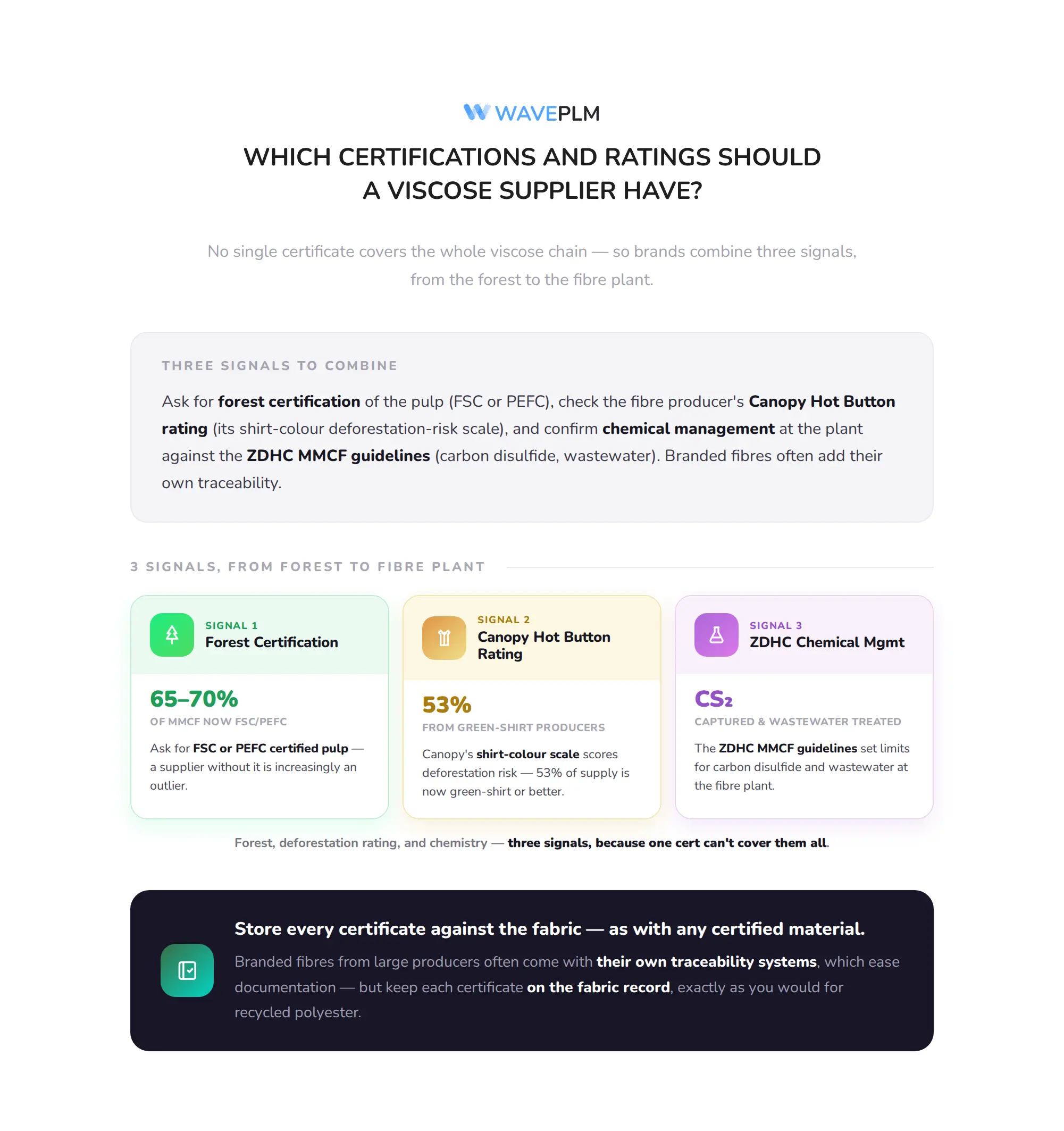
Because no single certificate covers the whole viscose chain, brands combine several signals. To begin with, ask for forest certification of the pulp. According to Textile Exchange, roughly 65% to 70% of MMCF production now uses FSC or PEFC certified raw material, so a supplier without it is increasingly an outlier.
Next, check the fibre producer’s Canopy rating. Canopy’s annual Hot Button Report scores MMCF producers on deforestation risk and progress, using a shirt colour scale. In its 2024 report, Canopy rated 28 of 35 producers, covering 97.5% of global capacity, and found that 53% of global MMCF supply came from green shirt producers or better (ESG Dive, December 2024).
Industry data: 53% of global viscose, lyocell, and other MMCF textile supply came from producers rated green shirt or higher in Canopy’s 2024 Hot Button Report, down slightly from 54% in 2023 (Canopy via ESG Dive, December 2024).
Finally, ask about chemical management at the fibre plant. The ZDHC Man-Made Cellulosic Fibres guidelines set expectations for wastewater and air emissions, including carbon disulfide. In addition, branded fibres from large producers often come with their own traceability systems, which make documentation easier. Store these certificates against the fabric, as you would for recycled polyester or any other certified material.
Is Viscose Covered by the EU Deforestation Regulation?
Mostly not, which surprises many teams. The EU Deforestation Regulation (EUDR) lists wood pulp in its scope under HS chapter 47. However, viscose fibre, yarn, and fabric fall under HS chapters 54 and 55, and garments fall under chapters 61 and 62. None of those textile chapters appear in Annex I, so importing viscose fabric or finished garments does not trigger an EUDR due diligence statement on its own.
That said, the regulation still matters upstream. A fibre producer that places dissolving pulp on the EU market is covered, and retailers increasingly ask brands for deforestation evidence anyway. Therefore, pulp certification and the Canopy rating remain the practical proof. Our EUDR guide for fashion brands covers the materials that are in scope, such as natural rubber.
How to Label Viscose Fabric in the US and EU
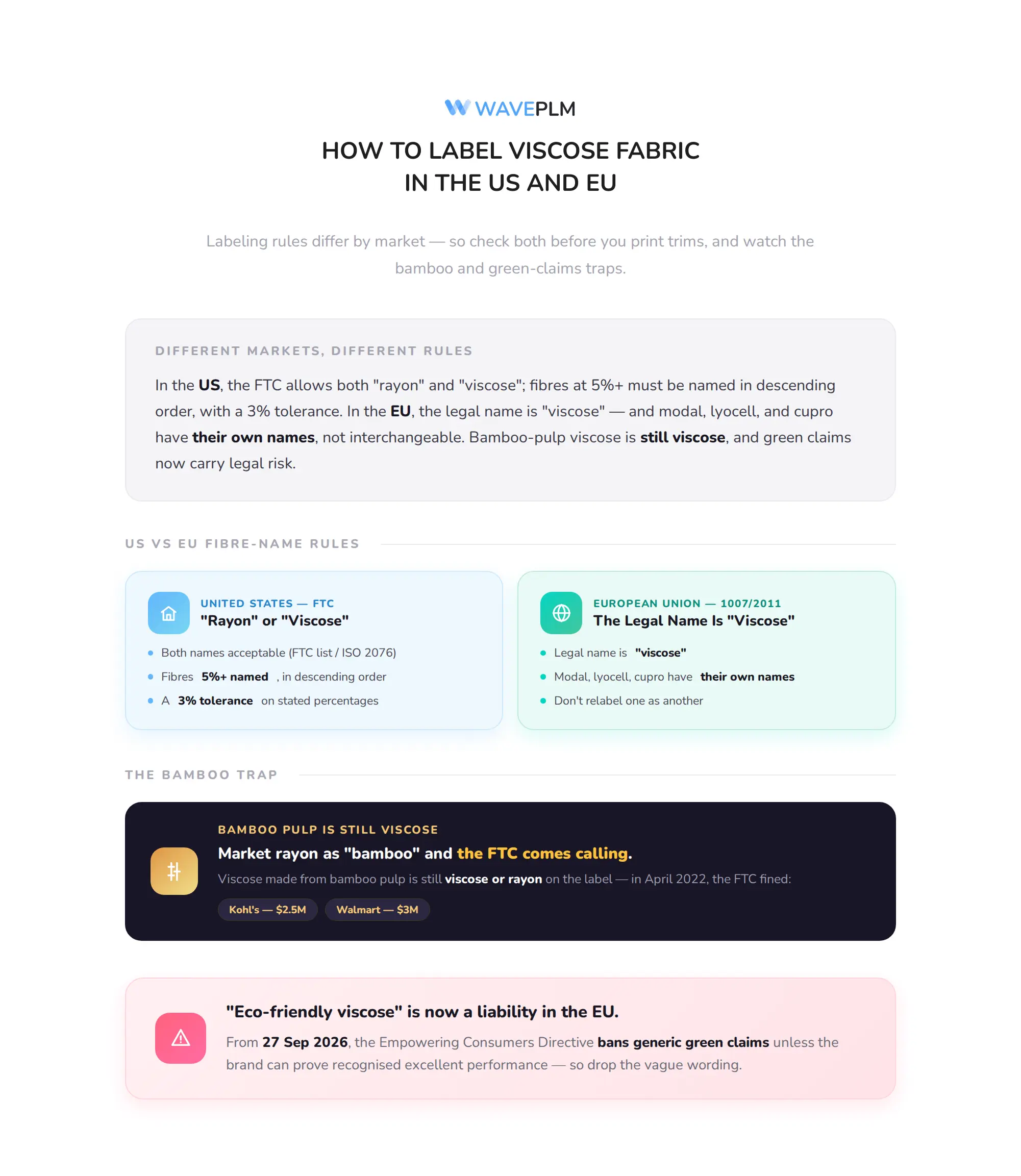
Since labeling rules differ by market, check both before you print trims.
- United States. The FTC Textile Rules require generic fibre names from its own list or from ISO 2076, so “rayon” and “viscose” are both acceptable. Fibres at 5% or more of the weight must be named, in descending order. The FTC also allows a 3% tolerance on stated percentages.
- European Union. Under Regulation (EU) No 1007/2011, the legal name is “viscose”. Modal, lyocell, and cupro have their own listed names and should not be relabeled as viscose, or the other way round.
- Bamboo. Viscose made from bamboo pulp is still viscose or rayon. In April 2022, the FTC required Kohl’s to pay $2.5 million and Walmart to pay $3 million for marketing rayon textiles as bamboo.
Beyond fibre names, environmental wording carries extra risk. In the EU, the Empowering Consumers Directive applies from 27 September 2026 and bans generic claims such as “eco-friendly viscose” unless the brand can prove recognised excellent environmental performance. For the wider picture, see our article on what fashion brands must prove on green claims.
A Viscose Sourcing Checklist for Your Next Season
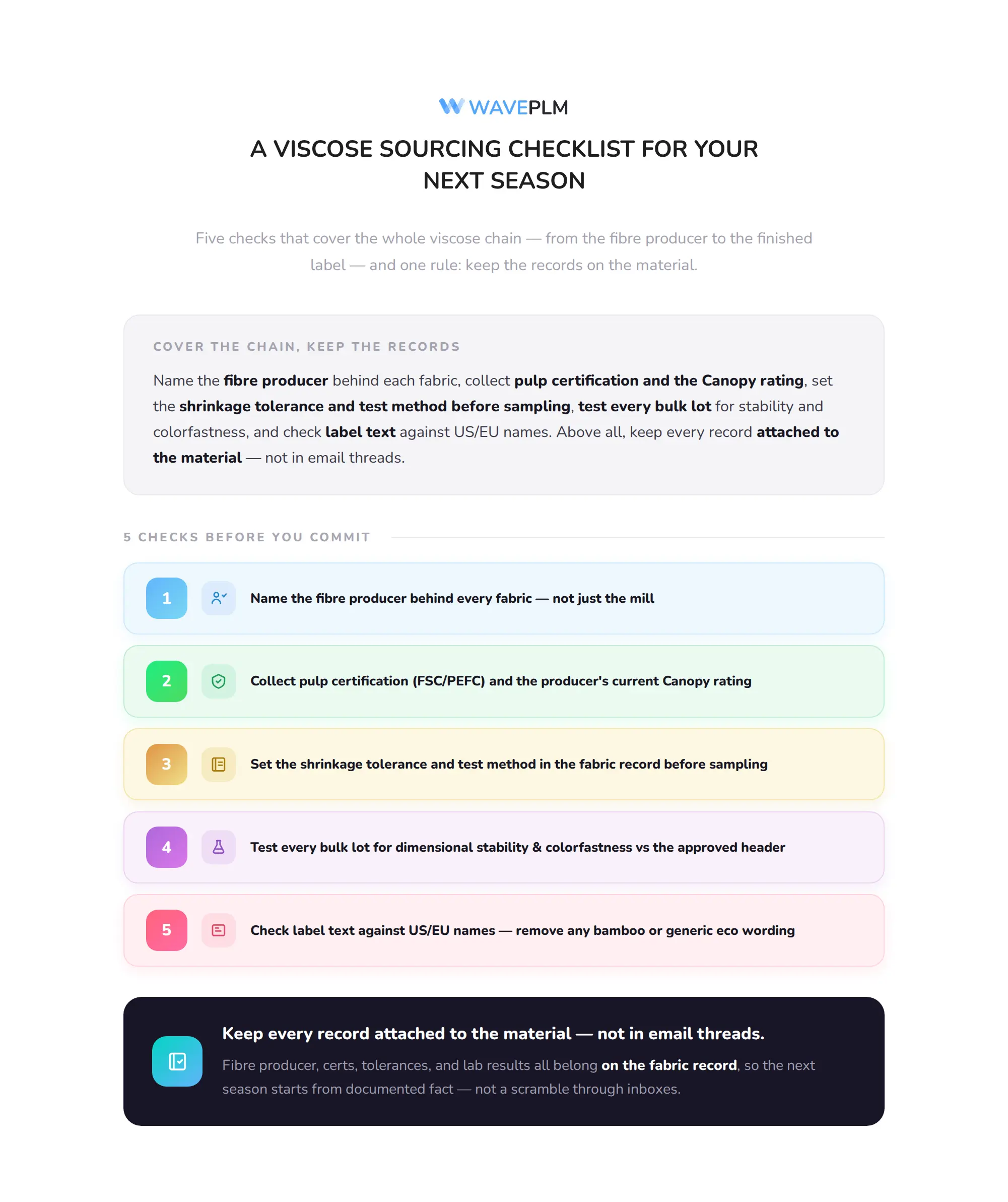
- Name the fibre producer behind every viscose fabric, not just the mill.
- Collect pulp certification (FSC or PEFC chain of custody) and the producer’s current Canopy rating.
- Set the shrinkage tolerance and test method in the fabric record before sampling.
- Test every bulk lot for dimensional stability and colorfastness, then compare with the approved header.
- Check label text against US and EU fibre names, and remove any bamboo or generic eco wording.
Above all, keep these records attached to the material, not in email threads. Our guide to fabric sourcing, MOQs, and lead times shows how this fits into the wider sourcing calendar.
Frequently Asked Questions
What is viscose fabric made of?
Viscose fabric is made from cellulose, usually wood pulp from eucalyptus, pine, or beech, and sometimes bamboo. The pulp is dissolved with chemicals and spun back into fibre. Because the raw material is plant-based, viscose is a regenerated cellulosic fibre, not a synthetic.
Is viscose the same as rayon?
Mostly, yes. Rayon is the US umbrella term for regenerated cellulose fibres, and viscose is the most common type and the EU legal name. Under FTC rules, US labels may use either “rayon” or “viscose”. Modal and lyocell are related fibres with their own names.
How much does viscose fabric shrink?
Untreated regular viscose can shrink up to about 10% in a machine wash, according to fibre supplier Swicofil. Pre-shrunk and compacted viscose fabric performs much better. Brands should specify a test method, three wash cycles, and a tolerance in the tech pack.
Is viscose fabric sustainable?
It depends on the pulp and the plant. Viscose fabric from FSC or PEFC certified pulp, made by a producer with a strong Canopy rating and closed chemical recovery, carries far less risk. Viscose from uncertified pulp can be linked to deforestation and pollution.
Does the EUDR apply to viscose clothing?
No. The EUDR covers wood pulp under HS chapter 47, but viscose fibre, fabric, and garments sit in textile chapters that are not in Annex I. Pulp suppliers are still covered, so brands should keep pulp certification on file for retailer requests.
Can I call bamboo viscose “bamboo fabric”?
No. Once bamboo pulp is turned into viscose, the fibre is viscose or rayon. The FTC fined Kohl’s and Walmart a combined $5.5 million in 2022 for marketing rayon textiles as bamboo. In the EU, the label must say “viscose”.
Three Fields Every Viscose Fabric Record Needs
If you only change one thing this season, add three fields to each viscose fabric record: the fibre producer, the pulp certificate number, and the approved shrinkage result for the current lot. Together, they answer the questions a retailer, an auditor, or a customer service team will ask later. Wave PLM stores those fields on the material itself and carries them into every style that uses it, so the evidence travels with the product. See how Wave PLM structures material records.



Leave a Reply