
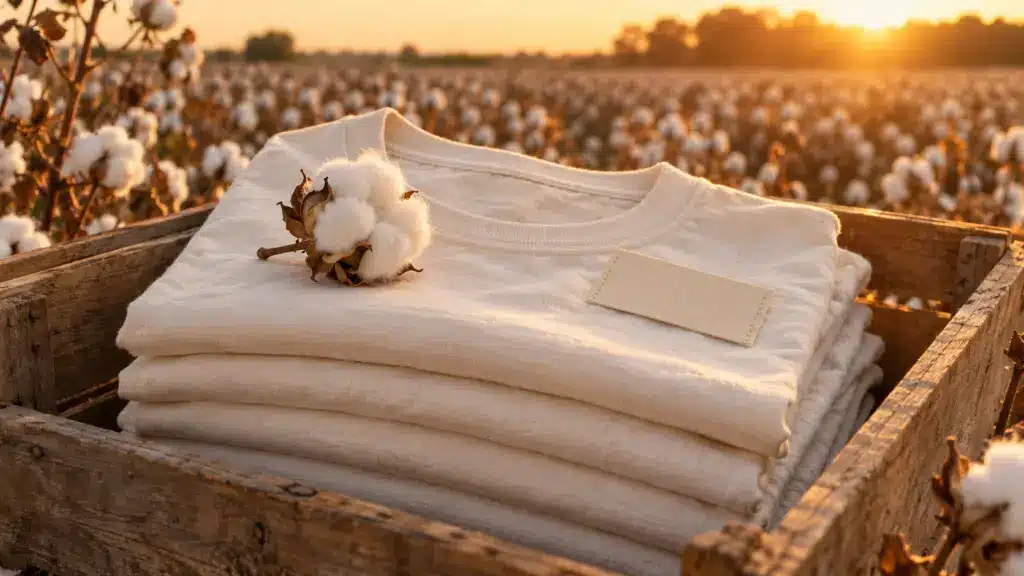
Better Cotton is the world’s largest cotton sustainability programme, run by the Better Cotton Initiative (BCI). It trains and certifies farmers to grow cotton with less water and pesticide use and better working conditions. However, buying Better Cotton has never automatically meant that your garment contains it. For most of its history, the programme worked on a mass balance basis, so the cotton in a product could come from anywhere.
However, that has now changed in ways that matter for your hangtags. In October 2025, the organisation went back to its full name, the Better Cotton Initiative, and launched a new label for physically traceable BCI Cotton. Meanwhile, brands could use the old mass balance on-product mark only until May 2026. This guide explains what Better Cotton proves today, what you can still claim, and how it compares with organic cotton.
What Is Better Cotton?
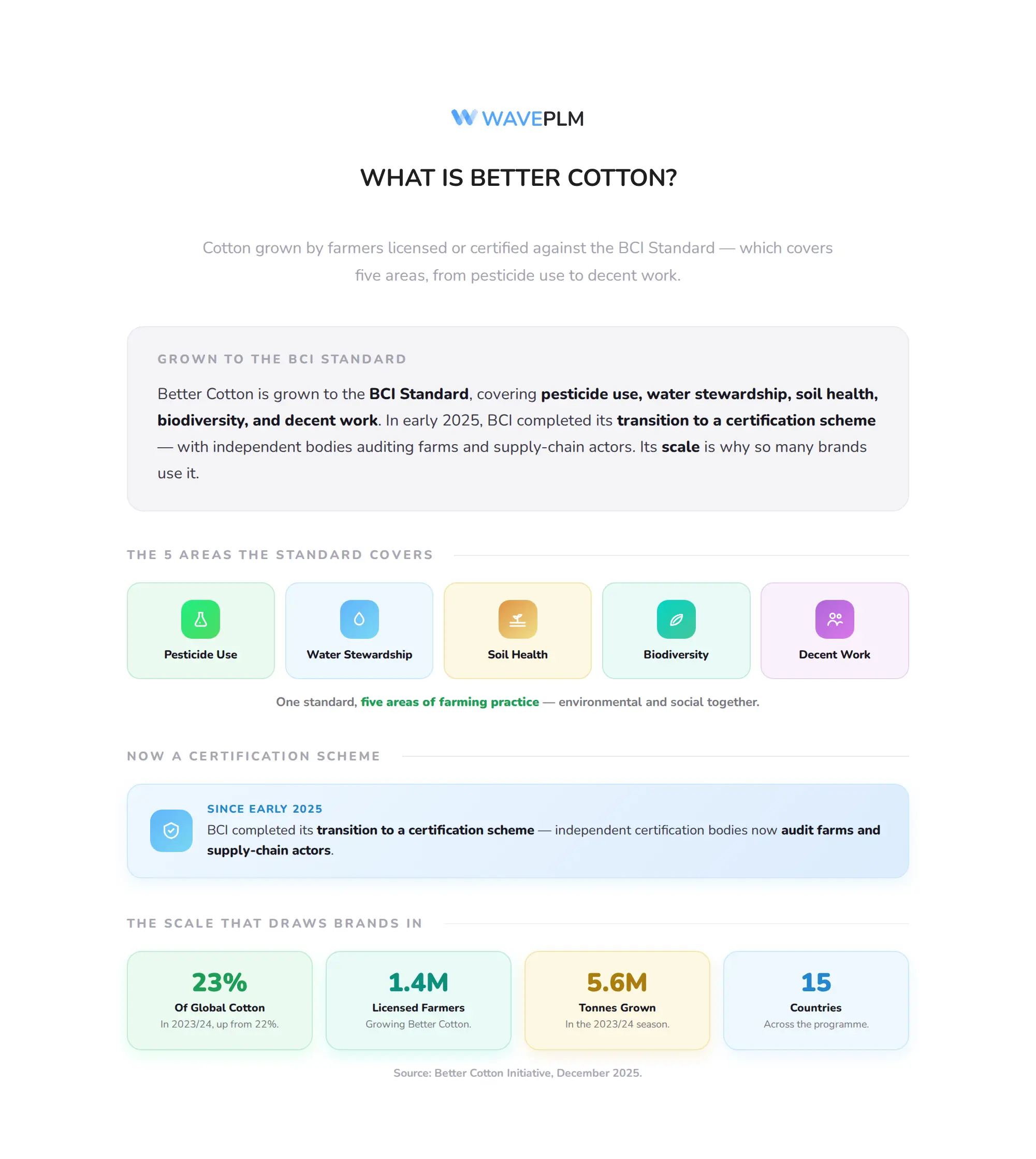
Better Cotton is cotton grown by farmers licensed or certified against the BCI Standard, which covers pesticide use, water stewardship, soil health, biodiversity, and decent work. Early in 2025, BCI completed its transition to a certification scheme, with independent certification bodies auditing farms and supply chain actors.
In practice, the programme’s scale explains why so many brands use it. According to BCI, Better Cotton made up 23% of global cotton production in the 2023/24 season. In addition, about 1.4 million licensed farmers grew 5.6 million tonnes of it across 15 countries.
Industry data: BCI Cotton accounted for 23% of global cotton production in the 2023/24 season, up from 22% the season before, grown by around 1.4 million licensed farmers in 15 countries (Better Cotton Initiative, December 2025).
What Is the Difference Between Mass Balance and Physical BCI Cotton?
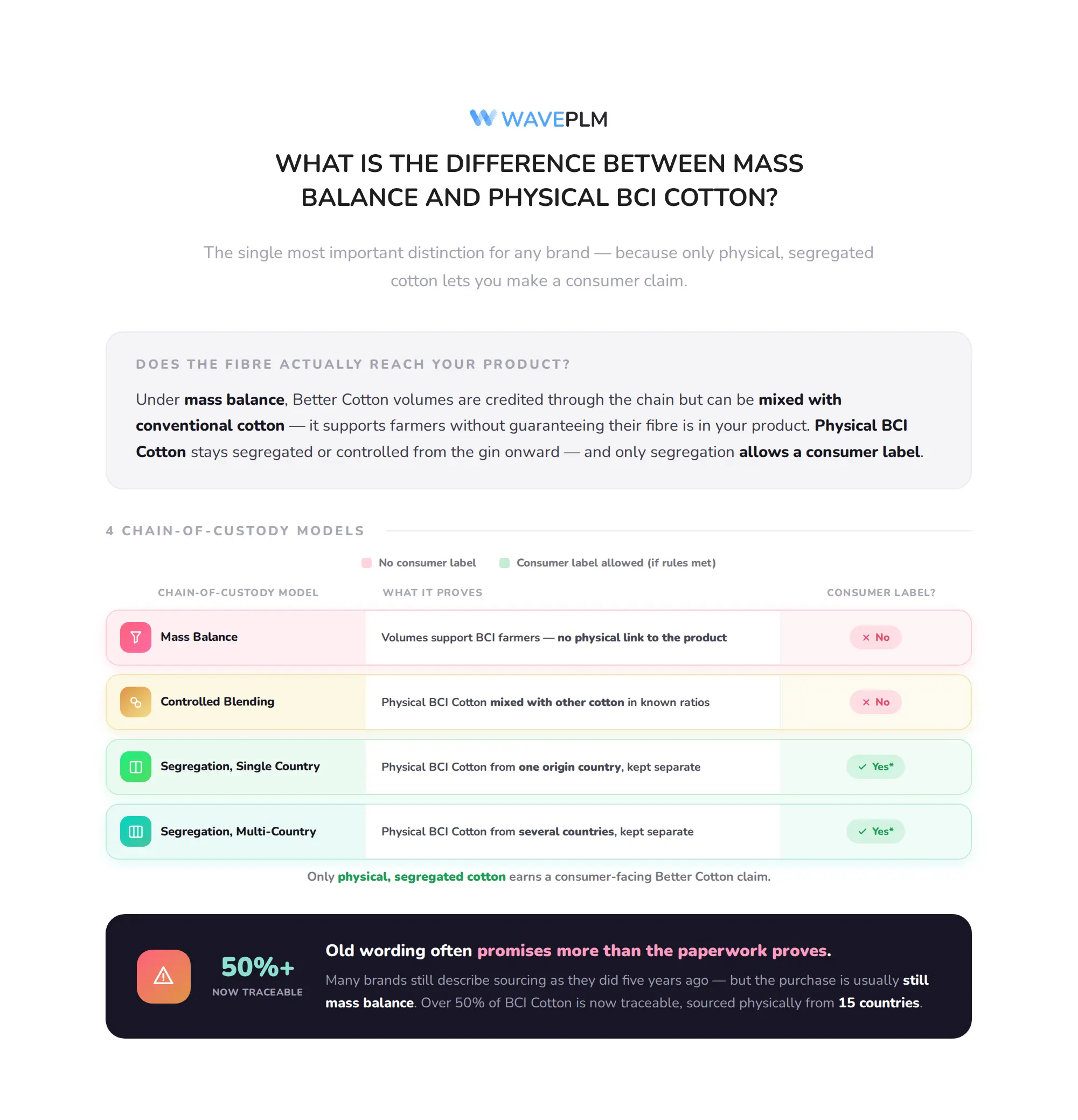
This is the single most important distinction for any brand. Under mass balance, Better Cotton volumes are recorded and credited through the supply chain, but they can be mixed with conventional cotton. As a result, a mass balance purchase supports farmers without guaranteeing that their fibre is in your product. Physical BCI Cotton, by contrast, stays separate or controlled from the gin onward.
| Chain of custody model | What it proves | Consumer label allowed? |
|---|---|---|
| Mass balance | Volumes purchased support BCI farmers; no physical link to the product | No |
| Controlled blending | Physical BCI Cotton mixed with other cotton in known ratios | No |
| Segregation (single country) | Physical BCI Cotton from one origin country, kept separate | Yes, if label rules are met |
| Segregation (multi-country) | Physical BCI Cotton from several countries, kept separate | Yes, if label rules are met |
Admittedly, traceability is growing quickly, but it is not yet universal. According to BCI, more than 50% of BCI Cotton entering fashion supply chains was traceable by the end of 2025. Furthermore, brands can now source physical BCI Cotton from 15 countries, since traceability launched in Brazil and Australia.
Our finding: Many brands still describe their Better Cotton sourcing in the same words they used five years ago. Yet the purchase behind the claim is usually still mass balance, so the wording now promises more than the paperwork proves.
What Happened to the Better Cotton On-Product Mark?
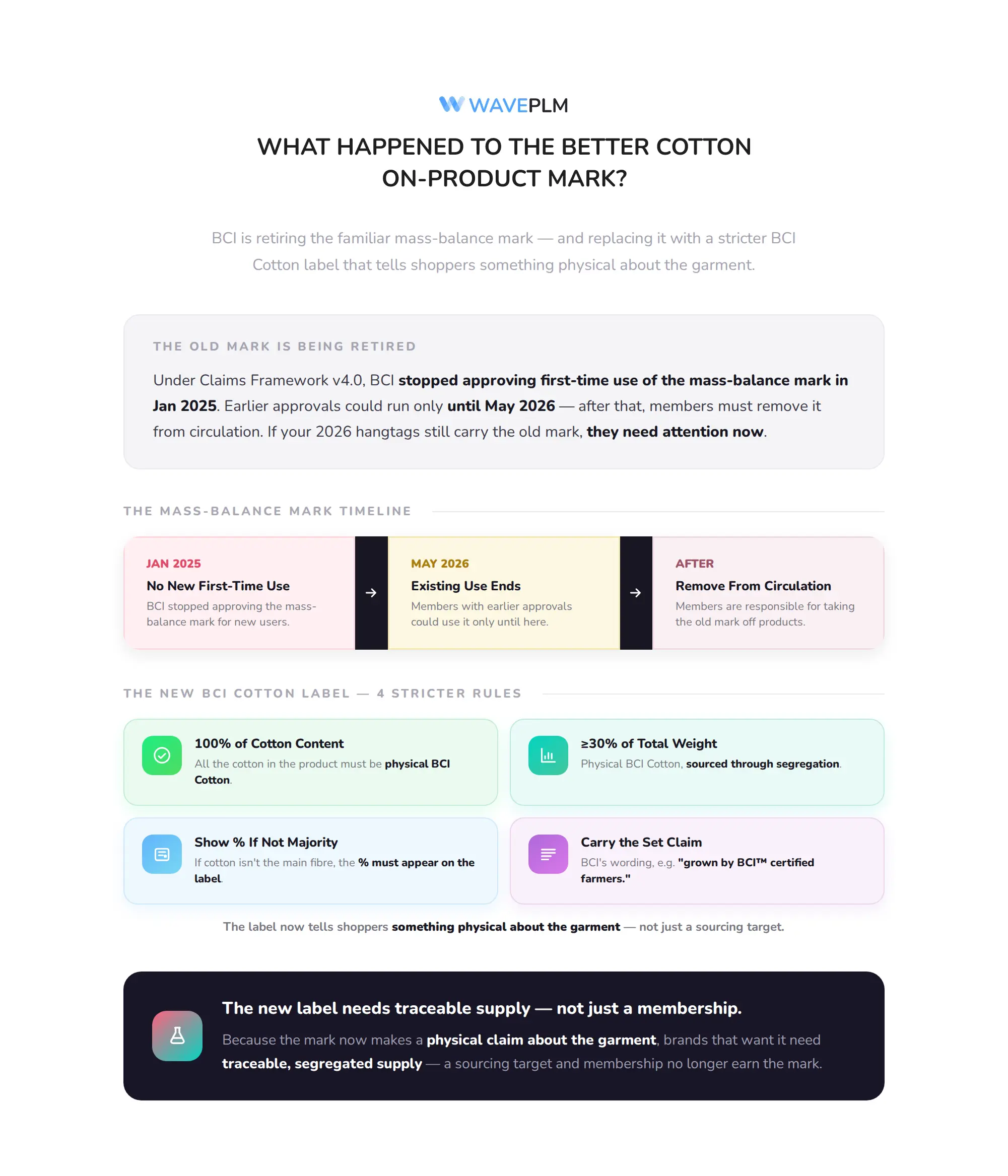
BCI is retiring the familiar mass balance on-product mark. Under BCI’s Claims Framework v4.0, BCI stopped approving first-time use of the mass balance mark in January 2025. Members with earlier approvals could keep using it only until May 2026, and after that they are responsible for removing it from circulation. Consequently, if your 2026 hangtags still carry the old Better Cotton mark, they need attention now.
Instead, the replacement is the new BCI Cotton label, and its rules are much stricter:
- 100% of the cotton content in the product must be physical BCI Cotton.
- Physical BCI Cotton must make up at least 30% of the product’s total weight, sourced through segregation.
- If cotton is not the majority fibre, the percentage must appear on the label.
- The label must carry BCI’s set accompanying claim, such as “The cotton in this product was grown by Better Cotton Initiative (BCI™) certified farmers.”
In short, the label now tells shoppers something physical about the garment. Therefore, brands that want it need traceable supply, not just a membership and a sourcing target.
What Can Brands Say About Better Cotton in 2026?
Claims are tightening on two fronts at once. On one side, BCI’s own framework fixes the wording. On the other, the EU’s Empowering Consumers Directive (EmpCo) applies from 27 September 2026. Specifically, it bans generic environmental claims. It also bans sustainability labels that are not based on a certification scheme or set by public authorities. Our article on the EU Green Claims Directive explains what brands still have to prove.
| Claim type | Example of compliant wording | What you need on file |
|---|---|---|
| Membership statement | “We are a member of the Better Cotton Initiative (BCI™).” | Active membership |
| Sourcing target | “Sourcing 60% of our cotton as BCI Cotton by 2028.” | BCI approval, progress data |
| Product label | BCI Cotton label plus the set accompanying claim | Physical BCI Cotton via segregation, 30%+ of weight |
| Risky: generic claim | “Sustainable cotton tee” | Avoid entirely in the EU |
| Risky: mass balance as content | “Made with Better Cotton” on a mass balance product | Not supportable; remove |
Sourcing targets deserve the same care. Under the Unfair Commercial Practices Directive, a public target such as “60% BCI Cotton by 2028” can count as a future environmental performance claim. Therefore, publish it only with a realistic plan and track progress against it each season. Otherwise, a missed target becomes a misleading claim in hindsight.
Above all, keep product-level claims tied to physical supply, and keep mass balance purchases in organisational reporting. That simple split removes most Better Cotton claim risk.
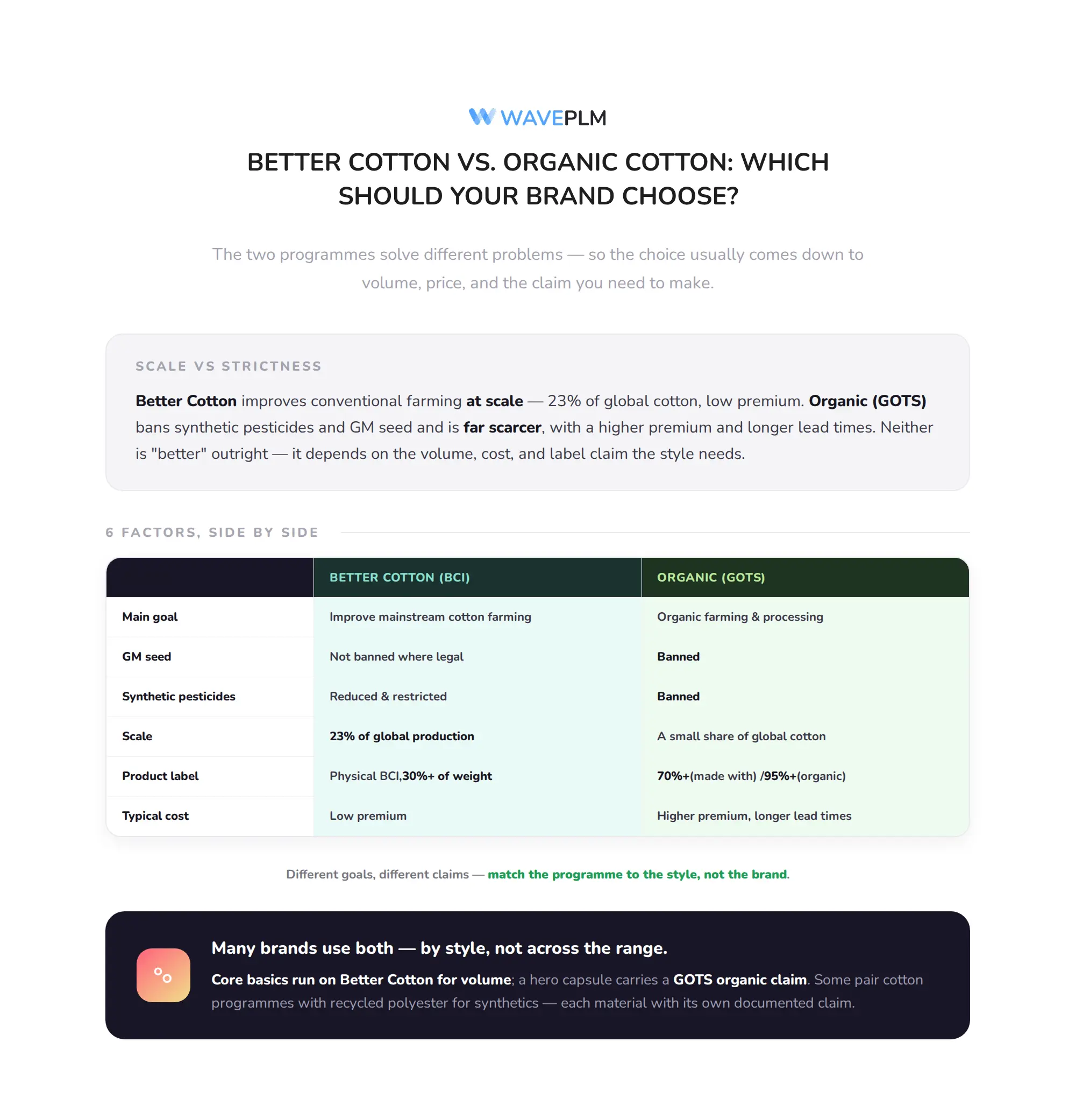
Better Cotton vs. Organic Cotton: Which Should Your Brand Choose?
In fact, the two programmes solve different problems. Better Cotton aims to improve conventional cotton farming at scale. Organic cotton, on the other hand, bans synthetic pesticides and genetically modified seed, and it is far scarcer. As a result, the choice is usually about volume, price, and the claim you need to make.
| Factor | Better Cotton (BCI) | Organic cotton (GOTS) |
|---|---|---|
| Main goal | Improve mainstream cotton farming | Organic farming and processing |
| GM seed | Not banned where legal | Banned |
| Synthetic pesticides | Reduced and restricted | Banned |
| Scale | 23% of global production | A small share of global cotton |
| Product label | Physical BCI Cotton, 30%+ of weight | 70%+ (“made with organic”) or 95%+ (“organic”) |
| Typical cost impact | Low premium | Higher premium and longer lead times |
As a result, many brands use both. For example, core basics run on Better Cotton for volume, while a hero capsule carries a GOTS organic claim. Similarly, some brands pair cotton programmes with recycled polyester fabric for synthetic styles, so each material carries its own documented claim. Chemical safety is a separate question again, which OEKO-TEX certification covers.
What Do the Criticisms of Better Cotton Mean for Due Diligence?
At the same time, Better Cotton has faced serious scrutiny. In April 2024, the NGO Earthsight linked Better Cotton-labelled cotton from Bahia, Brazil, to illegal deforestation and land conflicts in the Cerrado. Crucially, the report argued that country-level tracking could not show which farm the fibre came from. Afterwards, Better Cotton commissioned an independent audit of three licensed farms in Bahia. It also said it would suspend or revoke licences for farms that failed the standard.
For a brand, the lesson is practical rather than ideological. In other words, a programme logo is not the same as knowing your supply chain. Therefore, ask spinners and fabric mills for the origin country and chain of custody model behind every cotton order. Forced-labour rules such as those covered in our UFLPA guide already demand that level of origin evidence for US imports.
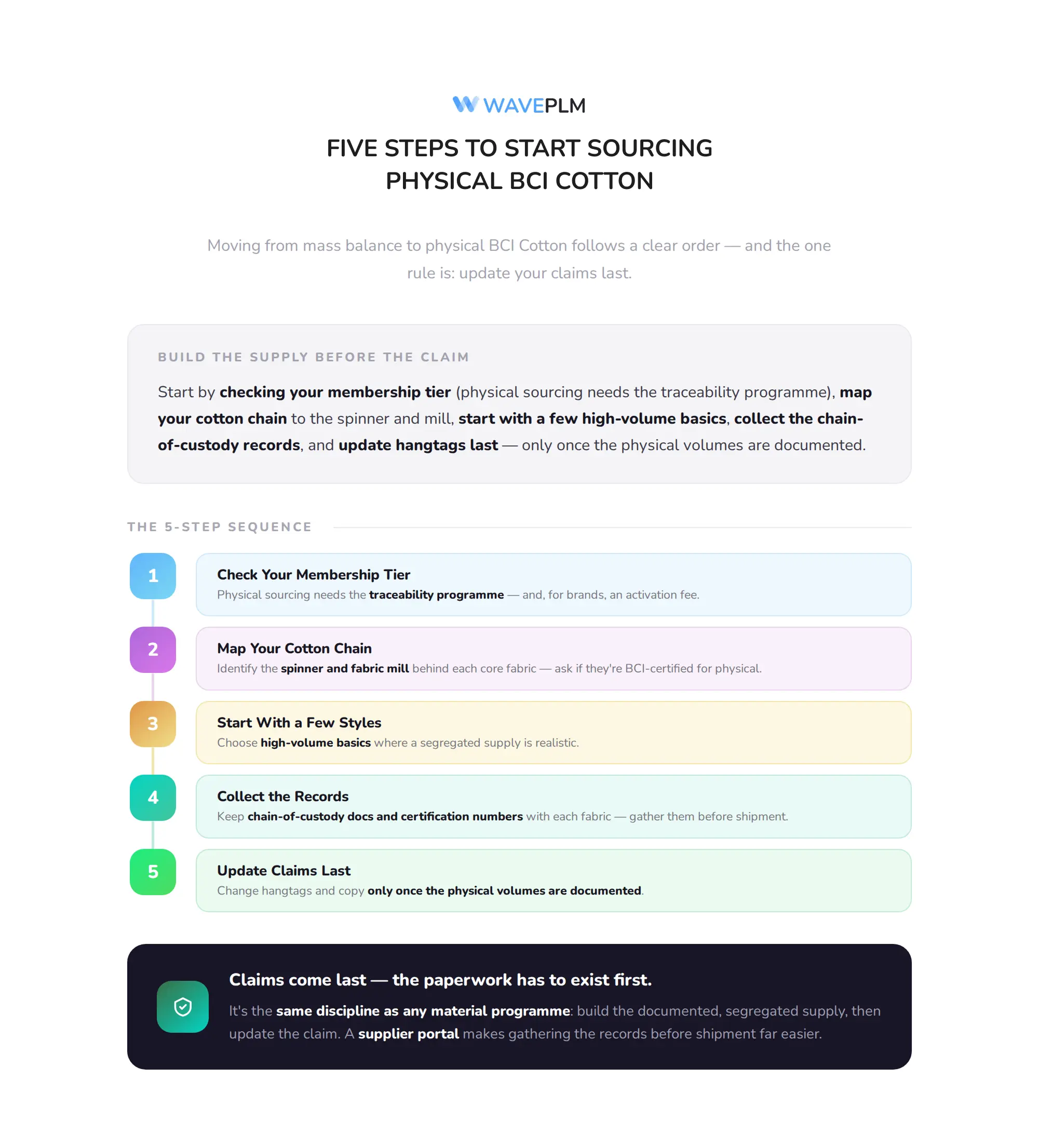
Five Steps to Start Sourcing Physical BCI Cotton
- Check your membership tier. Physical sourcing targets require participation in BCI’s traceability programme and, for retailer and brand members, a traceability activation fee.
- Map your cotton chain. Identify the spinner and fabric mill behind each core fabric and ask whether they are BCI certified for physical models.
- Start with a few styles. Choose high-volume basics where a segregated supply is realistic.
- Collect the records. Keep chain of custody documents and certification numbers with each fabric. A supplier portal helps you gather them before shipment.
- Update claims last. Change hangtags and product copy only once the physical volumes are documented.
Notably, this is the same discipline as any other material programme. Our guide to fabric sourcing, MOQs, and lead times shows how certified fabrics affect planning.
Frequently Asked Questions
What is Better Cotton?
Better Cotton is cotton grown by farmers licensed or certified under the Better Cotton Initiative (BCI) Standard, which covers pesticide use, water, soil, biodiversity, and decent work. It accounted for 23% of global cotton production in the 2023/24 season.
Is Better Cotton the same as organic cotton?
No. Better Cotton improves conventional farming practices and does not ban genetically modified seed or all synthetic pesticides. Organic cotton bans both and is certified under standards such as GOTS. Better Cotton is far more widely available and usually costs less.
Does buying Better Cotton mean it is in my product?
Only if you buy physical BCI Cotton through a segregation or controlled blending model. Under mass balance, your purchase supports Better Cotton farmers, but the cotton in your product may be conventional. That is why mass balance cannot carry a consumer product label.
Can I still use the old Better Cotton on-product mark?
No. BCI stopped approving new uses of the mass balance on-product mark in January 2025, and existing approvals allowed use only until May 2026. Brands are responsible for removing it from circulation and must use the new BCI Cotton label for physical cotton instead.
What percentage of BCI Cotton does a product need for the label?
First, all of the cotton in the product must be physical BCI Cotton. Second, it must make up at least 30% of the product’s total weight through a segregation model. If cotton is not the main fibre, the label must show the percentage.
Why was Better Cotton renamed BCI?
In October 2025, the organisation restored its original full name, the Better Cotton Initiative, alongside a new logo and a label for physically traceable cotton. The change followed its move to a third-party certification system earlier in 2025.
Before Your Next Hangtag Reprint
Most brands discover their Better Cotton claim gap at the worst moment: when a retailer asks for proof or when trims are already being reprinted. If you are planning the next season’s labels, that is the easiest point to separate physical styles from mass balance ones and fix the wording once. Wave PLM keeps chain of custody records, certificate numbers, and claim text on each fabric, so the right label follows the right style. Talk to the Wave PLM team about your cotton programme.





Leave a Reply