
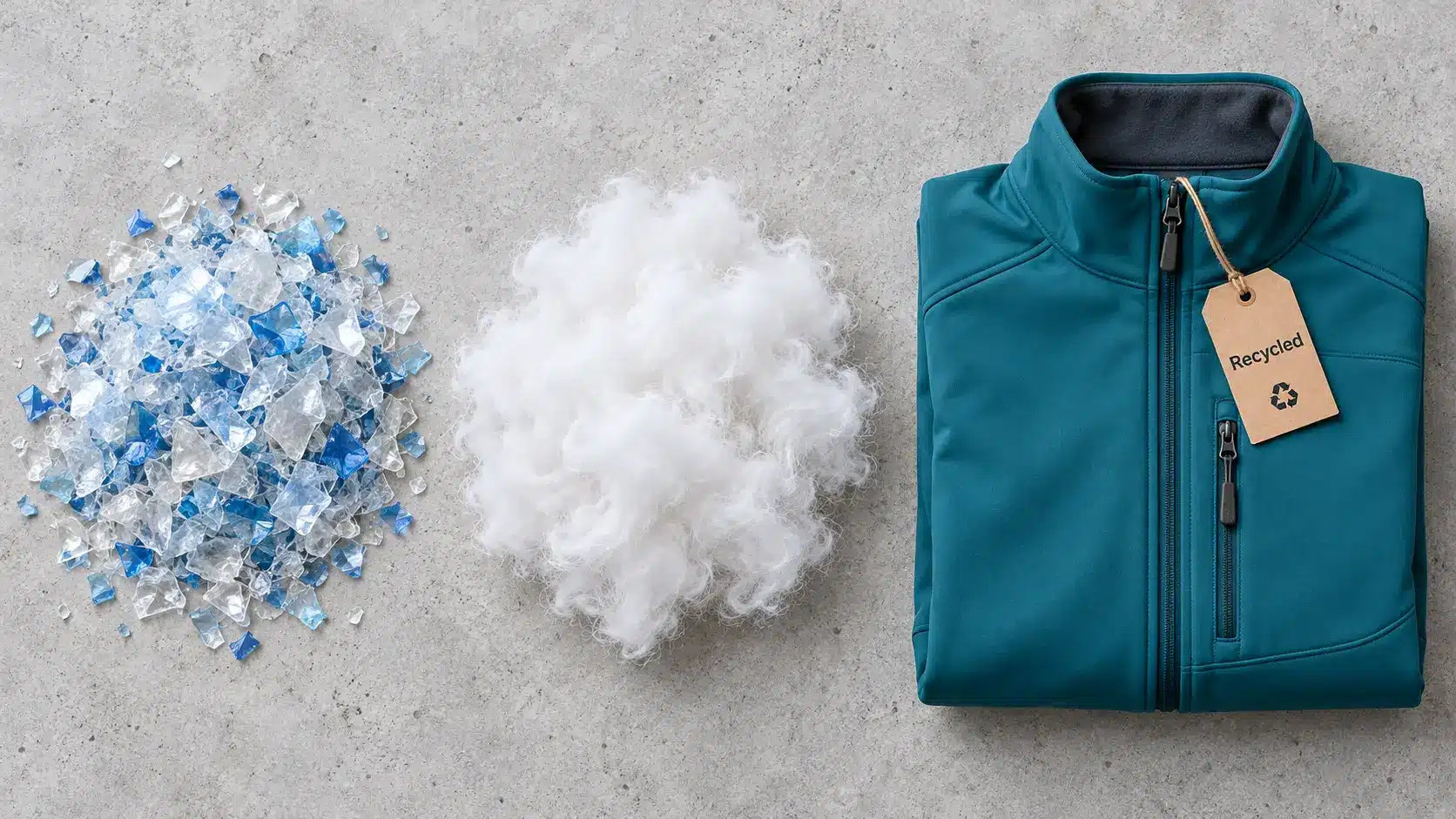
Recycled polyester fabric is polyester made from previously used plastic, usually PET bottles, instead of new oil-based raw material. For an apparel brand, however, the material itself is the easy part. The harder part is proving the recycled content, keeping that proof attached to each style, and making claims that survive a retailer audit or a regulator’s question.
This guide covers what brands actually need to check before switching. In particular, it explains where the feedstock comes from, what GRS certification proves, how cost compares with virgin polyester in 2026, and what changes in your tech pack. Finally, it lists the red flags that show up in supplier claims.
What Is Recycled Polyester Fabric?
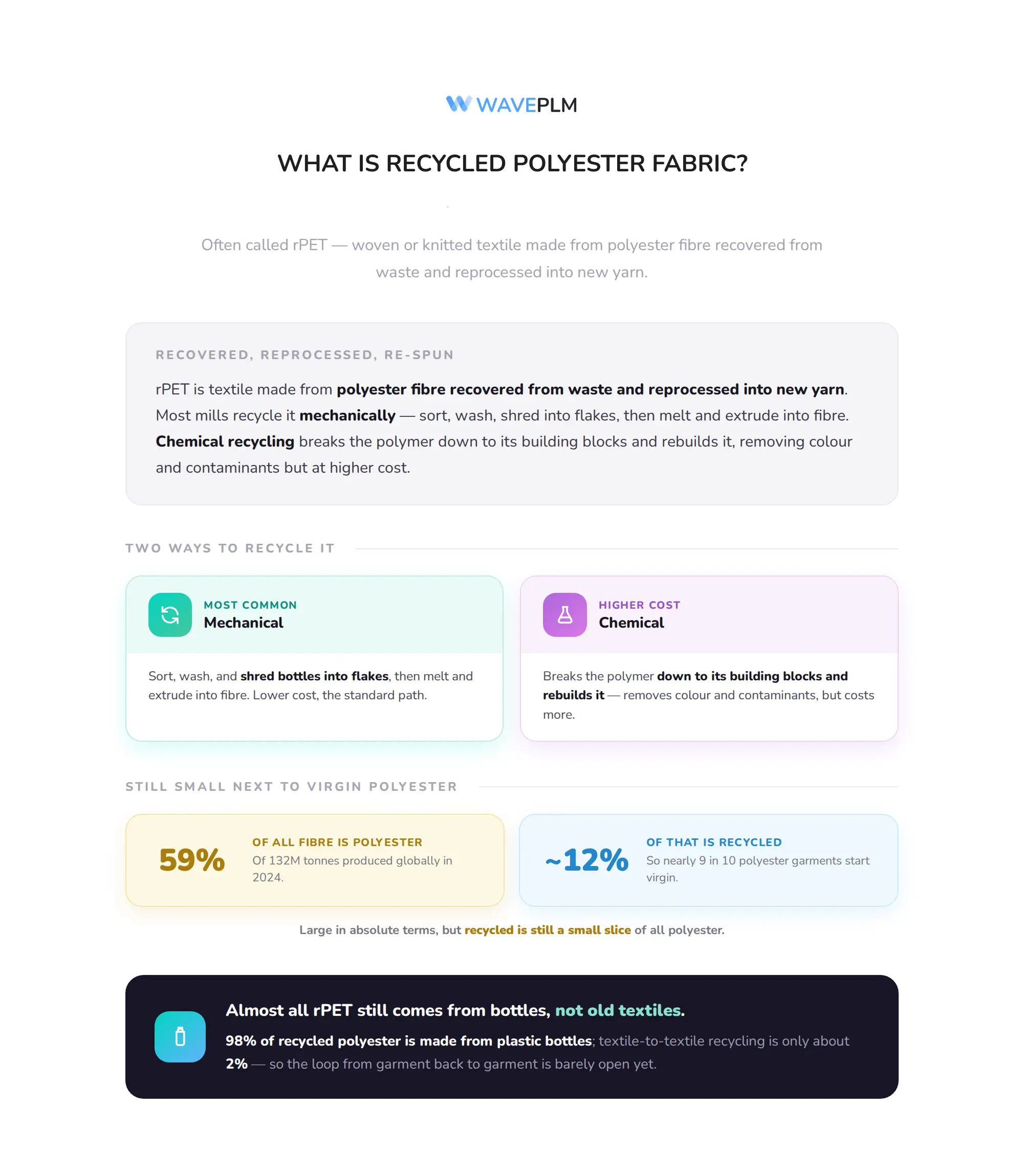
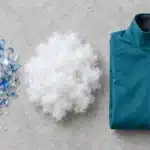
Recycled polyester fabric (often called rPET) is woven or knitted textile made from polyester fibre that was recovered from waste and reprocessed into new yarn. Most mills recycle it mechanically: they sort, wash, and shred bottles into flakes, then melt and extrude them into fibre. By contrast, chemical recycling breaks the polymer down to its building blocks and rebuilds it, which removes colour and contaminants but costs more.
The market is large but still small relative to polyester overall. According to Textile Exchange, polyester made up 59% of the 132 million tonnes of fibre produced globally in 2024. Of that polyester, only about 12% was recycled. In other words, nearly nine in ten polyester garments still start from virgin material.
Industry data: Recycled polyester is still primarily made from plastic bottles (98%), while polyester textile-to-textile recycling accounts for only around 2% of all recycled polyester (Textile Exchange, Materials Market Report 2025).
Where Does Recycled Polyester Actually Come From?
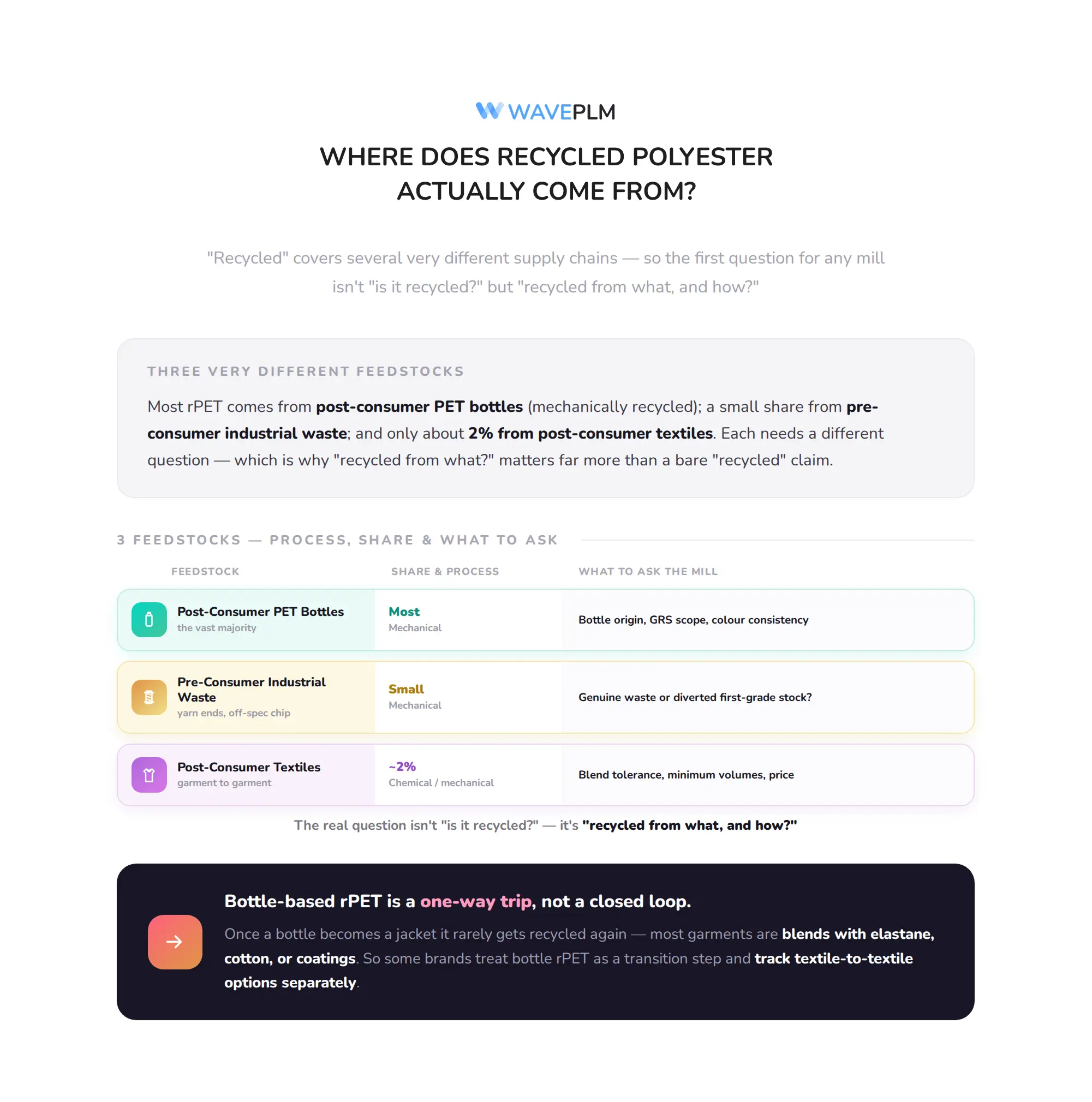
The word “recycled” covers several very different supply chains. Therefore, the first question to ask any mill is not “is it recycled?” but “recycled from what, and how?”
| Feedstock | Process | Typical share today | What to ask the mill |
|---|---|---|---|
| Post-consumer PET bottles | Mechanical (flake → chip → fibre) | The vast majority | Bottle origin, GRS scope, colour consistency |
| Pre-consumer industrial waste (yarn ends, off-spec chip) | Mechanical | Small | Whether it is genuine waste or diverted first-grade material |
| Post-consumer textiles | Chemical or mechanical | Around 2% of recycled polyester | Blend tolerance, minimum volumes, price |
Notably, bottle-based recycled polyester fabric is a one-way trip. Once a bottle becomes a jacket, it rarely gets recycled again, because most garments are blends with elastane, cotton, or coatings. As a result, some brands now treat bottle-based rPET as a transition step and track textile-to-textile options separately. Our guide on textile waste brands can control covers that end-of-life side.
Is Recycled Polyester Better Than Virgin Polyester?
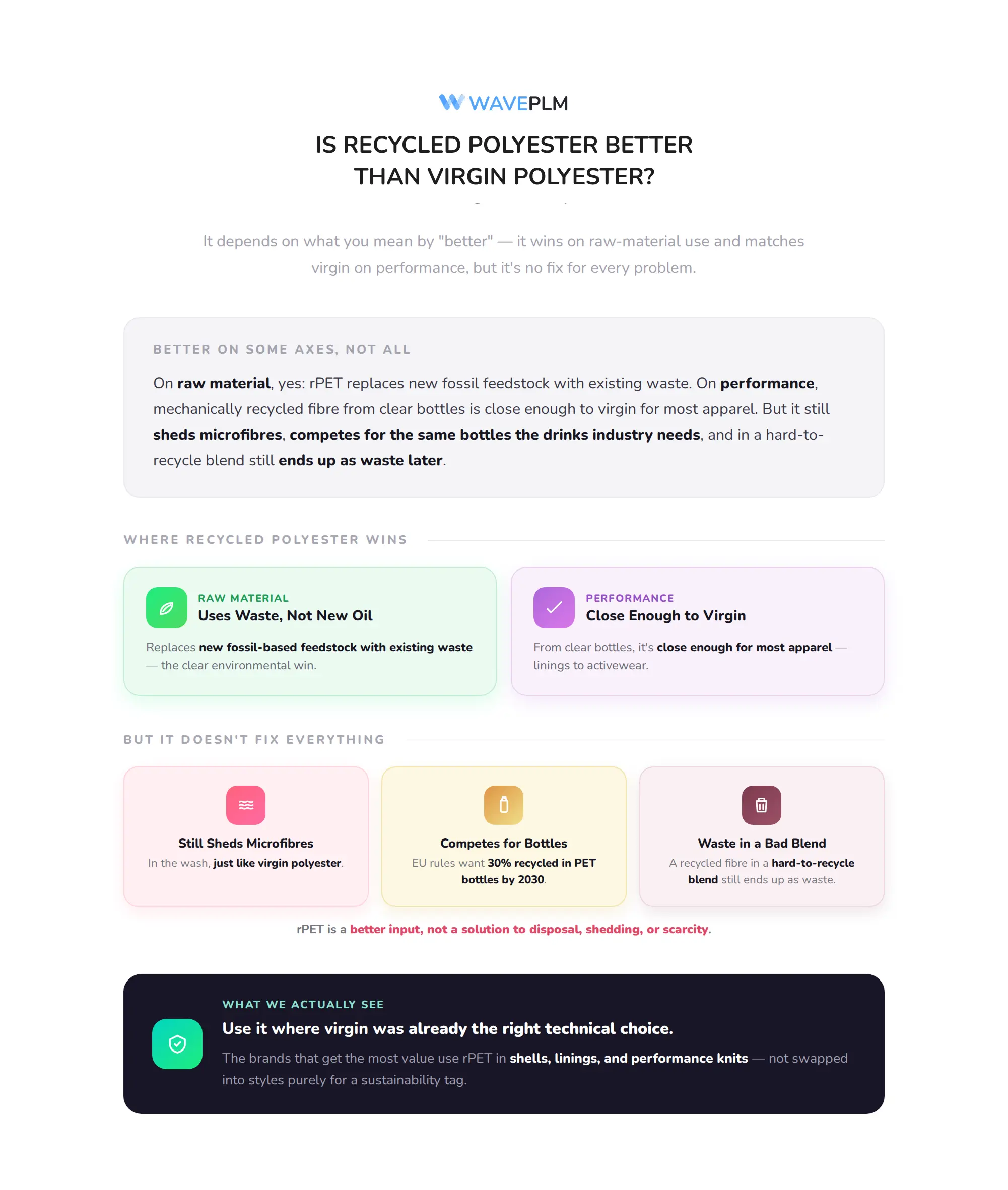
It depends on what you mean by “better.” On raw-material use, the answer is generally yes: recycled polyester fabric replaces new fossil-based feedstock with existing waste. On performance, mechanically recycled fibre from clear bottles is close enough to virgin for most apparel, from linings to activewear.
That said, recycled polyester is not a fix for every problem. First, it still sheds microfibres in the wash, just like virgin polyester. Second, it competes for the same bottles that the drinks industry now needs. For example, the EU’s single-use plastics rules require PET bottles to contain 30% recycled content by 2030, which keeps pulling clean flake back into bottles. Third, a recycled fibre in a hard-to-recycle blend still ends up as waste later.
Our finding: The brands that get the most value from recycled polyester fabric use it where virgin polyester was already the right technical choice, such as shells, linings, and performance knits, rather than swapping it into styles purely for a sustainability tag.
What Does GRS Certification Prove?
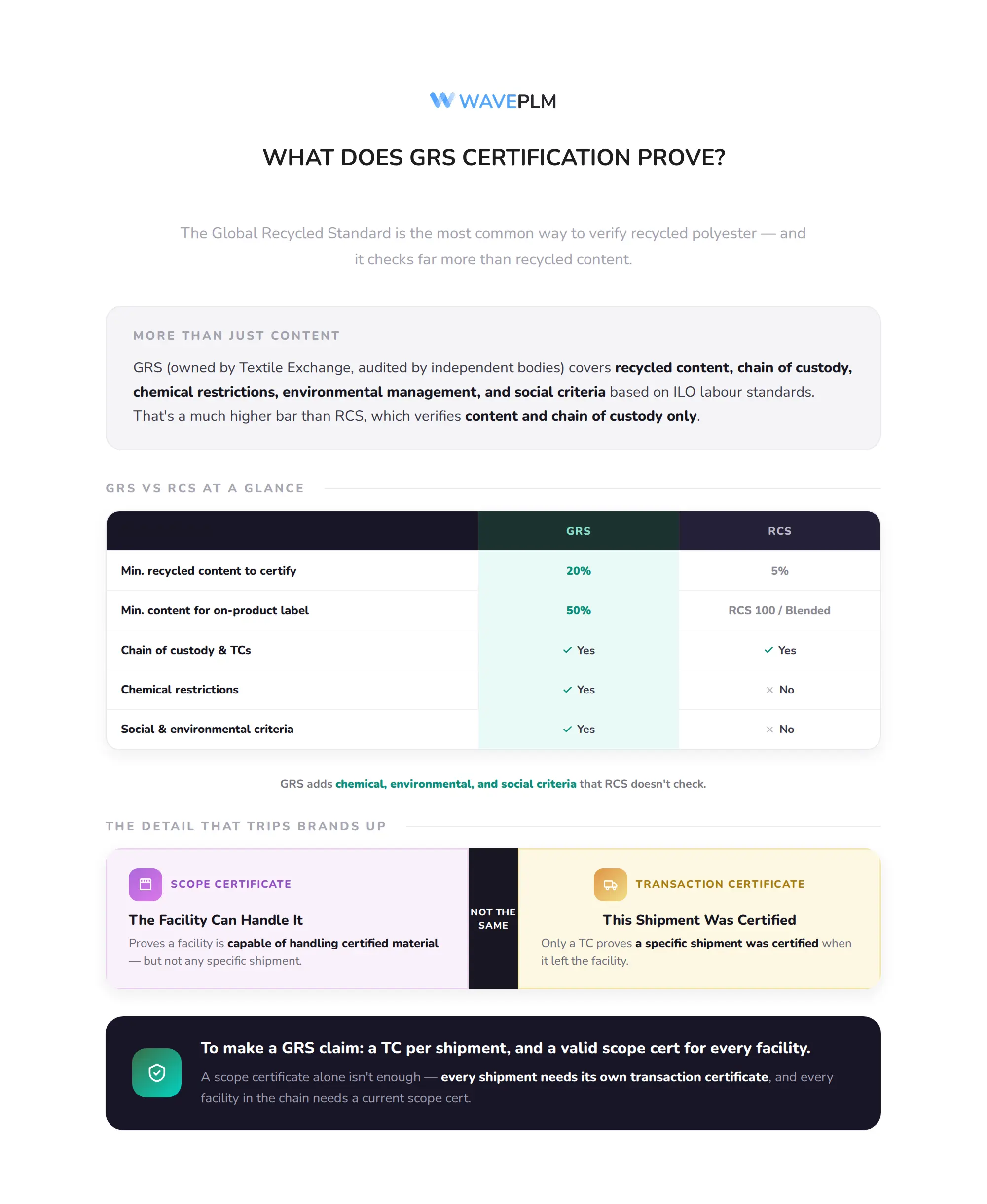
The Global Recycled Standard (GRS) is the most common way to verify recycled polyester fabric. Textile Exchange owns it, and independent certification bodies run the audits. Importantly, GRS checks more than content. It also covers chain of custody, chemical restrictions, environmental management, and social criteria based on ILO labour standards.
| Requirement | GRS | RCS (Recycled Claim Standard) |
|---|---|---|
| Minimum recycled content to certify | 20% | 5% |
| Minimum content for an on-product label | 50% | RCS 100 (95%+) or RCS Blended (5–95%) |
| Chain of custody and transaction certificates | Yes | Yes |
| Chemical restrictions | Yes | No |
| Social and environmental criteria | Yes | No |
The detail that trips brands up is the transaction certificate (TC). A supplier’s scope certificate proves the facility can handle certified material. However, only a TC proves that a specific shipment of recycled polyester fabric was certified when it left that facility. Consequently, if your brand wants to make a GRS claim, you need a TC for every shipment, and every facility in the chain needs a valid scope certificate. The same logic applies to organic cotton, as our GOTS certification guide explains.
How Much Does Recycled Polyester Fabric Cost Compared With Virgin?
For years, the standard answer was “a premium of 10–20%.” In 2026, however, that answer is out of date at the raw-material level. According to S&P Global (Platts), recycled PET flake began trading at a discount to virgin PET globally from April 2026, as virgin prices rose with oil while recycled grades moved only modestly. On May 13, 2026, Platts put the discount at $459 per tonne in Northwest Europe and $373 per tonne in Southeast Asia.
Even so, cheaper flake does not automatically mean cheaper fabric. In practice, the price of recycled polyester fabric still includes certification fees, TC administration, smaller dye lots, and higher minimums at some mills. For this reason, compare full fabric quotes at your real order volume, not chip prices.
| Cost line | Virgin polyester | Recycled polyester fabric |
|---|---|---|
| Raw material (2026) | Rising with oil prices | Flake at a discount to virgin since April 2026 |
| Certification | None required | GRS/RCS scope fees across the chain |
| Paperwork per shipment | Standard | Transaction certificate for every shipment |
| Minimums | Usually lower | Can be higher for certified colours |
| Claim value | None | Recycled-content claim if fully documented |
Once you have a quote, build it into the style’s cost sheet the same way as any other material. Our garment costing guide walks through that structure line by line.
What Changes in the Tech Pack When You Switch?
On paper, switching to recycled polyester fabric is a one-line material change. In reality, several specs deserve a second look before bulk.
- Shade and dye uptake: recycled chip can vary slightly between batches, so approve lab dips on the actual recycled base, not on a virgin reference.
- Fabric weight: keep the same GSM target and tolerance, and check it on the bulk lab report. Our fabric GSM guide explains the ±5% rule.
- Pilling and hand feel: request a pilling test on the new quality, especially for brushed or fleece finishes.
- Chemical safety: recycled content does not replace harmful-substance testing. Many mills combine GRS with OEKO-TEX certification.
In short, treat the switch as a new material, not a substitute. The tests in our apparel product testing guide are a good baseline for that first approval.
Which Recycled Polyester Claims Can You Safely Make in 2026?
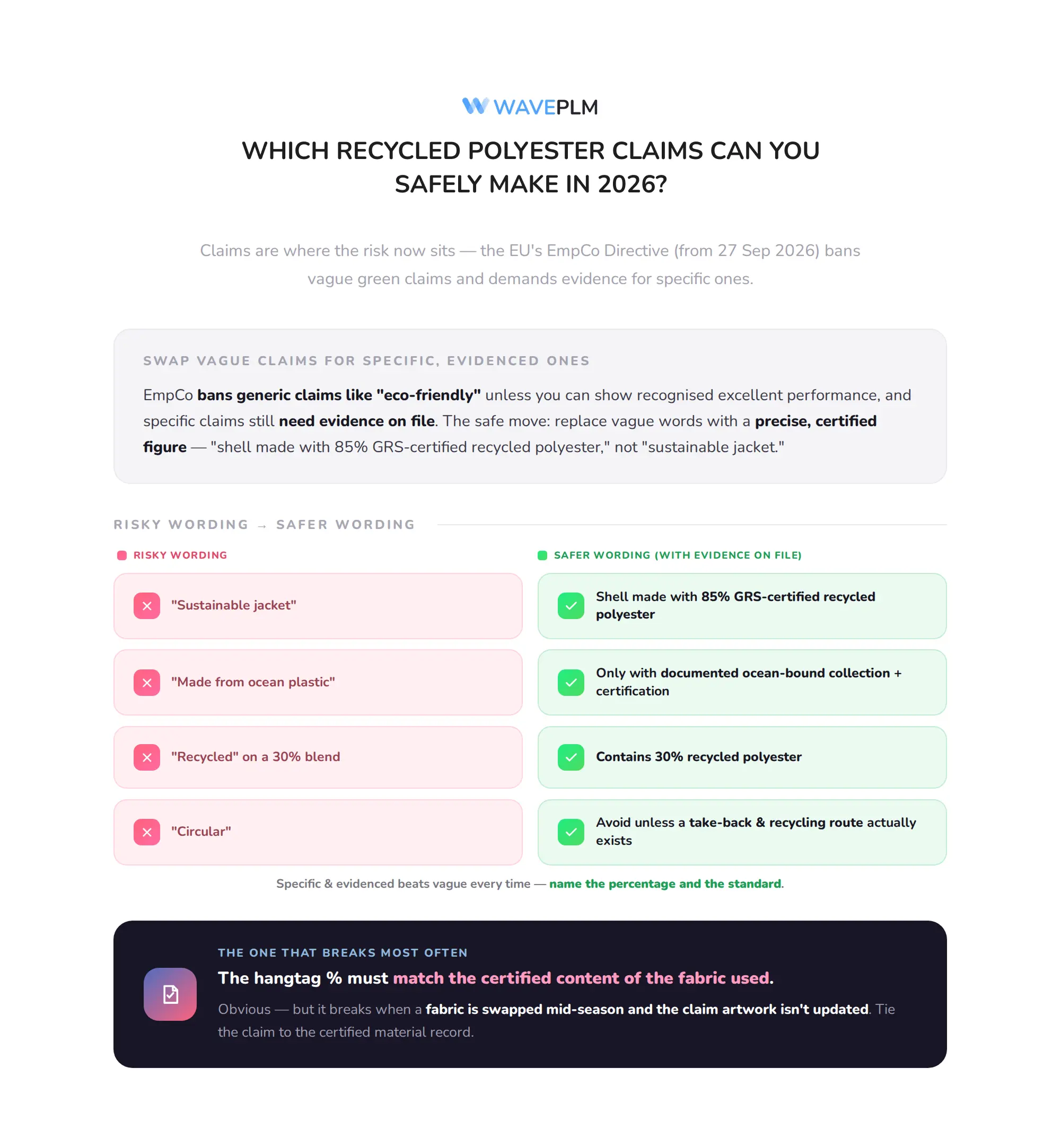
Claims are where the risk now sits. In the EU, the Empowering Consumers for the Green Transition Directive (EmpCo) applies from 27 September 2026. It bans generic environmental claims such as “eco-friendly” unless the brand can show recognised excellent environmental performance. Meanwhile, specific claims still need evidence. Our article on the EU Green Claims Directive explains what brands still have to prove now that it is withdrawn.
| Risky wording | Safer wording (with evidence on file) |
|---|---|
| “Sustainable jacket” | “Shell made with 85% GRS-certified recycled polyester” |
| “Made from ocean plastic” | Only with documented ocean-bound collection and certification |
| “Recycled” on a 30% blend | “Contains 30% recycled polyester” |
| “Circular” | Avoid unless a take-back and recycling route actually exists |
Above all, the percentage on the hangtag must match the certified content of the fabric used in that style. That sounds obvious; nevertheless, it breaks easily when a fabric is swapped mid-season and the claim artwork is not updated.
Red Flags in a Supplier’s Recycled Polyester Claim
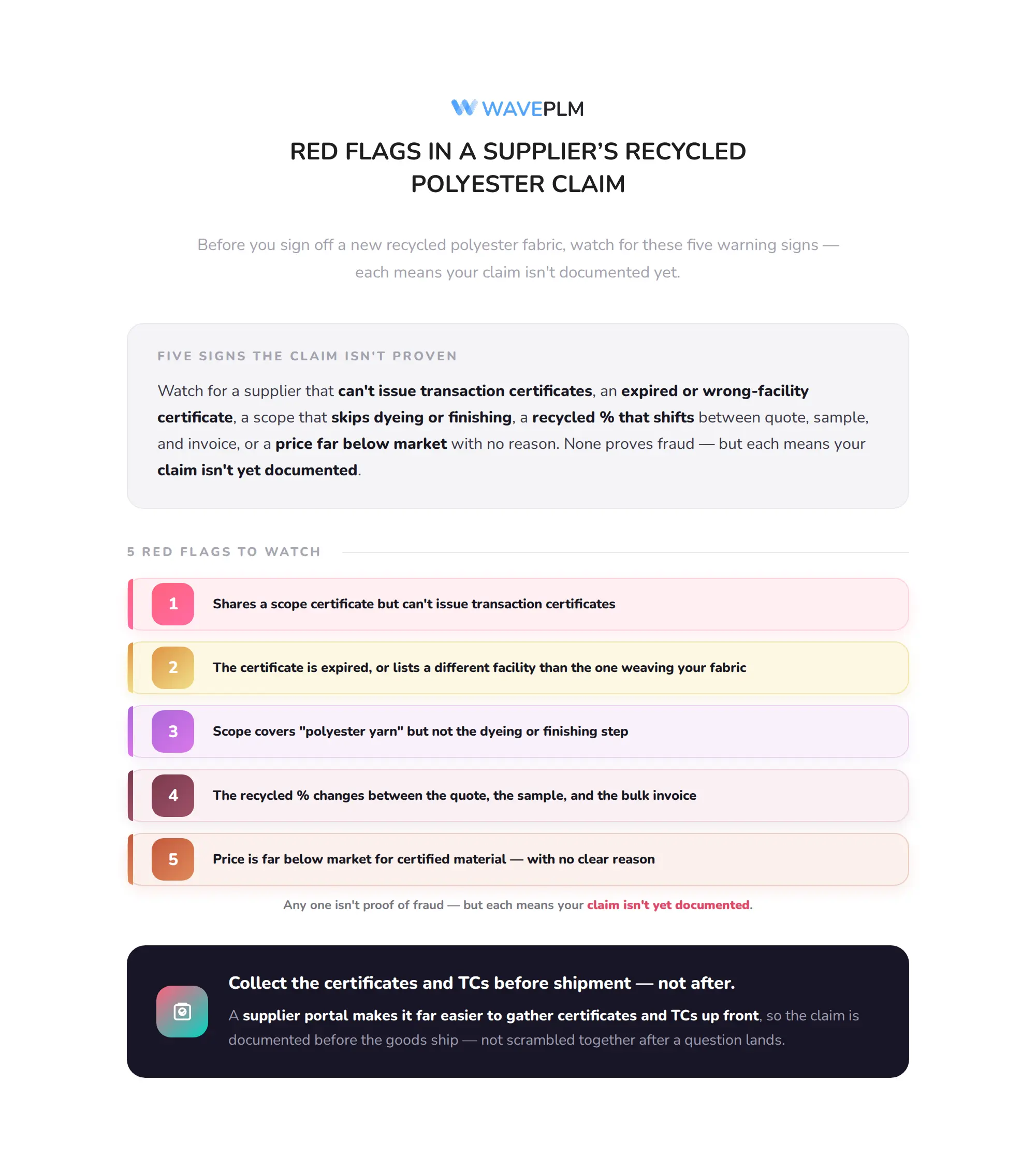
Before you sign off a new recycled polyester fabric, watch for these warning signs:
- The supplier shares a scope certificate but cannot issue transaction certificates.
- The certificate is expired, or it lists a different facility than the one weaving your fabric.
- The scope covers “polyester yarn” but not the dyeing or finishing step.
- The recycled percentage changes between the quote, the sample, and the bulk invoice.
- The price is far below the market for certified material without a clear reason.
Any one of these does not prove fraud. Still, each one means your claim is not yet documented. A supplier portal makes it much easier to collect certificates and TCs before shipment rather than after.
Frequently Asked Questions
What is recycled polyester fabric made from?
Recycled polyester fabric is made mostly from post-consumer PET bottles, which are washed, shredded into flakes, melted, and spun into new fibre. According to Textile Exchange, about 98% of recycled polyester comes from bottles. Only around 2% comes from recycling old textiles back into polyester.
Is recycled polyester fabric as durable as virgin polyester?
For most apparel uses, yes. Mechanically recycled fibre from clear bottles performs close to virgin polyester in strength and colour. However, brands should still run pilling, colorfastness, and weight tests on the actual recycled quality before approving bulk.
Does recycled polyester fabric cost more than virgin?
Not necessarily in 2026. S&P Global Platts reported that recycled PET flake traded at a discount to virgin PET globally from April 2026. Even so, the finished fabric can still cost more once certification, transaction certificates, and minimum order quantities are included.
What is the difference between GRS and RCS?
Both verify recycled content through chain of custody. GRS requires at least 20% recycled content to certify and 50% for an on-product label, and it adds chemical, environmental, and social criteria. RCS starts at 5% recycled content and only verifies the content claim.
Does recycled polyester shed microplastics?
Yes. Recycled polyester sheds microfibres in the wash in much the same way as virgin polyester. Fabric construction and finishing affect shedding more than the recycled origin of the fibre.
Can a brand call a product recycled without certification?
Legally it depends on the market, but it is risky everywhere. In the EU, EmpCo applies from 27 September 2026 and tightens rules on environmental claims. Most retailers also require GRS or RCS transaction certificates before accepting a recycled-content claim.
What a Missing Transaction Certificate Really Costs
One undocumented shipment is enough to block a recycled claim on an entire style. In that case, the hangtags get reprinted, the product page gets rewritten, and the season’s sustainability story loses a hero product. By comparison, attaching the scope certificate, the TC, and the certified percentage to the material record takes minutes when it happens at sampling. Wave PLM links those documents to every recycled polyester fabric in your library, so each BOM shows whether its claim is still covered. See how that works for your material library.






Leave a Reply