
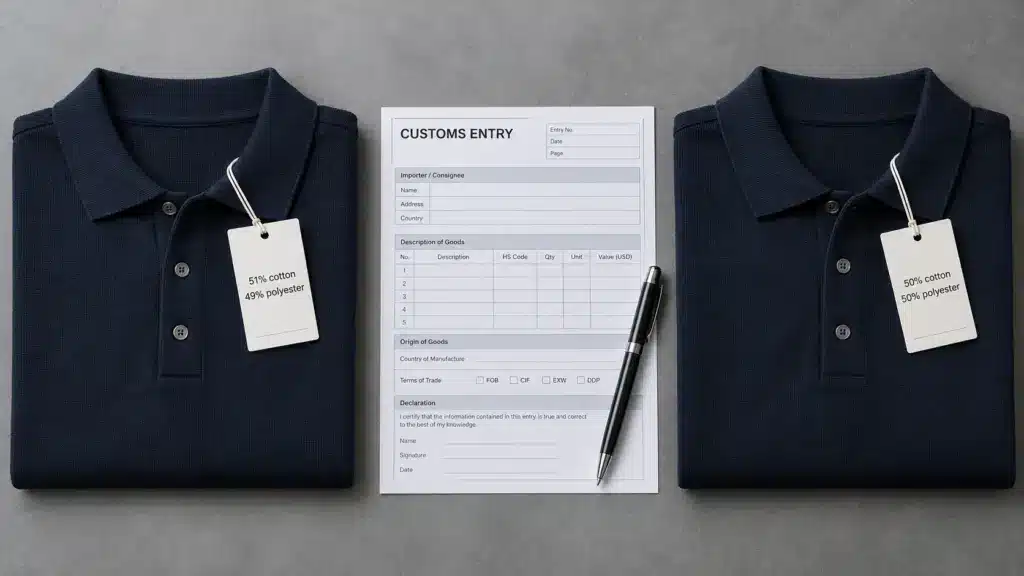
An HTS code is the 10-digit number that identifies a product in the Harmonized Tariff Schedule of the United States. For clothing, the HTS code sets the base duty rate, the quota and statistics category, and often which extra tariffs apply. As a result, two garments that look the same can carry very different duties. The code depends on construction, fibre content, and who the garment is made for.
Most HTS code guides explain how to search the schedule. This guide, by contrast, explains how apparel classification actually works. It also shows which design decisions move a garment into a different code, and how to keep the right number on each style. Wherever possible, it uses real tariff lines and rates.
What Is an HTS Code?
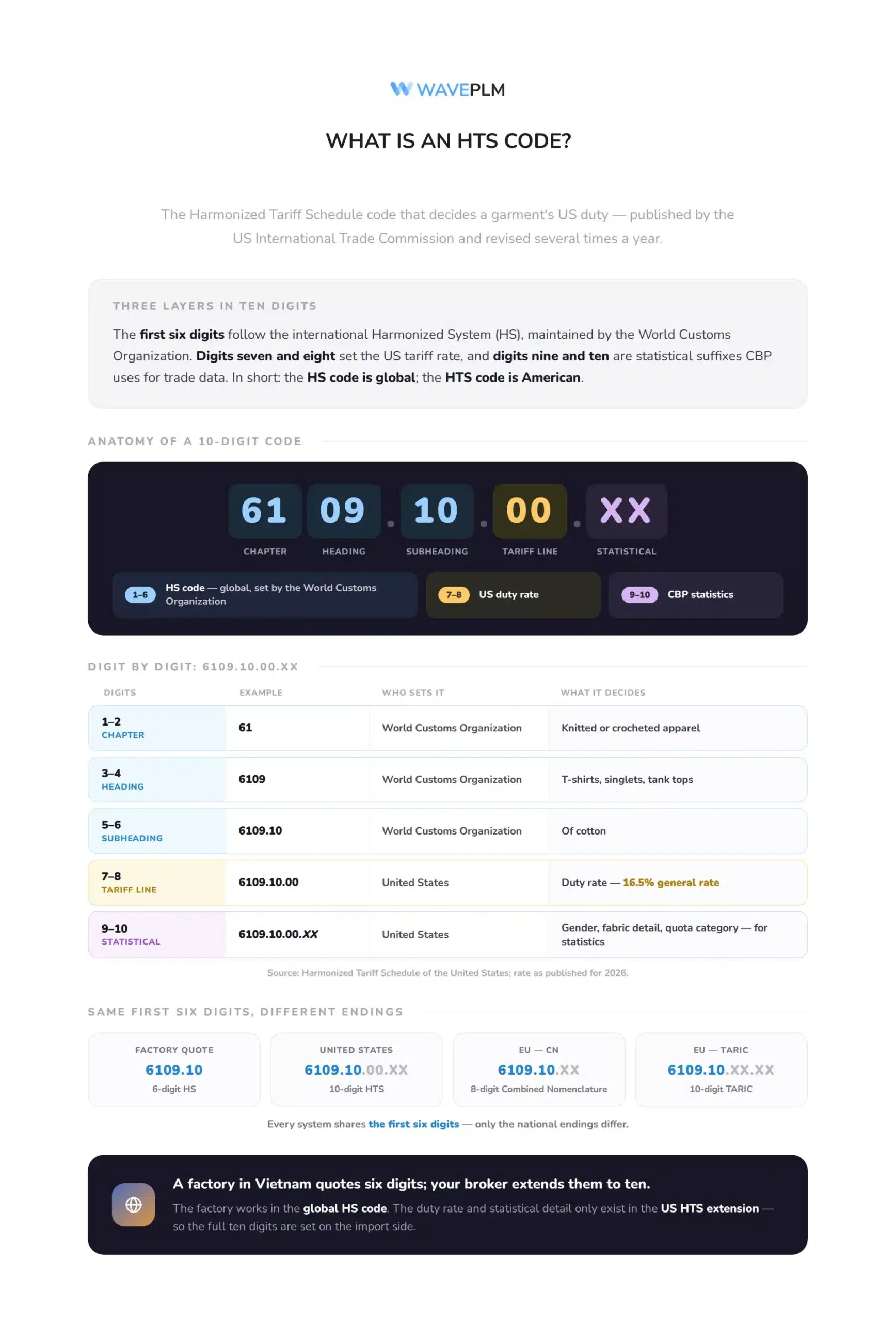
First of all, the US International Trade Commission publishes the Harmonized Tariff Schedule and revises it several times a year. Each HTS code has three layers. First, the first six digits follow the international Harmonized System (HS), which the World Customs Organization maintains and almost every trading country uses. Next, digits seven and eight set the US tariff rate. Finally, digits nine and ten are statistical suffixes that US Customs and Border Protection (CBP) uses for trade data.
| Digits | Example: 6109.10.00.XX | Who sets it | What it decides |
|---|---|---|---|
| 1–2 (chapter) | 61 | World Customs Organization | Knitted or crocheted apparel |
| 3–4 (heading) | 6109 | World Customs Organization | T-shirts, singlets, tank tops |
| 5–6 (subheading) | 6109.10 | World Customs Organization | Of cotton |
| 7–8 (tariff line) | 6109.10.00 | United States | Duty rate (16.5% general rate) |
| 9–10 (statistical) | .XX | United States | Gender, fabric detail, quota category for statistics |
In other words, the HS code is global and the HTS code is American. The EU, for example, uses an 8-digit Combined Nomenclature code and a 10-digit TARIC code, but the first six digits match. For this reason, a factory in Vietnam can quote a six-digit HS code that your broker extends to ten.
How Is Clothing Classified Under the HTS?
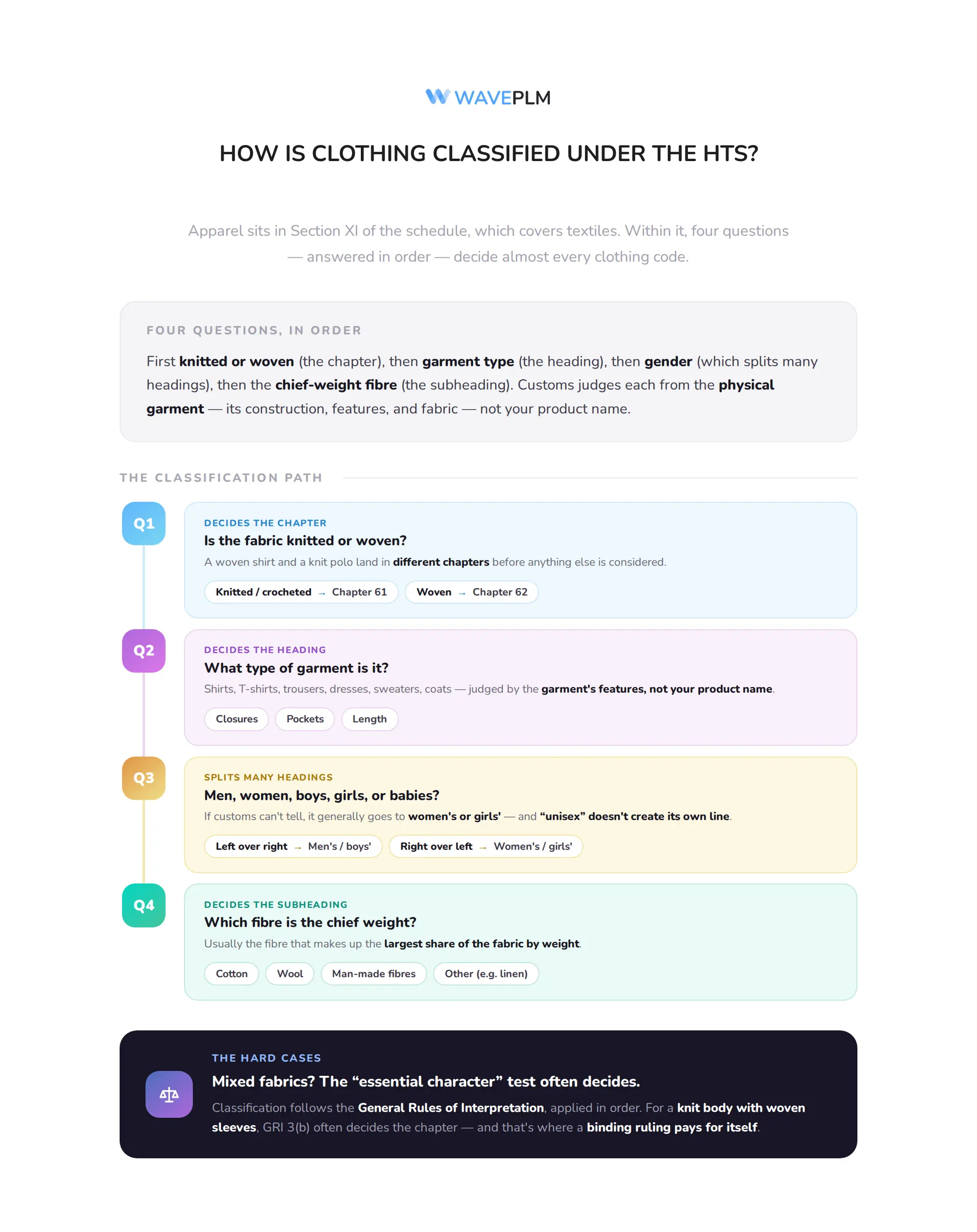
To begin with, apparel sits in Section XI of the schedule, which covers textiles. Within that section, four questions decide almost every HTS code for clothing. Answer them in this order.
- Is the fabric knitted or woven? Knitted and crocheted garments go to Chapter 61. Woven garments go to Chapter 62. A woven shirt and a knit polo are therefore in different chapters before anything else is considered.
- What type of garment is it? The heading separates shirts, T-shirts, trousers, dresses, sweaters, coats, and so on. Instead, customs uses the garment’s features, such as closures, pockets, and length, not your product name.
- Is it for men, women, boys, girls, or babies? Many headings split by gender. Garments that close left over right are generally treated as men’s or boys’, and right over left as women’s or girls’. If customs cannot tell, a garment generally goes to the women’s or girls’ category; a “unisex” label does not create its own line.
- Which fibre is the chief weight? Within the heading, the subheading usually depends on the fibre that makes up the largest share of the fabric by weight: cotton, wool, man-made fibres, or “other textile materials” such as linen.
Note: Classification follows the General Rules of Interpretation (GRI), applied in order. For garments made of several fabrics, such as a knit body with woven sleeves, the “essential character” test under GRI 3(b) often decides the chapter. Those cases are where a binding ruling pays for itself.
Why Does Fibre Content Change the HTS Code?
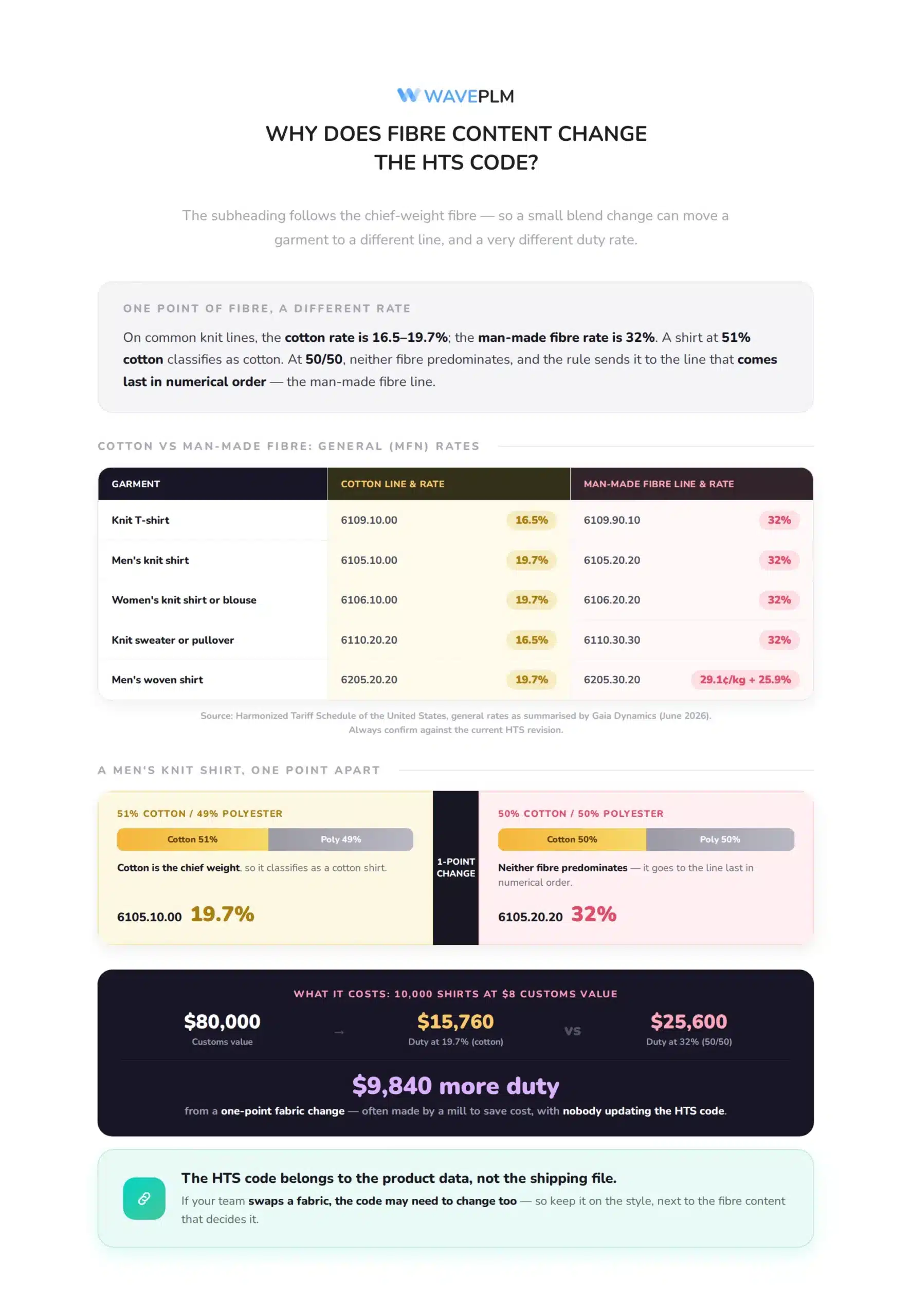
Because the subheading follows the chief weight fibre, a small blend change can move a garment to a different line and a very different rate. The examples below show general (MFN) rates for some of the most common apparel lines.
| Garment | Cotton line and rate | Man-made fibre line and rate |
|---|---|---|
| Knit T-shirt | 6109.10.00 — 16.5% | 6109.90.10 — 32% |
| Men’s knit shirt | 6105.10.00 — 19.7% | 6105.20.20 — 32% |
| Women’s knit shirt or blouse | 6106.10.00 — 19.7% | 6106.20.20 — 32% |
| Knit sweater or pullover | 6110.20.20 — 16.5% | 6110.30.30 — 32% |
| Men’s woven shirt | 6205.20.20 — 19.7% | 6205.30.20 — 29.1¢/kg + 25.9% |
To see what that means in money, take a men’s knit shirt. At 51% cotton and 49% polyester, cotton is the chief weight, so it classifies under 6105.10.00 at 19.7%. At 50/50, however, neither fibre predominates. In that case, the rule sends it to the heading that comes last in numerical order, which here is the man-made fibre line at 32%.
Our finding: On 10,000 knit shirts at a customs value of $8 each, the base duty is $15,760 as a cotton-chief-weight shirt and $25,600 at 50/50. That $9,840 gap comes from a one-point change in the fabric, often made by a mill to save cost, with nobody updating the HTS code on the style.
This is why the HTS code belongs to the product data rather than the shipping file. If your team swaps a fabric, the code may need to change too. Our guide to FOB price in apparel explains how that customs value is built.
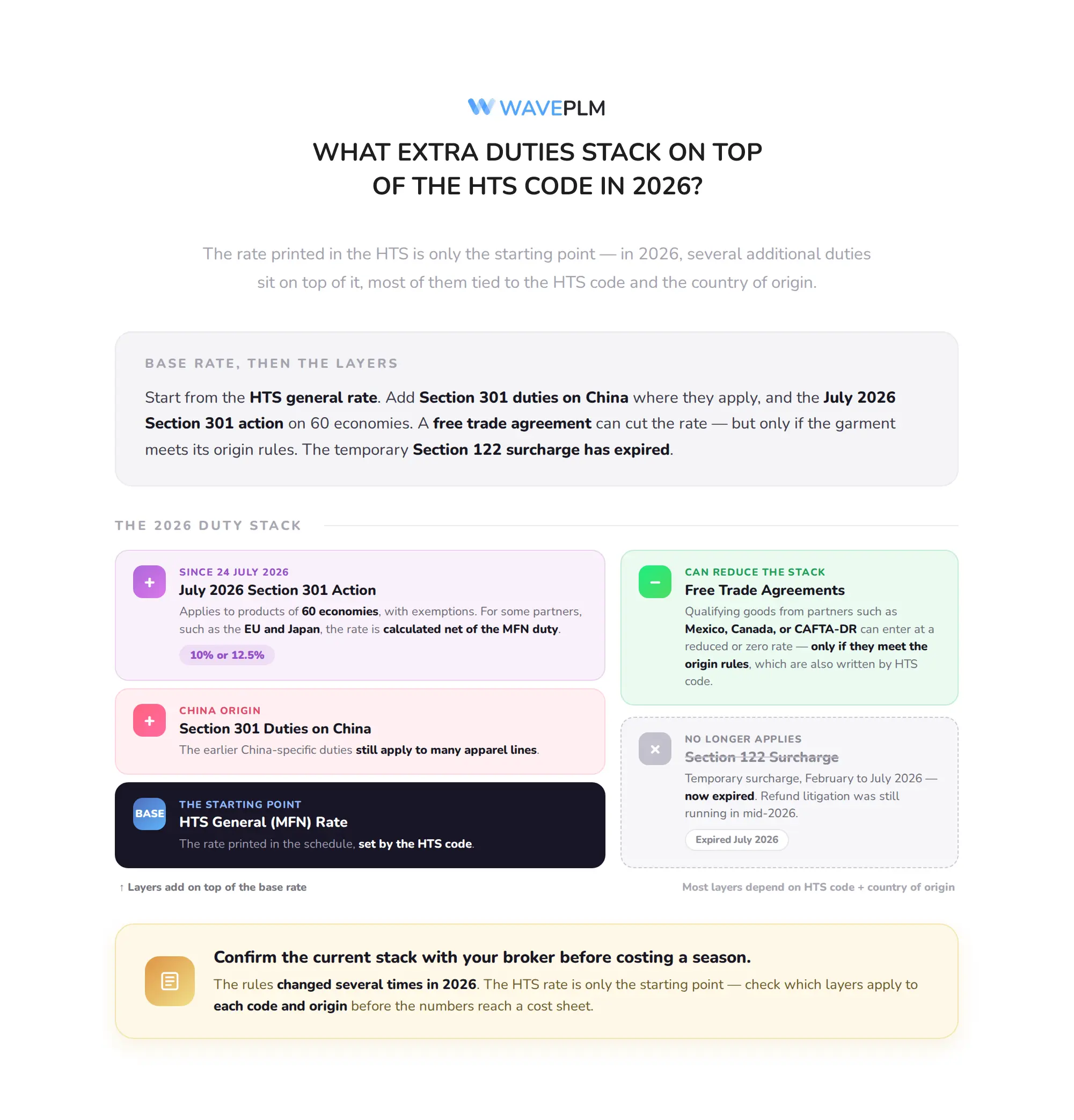
What Extra Duties Stack on Top of the HTS Code in 2026?
However, the rate printed in the HTS is only the starting point. In 2026, several additional duties apply on top of it. Most of them depend on the HTS code as well as the country of origin.
- Section 301 duties on China: the earlier China-specific duties still apply to many apparel lines.
- The July 2026 Section 301 action: since 24 July 2026, a duty of 10% or 12.5% applies to products of 60 economies, with exemptions and, for some partners such as the EU and Japan, a rate calculated net of the MFN duty.
- Free trade agreements: qualifying goods from partners such as Mexico, Canada, or CAFTA-DR countries can enter at a reduced or zero rate, but only if the garment meets the agreement’s origin rules, which are also written by HTS code.
Meanwhile, the temporary Section 122 surcharge, which applied from February to July 2026, has expired. Refund litigation, however, was still running in mid-2026. Since rules changed several times this year, confirm the current stack with your broker before costing a season. For the bigger picture, see our article on customs tariffs and duties in US fashion and our guide to nearshoring to Mexico.
How Do You Find the Right HTS Code for a Garment?
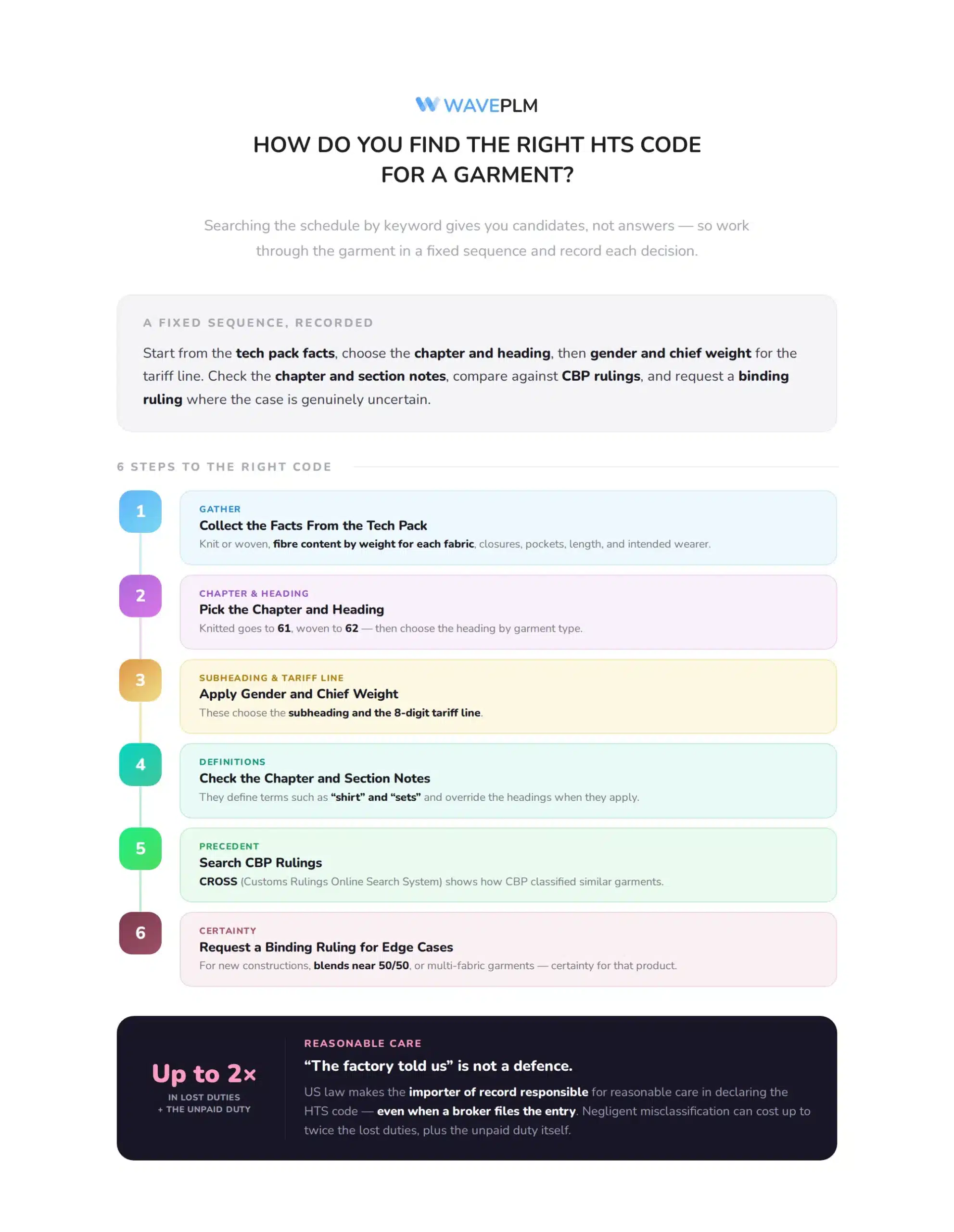
Admittedly, searching the schedule by keyword gives you candidates, not answers. Instead, work through the garment in a fixed sequence and record each decision.
- Collect the facts from the tech pack: knit or woven, fibre content by weight for each fabric, closures, pockets, length, and intended wearer.
- Pick the chapter and heading: knitted goes to 61, woven to 62, then choose the heading by garment type.
- Apply gender and chief weight: these choose the subheading and the 8-digit tariff line.
- Check the chapter and section notes: they define terms such as “shirt” and “sets” and override the headings when they apply.
- Search CBP rulings: the Customs Rulings Online Search System (CROSS) shows how CBP classified similar garments.
- Request a binding ruling for edge cases: for new constructions, blends near 50/50, or multi-fabric garments, a ruling gives you certainty for that product.
Importantly, US law makes the importer of record responsible for “reasonable care” in declaring the HTS code. That holds even when a broker files the entry. Consequently, “the factory told us” is not a defence. Negligent misclassification can lead to penalties of up to twice the lost duties, plus the unpaid duty itself.
Who Should Own the HTS Code Inside an Apparel Brand?
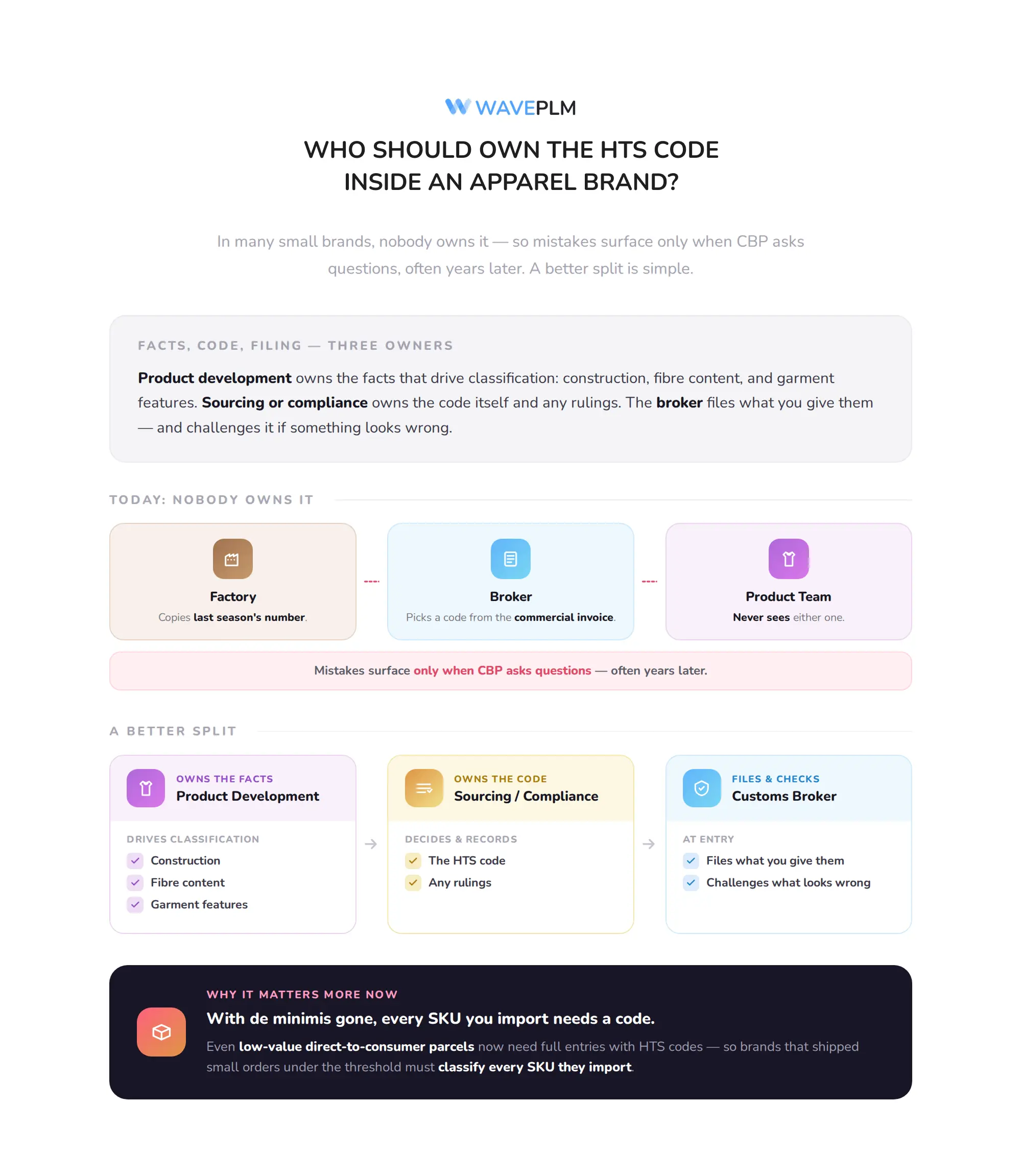
Surprisingly, in many small brands nobody owns it. Typically, the broker picks a code from the commercial invoice and the factory copies last season’s number. Meanwhile, the product team never sees either. As a result, mistakes surface only when CBP asks questions, often years later.
Fortunately, a better split is simple. Product development owns the facts that drive classification: construction, fibre content, and garment features. Meanwhile, sourcing or compliance owns the code itself and any rulings. The broker files what you give them, and challenges it if something looks wrong. Our guide to working with a sourcing agent covers where that hand-off often breaks.
Industry data: With the end of the de minimis exemption, even low-value direct-to-consumer parcels now need full entries with HTS codes. Brands that previously shipped small orders under the threshold now have to classify every SKU they import. See our article on the de minimis tariff for the timeline.
How Does the HTS Code Affect Landed Cost?
The HTS code decides the duty rate. In turn, the duty rate is usually the largest single addition to FOB in a landed cost. Therefore, a wrong code distorts margin before the first unit sells. Put the code and its rate on the cost sheet, not just on the entry, and recalculate when the fabric changes. For details, our step-by-step landed cost guide shows where duty sits in the formula. Similarly, the garment costing guide shows how it flows into retail price.
Five Questions to Send Your Customs Broker This Week
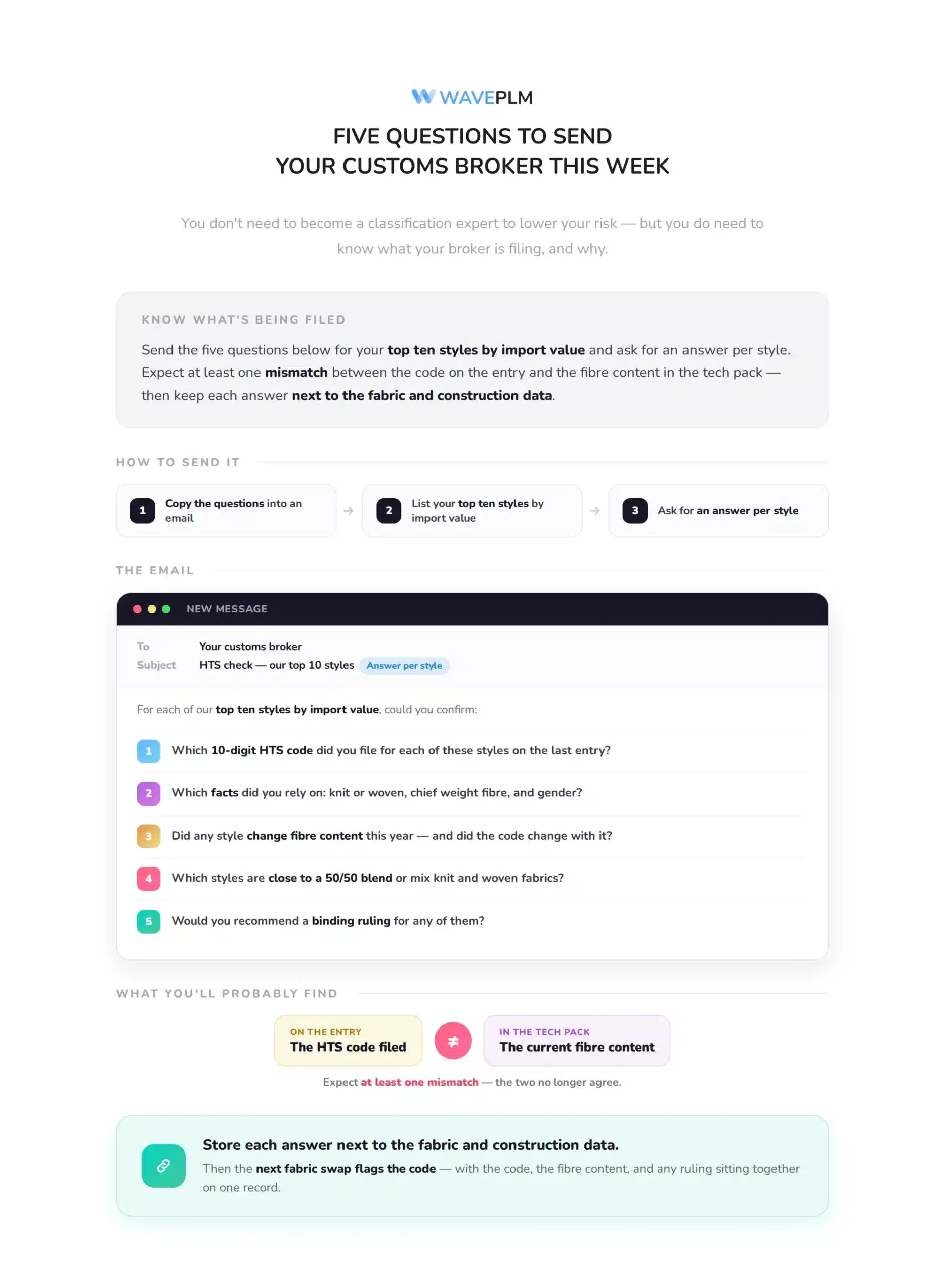
You do not need to become a classification expert to lower your risk. However, you do need to know what your broker is filing and why. Copy the questions below into an email, list your top ten styles by import value, and ask for an answer per style.
- Which 10-digit HTS code did you file for each of these styles on the last entry?
- Which facts did you rely on: knit or woven, chief weight fibre, and gender?
- Did any style change fibre content this year, and did the code change with it?
- Which of these styles are close to a 50/50 blend or mix knit and woven fabrics?
- Would you recommend a binding ruling for any of them?
When the answers come back, you will probably find at least one mismatch. In other words, the code on the entry and the fibre content in the tech pack no longer agree. From then on, store each answer next to the fabric and construction data, so the next fabric swap flags the code. Need one record where the code, the fibre content, and the ruling sit together? Wave PLM has a field for each.
Frequently Asked Questions
What is an HTS code?
An HTS code is the 10-digit product number used in the Harmonized Tariff Schedule of the United States. The first six digits follow the international HS system, the next two set the US duty rate, and the last two are for statistics. Every imported product, including clothing, needs one HTS code on the entry.
What is the difference between an HS code and an HTS code?
An HS code is the 6-digit international classification maintained by the World Customs Organization. An HTS code is the 10-digit US version that adds national tariff and statistical digits. The first six digits of both are the same for the same product.
How do I find the HTS code for clothing?
Start with construction: knitted garments go to Chapter 61 and woven garments to Chapter 62. Then choose the heading by garment type, apply gender, and use the chief weight fibre to pick the subheading. Finally, check CBP rulings for similar garments, and request a binding ruling for unclear cases.
Does fibre content change the duty rate on clothing?
Yes. The subheading usually follows the fibre with the largest share by weight. For example, a knit T-shirt classified as cotton has a 16.5% general rate, while the same T-shirt in man-made fibres has a 32% rate.
Who is responsible if the HTS code is wrong?
The importer of record is responsible, even when a customs broker files the entry. US law requires importers to use reasonable care. Negligent misclassification can lead to back duties and penalties of up to twice the lost duties.
Are unisex garments classified as men’s or women’s?
There is no separate unisex line for most apparel. If customs cannot tell whether a garment is men’s or women’s, it generally uses the women’s or girls’ heading. Closure direction and cut are the main clues customs uses.
Conclusion
An HTS code for clothing comes from a short chain of decisions: knit or woven, garment type, gender, and chief weight fibre. Each link sits in your product data. Therefore, a fabric or construction change can quietly move the code and the duty. So classify from the tech pack and check rulings for edge cases. Then keep the code on the style record, next to the facts that support it. Do that, and duty becomes a number you plan for instead of a surprise on the entry.




Leave a Reply