

An FOB price is the price of goods delivered on board the ship at the port of export. In apparel, an FOB price usually covers the finished, packed garment plus everything needed to get it onto the vessel: materials, making, factory overhead and profit, inland transport to the port, and export clearance. However, it does not cover ocean freight, insurance, import duty, or delivery to your warehouse.
FOB stands for “Free On Board”, one of the ICC’s Incoterms rules. It remains the most common way garment factories quote full-package production. As a result, brands compare most factory offers on an FOB price basis. This guide explains what an FOB price includes, how it differs from other Incoterms, and how to compare quotes without surprises.
What Does an FOB Price Include in Apparel?
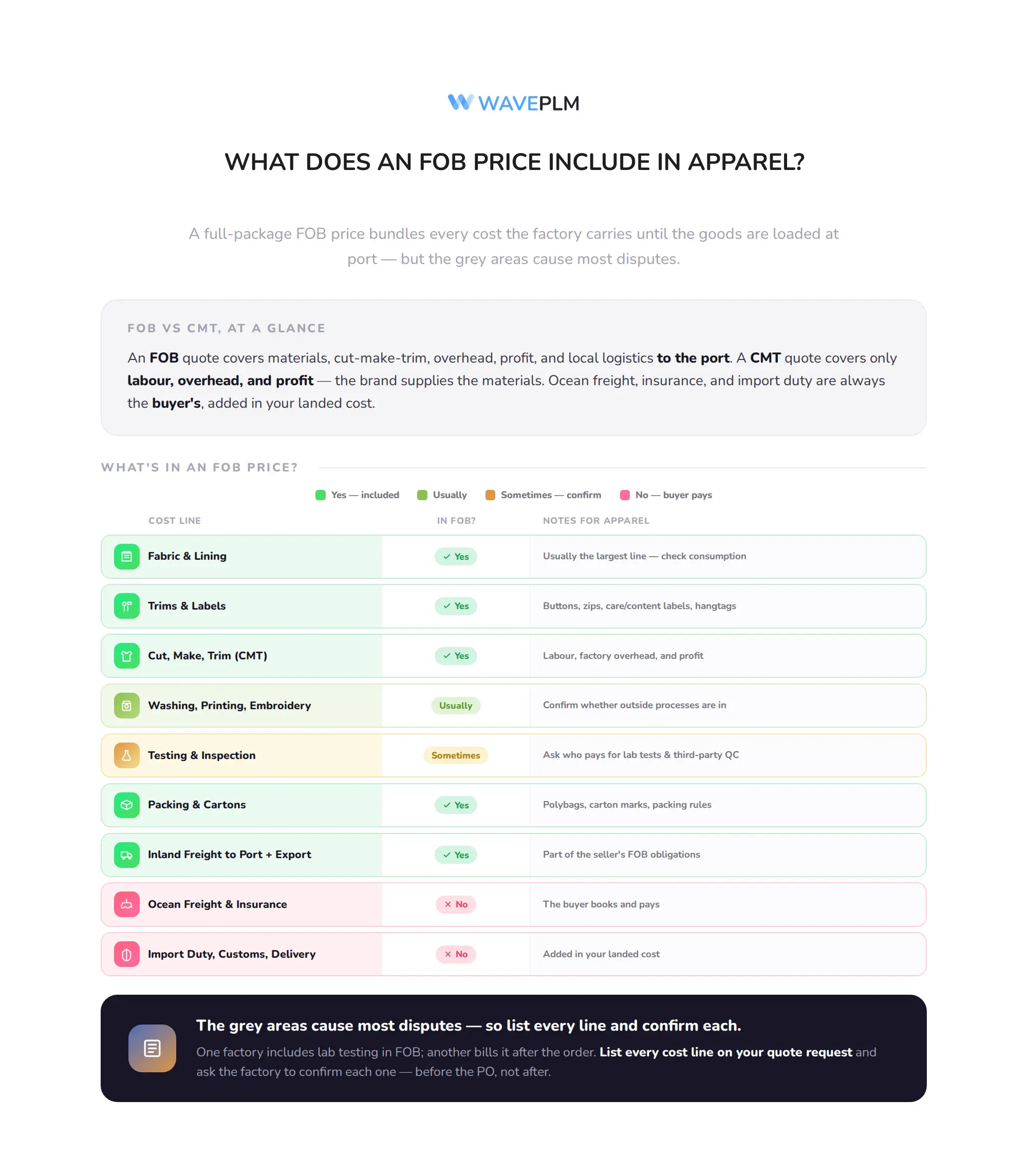
In general, a full-package FOB price bundles every cost the factory carries until the goods are loaded. According to Online Clothing Study (December 2025), an FOB quote covers materials, cut-make-trim (CMT), factory overhead, profit, and local logistics to the port. By contrast, a CMT quote covers only labour, overhead, and profit, while the brand supplies the materials.
| Cost line | In an FOB price? | Notes for apparel |
|---|---|---|
| Fabric and lining | Yes | Usually the largest line; check consumption per garment |
| Trims and labels | Yes | Buttons, zips, care and content labels, hangtags |
| Cut, make, trim (CMT) | Yes | Labour, factory overhead, and profit |
| Washing, printing, embroidery | Usually | Confirm whether outside processes are included |
| Testing and inspection | Sometimes | Ask who pays for lab tests and third-party QC |
| Packing and cartons | Yes | Polybags, carton marks, and retailer packing rules |
| Inland freight to port, export clearance | Yes | Part of the seller’s obligations under FOB |
| Ocean freight and insurance | No | The buyer books and pays |
| Import duty, customs fees, delivery | No | Added in your landed cost |
In practice, the grey areas cause most disputes. For example, one factory includes lab testing in its FOB price, while another bills it separately after the order. Therefore, list every cost line on your quote request and ask the factory to confirm each one. Our garment costing guide shows how to structure that cost sheet.
FOB Price vs. CMT: Which Should You Ask For?
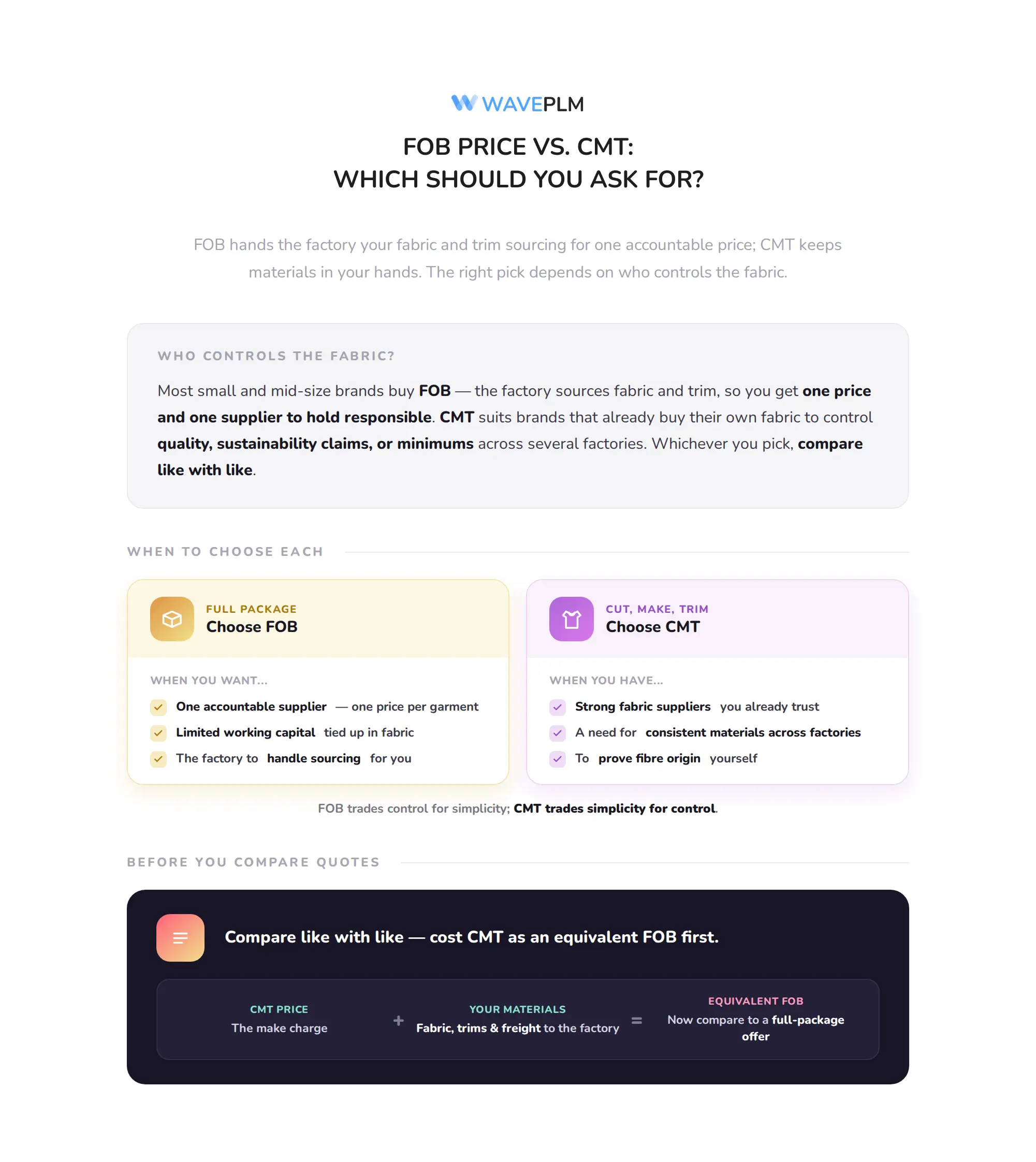
In practice, most small and mid-size brands buy on FOB terms because the factory handles fabric and trim sourcing. As a result, the brand gets one price per garment and one supplier to hold responsible. CMT, on the other hand, suits brands that already buy their own fabric, often to control quality, sustainability claims, or minimums across several factories.
- Choose FOB when you want one accountable supplier and limited working capital tied up in fabric.
- Choose CMT when you have strong fabric suppliers, need consistent materials across factories, or must prove fibre origin yourself.
Either way, compare like with like. For instance, a CMT price plus your own fabric, trims, and freight to the factory should be costed as an equivalent FOB price before you compare it with a full-package offer. For more on choosing factories, see our guide on how to find a clothing manufacturer.
Where Does Risk Pass Under FOB?
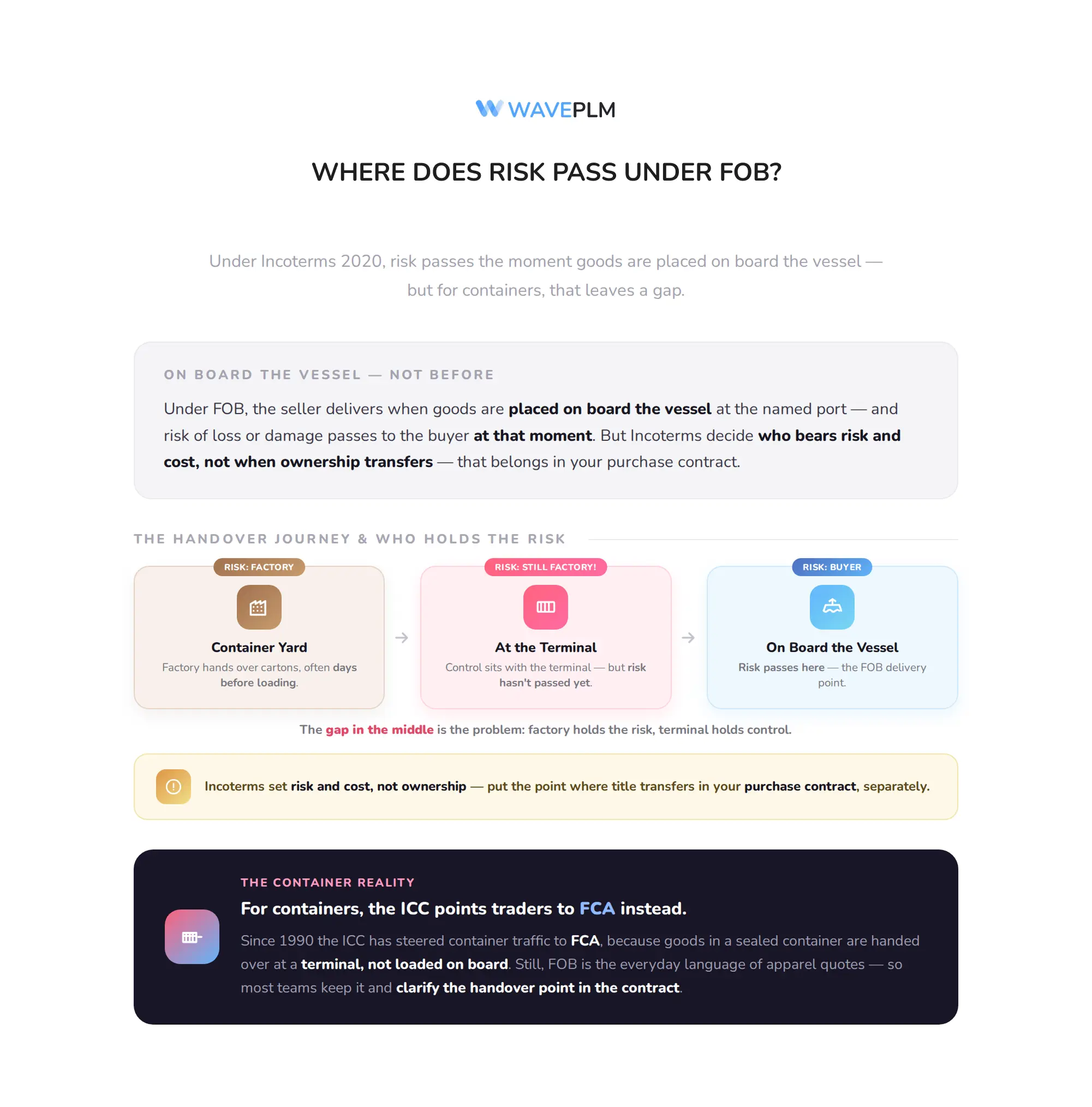
Under Incoterms 2020, the seller delivers when the goods are placed on board the vessel at the named port of shipment. Thus, from that moment, the risk of loss or damage passes to the buyer. Notably, Incoterms decide who bears risk and cost, not when ownership transfers; that belongs in your purchase contract.
Industry data: FOB is a sea and inland waterway term in Incoterms 2020. Since the 1990 edition, the ICC has pointed traders towards FCA for container traffic, because goods in a sealed container are usually handed over at a terminal, not loaded on board by the seller.
Specifically, this detail matters for apparel because almost all garments ship in containers. In reality, the factory hands the cartons or the stuffed container to the carrier at a container yard, often days before loading. Consequently, if something happens in between, FOB leaves the risk with the factory but control with the terminal. For that reason, some brands and forwarders use FCA instead. Even so, FOB remains the everyday language of apparel quotes, so most teams keep using it and clarify the handover point in the contract.
FOB vs. FCA vs. CIF vs. DDP: How Do the Main Incoterms Compare?
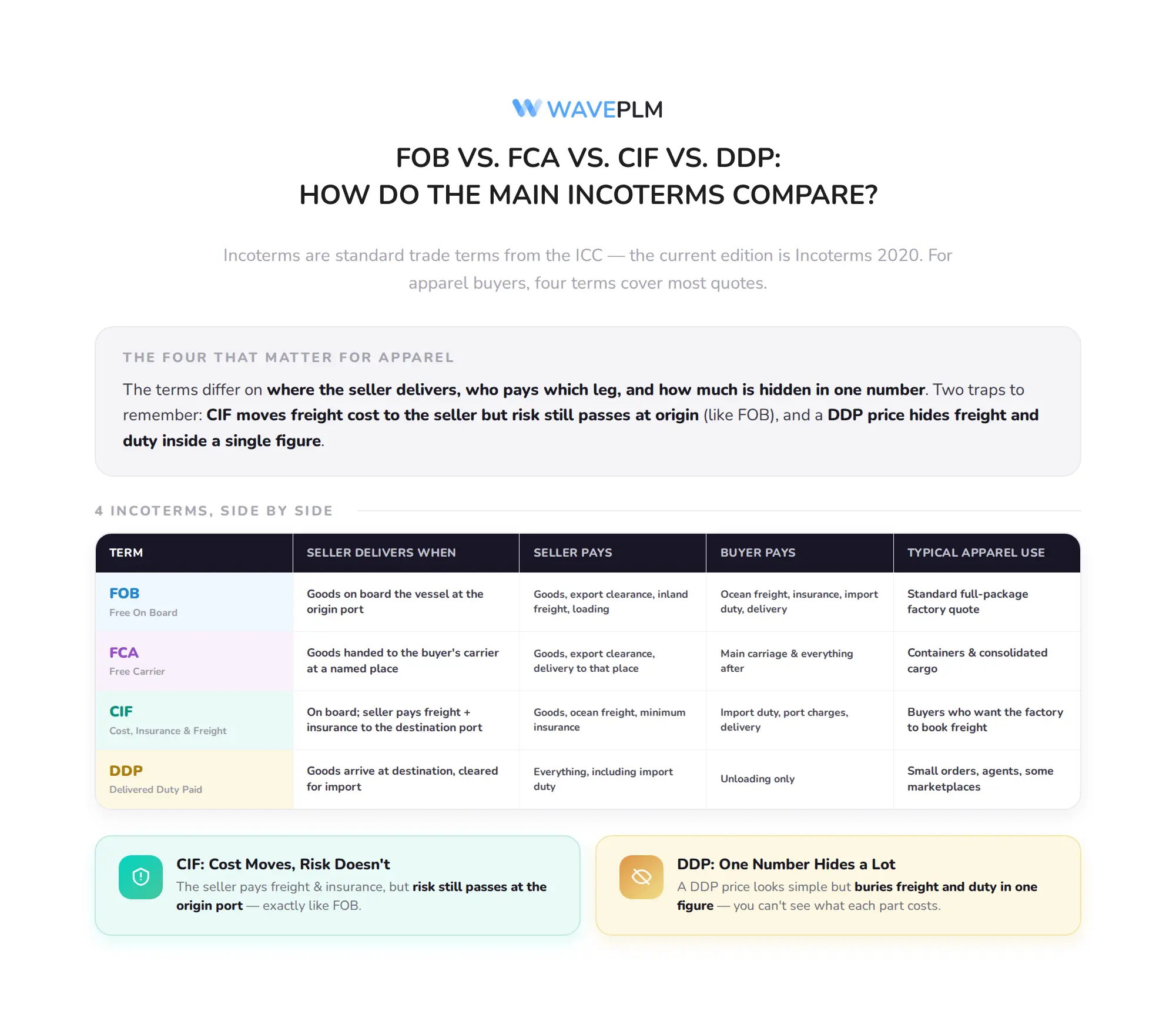
In short, Incoterms are standard trade terms published by the International Chamber of Commerce (ICC). The current edition is Incoterms 2020; there is no newer official edition yet. For apparel buyers, however, four terms cover most quotes.
| Term | Seller delivers when | Seller pays | Buyer pays | Typical apparel use |
|---|---|---|---|---|
| FOB (Free On Board) | Goods are on board the vessel at the origin port | Goods, export clearance, inland freight, loading | Ocean freight, insurance, import duty, delivery | Standard full-package factory quote |
| FCA (Free Carrier) | Goods are handed to the buyer’s carrier at a named place | Goods, export clearance, delivery to that place | Main carriage and everything after | Containers and consolidated cargo |
| CIF (Cost, Insurance and Freight) | Goods are on board the vessel; seller pays freight and minimum insurance to the destination port | Goods, ocean freight, minimum insurance | Import duty, port charges, delivery | Buyers who prefer the factory to book freight |
| DDP (Delivered Duty Paid) | Goods arrive at the named destination, cleared for import | Everything, including import duty | Unloading only | Small orders, agents, some marketplaces |
Importantly, CIF moves the cost of freight to the seller, but the risk still passes at the origin port, just as with FOB. Similarly, a DDP price looks simple, yet it hides the freight and duty inside one number, so you cannot see what you pay for each part.
Is FOB Shipping Point the Same as FOB in Incoterms?
No. In fact, the confusion is common in US companies. “FOB shipping point” and “FOB destination” come from the Uniform Commercial Code, which governs domestic sales in the US. Under those terms, “FOB shipping point” means the buyer takes on freight costs and transit risk once the goods leave the seller, while “FOB destination” keeps them with the seller until delivery.
In contrast, Incoterms FOB always names a port of shipment, for example “FOB Ho Chi Minh City, Incoterms 2020”. For import orders, therefore, always write the full Incoterm with the named port and the edition. That way, the factory, the forwarder, and your finance team read the same FOB price the same way.
How Does an FOB Price Become Landed Cost?
Indeed, the FOB price is only the first line of your landed cost. To reach the real cost of a garment in your warehouse, add ocean or air freight, insurance, import duty, customs brokerage and fees, port charges, and inland delivery. Our landed cost guide walks through the full calculation.
| Line | Per unit |
|---|---|
| FOB price, knit polo | $14.00 |
| Ocean freight and insurance | $0.80 |
| Import duty (illustrative rate on FOB value) | $4.20 |
| Brokerage, port, and customs fees | $0.25 |
| Inland delivery to warehouse | $0.25 |
| Landed cost | $19.50 |
Notably, the duty base differs by market. US customs generally values imports on the price paid for the goods, which excludes international freight and insurance, so the FOB price is close to the duty base. By contrast, the EU values imports on a CIF basis, so freight and insurance to the EU border are added before duty is calculated. As a result, the same FOB price can produce a different duty bill in each market.
Finally, once you have landed cost, you can set your selling prices. Our guide to wholesale pricing for apparel continues the same polo example from landed cost to a line sheet price.
How Do You Compare FOB Prices From Different Factories?
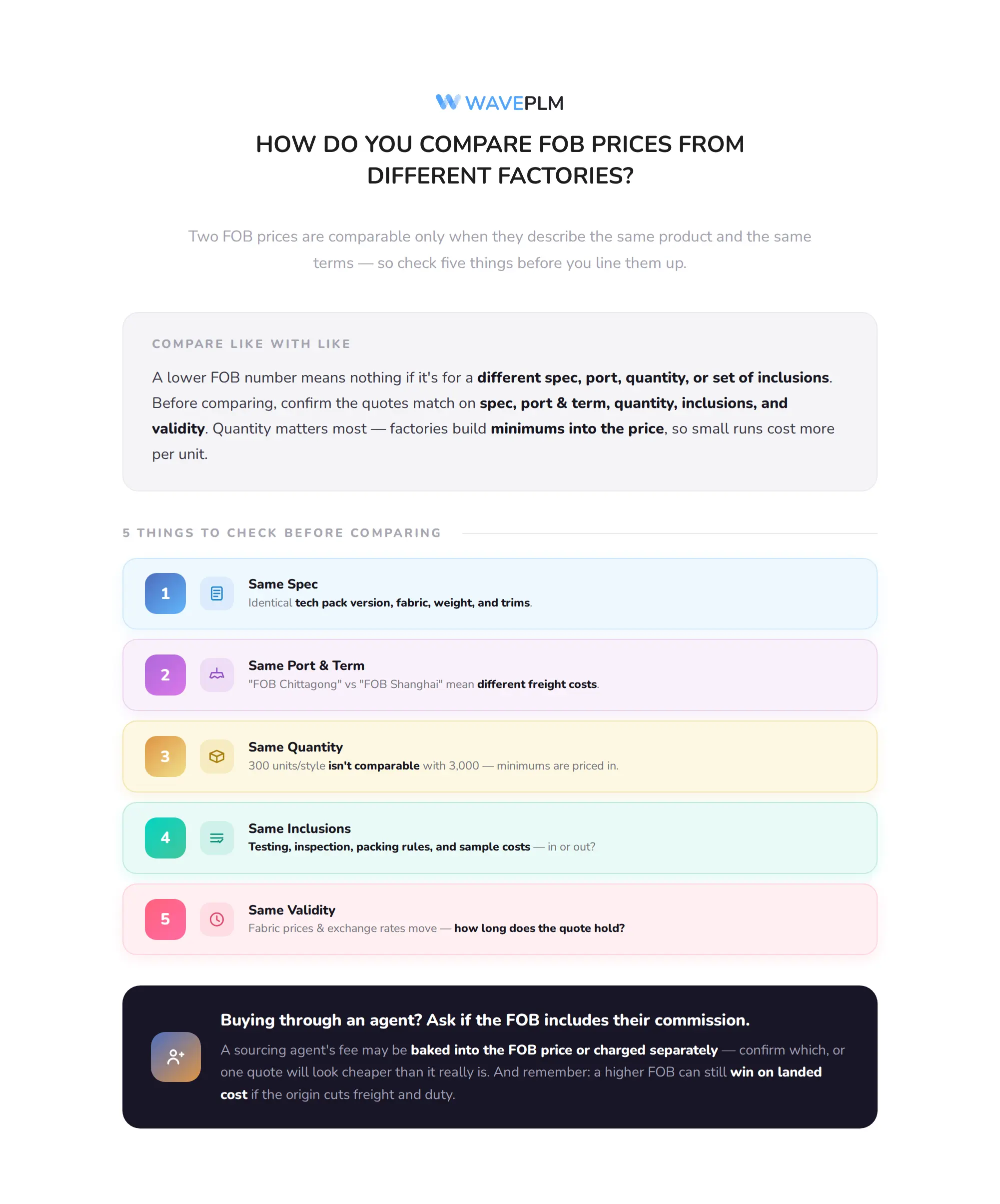
Importantly, two FOB prices are comparable only when they describe the same product and the same terms. Before you compare, check five things:
- Same spec: identical tech pack version, fabric, weight, and trims.
- Same port and term: “FOB Chittagong” and “FOB Shanghai” lead to different freight costs.
- Same quantity: a price for 300 units per style is not comparable with one for 3,000.
- Same inclusions: testing, inspection, packing rules, and sample costs.
- Same validity: fabric prices and exchange rates move, so check how long the quote holds.
In particular, quantity deserves attention, because factories build minimums into the price. Our article on cut-and-sew MOQs and lead times explains why small runs cost more per unit. Similarly, origin changes freight and duty, which is why nearshoring can win on landed cost even with a higher FOB price; see our analysis of nearshoring to Mexico.
Note: If you buy through a sourcing agent, ask whether the FOB price includes the agent’s commission or whether it is charged separately. Our guide to working with a sourcing agent covers common fee models.
Three FOB Quotes, Side by Side
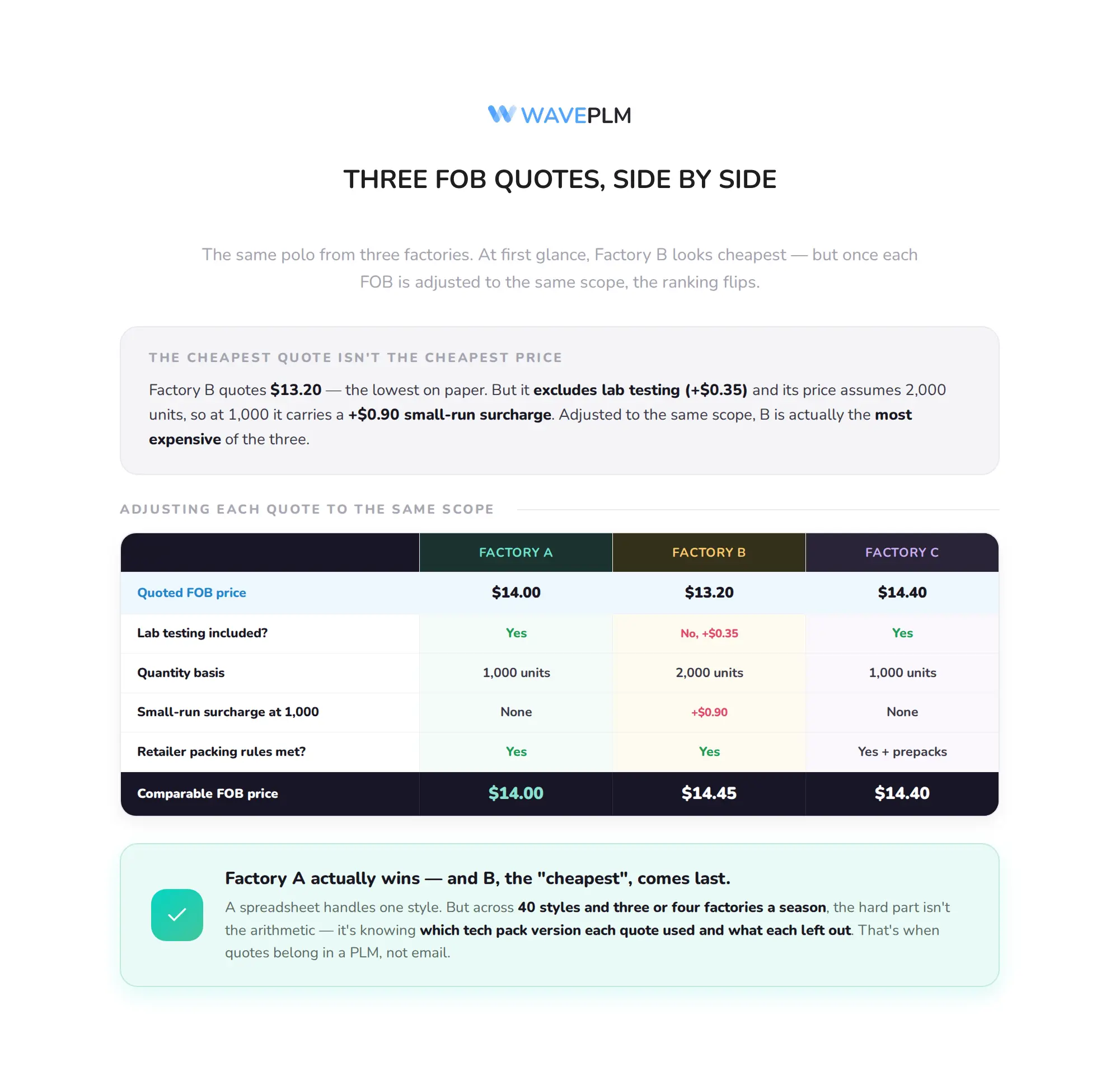
As an illustration, here is what a fair comparison looks like for the same polo from three factories. At first glance, Factory B looks cheapest. However, once each FOB price is adjusted to the same scope, the ranking changes.
| Item | Factory A | Factory B | Factory C |
|---|---|---|---|
| Quoted FOB price | $14.00 | $13.20 | $14.40 |
| Lab testing included? | Yes | No, +$0.35 | Yes |
| Quantity basis | 1,000 units | 2,000 units | 1,000 units |
| Small-run surcharge at 1,000 units | None | +$0.90 | None |
| Retailer packing rules met? | Yes | Yes | Yes, plus prepacks |
| Comparable FOB price | $14.00 | $14.45 | $14.40 |
For a first collection, a spreadsheet like this is enough. However, once you are quoting 40 styles across three or four factories every season, the hard part is no longer the arithmetic. Instead, it is knowing which tech pack version each quote was based on and what each factory left out. If your team has reached that point, it may be time to move quotes out of email and into a PLM; Wave PLM was built for brands at exactly that stage.
Frequently Asked Questions
What is FOB price in simple terms?
FOB price is the price of goods loaded on board a ship at the export port. The seller pays all costs up to that point, including export clearance. After loading, the buyer pays freight, insurance, import duty, and delivery, and carries the risk.
Is FOB price the same as cost price?
No. FOB price is the cost of the product at the origin port. Your full cost, or landed cost, also includes ocean freight, insurance, import duty, customs fees, and delivery to your warehouse.
Does FOB include shipping?
FOB includes transport from the factory to the export port and loading on the vessel. However, it does not include the main international freight, which the buyer books and pays. CIF and DDP terms move more of the shipping cost to the seller.
What is the difference between FOB and CMT in garments?
An FOB price is a full-package price that includes fabric, trims, making, overhead, profit, and delivery to the port. A CMT price covers only cutting, making, and trimming, while the brand supplies the materials. Both are often quoted by the same factories.
What is the difference between FOB shipping point and FOB destination?
These are US domestic terms. With FOB shipping point, the buyer takes on freight cost and risk once the goods leave the seller. With FOB destination, the seller keeps both until delivery. Incoterms FOB for imports is different and always names a port of shipment.
Should apparel brands use FOB or FCA?
FOB is still the most common term in apparel quotes. Technically, however, FCA fits container shipments better, because the factory hands goods to the carrier at a terminal rather than loading them on board. Whichever you use, name the place and the Incoterms edition.
Conclusion
An FOB price tells you what a garment costs at the origin port, nothing more. To use it well, confirm exactly what each factory includes, write the full Incoterm with the named port, and convert every quote into landed cost before you compare. In addition, remember that duty bases differ between the US and the EU. With that discipline, the FOB price becomes a reliable starting point for costing, sourcing decisions, and pricing.








Leave a Reply