
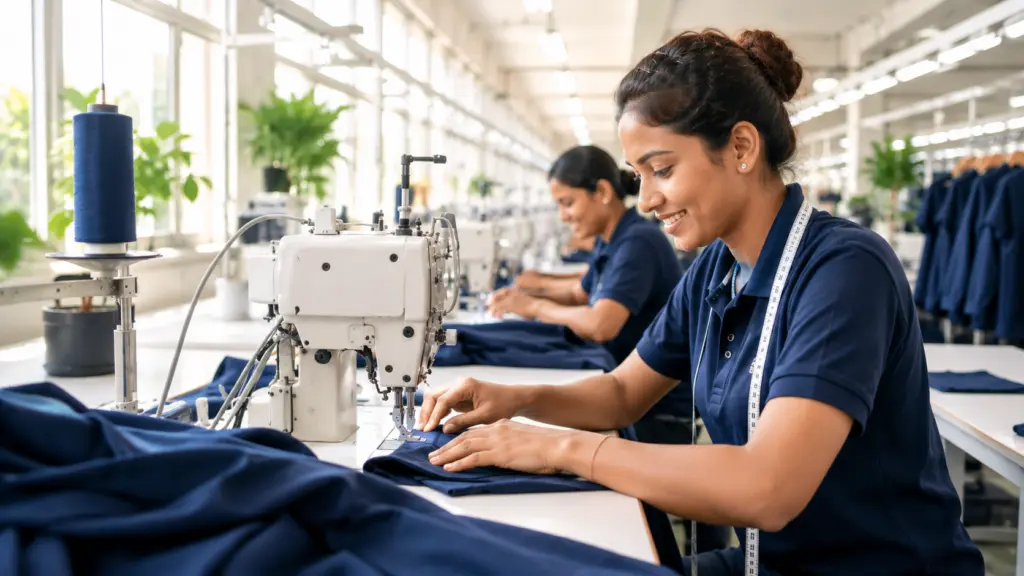
A private label clothing manufacturer produces garments to your exact specifications. The factory then ships them under your brand name — with your woven labels, hangtags, and packaging already attached. Unlike wholesale reselling, private label gives you a product no competitor carries under your identity. For apparel brands building a distinct market position, it is the fastest path to product ownership without operating your own factory.
This guide covers how private label manufacturing works and how it differs from cut and sew and white label production. It also explains what to look for in a factory partner, typical costs and lead times, and how PLM software prevents the operational problems that derail most first-time private label programs.
What Is a Private Label Clothing Manufacturer?
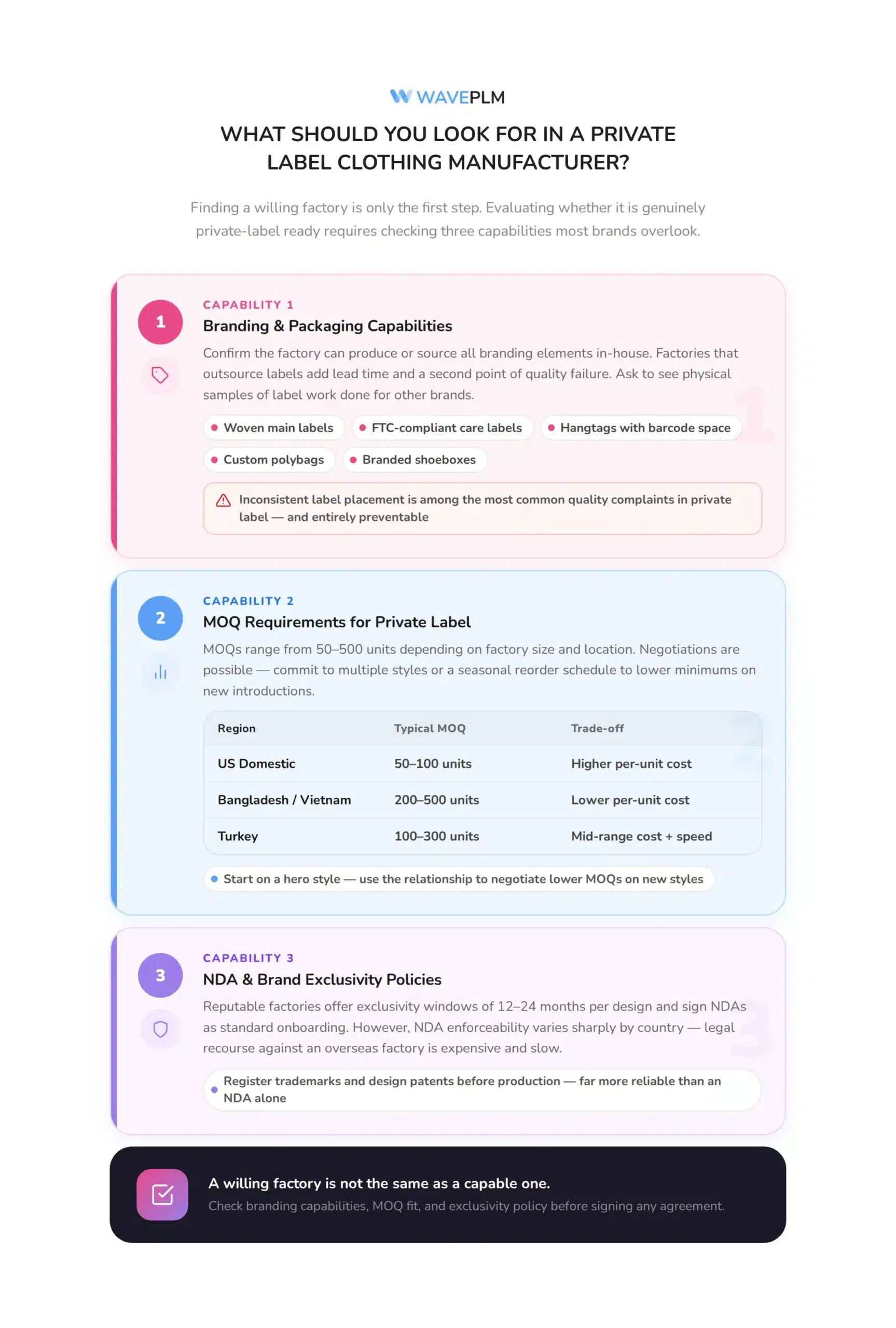
A private label clothing manufacturer is a production facility that makes garments sold under a retailer’s or brand’s own name. Specifically, the factory handles cutting, sewing, and finishing. Importantly, it also handles all branding: woven labels, care tags, hangtags, custom packaging, and branded polybags. As a result, the brand owns the product identity. The manufacturer handles physical production only.
This model is common among DTC brands, boutiques, activewear companies, and fashion startups. Specifically, it suits any brand that wants genuinely branded product without the capital required to build or lease factory space. A private label clothing manufacturer differs from a contract manufacturer in one key way: the brand supplies the design, and the factory executes it entirely under the brand’s identity. There is no factory logo anywhere on the finished garment.
Our finding: Wave PLM customers working with private label clothing manufacturers report that branding setup adds an average of two weeks to pre-production. Label artwork approvals, hangtag specs, and packaging mockups all require factory sign-off. Building this buffer into your seasonal calendar from day one prevents launch delays no amount of expediting can fix.
Private Label vs. Cut and Sew vs. White Label: What Is the Difference?
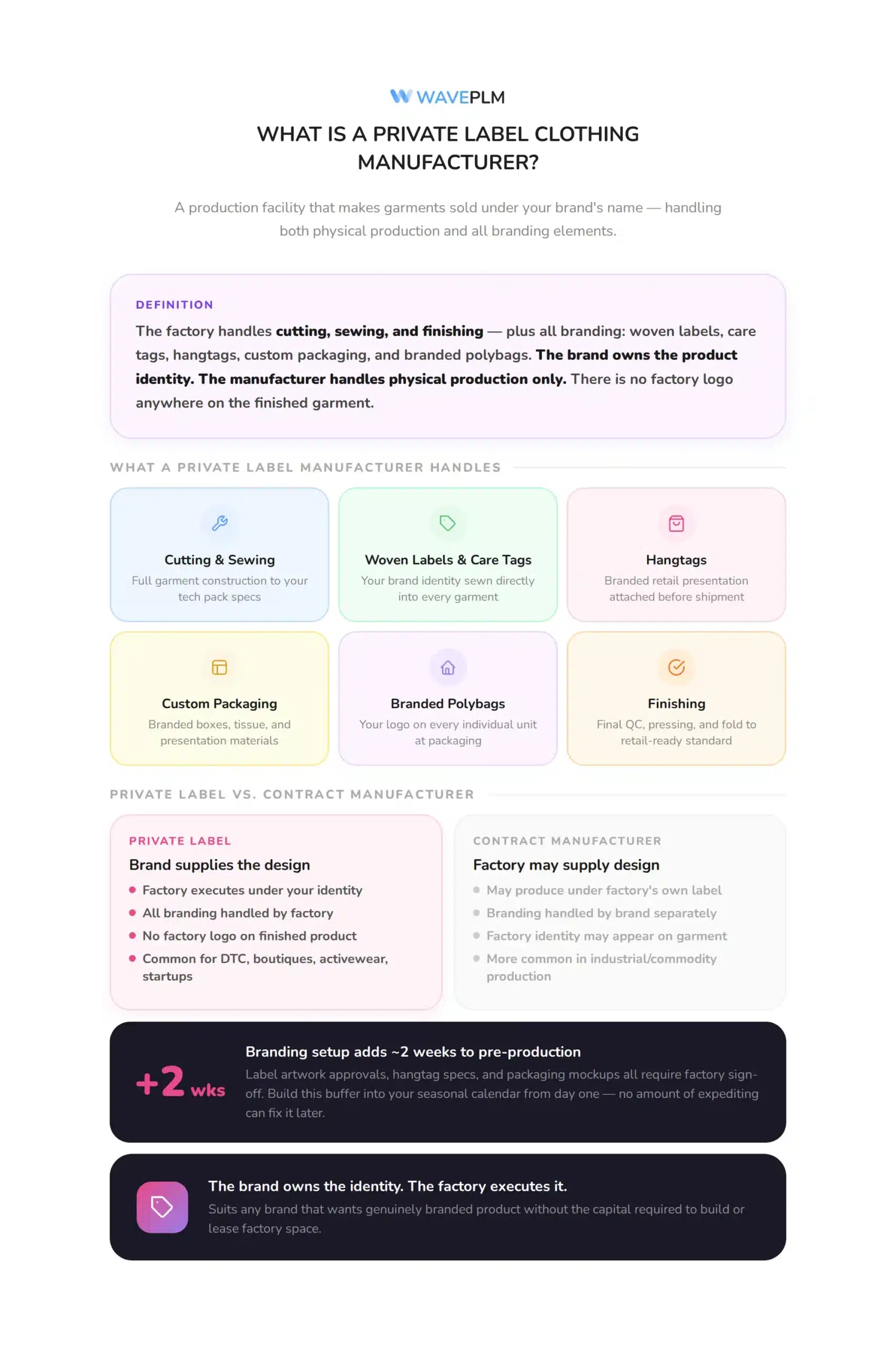
These three terms are frequently confused. However, each describes a fundamentally different factory relationship. Understanding the distinction matters before you begin sourcing. The wrong model for your stage of growth leads to either over-investing in development or under-investing in differentiation.
| Model | Who designs it? | Who brands it? | Typical MOQ | Best for |
|---|---|---|---|---|
| Private label | Brand (with factory input) | Brand | 50–300 units/style | DTC brands and boutiques launching a branded line |
| Cut and sew | Brand (fully custom from fabric up) | Brand | 100–500 units/style | Brands needing full design control over every material |
| White label | Factory (pre-made generic styles) | Brand | 12–50 units/style | New entrants testing the market quickly at low risk |
In practice, private label sits between cut and sew manufacturing and white label. You bring a design direction. The factory may suggest pattern or fabric adjustments. Together you produce a garment no other brand sells under your name. Cut and sew requires more development work and higher MOQs. However, it delivers greater differentiation. White label, by contrast, is faster to market but offers almost no product exclusivity.
What Should You Look for in a Private Label Clothing Manufacturer?
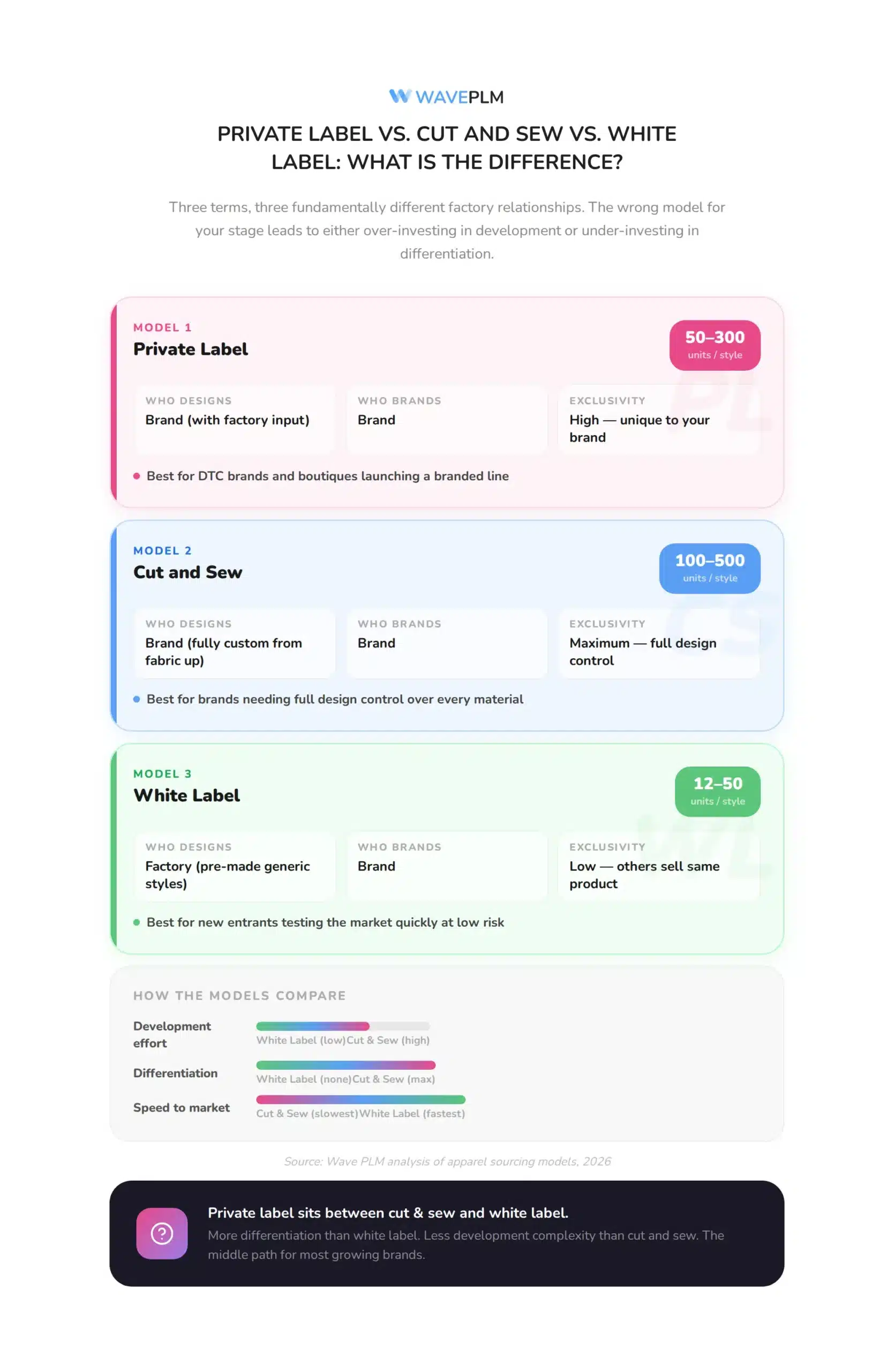
Finding a factory willing to work with a smaller brand is only the first step. Evaluating whether that factory is genuinely private-label ready requires checking capabilities most brands overlook at the sourcing stage.
Branding and Packaging Capabilities
A true private label clothing manufacturer handles more than sewing. Before signing any agreement, confirm the factory can produce or source: woven main labels, FTC-compliant care labels, hangtags with barcode space, custom polybags with your logo, and branded shoeboxes if applicable. In some cases, factories outsource these items to separate label vendors. Consequently, that arrangement adds lead time and a second point of quality failure. Additionally, ask to see physical samples of label work done for other brands. Inconsistent label placement is among the most common quality complaints in private label production — and it is entirely preventable.
MOQ Requirements for Private Label
Minimum order quantities for a private label clothing manufacturer typically run between 50 and 300 units per style per colorway. The range depends on factory size and garment complexity. Domestic manufacturers in the US generally accept lower MOQs — often 50–100 units — because they compete on speed and service rather than volume. Overseas factories in Bangladesh, Vietnam, and Turkey usually start at 200–500 units. In return, they offer significantly lower per-unit costs at scale.
MOQ negotiations are possible. This is particularly true if you commit to multiple styles at once or agree to a seasonal reorder schedule. Many brands start with a higher MOQ on a hero style. They then use that established relationship to negotiate lower minimums on new introductions. Fabric sourcing MOQs also factor into the equation, since certain materials carry their own minimums that compound with garment minimums at the factory level.
NDA and Brand Exclusivity Policies
One significant risk in private label manufacturing is that your design — or a close derivative — appears in another brand’s line. Reputable factories offer exclusivity windows of 12–24 months per design. They will also sign NDAs as a standard part of onboarding. However, enforceability varies sharply by country. Legal recourse against an overseas factory is expensive and slow. Therefore, protecting novel design elements through registered trademarks or design patents before production is far more reliable than relying on a factory NDA alone.
Industry data: According to the Fashion Law Institute, design copying from overseas manufacturers is most common in the 12 months immediately following a successful product launch. That is precisely when sales data reveals which styles are worth copying. Filing a design patent application within 90 days of first sale is the most effective deterrent for US-market brands.
How Do You Find Private Label Clothing Manufacturers?
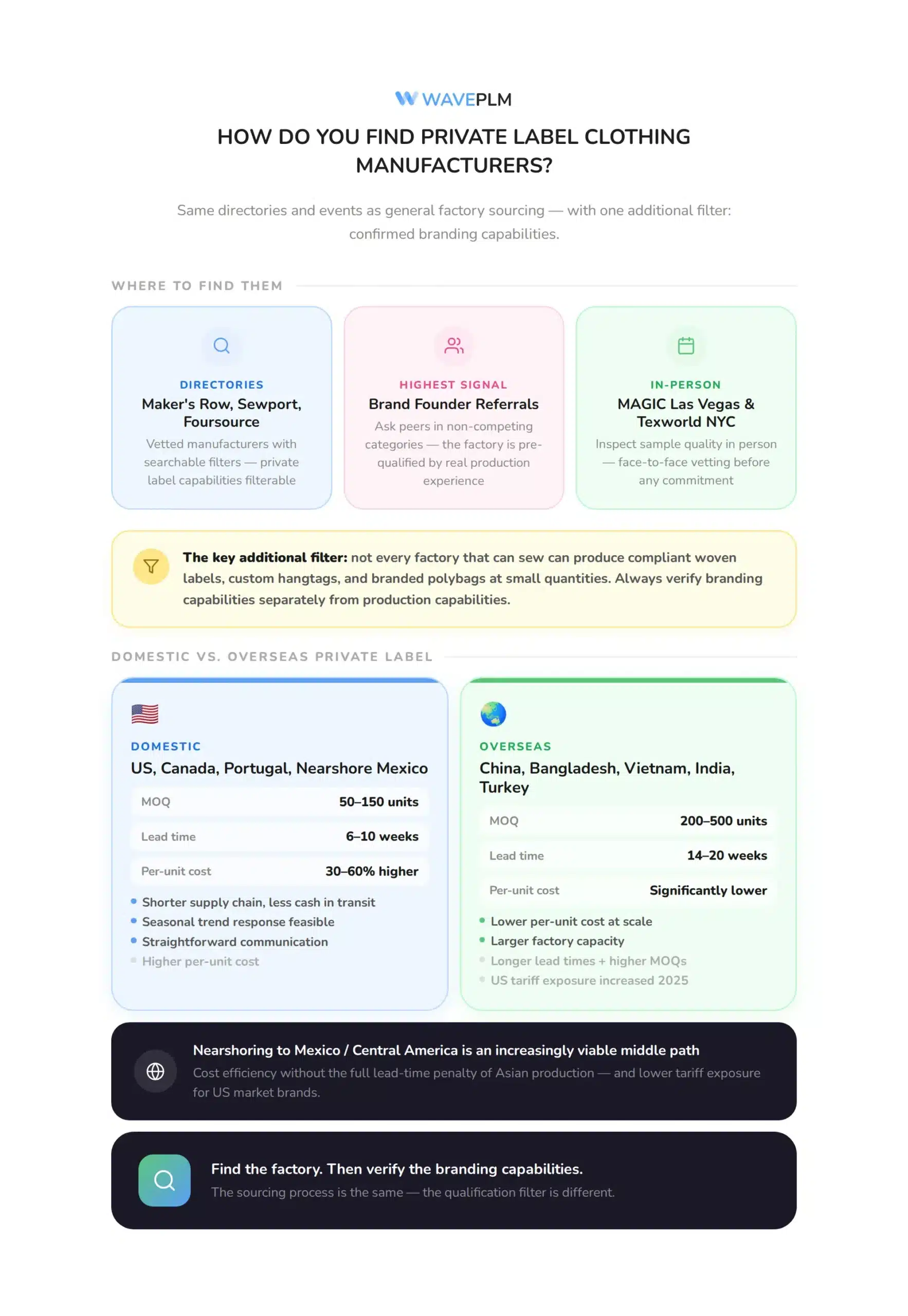
Sourcing a private label clothing manufacturer starts with the same directories and events as finding any apparel factory. Maker’s Row, Sewport, and Foursource list vetted manufacturers with searchable filters. Trade shows like MAGIC Las Vegas and Texworld NYC let you inspect sample quality in person. Referrals from other brand founders in your category are often the highest-signal source.
The key difference from general factory sourcing is the additional filter for branding capabilities. Furthermore, not every factory that can sew can produce compliant woven labels, custom hangtags, and branded polybags at small quantities. A complete factory qualification process — including RFI templates and sample evaluation criteria — is covered in our guide to finding a clothing manufacturer.
Domestic vs. Overseas Private Label Factories
The core trade-off between domestic and overseas private label manufacturing is cost versus speed versus minimums.
Domestic factories in the US, Canada, Portugal, and nearshore Mexico typically offer lead times of 6–10 weeks from approved sample. They accept MOQs of 50–150 units. Communication is also straightforward. Per-unit costs run 30–60% higher than comparable overseas production. However, the shorter supply chain reduces the cash tied up in transit and makes seasonal trend response genuinely feasible.
Overseas factories — primarily in China, Bangladesh, Vietnam, India, and Turkey — offer lower per-unit costs. The trade-off is longer lead times (14–20 weeks), higher MOQs, and more complex logistics. Furthermore, US import tariff exposure increased in 2025, which narrows the cost advantage for brands primarily selling in the American market. Nearshoring to Mexico or Central America is an increasingly viable middle path. It offers cost efficiency without the full lead-time penalty of Asian production.
How Much Does Private Label Manufacturing Cost?
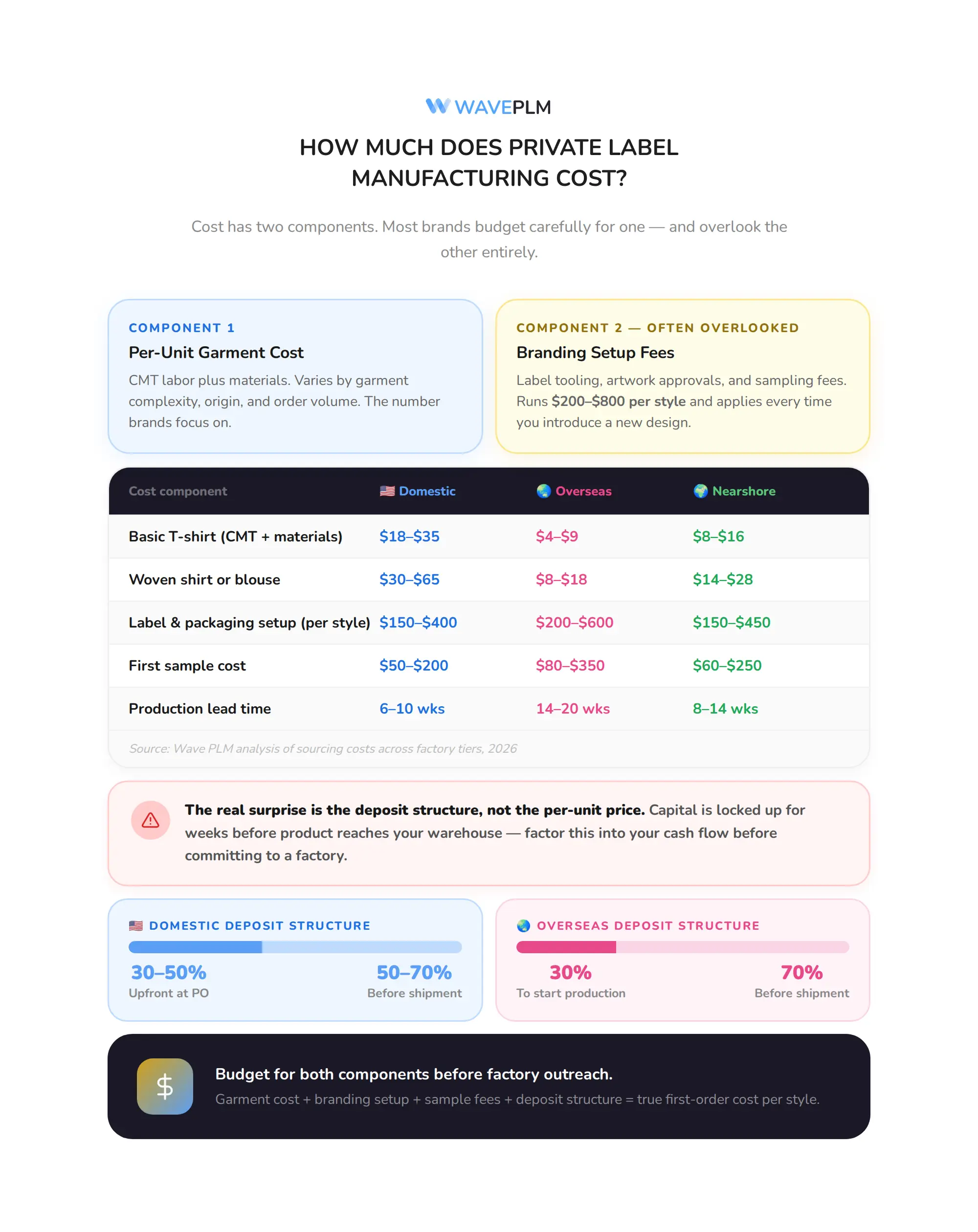
Cost in private label manufacturing has two components. The first is the per-unit garment cost — CMT plus materials. The second is branding setup: label tooling, artwork approvals, and sampling fees. In practice, many brands budget carefully for the garment cost and overlook setup fees entirely. Those fees can run $200–$800 per style depending on label complexity. Additionally, they apply every time you introduce a new design.
| Cost component | Domestic (US) | Overseas (Asia) | Nearshore (Mexico/CA) |
|---|---|---|---|
| Basic T-shirt (CMT + materials) | $18–$35 | $4–$9 | $8–$16 |
| Woven shirt or blouse | $30–$65 | $8–$18 | $14–$28 |
| Label and packaging setup (per style) | $150–$400 | $200–$600 | $150–$450 |
| First sample cost | $50–$200 | $80–$350 | $60–$250 |
| Typical production lead time | 6–10 weeks | 14–20 weeks | 8–14 weeks |
A complete picture of landed cost — including duties, freight, and pre-shipment inspection — requires a full garment costing exercise before committing to any factory. For most brands, however, the real surprise is not the per-unit price. It is the deposit structure. Domestic factories typically require 30–50% upfront. Overseas factories commonly require 30% to start production and 70% before shipment. That means capital is locked up for weeks before product reaches your warehouse.
How Does PLM Software Support Private Label Production?
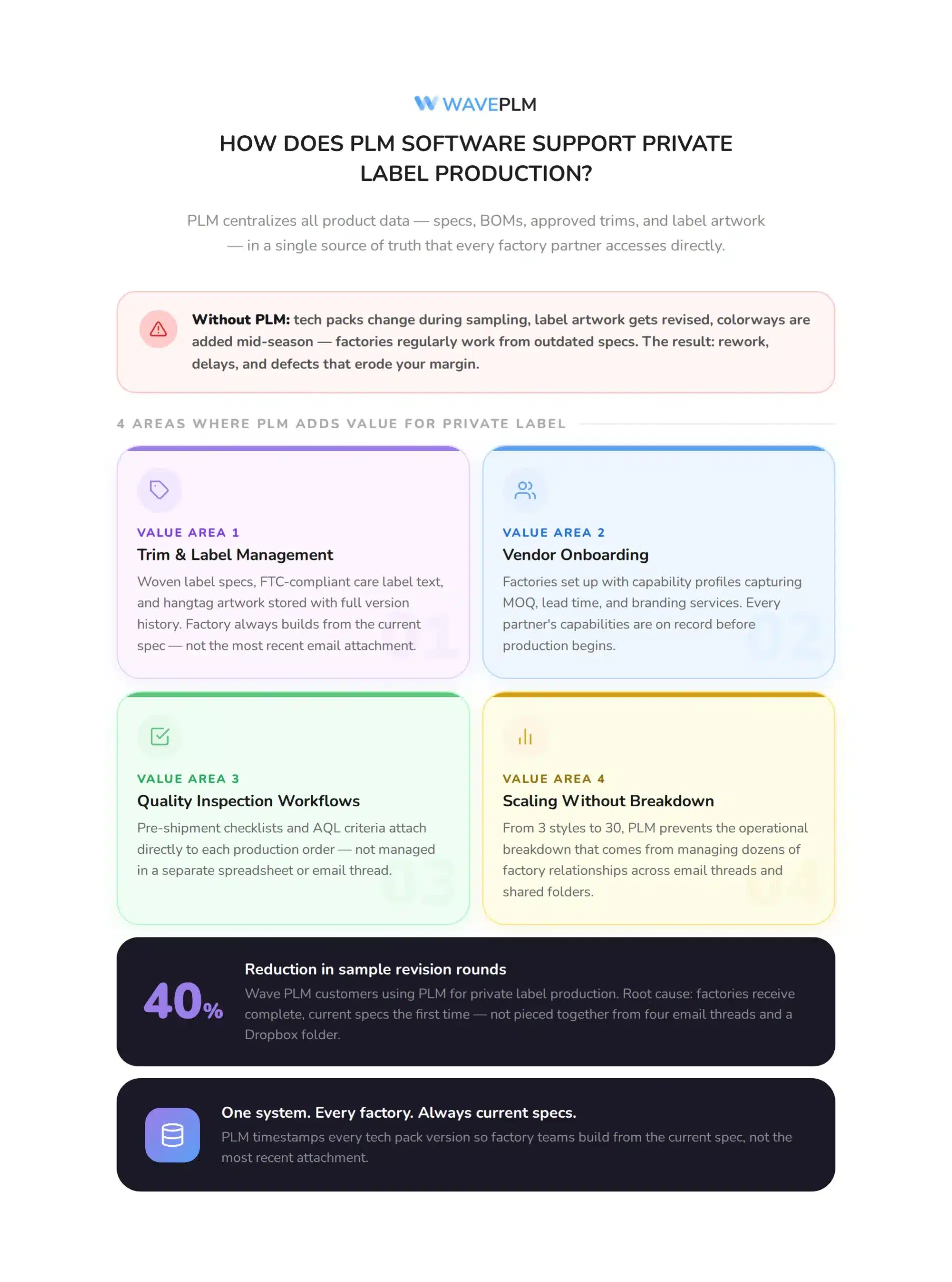
Managing a private label program across multiple factory partners creates a version control challenge. Tech packs change during sampling. Label artwork gets revised. Colorways are added or dropped mid-season. Without a central system, factories regularly work from outdated specs. The result is rework, delays, and defects that erode your margin.
Product lifecycle management (PLM) software addresses this directly. It centralizes all product data — specs, bills of materials, approved trims, and label artwork — in a single source of truth. Factory partners access this through a supplier portal. Specifically, Wave PLM timestamps every tech pack version and tracks approval status. Factory teams therefore always build from the current spec rather than the most recent email attachment.
For private label production specifically, PLM adds value in four areas. First, trim and label management: woven label specs, FTC-compliant care label text, and hangtag artwork live in the system with full version history. Second, vendor onboarding: factories are set up with capability profiles capturing their MOQ, lead time, and branding services. Third, quality inspection workflows: pre-shipment checklists and AQL criteria attach directly to each production order. Fourth, scaling: as your program grows from 3 styles to 30, PLM prevents the operational breakdown that comes from managing dozens of factory relationships in email threads.
Our finding: Brands using Wave PLM for private label production report a 40% reduction in sample revision rounds. The primary reason is simple: factories receive complete, current specs the first time. Previously, teams were piecing together instructions from four separate email threads and a shared Dropbox folder.
What Are the Most Common Mistakes Brands Make with Private Label Manufacturing?
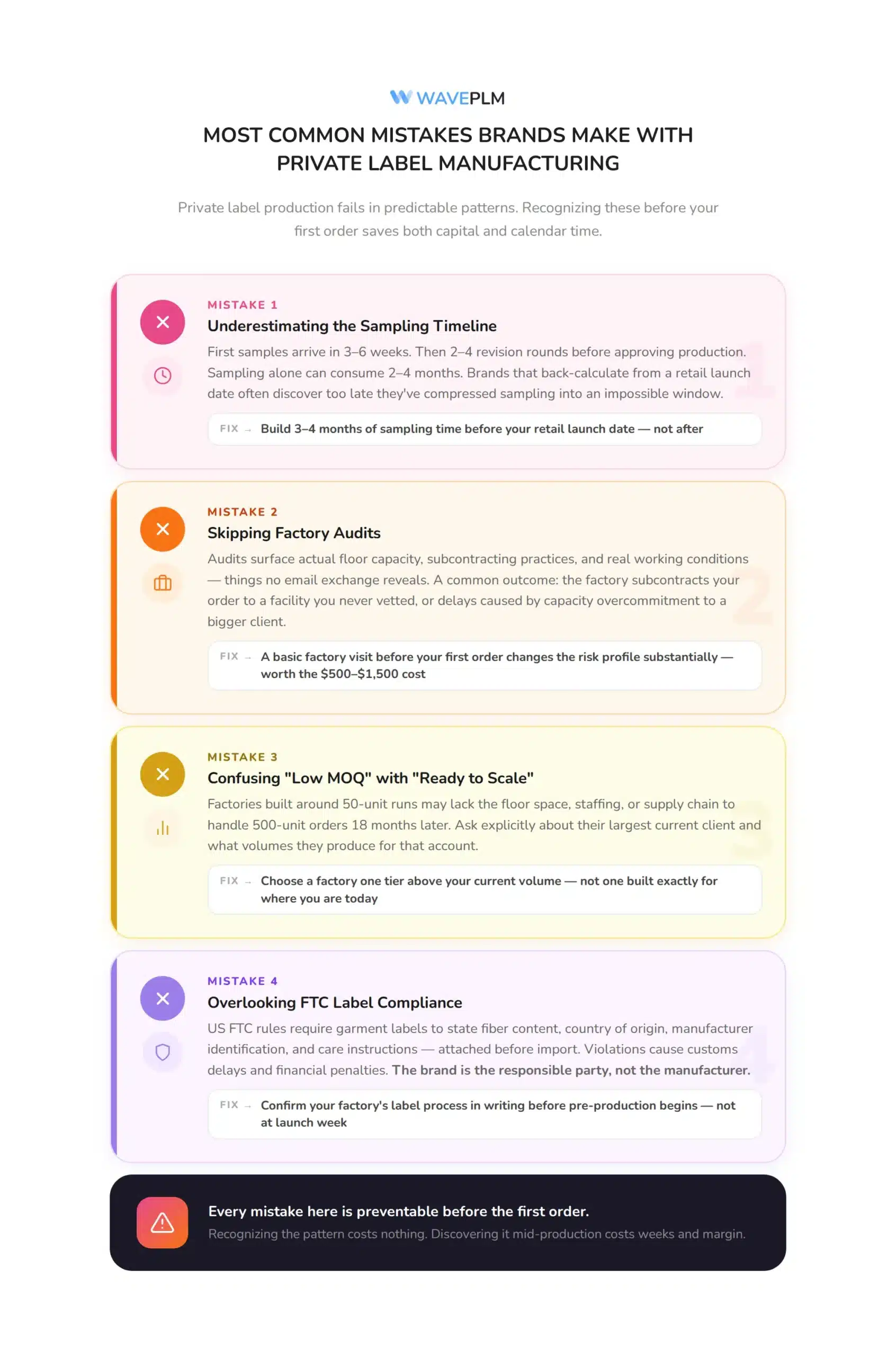
Private label production fails in predictable patterns. Recognizing these before your first order saves both capital and calendar time.
Underestimating the Sampling Timeline
First samples from a new private label clothing manufacturer typically arrive in 3–6 weeks. Most brands then need 2–4 revision rounds before approving production. That means sampling alone can consume 2–4 months. Brands that back-calculate from a retail launch date often discover too late that they have compressed sampling into an impossible window. The choice becomes launching with a product that isn’t right or missing the seasonal window entirely.
Skipping Factory Audits
Factory audits — whether an in-person visit or a third-party social compliance audit — surface issues that no email exchange reveals. These include actual floor capacity, subcontracting practices, and real working conditions. Skipping an audit to save $500–$1,500 routinely leads to larger problems. A common outcome is a factory that subcontracts your order to a facility you never vetted. Another is a production delay caused by capacity overcommitment to a bigger client. Consequently, even a basic factory visit before your first order changes the risk profile substantially.
Confusing “Low MOQ” with “Ready to Scale”
Manufacturers advertising low minimums attract smaller brands. However, these factories are often structured around small orders and struggle when volumes increase significantly. A factory built around 50-unit runs may lack the floor space, staffing, or supply chain to handle 500-unit orders 18 months later. As a result, brands that grow quickly often find themselves resourcing from scratch. Hard-won quality consistency and branding standards are lost in the process. When evaluating any private label clothing manufacturer, ask explicitly about their largest current client and what volumes they produce for that account.
Overlooking FTC Label Compliance
US Federal Trade Commission rules require garment labels to state fiber content, country of origin, manufacturer identification, and care instructions. These labels must be attached before import. Violations cause customs delays and potential financial penalties. Notably, the brand is the responsible party for compliance — not the manufacturer. Confirming your factory’s label process in writing before pre-production prevents this avoidable problem from becoming a launch-week crisis.
Frequently Asked Questions
What is a private label clothing manufacturer?
A private label clothing manufacturer is a factory that produces garments to a brand’s specifications and ships them under the brand’s own labels, hangtags, and packaging. The manufacturer handles production while the brand owns the product identity. This model is widely used by DTC brands, boutiques, and fashion startups that want genuinely branded product without owning or operating their own production facility.
What is the difference between private label and white label clothing?
White label clothing uses pre-made, generic styles produced by the factory — the brand simply applies its label to an existing product. Private label clothing is built to the brand’s own specifications, giving more control over silhouette, fabric, and construction. Private label typically requires higher MOQs (50–300 units) than white label (12–50 units). In return, it delivers a more differentiated product that competitors cannot easily copy by placing the same factory order.
What is a typical MOQ for a private label clothing manufacturer?
MOQs for a private label clothing manufacturer typically range from 50 to 300 units per style per colorway. Domestic US manufacturers generally accept 50–150 units because they compete on speed and service. Overseas factories in Asia commonly require 200–500 units at minimum. MOQs are often negotiable if you commit to multiple styles at once or agree to a regular reorder schedule with the factory over a full season.
How long does private label clothing manufacturing take?
From first contact with a new private label clothing manufacturer to product arriving in your warehouse, expect 4–6 months. The typical breakdown is: 2–4 weeks for factory vetting and NDA, 6–12 weeks for sampling and revision rounds, 8–14 weeks for production overseas (or 4–8 weeks domestic), and 2–4 weeks for shipping and customs. Brands that compress the sampling phase to save time nearly always miss their launch target as a result.
How does PLM software help manage a private label clothing manufacturer relationship?
PLM software centralizes tech packs, BOMs, label specs, and approved artwork in one place that both internal teams and factory partners can access in real time. This eliminates the version control errors that cause most private label production defects. Wave PLM specifically timestamps every spec revision, manages vendor onboarding profiles with MOQ and capability data, and automates pre-shipment quality checklists — so brands maintain consistency across multiple factory relationships without relying on email threads.
Do private label clothing manufacturers offer exclusivity on designs?
Most reputable private label clothing manufacturers offer exclusivity windows of 12–24 months per design and will sign NDAs covering your styles and brand specifications. However, NDA enforcement in overseas jurisdictions is difficult and costly. Design registration — through a US design patent or trademark — provides far more reliable protection than a factory NDA alone. Always request exclusivity terms in writing before beginning sampling, not after your first order ships.
Building a private label program creates product exclusivity that wholesale sourcing cannot deliver. However, the difference between a profitable launch and a costly sourcing failure comes down to factory vetting, realistic timeline planning, and rigorous specification management from day one.
Wave PLM gives apparel brands a single platform to manage tech packs, communicate with private label clothing manufacturers, and track every production order from first sample to final shipment. See how Wave PLM supports private label production →





Leave a Reply