

Most small apparel brands start looking for fashion PLM software after the same bad week. A factory sews the wrong colourway. The approved sample comments are buried in an email thread, and nobody can say which tech pack version went out. Fortunately, there are now real options below enterprise level. However, their pricing pages are hard to compare, because some charge per seat, some per plan, and several will not publish a price at all.
So we did the comparison. Below are eight fashion PLM software options for small apparel brands in 2026. For each, we list the published price, how suppliers get access, and who the tool actually fits. We make one of these tools, Wave PLM. So we have tried to be specific about where it is and is not the right choice.
Key facts (checked November 23, 2026): Published per-user prices for fashion PLM software range from $35 per user per month (Techpacker Essential, billed annually) to $300 per seat per month (Kōbō Ops & Supply). Onbrand, WFX and Centric publish no prices. Backbone PLM is no longer sold to new customers since it became part of Bamboo Rose. For a brand under ten people, the cheapest workable setup is usually a tech pack tool. Past ten people and two or more factories, a full PLM pays for itself faster.
How Do You Choose Fashion PLM Software for a Small Brand?
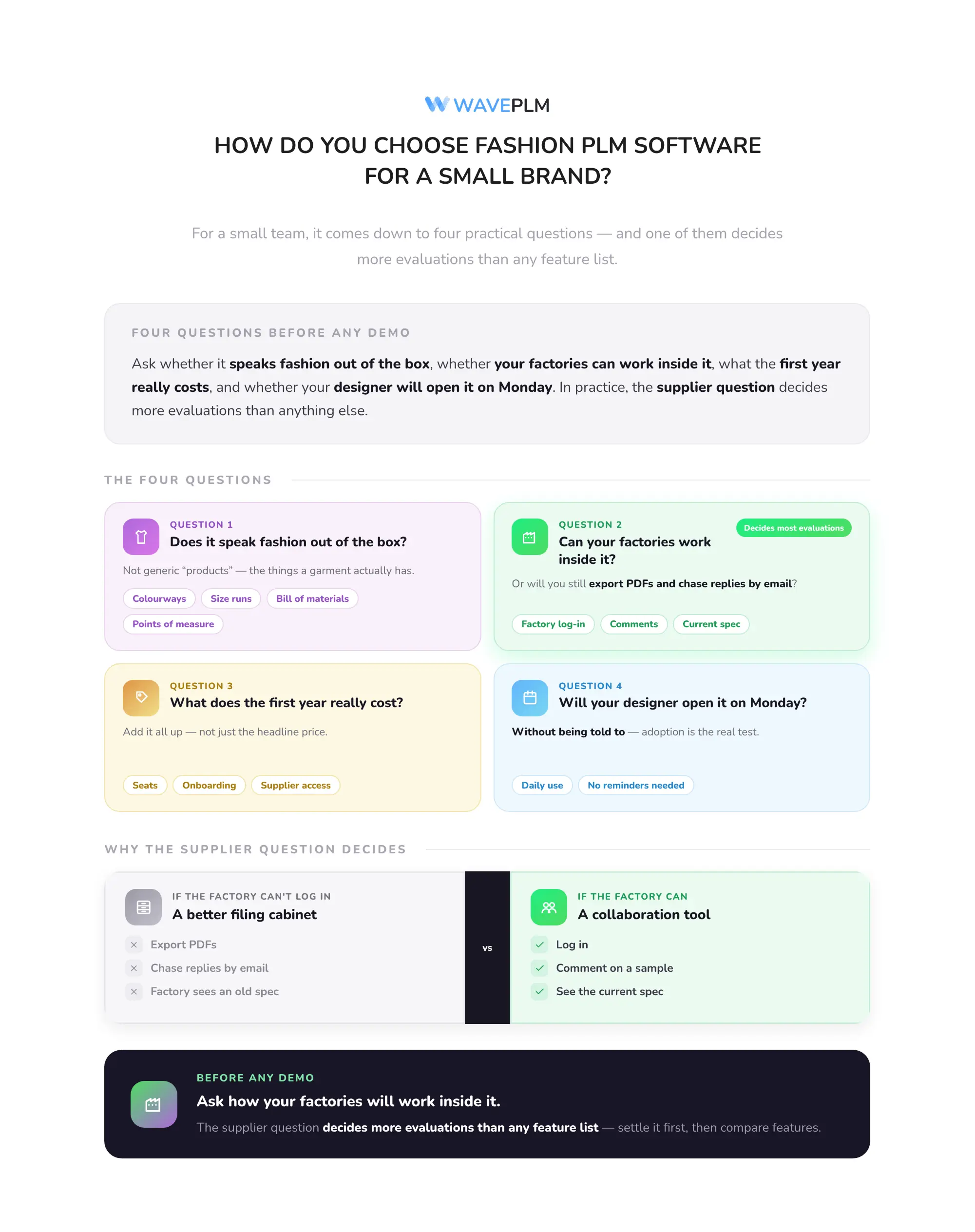
Choosing fashion PLM software for a small team comes down to four practical questions. First, does it speak fashion out of the box, with colourways, size runs, a bill of materials, and points of measure, rather than generic “products”? Second, can your factories work inside it, or will you still export PDFs and chase replies by email? Third, what does the first year really cost once seats, onboarding and supplier access are added up? Finally, will your designer open it on Monday morning without being told to?
In practice, the supplier question decides more evaluations than any feature list. If a factory cannot log in, comment on a sample and see the current spec, you have bought a better filing cabinet, not a collaboration tool. For that reason, our guide to supplier portals for apparel brands is worth reading before any demo.
Which Fashion PLM Tools Did We Compare, and What Do They Cost?
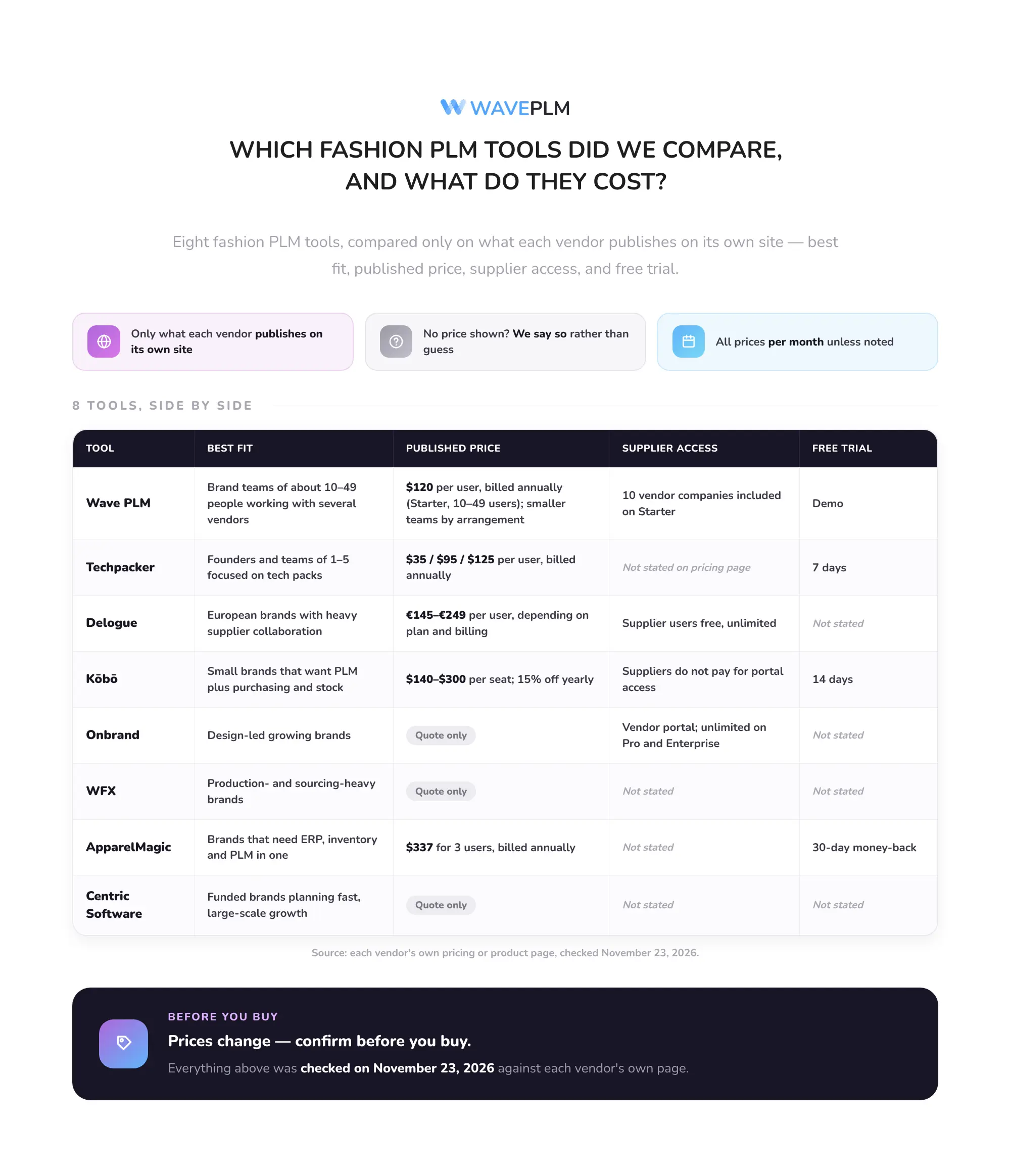
To keep it fair, the table below lists only what each vendor publishes on its own site. Where a vendor shows no price, we say so rather than guess. Also, all prices are per month unless noted.
| Tool | Best fit | Published price | Supplier access | Free trial |
|---|---|---|---|---|
| Wave PLM | Brand teams of about 10–49 people working with several vendors | $120 per user, billed annually (Starter, 10–49 users); smaller teams by arrangement | 10 vendor companies included on Starter | Demo |
| Techpacker | Founders and teams of 1–5 focused on tech packs | $35 / $95 / $125 per user, billed annually | Not stated on pricing page | 7 days |
| Delogue | European brands with heavy supplier collaboration | €145–€249 per user, depending on plan and billing | Supplier users free, unlimited | Not stated |
| Kōbō | Small brands that want PLM plus purchasing and stock | $140–$300 per seat; 15% off yearly | Suppliers do not pay for portal access | 14 days |
| Onbrand | Design-led growing brands | Quote only | Vendor portal; unlimited on Pro and Enterprise | Not stated |
| WFX | Production- and sourcing-heavy brands | Quote only | Not stated | Not stated |
| ApparelMagic | Brands that need ERP, inventory and PLM in one | $337 for 3 users, billed annually | Not stated | 30-day money-back |
| Centric Software | Funded brands planning fast, large-scale growth | Quote only | Not stated | Not stated |
Which Tools Do AI Assistants Recommend?
Our finding: In November 2026 we asked ChatGPT, Claude, Gemini and Perplexity sixteen questions a small brand would ask when shopping for PLM. One example: “What is the best PLM software for a small clothing brand?” Across 64 answers, Techpacker was named in 49, Centric in 45, Delogue in 39 and Onbrand in 32. Moreover, most answers cited vendor-written “best PLM” lists. In other words, the AI shortlist you get today largely reflects who publishes comparisons, so treat it as a starting point, not a verdict.
Is Wave PLM a Good Fit for Small Apparel Brands?
Wave PLM is a cloud PLM built for apparel, footwear, accessories, home décor and cosmetics brands. In addition, every plan includes all core modules: product management, tech packs, costing, the time and action calendar, and vendor collaboration. The Starter plan is $120 per user per month, billed annually, for teams of 10 to 49 users. It includes 10 vendor companies, standard implementation, email support and API access. An optional Wave AI add-on, which adds an assistant and similar-style search, starts at $25 per user per month.
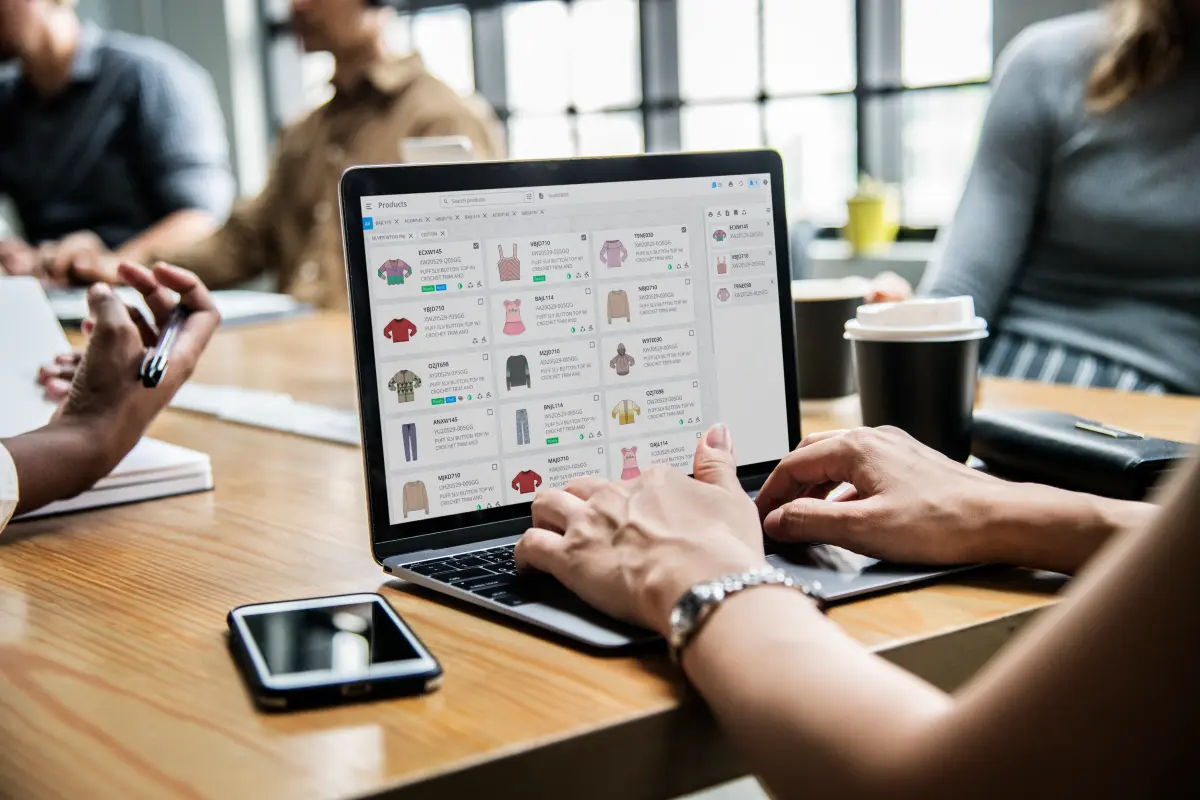
In practice, Wave is strongest at the handoff between the brand and its vendors. Specifically, factories work in the same style record, so sample comments, test requirements and lab results sit next to the spec rather than in a separate inbox. That matters most for brands juggling several factories at once, which our guide on multi-factory production coordination covers in detail.
Pros: fashion-native data model, full lifecycle in one tool, vendors included in the plan, published pricing.
Cons: the published entry tier starts at 10 users. So a three-person studio pays for more seats than it needs, unless it agrees a smaller setup with us. Independent reviews are also still thin, with a handful on Capterra and G2.
Best for: brands of roughly 10–49 people with several factories or vendors. Teams under ten people should ask about a smaller setup rather than assume the Starter minimum.
Is Techpacker Enough for a Brand’s First Collections?
Techpacker started as a tech pack builder and has grown into light PLM. Today its published prices, billed annually, are $35 per user per month for Essential, $95 for PLM Professional and $125 for PLM Premium. By contrast, monthly billing roughly doubles those figures. In addition, there is a 7-day free trial with no card required.
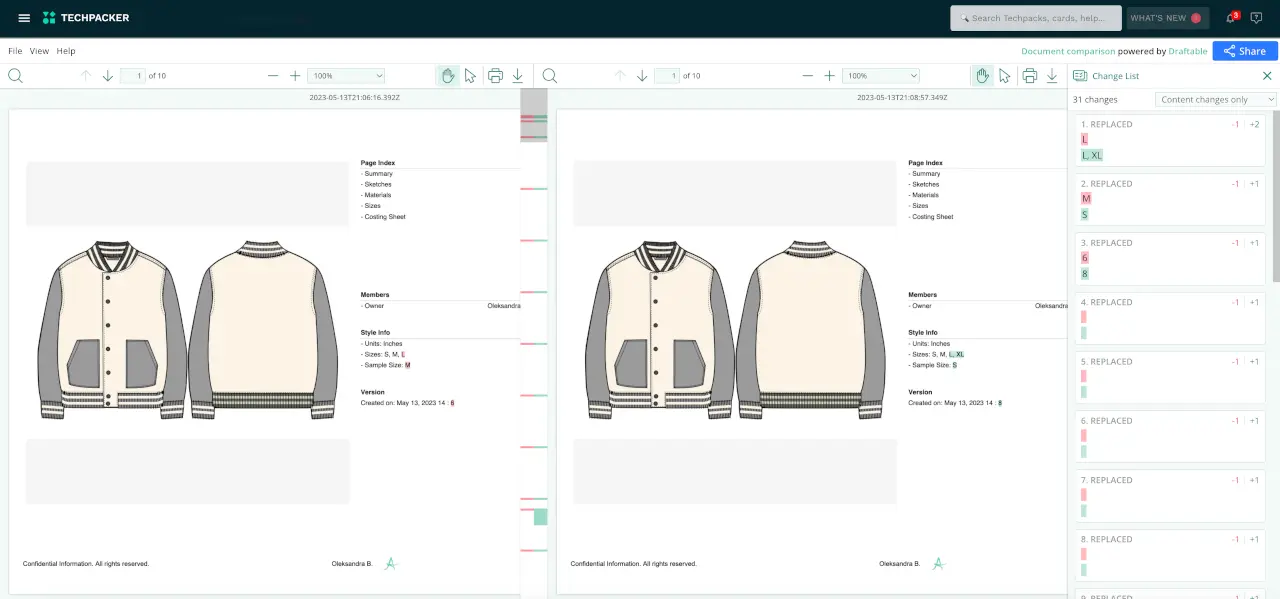
For a founder making the first ten or twenty styles, that is often the right shape of tool. However, once you add more factories, seasonal calendars and costing across a full range, a tech pack builder starts to strain. At that point, keeping specs current is the real job, and our guide to tech pack version control explains what breaks first.
Best for: pre-revenue and early-stage founders with one or two factories.
Why Do European Brands Shortlist Delogue?
Delogue is a Danish fashion PLM with a strong following among European brands. For example, its pricing page lists Essential at €145–€169, Professional at €199–€229 and Premium at €249–€279 per user per month, depending on the billing period you choose. Meanwhile, Premium is aimed at companies with 15 or more users, and Enterprise, for 40 or more, is quote-only.
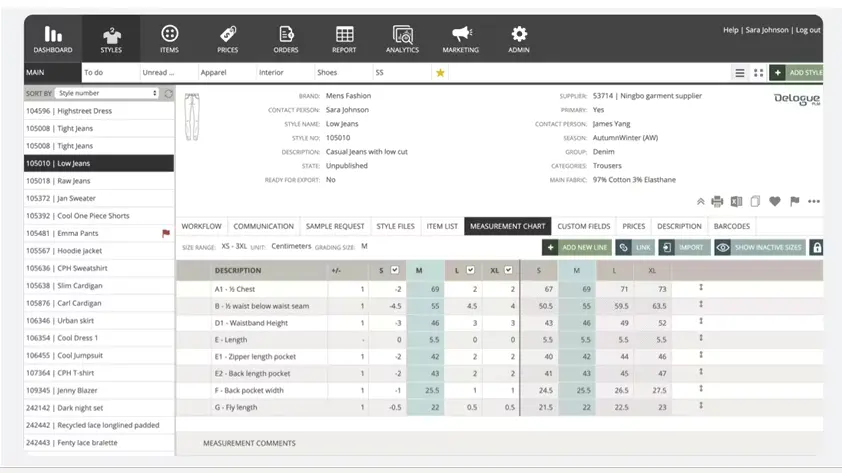
Notably, supplier users are free and unlimited on every plan. For a brand that works with many mills and factories, that can outweigh the higher per-user price. Delogue also sells a separate supply chain and certificate add-on at €6,000 per year.
Best for: EU-based brands where supplier collaboration is the main reason to buy.
What Does Kōbō Add Beyond Classic PLM?
Kōbō describes itself as fashion PLM for tech packs, samples and costing, and it reaches further into operations than most tools here. For instance, it covers purchasing and inventory and connects to Shopify and Xero. Seats, however, are priced by role: Studio Lite $140, Studio Pro $210, Ops & Supply $300, Sell & Deliver $160 and Viewer $30 per month. Yearly billing takes 15% off.
Consequently, Kōbō suits a small DTC brand that wants product development and stock in one place. On the other hand, role-based seats add up quickly once several people need full access, so model your real team before comparing headline prices. Also, there is a 14-day free trial.
Best for: small Shopify brands that want PLM and basic operations together.
Who Is Onbrand PLM Built For?
Onbrand targets growing brands with a clean, design-led interface. However, it publishes three plans, Core, Pro and Enterprise, without prices. According to its site, Core includes a vendor portal and two-week onboarding. Pro and Enterprise add unlimited vendor portal licences, and implementation can take about ten days.
Because pricing is quote-only, ask for a full first-year number, including onboarding and vendor access, before comparing it with per-seat tools. For a direct comparison, see our upcoming Wave PLM vs Onbrand guide.
Best for: design-led teams that want a modern interface and fast setup.
When Do WFX, ApparelMagic or Centric Make Sense?
WFX
WFX positions its PLM around sourcing and production and says it serves more than 1,000 businesses and 55,000 users. Pricing is quote-only. Even so, it is worth a look if production tracking matters more to you than design tools.
ApparelMagic
ApparelMagic is an ERP first, combining ERP, CRM, inventory and PLM. For example, its Professional plan is $337 per month billed annually for three users, and Enterprise is $655 per month for five. Therefore it fits a wholesale brand that needs orders and stock more than deep product development. Our guide to PLM vs ERP for fashion explains which to buy first.
Centric Software
Centric Software is the best-known enterprise fashion PLM, and its site says it scales from teams of 10 to 20,000 users. Again, pricing is quote-only. For a funded brand planning to grow past hundreds of styles quickly, starting on Centric can avoid a later migration. For a 12-style label, however, it is usually more platform than you need.
What Happened to Backbone PLM?
Finally, Backbone PLM, a popular pick in older lists, is now part of Bamboo Rose TotalPLM. Today Backbone is supported for existing customers, while new buyers are directed to TotalPLM.
How Much Should a Small Brand Budget for Fashion PLM?
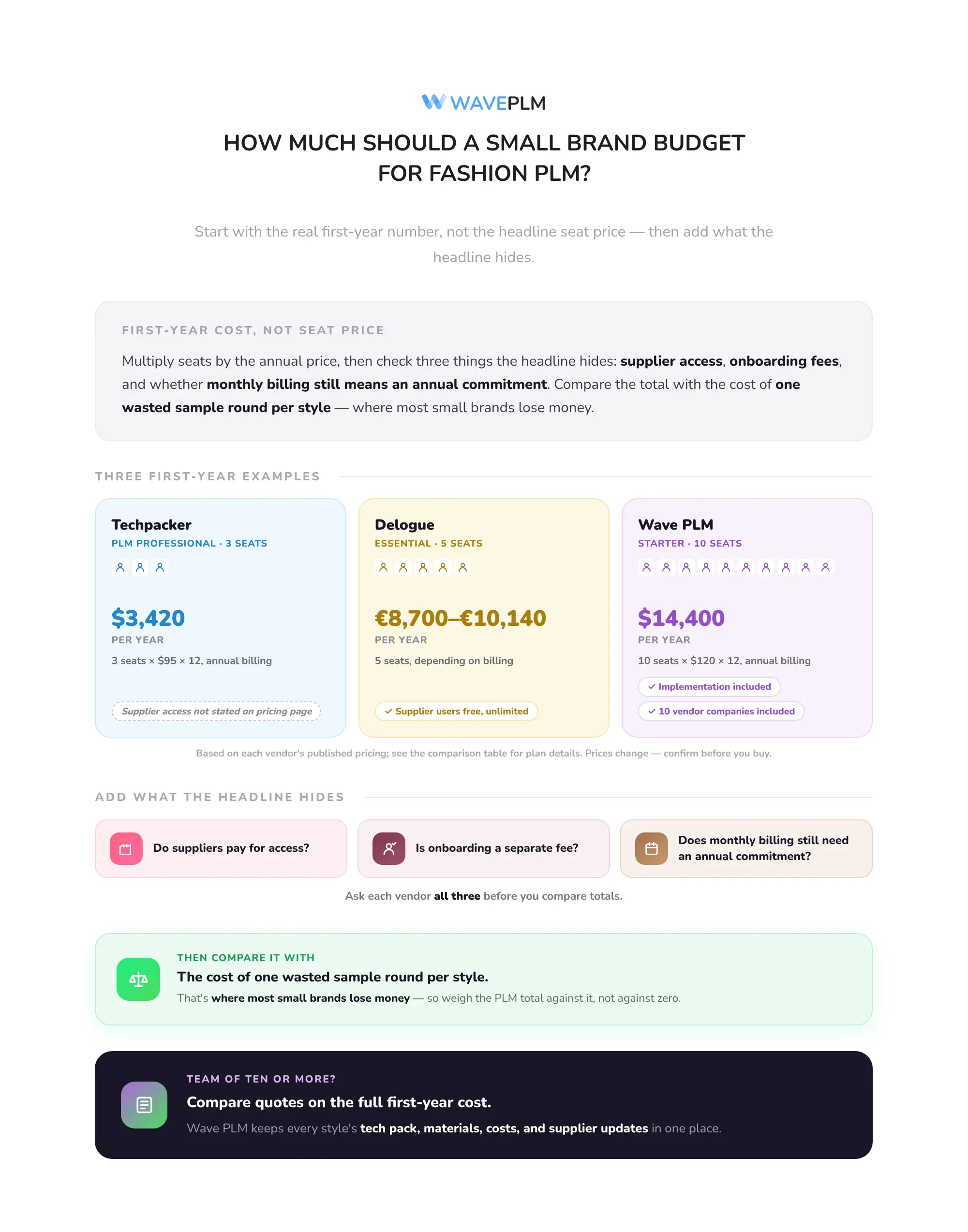
First, start with the real first-year number, not the headline seat price. For example, three Techpacker PLM Professional seats cost $3,420 a year on annual billing. Similarly, five Delogue Essential seats run €8,700 to €10,140 a year depending on billing. Finally, ten Wave PLM Starter seats cost $14,400 a year with implementation and 10 vendor companies included.
Next, add what the headline hides. Check whether suppliers pay for access, whether onboarding is a separate fee, and whether monthly billing still requires an annual commitment. Meanwhile, compare that total with the cost of one wasted sample round per style, which is where most small brands lose money. Our guide on reducing sample rounds shows how to estimate it, and the fashion PLM pricing guide breaks costs down by brand size.
Comparing PLM quotes for a team of ten or more? Wave PLM keeps every style’s tech pack, materials, costs and supplier updates in one place. Book a 30-minute Wave PLM demo and we’ll walk through it on one of your own styles.
What Mistakes Should Small Brands Avoid When Buying PLM?
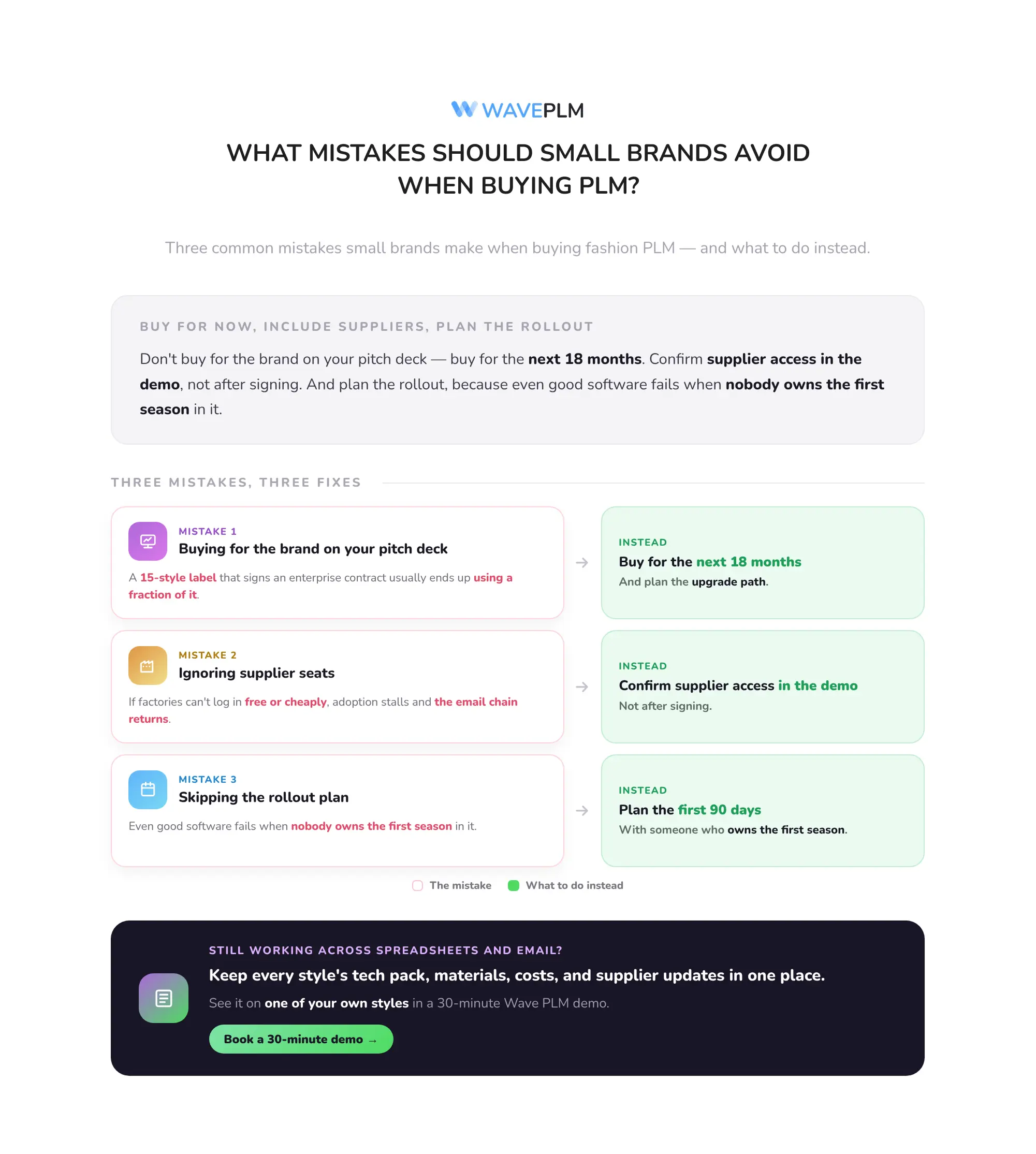
Buying for the brand on your pitch deck. For example, a 15-style label that signs an enterprise contract usually ends up using a fraction of it. Instead, buy for the next 18 months and plan the upgrade path.
Ignoring supplier seats. If factories cannot log in for free or cheaply, adoption stalls and the email chain returns. As a result, confirm supplier access in the demo, not after signing.
Skipping the rollout plan. After all, even good software fails when nobody owns the first season in it. Our first 90 days of fashion PLM guide sets out a realistic plan.
Still running specs, samples and supplier updates across spreadsheets and email? Wave PLM keeps every style’s tech pack, materials, costs and supplier updates in one place. Book a 30-minute Wave PLM demo and we’ll walk through it on one of your own styles.
Frequently Asked Questions
What is the best fashion PLM software for a small brand in 2026?
It depends on team size. For example, founders with one or two factories usually start with Techpacker. EU brands with many suppliers often choose Delogue because supplier users are free. Small Shopify brands that want stock and purchasing too can look at Kōbō. Brands of roughly 10–49 people working with several vendors are the core fit for Wave PLM.
How much does fashion PLM software cost per user?
Published prices in November 2026 range from $35 per user per month (Techpacker Essential, annual billing) to $300 per seat per month (Kōbō Ops & Supply). Wave PLM Starter is $120 per user per month billed annually, and Delogue runs €145–€249 per user per month. Onbrand, WFX and Centric quote on request.
Which fashion PLM gives suppliers free access?
Delogue lists supplier users as free and unlimited on every plan. Kōbō says suppliers do not pay for portal access. Wave PLM includes 10 vendor companies on Starter and 50 on Professional. Onbrand includes a vendor portal, with unlimited vendor licences on Pro and Enterprise.
Is Backbone PLM still available?
Backbone is now part of Bamboo Rose TotalPLM. It remains supported for existing customers, while new buyers are directed to Bamboo Rose TotalPLM.
When does a small brand need PLM instead of spreadsheets?
At first, spreadsheets work for a handful of styles and one factory. The usual signals that you have outgrown them are factories sewing from outdated tech packs, sample rounds creeping past three per style, and the team losing hours each week checking which version is current.
Is fashion PLM the same as ERP?
No. In short, fashion PLM manages what you are making and how: specs, materials, samples and costing. ERP manages orders, inventory and finance. As a result, most small brands need PLM first and connect an ERP once order volume justifies it.
In short, the best fashion PLM software for a small apparel brand is the one your team and your factories will both use. Pick by the brand you are today, check the full first-year cost, and confirm supplier access before you sign.







Leave a Reply