
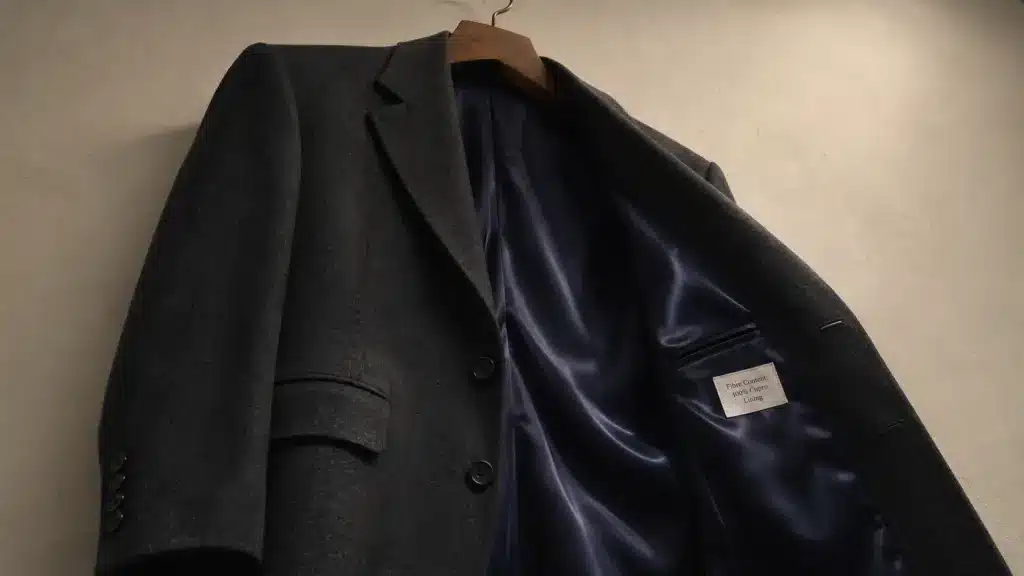
Cupro fabric is a regenerated cellulose textile made from cotton linter, the short fuzz left on cotton seeds after ginning. Chemically, it is a cousin of viscose, modal, and lyocell. In practice, cupro fabric is prized for a silk-like drape, a cool and smooth hand, and good breathability, which is why tailors have used it for premium linings for almost a century.
Most articles about cupro fabric are written for shoppers who want to know whether it feels like silk. This one, however, is written for the people who buy it by the metre. Specifically, it covers how the fibre is made, why the supply chain is unusually concentrated, what cupro fabric costs, how to spec it in a tech pack, and what you can legally put on the label.
What Is Cupro Fabric Made Of?
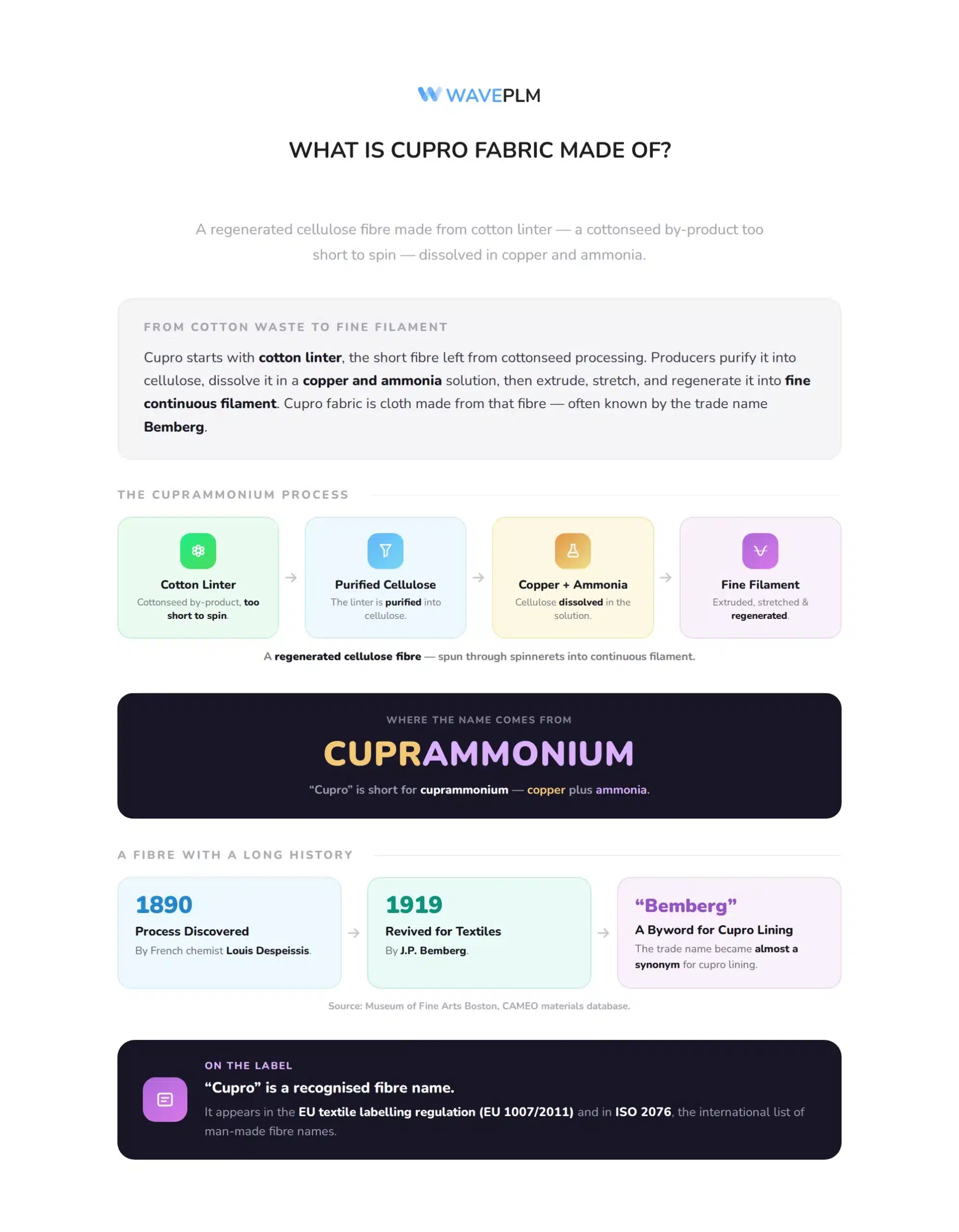
Cupro starts with cotton linter, a by-product of cottonseed processing that is too short to spin into yarn. Producers purify the linter into cellulose and then dissolve it in a solution of copper and ammonia. That is where the name comes from: “cupro” is short for cuprammonium. Next, the solution is extruded through spinnerets, stretched, and regenerated into fine continuous filament.
Definition: Cupro fabric is cloth made from cupro fibre, a regenerated cellulose fibre produced by the cuprammonium process. “Cupro” is a recognised fibre name in the EU textile labelling regulation (EU 1007/2011) and in ISO 2076, the international list of man-made fibre names.
Historically, the process dates back to 1890, when French chemist Louis Despeissis discovered it. Later, in 1919, J.P. Bemberg revived it for textiles, according to the Museum of Fine Arts Boston’s CAMEO materials database. As a result, the trade name Bemberg became almost a synonym for cupro lining.
How Is Cupro Different From Viscose, Modal, and Lyocell?
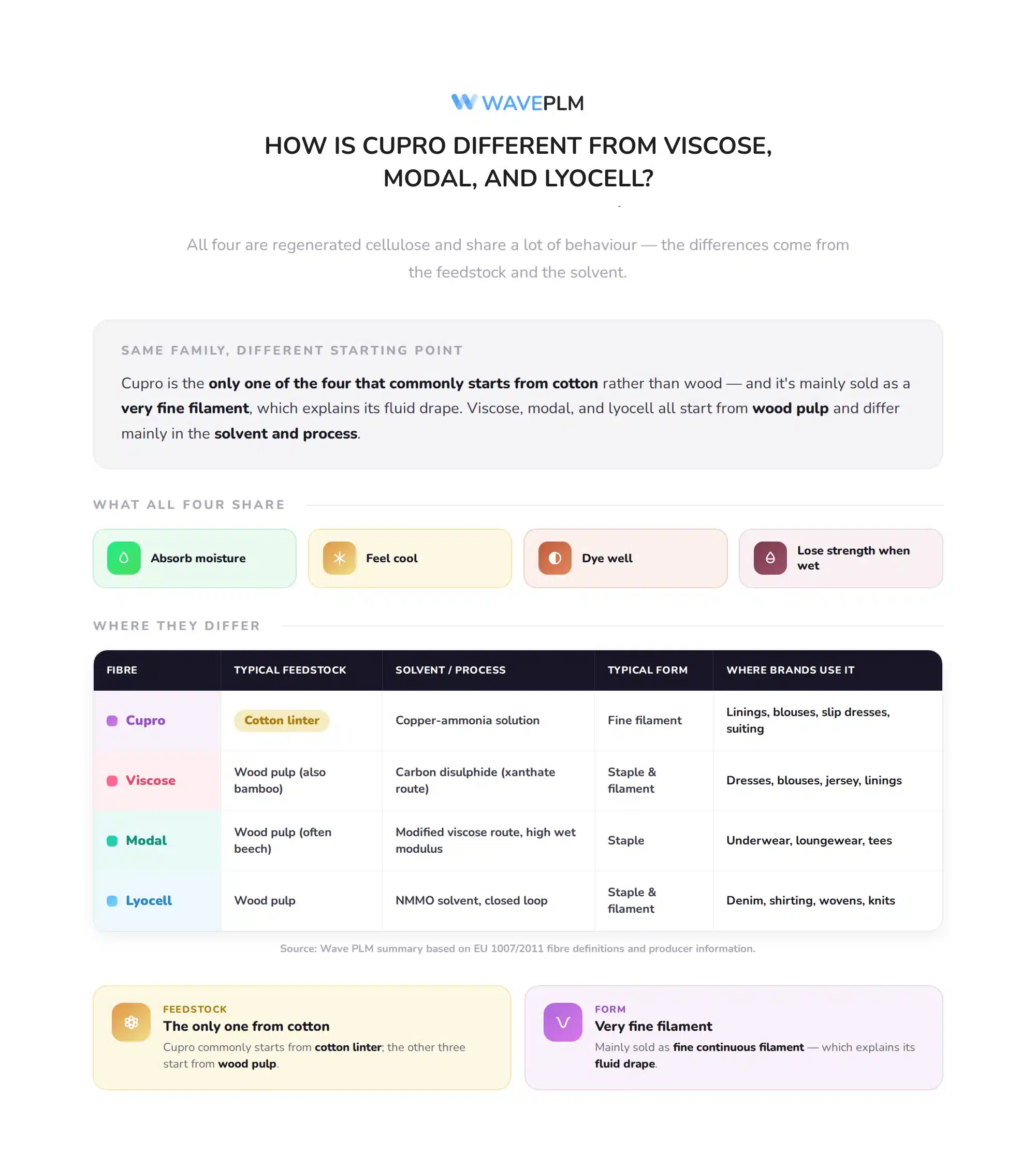
All four fibres are regenerated cellulose, so they share a lot of behaviour: they absorb moisture, feel cool, dye well, and lose strength when wet. The differences come from the feedstock and the solvent. The table below summarises them for a sourcing conversation.
| Fibre | Typical feedstock | Solvent / process | Typical form | Where brands use it |
|---|---|---|---|---|
| Cupro | Cotton linter | Copper-ammonia solution | Fine filament | Linings, blouses, slip dresses, suiting |
| Viscose | Wood pulp (also bamboo) | Carbon disulphide (xanthate route) | Staple and filament | Dresses, blouses, jersey, linings |
| Modal | Wood pulp (often beech) | Modified viscose route, high wet modulus | Staple | Underwear, loungewear, tees |
| Lyocell | Wood pulp | NMMO solvent, closed loop | Staple and filament | Denim, shirting, wovens, knits |
In short, cupro is the only one of the four that commonly starts from cotton rather than wood. It is also mainly sold as a very fine filament, which explains its fluid drape. For a deeper comparison, see our guides to viscose fabric, modal fabric, and lyocell fabric.
Who Makes Cupro Fabric, and Why Does Supply Matter?
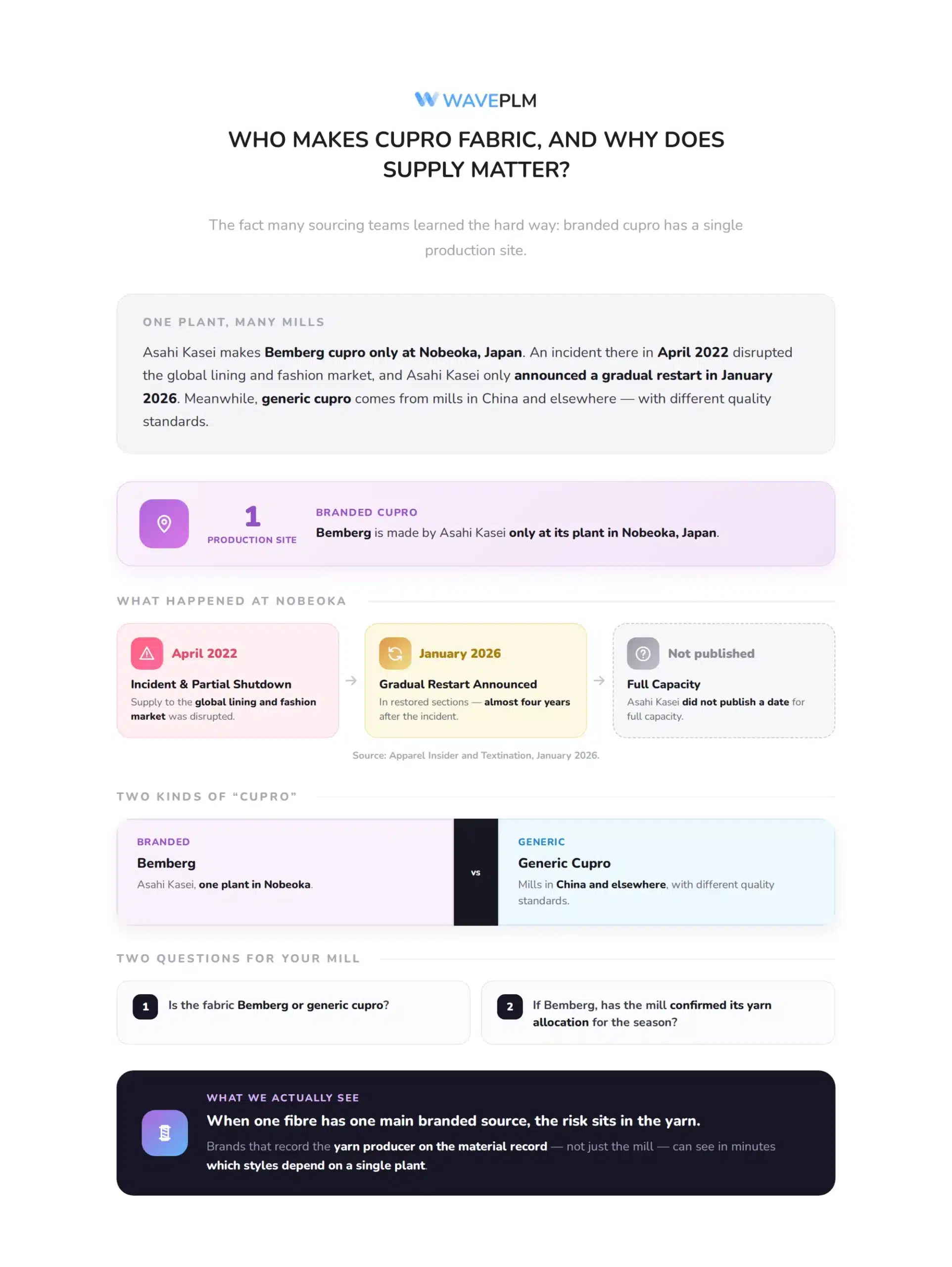
Here is the fact many sourcing teams learned the hard way: branded cupro has a single production site. Asahi Kasei makes Bemberg cupro only at its plant in Nobeoka, Japan. In April 2022, an incident at that plant triggered a partial shutdown and disrupted supply to the global lining and fashion market.
Industry data: Asahi Kasei announced in January 2026 that it would gradually resume Bemberg production in restored sections of the Nobeoka facility, almost four years after the April 2022 incident. The company did not publish a date for full capacity (Apparel Insider and Textination, January 2026).
Meanwhile, mills in China and elsewhere supply generic cupro yarn and fabric. Consequently, a fabric sold as “cupro” today can come from very different producers with different quality standards. For a buyer, that creates two practical questions. First, is the fabric Bemberg or generic cupro? Second, if it is Bemberg, has your mill confirmed its yarn allocation for the season?
Our finding: When one fibre has one main branded source, the risk sits in the yarn, not the fabric. Brands that record the yarn producer on the material record, not just the mill, can see in minutes which styles depend on a single plant.
How Much Does Cupro Fabric Cost?
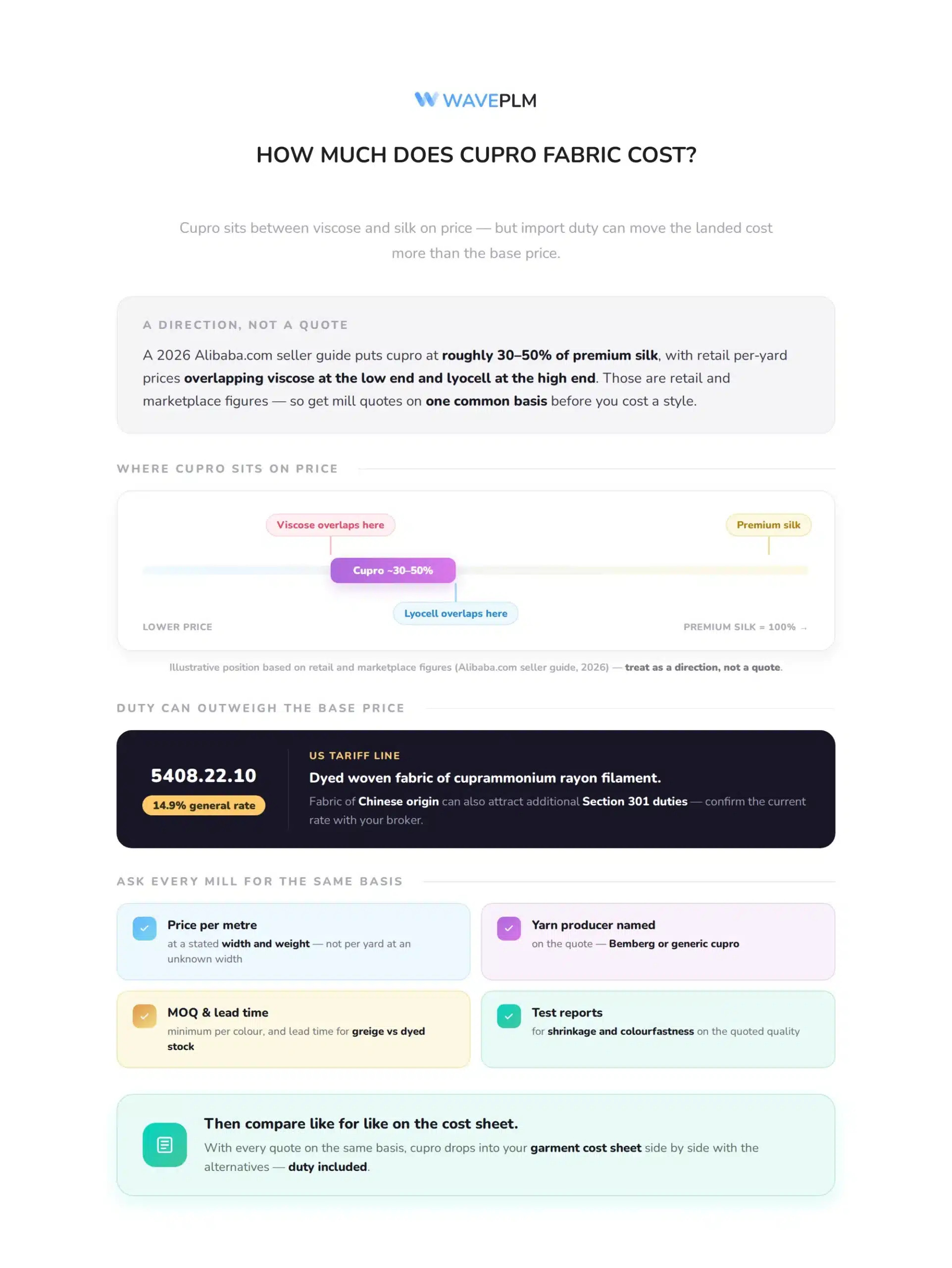
Cupro fabric sits between viscose and silk on price. An Alibaba.com seller guide published in 2026 estimates that cupro costs roughly 30 to 50% of premium silk. In the same guide, listed retail prices per yard for cupro overlapped with viscose at the low end and with lyocell at the high end. Those are retail and marketplace figures, so treat them as a direction rather than a quote.
In addition, import duty can move the landed cost more than the base price. For example, dyed woven fabric of cuprammonium rayon filament falls under US tariff line 5408.22.10, with a general duty rate of 14.9%. Fabric of Chinese origin can also attract additional Section 301 duties, so confirm the current rate with your broker. Our HTS code guide explains how classification drives duty.
To compare offers fairly, therefore, ask every mill for the same basis:
- Price per metre at a stated width and weight, not per yard at an unknown width
- Yarn producer named on the quote (Bemberg or generic cupro)
- Minimum order per colour and lead time for greige versus dyed stock
- Test reports for shrinkage and colourfastness on the quoted quality
After that, you can drop cupro fabric into your garment cost sheet on a like-for-like basis with the alternatives.
What Are the Properties of Cupro Fabric?
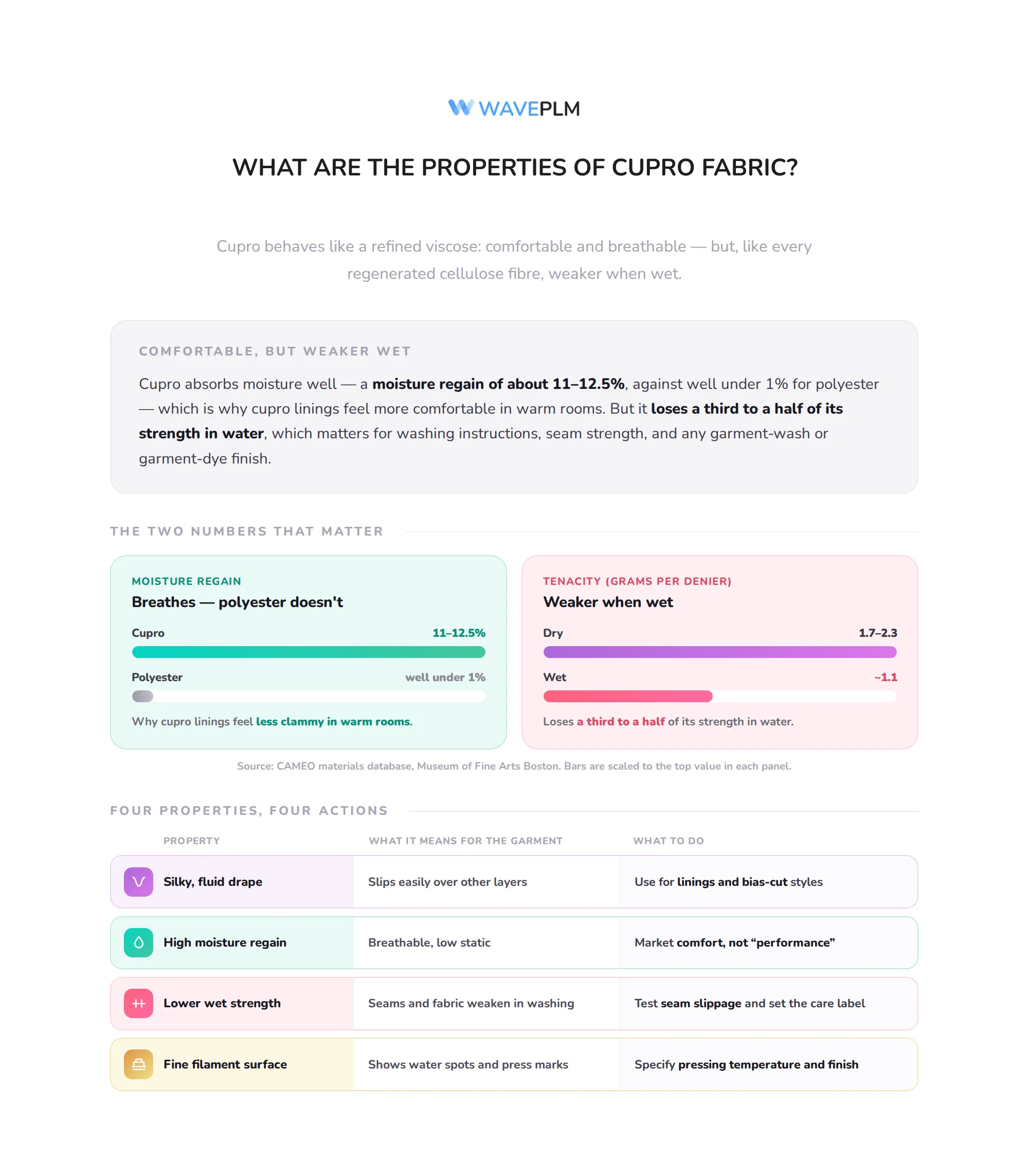
Cupro fabric behaves like a refined viscose. It absorbs moisture well, so it feels less clammy than polyester. In fact, the CAMEO database lists a moisture regain of about 11 to 12.5% for cupro fibre. By contrast, polyester absorbs well under 1%. That is the main reason cupro linings feel more comfortable in warm rooms.
However, cupro also shares the weakness of every regenerated cellulose fibre: it loses strength when wet. CAMEO lists a dry tenacity of 1.7 to 2.3 grams per denier and a wet tenacity of about 1.1 grams per denier. In other words, cupro can lose a third to a half of its strength in water. This matters for washing instructions, seam strength, and any garment-wash or garment-dye finish.
| Property | What it means for the garment | What to do |
|---|---|---|
| Silky, fluid drape | Slips easily over other layers | Use for linings and bias-cut styles |
| High moisture regain | Breathable, low static | Market comfort, not “performance” |
| Lower wet strength | Seams and fabric weaken in washing | Test seam slippage and set care label |
| Fine filament surface | Shows water spots and press marks | Specify pressing temperature and finish |
How Should You Spec Cupro Fabric in a Tech Pack?
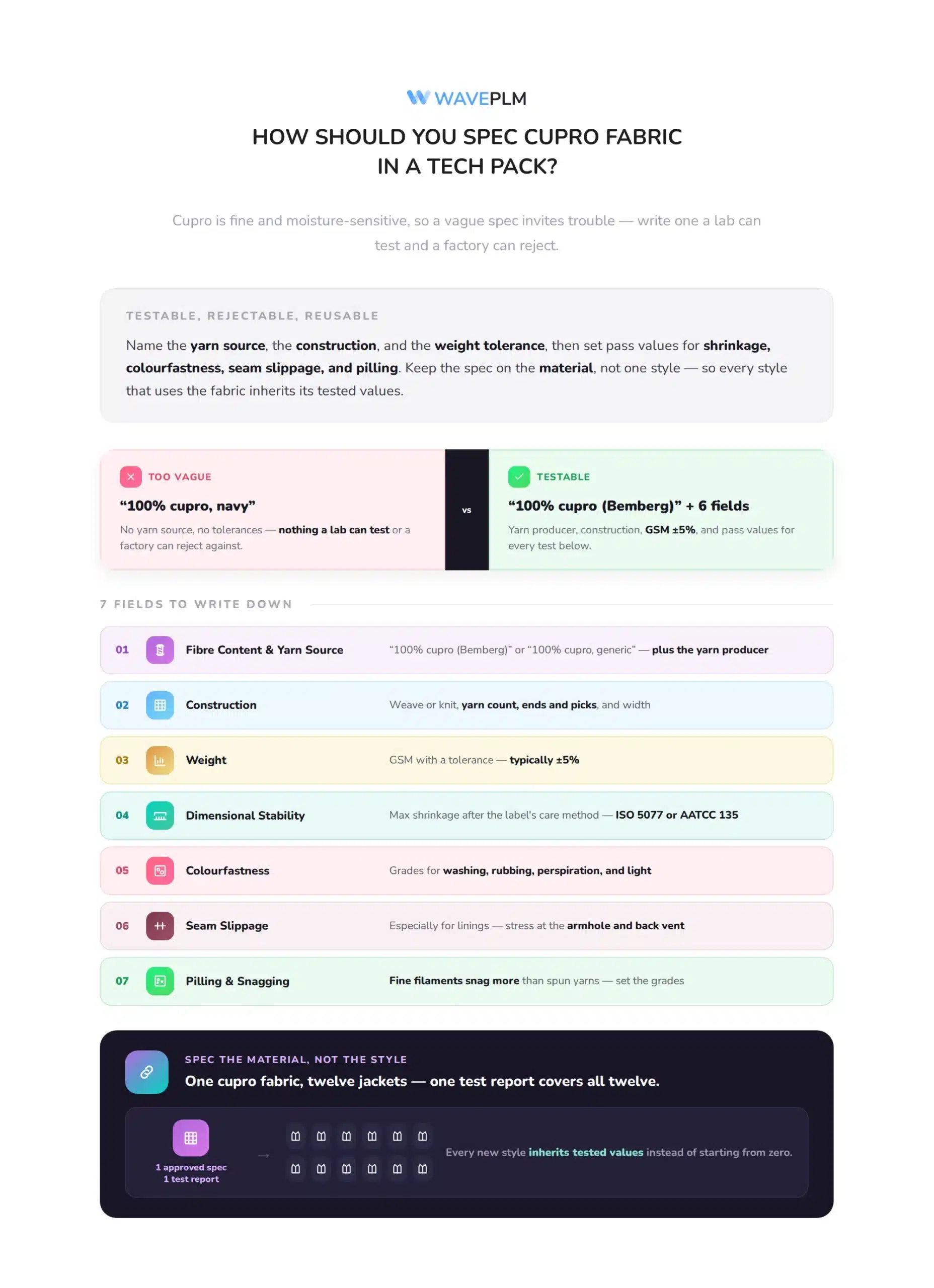
Because cupro fabric is fine and moisture-sensitive, a vague spec such as “100% cupro, navy” invites trouble. Instead, write the spec so a lab can test it and a factory can reject it. As a minimum, include these fields:
- Fibre content and yarn source. For example, “100% cupro (Bemberg)” or “100% cupro, generic”, plus the yarn producer.
- Construction. Weave or knit, yarn count, ends and picks, and width.
- Weight. Grams per square metre with a tolerance, typically ±5%. See our fabric GSM guide for how to set it.
- Dimensional stability. Maximum shrinkage after the care method on the label, tested to ISO 5077 or AATCC 135.
- Colourfastness. Grades for washing, rubbing, perspiration, and light, as set out in our colorfastness testing guide.
- Seam slippage. Especially for linings, which take stress at the armhole and back vent.
- Pilling and snagging. Fine filaments snag more than spun yarns; see the fabric pilling test guide for grades.
Notably, the spec should travel with the material, not only with one style. If the same cupro fabric lines twelve jackets, then one test report and one approved spec should cover all twelve. In turn, every new style inherits tested values instead of starting from zero.
Is Cupro Fabric Sustainable?
The honest answer is: it depends on the claim you want to make. On the positive side, cupro uses cotton linter, a by-product, instead of wood pulp. Furthermore, Asahi Kasei says its process recovers and reuses copper and ammonia in a closed loop. Bemberg also holds Global Recycled Standard (GRS) certification for its pre-consumer linter content, according to Textination.
On the other hand, sustainability language is now tightly regulated. For instance, the EU Empowering Consumers Directive applies from 27 September 2026 and bans generic environmental claims such as “eco-friendly” without recognised proof. Likewise, claims such as “biodegradable” or “vegan silk” need evidence that matches the exact wording. Our guide to the EU Green Claims Directive covers what brands still have to prove.
Note: A GRS claim needs a transaction certificate from each certified site in the chain, just like recycled polyester. The same chain-of-custody logic applies to recycled polyester.
How Should You Label Cupro Fabric Garments?
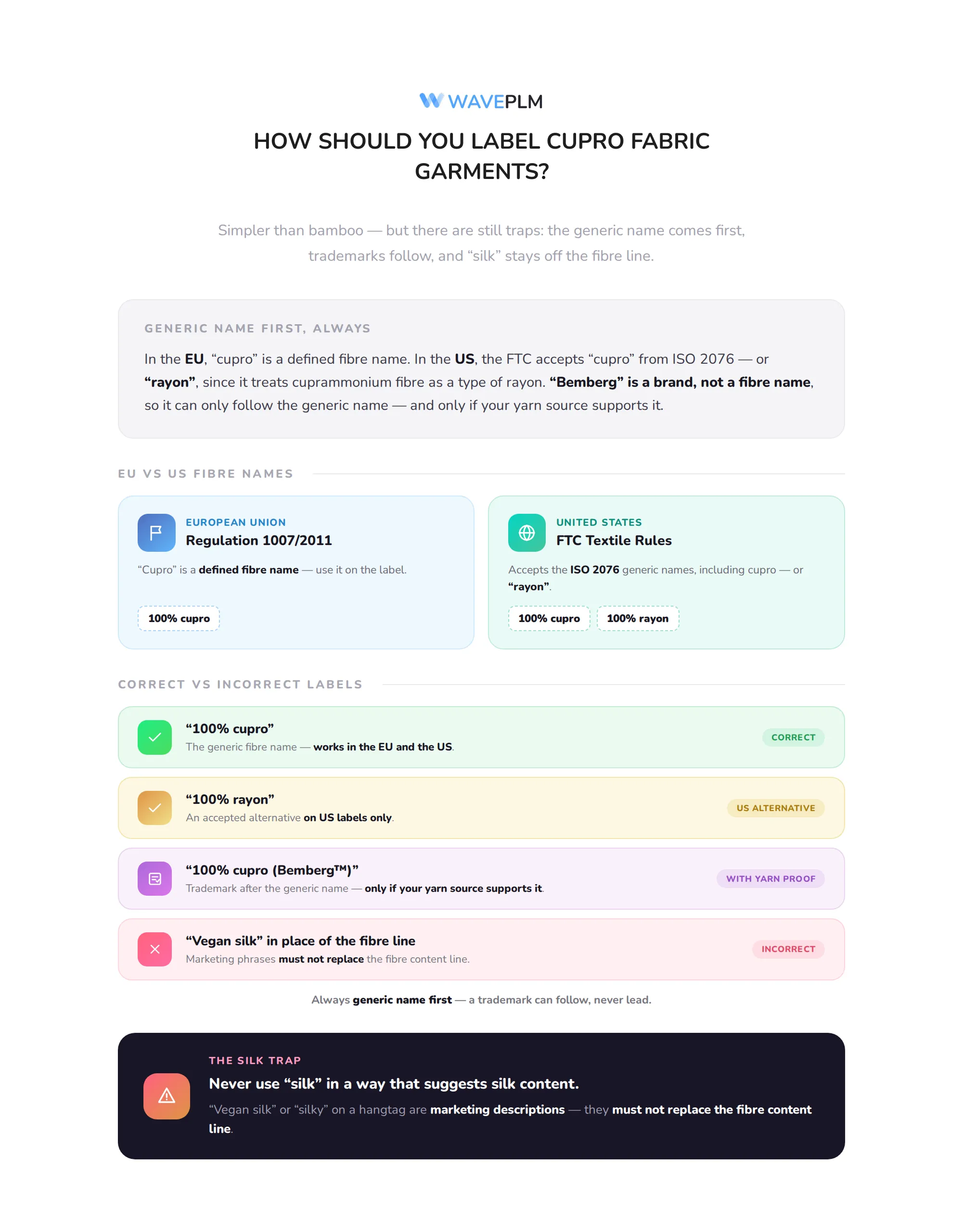
Labeling cupro is simpler than labeling bamboo, but there are still traps. In the EU, “cupro” is a defined fibre name in Regulation 1007/2011, so the label reads, for example, “100% cupro”. In the United States, the FTC Textile Rules accept the generic names listed in ISO 2076, and cupro is one of them. Alternatively, US labels can use “rayon”, since the FTC treats cuprammonium fibre as a type of rayon.
Trademarks, however, are a separate matter. “Bemberg” is a brand name, not a fibre name. So the generic fibre name must appear first, and any trademark can follow it, for instance “100% cupro (Bemberg™)”, as long as your yarn source supports it. Never use “silk” in a way that suggests silk content. Phrases such as “vegan silk” or “silky” on a hangtag are marketing descriptions, and they must not replace the fibre content line.
Where Does Cupro Fabric Work Best?
Cupro fabric earns its price when drape and comfort are visible to the customer. Typical good fits include:
- Jacket, coat, and suit linings, where breathability and low static matter most
- Slip dresses, skirts, and blouses that need a silk-like fall at a lower cost
- Lightweight trousers and shirting blends with cotton or wool
- Pocketing and facings in premium tailoring
Conversely, cupro is a poor fit for workwear, heavy-wash garments, and anything that must survive frequent hot washing. In those cases, a high wet modulus fibre such as modal, or a lyocell blend, usually performs better.
What If Your Cupro Supply Slips?
Because branded cupro has one plant, it is worth writing a fallback before you need it. The plan below shows how a brand can keep a lined jacket on schedule if the allocation for Bemberg lining is late or short.
| Trigger | Plan A | Plan B | Who decides, and by when |
|---|---|---|---|
| Mill cannot confirm Bemberg allocation 12 weeks before cut | Hold the order and request a written ship date | Approve a generic cupro lining already tested to the same spec | Sourcing lead, at the fabric commitment gate |
| Generic cupro fails shrinkage or colourfastness | Retest after a finishing change | Switch to a viscose or lyocell lining with an approved spec | Technical lead, before bulk dyeing |
| Lining switch changes the fibre content | Update the care and content label | Remove “Bemberg” from hangtags and product copy | Compliance owner, before labels print |
The last row is the one most brands forget. When the lining changes, the label, the hangtag, and the product description all have to change with it. Otherwise, a correct substitution turns into a labeling error on the shop floor.
Tracking that chain is easier when each fabric is a single record that lists its yarn producer, test reports, and every style it lines. With a structured fabric sourcing workflow, the question “which styles use Bemberg?” has a one-click answer. When the next allocation letter arrives, that answer decides whether you reschedule five styles or fifty, so it pays to have Wave PLM trace every lining back to its yarn before the factory calls.
Frequently Asked Questions
What is cupro fabric made from?
Cupro fabric is made from cotton linter, the short fibres left on cotton seeds after ginning. The linter is purified into cellulose, dissolved in a copper and ammonia solution, and spun into fine filament. As a result, cupro is a regenerated cellulose fibre, like viscose, but it starts from cotton instead of wood pulp.
Is cupro the same as Bemberg?
Not exactly. Bemberg is Asahi Kasei’s brand of cupro, made in Nobeoka, Japan. Other producers also make generic cupro. Therefore, every Bemberg fabric is cupro, but not every cupro fabric is Bemberg, and you should only use the trademark when your yarn source supports it.
Is cupro fabric better than silk?
Cupro fabric is not better or worse than silk, but it is different. It offers a similar drape and smooth hand at a lower cost, often estimated at 30 to 50% of premium silk. However, it is weaker when wet and cannot be sold or labeled as silk.
Does cupro fabric shrink?
Cupro fabric can shrink and lose strength when washed hot, because regenerated cellulose swells in water. That is why brands should set a maximum shrinkage in the tech pack and test it to ISO 5077 or AATCC 135. Cool washing or dry cleaning reduces the risk.
How should cupro be listed on a clothing label?
In the EU, the label uses the fibre name “cupro”, as defined in Regulation 1007/2011. In the US, the FTC accepts ISO 2076 names, so “cupro” works, and “rayon” is also acceptable. A trademark such as Bemberg may follow the generic name but cannot replace it.
Is cupro fabric sustainable?
Cupro fabric uses a cotton by-product and, in Bemberg’s case, a closed-loop process that recovers copper and ammonia. Even so, any environmental claim on a product must be specific and backed by evidence, especially under the EU Empowering Consumers Directive from September 2026.
Conclusion
Cupro fabric gives brands a silk-like drape, real breathability, and a cotton-based story at a mid-range price. Nevertheless, it comes with a concentrated supply base, a known weakness when wet, and claims that are easy to overstate. To buy it well, name the yarn source, spec weight, shrinkage, colourfastness, and seam slippage, and keep any sustainability or trademark claim tied to evidence. Finally, plan a tested fallback lining before the season starts, not after the allocation letter arrives.





Leave a Reply