
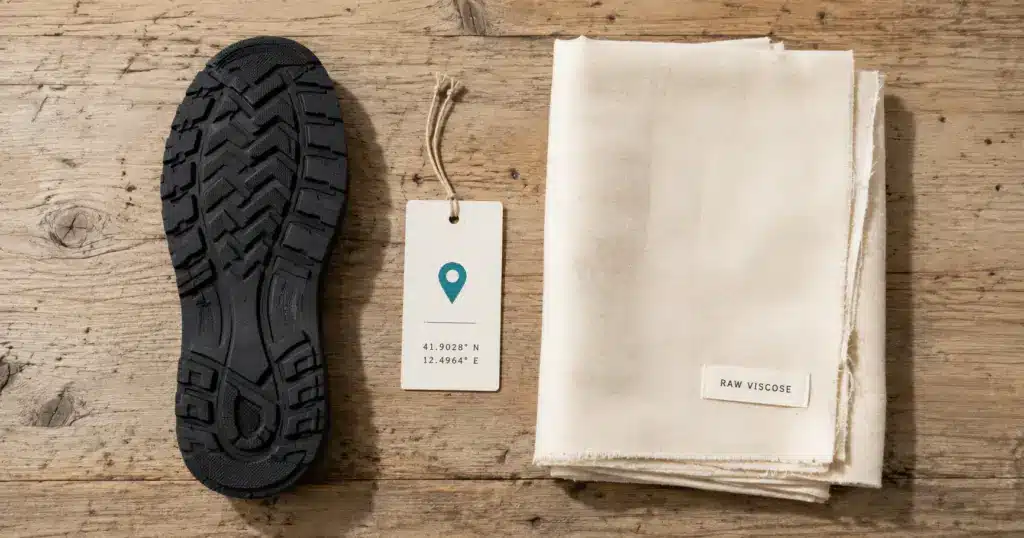
The EU deforestation regulation no longer covers leather. A December 2025 revision quietly dropped it. That surprises most brands, since leather was the material everyone assumed the law targeted. What actually stayed in scope is narrower. Specifically: natural rubber for shoe soles and elastics, viscose-family fibers made from dissolving wood pulp, and wooden trims or hardware. This guide covers what EUDR now requires from apparel and footwear brands. It also covers the December 2026 deadline, and how this due diligence differs from the human-rights due diligence brands already track under CSDDD.
A deforestation regulation is, at its core, a market-access rule. It says that certain commodities linked to forest loss cannot enter the EU market. First, a company must prove where the raw material was grown or harvested, product by product. The EU deforestation regulation applies that logic to seven commodity groups: cattle, cocoa, coffee, oil palm, rubber, soy, and wood, plus a defined list of derived products. Notably, fashion brands sit downstream of exactly two of those seven: rubber and wood.
What Is the EU Deforestation Regulation?
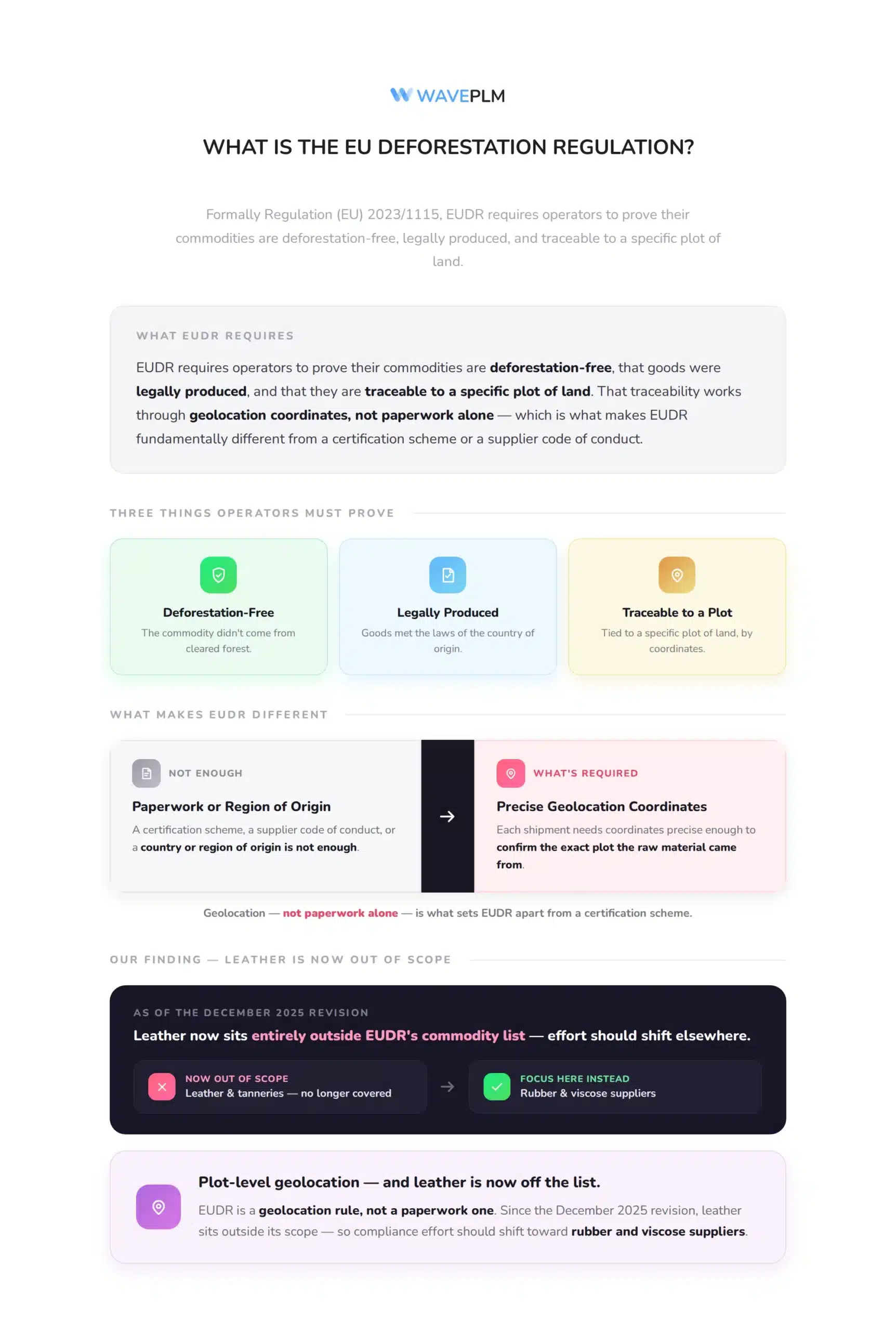
The EU deforestation regulation, formally Regulation (EU) 2023/1115, requires operators to prove their commodities are deforestation-free. It also requires proof that goods were legally produced. In addition, it requires traceability to a specific plot of land. That traceability works through geolocation coordinates, not paperwork alone. Each shipment needs coordinates precise enough to confirm the exact plot the raw material came from. A country or region of origin is not enough (World Resources Institute). This geolocation requirement is what makes EUDR fundamentally different from a certification scheme or a supplier code of conduct.
Our finding: Several Wave PLM customers who source leather goods assumed the EU deforestation regulation applied to their tanneries, the same way it applies to meat processors. As of the December 2025 revision, it does not. Leather now sits entirely outside EUDR’s commodity list. That means compliance effort should shift toward rubber and viscose suppliers instead.
Why Doesn’t Leather Fall Under EUDR Anymore?
Cattle leather, under HS codes 4101, 4104, and 4107, dropped out of the EU deforestation regulation’s scope in the December 2025 revision. The European Commission’s reasoning treats leather as a meat-production by-product. Specifically, one that carries only 2.5 to 5 percent of the deforestation footprint attributed to cattle overall (TrustTrace). As a result, this pushes the compliance burden back onto meat and hide suppliers. In turn, footwear and leather goods brands buying finished leather downstream are largely off the hook.
This is a recent change, and so far an under-reported one. As a result, a brand researching EUDR obligations today may still find guidance written before December 2025, back when leather was assumed to be in scope. Consequently, that older guidance is now outdated for any fashion brand whose primary raw material is leather rather than rubber or wood pulp.
What Materials Are Still Covered Under EUDR?
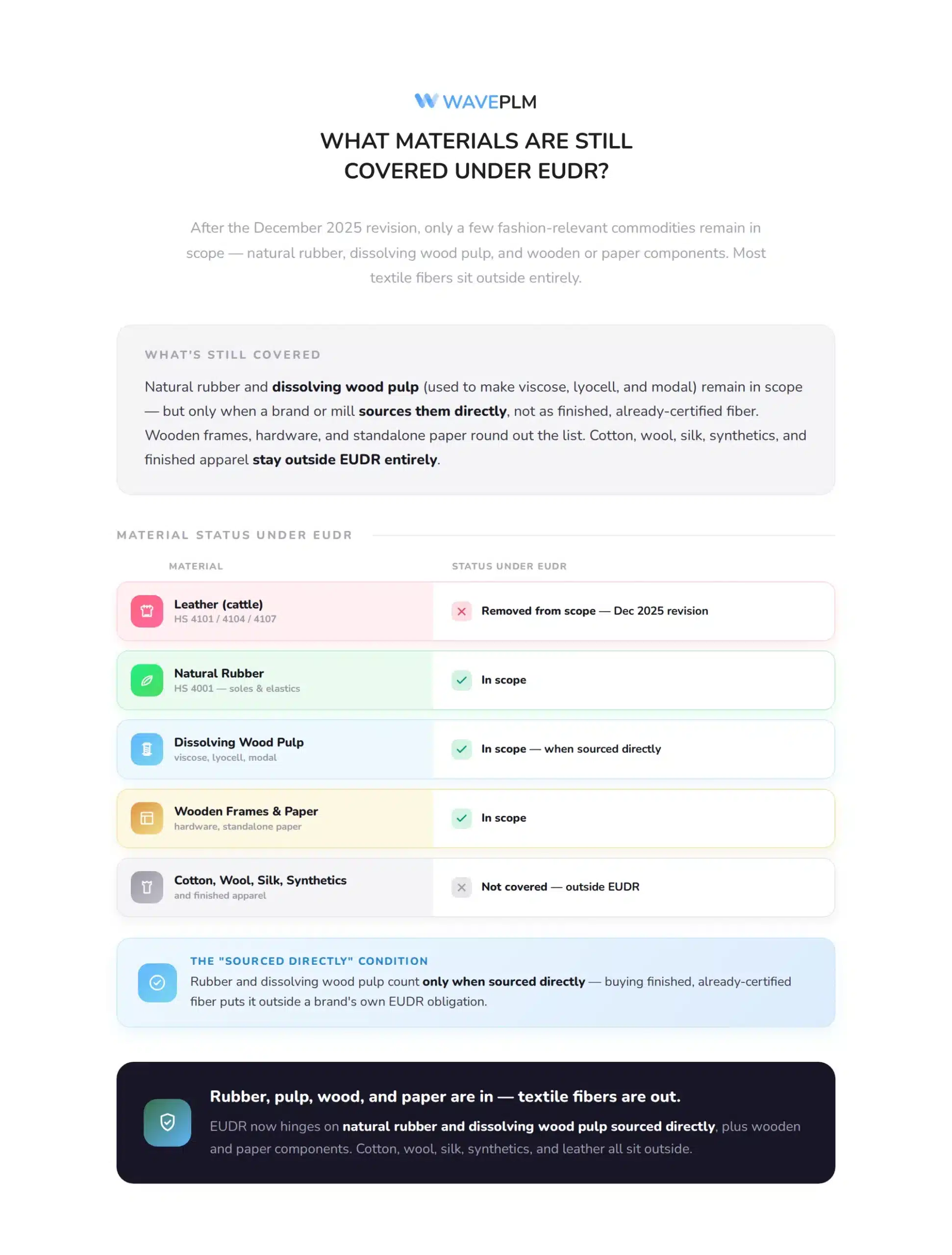
Natural rubber, specifically Hevea brasiliensis under HS code 4001, remains fully in scope. This applies when it’s sourced directly for footwear soles and elastic components. Dissolving wood pulp used to make viscose, lyocell, and modal fibers is also covered. That’s true when a brand or its mill sources that pulp directly, rather than buying finished, already-certified fiber. Meanwhile, wooden frames and hardware, along with standalone paper products, round out the categories relevant to fashion (TrustTrace). Cotton, wool, silk, synthetic fibers, and finished apparel made from these materials remain outside EUDR entirely.
| Material | Status under EUDR |
|---|---|
| Leather (cattle, HS 4101/4104/4107) | Removed from scope, Dec 2025 revision |
| Natural rubber (HS 4001, soles and elastics) | In scope |
| Dissolving wood pulp (viscose, lyocell, modal) | In scope, when sourced directly |
| Wooden frames, hardware, standalone paper | In scope |
| Cotton, wool, silk, synthetic fibers | Not covered |
When Does EUDR Actually Take Effect?
The EU has already delayed this regulation twice. It was originally due to apply from December 2024. First, that date moved to December 2025, then the December 2025 revision pushed it back again. Large and medium operators now face an application date of 30 December 2026. Micro and small operators get an additional window, to 30 June 2027 (Council of the EU). The European Commission must also complete a broader simplification review by 30 April 2026, so further adjustment before the deadline is possible.
For a fashion brand, that repeated slippage is not a reason to wait. Sourcing teams generally need one to two seasons of lead time. That’s how long it takes to collect geolocation data from rubber and viscose suppliers who have never been asked for it before. Otherwise, waiting for the next delay announcement, instead of starting now, leaves too little runway.
What Does Due Diligence Actually Require From Fashion Brands?
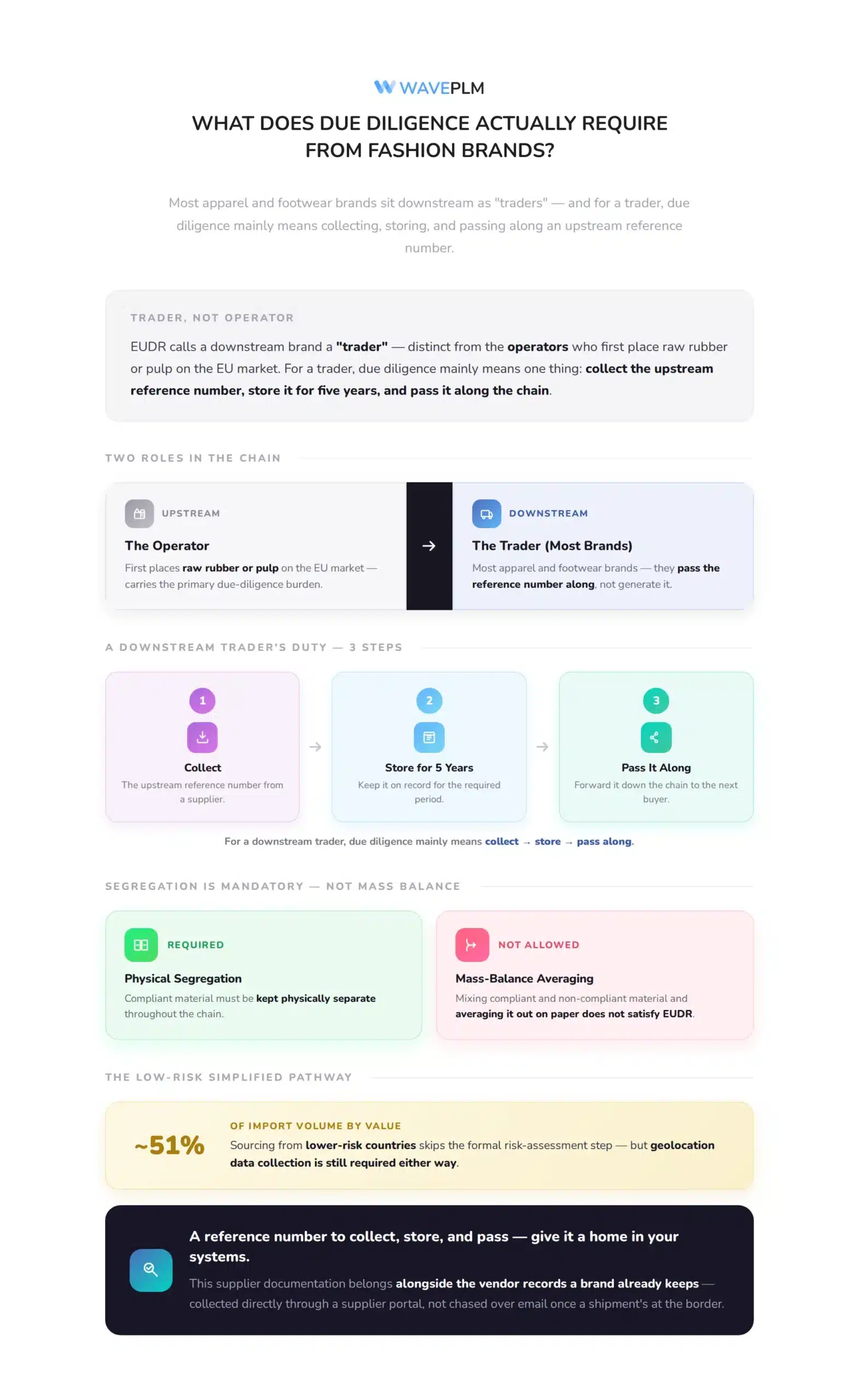
Most apparel and footwear brands sit downstream in the supply chain. The regulation calls this role a “trader,” distinct from the operators who first place raw rubber or pulp on the EU market. For a downstream trader, due diligence mainly means one thing: collecting the upstream reference number from a supplier, storing it for five years, and passing it along the chain (TrustTrace). In addition, physical segregation of compliant material is mandatory throughout. A mass-balance chain of custody, where compliant and non-compliant material get mixed and averaged out on paper, does not satisfy EUDR.
For sourcing from lower-risk countries, currently around 51 percent of import volume by value, a simplified pathway skips the formal risk assessment step. Geolocation data collection is still required either way (TrustTrace). This is exactly the kind of supplier documentation that needs a home in a brand’s systems. Specifically, it belongs alongside the vendor records most compliance programs already keep for other regulations.
Our supplier portal guide covers how brands collect this kind of structured documentation directly from vendors. In short, that beats chasing spreadsheets over email once a shipment is already at the border.
What Happens If a Brand Doesn’t Comply?
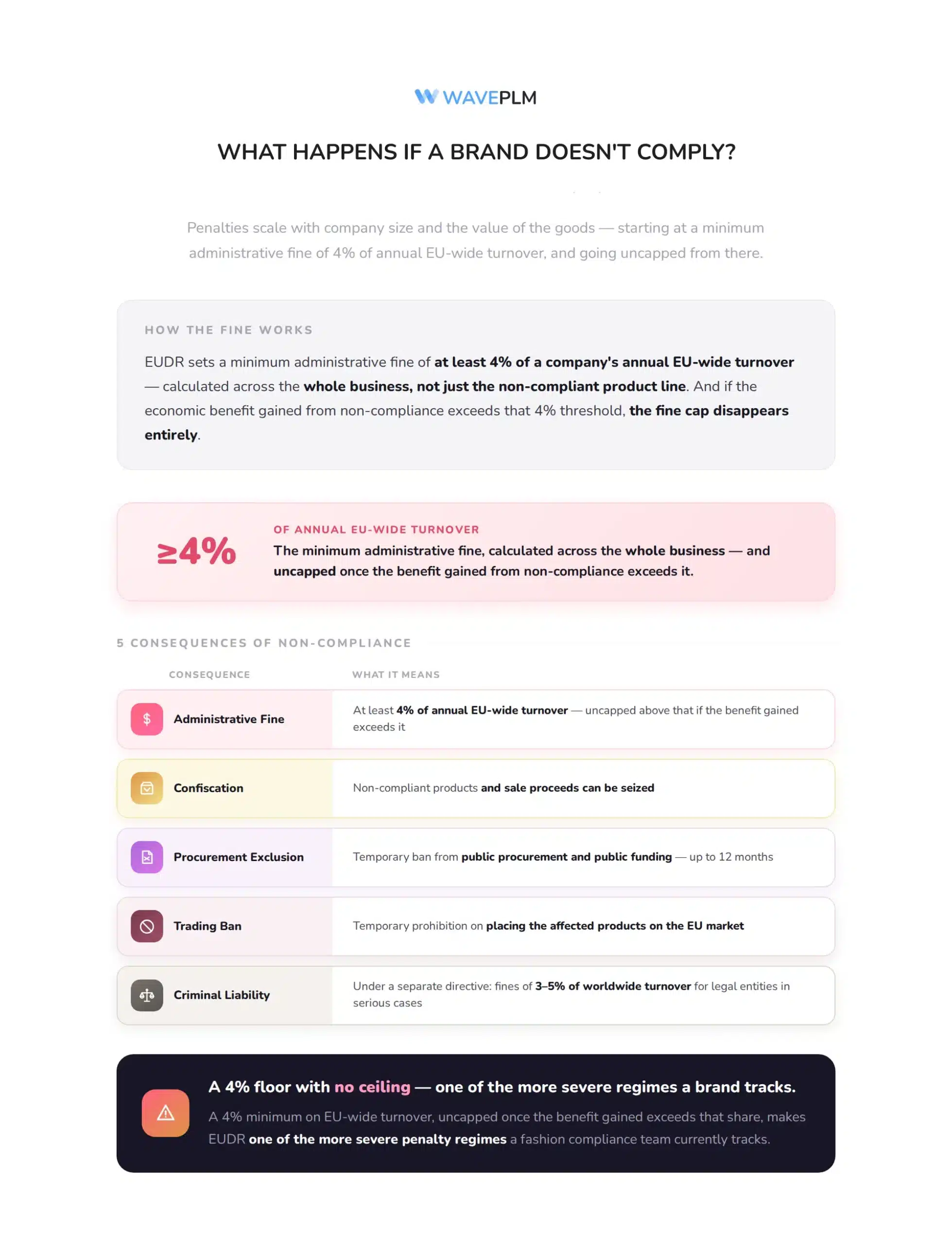
Penalties under the EU deforestation regulation scale with company size and the value of the goods involved. The regulation sets a minimum administrative fine: at least 4 percent of a company’s annual EU-wide turnover. That figure is calculated across the whole business, not just the non-compliant product line (Coolset). Notably, if the economic benefit gained from non-compliance exceeds that 4 percent threshold, the fine cap disappears entirely.
| Consequence | What it means |
|---|---|
| Administrative fine | At least 4% of annual EU-wide turnover, uncapped above that if the benefit gained exceeds it |
| Confiscation | Non-compliant products and sale proceeds can be seized |
| Procurement exclusion | Temporary ban from public procurement and public funding, up to 12 months |
| Trading ban | Temporary prohibition on placing the affected products on the EU market |
| Criminal liability | Under a separate Environmental Crime Directive, fines of 3-5% of worldwide turnover for legal entities in serious cases |
Industry data: A 4 percent minimum fine on annual EU-wide turnover, with no upper cap once the benefit gained exceeds that share, makes EUDR one of the more severe penalty regimes a fashion brand’s compliance team currently tracks (Coolset).
How Is EUDR Different From CSDDD and UFLPA?
Fashion compliance teams already juggle several supply-chain rules. So, it helps to separate what each one actually checks. Our EU CSDDD guide covers broad human-rights and environmental due diligence across a company’s full value chain. That rule applies mainly to very large companies. EUDR, in contrast, is narrower and commodity-specific. It applies to any company, regardless of size, that places rubber, wood pulp, or the other six covered commodities on the EU market. Instead, it checks geolocation and land-use legality, not labor conditions broadly.
UFLPA certification, meanwhile, addresses a different question again. It targets forced labor in a supply chain tied to China’s Xinjiang region, enforced at the US border rather than the EU market. A shipment can clear UFLPA review and still fail EUDR due diligence, since the two rules check entirely different things. Treating them as one combined “supply chain compliance” checklist risks missing what each one specifically requires.
How Should Fashion Brands Prepare Now?
Preparation starts with an honest audit: which suppliers actually touch a covered commodity? Most brands do not source raw rubber or wood pulp directly. Instead, a mill or component supplier usually handles that step. So, the first practical step is mapping which vendors sit closest to those raw materials. From there, request geolocation and legality documentation well before the December 2026 deadline.
Our vendor onboarding guide covers how to build this kind of documentation request into a supplier’s setup checklist from day one. That beats retrofitting it onto vendors who have worked with a brand for years, never once asked for a geolocation coordinate. Sourcing teams that already track fabric lead times through a fabric sourcing workflow have a natural place to attach this new documentation. As a result, there is no need to start a separate compliance spreadsheet from scratch.
Brands already running chemical compliance programs for their restricted substances list testing will recognize this pattern. A new regulation rarely means starting over. Instead, it usually means extending records a brand already keeps by one more field.

Wave PLM and EUDR Readiness
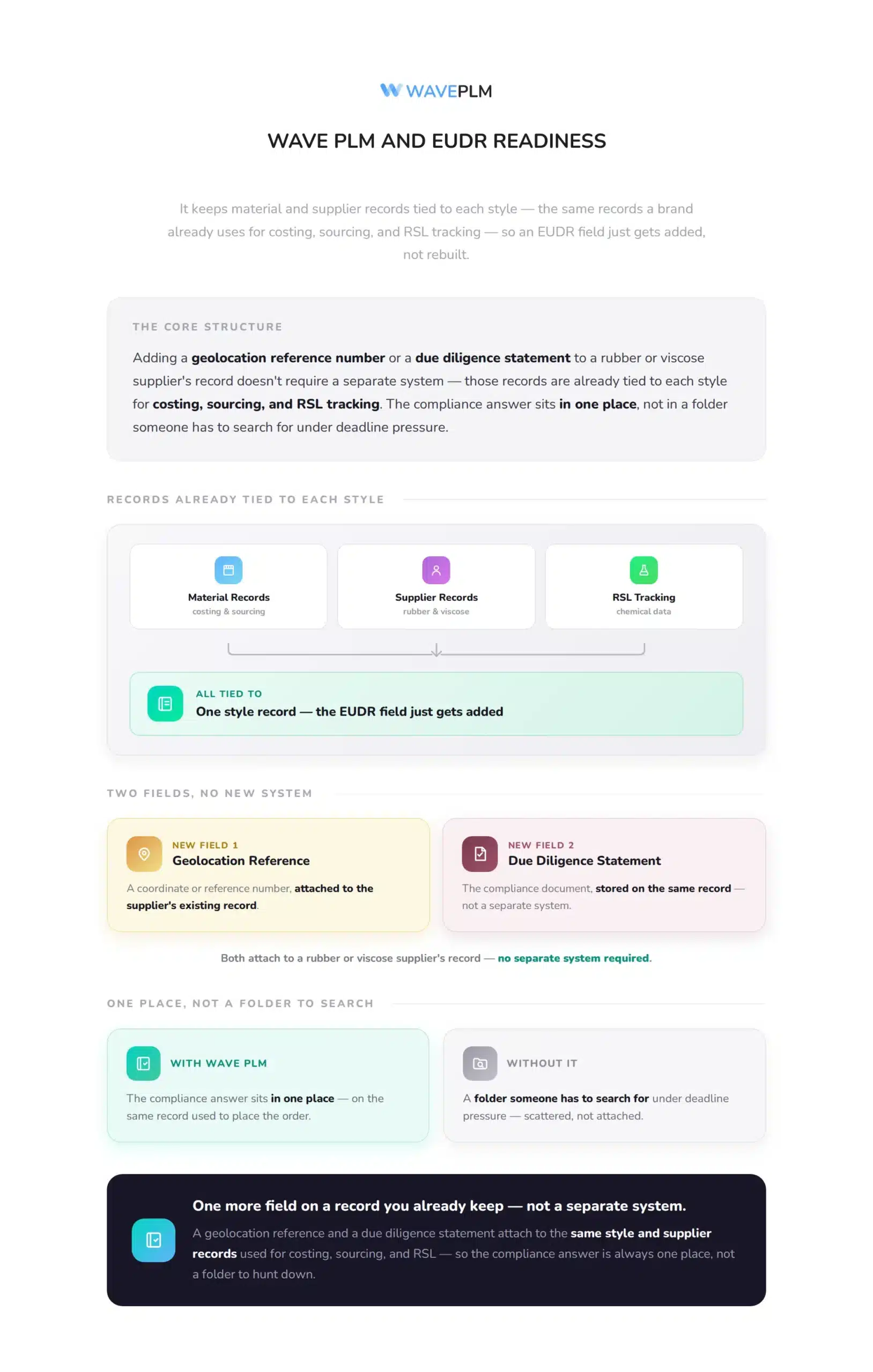
Wave PLM keeps material and supplier records tied to each style. These are the same records a brand already uses for costing, sourcing, and RSL tracking. Adding a geolocation reference number, or a due diligence statement, to a rubber or viscose supplier’s record does not require a separate system. As a result, the compliance answer sits in one place, not in a folder someone has to search for under deadline pressure.
Frequently Asked Questions
Does the EU deforestation regulation still apply to leather?
No. Cattle leather (HS codes 4101, 4104, 4107) dropped out of EUDR’s scope in the December 2025 revision, since the European Commission classified it as a low-impact by-product of meat production.
What materials in fashion are still covered by EUDR?
Natural rubber used in footwear soles and elastics, dissolving wood pulp used for viscose, lyocell, and modal fibers when sourced directly, plus wooden frames, hardware, or standalone paper products.
When does the EU deforestation regulation take effect?
Large and medium operators must comply from 30 December 2026. Micro and small operators get until 30 June 2027, after the regulation’s second delay, agreed in December 2025.
What is the penalty for EUDR non-compliance?
Fines start at a minimum of 4% of a company’s annual EU-wide turnover, with no upper cap if the economic benefit from non-compliance exceeds that amount. Confiscation of goods, a temporary EU market trading ban, and a public procurement exclusion of up to 12 months can also apply.
How is EUDR different from CSDDD?
CSDDD covers broad human-rights and environmental due diligence across a large company’s full value chain. EUDR is narrower and commodity-specific. It requires geolocation-level traceability for rubber, wood, and five other named commodities, regardless of company size.
Do fashion brands need to collect geolocation data themselves?
Most fashion brands act as downstream traders, not the operators who first place raw rubber or wood pulp on the EU market. Their main obligation: collect the upstream reference number from suppliers, store it for five years, and pass it along the supply chain.
The EU deforestation regulation has changed twice in ways that catch fashion brands by surprise. First, by delaying the deadline to December 2026. Then, by dropping leather from scope entirely while keeping rubber and viscose in it. A brand that built its compliance plan around leather testing now needs to redirect that effort. The suppliers who actually sit inside the current rule are the ones that matter now. Wave PLM keeps that supplier and material data in one system. A shift like this means updating a few records, not rebuilding a compliance program from scratch.







Leave a Reply