
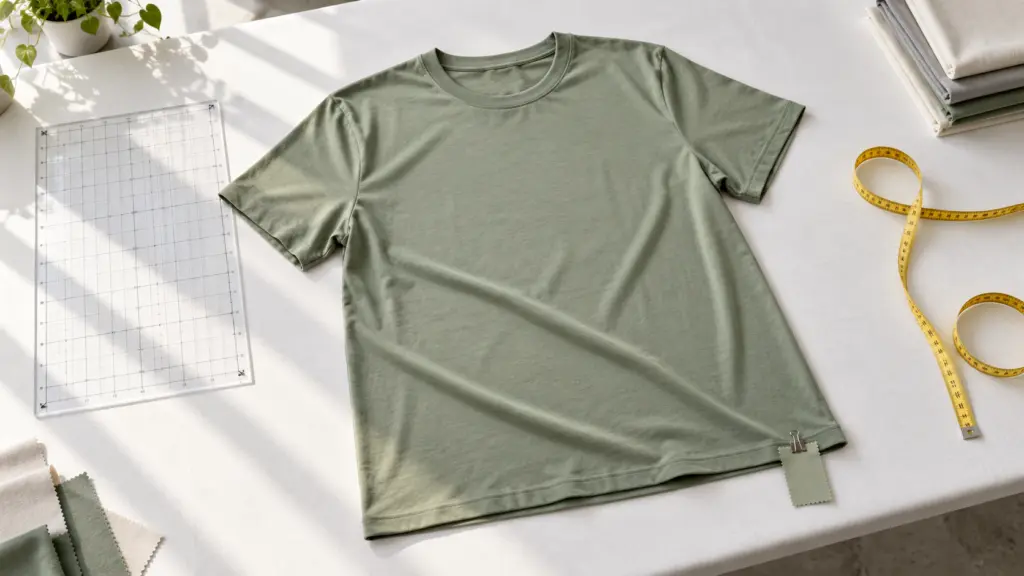
Modal fabric is made from a regenerated cellulose fibre, usually spun from beech or other hardwood pulp, that keeps much more of its strength when wet than ordinary viscose. As a result, modal fabric feels soft and smooth like viscose but holds its shape better in the wash. Consequently, it dominates underwear, loungewear, and premium T-shirt jersey.
For a brand, however, the useful questions are more specific. For example, how is modal different from viscose on a lab report? Why does it cost more than lyocell right now? And what can you legally print on the label? Thus, this guide answers each one and ends with the fields to add to your fabric spec.
What Is Modal Fabric Made Of?
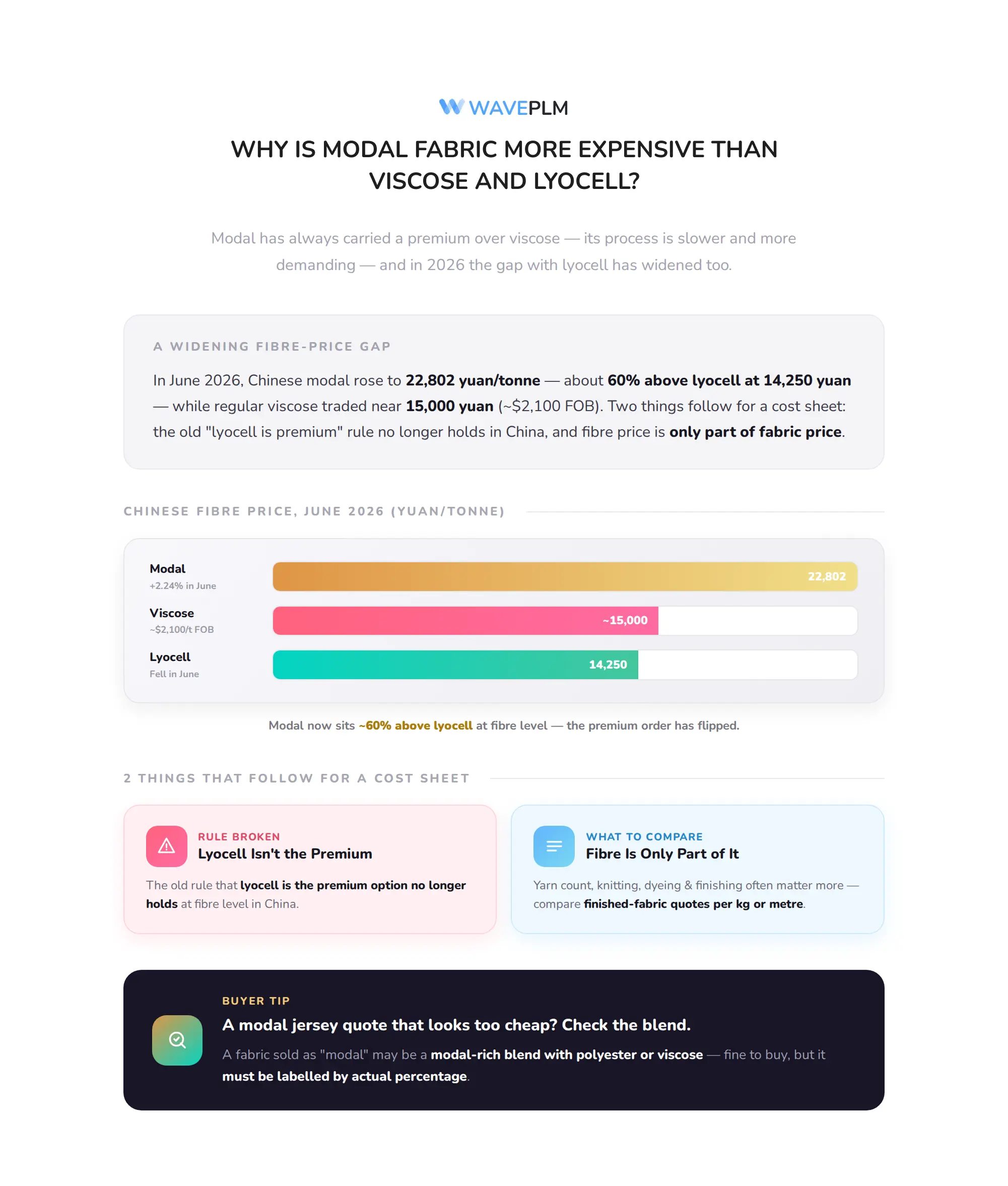
Modal is a cellulose fibre in the same family as viscose and lyocell. Like viscose, it starts as dissolving wood pulp, which producers convert into a spinning solution and then regenerate into fibre. However, the difference lies in the spinning conditions. Specifically, producers adjust the process so the fibre has a more ordered structure, which gives it a higher breaking strength and a much higher wet modulus.
In other words, wet modulus is how strongly a fibre resists stretching when it is wet. Meanwhile, ordinary viscose swells and stretches when wet, which is why viscose garments shrink and lose shape. In contrast, modal resists that, so modal fabric is often described as a high wet modulus (HWM) fibre.
Definition: Under EU Regulation 1007/2011, modal is a cellulose fibre with a high breaking force and a high wet modulus. The regulation sets minimum values for the dry breaking force and for the force needed to stretch the wet fibre by 5%, both scaled to fibre fineness.
Historically, the fibre comes from Austria. Lenzing has produced it since the 1960s; it was first sold as “Hochmodul 333”, and Lenzing Modal is still made from beech wood. Today, however, many producers in Asia also make generic modal fibre.
How Is Modal Fabric Different From Viscose and Lyocell?
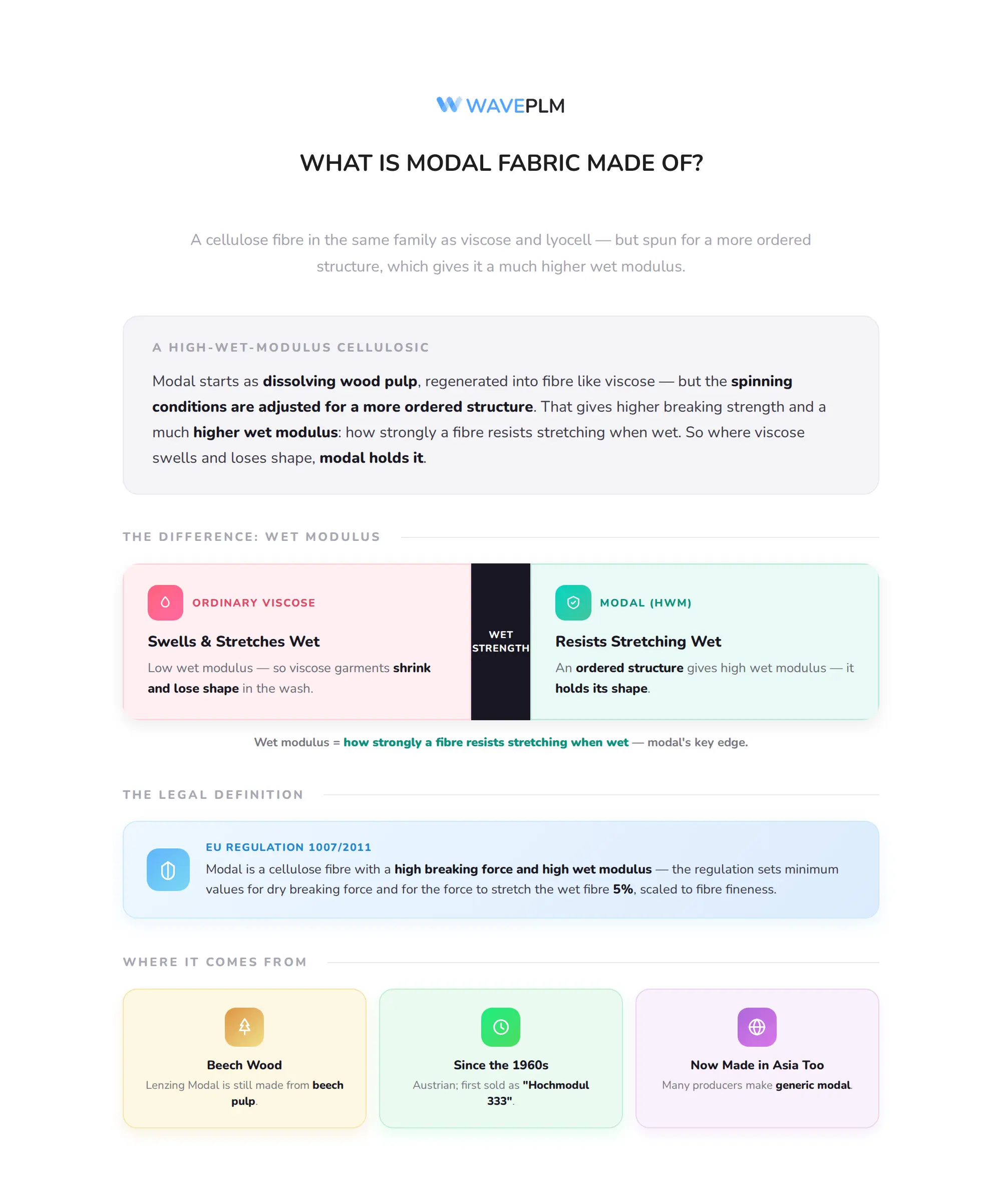
All three fibres come from wood pulp, yet they behave differently in production. Overall, modal sits in the middle: stronger and more stable than viscose, but with a softer, more fluid hand than most lyocell. Accordingly, the table below focuses on the points that change a buying decision.
| Decision point | Modal | Viscose | Lyocell |
|---|---|---|---|
| Best known for | Softness and shape retention in knits | Drape and print quality in wovens | Strength and low shrinkage in wovens |
| Wet strength | Medium to high | Low | High |
| Shrinkage risk | Low to medium | High | Low |
| Main surface risk | Pilling and fuzzing in fine jersey | Creasing and seam slippage | Fibrillation (white, frosted look) |
| China fibre price, mid-2026 | About 22,800 yuan per tonne | About US$2,100 per tonne FOB | About 14,250 yuan per tonne |
| Typical products | Underwear, loungewear, tees, sleepwear | Dresses, blouses, linings, prints | Shirting, denim blends, dresses |
In practice, choose modal fabric when a knit must stay soft after many washes and keep its fit. By contrast, viscose usually wins for printed woven dresses, and lyocell wins where strength matters most. For the other two fibres in detail, see our guides to viscose fabric and lyocell fabric.
Why Is Modal Fabric More Expensive Than Viscose and Lyocell?
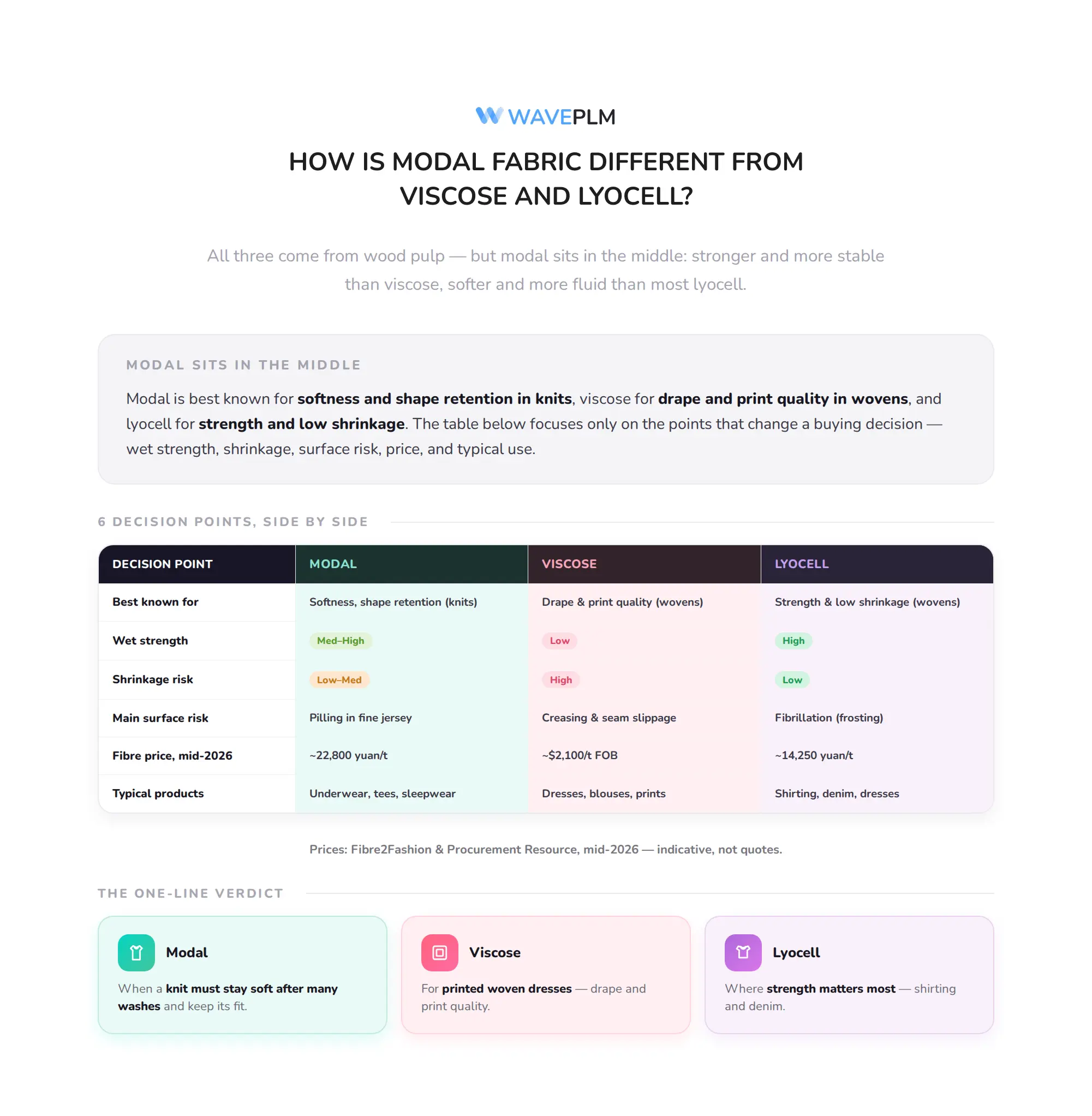
Notably, modal has always carried a premium over viscose because the process is slower and more demanding. In 2026, however, the gap with lyocell has also widened. According to Fibre2Fashion, Chinese modal fibre rose 2.24% to 22,802 yuan per tonne at the end of June 2026, while lyocell fell to 14,250 yuan per tonne. Meanwhile, regular viscose staple fibre traded at roughly US$2,100 per tonne FOB China, or about 15,000 yuan, according to Procurement Resource.
Industry data: In June 2026, Chinese modal fibre traded at 22,802 yuan per tonne, about 60% above lyocell at 14,250 yuan per tonne (Fibre2Fashion, June 30, 2026).
As a result, two things follow for a cost sheet. First, the old rule that lyocell is the premium option no longer holds at fibre level in China. Second, fibre price is only part of the fabric price; yarn count, knitting, dyeing, and finishing often matter more. Therefore, compare finished fabric quotes per kilogram or per metre, not fibre prices per tonne. Our garment costing guide shows where each line belongs.
Buyer tip: When a modal jersey quote looks too cheap, check the blend first. A fabric sold as “modal” may be a modal-rich blend with polyester or viscose, which is fine to buy but must be labelled by actual percentage.
Does Modal Fabric Shrink?
Modal fabric shrinks less than viscose, because the fibre keeps more of its strength when wet. According to Fibre2Fashion (November 2025), modal retains up to 85% of its dry strength when wet, and its shrinkage on washing is very low compared with viscose. That said, fibre content is only one factor.
In reality, most modal fabric shrinkage complaints come from construction and finishing. For example, single jersey that was stretched on the frame during finishing will relax in the first wash. Similarly, high-heat tumble drying can still shrink modal blends. For that reason, a tech pack should never say “modal, low shrinkage” and stop there. Instead, write the test method, the number of washes, and the tolerance, for example length and width within plus or minus 5% after three home launderings.
Equally important, measure garments, not just fabric. For instance, a modal tee can pass a fabric test and still twist at the side seam after washing, which is a knitting and cutting issue rather than a fibre issue.
Does Modal Fabric Pill?
Yes, it can. In fact, fine modal jersey and brushed modal are soft precisely because the fibres are fine and loosely held, and that makes the surface prone to fuzz and pills. In addition, blends with polyester tend to hold pills on the surface longer, because the stronger synthetic fibre anchors them.
Therefore, add a pilling requirement to every modal fabric spec, especially for loungewear and sleepwear that rub against bedding. Many buyers ask for grade 3 to 4 under ISO 12945 for knits; our guide to fabric pilling tests and grades explains how to set the method and threshold. Notably, compact or siro-spun yarns and a light enzyme finish usually improve results more than changing the fibre.
Is Modal Fabric Sustainable?
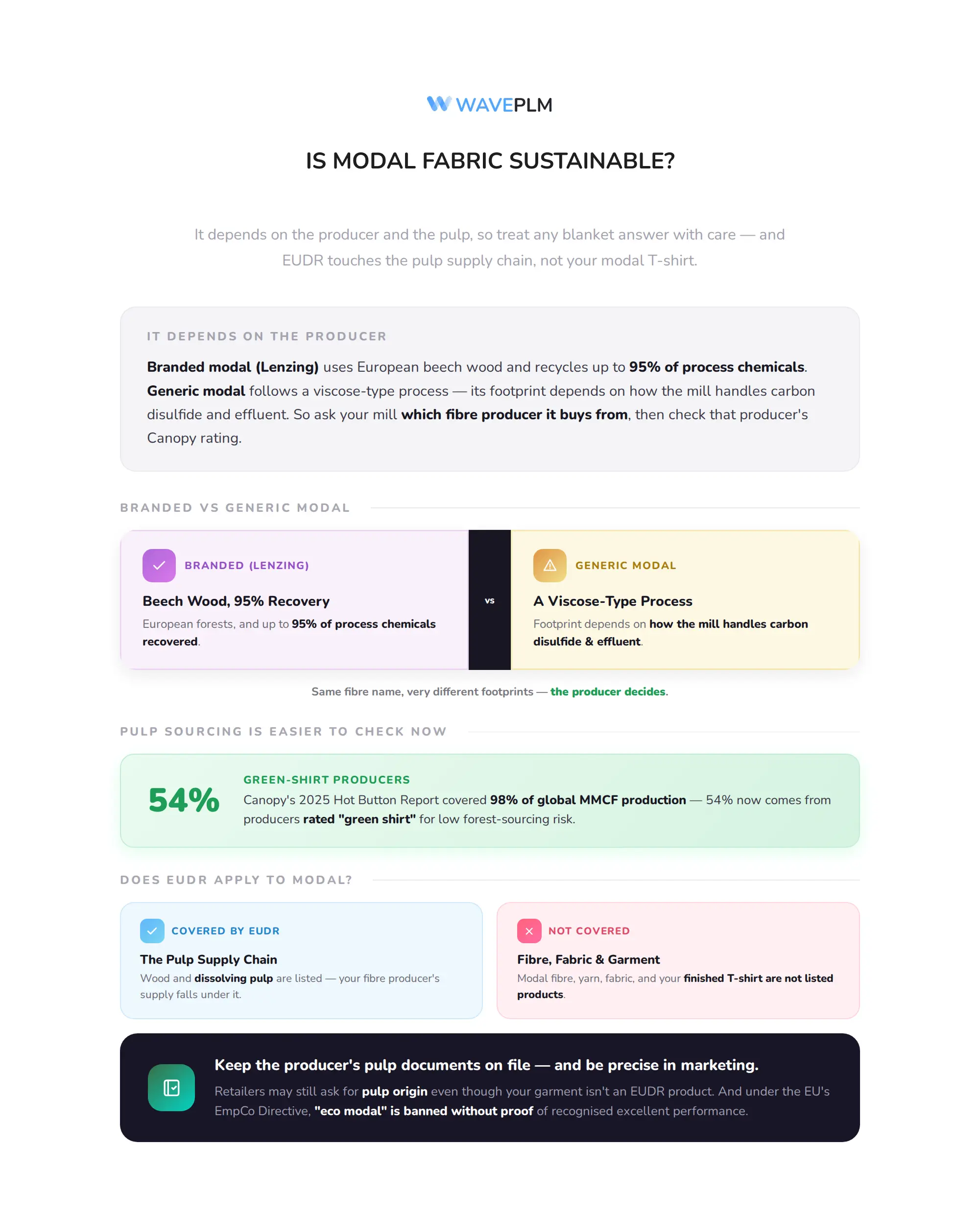
Importantly, it depends on the producer and the pulp, so treat any blanket answer with care. On the positive side, branded modal from Lenzing uses beech wood from European forests, and Lenzing has reported recycling up to 95% of the process chemicals. On the other hand, generic modal follows a viscose-type process, and its footprint depends on how well the mill handles carbon disulfide and effluent.
Fortunately, pulp sourcing is easier to check than it was a decade ago. In its 10th Hot Button Report (October 2025), Canopy assessed 30 producers representing 98% of global man-made cellulosic fibre production. Moreover, it found that 54% of production now comes from producers with a “green shirt” rating for forest sourcing. Therefore, ask your mill which fibre producer it buys from, then look up that producer’s rating.
Industry data: Canopy’s 2025 Hot Button Report covered 98% of global man-made cellulosic fibre production and found that 54% of it came from producers rated “green shirt” for low risk of sourcing from ancient and endangered forests.
Additionally, be precise in marketing. In the EU, the Empowering Consumers Directive has applied since 27 September 2026 and bans generic environmental claims, such as “eco modal”, unless you can prove recognised excellent environmental performance. Our article on green claims for fashion brands covers what evidence to keep.
Does EUDR Apply to Modal Fabric?
Not to the fabric or the garment. The EU Deforestation Regulation covers wood and some wood products, including dissolving pulp, but modal fibre, yarn, fabric, and finished apparel are not listed products. In other words, your fibre producer’s pulp supply chain falls under EUDR, while your modal T-shirt does not. Even so, retailers may still ask for pulp origin, so keep the producer’s documents on file. Our EUDR guide for fashion brands explains the scope.
How Should You Label Modal Fabric?
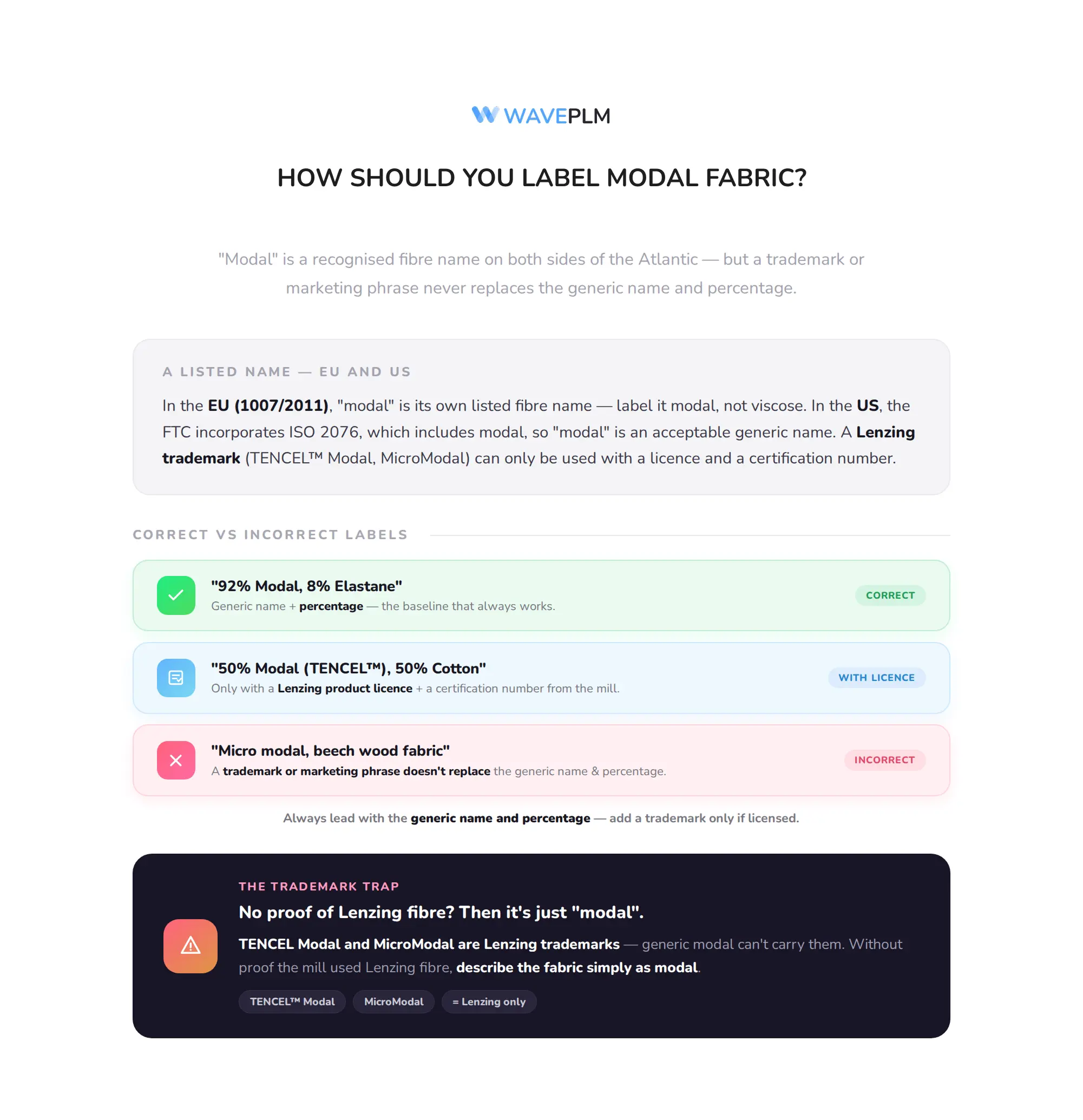
Modal is a recognised fibre name on both sides of the Atlantic. In the EU, Regulation 1007/2011 lists “modal” as its own fibre name, so it should appear on the label as modal, not as viscose. In the US, the FTC Textile Rules incorporate the generic names in ISO 2076, which include modal, so “modal” is an acceptable generic name on the fibre content label.
- Correct: “92% Modal, 8% Elastane”.
- Correct with a licence: “50% Modal (TENCEL™), 50% Cotton”, if Lenzing has granted a product licence and the mill supplies a certification number.
- Incorrect: “Micro modal, beech wood fabric”, because a trademark or marketing phrase does not replace the generic fibre name and percentage.
Similarly, brand names deserve particular care. TENCEL Modal and MicroModal are Lenzing trademarks, so a fabric made from generic modal cannot carry them. Consequently, if a mill cannot provide proof that it used Lenzing fibre, describe the fabric simply as modal.
What Should a Modal Fabric Spec Include?
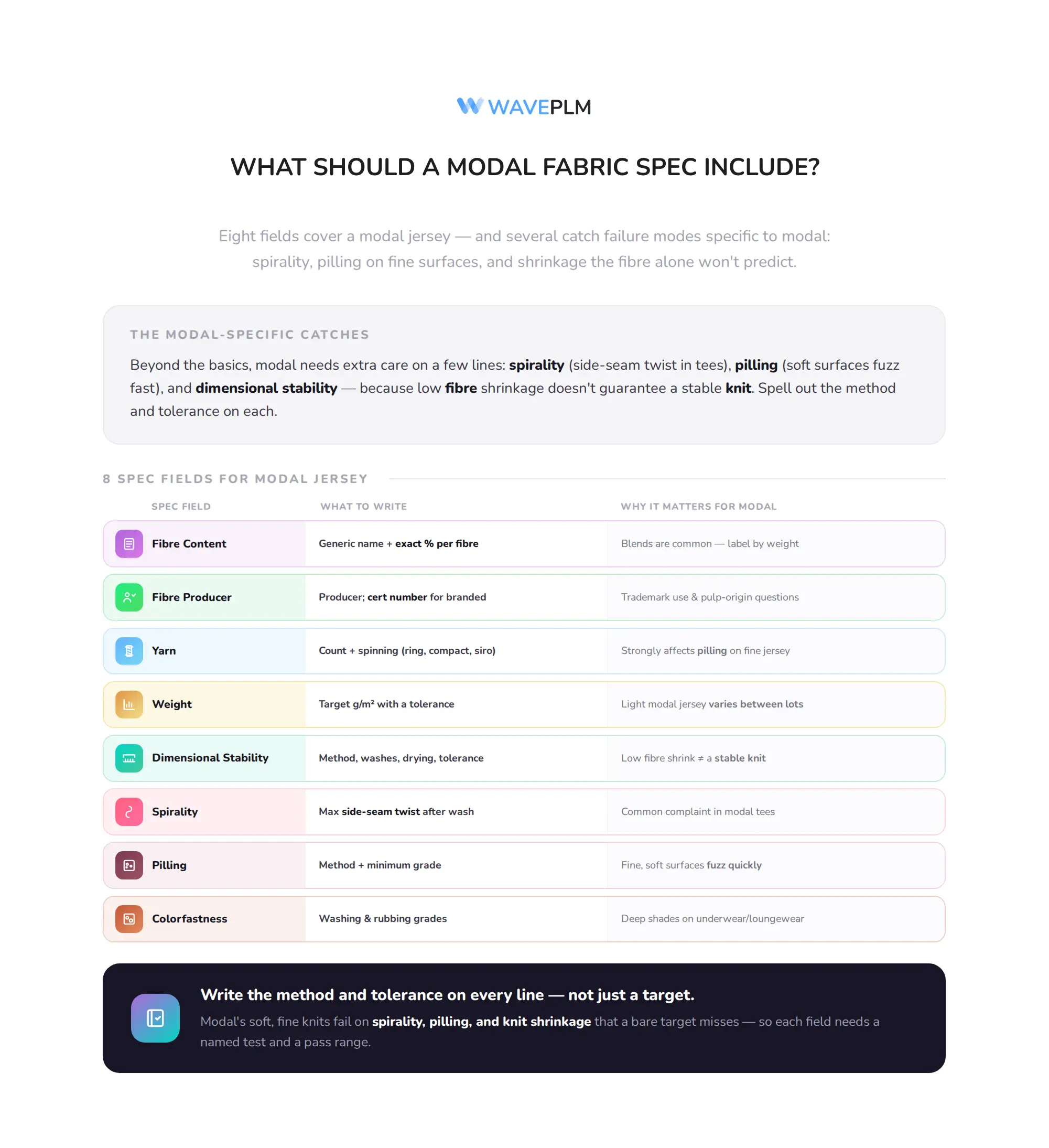
| Spec field | What to write | Why it matters for modal |
|---|---|---|
| Fibre content | Generic name and exact percentage per fibre | Blends are common and must be labelled by weight |
| Fibre producer | Producer name; certification number for branded fibre | Needed for trademark use and pulp-origin questions |
| Yarn | Count and spinning system (ring, compact, siro) | Strongly affects pilling on fine jersey |
| Weight | Target g/m² with tolerance | Light modal jersey varies easily between lots |
| Dimensional stability | Method, number of washes, drying, tolerance | Low fibre shrinkage does not guarantee a stable knit |
| Spirality | Maximum side-seam twist after washing | Common complaint in modal and modal-blend tees |
| Pilling | Method and minimum grade | Fine, soft surfaces fuzz quickly |
| Colorfastness | Washing and rubbing grades | Deep shades on underwear and loungewear |
For the weight line, see our explainer on fabric GSM. Likewise, the colorfastness guide lists typical rubbing grades for dark knits. To see how these tests fit together in development, read our overview of apparel product testing.
When Is Modal the Right Fabric?
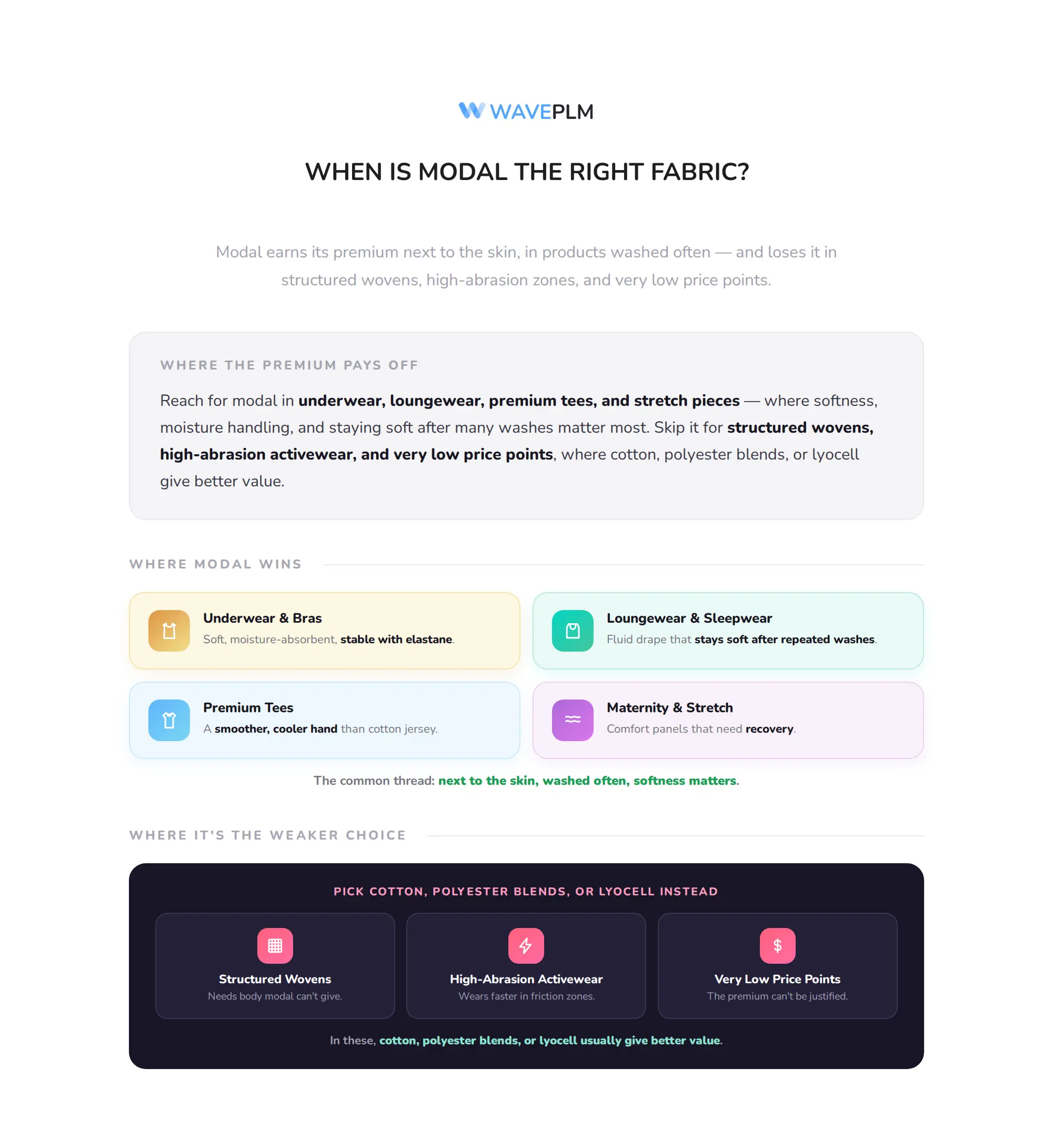
In practice, modal fabric earns its premium in products worn next to the skin and washed often. Consider it for:
- Underwear and bras: soft, moisture-absorbent, and stable with elastane.
- Loungewear and sleepwear: fluid drape that stays soft after repeated washes.
- Premium tees: a smoother, cooler hand than cotton jersey.
- Maternity and stretch pieces: comfort panels that need recovery; our article on maternity apparel PLM covers how to manage them.
Conversely, modal fabric is a weaker choice for structured wovens, high-abrasion activewear zones, and very low price points. In those cases, cotton, polyester blends, or lyocell usually give better value.
Modal in Practice: Before and After a Fibre Swap
Swapping viscose jersey for modal fabric is one of the most common quality upgrades in loungewear. However, the swap touches more records than most teams expect. Specifically, here is how the same change looks in two different setups.
| Step | Spreadsheets and email | One shared material record |
|---|---|---|
| Update fibre content | Edited in each style’s tech pack separately | Changed once and pushed to every style that uses the fabric |
| New test results | Lab PDF saved in someone’s inbox | Attached to the fabric, visible to design and QA |
| Care and content labels | Re-keyed by hand, risk of “viscose” left on old labels | Generated from the current fibre content |
| Cost sheet | Old fabric price copied forward | New price linked to every affected style |
Here is a quick test for your own team. Pick one fabric you switched last season. Then count the tech packs, labels, and cost sheets that still show the old fibre. If that takes longer than a minute, the material data lives in too many places. In that case, the next swap will repeat the same clean-up. That is the gap a shared material library closes, and it is the first thing we show in a Wave PLM walkthrough.
Frequently Asked Questions
What is modal fabric made of?
Modal fabric is made from regenerated cellulose, usually from beech or other hardwood pulp. Producers dissolve the pulp and spin it into fibre under conditions that give the fibre high strength and a high wet modulus. As a result, modal is softer and more stable in the wash than ordinary viscose.
What is the downside of modal fabric?
The main drawbacks are cost and surface wear. Modal fibre costs more than viscose and, in China in 2026, more than lyocell. In addition, fine modal jersey can pill or fuzz, so brands should specify yarn type and a minimum pilling grade.
Is modal the same as cotton?
No. Cotton is a natural seed fibre, while modal is a manufactured fibre regenerated from wood cellulose. Both are cellulose, so they feel breathable and absorb moisture, but modal fabric is smoother, drapes more, and usually absorbs more moisture than cotton.
Is modal a type of polyester?
No. Polyester is a synthetic fibre made from petrochemicals, whereas modal is made from wood pulp. However, many modal fabrics are blended with polyester or elastane, so always check the fibre content label for the actual percentages.
Does modal fabric shrink in the wash?
Modal fabric shrinks much less than viscose because it keeps more of its strength when wet. Still, knit construction, finishing, and hot tumble drying can cause shrinkage. Brands should specify a dimensional stability test with a clear tolerance in the tech pack.
Can I call my fabric TENCEL Modal?
Only if the fabric uses Lenzing fibre and you hold a product licence from Lenzing. The mill must also supply a valid certification number. Otherwise, use the generic fibre name, modal, with its percentage on the label.
Conclusion
Modal fabric is the soft, stable member of the wood-cellulose family, and it is the default choice for next-to-skin knits that must survive many washes. In short, buy it for shape retention and hand feel, budget for its 2026 price premium, and spec it properly: producer, yarn, pilling, dimensional stability, and spirality. Finally, label it as modal, keep trademarks for licensed fibre, and keep evidence for every sustainability claim you make.



Leave a Reply