

Wholesale pricing is the price a brand charges retailers, distributors, or other businesses that buy its products to resell them. In apparel, a good wholesale price has to do two jobs at once. First, it must cover the brand’s landed cost with enough margin. Second, it must leave the retailer room to sell at the recommended retail price and still make its own margin. If either side fails, the account either loses money or never reorders.
This guide explains how to set wholesale pricing for an apparel line step by step. Specifically, it covers the two core formulas and how to reconcile them. It also covers volume tiers, payment terms, and a full worked example for your own cost sheets.
What Is Wholesale Pricing in Apparel?
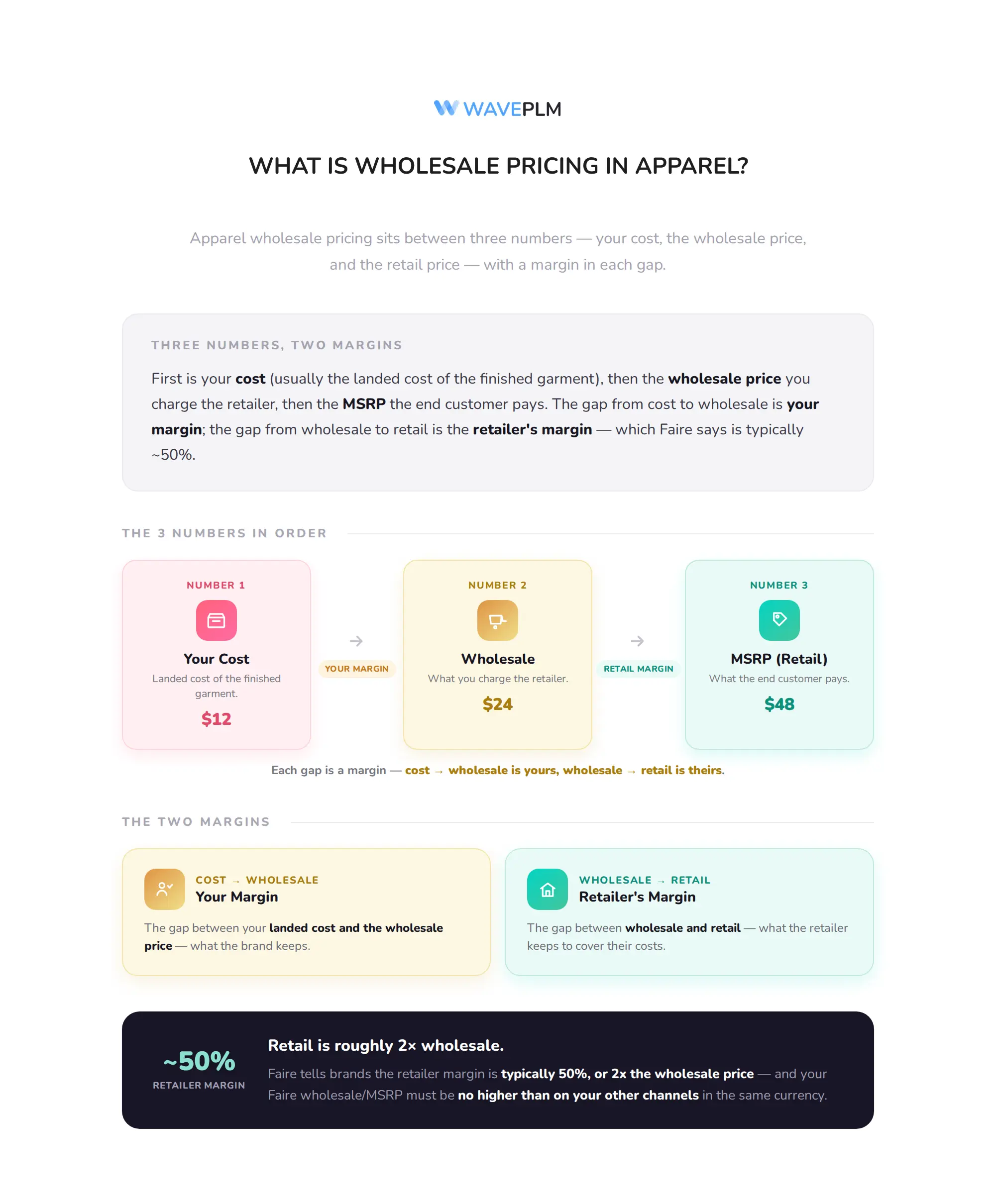
In practice, apparel wholesale pricing sits between three numbers. First comes your cost, usually the landed cost of the finished garment. Second is the wholesale price, which you charge the retailer. Third is the manufacturer’s suggested retail price (MSRP), the price you expect the end customer to pay.
The gap between cost and wholesale is your margin. Meanwhile, the gap between wholesale and retail is the retailer’s margin. According to Faire’s guidance for brands, retailers typically expect a margin of about 50%. In other words, retail is roughly two times wholesale.
Industry data: Faire tells brands that the retailer margin is “typically 50%, or 2x the wholesale price”. In addition, wholesale prices and MSRP on Faire must be no higher than on the brand’s other channels in the same currency.
Wholesale vs. Retail Pricing: What’s the Difference?
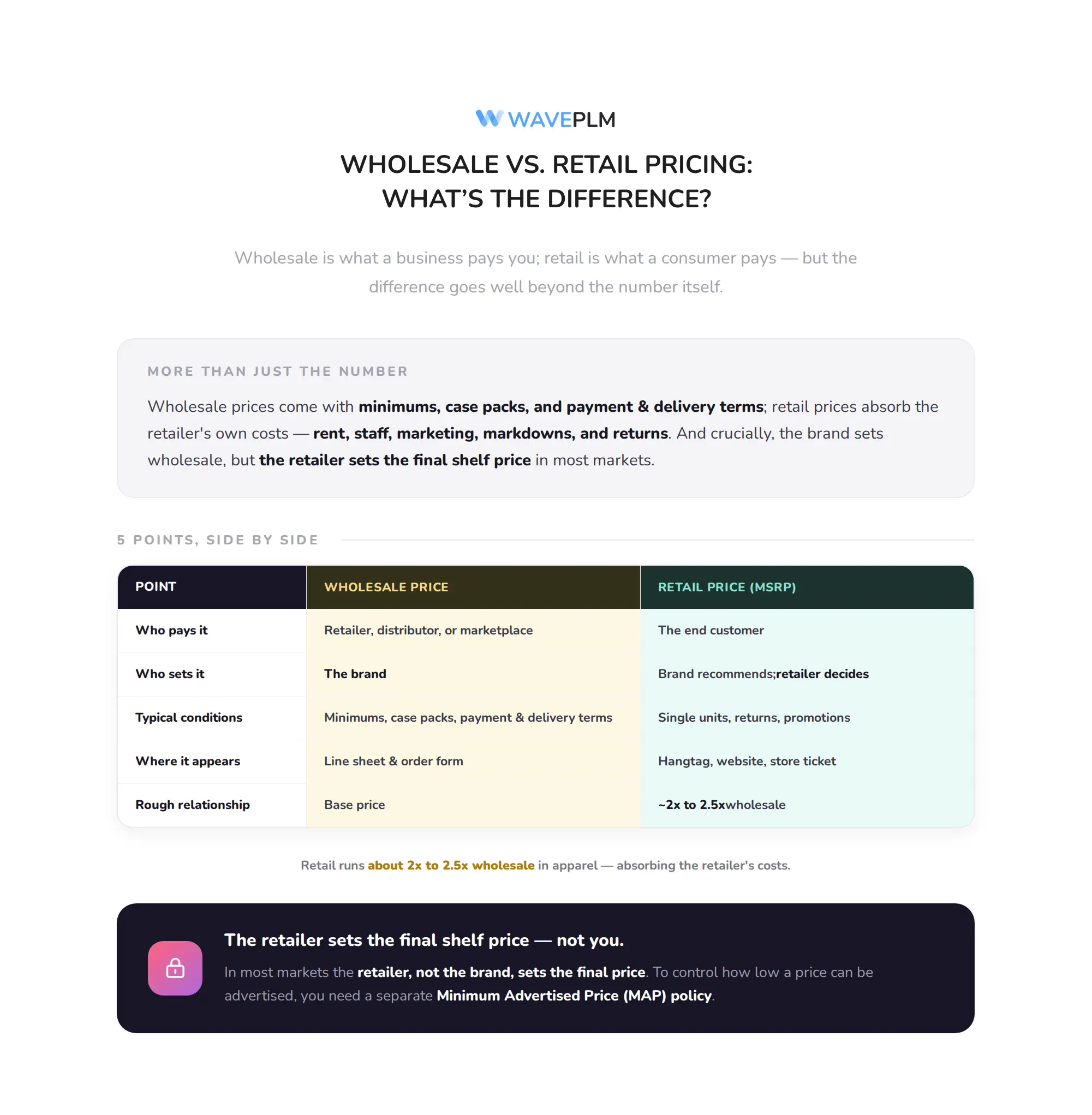
Simply put, wholesale pricing is what a business pays you; retail pricing is what a consumer pays. However, the difference goes beyond the number itself. Wholesale prices usually come with minimum order quantities, case packs, payment terms, and delivery terms. Retail prices, on the other hand, include the retailer’s own costs: rent, staff, marketing, markdowns, and returns.
| Point | Wholesale price | Retail price (MSRP) |
|---|---|---|
| Who pays it | Retailer, distributor, or marketplace | End customer |
| Who sets it | The brand | The brand recommends; the retailer decides |
| Typical conditions | Minimums, case packs, payment and delivery terms | Single units, returns policy, promotions |
| Where it appears | Line sheet and order form | Hangtag, website, store ticket |
| Rough relationship | Base price | About 2x to 2.5x wholesale in apparel |
Notably, the retailer, not the brand, sets the final shelf price in most markets. To control how low a price can be advertised, you need a separate policy. Our guide to minimum advertised price (MAP) policies explains how that works.
How Do You Calculate a Wholesale Price?
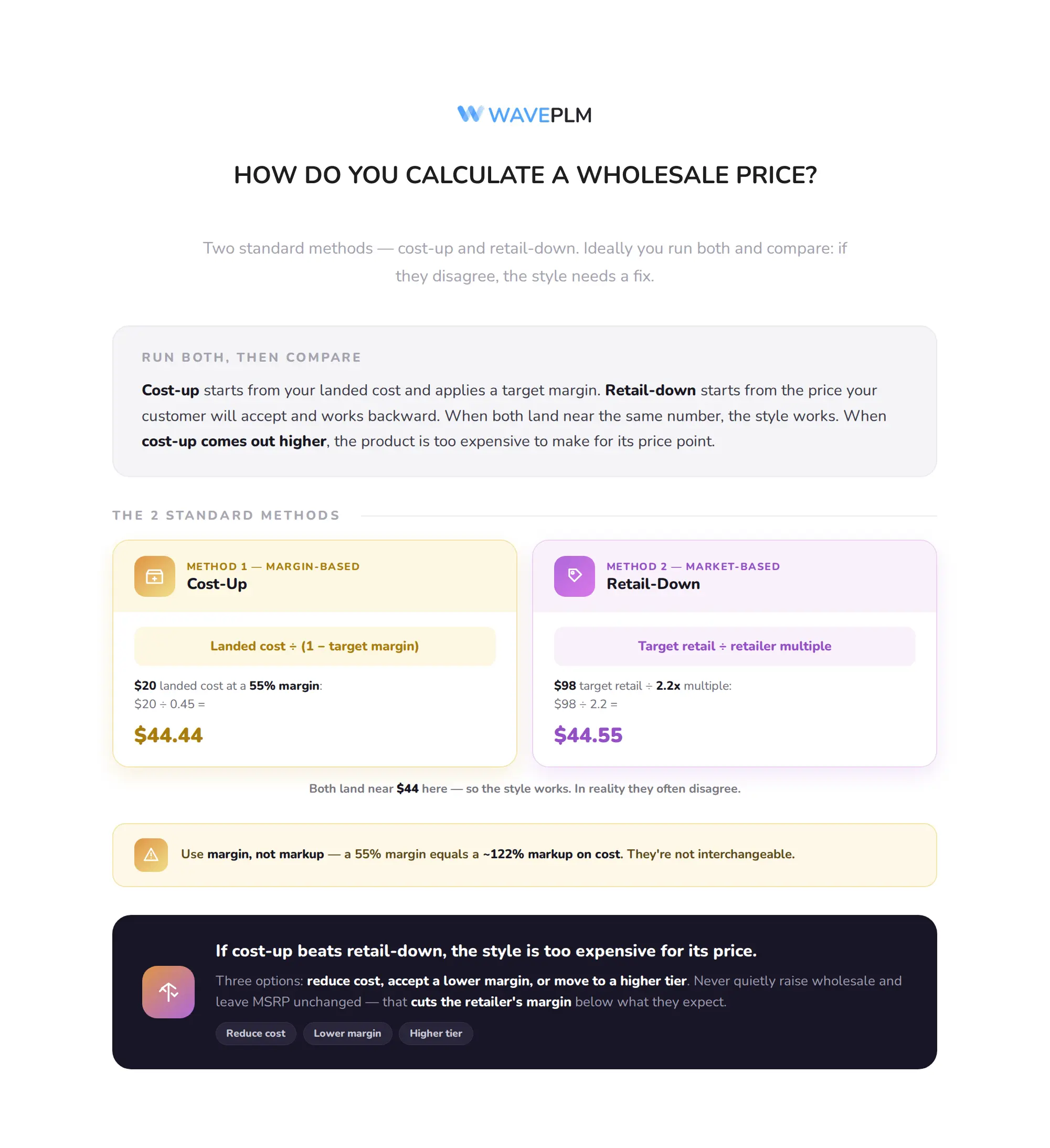
There are two standard ways to calculate a wholesale price. Ideally, you run both and compare the results.
Method 1: Cost-up (margin-based)
Start from your landed cost and apply your target gross margin:
Formula: Wholesale price = Landed cost ÷ (1 − target margin). For example, a $20 landed cost at a 55% target margin gives $20 ÷ 0.45 = $44.44.
Importantly, this formula uses margin, not markup. In fact, a 55% margin equals a markup of about 122% on cost. Thus, the two words are not interchangeable. For the cost itself, our landed cost guide and garment costing guide walk through each line.
Method 2: Retail-down (market-based)
Alternatively, start from the retail price your customer will accept and work backwards:
Formula: Wholesale price = Target retail price ÷ retailer multiple. For example, a $98 target retail price divided by a 2.2x retailer multiple gives a wholesale price of $44.55.
The simplest version of this method is keystone pricing, where retail equals exactly two times wholesale. Our article on keystone pricing covers when that rule works and when it does not.
Reconciling the two methods
In the examples above, both methods land near $44, so the style works. In reality, they often disagree. If cost-up gives a higher number than retail-down, the product is too expensive to make for its price point. In that case, you have three options. Reduce cost, accept a lower margin, or move the style to a higher price tier. However, never quietly raise the wholesale price and leave the MSRP unchanged. Otherwise, the retailer’s margin falls below what it expects.
What Margin Should an Apparel Brand Target on Wholesale?
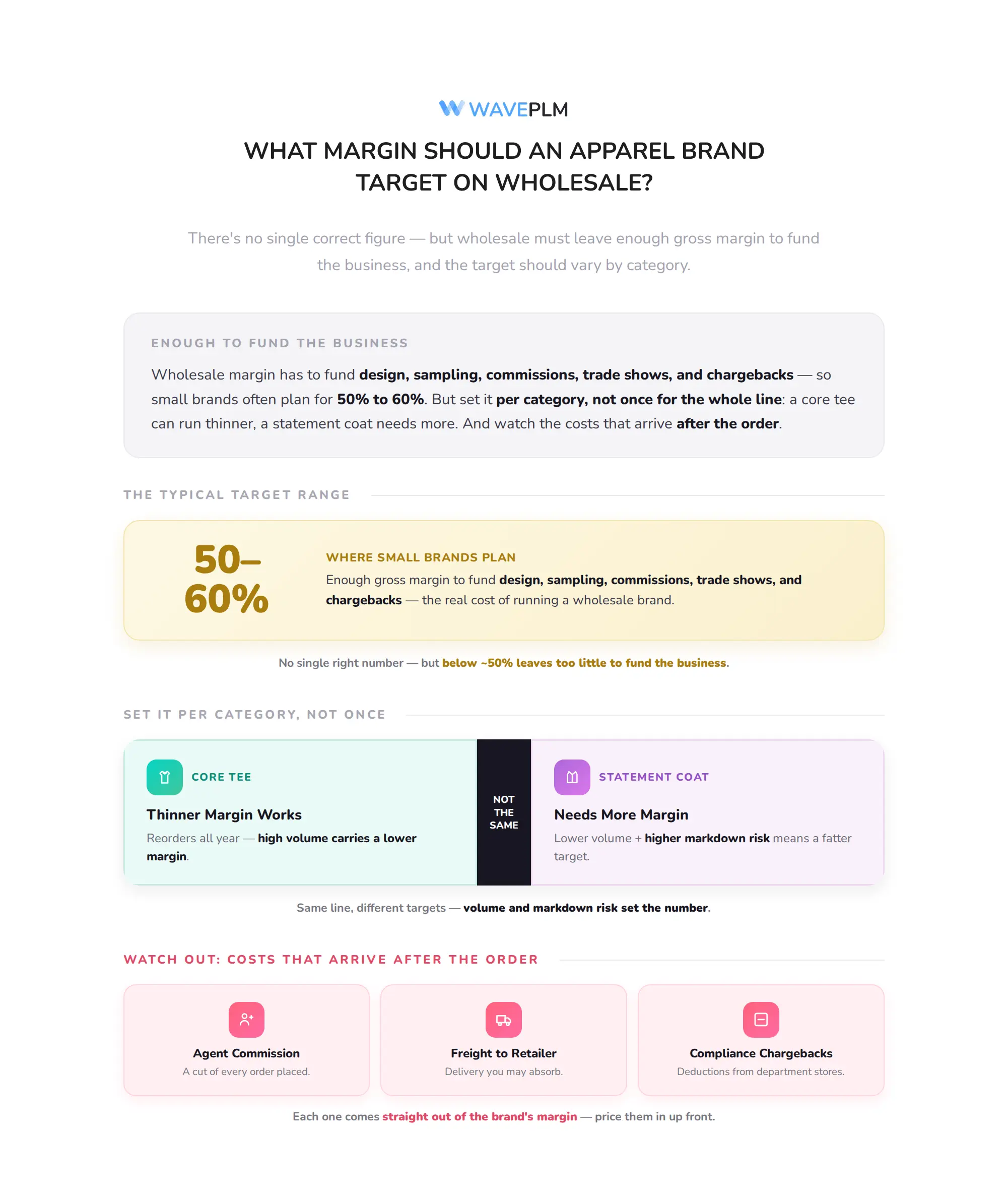
There is no single correct figure. Still, wholesale pricing must leave enough gross margin to fund design, sampling, commissions, trade shows, and chargebacks. For that reason, small apparel brands often plan for a wholesale margin of roughly 50% to 60%.
Margin also varies inside a collection. For example, a core T-shirt that reorders all year can run on a thinner margin. In contrast, a statement coat needs more to cover lower volume and higher markdown risk. Therefore, set the target margin per category, not once for the whole line.
Watch out: The costs most easily left out of wholesale pricing arrive after the order. These include agent commission, freight to the retailer, and compliance chargebacks. Each one comes straight out of the brand’s margin.
Chargebacks deserve particular attention if you sell to department stores. Our guide to retail chargebacks and vendor compliance lists the most common deductions.
Should You Offer Volume Tiers and Discounts?
Volume tiers can grow average order size, but they also complicate wholesale pricing. As a rule, offer tiers only where a bigger order really lowers your cost. For example, a larger order may meet a factory minimum or fill a full carton. Our guide to minimum order quantities shows how factory MOQs shape those breakpoints.
| Tool | How it works | When to use it |
|---|---|---|
| Opening order minimum | Minimum value or units for a first order | Always; protects small-order handling costs |
| Size-run or prepack | Sell in fixed size ratios, such as 1-2-2-1 | Core styles with predictable size curves |
| Volume tier | Lower unit price above a set order value | Only when bigger orders lower your own cost |
| Early order discount | Discount for orders placed before a deadline | To lock production quantities before you buy fabric |
| Reorder price | Same or slightly higher price for in-season reorders | Replenishment styles with stock on hand |
Of all these tools, the early order discount often pays for itself. In particular, it gives you real order quantities before you commit to fabric, which reduces both overbuying and stock-outs.
Which Payment and Delivery Terms Affect Wholesale Pricing?
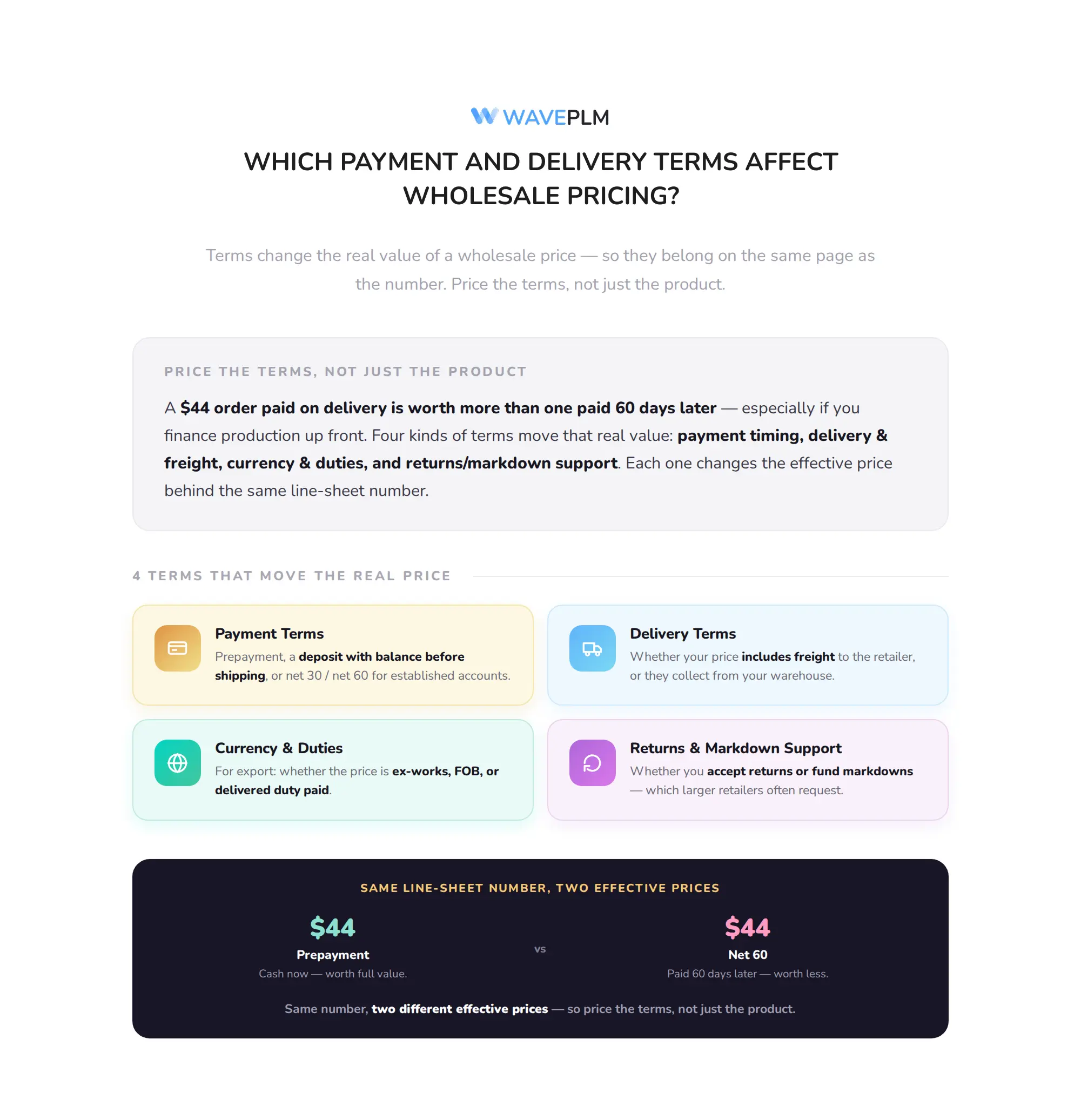
Terms change the real value of a wholesale price. Hence, they belong on the same page as the price. For example, a $44 order paid on delivery is worth more than one paid 60 days later. This matters most if you finance production up front.
- Payment terms: prepayment, a deposit with the balance before shipping, or net 30 or net 60 for established accounts.
- Delivery terms: whether your price includes freight to the retailer, or the retailer collects from your warehouse.
- Currency and duties: for export accounts, whether the price is ex-works, FOB, or delivered with duties paid.
- Returns and markdown support: whether you accept returns or fund markdowns, which some larger retailers request.
In short, price the terms, not just the product. Consequently, net 60 for one account and prepayment for another means two different effective prices, even with the same line sheet number.
A Worked Wholesale Pricing Example
Here is a simple example for a knit polo. The figures are illustrative; replace them with your own cost sheet.
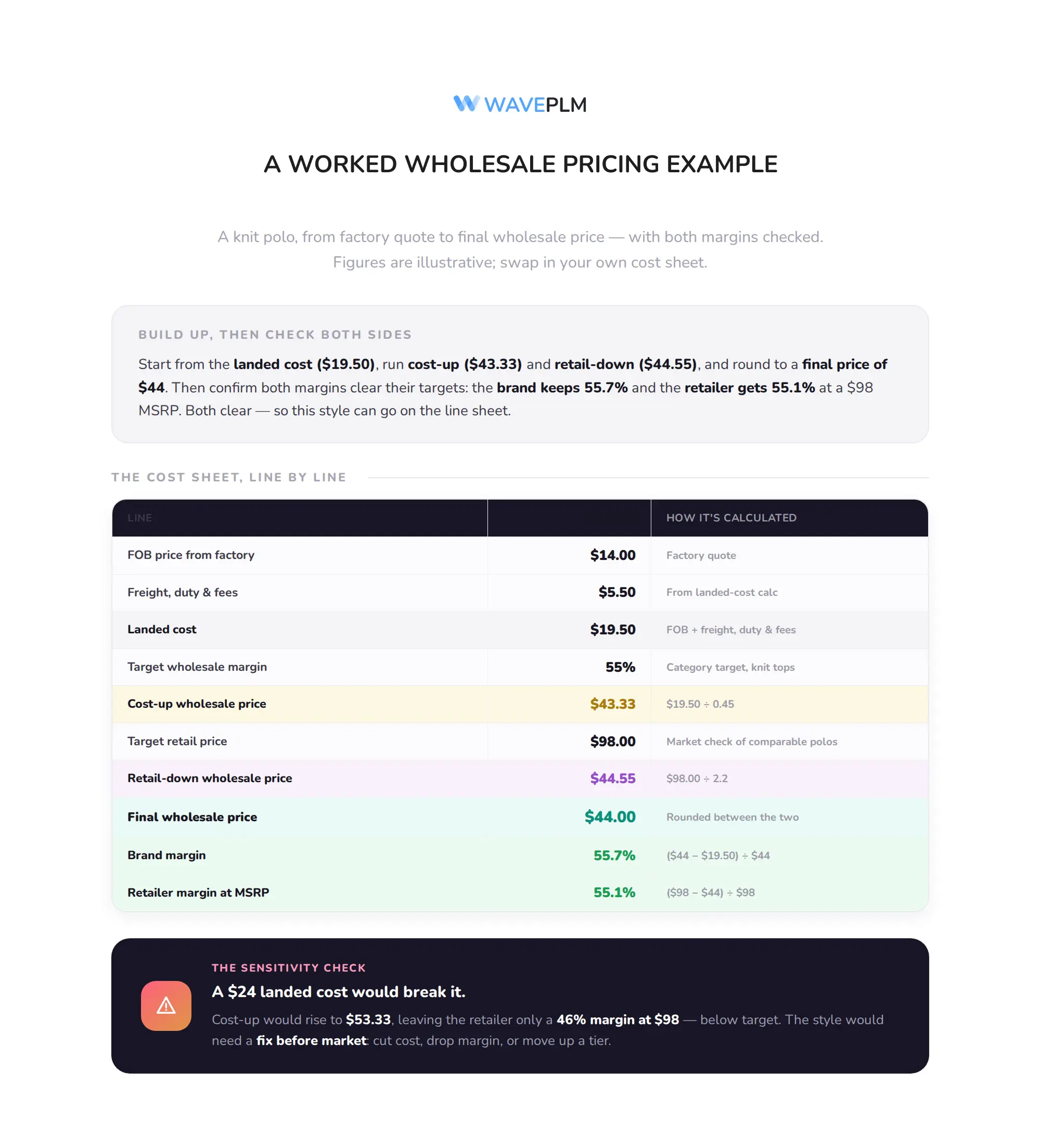
| Line | Value | How it is calculated |
|---|---|---|
| FOB price from factory | $14.00 | Factory quote |
| Freight, duty, and fees | $5.50 | From the landed cost calculation |
| Landed cost | $19.50 | FOB + freight, duty, and fees |
| Target wholesale margin | 55% | Category target for knit tops |
| Cost-up wholesale price | $43.33 | $19.50 ÷ 0.45 |
| Target retail price | $98.00 | Market check of comparable polos |
| Retail-down wholesale price | $44.55 | $98.00 ÷ 2.2 |
| Final wholesale price | $44.00 | Rounded between the two results |
| Brand margin | 55.7% | ($44.00 − $19.50) ÷ $44.00 |
| Retailer margin at MSRP | 55.1% | ($98.00 − $44.00) ÷ $98.00 |
As the table shows, both sides clear their targets, so the style can go on the line sheet. Had the landed cost been $24 instead, the cost-up price would rise to $53.33. That would leave the retailer only a 46% margin at $98, and the style would need a fix before market.
How Do You Present Wholesale Pricing to Retailers?
Retail buyers compare many brands quickly. Therefore, present wholesale pricing clearly and consistently. For each style, a line sheet should show wholesale price, MSRP, colours, sizes, minimums, and delivery windows. Our guide on how to create a line sheet covers the layout.
In addition, keep one price list per currency and channel, and date it. When a buyer says “your price went up”, a dated price list settles the question in seconds. Finally, review sell-through with each account after the season; our article on sell-through rate explains which numbers to ask for.
What Mistakes Do Brands Make With Wholesale Pricing?
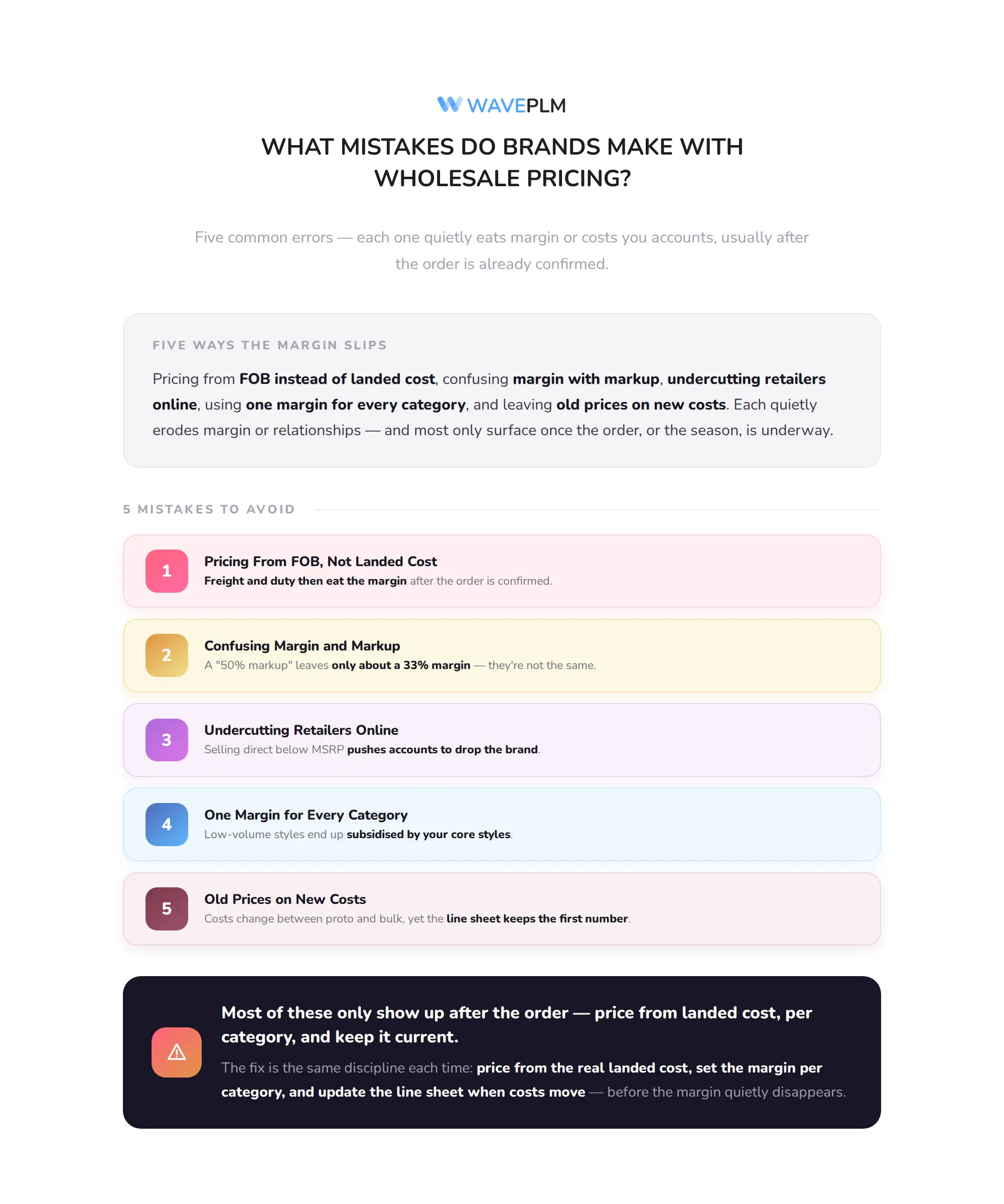
- Pricing from FOB, not landed cost. Freight and duty then eat the margin after the order is confirmed.
- Confusing margin and markup. A “50% markup” leaves only about a 33% margin.
- Undercutting retailers online. Selling direct below MSRP pushes accounts to drop the brand.
- One margin for every category. As a result, low-volume styles end up subsidised by core styles.
- Old prices on new costs. Costs change between proto and bulk, yet the line sheet keeps the first number.
What Your Sales Team Needs Before Market Week
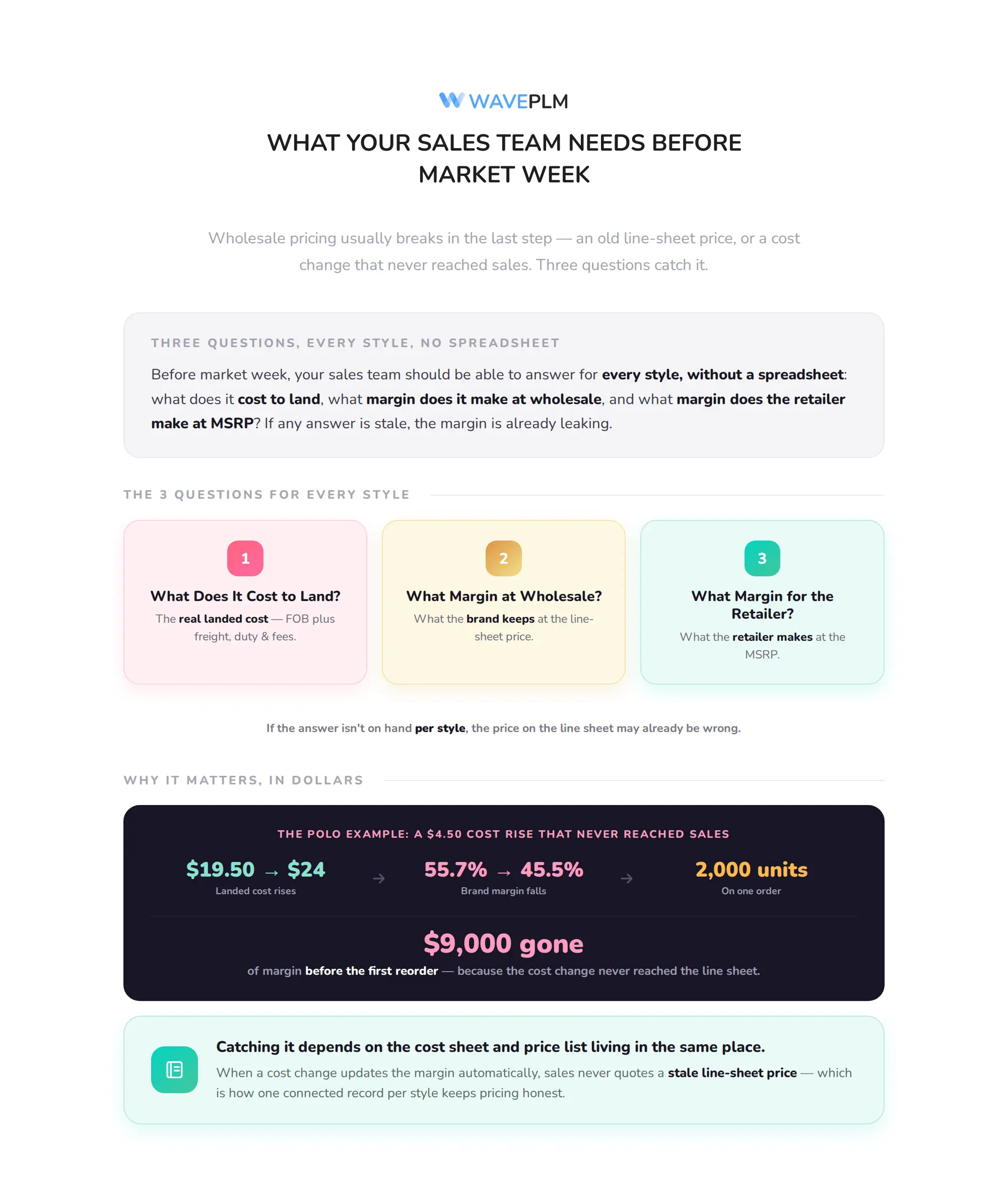
Wholesale pricing usually breaks in the last step. Often, the line sheet price comes from an old cost sheet, or a cost change never reaches sales. Before your next market week, your sales team should answer three questions for every style without a spreadsheet. First, what does it cost to land? Second, what margin does it make at wholesale? Finally, what margin does the retailer make at MSRP?
The stakes are easy to put in numbers. In the polo example above, a landed cost that rises from $19.50 to $24.00 but never reaches the line sheet cuts the brand margin from 55.7% to 45.5% on every unit. On a 2,000-unit wholesale order, that is $9,000 of margin gone before the first reorder. Catching it depends on the cost sheet and the price list living in the same place, which is how Wave PLM structures every style.
Frequently Asked Questions
What is wholesale pricing?
Wholesale pricing is the price a brand charges retailers, distributors, and other resellers. It sits below the recommended retail price so the reseller can make its own margin. In apparel, it usually comes with minimum order quantities and payment terms.
How do you calculate wholesale pricing for clothing?
Divide your landed cost by one minus your target margin; for example, $20 at a 55% margin gives about $44. Then check the result against the retail price divided by the retailer’s multiple, usually around 2x. If the two numbers differ a lot, adjust cost, margin, or price tier.
What is the difference between wholesale and retail pricing?
Wholesale pricing is what retailers pay the brand, while retail pricing is what consumers pay the retailer. Retail prices cover the store’s own costs and margin. In apparel, retail is commonly about two to two and a half times the wholesale price.
What is a good wholesale margin for an apparel brand?
Many small apparel brands target roughly 50% to 60% gross margin on landed cost at wholesale. However, the right figure depends on category, volume, and the costs you carry after the sale, such as commissions, freight, and chargebacks.
Is keystone pricing the same as wholesale pricing?
No. Keystone is one rule for setting retail price, where retail equals twice the wholesale price. Wholesale pricing is the broader process of setting the price you charge retailers, including margin targets, tiers, and terms.
Should wholesale prices differ by country?
Often, yes. Duties, freight, currency, and local price levels differ. Therefore, many brands keep a separate wholesale price list per currency and delivery term. Even so, keep the logic consistent so that each market still delivers your target margin.
Conclusion
Good wholesale pricing balances two margins: yours and the retailer’s. To get there, start from landed cost and check it against the retail price the market will accept. Then, fix any style where the two methods disagree before it reaches the line sheet. Additionally, add only the tiers and terms that match your real costs, and keep one dated price list per channel. With that structure, wholesale pricing becomes a repeatable process rather than a negotiation you have to win every season.





Leave a Reply