
A certificate of origin is a trade document that states the country where a product was made. For apparel brands, it matters for two reasons. First, it can unlock a lower or zero duty rate under a trade agreement. Second, it supports the “Made in” label and the origin you declare to customs. In 2026, that origin also decides which extra tariffs apply.
Most guides explain the certificate of origin as a generic export form. This one, however, is written for apparel teams. Specifically, it explains which type you need and how garment origin is decided. It also covers what USMCA and the EU expect, and which records to keep for every style.
What Is a Certificate of Origin?
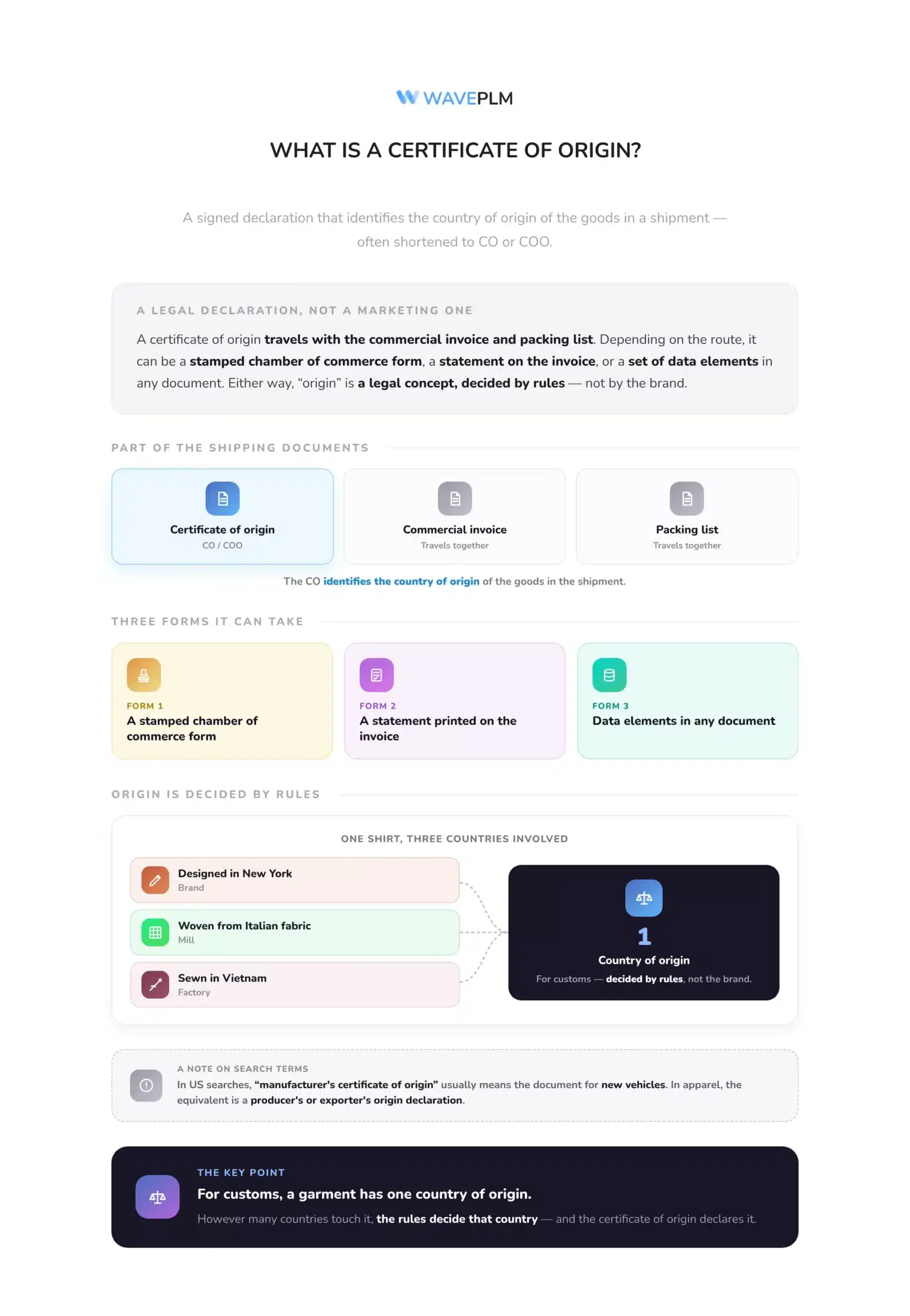
A certificate of origin (often shortened to CO or COO) is a signed declaration that identifies the country of origin of the goods in a shipment. Typically, it travels with the commercial invoice and packing list. Depending on the route, it may be a stamped chamber of commerce form. Alternatively, it may be a statement printed on the invoice or a set of data elements in any document.
Importantly, “origin” here is a legal concept, not a marketing one. Take a shirt designed in New York, woven from Italian fabric, and sewn in Vietnam. For customs, it has one country of origin. Moreover, rules decide that country, not the brand.
Note: In US searches, “manufacturer’s certificate of origin” usually refers to the document issued for new vehicles. In apparel, the equivalent is a producer’s or exporter’s origin declaration, which is what this guide covers.
What Is the Difference Between Preferential and Non-Preferential Origin?
There are two types of certificate of origin, and they do different jobs. In fact, mixing them up is the most common mistake new importers make.
| Non-preferential certificate of origin | Preferential certificate of origin | |
|---|---|---|
| Purpose | Proves where goods were made | Claims a reduced or zero duty under a trade agreement |
| Who issues it | Usually a chamber of commerce | Exporter, producer, or importer (self-certified), or customs on some routes |
| Rules used | National origin rules, e.g. “wholly assembled” for US apparel | The agreement’s own rules, e.g. yarn-forward under USMCA |
| Typical use in apparel | Buyer or letter-of-credit requirement, some importing countries | USMCA, CAFTA-DR, EU GSP, EU free trade agreements |
| Typical format | Stamped form, often electronic | Statement on invoice, data elements, EUR.1 on some routes |
In short, a non-preferential certificate of origin says “this was made in Vietnam.” A preferential one, by contrast, says “this meets USMCA rules, so it enters duty-free.” The second type saves money. As a result, it is also the one customs audits most closely.
How Is the Country of Origin of a Garment Decided?
For US customs, the origin of most textile and apparel products follows 19 CFR 102.21. For a typical sewn garment, origin goes to the country where it was “wholly assembled”. In other words, it is where the separate pieces were sewn together. Cutting alone does not decide origin, and neither does hemming.
For example, ruling HQ 561414 covered T-shirts cut or hemmed in China or Taiwan. Because they were fully sewn in the Marshall Islands, CBP held that they originated there. By contrast, knit-to-shape garments such as many sweaters follow a different branch of the rule. Generally, they take the origin of the country where they were knitted.
This matters because your declared origin decides which tariffs apply. In 2026, Section 301 duties and other country measures stack on top of the normal rate. Therefore, a wrong origin is not a paperwork slip. Instead, it is an underpayment, and CBP can treat it as negligence or worse. For the classification side of the same entry, see our guide to HTS codes for clothing.
Our finding: Origin is a style-level fact, not a shipment-level one. Suppose a brand moves sewing for one style from China to Cambodia. Then every certificate of origin, “Made in” label, and duty calculation for that style changes. That happens even if the fabric and factory group stay the same.

How Does the USMCA Certificate of Origin Work for Apparel?
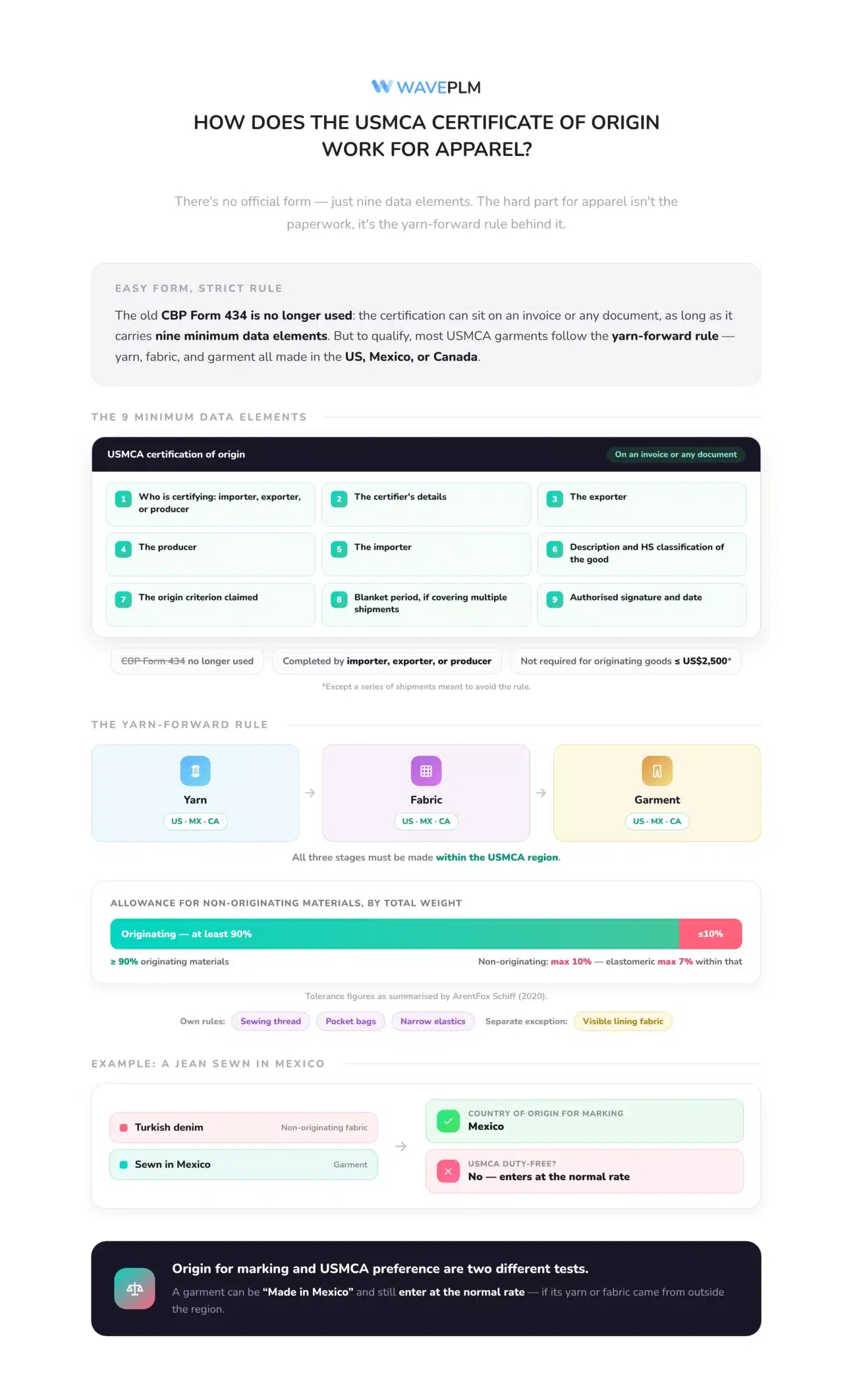
Under USMCA, there is no official certificate of origin form. According to CBP, the old CBP Form 434 is no longer used. Instead, the certification can appear on an invoice or any other document. What matters is that it contains nine minimum data elements:
- Whether the importer, exporter, or producer is certifying
- The certifier’s details
- The exporter
- The producer
- The importer
- Description and HS classification of the good
- The origin criterion being claimed
- The blanket period, if the certification covers multiple shipments
- An authorised signature and date
Furthermore, CBP confirms that the importer, exporter, or producer may complete it. For originating goods worth US$2,500 or less, a written certification is not required. The exception is a series of shipments meant to avoid the rule.
The hard part for apparel is not the form, but the rule behind it. Most USMCA garments follow the yarn-forward rule. That is, the yarn, fabric, and garment must all be made in the US, Mexico, or Canada. As ArentFox Schiff summarised in 2020, non-originating materials may be at most 10% of total weight. Within that, elastomeric content may not exceed 7%. Additionally, sewing thread, pocket bags, and narrow elastics have their own rules. Visible lining fabric, meanwhile, has a separate exception.
Consequently, a jean sewn in Mexico from Turkish denim does not qualify. Mexico is still its country of origin for marking. However, it enters at the normal rate, not duty-free. For a full view of what nearshoring changes, read our guide to nearshoring to Mexico.
What Does a Certificate of Origin Save in Practice?
The saving depends on the gap between the normal duty rate and the preferential one. Take 10,000 cotton knit T-shirts with an entered value of $8 each, so $80,000 in total. Under HTS 6109.10.00, the general rate is 16.5%.
| Scenario | Duty rate | Duty on $80,000 |
|---|---|---|
| Sewn in Mexico, Asian fabric (no USMCA claim possible) | 16.5% | $13,200 |
| Sewn in Mexico, North American yarn and fabric, valid USMCA certification | 0% | $0 |
| Valid origin, but certification missing at entry and never claimed | 16.5% | $13,200 |
Notably, the third row is the painful one. The goods qualified, yet the brand paid full duty because nobody collected the certification. In that case, a post-entry claim may still be possible within the time limits. Even so, it costs broker time and cash flow. For how origin flows into the per-unit number, see our landed cost guide.
How Do EU Origin Rules Work for Apparel Imports?
The EU also separates preferential from non-preferential origin. Non-preferential origin decides the “Made in” status and any trade defence measures. Preferential origin, on the other hand, can cut duty to zero. It applies under the Generalised Scheme of Preferences (GSP) or a free trade agreement.
GSP countries include major garment exporters such as Bangladesh and Cambodia under Everything But Arms. For these, the European Commission requires exporters to register in the Registered Exporter system (REX). Each shipment then carries a statement on origin added to the invoice. Some free trade agreements, however, still use the EUR.1 movement certificate.
The production rule differs by country group. As a rule, least developed countries can qualify garments made from imported fabric. This is called single transformation. Other GSP beneficiaries, however, generally need to start from yarn. So both fabric making and sewing must happen locally. Before you order for the EU, check the rule for that factory’s country, not only the HS code.
Who Issues a Certificate of Origin, and What Does It Cost?
Chambers of commerce usually issue non-preferential certificates. Many are accredited through the ICC Certificate of Origin Accreditation Chain. Notably, fees are modest. For instance, the London Chamber of Commerce listed £29 plus VAT per self-prepared certificate for members in July 2026. Non-members paid £58 plus VAT. Similarly, chambers elsewhere charge comparable amounts.
Preferential certificates, in contrast, are mostly self-certified, so there is no fee. Instead, the real cost is the evidence behind the claim. That means bills of materials, supplier declarations, and production records for each step.
What Records Should You Keep for Each Style?
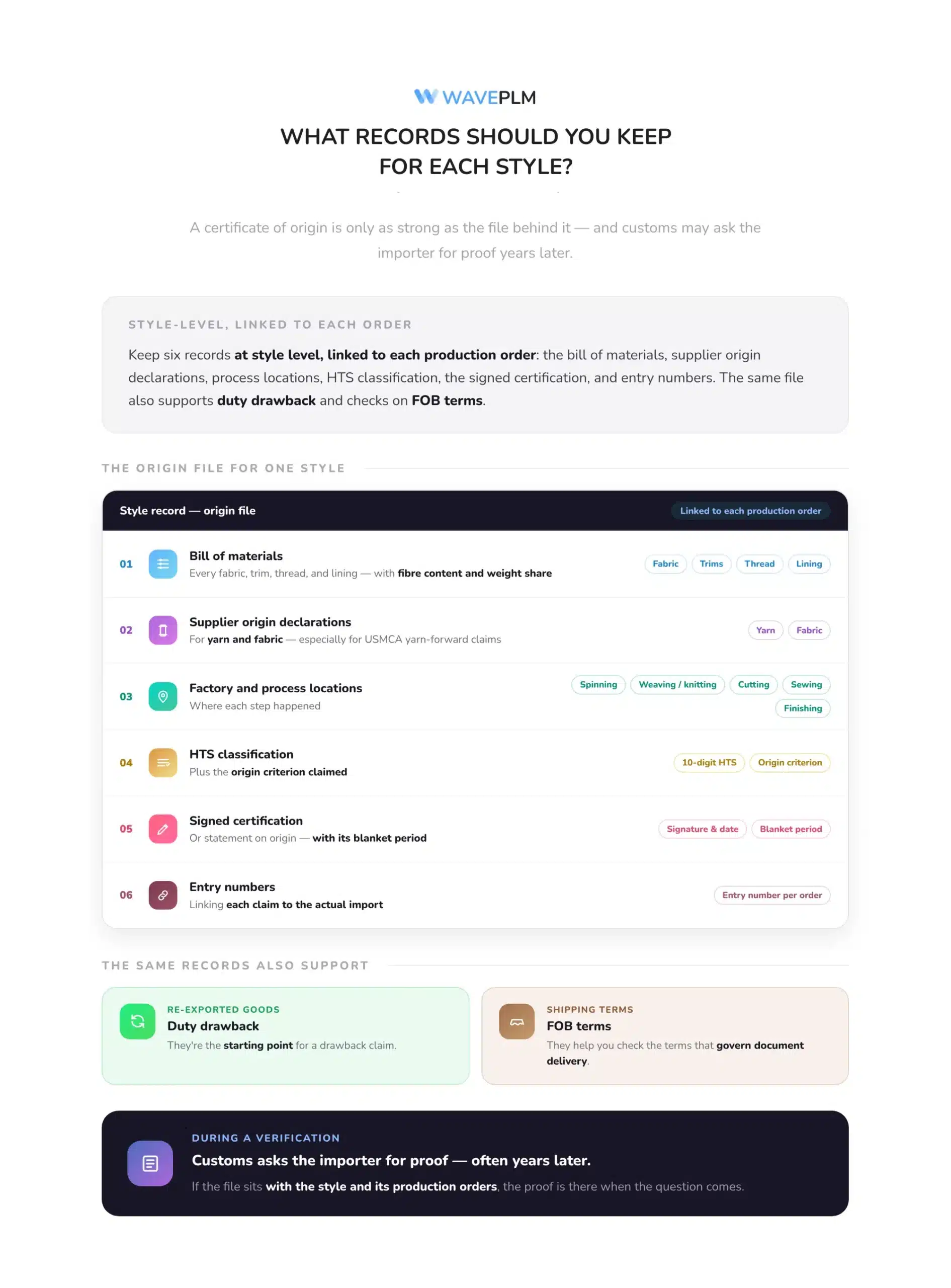
A certificate of origin is only as strong as the file behind it. During a verification, customs will ask the importer for proof, often years later. Therefore, keep these records at style level, linked to each production order:
- Bill of materials with every fabric, trim, thread, and lining, including fibre content and weight share. Our guide to multi-level BOMs shows how to structure it.
- Supplier origin declarations for yarn and fabric, especially for USMCA yarn-forward claims.
- Factory and process locations for spinning, weaving or knitting, cutting, sewing, and finishing.
- HTS classification and the origin criterion claimed.
- The signed certification or statement on origin, with its blanket period.
- Entry numbers linking each claim to the actual import.
In addition, the same records support other claims. For example, they are the starting point for duty drawback on re-exported goods. Likewise, they help you check the FOB terms that govern document delivery.
What Are the Most Common Certificate of Origin Mistakes?
- Assuming “sewn in Mexico” means USMCA duty-free. Without North American yarn and fabric, it usually does not.
- Letting the factory decide origin. Factories often state the country of the last operation, which may be finishing or packing rather than assembly.
- Reusing an old blanket certification after a fabric or trim supplier has changed.
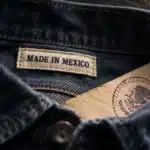
- Mismatched labels. The “Made in” label, the certificate of origin, and the customs entry must all show the same country.
- No supplier declarations on file. A certification without upstream evidence will not survive a verification.
Finally, remember that origin rules change faster than labels. Our article on textile exports in fashion covers the export side of the same paperwork.
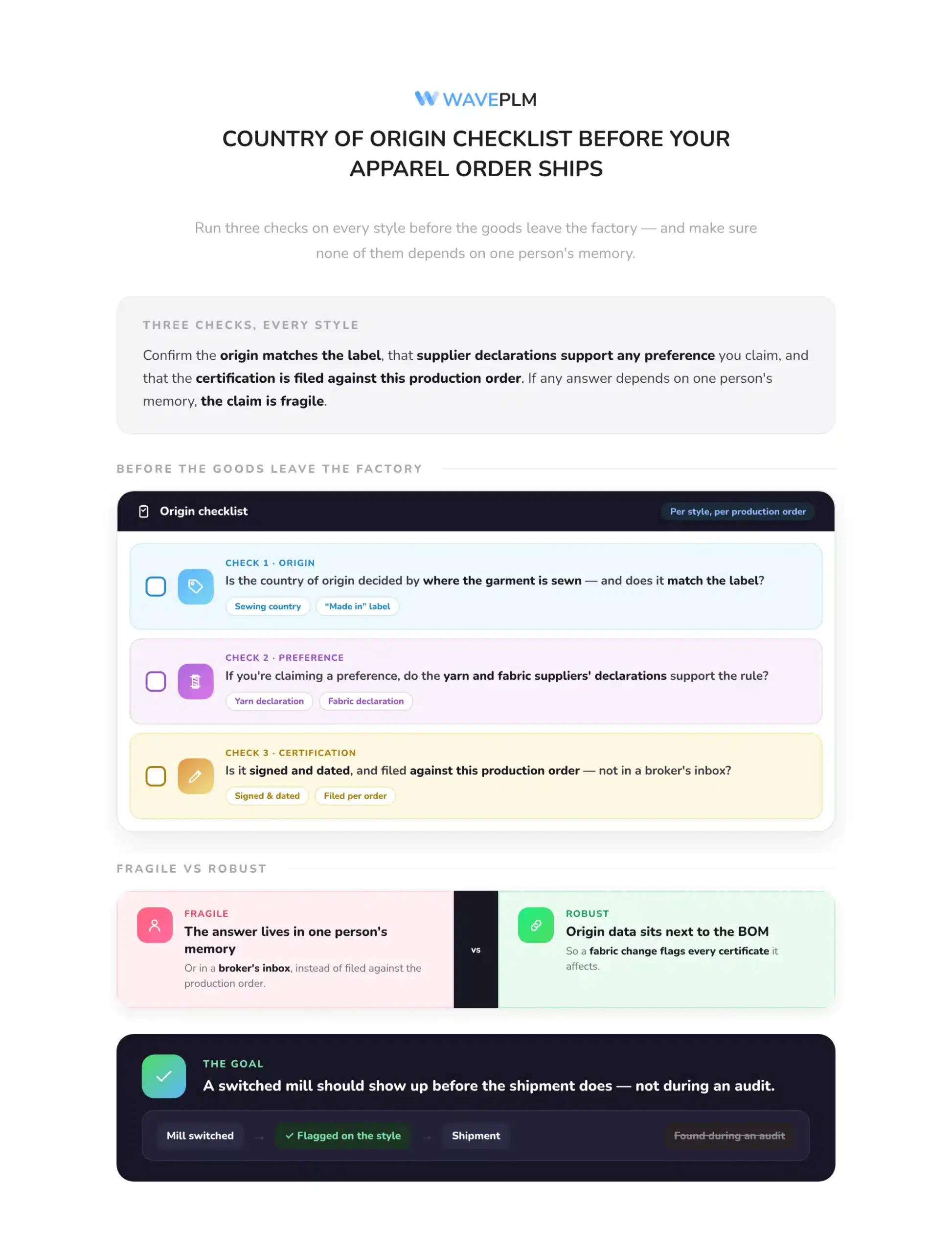
Checklist Before Your Next Order Ships
First, run three checks on every style before the goods leave the factory. Is the country of origin decided by where the garment is sewn, and does it match the label? If you are claiming a preference, do the yarn and fabric suppliers’ declarations support the rule? And is the certification, signed and dated, filed against this production order rather than in a broker’s inbox?
Finally, if any answer depends on one person’s memory, the claim is fragile. Ideally, origin data sits next to the BOM, so a fabric change flags every certificate it affects. Wave PLM ties supplier origin to each style’s materials. That way, a switched mill shows up before the shipment does, not during an audit.
Frequently Asked Questions
What is a certificate of origin for clothing?
Specifically, a certificate of origin for clothing is a document that states the country where garments were made. The non-preferential type only proves origin. A preferential one, however, claims reduced or zero duty under a deal such as USMCA or the EU GSP.
Do I need a certificate of origin to import clothing into the US?
For ordinary imports, CBP does not usually require a separate non-preferential certificate. Still, the origin must be declared correctly. However, a duty-free claim under USMCA needs a valid certification of origin. The exception is qualifying shipments of US$2,500 or less.
Is there an official USMCA certificate of origin form?
No. CBP confirms there is no required form and that CBP Form 434 is no longer used. Instead, the certification can appear on an invoice or any other document. It must include the nine minimum data elements, such as the HS code, origin criterion, and a signature.
How is the country of origin of a garment determined?
In the US, most sewn garments take the origin of the country where they are wholly assembled under 19 CFR 102.21. That is where the pieces are sewn together. Cutting or hemming alone does not decide origin. Knit-to-shape garments, by contrast, take the origin of the knitting country.
What is the yarn-forward rule?
The yarn-forward rule requires the yarn, fabric, and garment to be made inside the agreement’s territory. Under USMCA, non-originating materials may still be up to 10% of the weight. Within that, elastomeric content is limited to 7%.
How much does a certificate of origin cost?
Non-preferential certificates from chambers of commerce usually cost tens of dollars or pounds per document. For example, the London Chamber of Commerce charged £29 plus VAT for members in July 2026. Preferential certifications are mostly self-issued and free, but they require supporting records.
Conclusion
A certificate of origin looks like a routine export form. Yet for apparel brands, it decides both duty and compliance. First, know which type you need, preferential or non-preferential. Next, apply the right origin rule: where the garment is sewn for marking, and yarn-forward for USMCA. Above all, keep the evidence at style level. After all, the claim is only as good as the BOM behind it. Done that way, origin becomes a cost lever instead of an audit risk.



Leave a Reply