
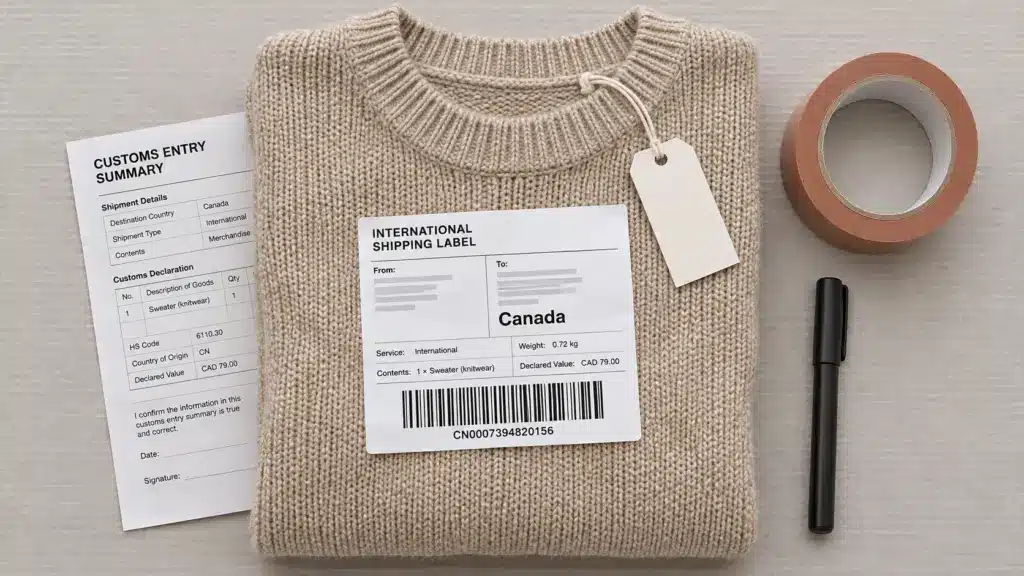
Duty drawback is a US customs refund of up to 99% of the duties, taxes, and certain fees paid on imported goods that are later exported or destroyed under customs supervision. For an apparel brand, duty paid on a shipment of sweaters can come back if some of those sweaters leave the country again. Typical examples are orders to Canadian customers and faulty goods sent back to a supplier.
Most guides to duty drawback are written for manufacturers and large importers. This one, by contrast, is written for apparel and footwear brands that import finished goods and sell direct to consumers or wholesale. It explains which claim types fit apparel, which 2026 tariffs qualify, what the paperwork looks like, and when the refund is worth the effort.
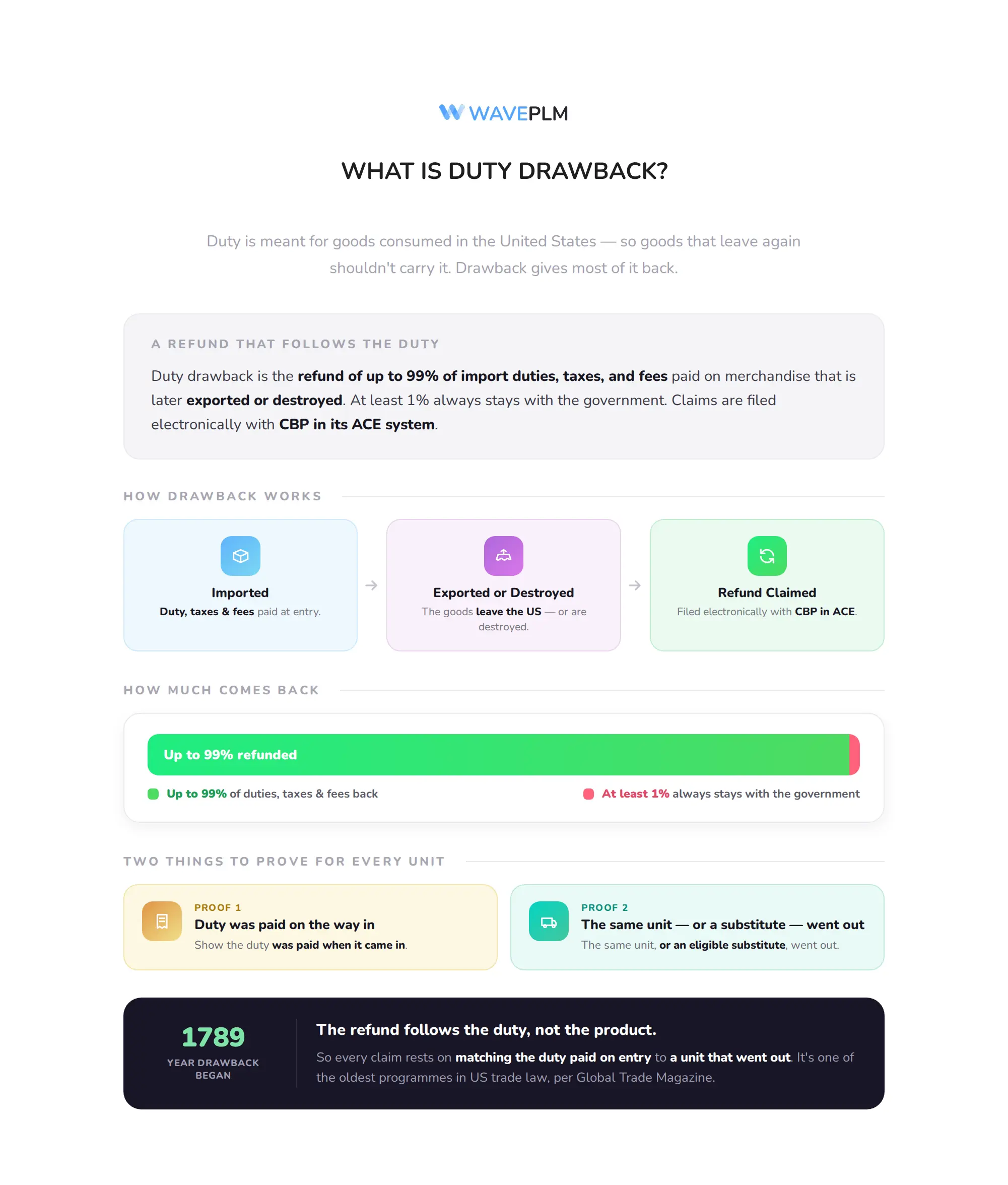
What Is Duty Drawback?
Duty drawback is one of the oldest programmes in US trade law. According to Global Trade Magazine, it has existed since 1789. In short, the idea is simple: duty is meant to apply to goods consumed in the United States, so goods that leave again should not carry it.
Definition: Duty drawback is the refund of up to 99% of import duties, taxes, and fees paid on merchandise that is subsequently exported or destroyed. At least 1% always stays with the government. Claims are filed electronically with US Customs and Border Protection (CBP) in its ACE system.
Importantly, the refund follows the duty, not the product. So you need to prove two things for every unit you claim. First, duty was paid when it came in. Second, the same unit, or an eligible substitute, went out.
Which Types of Duty Drawback Apply to Apparel?
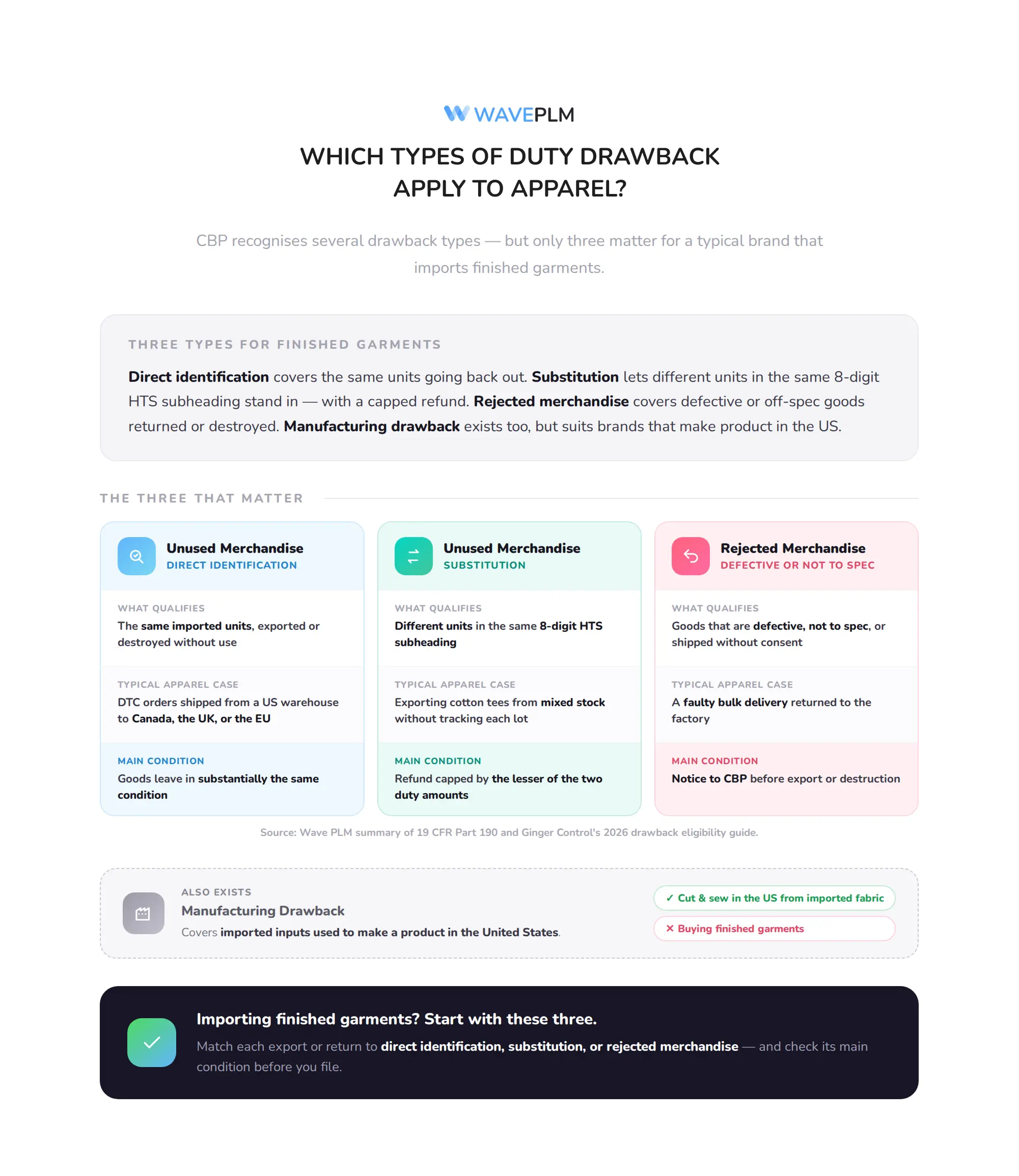
CBP recognises several drawback types. However, only three matter for a typical brand that imports finished garments. The table compares them.
| Type | What qualifies | Typical apparel case | Main condition |
|---|---|---|---|
| Unused merchandise (direct identification) | The same imported units, exported or destroyed without use | DTC orders shipped from a US warehouse to Canada, the UK, or the EU | Goods leave in substantially the same condition |
| Unused merchandise (substitution) | Different units in the same 8-digit HTS subheading | Exporting cotton tees from mixed stock without tracking each lot | Refund capped by the lesser of the two duty amounts |
| Rejected merchandise | Goods that are defective, not to spec, or shipped without consent | A faulty bulk delivery returned to the factory | Notice to CBP before export or destruction |
Manufacturing drawback also exists, but it covers imported inputs used to make a product in the United States. Therefore, it fits a brand that cuts and sews domestically from imported fabric, not one that buys finished garments.
Which 2026 Tariffs Qualify for Duty Drawback?
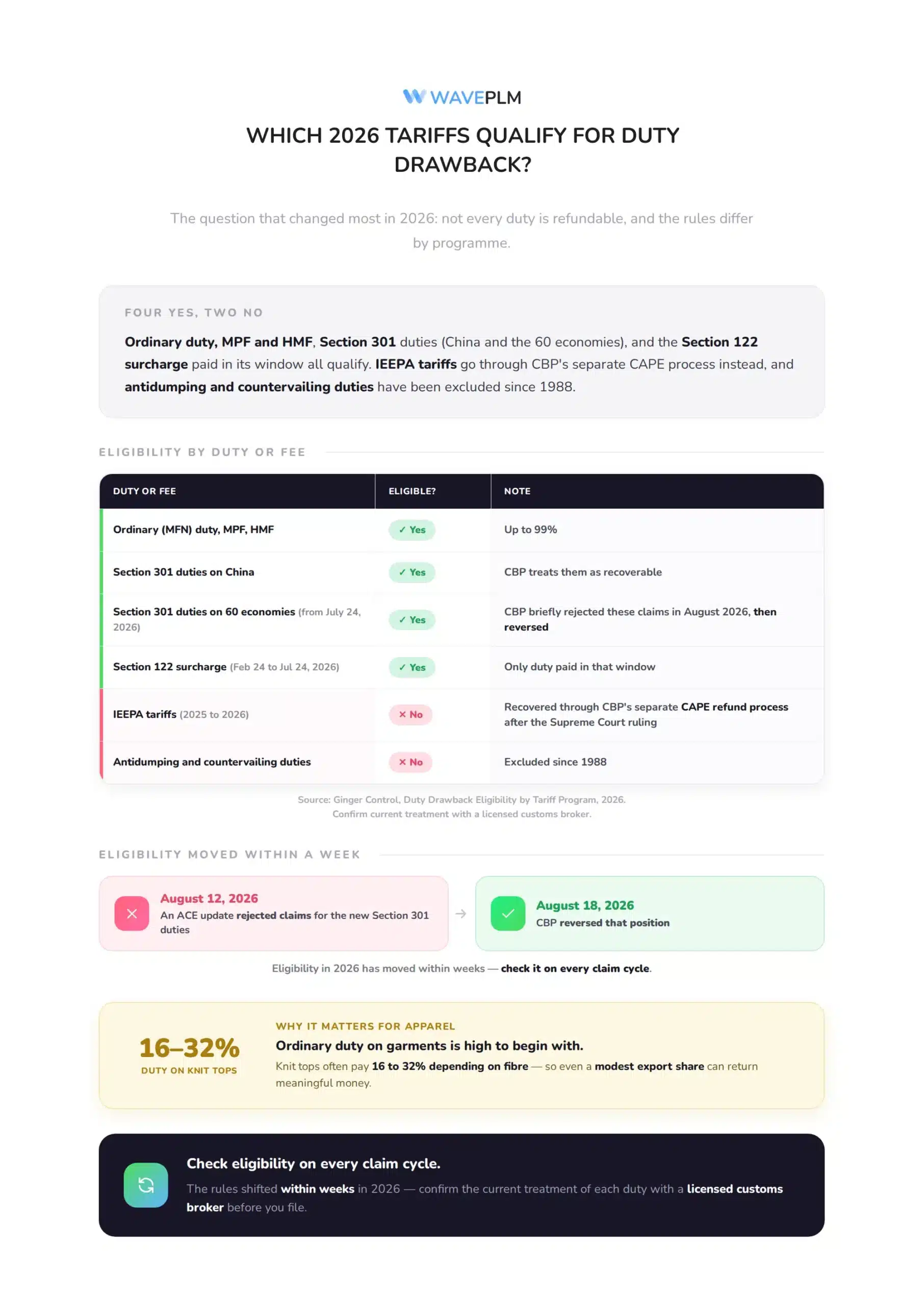
This is the question that changed most in 2026. Not every duty is refundable, and the rules differ by programme. The summary below follows Ginger Control’s 2026 eligibility matrix.
| Duty or fee | Eligible for drawback? | Note |
|---|---|---|
| Ordinary (MFN) duty, MPF, HMF | Yes | Up to 99% |
| Section 301 duties on China | Yes | CBP treats them as recoverable |
| Section 301 duties on 60 economies (from July 24, 2026) | Yes | CBP briefly rejected these claims in August 2026, then reversed |
| Section 122 surcharge (Feb 24 to Jul 24, 2026) | Yes | Only duty paid in that window |
| IEEPA tariffs (2025 to 2026) | No | Recovered through CBP’s separate CAPE refund process after the Supreme Court ruling |
| Antidumping and countervailing duties | No | Excluded since 1988 |
Industry data: According to Ginger Control, an ACE system update on August 12, 2026 rejected drawback claims for the new Section 301 duties, and CBP reversed that position on August 18. In other words, eligibility in 2026 has moved within weeks, so check it on every claim cycle.
For apparel, the practical takeaway is clear. Ordinary duty on garments is high to begin with. Knit tops often pay 16 to 32% depending on fibre, as our HTS code guide for clothing shows. Consequently, even a modest export share can return meaningful money.
Do Customer Returns Qualify for Duty Drawback?
Sometimes, but not automatically. A return from a US customer that goes back into US inventory creates no claim, because the goods never left the country. In contrast, a return can qualify if the unit is then exported or destroyed under CBP supervision. Shipping it back to the supplier or to an overseas outlet both count.
Cross-border returns are the more common case. For example, say a Canadian customer buys a jacket shipped from your US warehouse. That sale is an export, so the duty paid on the jacket can be claimed. Notably, keeping the return and reselling it in the US later does not cancel the original export.
There is one caveat for North America. According to Passport, substitution drawback is not available for exports to Canada, Mexico, or Chile because of free trade agreement rules. So for those destinations, plan on direct identification of the actual units.
How Much Can an Apparel Brand Recover?
The answer depends on three numbers: duty rate, export share, and claim cost. Here is a worked example using the duty rate for cotton knit tees from our HTS guide.
| Step | Value |
|---|---|
| Imported: 10,000 cotton tees at $8 customs value | $80,000 |
| Ordinary duty at 16.5% (HTS 6109.10.00) | $13,200 |
| Units later exported to customers in Canada and the UK | 1,500 (15%) |
| Duty paid on exported units | $1,980 |
| Duty drawback at 99% | $1,960 |
| Same order entered during the Section 122 window (+10% surcharge) | $3,148 refund on the same 1,500 units |
Admittedly, one style is rarely worth a claim on its own. Across a full year of imports, however, the numbers add up. Passport models a brand importing $500,000 a year at a 14% blended duty rate and exporting 20%. As a result, the model shows about $13,860 in recoverable duty. Meanwhile, Passport also says more than 85% of eligible businesses never file a claim.
Our finding: The rate of return on duty drawback is decided less by tariffs than by data. Brands that can tie an export back to its import entry in minutes file every quarter. Brands that have to rebuild that link from spreadsheets usually give up after the first claim.
What Records Do You Need for a Duty Drawback Claim?
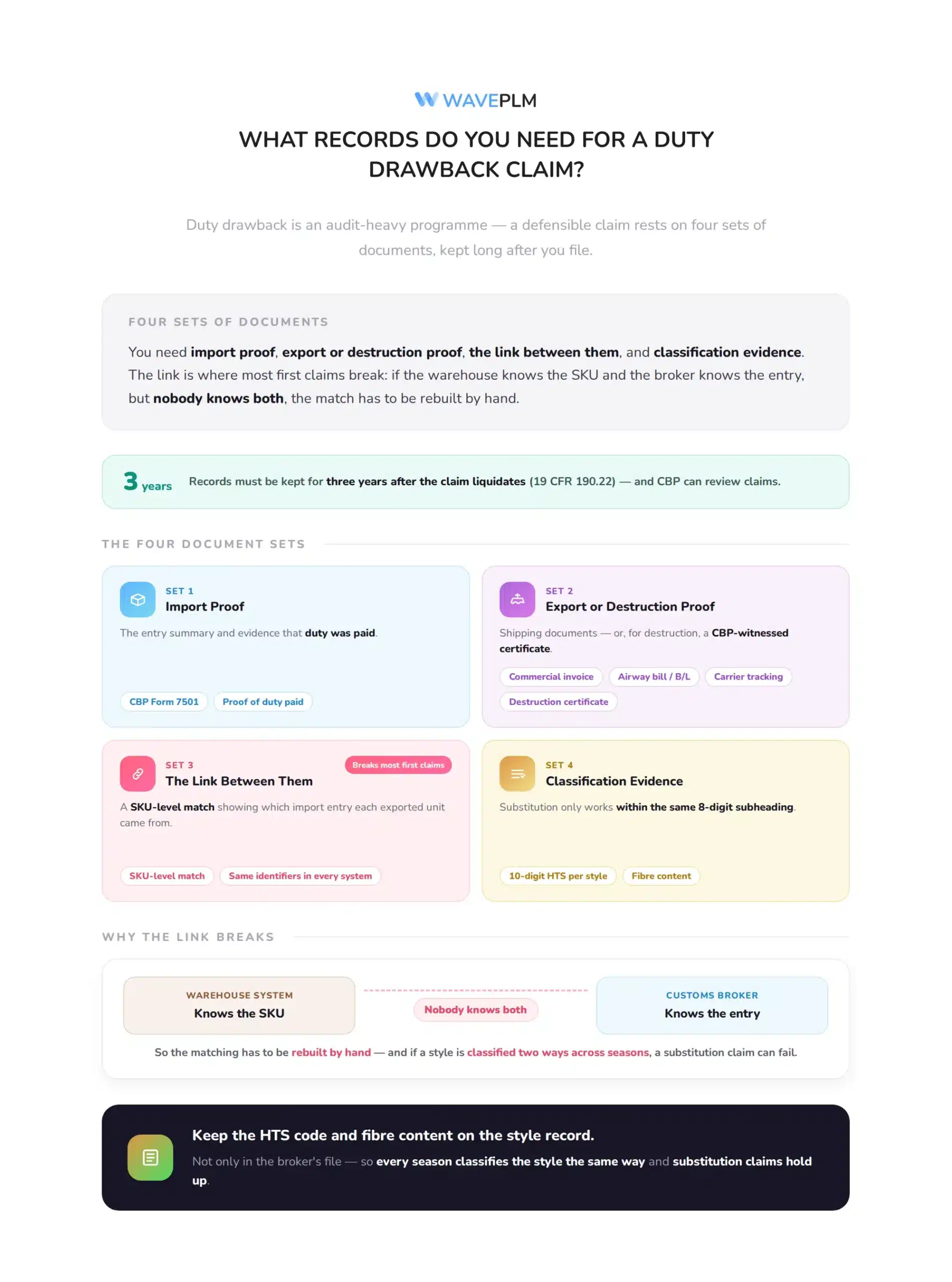
Duty drawback is an audit-heavy programme. CBP can review claims, and records must be kept for three years after the claim liquidates under 19 CFR 190.22. Specifically, a defensible claim rests on four sets of documents:
- Import proof. The entry summary (CBP Form 7501) and evidence that duty was paid.
- Export or destruction proof. Commercial invoice, airway bill or bill of lading, and carrier tracking. For destruction, a CBP-witnessed certificate.
- The link between them. A SKU-level match that shows which import entry each exported unit came from, using the same identifiers in every system.
- Classification evidence. The 10-digit HTS code for each style, plus fibre content, since substitution only works within the same 8-digit subheading.
The third item breaks most first claims. If your warehouse system knows the SKU, your broker knows the entry, and nobody knows both, then matching has to be rebuilt by hand. Likewise, if the same style is classified two different ways across seasons, a substitution claim can fail. That is why the HTS code and fibre content belong on the style record, not only in the broker’s file.
How Long Does Duty Drawback Take?
Duty drawback has a long setup and a fast payout once it runs. First, the filing window is five years from the date of import, so older exports can still be claimed. Next, setting up drawback privileges takes 4 to 12 months, according to Passport. After that, first refunds usually arrive within 6 to 18 months. Finally, with accelerated payment, later refunds can arrive 3 to 6 weeks after filing.
For unused or rejected merchandise, CBP also expects a Notice of Intent to Export. It must arrive at least five working days before the goods leave, unless CBP waives it. As a result, a brand that wants to claim on factory rejects must plan the paperwork before the shipment goes back, not after.
Should Your Brand File for Duty Drawback?
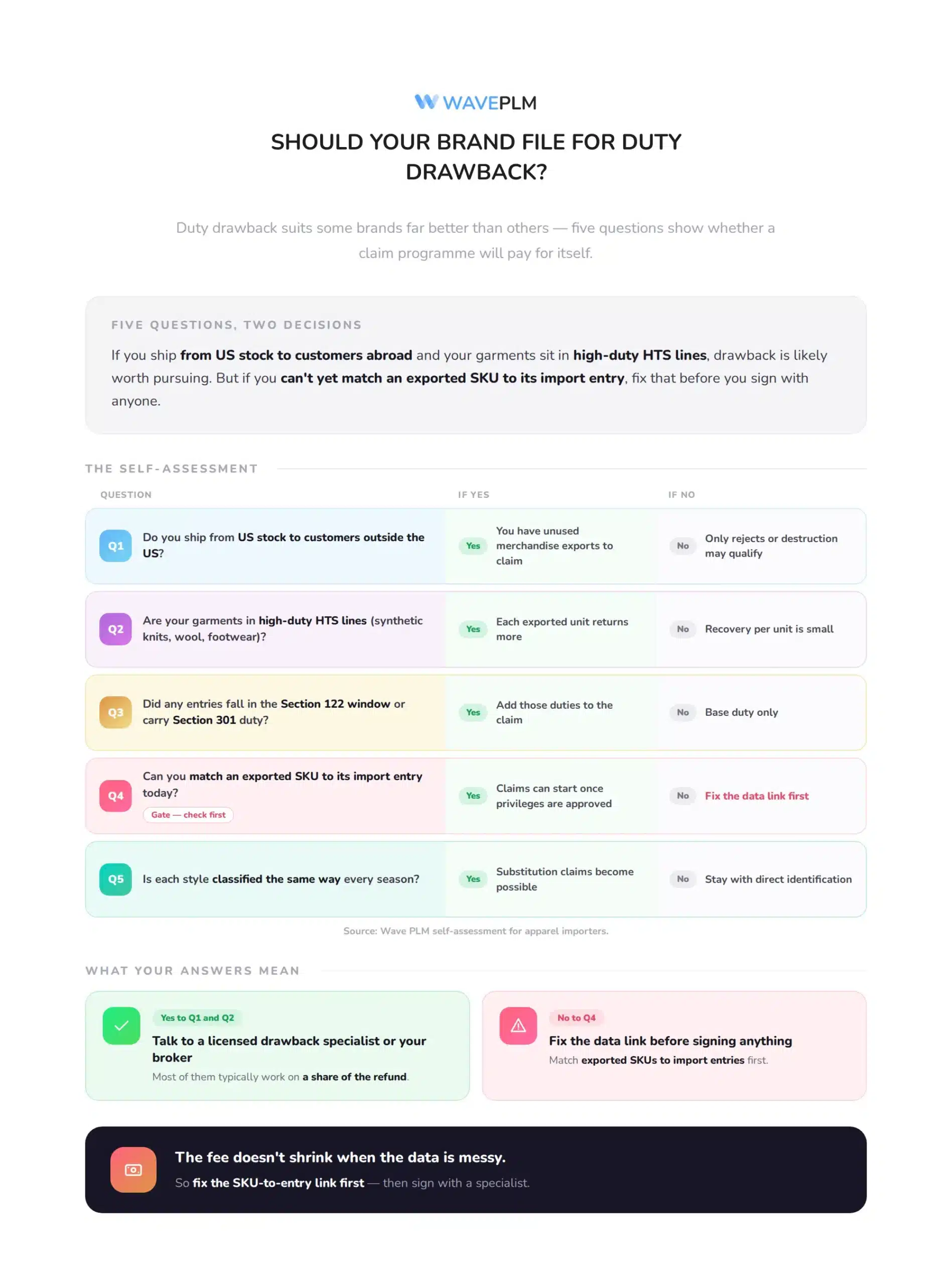
Duty drawback suits some brands far better than others. The checklist below is a quick way to judge whether a claim programme will pay for itself.
| Question | If yes | If no |
|---|---|---|
| Do you ship from US stock to customers outside the US? | You have unused merchandise exports to claim | Only rejects or destruction may qualify |
| Are your garments in high-duty HTS lines (synthetic knits, wool, footwear)? | Each exported unit returns more | Recovery per unit is small |
| Did any entries fall in the Section 122 window or carry Section 301 duty? | Add those duties to the claim | Base duty only |
| Can you match an exported SKU to its import entry today? | Claims can start once privileges are approved | Fix the data link first |
| Is each style classified the same way every season? | Substitution claims become possible | Stay with direct identification |
If you answered yes to the first two questions, talk to a licensed drawback specialist or your customs broker. Typically, most of them work on a share of the refund. If, on the other hand, you answered no to the fourth question, fix that before signing anything. After all, the fee does not shrink when the data is messy.
How Does Duty Drawback Fit Into Landed Cost?
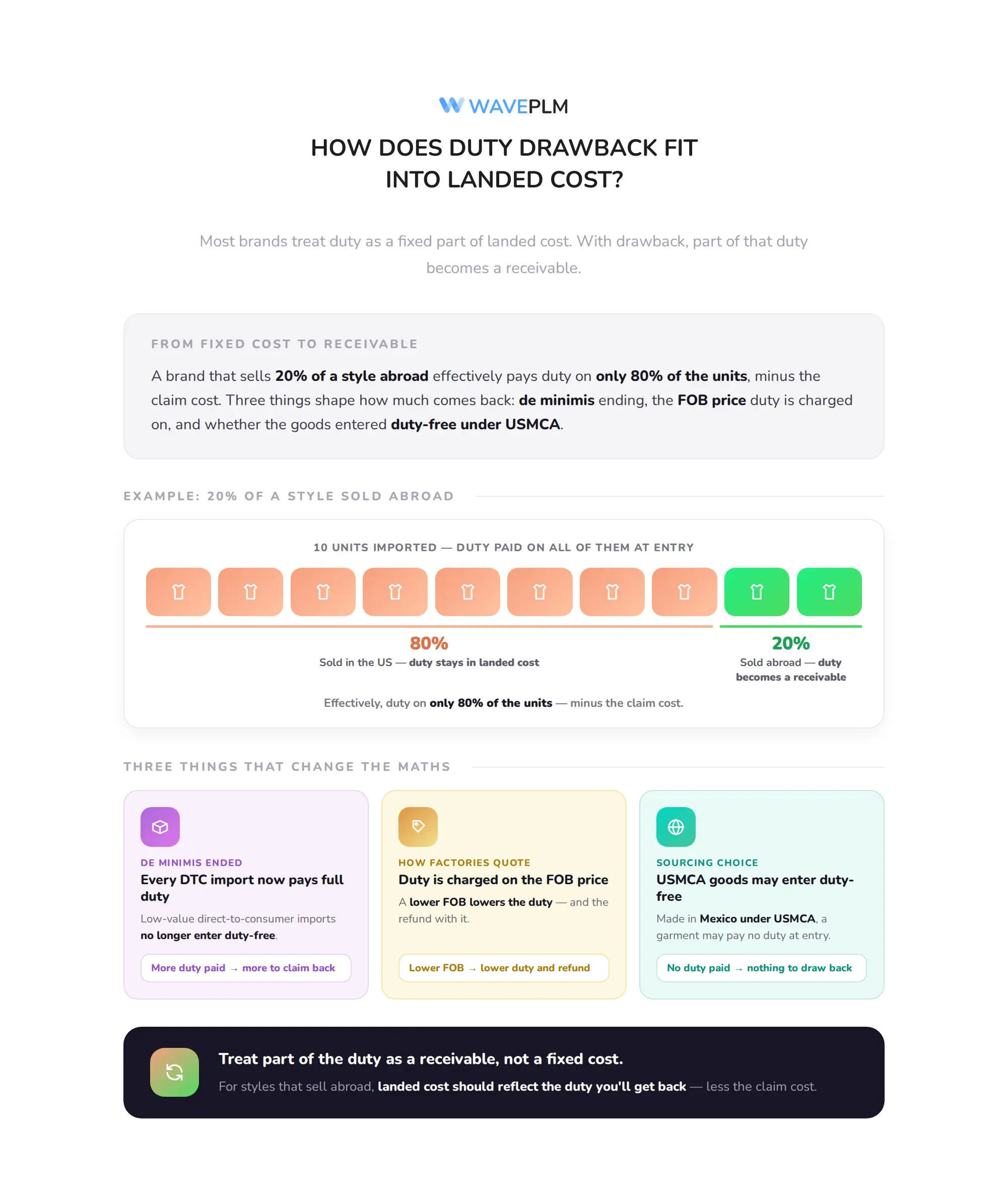
Most brands treat duty as a fixed part of landed cost. With drawback, however, part of that duty becomes a receivable. For example, a brand that sells 20% of a style abroad effectively pays duty on only 80% of the units, minus the claim cost.
This matters most after the end of the US de minimis exemption, since every low-value DTC import now pays full duty. Our guide to the de minimis tariff change explains why. It also connects to how factories quote. US duty is generally charged on the FOB price, so a lower FOB lowers both the duty and the refund.
Finally, drawback interacts with sourcing choices. Goods made in Mexico under USMCA may enter duty-free, which leaves nothing to draw back. Our analysis of nearshoring to Mexico covers that trade-off. Similarly, the overview of US customs, tariffs, and duties for fashion sets out the base rates.
Where Should Drawback Data Live?
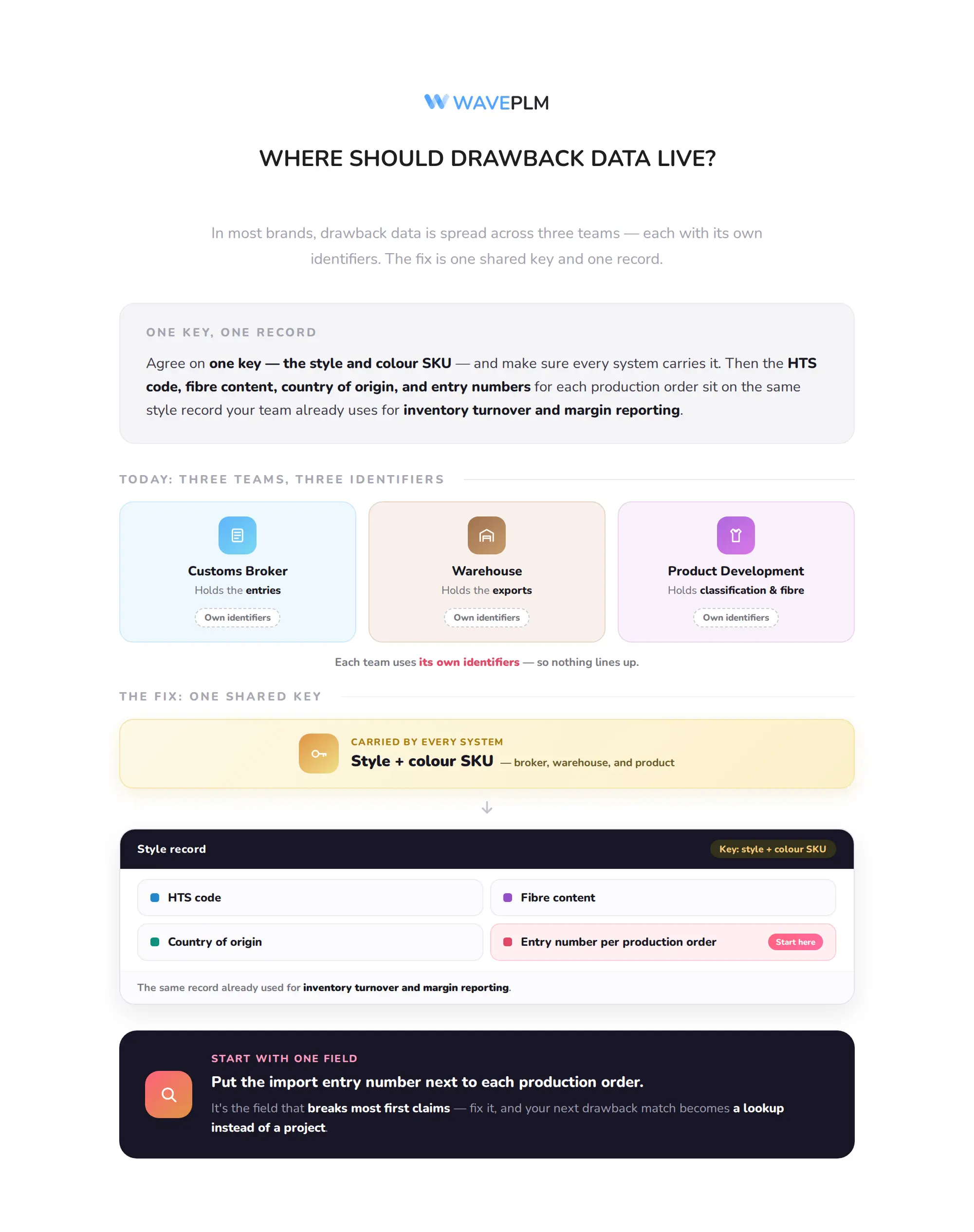
In most brands, drawback spreads data across three teams. The broker holds the entries, the warehouse holds the exports, and product development holds the classification and fibre content. Unfortunately, each team uses its own identifiers.
The simplest fix is to agree on one key, the style and colour SKU, and to make sure every system carries it. Then the HTS code, fibre content, country of origin, and the entry numbers for each production order can sit on the same style record. In practice, that is also the record your team already uses for inventory turnover and margin reporting.
Start with the field that breaks most first claims. Put the import entry number next to each production order on the style, the way Wave PLM links entries to styles. Your next drawback match then becomes a lookup instead of a project.
Frequently Asked Questions
What is duty drawback in simple terms?
Duty drawback is a refund of import duty on goods that leave the United States again. Suppose you import garments, pay duty, and later export or destroy some of them. US Customs can then refund up to 99% of the duty, taxes, and fees paid on those units.
How much of the duty can be refunded?
Up to 99% of eligible duties, taxes, and fees. The remaining 1% always stays with the government. Substitution claims are also capped at 99% of the lower of the duty on the imported goods and the duty that would apply to the exported goods.
How long do you have to file a duty drawback claim?
Claims must be filed within five years of the date of import. Records must then be kept for three years after the claim liquidates. Because privileges take months to set up, brands should start early rather than wait until the deadline.
Can I get duty drawback on IEEPA tariffs?
No. IEEPA tariffs were excluded from drawback. After the Supreme Court ruling in February 2026, they are recovered through CBP’s separate CAPE refund process instead. By contrast, ordinary duty, Section 301 duty, and the Section 122 surcharge are eligible.
Do online returns qualify for duty drawback?
Only if the returned goods are then exported or destroyed under CBP supervision. A domestic return that goes back into US stock does not qualify. However, orders shipped from a US warehouse to customers abroad are exports, so the duty on those units can be claimed.
Is duty drawback worth it for a small apparel brand?
It depends on export volume, duty rates, and data quality. A brand exporting a few hundred units a year will usually recover less than the setup cost. In contrast, a brand with steady international DTC sales in high-duty categories can recover thousands of dollars a year.
Conclusion
Duty drawback lets apparel brands recover up to 99% of the duty on goods that leave the United States. That includes cross-border DTC orders, factory rejects, and destroyed stock. In 2026, ordinary duty, Section 301 duty, and the Section 122 surcharge qualify, while IEEPA tariffs and antidumping duties do not. The refund is real, but it rewards preparation. Classify each style consistently, keep the import entry linked to the SKU, and file regularly once privileges are in place.





Leave a Reply