
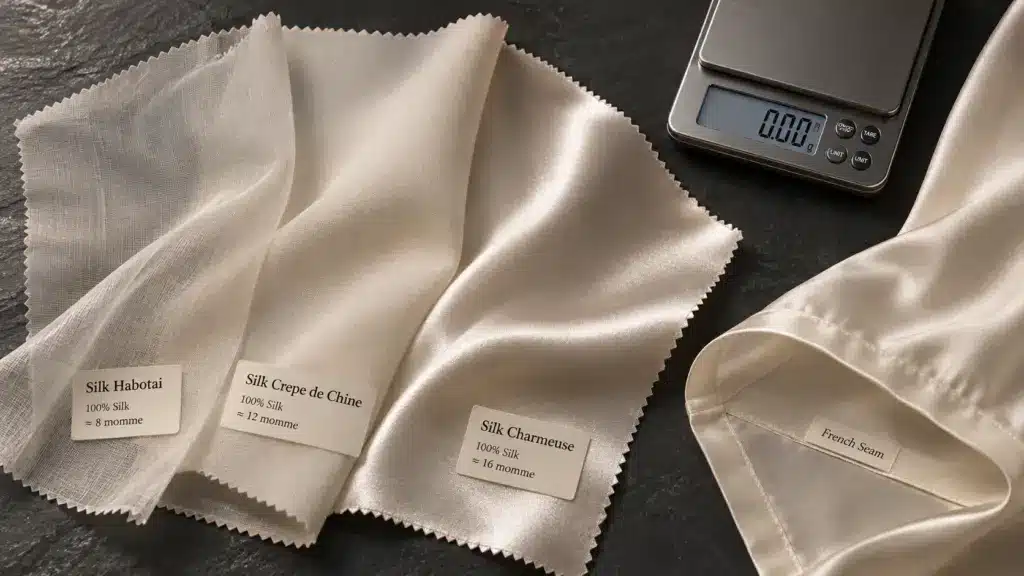
Silk fabric is a textile woven or knitted from silk, a natural protein fibre spun by silkworm larvae to build their cocoons. Most commercial silk fabric comes from the domesticated mulberry silkworm, Bombyx mori. Above all, it is valued for its lustre, smooth hand, light weight, and strength, but it is also expensive, sensitive to water and light, and easy to mislabel.
Search results for silk fabric are full of shops selling it by the yard. This guide, however, is written for the people who specify it for a collection. Specifically, it explains how silk is graded and weighed, why it costs what it does, how to test it, and what you can and cannot call “silk” on a label.
What Is Silk Fabric Made Of?
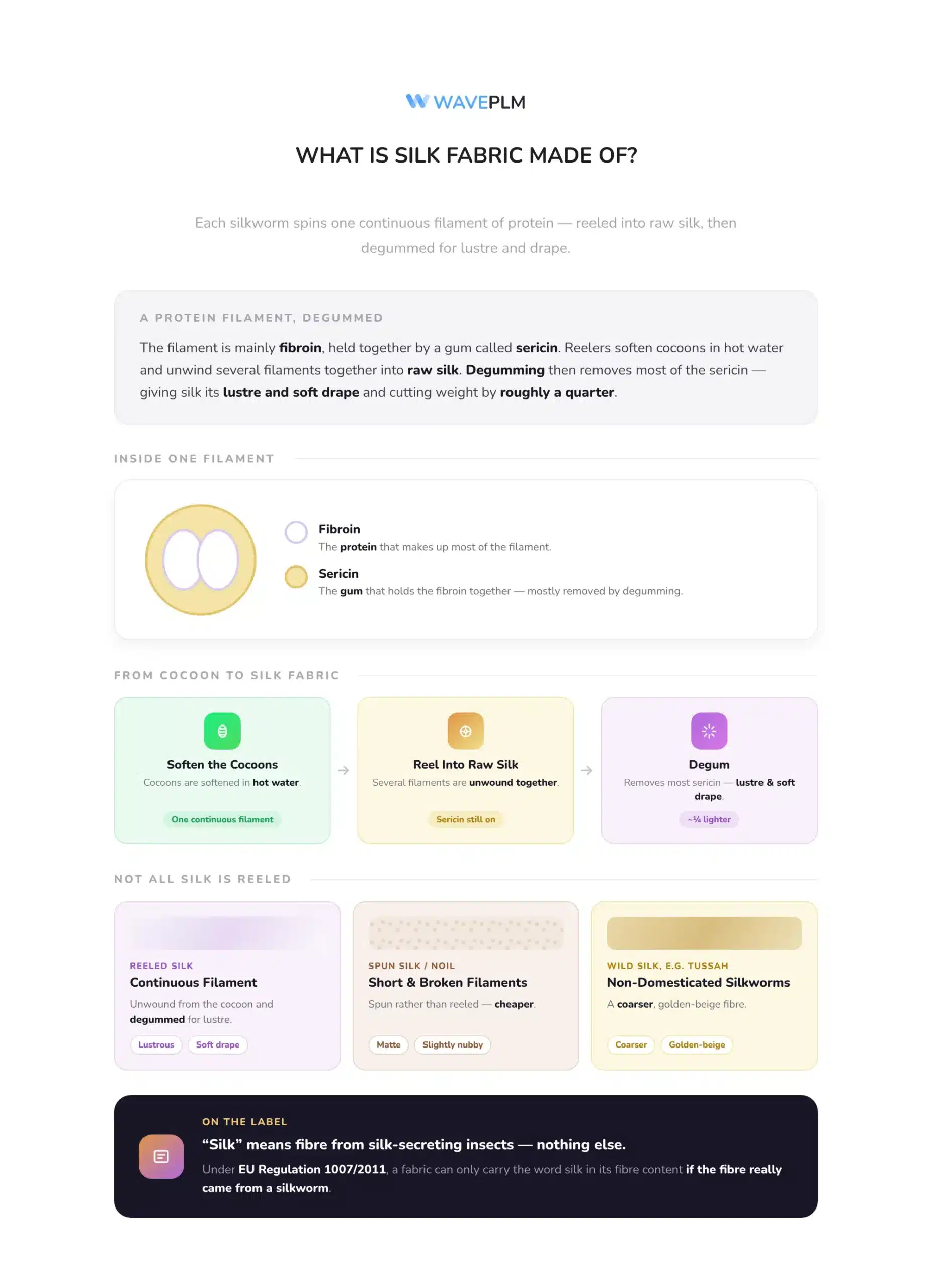
First of all, each silkworm spins one continuous filament of protein, mainly fibroin held together by a gum called sericin. To make yarn, reelers soften the cocoons in hot water and unwind several filaments together into raw silk. Later, a process called degumming removes most of the sericin. That step gives silk fabric its characteristic lustre and soft drape, and it also reduces weight by roughly a quarter.
Definition: Silk fabric is cloth made from silk fibre. Under EU Regulation 1007/2011, “silk” means fibre obtained exclusively from silk-secreting insects. As a result, a fabric can only carry the word silk in its fibre content if the fibre really came from a silkworm.
However, not all silk is reeled. For example, short and broken filaments are spun into “spun silk” or “noil”, which is cheaper and has a matte, slightly nubby surface. Similarly, wild silks, such as tussah, come from non-domesticated silkworms and have a coarser, golden-beige fibre.
Where Is Silk Fabric Made?
Notably, silk production is highly concentrated. According to Texfash, China and India together account for about 95% of global production of roughly 86,000 tonnes. For scale, that is a tiny fraction of world cotton output, which is measured in tens of millions of tonnes.
Industry data: Texfash reports that China’s raw silk production fell from about 142,000 tonnes in 2017 to 46,700 tonnes in 2021, while India produced about 36,500 tonnes in 2022–23. Even so, India imported almost 3,900 tonnes of raw silk in 2022–23, nearly double the previous year, because domestic output could not meet demand.
In practice, most silk fabric that Western brands buy is woven and finished in China, with Italian mills, especially around Como, focusing on high-end printing and finishing. Consequently, “Made in Italy” on a silk scarf often refers to the printing or the fabric finishing, not to where the fibre was grown.
Why Is Silk Fabric So Expensive?
Silk is expensive because the raw fibre is expensive, and the raw fibre is expensive because farming and reeling are slow and labour-intensive. According to a silk pricing guide from ursilk citing SunSirs, China spot raw silk traded at about $59 per kilogram in July 2026. In comparison, ICE cotton futures traded near 80 cents per pound in October 2026, or under $2 per kilogram. In other words, silk fibre costs roughly 30 times as much as cotton by weight.
Naturally, fabric prices follow the fibre. The same guide lists mulberry charmeuse at 17 to 19.5 momme at about $15 to $25 per yard at US retail fabric suppliers, while wild tussah silk reached about $70 per yard. For bulk production, of course, prices from mills will be lower, but the ratio between qualities holds.
Does Silk Fabric Carry Lower Import Duty Than Polyester?
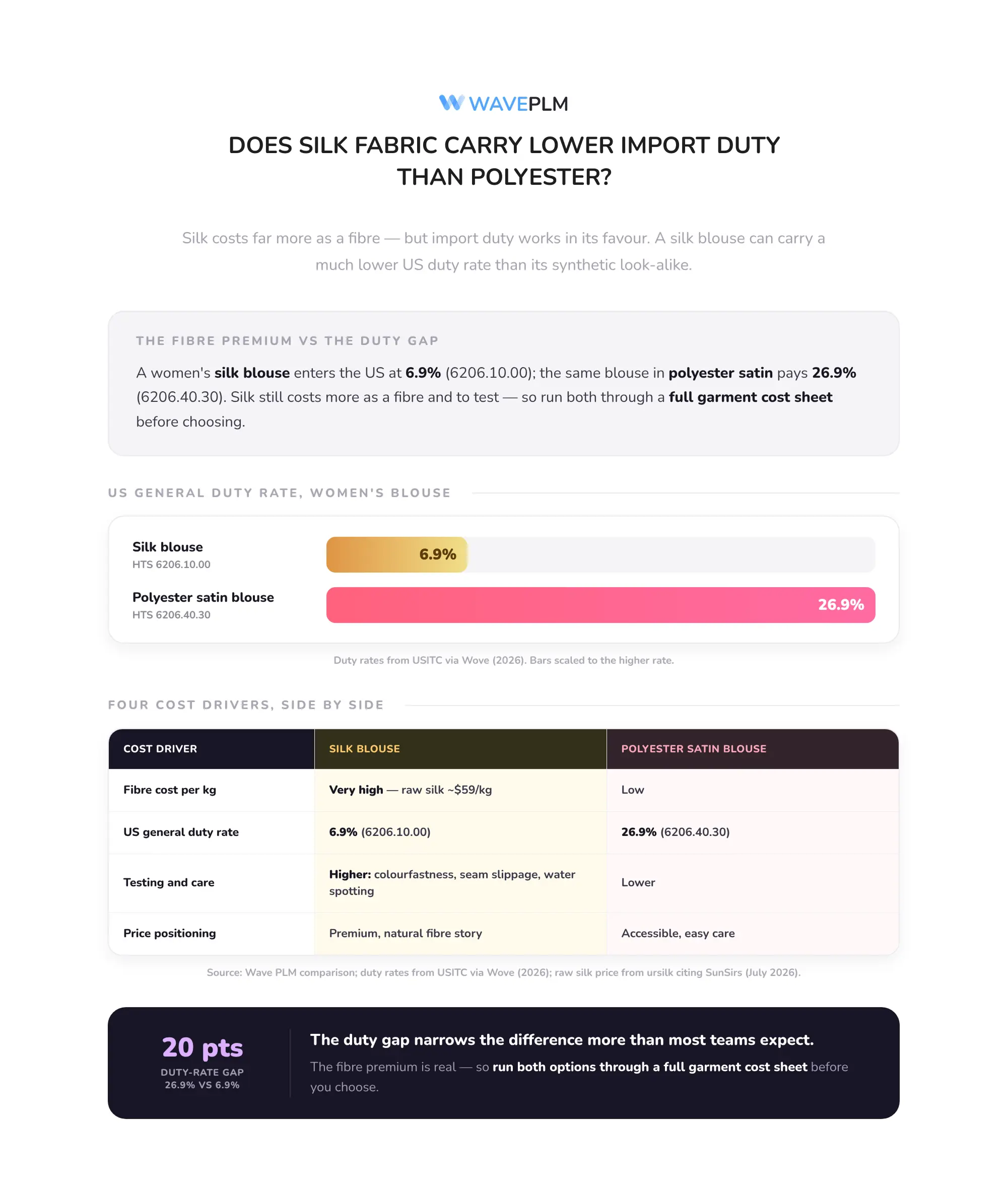
Import duty, on the other hand, works in silk’s favour. In the US, women’s blouses of silk fall under HTS 6206.10.00 at a general rate of 6.9%. By contrast, the same blouse in man-made fibre, such as polyester satin, falls under 6206.40.30 at 26.9%. So a silk blouse can carry a much lower duty rate than its synthetic look-alike. Our HTS code guide for clothing explains why fibre content drives the tariff line.
| Cost driver | Silk blouse | Polyester satin blouse |
|---|---|---|
| Fibre cost per kg | Very high (raw silk ~$59/kg) | Low |
| US general duty rate | 6.9% (6206.10.00) | 26.9% (6206.40.30) |
| Testing and care | Higher: colourfastness, seam slippage, water spotting | Lower |
| Price positioning | Premium, natural fibre story | Accessible, easy care |
Before choosing, therefore, run both options through a full garment cost sheet. The fibre premium is real, but the duty gap narrows the difference more than most teams expect.
What Is Momme, and How Should You Spec It?
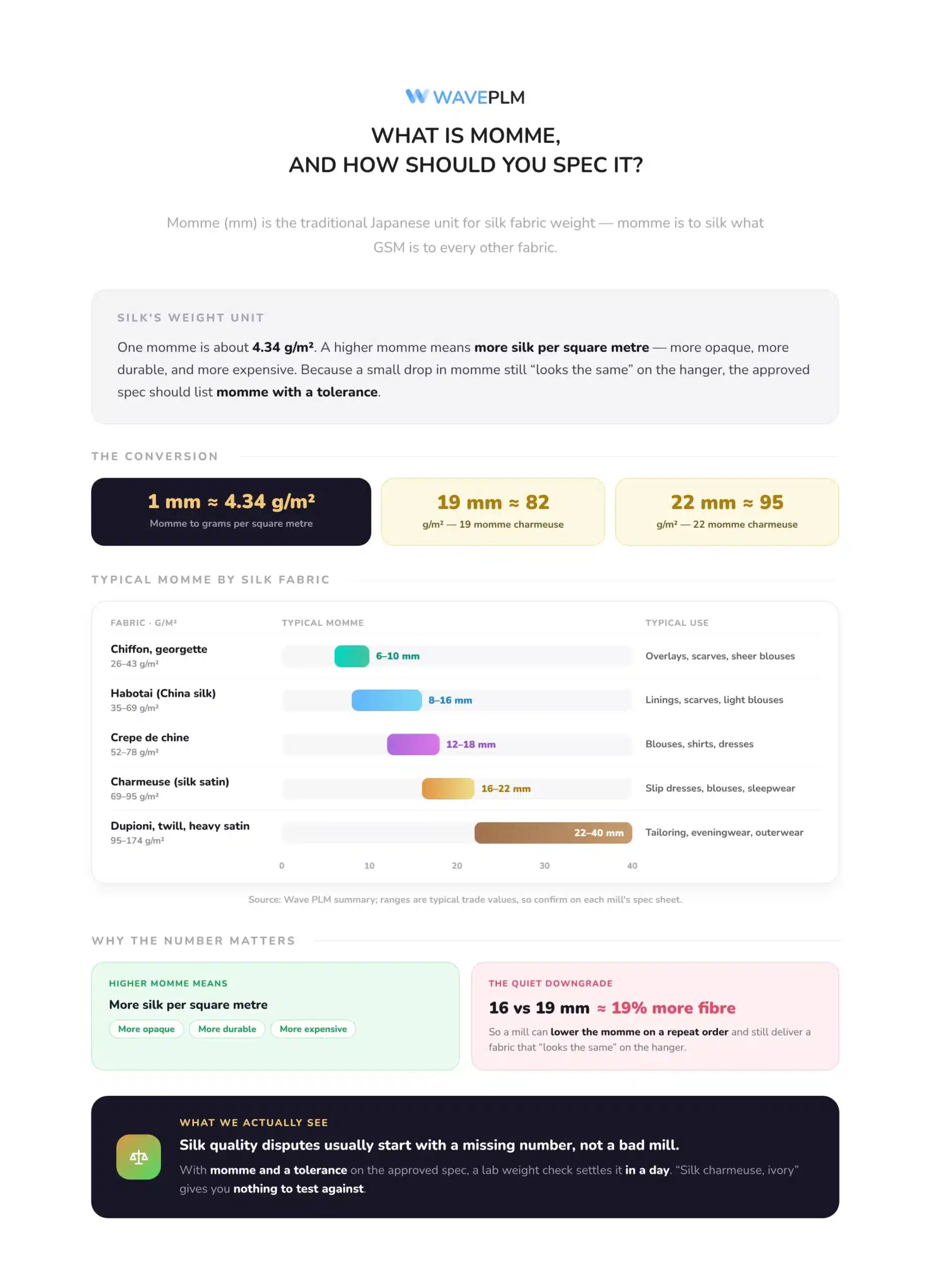
Momme (mm) is the traditional Japanese unit for silk fabric weight. One momme equals about 4.34 grams per square metre. Therefore, a 19 momme charmeuse weighs roughly 82 g/m², and a 22 momme charmeuse weighs about 95 g/m². In short, momme is to silk what GSM is to every other fabric.
| Silk fabric | Typical momme | Approx. g/m² | Typical use |
|---|---|---|---|
| Chiffon, georgette | 6–10 | 26–43 | Overlays, scarves, sheer blouses |
| Habotai (China silk) | 8–16 | 35–69 | Linings, scarves, light blouses |
| Crepe de chine | 12–18 | 52–78 | Blouses, shirts, dresses |
| Charmeuse (silk satin) | 16–22 | 69–95 | Slip dresses, blouses, sleepwear |
| Dupioni, twill, heavy satin | 22–40 | 95–174 | Tailoring, eveningwear, outerwear |
Put simply, a higher momme means more silk per square metre. As a result, the fabric is more opaque, more durable, and more expensive. Notably, the difference between 16 and 19 momme is almost 19% more fibre. That is why a mill can quietly lower the momme on a repeat order and still deliver a fabric that “looks the same” on the hanger.
Our finding: Silk quality disputes usually start with a missing number, not a bad mill. When the approved spec lists momme with a tolerance, a lab weight check settles the question in a day. When it only says “silk charmeuse, ivory”, there is nothing to test against.
What Do Silk Grades Like 6A Mean?
Raw silk is graded on a letter scale with 6A at the top, meaning the most even and cleanest filament. Grading considers evenness, cleanness, and the number of defects in the reeled yarn. Accordingly, 6A raw silk produces the smoothest fabrics, especially for charmeuse and fine crepes.
However, grade is a yarn property. It does not guarantee momme, colourfastness, or finishing quality. For that reason, treat “6A mulberry silk” as one line of the spec, not the whole spec.
What Is the Difference Between Satin and Silk Fabric?
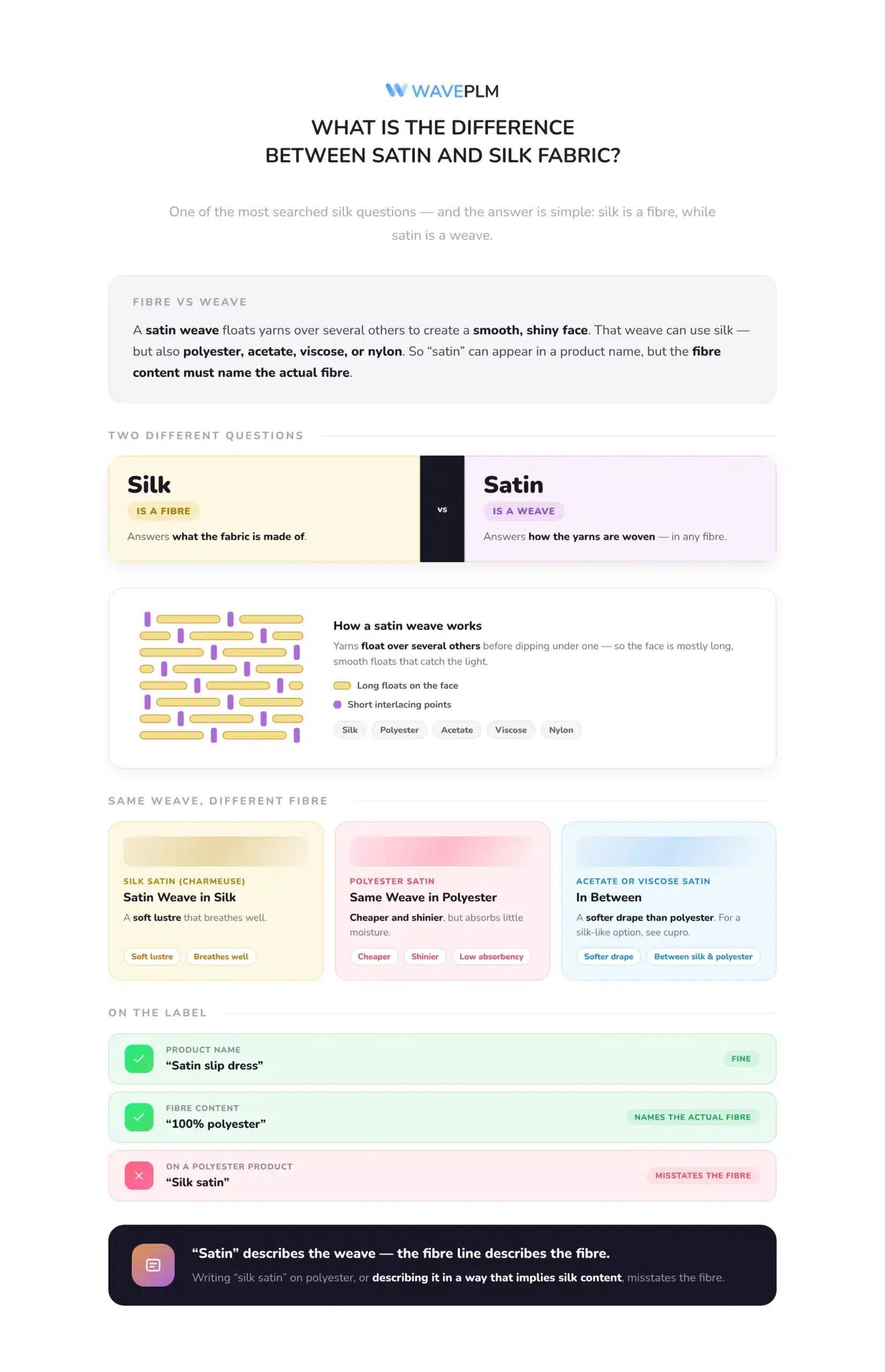
In fact, this is one of the most searched questions about silk fabric, and the answer is simple: silk is a fibre, while satin is a weave. Specifically, a satin weave floats yarns over several others to create a smooth, shiny face. That weave can use silk, but it can also use polyester, acetate, viscose, or nylon.
- Silk satin (charmeuse) is a satin weave in silk. It has a soft lustre and breathes well.
- Polyester satin is the same weave in polyester. It is cheaper, shinier, and absorbs little moisture.
- Acetate or viscose satin sits in between, with a softer drape than polyester. For a silk-like alternative, see our guide to cupro fabric.
For labeling, however, the difference matters. “Satin” can appear in a product name, but the fibre content must name the actual fibre, for example “100% polyester”. Writing “silk satin” on a polyester product, or describing it in a way that implies silk content, misstates the fibre.
How Should You Test Silk Fabric Before Bulk?
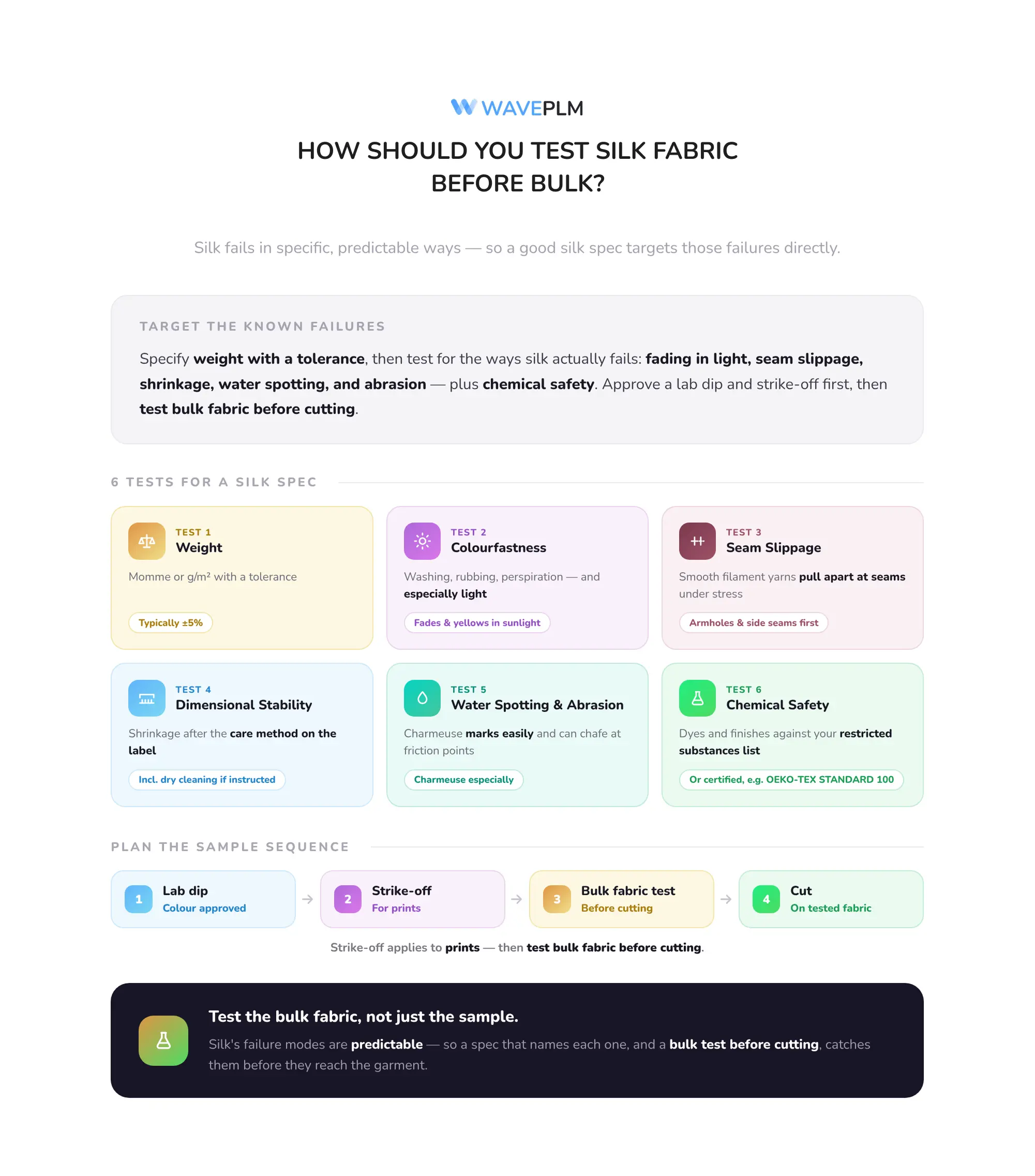
Fortunately, silk fails in specific, predictable ways. Therefore, a good silk spec targets those failures directly:
- Weight. Momme or g/m² with a tolerance, typically ±5%.
- Colourfastness. Washing, rubbing, perspiration, and especially light, since silk fades and yellows in sunlight. Our colorfastness testing guide sets out the grades.
- Seam slippage. Smooth filament yarns pull apart at seams under stress, which shows first at armholes and side seams.
- Dimensional stability. Shrinkage after the care method on the label, including dry cleaning if that is the instruction.
- Water spotting and abrasion. Charmeuse in particular marks easily and can show chafing at friction points.
- Chemical safety. Dyes and finishes tested against your restricted substances list, or certified, for example to OEKO-TEX STANDARD 100.
Moreover, plan the sample sequence. Approve a lab dip and a strike-off for prints first, then test bulk fabric before cutting. Our hub on apparel product testing covers the core lab tests and when to run them.
How Should You Label Silk Fabric Garments?
Silk labeling follows the same rules as other fibres, but the claims around it need extra care. In the EU, the label uses “silk” as defined in Regulation 1007/2011. In the US, the Textile Fiber Products Identification Act requires the generic fibre name and percentage, so the label reads, for example, “100% silk”.
Beyond the fibre line, three kinds of claims cause most problems:
- “Mulberry silk” and grades. Fine to use when your yarn source supports them, but keep the supplier documentation on file.
- “Peace silk” or “cruelty-free silk”. These describe a production method in which the moth leaves the cocoon. They need evidence from the supply chain, not just the mill’s sales copy.
- Environmental claims. From 27 September 2026, the EU Empowering Consumers Directive bans generic claims such as “eco-friendly” without recognised proof. Our guide to the EU Green Claims Directive explains what still has to be substantiated.
In addition, care labels deserve attention. Many silk garments are labeled “dry clean only” by default. If you choose “hand wash cold” instead, test the fabric to that method first, because colour loss and water spots will show up as returns.
When Is Silk the Right Choice for a Style?
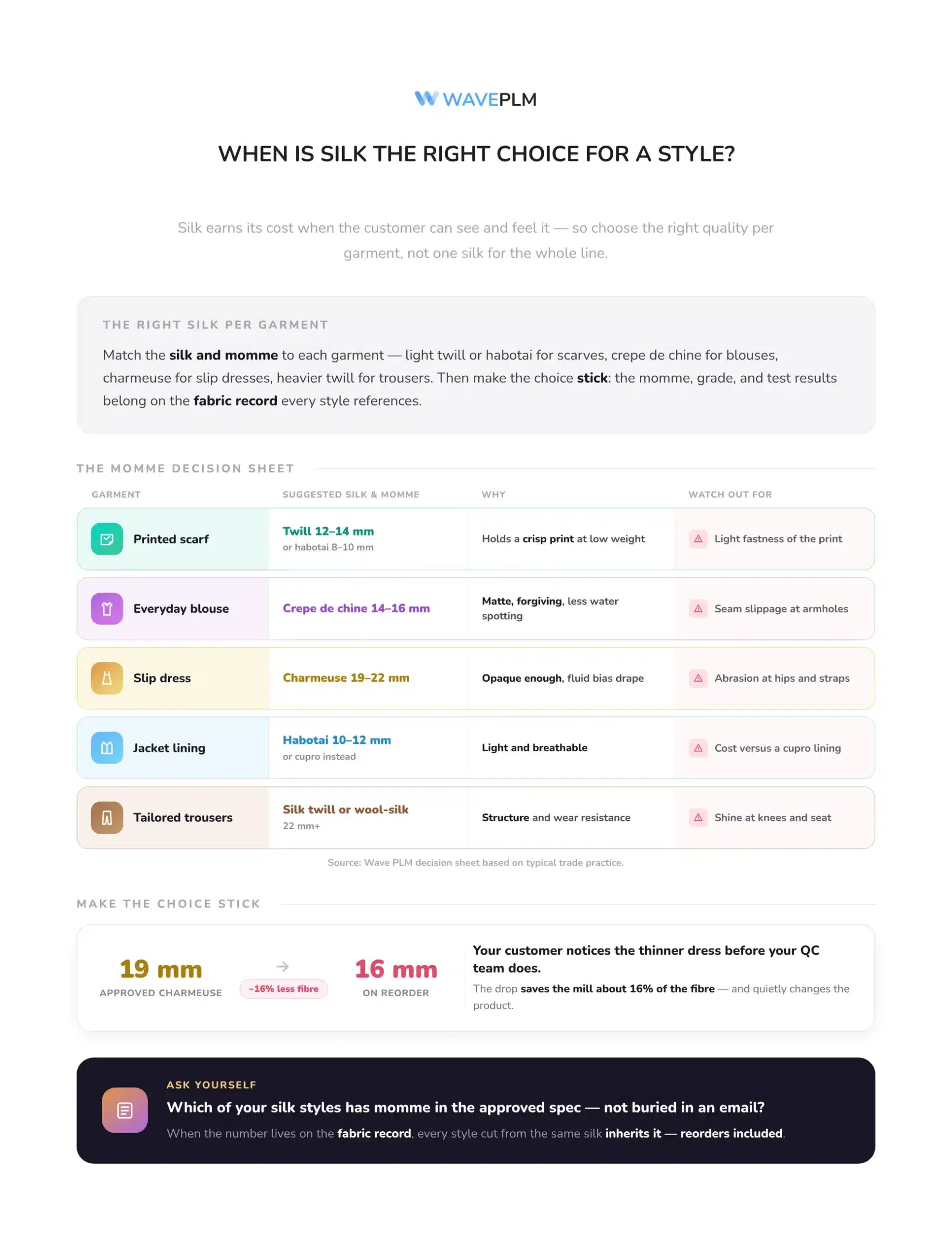
Ultimately, silk fabric earns its cost when the customer can see and feel it. The momme decision sheet below helps a product team choose the right quality per garment instead of using one silk for the whole line.
| Garment | Suggested silk and momme | Why | Watch out for |
|---|---|---|---|
| Printed scarf | Twill 12–14 mm or habotai 8–10 mm | Holds a crisp print at low weight | Light fastness of the print |
| Everyday blouse | Crepe de chine 14–16 mm | Matte, forgiving, less water spotting | Seam slippage at armholes |
| Slip dress | Charmeuse 19–22 mm | Opaque enough, fluid bias drape | Abrasion at hips and straps |
| Jacket lining | Habotai 10–12 mm, or cupro instead | Light and breathable | Cost versus a cupro lining |
| Tailored trousers | Silk twill or wool-silk 22 mm+ | Structure and wear resistance | Shine at knees and seat |
Once you choose, though, the choice has to stick. A 19 momme charmeuse that drops to 16 momme on reorder saves the mill about 16% of the fibre, and your customer will notice the thinner dress before your QC team does. That is why the momme, grade, and test results belong on the fabric record that every style references. Which of your silk styles has momme written into the approved spec, rather than buried in an email thread? In Wave PLM, that number lives on the fabric record, so every style cut from the same silk inherits it, reorders included.
Frequently Asked Questions
What is silk fabric made from?
Silk fabric is made from protein filaments spun by silkworms to build their cocoons. Most commercial silk comes from the mulberry silkworm, Bombyx mori. The cocoons are softened, the filaments are reeled into yarn, and the yarn is woven or knitted into fabric.
Why is silk fabric so expensive?
Silk is expensive because silkworm farming and reeling are slow and labour-intensive. In July 2026, China spot raw silk traded at about $59 per kilogram, roughly 30 times the price of cotton. Higher momme weights and higher grades such as 6A cost even more.
What does momme mean in silk?
Momme is a unit of silk fabric weight. One momme equals about 4.34 grams per square metre. A higher momme means a heavier, more opaque, and usually more durable silk fabric, so momme should always appear in the fabric spec.
Is satin the same as silk?
No. Silk is a fibre, and satin is a weave. Satin can be made from silk, polyester, acetate, or viscose. Only satin made from silk fibre can be labeled silk, so a polyester satin must list polyester as its fibre content.
Can silk be made synthetically?
Not as true silk for apparel. Fabrics such as polyester satin, acetate, viscose, and cupro imitate silk’s look and drape, but they are different fibres. Under EU and US labeling rules, they must be labeled with their real fibre names, never as silk.
Where is most silk fabric made?
China and India produce about 95% of the world’s raw silk, according to Texfash. Most silk fabric sold to Western brands is woven and dyed in China. Italian mills around Como specialise in high-end printing and finishing.
Conclusion
Silk fabric gives a collection lustre, drape, and a natural-fibre story that few alternatives match. At the same time, it is costly, concentrated in two producing countries, and easy to weaken through a lower momme or a vague spec. To buy it well, specify momme with a tolerance, name the grade and weave, test light fastness and seam slippage, and label the fibre exactly. Then compare the full landed cost against synthetic satin, because the duty gap often makes silk more competitive than it first appears.




Leave a Reply