

Fashion ERP software is a business management platform that connects inventory, orders, financials, and production in one system. Specifically, apparel ERP handles the operational backbone of a brand — purchasing, warehouse management, wholesale order processing, and financial reporting. At brands processing 500 or more orders per month, a dedicated fashion ERP system typically reduces order processing time by 35–50% compared to teams managing the same workflows across disconnected spreadsheets and point solutions.
Using fashion erp software can streamline business processes significantly. Many companies are now investing in fashion erp software for better efficiency.
In total, this buyer’s guide covers what fashion ERP software does, which modules apparel brands actually need, 2026 pricing benchmarks, key vendors, and how ERP fits alongside a PLM system.
Fashion erp software is becoming essential for modern apparel businesses. Choosing the right fashion erp software can reduce errors significantly.
What Is Fashion ERP Software?
Fashion ERP (Enterprise Resource Planning) software is an integrated platform that manages the operational and financial functions of an apparel business. It connects data across departments — purchasing, inventory, sales, warehouse, and accounting — into a single system of record. Notably, this eliminates the data duplication and reconciliation errors that occur when teams manage the same information in separate tools.
In the fashion industry, ERP systems are built or configured to handle the specific data structures that apparel operations require. For example, size and color matrix management, style-based inventory tracking, season-based planning, and wholesale order entry are functions that general-purpose ERP systems handle poorly. Fashion-specific ERP systems address these directly.
Industry data: According to Gartner (2025), 67% of mid-market apparel brands that implemented a fashion-specific ERP system reduced order fulfillment errors by more than 40% within the first year of deployment.
What Modules Does Fashion ERP Software Include?
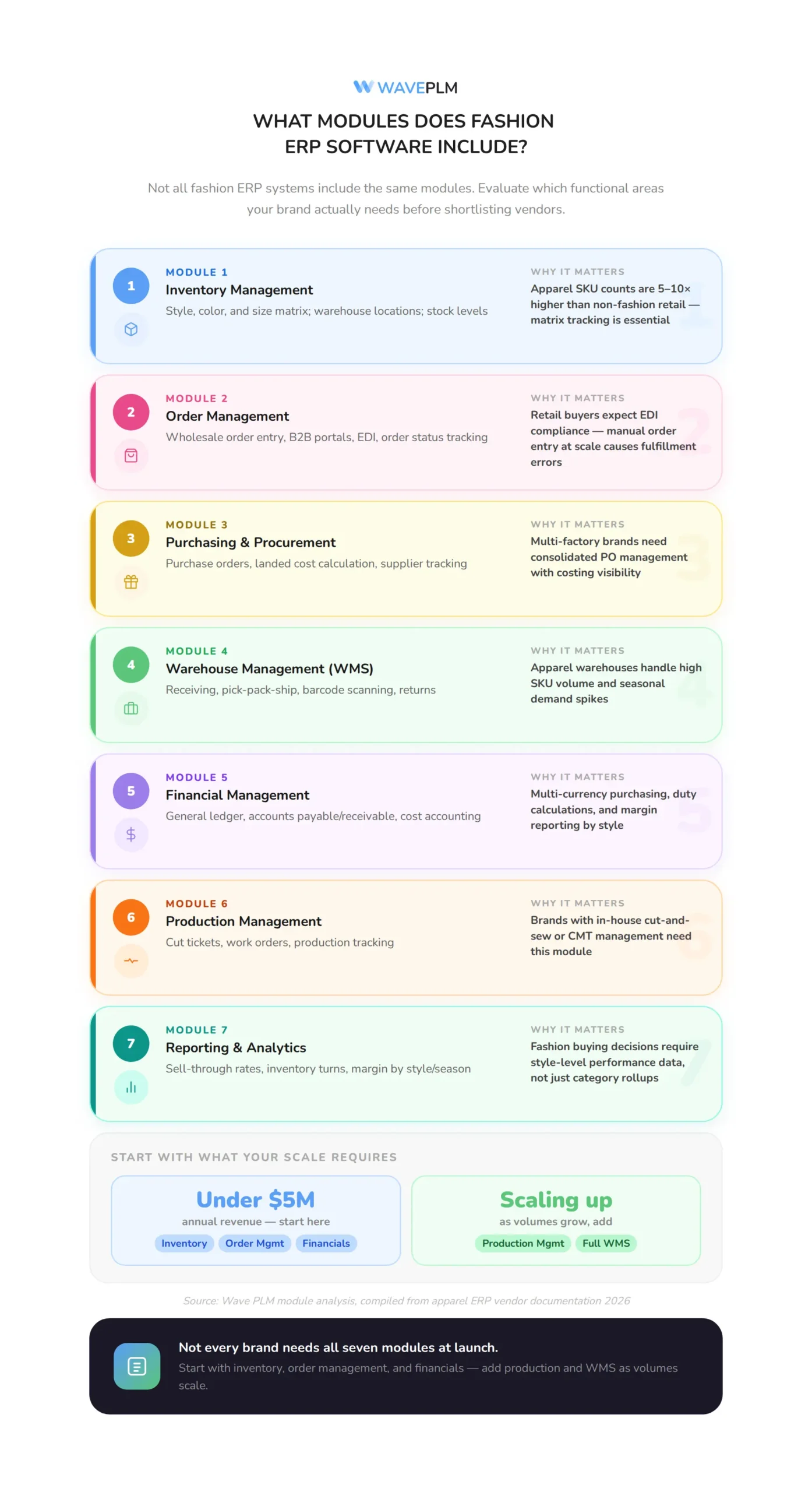
Not all fashion ERP systems include the same modules. Therefore, it is important to evaluate which functional areas your brand actually needs before shortlisting vendors. The following modules are standard in fashion-specific ERP platforms.
| Module | What it manages | Why it matters for apparel |
|---|---|---|
| Inventory management | Style, color, and size matrix; warehouse locations; stock levels | Apparel SKU counts are 5–10× higher than non-fashion retail; matrix tracking is essential |
| Order management | Wholesale order entry, B2B portals, EDI, order status tracking | Retail buyers expect EDI compliance; manual order entry at scale causes fulfillment errors |
| Purchasing and procurement | Purchase orders, landed cost calculation, supplier tracking | Multi-factory brands need consolidated PO management with costing visibility |
| Warehouse management (WMS) | Receiving, pick-pack-ship, barcode scanning, returns | Apparel warehouses handle high SKU volume and seasonal demand spikes |
| Financial management | General ledger, accounts payable/receivable, cost accounting | Multi-currency purchasing, duty calculations, and margin reporting by style |
| Production management | Cut tickets, work orders, production tracking | Brands with in-house cut-and-sew operations or CMT management need this module |
| Reporting and analytics | Sell-through rates, inventory turns, margin by style/season | Fashion buying decisions require style-level performance data, not just category rollups |
Importantly, not every apparel brand needs all of these modules at launch. Specifically, brands under $5M in annual revenue typically start with inventory, order management, and financials. Production management and full WMS capabilities become necessary as volumes scale.
Many businesses are switching to fashion erp software for improved data management.
Fashion erp software facilitates better collaboration across teams.
How Is Fashion ERP Different from Fashion PLM?
Investing in fashion erp software can yield high returns on efficiency. Effective fashion erp software can align your business strategy with operational needs. Brands see significant improvements after adopting fashion erp software.
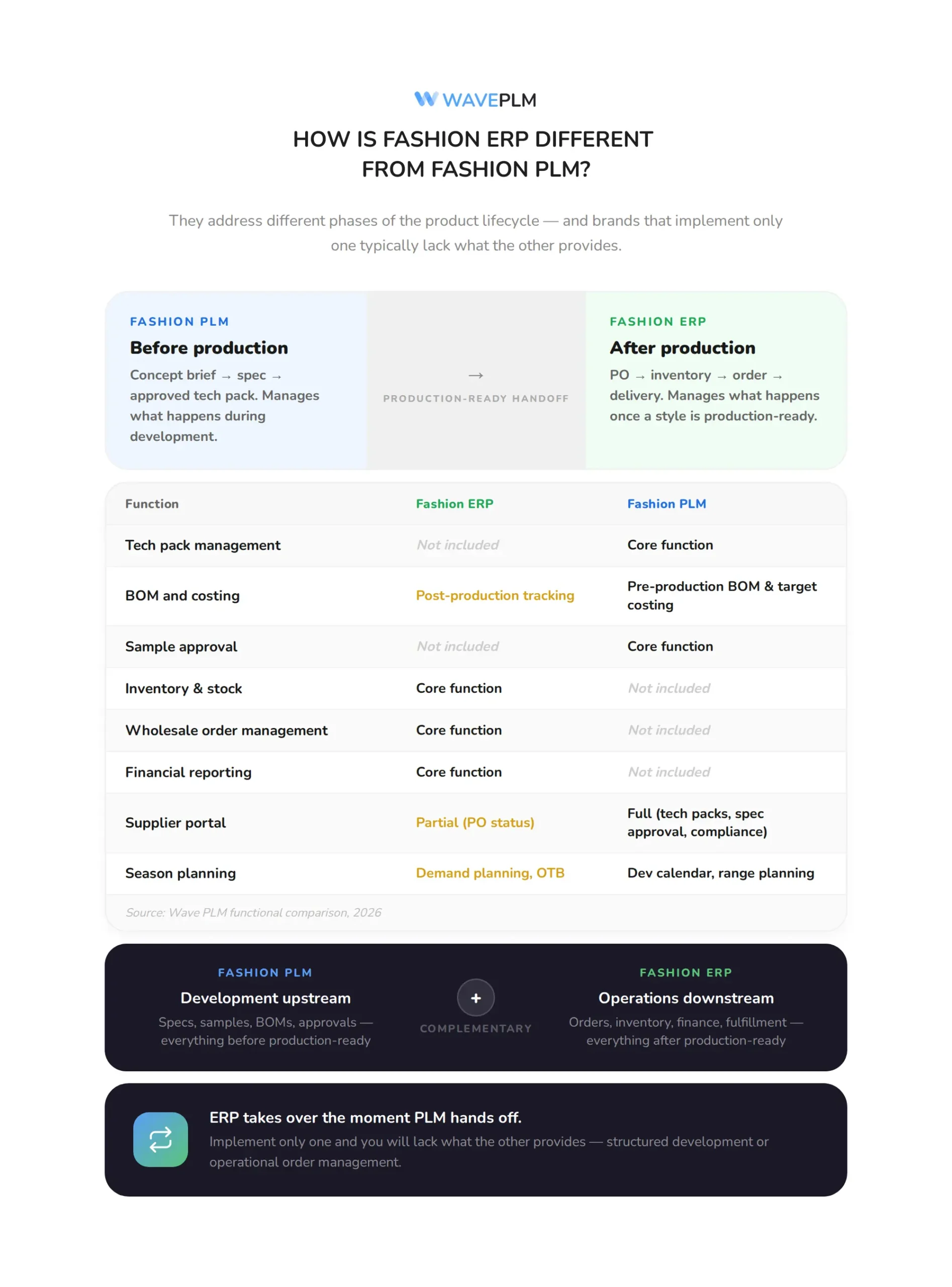
Fashion ERP and fashion PLM (product lifecycle management) are frequently confused, but they address different phases of the product lifecycle. ERP manages what happens after a product is designed and approved for production. PLM manages what happens before and during development — from concept brief through to approved production spec.
| Function | Fashion ERP | Fashion PLM |
|---|---|---|
| Tech pack management | Not included | Core function |
| BOM and costing | Post-production cost tracking | Pre-production BOM and target costing |
| Sample approval | Not included | Core function |
| Inventory and stock | Core function | Not included |
| Wholesale order management | Core function | Not included |
| Financial reporting | Core function | Not included |
| Supplier portal (production docs) | Partial (PO status) | Full (tech packs, spec approval, compliance) |
| Season planning | Demand planning, OTB | Development calendar, range planning |
Fashion erp software helps manage vendor relations effectively. Many SMBs benefit greatly from fashion erp software solutions.
In practice, ERP and PLM are complementary systems. ERP takes over the moment a style is production-ready; PLM manages everything upstream of that handover. Consequently, brands that implement only ERP typically lack structured development workflows, and brands that implement only PLM lack operational order and inventory management. For a detailed comparison of how these systems divide responsibility, see the full PLM vs ERP guide.
Adopting fashion erp software can simplify inventory management. Fashion erp software is essential for tracking sales and orders. Choosing the right fashion erp software can enhance customer satisfaction. Integrating fashion erp software into daily operations is crucial for efficiency. Fashion erp software provides visibility across the supply chain.
What Does Fashion ERP Software Cost in 2026?
Fashion ERP pricing varies significantly by vendor tier, deployment model, and user count. The following benchmarks reflect 2026 market rates for SMB and mid-market apparel brands.
With fashion erp software, managing seasonal demands becomes easier. Fashion erp software can significantly improve procurement processes.
| Vendor tier | Pricing model | Typical cost (2026) | Best fit |
|---|---|---|---|
| SMB fashion ERP (e.g., ApparelMagic, AIMS360, Uphance) | SaaS, per-user/month | $200–$500/user/month | Brands with 5–50 employees, $1M–$20M revenue |
| Mid-market ERP (e.g., Oracle NetSuite, Microsoft Dynamics 365) | SaaS + implementation fees | $1,500–$4,000/user/month + $30,000–$150,000 implementation | Brands with 50–500 employees, $20M–$200M revenue |
| Enterprise fashion ERP (e.g., Infor CloudSuite Fashion, SAP S/4HANA) | License + implementation + support | $200,000–$1,000,000+ total first-year cost | Large retailers and brands with $200M+ revenue |
Furthermore, these figures represent software cost only. Total cost of ownership also includes data migration, staff training, integration development, and ongoing customization. As a result, SMB brands should budget an additional 30–50% above the base software cost for first-year implementation expenses.
Our finding: Wave PLM customers who evaluated apparel ERP systems in 2025–2026 reported that 60% of implementation projects exceeded initial budget estimates, primarily due to underestimated data migration complexity and user training requirements.
Which Fashion ERP Vendors Lead the Market in 2026?
The fashion ERP vendor market segments clearly by brand size. Therefore, evaluating vendors within your revenue and operational tier is more productive than comparing SMB solutions against enterprise platforms.
SMB fashion ERP systems (under $20M revenue): ApparelMagic, AIMS360, and Uphance are the most widely adopted in this segment. All three are SaaS platforms with fashion-specific matrix inventory, wholesale order entry, and basic production tracking built in. Moreover, implementation timelines are typically 4–12 weeks at this tier.
Mid-market ERP with fashion modules ($20M–$200M revenue): Oracle NetSuite and Microsoft Dynamics 365 Business Central are the dominant platforms. Specifically, both require fashion-specific extensions or ISV add-ons to handle style/color/size matrix management and apparel-specific reporting. Implementation timelines range from 3–9 months at this tier.
Enterprise fashion ERP ($200M+ revenue): Infor CloudSuite Fashion, SAP S/4HANA with fashion management modules, and FDM4 serve large brands and multi-division retailers. Consequently, these implementations require dedicated project teams and typically take 12–24 months to complete.
Additionally, WFX (World Fashion Exchange) occupies a unique position as a combined ERP and supply chain platform with strong vendor onboarding and compliance tracking features built in.
The right fashion erp software empowers brands to scale efficiently. Investing in fashion erp software pays off in streamlined workflows.
When Does a Fashion Brand Need ERP vs. PLM — or Both?
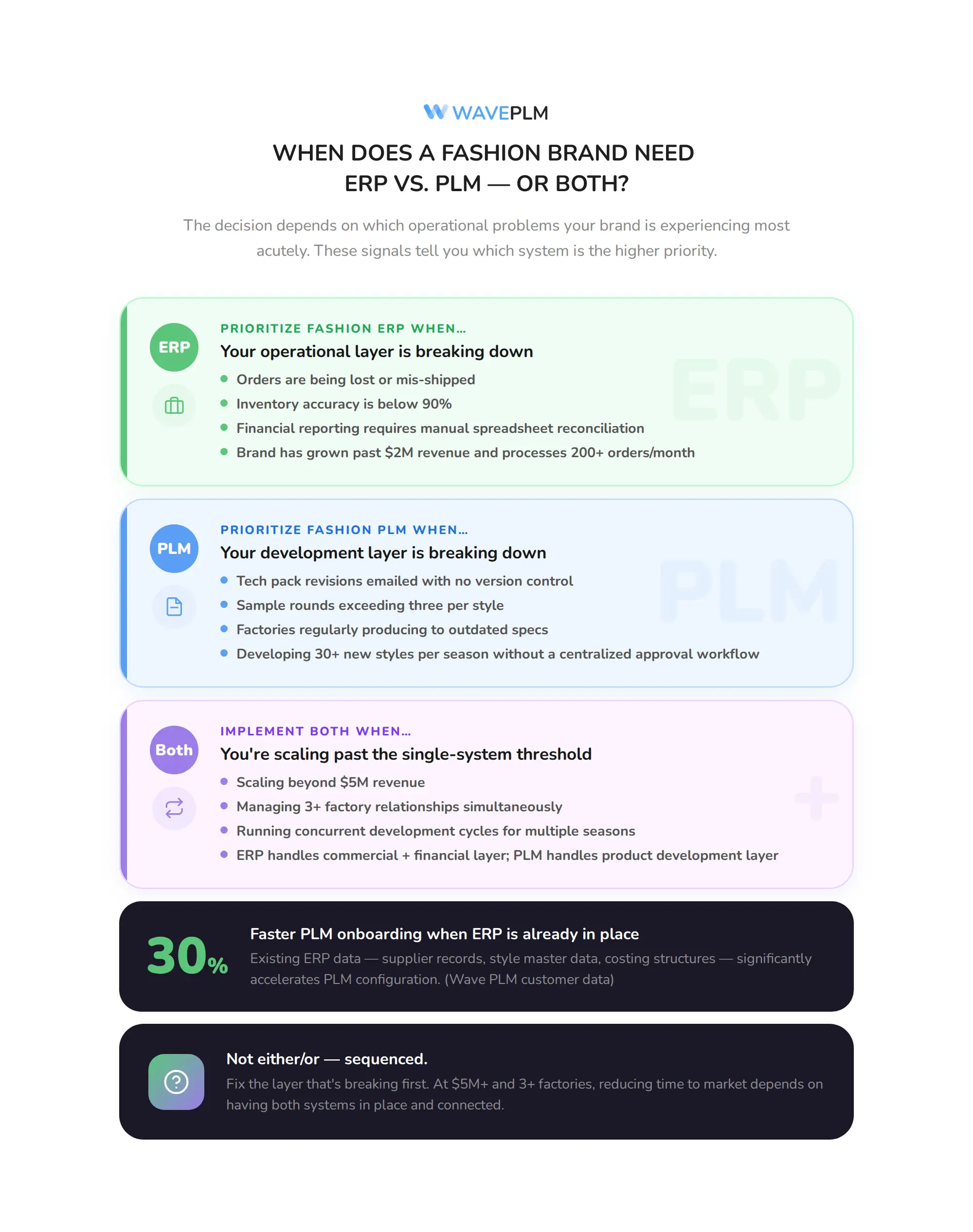
In practice, the decision between ERP and PLM — or the sequence for implementing both — depends on which operational problems the brand is experiencing most acutely. In practice, the following signals indicate which system is the higher priority.
Prioritize fashion ERP when: Orders are being lost or mis-shipped. Inventory accuracy is below 90%. Financial reporting requires manual reconciliation across multiple spreadsheets. The brand has grown past $2M annual revenue and processes more than 200 orders per month.
Fashion erp software enables data-driven decision-making.
Prioritize fashion PLM when: Tech pack revisions are being emailed to factories with no version control. Sample rounds exceed three per style. Factories regularly produce to outdated specs. The brand is developing more than 30 new styles per season without a centralized approval workflow.
Choosing to implement fashion erp software is a step towards operational excellence.
Adopting fashion erp software can help brands navigate complex market demands.
Implement both when: The brand is scaling beyond $5M revenue, managing 3+ factory relationships, and running concurrent development cycles for multiple seasons. At this stage, the operational complexity of product development and order management cannot be managed in a single system. ERP handles the commercial and financial layer; PLM handles the product development layer. For brands at this scale, reducing time to market depends on having both systems in place and properly connected.
Our finding: Wave PLM customers who had implemented a fashion ERP system before adding PLM reduced their PLM onboarding time by 30% on average. Specifically, existing ERP data — supplier records, style master data, and costing structures — significantly accelerated PLM configuration.
How Do Fashion ERP and PLM Work Together?
When both systems are deployed, they share a data handover at a specific point in the product lifecycle. PLM manages the development stage; ERP takes over once the product is approved for bulk production. In practice, this means the two systems need to exchange style master data, bill of materials, and costing information at the point of production handover.
The integration between fashion ERP and PLM varies by vendor combination. Consequently, brands should evaluate the integration approach before committing to either platform. The most common approaches are:
- Native integration — some PLM and ERP vendors offer pre-built connectors. This is the lowest-friction approach but limits vendor choice.
- API integration — most modern SaaS platforms expose APIs. This allows flexible vendor selection but requires integration development effort (typically 4–8 weeks of developer time).
- Manual export/import — some SMB brands use CSV export from PLM to populate ERP at handover. This is viable for brands under 50 styles per season but becomes error-prone at higher volumes.
For brands using SAP, Wave PLM’s approach to PLM and ERP integration covers the handover architecture in detail. Similarly, the PLM implementation guide addresses how to sequence a PLM rollout when ERP is already in place.
How Should a Fashion Brand Evaluate ERP Software?
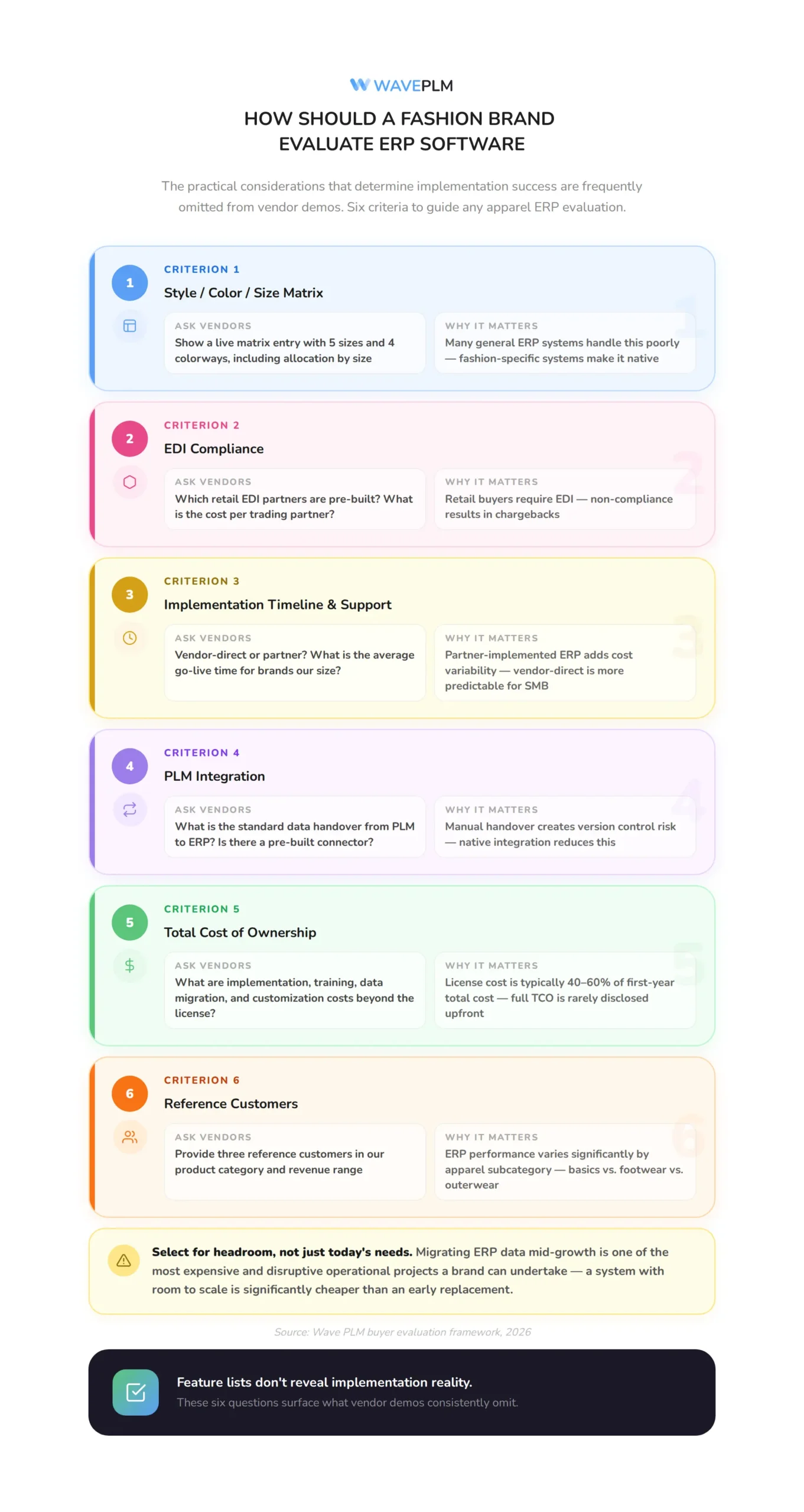
Evaluating fashion ERP software involves more than comparing feature lists. Specifically, the practical considerations that most often determine implementation success are frequently omitted from vendor demos. The following criteria should guide any apparel ERP evaluation.
| Evaluation criterion | What to ask vendors | Why it matters |
|---|---|---|
| Style/color/size matrix | Show us a live matrix entry with 5 sizes and 4 colorways, including allocation by size | Many general ERP systems handle this poorly; fashion-specific systems make it native |
| EDI compliance | Which retail EDI partners are pre-built? What is the cost per trading partner? | Retail buyers require EDI; non-compliance results in chargebacks |
| Implementation timeline and support | Who handles implementation — vendor direct or partner? What is the average go-live time for brands our size? | Partner-implemented ERP adds cost variability; vendor-direct is more predictable for SMB |
| PLM integration | What is the standard data handover from PLM to ERP? Is there a pre-built connector? | Manual handover creates version control risk; native integration reduces this |
| Total cost of ownership | What are the implementation, training, data migration, and customization costs beyond the license fee? | License cost is typically 40–60% of first-year total cost; full TCO is rarely disclosed upfront |
| Reference customers | Provide three reference customers in our product category and revenue range | ERP performance varies significantly by apparel subcategory (basics vs. footwear vs. outerwear) |
Furthermore, brands scaling from 20 to 100 styles per season should evaluate whether the ERP system they select today can accommodate their product data complexity in two to three seasons. Notably, migrating ERP data mid-growth is one of the most expensive and disruptive operational projects a brand can undertake. Selecting a system with headroom is significantly cheaper than an early replacement.
Frequently Asked Questions
What is fashion ERP software?
Fashion ERP software is an integrated business management platform that connects inventory, order management, purchasing, warehouse operations, and financial reporting for apparel brands. It handles the operational and commercial layer of the business — not product development or design. Fashion-specific ERP systems include style/color/size matrix management, EDI compliance, and seasonal inventory planning that general ERP platforms do not support natively.
What is the difference between fashion ERP and fashion PLM?
Fashion ERP manages the commercial and operational layer of the business: inventory, orders, financials, and fulfillment. Fashion PLM manages the product development layer: tech packs, sample approvals, BOM, costing, and vendor specs. The two systems are complementary. ERP takes over once a style is approved for bulk production; PLM manages everything upstream of that point.
What does fashion ERP software cost in 2026?
SMB-tier fashion ERP platforms such as ApparelMagic, AIMS360, and Uphance typically cost $200–$500 per user per month on SaaS plans. Mid-market platforms such as Oracle NetSuite range from $1,500–$4,000 per user per month, with $30,000–$150,000 in additional implementation costs. Enterprise platforms (Infor, SAP) typically require $200,000–$1,000,000+ in total first-year investment.
What ERP do most fashion brands use?
Notably, small and mid-sized apparel brands most commonly use ApparelMagic, AIMS360, Uphance, or Oracle NetSuite. Large fashion retailers and global brands typically use Infor CloudSuite Fashion, SAP S/4HANA, or Microsoft Dynamics 365 with fashion-specific extensions. The best choice depends on brand size, product category, and existing tech stack — there is no single dominant system across all tiers.
Do small apparel brands need ERP software?
Small apparel brands typically benefit from fashion ERP once they pass $1–2M in annual revenue, 200+ monthly orders, or 3+ wholesale accounts requiring EDI. Below this threshold, a combination of Shopify or similar ecommerce platform, QuickBooks, and a spreadsheet-based inventory system is often sufficient. The decision point is usually when inventory errors or fulfillment failures start generating measurable revenue loss.
Can fashion ERP replace PLM software?
No. Fashion ERP cannot replace PLM software because the two systems manage fundamentally different functions. ERP does not include tech pack management, version-controlled spec distribution, sample approval workflows, or BOM-based pre-production costing. Conversely, PLM does not manage orders, inventory, warehouse operations, or financial accounting. Growing brands need both systems, connected at the point of production handover.
How long does it take to implement fashion ERP software?
Implementation timelines vary significantly by vendor tier. SMB-tier platforms such as ApparelMagic and AIMS360 typically go live in 4–12 weeks. Mid-market platforms such as Oracle NetSuite require 3–9 months. Enterprise platforms (Infor, SAP) typically take 12–24 months. Specifically, the main variables are data migration complexity, EDI setup requirements, and the number of integrations with existing systems.
Ultimately, fashion ERP software is the operational foundation for any apparel brand managing significant order volumes, multi-location inventory, or wholesale channel compliance. Selecting the right system requires matching vendor tier to brand size, evaluating fashion-specific module depth, and planning for the PLM integration that will eventually be necessary as product development complexity grows.
Moreover, Wave PLM is the product development layer that works alongside fashion ERP — managing everything from concept brief to production-ready tech pack. See how Wave PLM connects with your ERP to complete the product lifecycle.








Leave a Reply