
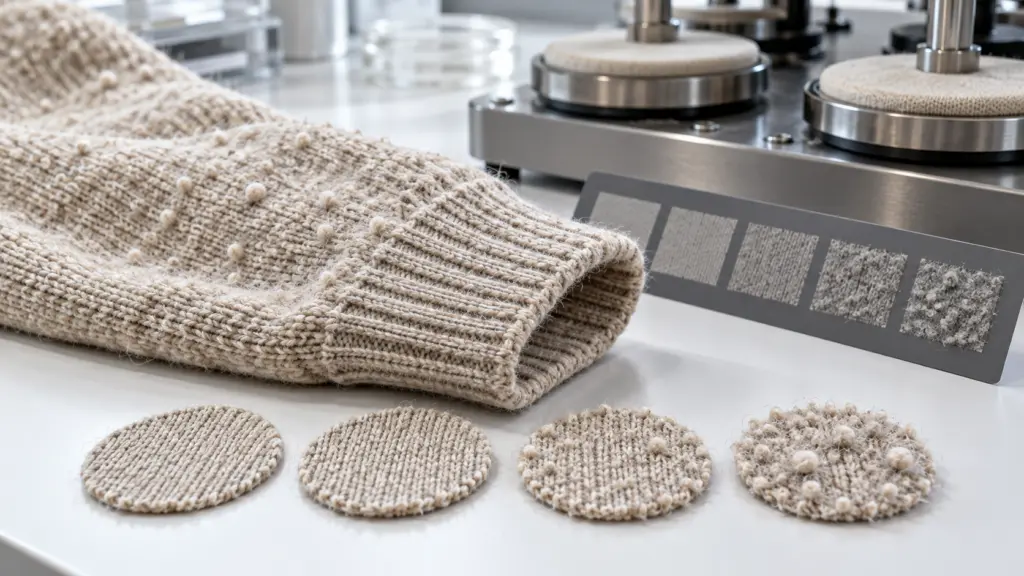
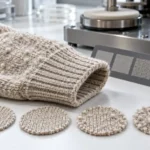
Fabric pilling is the formation of small balls of tangled fibre on the surface of a fabric after wear and washing. For a consumer, it makes a new sweater look old. For an apparel brand, however, fabric pilling is a measurable quality property. Labs test it and rate it from 1 to 5. In turn, buyers set a minimum grade that a fabric must reach before they approve bulk.
This guide is written for product, sourcing, and quality teams. Specifically, it explains what causes pilling and how the main ISO and ASTM tests work. It also covers which grades to require and how to write pill resistance into a fabric spec, so that bulk matches the approved sample.
What Is Fabric Pilling?
In practice, fabric pilling happens in three stages. First, friction pulls loose fibre ends out of the yarn and creates fuzz on the surface. Next, those fibres tangle together into small balls. Finally, the pills either break off or stay anchored to the fabric. In fact, whether they break off depends mostly on fibre strength.
That last stage explains a common surprise. Pills on cotton and wool tend to shed over time. In contrast, strong synthetic fibres such as polyester and nylon hold the pills in place. As a result, a polyester blend can look worse after a few months than a weaker cotton jersey. This happens even when both fabrics fuzz at the same rate.
Industry data: According to testing lab Begoodtex, most retailers require knitted garments to achieve grade 3-4 under ISO 12945-1, the pilling box method (Begoodtex, ISO 12945 overview, 2025).
What Causes Fabric Pilling?
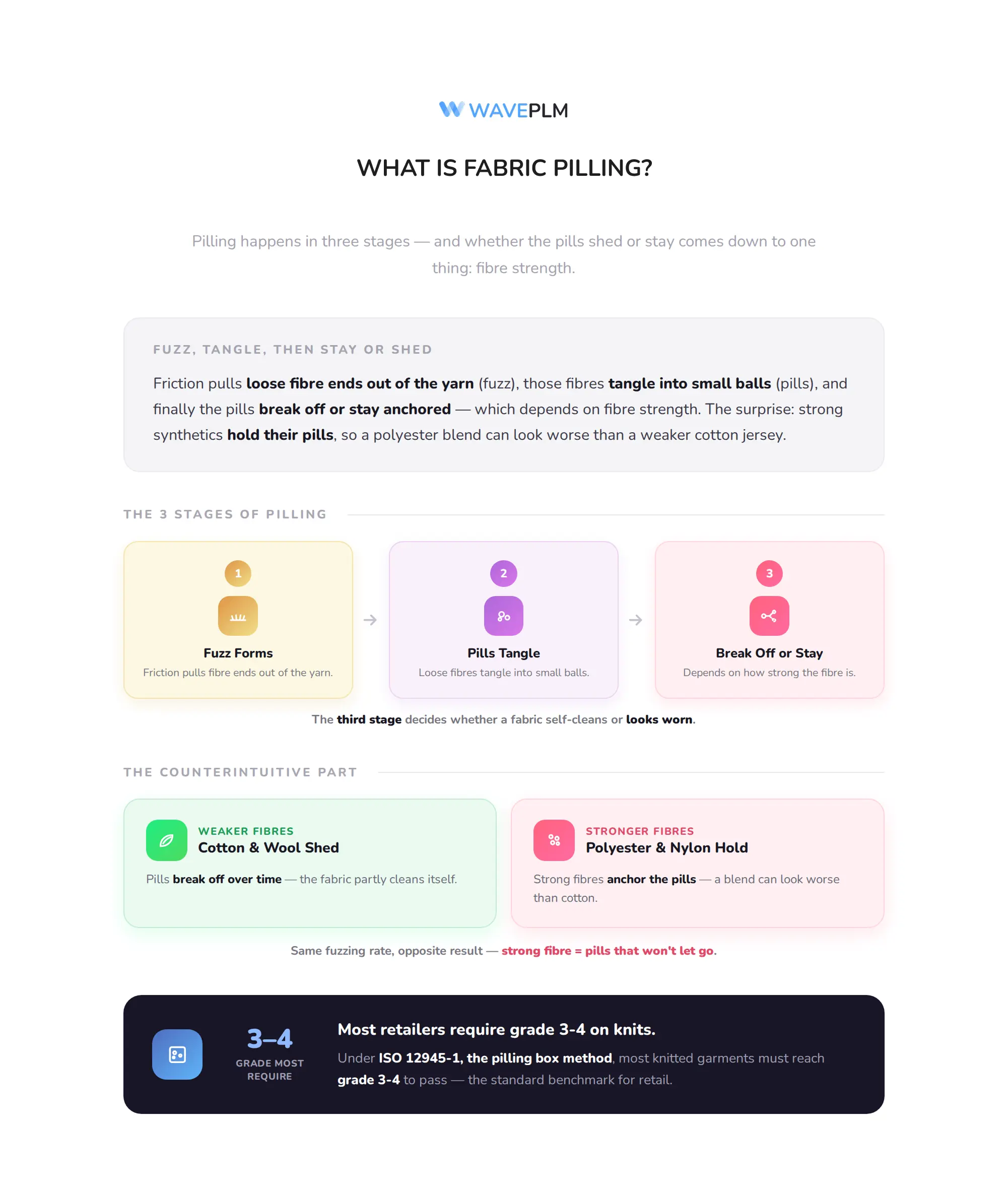
According to Cotton Incorporated, pilling comes from fibre choice, construction, and mill processing. In other words, it depends less on how consumers treat the garment. In practice, that means product teams can design out most fabric pilling problems at the spec stage. The main drivers are:
- Short fibres. Short staple cotton, recycled fibre, and some wool grades have more loose ends that work their way to the surface.
- Low yarn twist. Soft, lofty yarns feel good on the hanger; however, they release fibres faster under friction.
- Open construction. Loose knits, brushed surfaces, and fleece back fabrics pill more than tight plain weaves.
- Strong blends. Mixing a weak fibre with polyester or nylon keeps pills attached instead of letting them shed.
- Finishing. Skipping singeing, shearing, or an anti-pilling finish leaves more surface fibre in the fabric.
For example, mechanically recycled cotton often has shorter fibres than virgin cotton. Similarly, recycled polyester behaves like virgin polyester on pilling, so the same blend rules apply. For details, see our guide to recycled polyester fabric.
Which Fabrics Pill the Most?
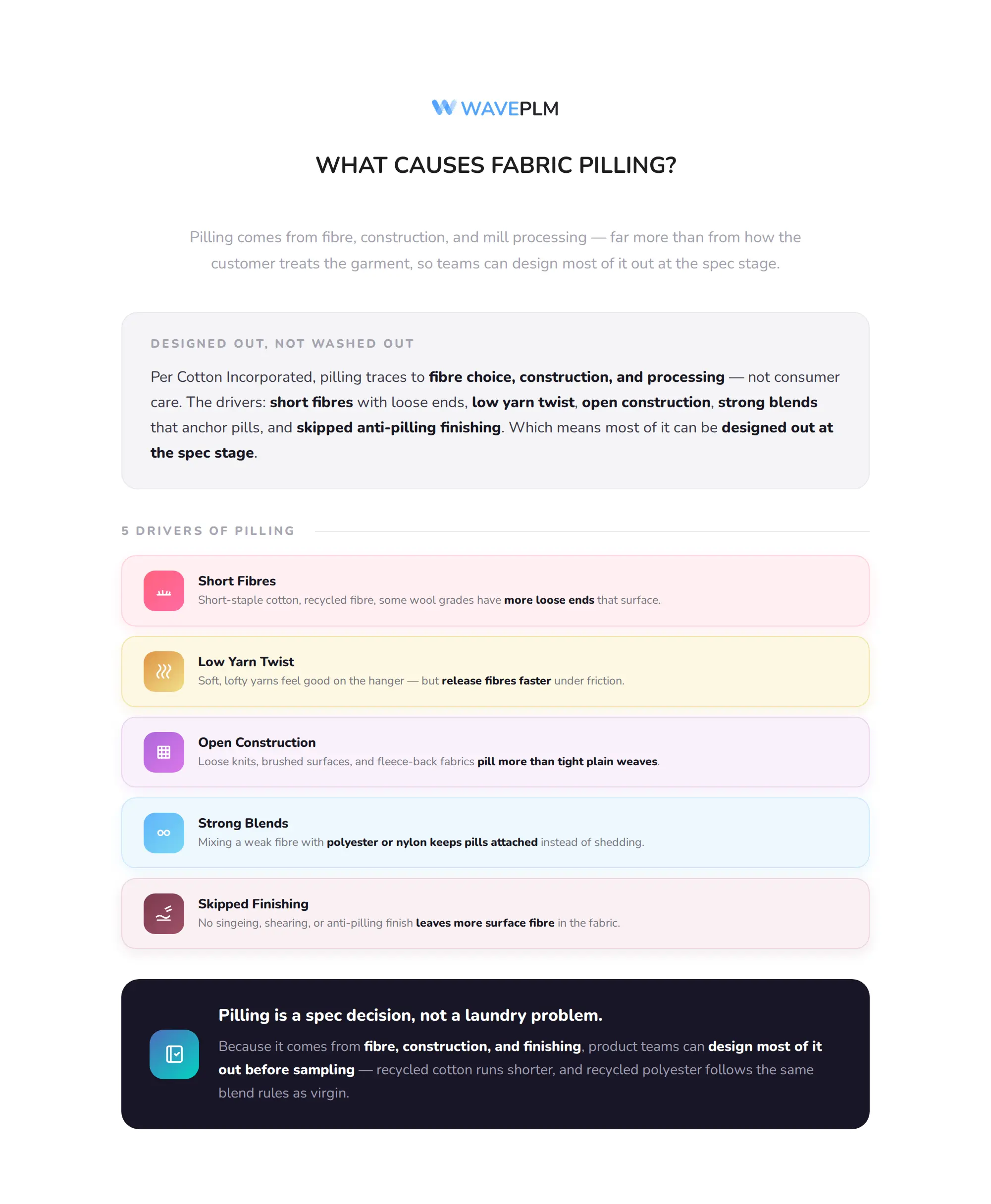
| Fabric type | Pilling risk | Why |
|---|---|---|
| Polyester/cotton fleece | High | Brushed surface plus strong fibre that anchors pills |
| Acrylic and acrylic blend knits | High | Strong fibre, lofty yarns, open knit structure |
| Lambswool and merino knits | Medium to high | Fine fibres and low twist; pills often shed with wear |
| Viscose and modal jersey | Medium | Soft fibre and fluid knits; fuzzing is common |
| Cotton jersey | Low to medium | Depends on staple length and combing |
| Tight wovens (poplin, twill) | Low | Dense structure limits fibre migration |
Viscose is a good example of a fabric where finishing matters as much as fibre. Our guide to viscose fabric covers the other tests that belong in the same spec.
How Is Fabric Pilling Tested?
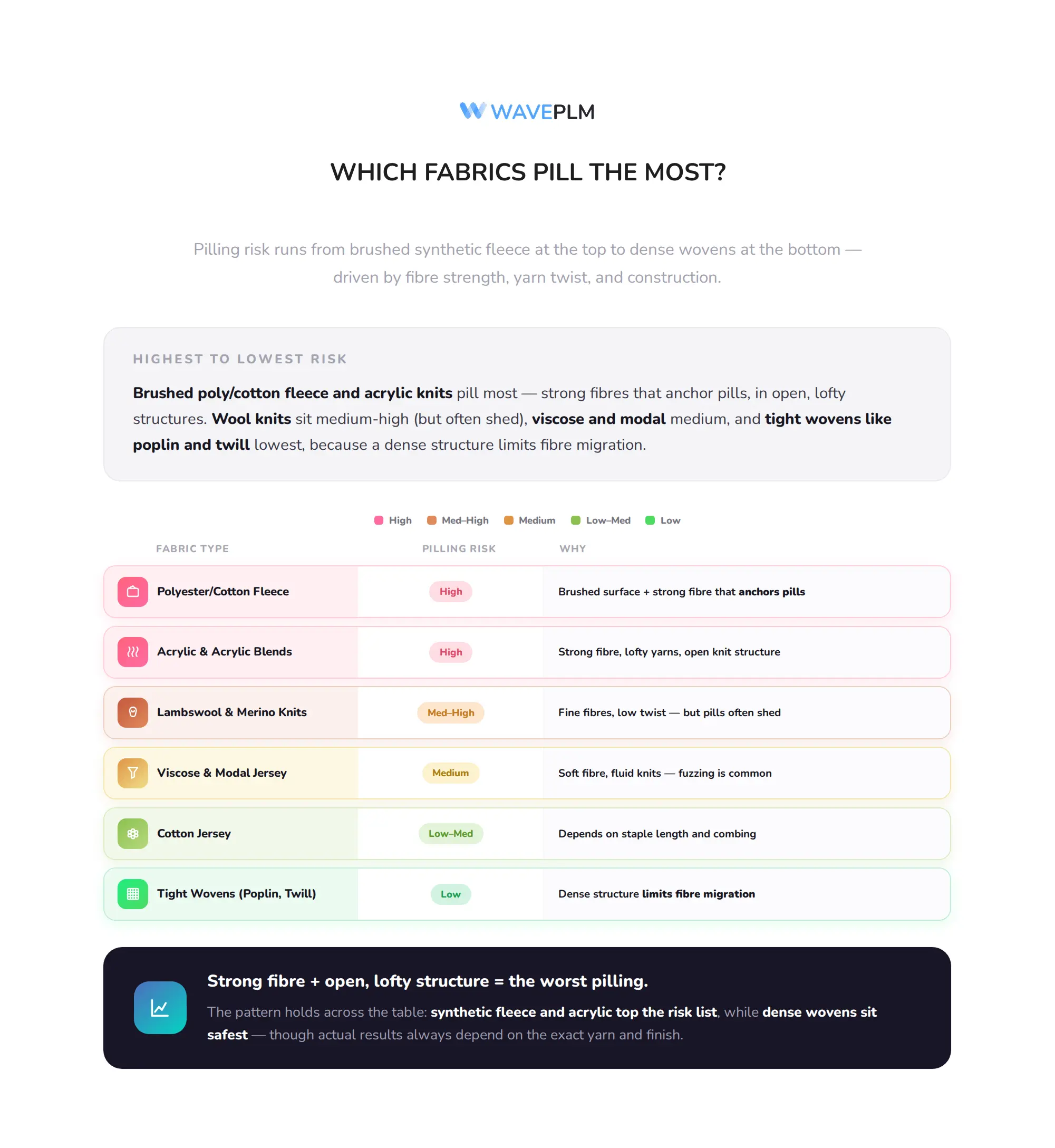
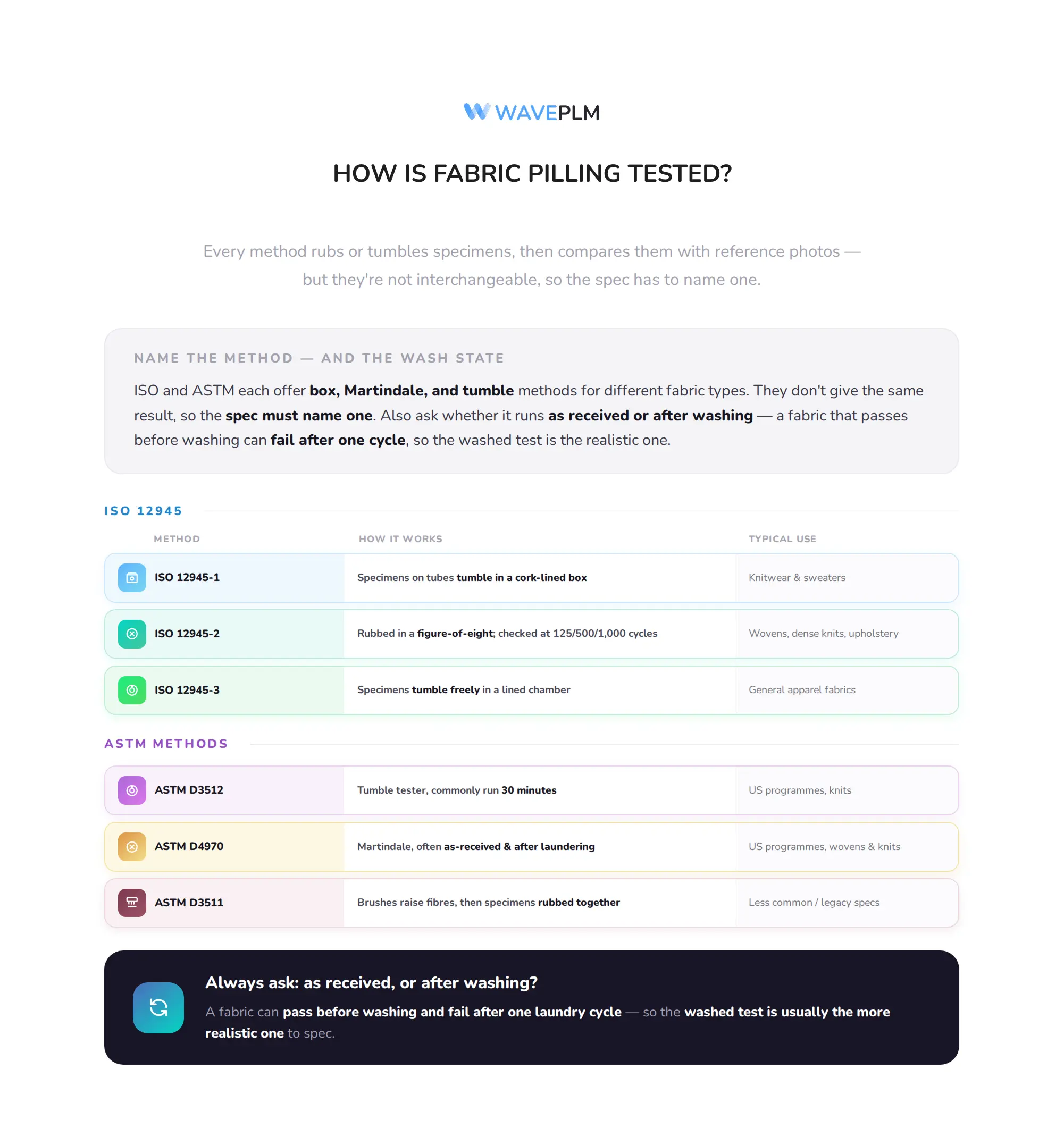
Every pilling test works the same way. First, it rubs or tumbles fabric specimens in a controlled way. Finally, a technician compares them with reference photos. However, the methods are not interchangeable, so the spec has to name one.
| Method | How it works | Typical use |
|---|---|---|
| ISO 12945-1 (pilling box) | Specimens on tubes tumble in a cork-lined box | Knitwear and sweaters |
| ISO 12945-2 (modified Martindale) | Specimen rubbed in a figure-of-eight path; checked at set cycle counts such as 125, 500, and 1,000 | Wovens, dense knits, upholstery |
| ISO 12945-3 (random tumble) | Specimens tumble freely in a lined chamber | General apparel fabrics |
| ASTM D3512 (random tumble) | Tumble tester, commonly run for 30 minutes | US buyer programmes, knits |
| ASTM D4970 (Martindale) | Martindale tester, often tested as received and after laundering | US buyer programmes, wovens and knits |
| ASTM D3511 (brush pilling) | Brushes raise fibres, then specimens are rubbed together | Less common; some legacy specs |
In addition, ask whether the test runs on fabric as received or after a set number of washes. After all, a fabric that passes before washing can fail after one laundry cycle. The washed test is therefore usually the more realistic one. The apparel product testing overview shows where pilling sits in a standard lab package.
What Pilling Grade Should a Fabric Pass?
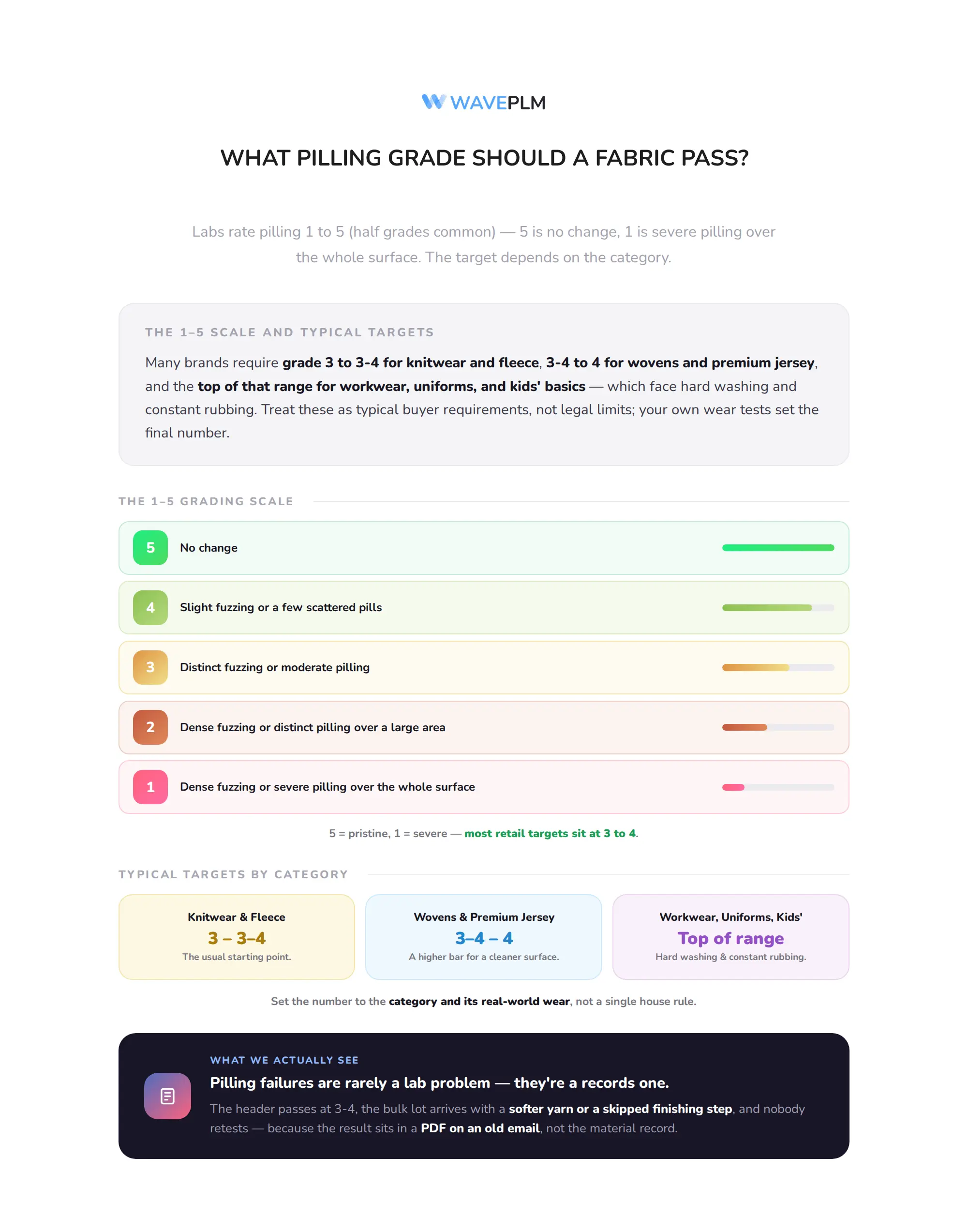
Specifically, labs rate fabric pilling on a 1 to 5 scale, where half grades are common. In short, 5 means no change and 1 means severe pilling over the whole surface.
| Grade | What the surface looks like |
|---|---|
| 5 | No change |
| 4 | Slight fuzzing or a few scattered pills |
| 3 | Distinct fuzzing or moderate pilling |
| 2 | Dense fuzzing or distinct pilling over a large area |
| 1 | Dense fuzzing or severe pilling over the whole surface |
As a starting point, many brands require grade 3 to 3-4 for knitwear and fleece. For wovens and premium jersey, the usual target is 3-4 to 4. Meanwhile, workwear, school uniforms, and kids’ basics often sit at the top of that range. These garments face hard washing and constant rubbing. Treat these as typical buyer requirements rather than legal limits; your own wear tests should decide the final number.
Our finding: Pilling failures are rarely a lab problem. More often, the approved header passes at 3-4, the bulk lot arrives with a softer yarn or a skipped finishing step, and nobody retests it because the result is only stored in a PDF attached to an old email.
Fabric Pilling vs Fuzzing vs Abrasion
These three results are related, although they are not the same thing. Fuzzing is the first stage, when loose fibres raise a hairy surface but have not yet formed balls. Abrasion, by contrast, measures how quickly the fabric wears through, usually as a Martindale cycle count to a hole or thread break. Consequently, a fabric can have excellent abrasion resistance and still show poor fabric pilling, which is typical of strong polyester blends. For that reason, ask the lab to report pilling and abrasion as separate results, each with its own minimum.
How Do You Write Pill Resistance Into a Tech Pack?
A useful pilling spec has four parts. Without all four, nobody can compare the lab result from one lot to the next.
- Method. Name the exact standard, for example ISO 12945-2 or ASTM D3512.
- Conditions. State the cycle count or run time, and whether the specimen is tested before or after washing.
- Minimum grade. Write the grade, for example “minimum 3-4”, and say which face of the fabric is assessed.
- Frequency. Require a report for the approved header and for each bulk lot.
Next, put these lines in the fabric record and in the tech pack, next to fabric weight and colorfastness. Notably, a drop in GSM between header and bulk is an early warning sign of a pilling failure. That is because lighter fabrics often use softer, lower twist yarns.
How Can Mills and Brands Reduce Fabric Pilling?
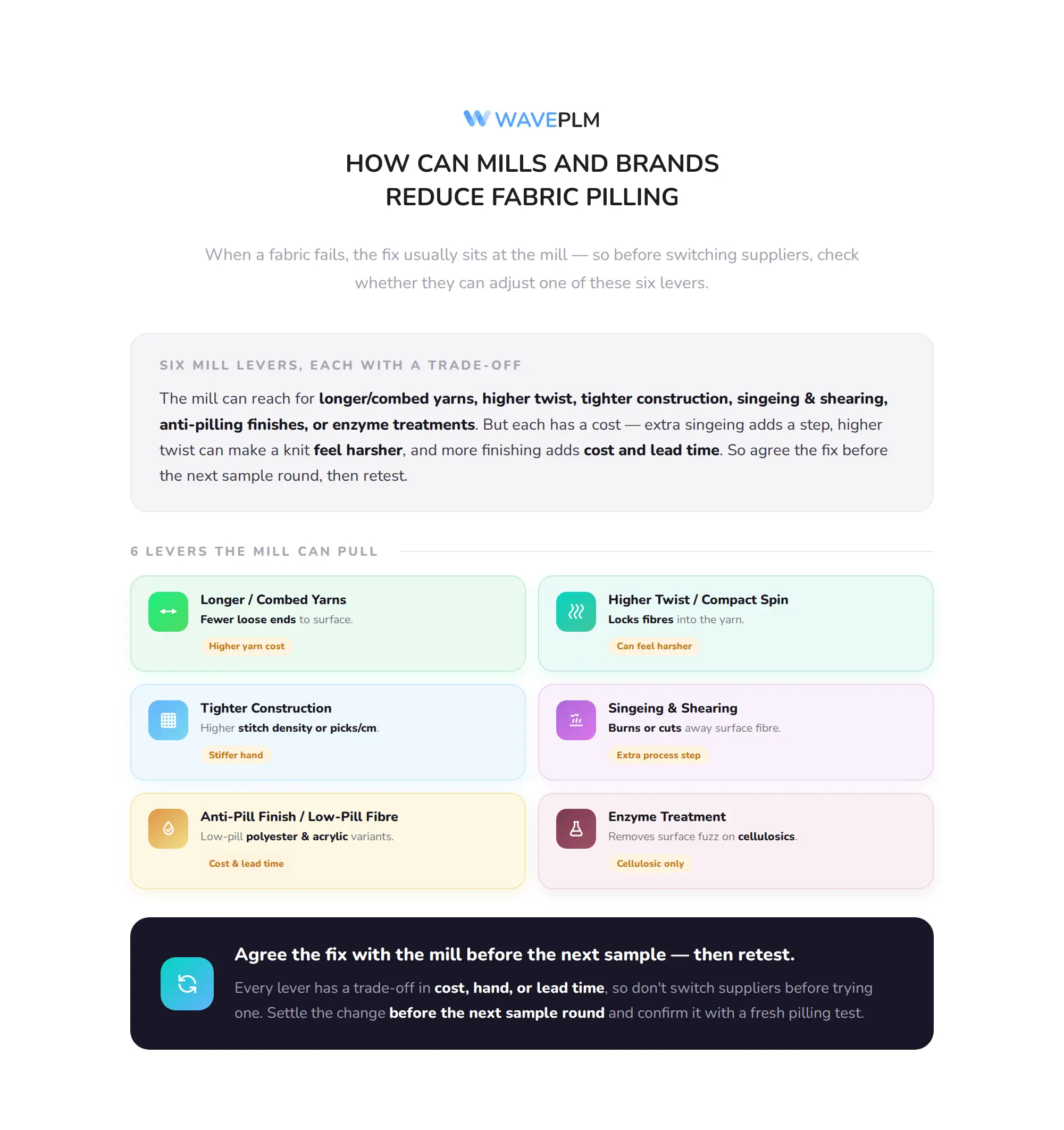
Once a fabric fails, the fix usually sits at the mill. Before changing suppliers, check whether the mill can adjust one of these levers:
- Longer staple or combed yarns, which leave fewer loose ends.
- Higher twist or compact spinning, which locks fibres into the yarn.
- Tighter construction, such as a higher stitch density or picks per centimetre.
- Singeing and shearing, which burn or cut away surface fibre.
- Anti-pilling finishes or low-pill fibres, such as low-pill polyester and acrylic variants.
- Enzyme treatments on cellulosic fabrics, which remove surface fuzz.
Each lever has a trade-off, however; for instance, extra singeing adds a process step. Higher twist can make a knit feel harsher, and extra finishing adds cost and lead time. For that reason, agree the fix with the mill before the next sample round, then retest. Activewear brands face this trade-off constantly, as our article on activewear PLM explains.
Why Pilling Data Will Matter More for Durability Rules
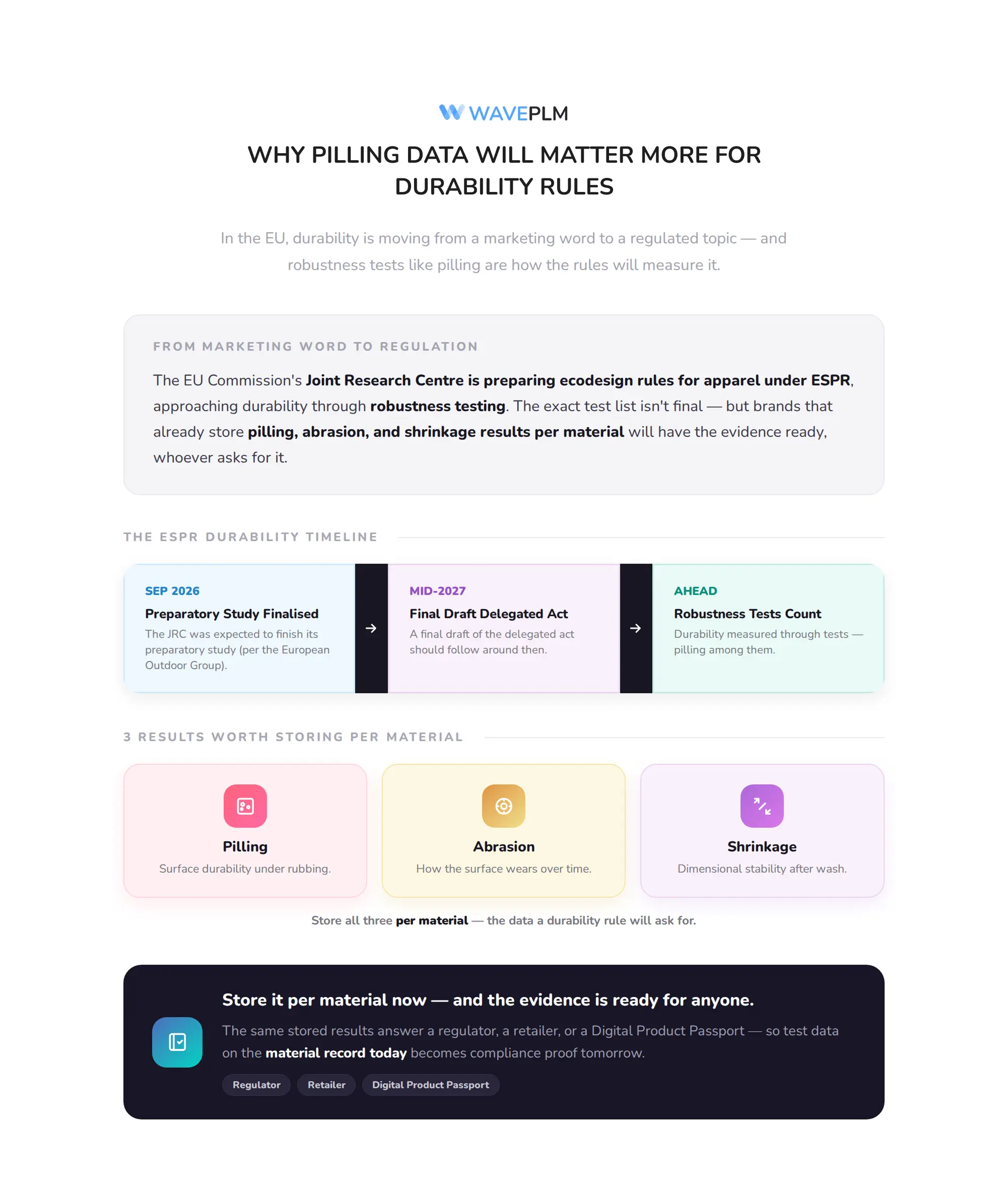
Durability is moving from a marketing word to a regulated topic in the EU. Currently, the European Commission’s Joint Research Centre is preparing ecodesign rules for apparel under ESPR. So far, it is approaching durability through robustness testing. According to the European Outdoor Group, the JRC expected to finalise its preparatory study in September 2026. A final draft of the delegated act should follow around mid-2027.
That said, the exact test list is not final yet. Even so, brands that already store pilling, abrasion, and shrinkage results per material will have evidence ready. That evidence works whether a regulator, a retailer, or a digital product passport asks for it.
Frequently Asked Questions
What causes fabric pilling?
Fabric pilling is caused by friction that pulls loose fibres to the surface, where they tangle into small balls. Short fibres, low twist yarns, loose knits, brushed surfaces, and blends with strong synthetics all increase it. Most of these factors are set at the yarn and fabric spec stage.
How is fabric pilling tested?
Labs rub or tumble fabric specimens on a pilling box, Martindale, or random tumble tester. They also compare them with reference images. Common methods are ISO 12945-1, ISO 12945-2, ASTM D3512, and ASTM D4970. The result is a grade from 1 to 5.
What is a good pilling grade?
Grade 5 means no pilling and grade 1 means severe pilling. Many retailers require knitted garments to reach grade 3-4 under ISO 12945-1. Wovens and premium jersey often need 3-4 or 4. Similarly, hard-wearing categories such as uniforms sit at the top of the range.
Which fabrics pill the least?
Tightly woven fabrics made from long staple fibres, such as combed cotton poplin, pill the least. Lyocell and silk also resist pilling well. In contrast, acrylic knits, polyester/cotton fleece, and soft lambswool are among the most pill-prone fabrics.
Why does polyester pill more than cotton?
Polyester does not always form more pills, but its strong fibres hold the pills on the surface. Cotton pills tend to break off and shed. As a result, polyester blends often look more pilled after a few months of wear.
Can fabric pilling be prevented?
It can be reduced significantly, though rarely eliminated. Mills use longer fibres, higher twist, tighter construction, singeing, shearing, and anti-pilling finishes. Brands should set a minimum grade in the spec and require a test report for every bulk lot.
Where the Pilling Grade Usually Gets Lost
Picture a knit that passes at 3-4 in March. By October, however, the reorder comes back at grade 2. Meanwhile, the team spends a week hunting for the original report, the yarn count, and the finishing route. In most cases the information existed; it just lived in separate inboxes. Wave PLM keeps the pilling method, the minimum grade, and every lot’s result on the fabric record. As a result, the comparison takes minutes instead of a week. Explore how Wave PLM handles fabric testing.






Leave a Reply