
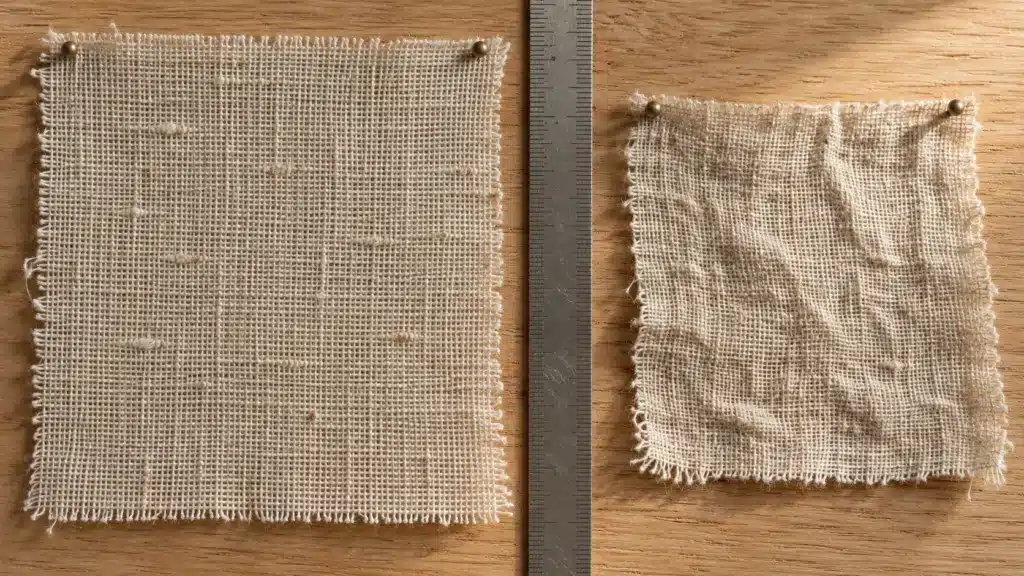
Linen fabric is a woven or knitted textile made from flax, a bast fibre taken from the stem of the Linum usitatissimum plant. In practice, linen fabric is cool, strong, and absorbent, but it creases easily and can shrink several percent if it is not pre-washed. That combination makes it a summer staple for shirts, trousers, and dresses, and also a frequent source of fit complaints.
Most guides about linen fabric are written for shoppers. This one, however, is written for the people who buy it by the metre. Specifically, it covers where flax comes from and what the European certifications guarantee. It also explains how to spec weight and shrinkage, why prices moved in 2025, and how to label the garment.
What Is Linen Fabric Made Of?
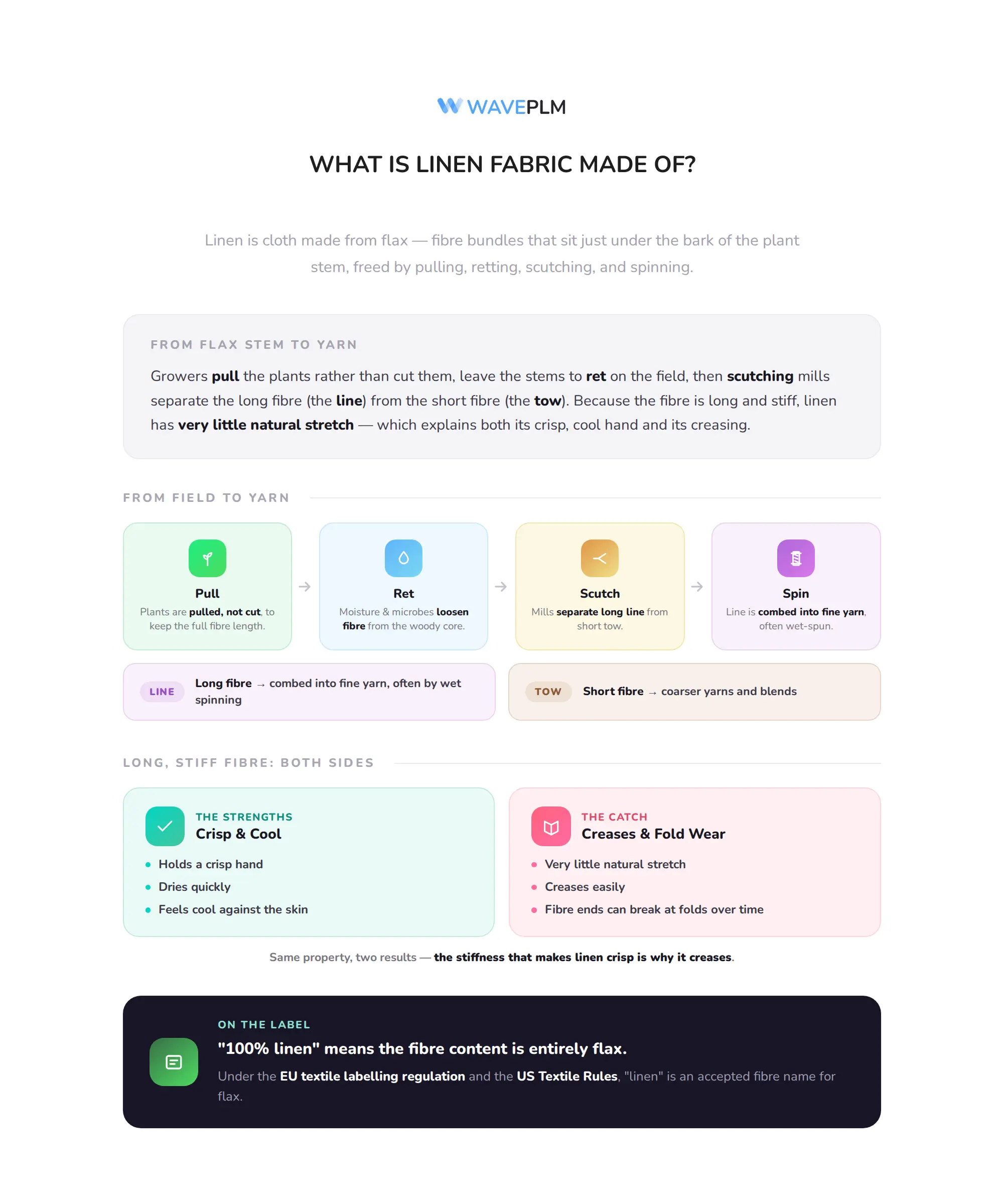
Flax fibres sit in bundles just under the bark of the plant stem. To free them, growers pull the plants rather than cut them. Then they leave the stems on the field to ret, so moisture and microbes loosen the fibre from the woody core. Next, scutching mills separate the long fibre (the “line”) from the short fibre (the “tow”). Finally, spinners comb the long fibre into fine yarn, often by wet spinning, while tow goes into coarser yarns and blends.
Definition: Linen fabric is cloth made from flax fibre. Under the EU textile labelling regulation and the US Textile Rules, “linen” is an accepted fibre name for flax, so a label reading “100% linen” means the fibre content is entirely flax.
Because the fibre is long and stiff, linen fabric has very little natural stretch. As a result, it holds a crisp hand, dries quickly, and feels cool against the skin. On the other hand, the same stiffness is why the fabric creases and why fibre ends can break at folds over time.
Where Does Linen Fabric Come From?
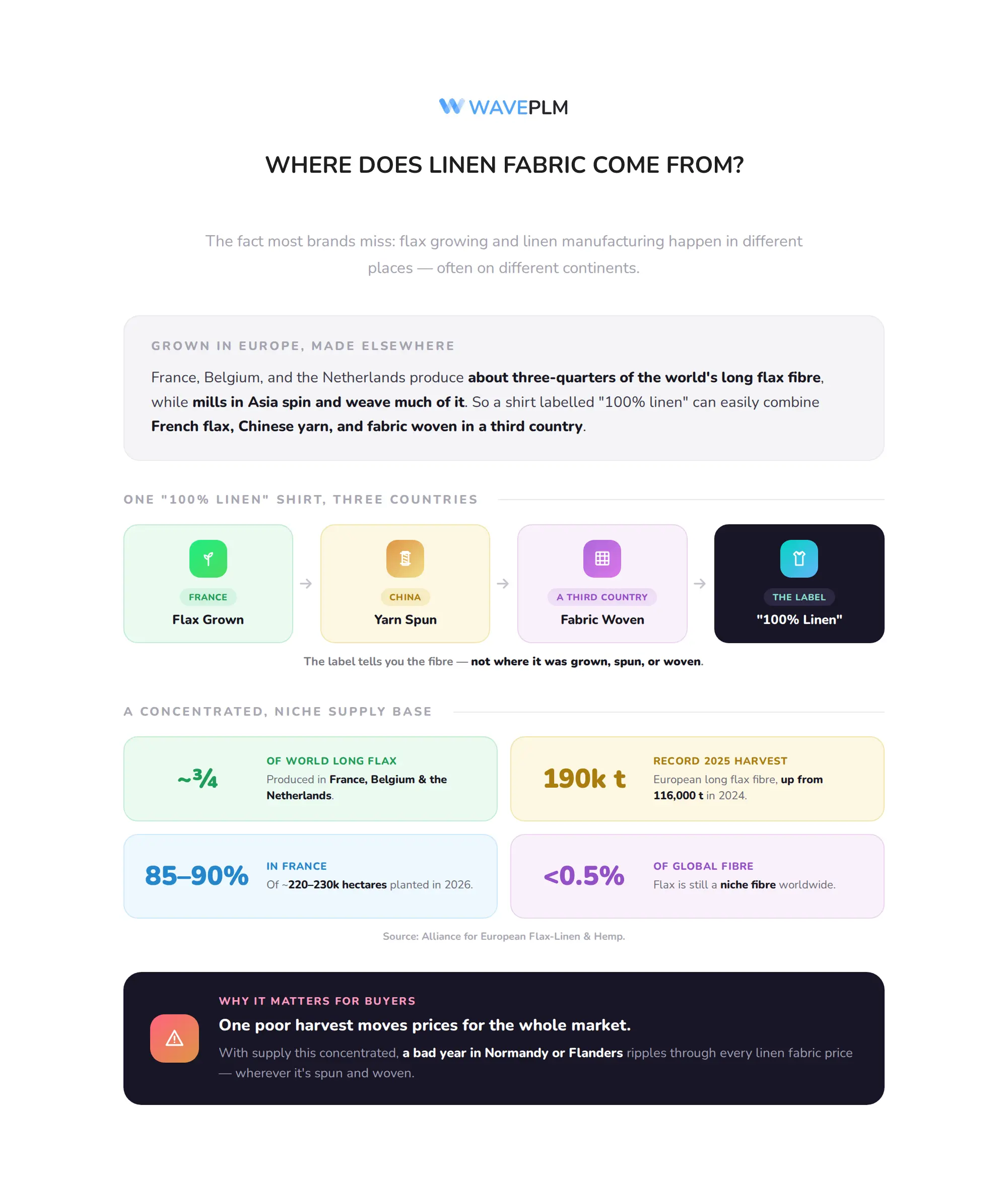
Here is the fact most brands miss: flax growing and linen manufacturing happen in different places. According to the Alliance for European Flax-Linen & Hemp, France, Belgium, and the Netherlands produce about three-quarters of the world’s long flax fibre. Meanwhile, mills in Asia spin and weave much of that fibre. Therefore, a shirt labelled “100% linen” can easily combine French flax, Chinese yarn, and fabric woven in a third country.
Industry data: The Alliance reports a record European harvest of about 190,000 tonnes of long flax fibre in 2025, up from 116,000 tonnes in 2024. Planted area reached roughly 220,000 to 230,000 hectares in 2026, with 85 to 90% of it in France. Even so, flax remains under 0.5% of global textile fibre production.
In other words, linen is a niche fibre with a concentrated supply base. That matters for buyers, because one poor harvest in Normandy or Flanders moves prices for the whole market, as the next section shows.
What Do European Flax and Masters of Linen Certify?
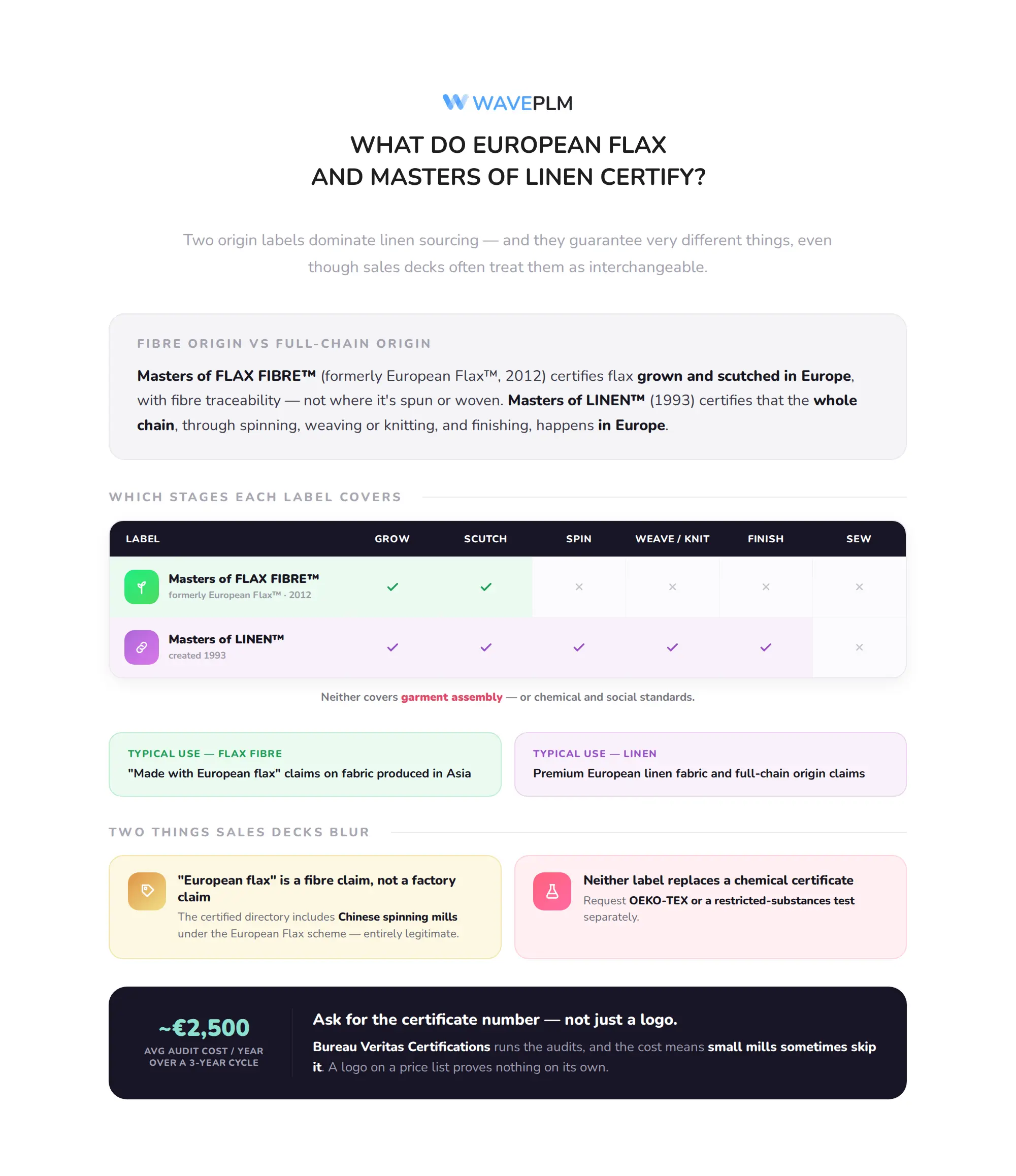
Two origin labels dominate linen sourcing, and they guarantee very different things. Unfortunately, sales decks often treat them as interchangeable. The table below sets out the difference.
| Label | What it guarantees | What it does not guarantee | Typical buyer use |
|---|---|---|---|
| Masters of FLAX FIBRE™ (formerly European Flax™, created 2012) | Flax grown and scutched in Europe, with traceability of the fibre | Where the yarn is spun, the fabric woven, or the garment sewn | “Made with European flax” claims on fabric produced in Asia |
| Masters of LINEN™ (created 1993) | The whole chain, including spinning, weaving or knitting, and finishing, takes place in Europe | Garment assembly location; chemical or social standards | Premium European linen fabric and full-chain origin claims |
For example, the Alliance’s directory of certified companies includes Chinese spinning mills under the European Flax scheme. That is entirely legitimate, but it means “European flax” on a hangtag is a claim about the fibre, not about the factory. Similarly, neither label replaces a chemical certificate, so OEKO-TEX or a restricted substances test is still a separate request.
Bureau Veritas Certifications runs the audits. The Alliance puts the average audit cost at about €2,500 per year over a three-year cycle. Consequently, small mills sometimes skip it. Ask for the certificate number, not just a logo on a price list.
How Much Does Linen Fabric Cost in 2026?
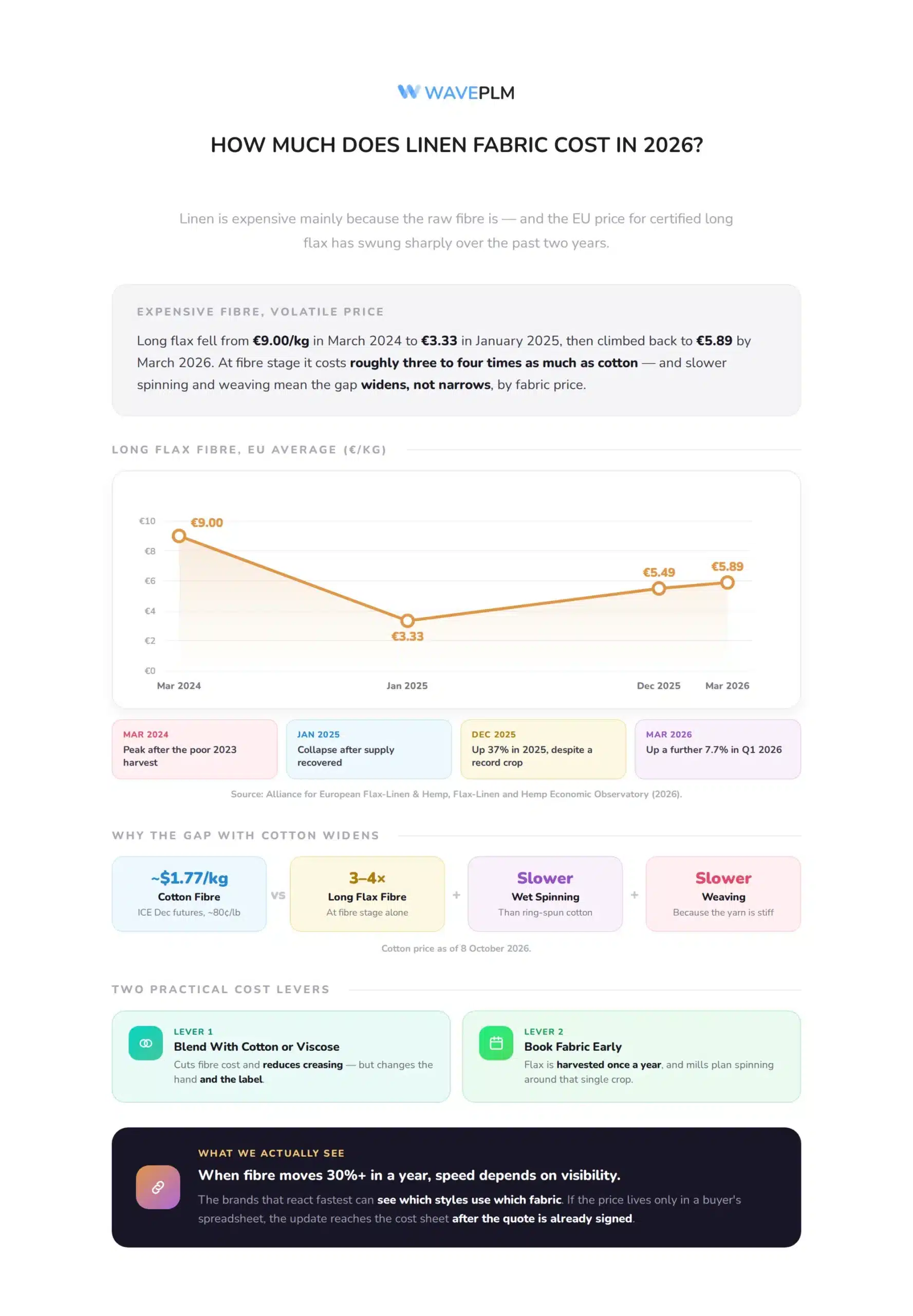
Linen fabric is expensive mainly because the raw fibre is. For context, the Alliance tracks an EU average price for certified long flax fibre. It has swung sharply over the past two years.
| Date | Long flax fibre, EU average (€/kg) | What happened |
|---|---|---|
| March 2024 | 9.00 | Peak after the poor 2023 harvest |
| January 2025 | 3.33 | Collapse after supply recovered |
| December 2025 | 5.49 | Up 37% over 2025 despite a record crop |
| March 2026 | 5.89 | Up a further 7.7% in Q1 2026 |
By comparison, ICE December cotton futures traded at about 80 cents per pound on October 8, 2026, which is roughly $1.77 per kilogram. So, at the fibre stage alone, long flax costs around three to four times as much as cotton. On top of that, mills wet spin fine linen yarns, which is slower than ring spinning cotton. Weaving also runs slower because the yarn is stiff. Hence the gap usually widens, rather than narrows, by the time you see a fabric price.
Our finding: When linen fibre prices move 30% or more in a year, the brands that react fastest are the ones that can see which styles use which fabric. If the fabric price lives only in a buyer’s spreadsheet, the update reaches the garment cost sheet after the quote is already signed.
There are also two practical cost levers. First, linen-cotton and linen-viscose blends cut fibre cost and reduce creasing, although they also change the hand and the label. Second, booking fabric early helps, because farmers harvest flax once a year and mills plan spinning around that single crop. For more on MOQs and lead times, see our guide to fabric sourcing for apparel brands.
Does Linen Fabric Shrink?
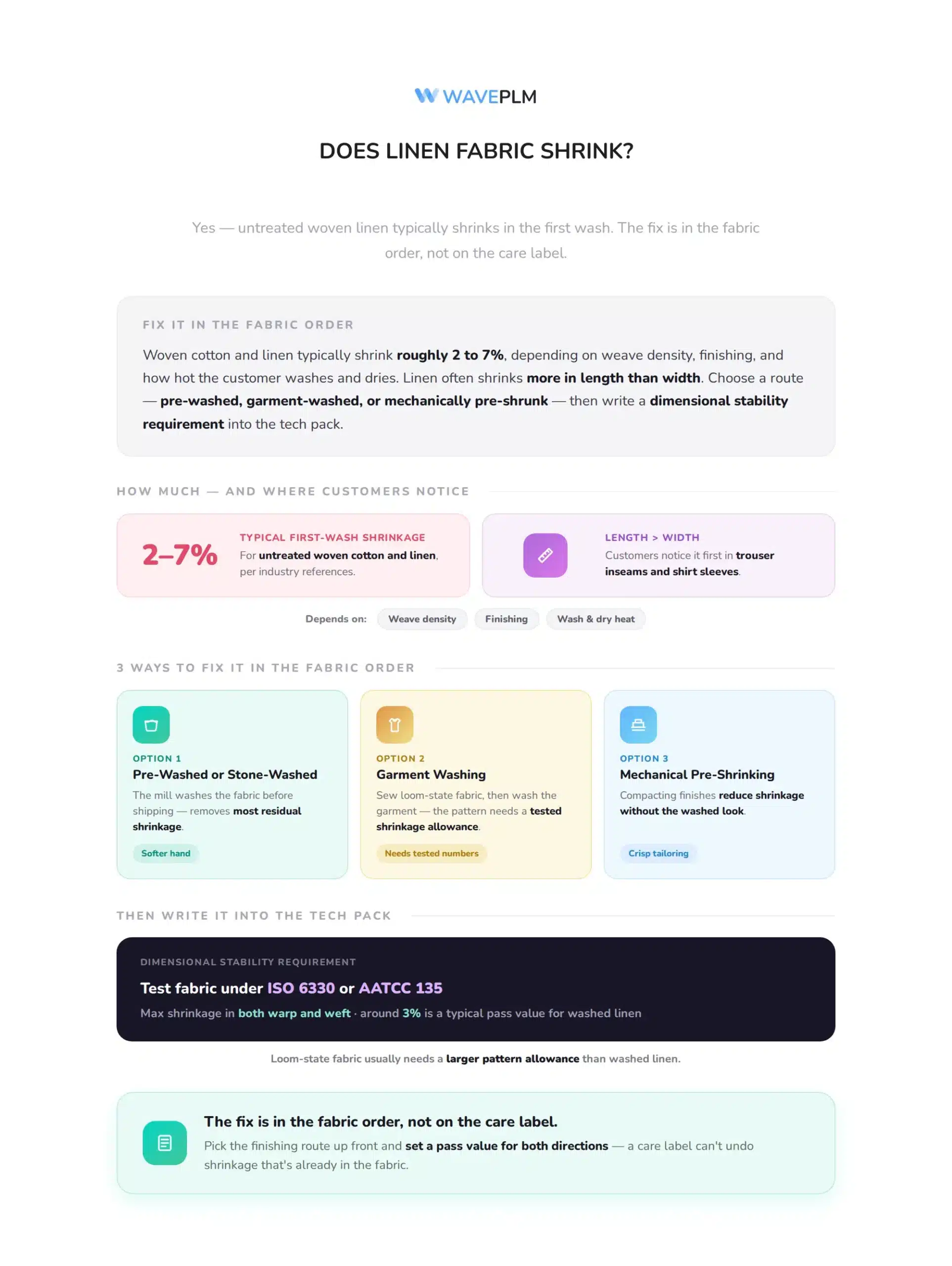
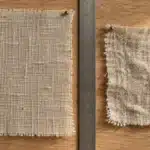
Yes. Untreated woven linen fabric typically shrinks in the first wash. Industry references put woven cotton and linen at roughly 2 to 7%. The exact figure depends on weave density, finishing, and how hot the customer washes and dries the garment. In addition, linen often shrinks more in length than in width, so trouser inseams and shirt sleeves are where customers notice it first.
For that reason, the fix is in the fabric order, not on the care label. Here are the main options:
- Pre-washed or stone-washed fabric: the mill washes the fabric before shipping, which removes most residual shrinkage and gives a softer hand.
- Garment washing: you sew in greige or loom-state fabric, then wash the finished garment. However, your pattern must include a shrinkage allowance, so the factory needs tested numbers before cutting.
- Mechanical pre-shrinking: compacting finishes reduce shrinkage without the washed look, which suits crisp tailoring.
Whichever route you choose, write a dimensional stability requirement into the tech pack. A common approach is to test fabric under ISO 6330 or AATCC 135 and set a maximum shrinkage in both warp and weft. Notably, around 3% is a typical pass value for washed linen. Loom-state fabric, by contrast, usually needs a larger pattern allowance. Our hub on apparel product testing explains how to order these tests.
How Should You Spec Linen Fabric Weight?
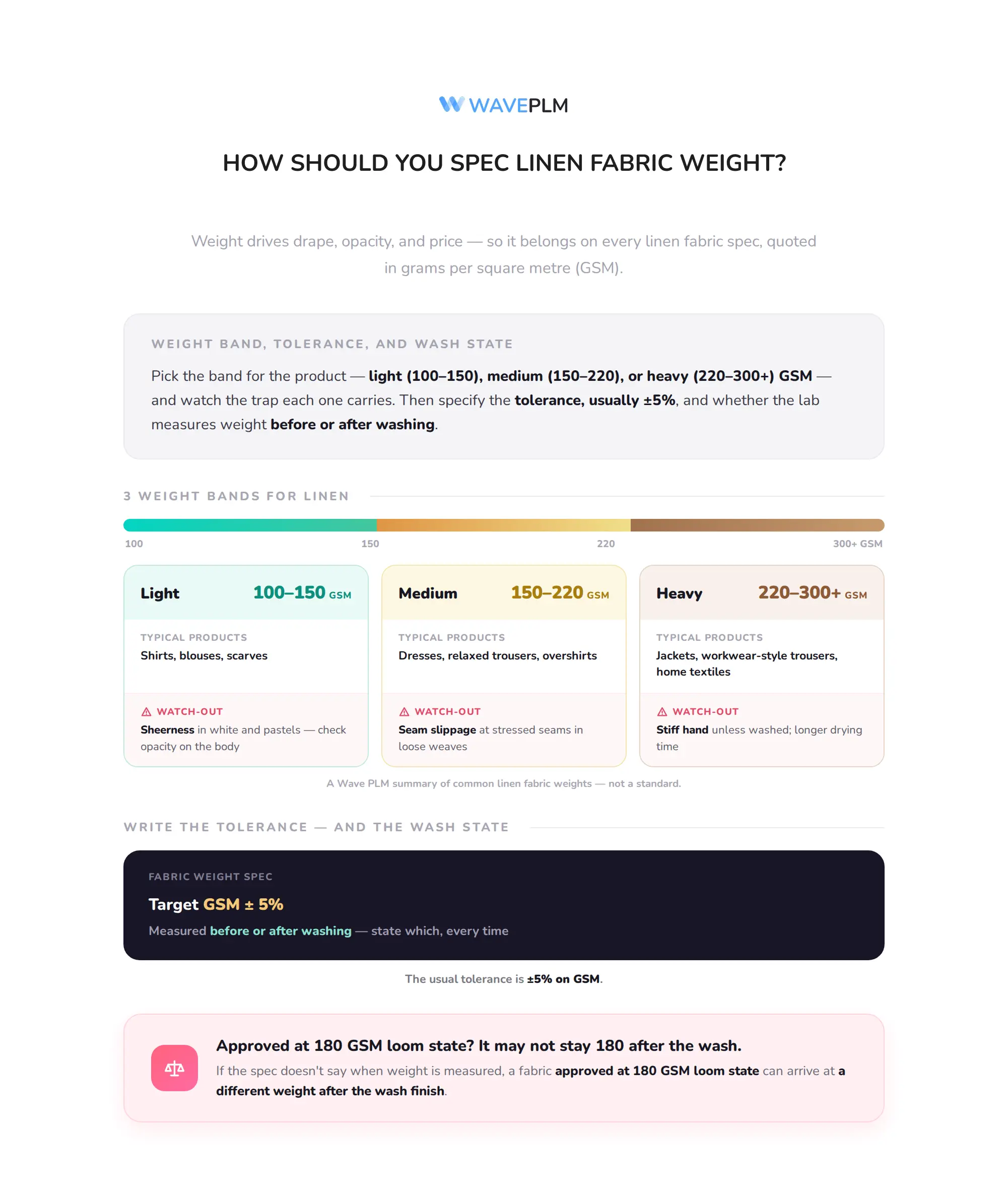
Weight drives drape, opacity, and price, so it belongs on every linen fabric spec. Generally, mills quote linen in grams per square metre (GSM). The ranges below are a Wave PLM summary of common use, not a standard.
| Weight band | Approx. GSM | Typical products | Watch-outs |
|---|---|---|---|
| Light | 100–150 | Shirts, blouses, scarves | Sheerness in white and pastels; check opacity on the body |
| Medium | 150–220 | Dresses, relaxed trousers, overshirts | Seam slippage at stressed seams in loose weaves |
| Heavy | 220–300+ | Jackets, workwear-style trousers, home textiles | Stiff hand unless washed; longer drying time |
Also specify the tolerance, usually ±5% on GSM, and say whether the lab measures weight before or after washing. Otherwise, a fabric approved at 180 GSM loom state can arrive at a different weight after the wash finish. Our fabric GSM guide covers the test method and how to write the tolerance.
What Quality Problems Are Common With Linen Fabric?
Beyond shrinkage, four issues come up again and again in linen production. Ideally, agree each one with the mill before bulk, not at inspection.
- Slubs: thick spots in the yarn are natural in linen. Still, agree on how many are acceptable per metre, or your AQL inspection will flag good fabric as defective.
- Creasing and crack marks: sharp folds during shipping can leave permanent marks, so ask for rolled fabric rather than folded bolts.
- Shade variation: flax takes dye less evenly than cotton, so request shade bands and a minimum colorfastness grade for washing and rubbing.
- Seam slippage: loose, open weaves can pull apart at seams, especially on fitted styles, so test slippage on medium-weight fabrics.
How Does Linen Compare With Cotton and Viscose?
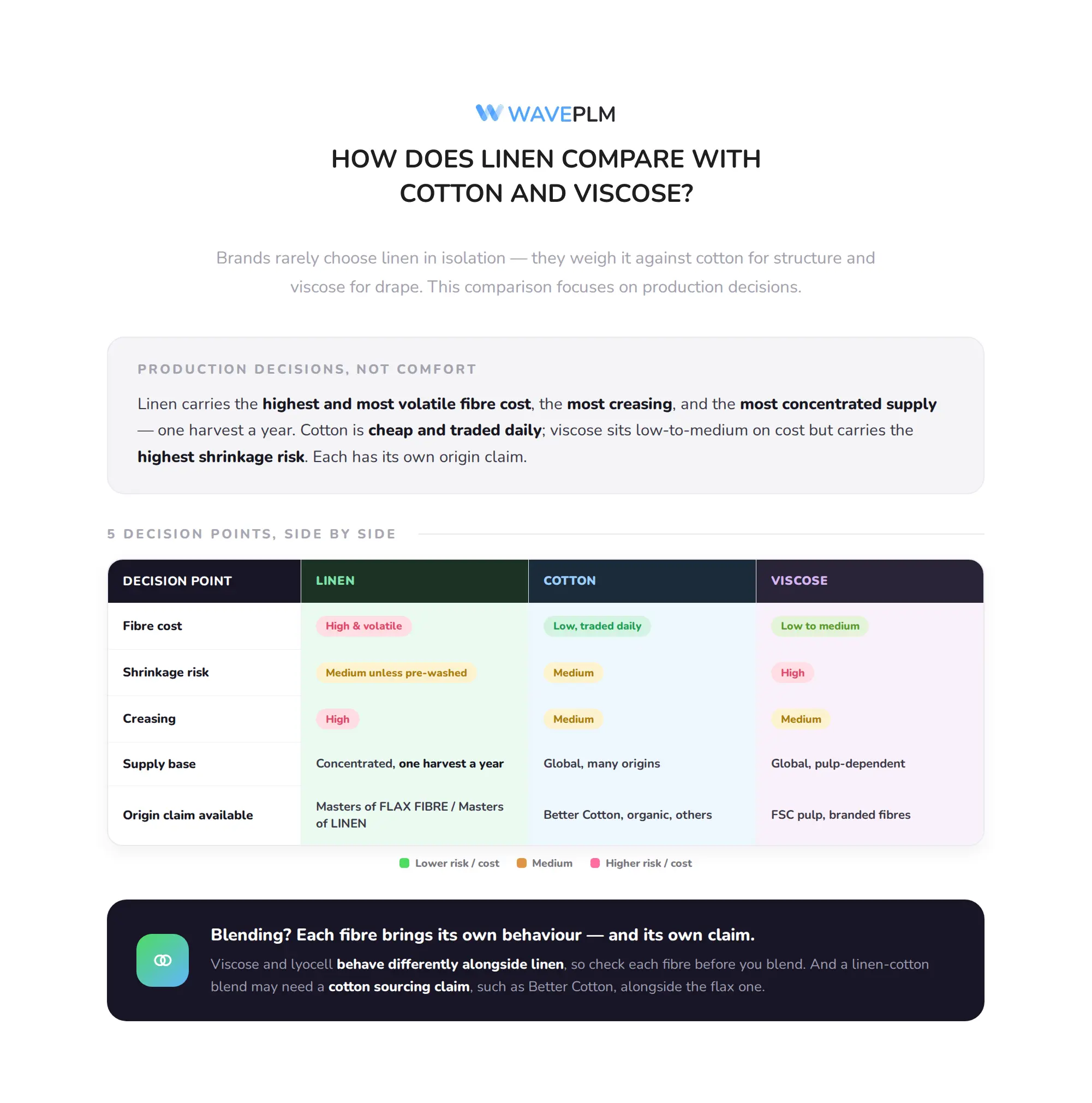
Brands rarely choose linen in isolation; instead, they weigh it against cotton for structure and viscose for drape. The comparison below focuses on production decisions rather than consumer comfort.
| Decision point | Linen | Cotton | Viscose |
|---|---|---|---|
| Fibre cost | High and volatile | Low and traded daily | Low to medium |
| Shrinkage risk | Medium unless pre-washed | Medium | High |
| Creasing | High | Medium | Medium |
| Supply base | Concentrated, one harvest a year | Global, many origins | Global, pulp-dependent |
| Origin claim available | Masters of FLAX FIBRE / Masters of LINEN | Better Cotton, organic, others | FSC pulp, branded fibres |
If you are considering blends, our guides to viscose fabric and lyocell fabric explain how those fibres behave alongside linen. Likewise, Better Cotton is worth reading if a linen-cotton blend needs a cotton sourcing claim too.
How Should You Label Linen Fabric Garments?
Fibre naming is straightforward, but marketing language is where brands get into trouble. In the United States, the FTC’s Textile Rules list linen as an acceptable fibre name. However, a 2012 FTC staff advisory opinion looked at a chemically processed, cotton-like flax fibre. Staff concluded that brands should call it “flax” rather than “linen”, because it behaved differently from traditional linen. In the EU, Regulation 1007/2011 lists flax, also called linen, as the fibre from the bast of the flax plant.
Beyond the fibre name, keep three rules in mind:
- “Linen look” is not linen. Polyester or viscose slub fabrics cannot carry the word linen in the fibre content, and product copy should not imply it either.
- Blends need percentages. A linen-cotton shirt must show both fibres in descending order of weight, for example “55% linen, 45% cotton”.
- Origin and green claims need proof. “European flax” requires certified fibre, and environmental claims such as “low impact” fall under the EU’s rules on generic claims, which apply from 27 September 2026. See our guide to the EU Green Claims rules for what evidence to keep.
Our finding: The most common linen labelling error we see is not the fibre name. Instead, it is a sustainability line copied from the mill’s brochure onto a hangtag, with no certificate number stored against the style that carries it.
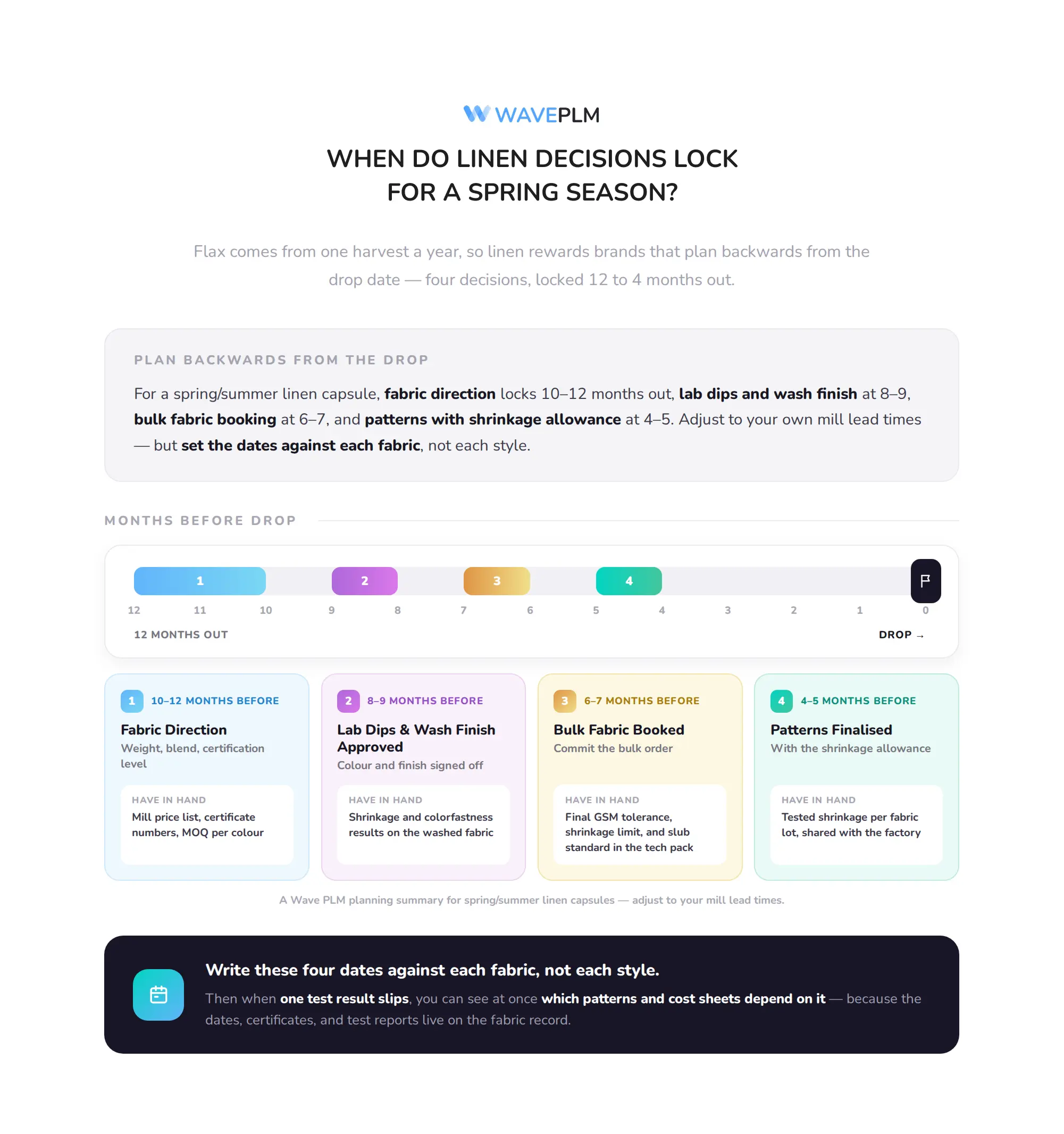
When Do Linen Decisions Lock for a Spring Season?
Because flax comes from one harvest a year, linen fabric rewards brands that plan backwards from the drop date. The timeline below is a Wave PLM planning summary for a spring/summer linen capsule; adjust it to your own mill lead times.
| Months before drop | Decision | What to have in hand |
|---|---|---|
| 10–12 | Fabric direction: weight, blend, certification level | Mill price list, certificate numbers, MOQ per colour |
| 8–9 | Lab dips and wash finish approved | Shrinkage and colorfastness results on the washed fabric |
| 6–7 | Bulk fabric booked | Final GSM tolerance, shrinkage limit, and slub standard in the tech pack |
| 4–5 | Patterns finalised with shrinkage allowance | Tested shrinkage per fabric lot, shared with the factory |
Write those four dates into next season’s calendar now, against each linen fabric rather than each style. Then, when one test result slips, you can see at once which patterns and cost sheets depend on it. For the same reason, the material library in Wave PLM carries those dates, certificates, and test reports on the fabric record itself.
Frequently Asked Questions
What kind of fabric is linen?
Linen fabric is a natural textile woven or knitted from flax, a bast fibre taken from the stem of the flax plant. It is strong, absorbent, and quick-drying, with a crisp hand and little stretch. Because of that low elasticity, it creases more easily than cotton.
Does linen fabric shrink in the wash?
Untreated linen fabric can shrink roughly 2 to 7% in the first wash, usually more in length than in width. Pre-washed or garment-washed linen shrinks much less. Brands should set a maximum shrinkage in the tech pack and test it before bulk cutting.
Why is linen fabric so expensive?
Linen fabric costs more because flax fibre is scarce and labour-intensive to process. About three-quarters of the world’s long flax fibre comes from France, Belgium, and the Netherlands. Farmers harvest it only once a year. In 2026, long flax fibre cost several times more per kilogram than cotton.
Is linen better than cotton for summer clothing?
Linen is usually cooler and dries faster than cotton, which makes it popular for hot-weather shirts and trousers. However, it creases more, costs more, and needs closer shrinkage control. Many brands use linen-cotton blends to balance comfort, cost, and wrinkle resistance.
What is the difference between European Flax and Masters of Linen?
The European Flax label, now Masters of FLAX FIBRE, certifies that the flax was grown and scutched in Europe. Masters of LINEN goes further and requires spinning, weaving or knitting, and finishing to happen in Europe as well. Only the second supports a claim that the fabric itself is European.
Can I call a polyester slub fabric linen?
No. The fibre content label must name the actual fibres. So a polyester or viscose fabric with a linen-like texture cannot carry the word linen. Describing the texture, for example “slub weave”, is fine as long as it does not imply flax content.
Conclusion
Linen fabric gives brands a cool, natural, and premium story, but it comes with a volatile fibre price and a concentrated supply base. To buy it well, separate where the flax grew from where the fabric was made, and ask for the right certificate. Then spec weight, shrinkage, slubs, and shade before bulk, and label the fibre and any origin claim with evidence on file. Do that, and linen becomes a dependable part of the range instead of a seasonal risk.


Leave a Reply