
Fabric GSM is the weight of one square meter of fabric, measured in grams. For example, a 180 GSM cotton jersey weighs 180 grams per square meter, which is a standard midweight T-shirt. As a rule, the higher the number, the heavier and usually thicker the fabric feels.
For an apparel brand, however, GSM is more than a feel indicator. It is a contract value. It sets how much fabric a factory buys, how much each garment costs, how it drapes after washing, and even which customs heading a fabric falls under. This guide explains how to measure it, which ranges suit which garments, how to write it in a tech pack, and why the number often drifts between the approved sample and bulk production.
What Is GSM in Fabric?
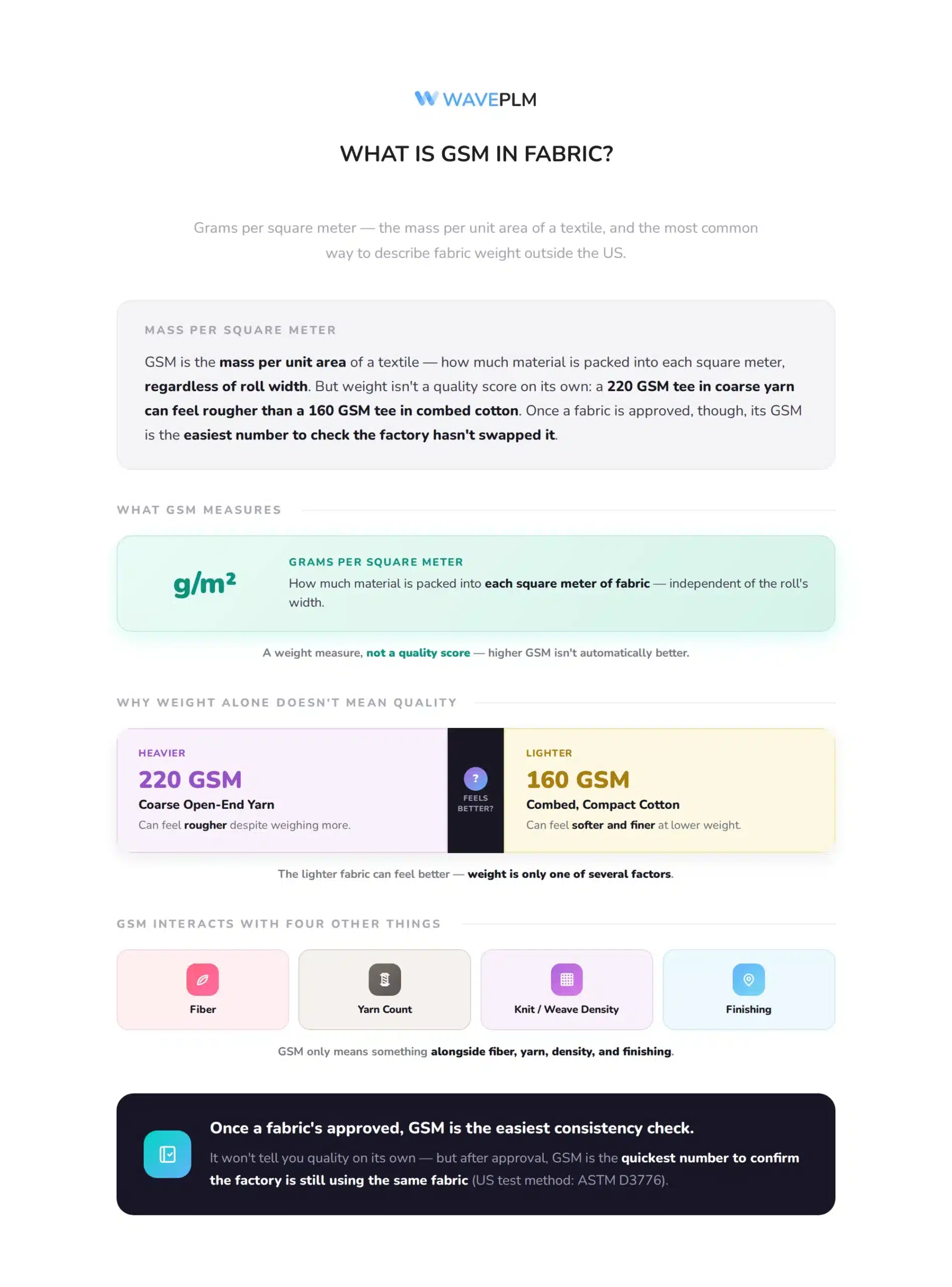
GSM stands for grams per square meter. It is the mass per unit area of a textile, and it is the most common way mills, factories, and brands describe fabric weight outside the US. In other words, GSM tells you how much material is packed into each square meter, regardless of the roll width.
Importantly, weight is not a quality score on its own. A 220 GSM tee made from coarse open-end yarn can feel rougher than a 160 GSM tee in combed, compact cotton. In reality, weight interacts with fiber, yarn count, knit or weave density, and finishing. That said, once a brand approves a fabric, its GSM becomes the easiest number to check that the factory is still using the same fabric.
Industry data: ASTM D3776 is the US standard test method for mass per unit area (weight) of fabric. It defines four options: full rolls for acceptance testing of commercial shipments, full-width samples including selvages, small swatches that apply to the sample only, and narrow fabrics. Results are reported on conditioned fabric.
How Do You Measure Fabric GSM?
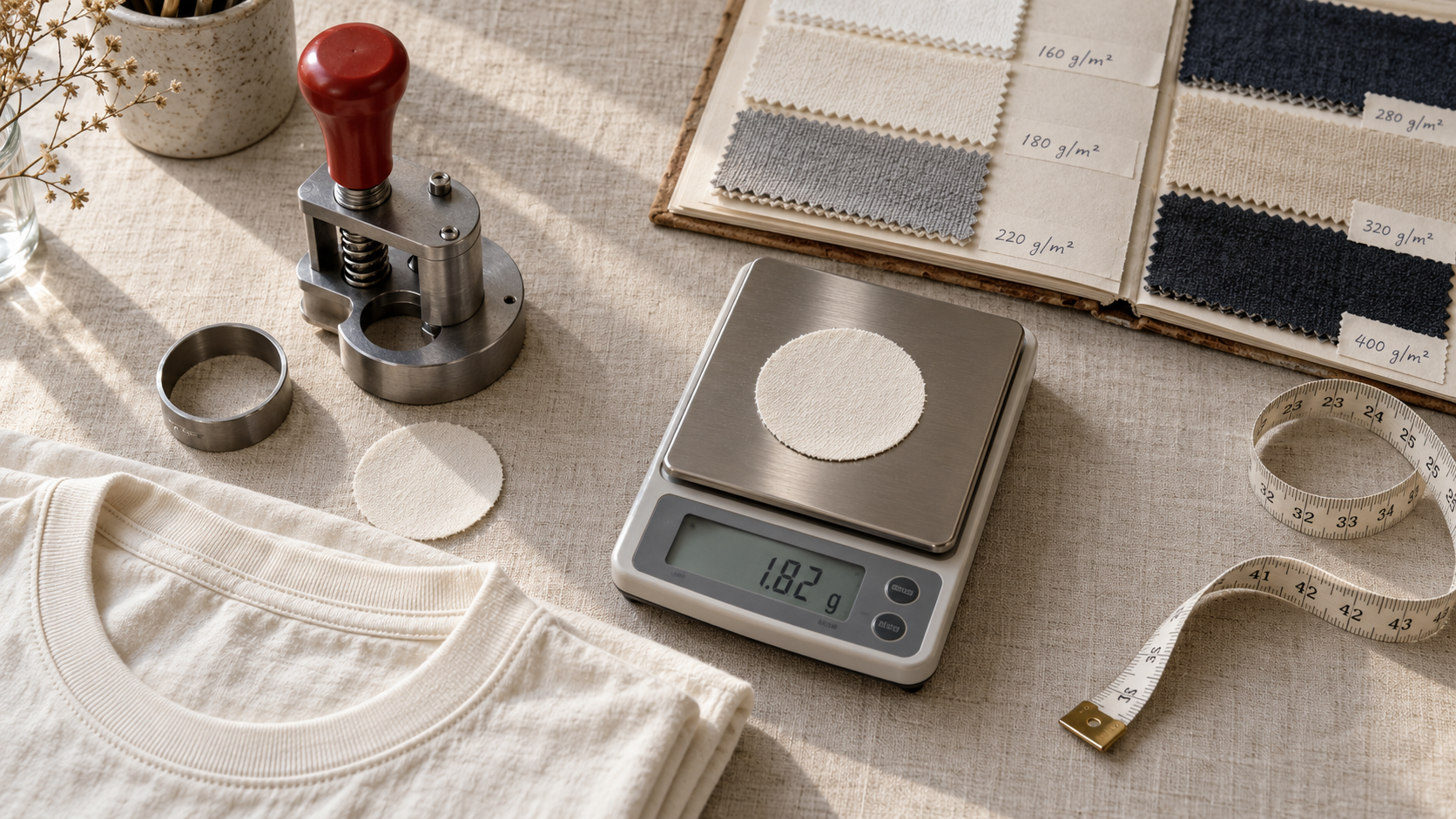
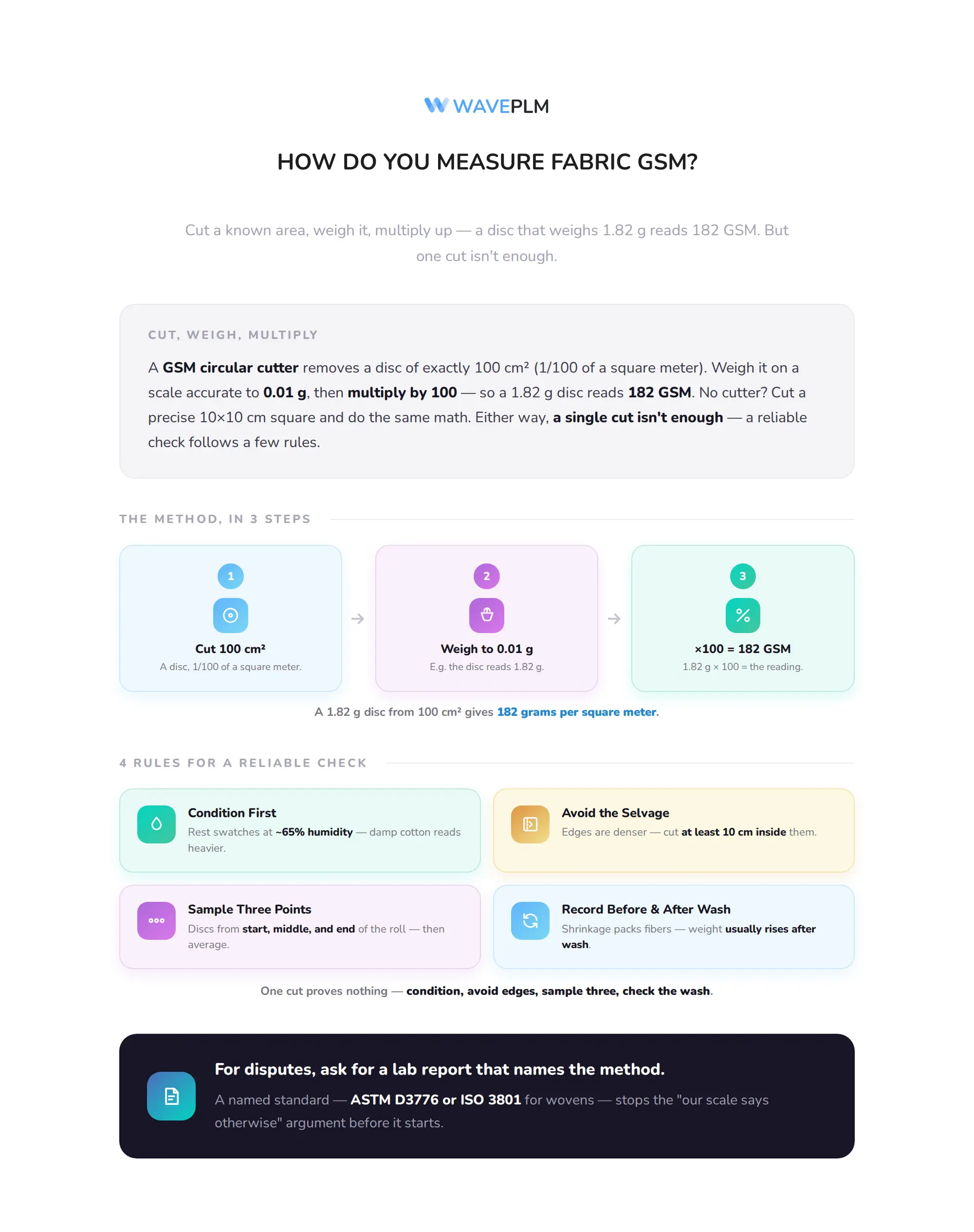
Most factories and fabric labs use a GSM circular cutter. The cutter removes a disc of exactly 100 cm², which is 1/100 of a square meter. Next, the disc is weighed on a scale accurate to 0.01 g, and the weight is multiplied by 100. Consequently, a disc that weighs 1.82 g gives a reading of 182 GSM.
Alternatively, without a cutter, a technician can cut a precise 10 cm × 10 cm square and apply the same math. Either way, a single cut is not enough. In practice, a reliable fabric GSM check follows a few rules:
- Condition first. Fabric absorbs moisture, so let swatches rest in a standard atmosphere (about 65% relative humidity) before weighing. Cotton weighed straight out of a humid warehouse reads heavier.
- Avoid the selvage. Edges are denser than the body of the roll, so cut at least 10 cm inside them.
- Sample three points. Take discs from the start, middle, and end of the roll, then average them.
- Record before and after wash. Shrinkage packs fibers closer together, so the weight usually rises after the first wash.
For commercial disputes, ask for a lab report that names the method, for instance ASTM D3776 or ISO 3801 for woven fabrics. Specifically, a named method stops the “our scale says otherwise” argument before it starts. Our guide to apparel product testing covers how to fit this check into a wider lab plan.
What Fabric GSM Should You Use for Each Garment?
There is no single right weight for a category. Still, most brands land inside familiar bands, and buyers recognize them. For that reason, the table below is a practical starting point for development briefs.
| Garment | Typical fabric | Common GSM range | Notes |
|---|---|---|---|
| Lightweight / summer T-shirt | Single jersey | 120–150 | Drapes well, can look sheer in light colors |
| Standard T-shirt | Single jersey | 160–190 | The mainstream retail sweet spot |
| Heavyweight / streetwear tee | Single jersey, compacted | 220–280 | Boxy fit, holds shape, higher fabric cost |
| Polo shirt | Piqué | 180–240 | Piqué texture adds weight versus jersey |
| Shirting | Poplin, oxford | 90–140 | Oxford sits at the top of the band |
| Leggings / activewear | Nylon or poly-spandex | 200–300 | Higher GSM improves opacity on squat tests |
| Hoodie / sweatshirt | French terry, fleece | 280–400 | Heritage styles go to 450 |
| Denim jeans | Cotton twill | 340–475 (about 10–14 oz) | Usually quoted in ounces per square yard |
Above all, choose the weight from the product’s job, not from a competitor’s hang tag. A gym legging that must pass a squat-proof test needs a different weight than a fashion legging. Our activewear PLM guide shows how performance brands track opacity and recovery alongside weight.
How Do You Convert GSM to Ounces?
US mills and denim suppliers often quote ounces per square yard (oz/yd²). The conversion is fixed: 1 oz/yd² equals 33.906 g/m². Therefore, divide GSM by 33.906 to get ounces, or multiply ounces by 33.906 to get GSM.
| GSM | oz/yd² (approx.) | Typical use |
|---|---|---|
| 150 | 4.4 | Light jersey tee |
| 200 | 5.9 | Midweight tee, light chino |
| 300 | 8.8 | Light fleece, overshirt |
| 400 | 11.8 | Heavy fleece, midweight denim |
| 475 | 14.0 | Heavy denim |
Our finding: The most expensive GSM mistake we see is not a wrong number but a wrong unit. Some suppliers quote ounces per linear yard, which depends on roll width, instead of ounces per square yard. A 58-inch fabric quoted at “12 oz per linear yard” weighs roughly 7.4 oz/yd², or about 252 GSM, so always confirm the unit in writing.
How Should You Write Fabric GSM in a Tech Pack?
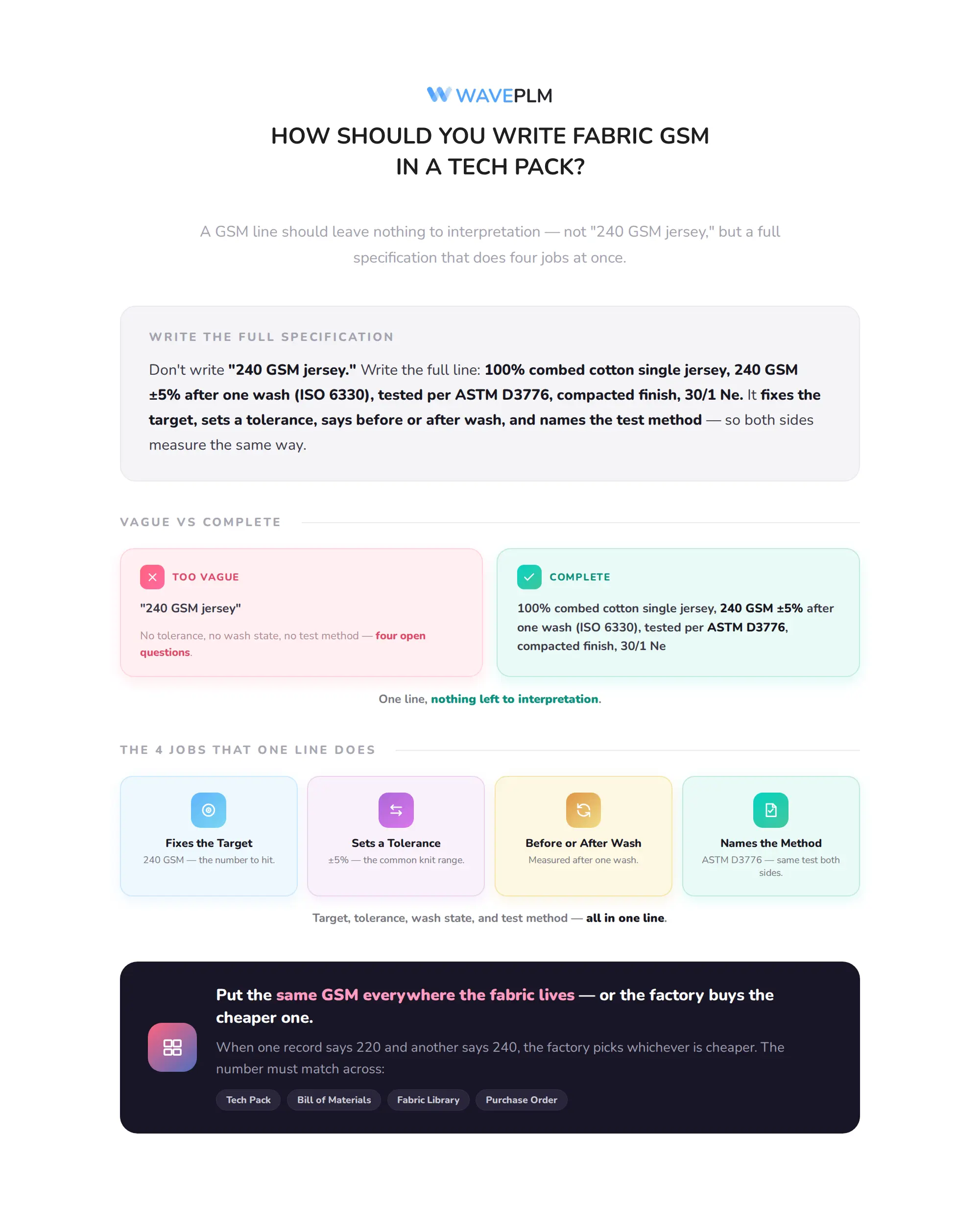
Ideally, a fabric GSM line in a tech pack leaves nothing to interpretation. Instead of “240 GSM jersey,” write a full specification. For example:
Specification example: Body fabric: 100% combed cotton single jersey, 240 GSM ± 5% after one wash (ISO 6330, tumble dry), tested per ASTM D3776, compacted finish, 30/1 Ne yarn.
This line does four jobs at once. First, it fixes the target weight. Second, it sets a tolerance of ±5%, which is the most common commercial range for knits. Third, it says whether the number is measured before or after washing. Finally, it names the test method, so both sides measure the same way.
Equally important, the same fabric GSM must appear everywhere the fabric lives: the tech pack, the bill of materials, the fabric library, and the purchase order. Otherwise, when one of these records says 220 and another says 240, the factory will buy whichever is cheaper. Our tech pack guide for beginners and the multi-level BOM guide show how to structure those records.
How Does Fabric GSM Change Garment Cost?
Knit fabric is usually priced per kilogram, while many wovens are priced per meter. In both cases, weight drives cost, but the math is most visible with knits. The fabric weight per garment equals the fabric area the marker uses multiplied by the fabric GSM.
Consider a simple example: a tee marker uses 0.75 m² of fabric per garment, including cutting waste, and the knit costs $8.00 per kg.
| GSM | Fabric weight per tee | Fabric cost per tee | Change vs. 180 GSM |
|---|---|---|---|
| 180 | 135 g | $1.08 | baseline |
| 220 | 165 g | $1.32 | +22% |
| 240 | 180 g | $1.44 | +33% |
As a result, moving from a standard to a heavyweight tee adds a third to fabric cost before any change in yarn quality. Similarly, a factory that ships 225 GSM against a 240 GSM order quietly saves about 6% of the fabric weight it pays for. Over a 3,000-unit order, in other words, that gap is real money. For the full cost sheet, see our garment costing guide.
Beyond cost, fabric GSM can also affect classification. In the Harmonized System, woven cotton fabrics with 85% or more cotton fall under heading 5208 if they weigh not more than 200 g/m² and under 5209 if they weigh more. That threshold matters mainly when you import fabric rather than finished garments, yet it is a good reminder that weight is a legal data point, not just a feel note. Our guide on calculating landed cost for apparel imports explains how classification flows into duty.
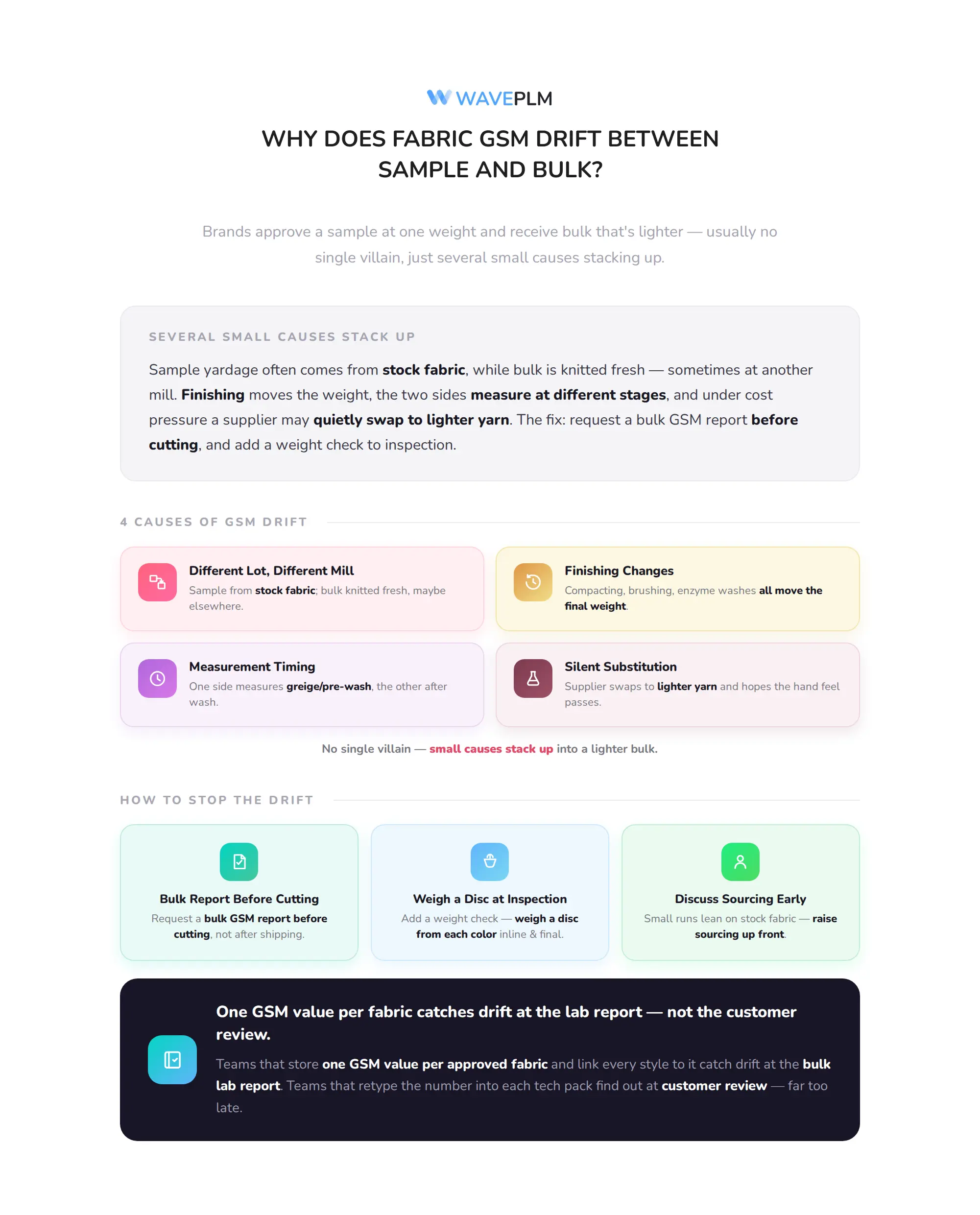
Why Does Fabric GSM Drift Between Sample and Bulk?
Brands often approve a sample at one weight and receive bulk that is lighter. Usually, there is no single villain. Instead, several small causes stack up:
- Different lot, different mill. Sample yardage often comes from stock fabric, while bulk is knitted fresh, sometimes at another mill.
- Finishing changes. Compacting, brushing, and enzyme washes all move the final weight.
- Measurement timing. One side measures greige or pre-wash fabric, the other measures after wash.
- Silent substitution. Under cost pressure, a supplier swaps to a lighter yarn and hopes the hand feel passes.
To prevent drift, therefore, request a bulk fabric GSM report before cutting, not after shipping. Likewise, add a weight check to your inline and final inspection checklist so inspectors weigh a disc from each color. Our AQL inspection guide explains where those checks fit. Furthermore, if you work with lower minimums, discuss fabric sourcing early, because small runs are more likely to use stock fabric. The MOQ guide and our fabric sourcing guide cover that trade-off.
Our finding: Teams that store one fabric GSM value per approved fabric, and link every style to that record, catch drift at the bulk lab report stage. Teams that retype the number into each tech pack usually discover it at the customer review stage.
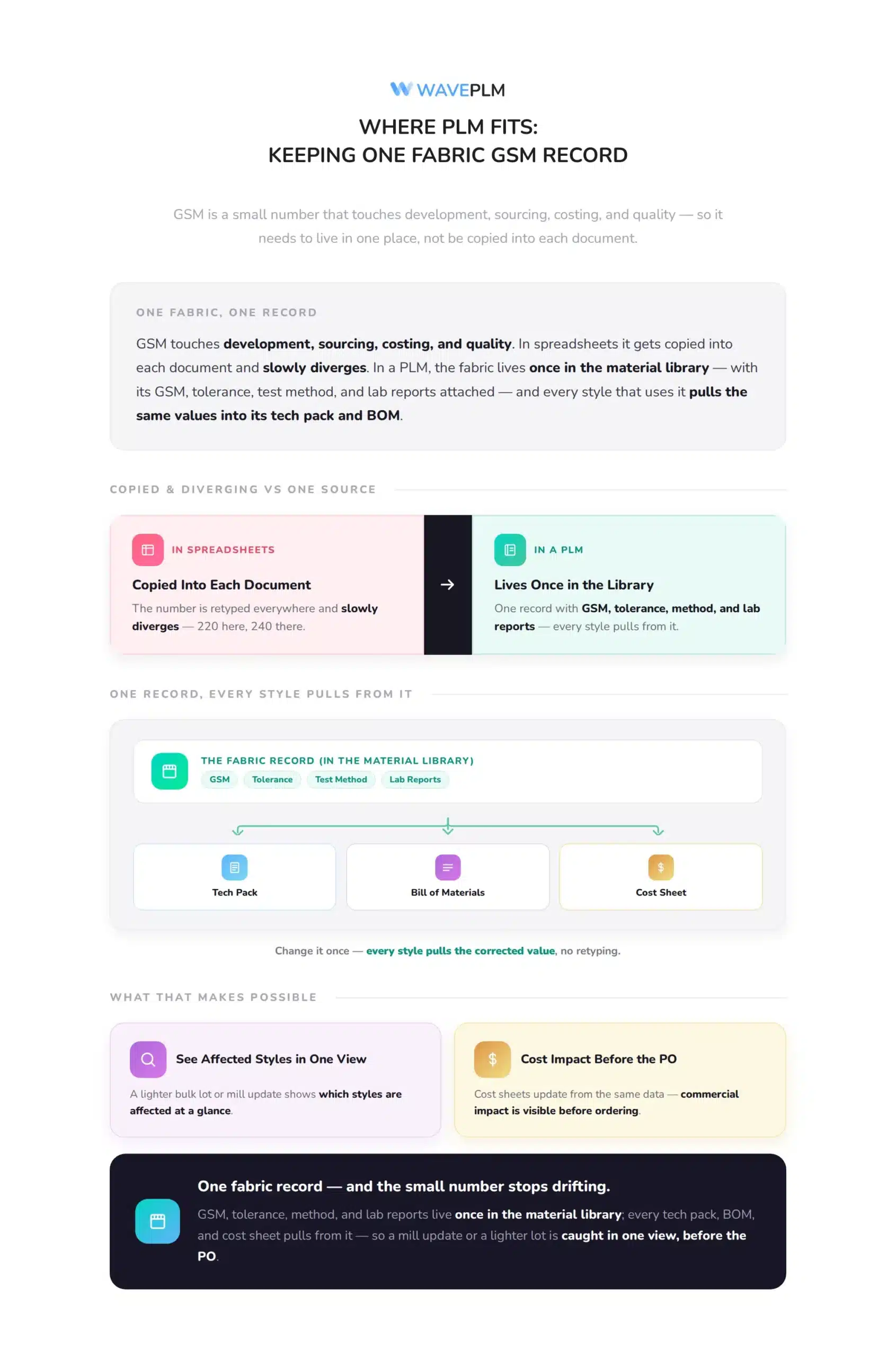
Where PLM Fits: Keeping One Fabric GSM Record
In short, fabric GSM is a small number that touches development, sourcing, costing, and quality. With spreadsheets, for instance, it gets copied into each of those documents and slowly diverges. In a PLM system, by contrast, the fabric lives once in the material library with its GSM, tolerance, test method, and lab reports attached. As a result, every style that uses that fabric pulls the same values into its tech pack and BOM.
Consequently, when a mill updates a fabric or a lab report shows a lighter bulk lot, the team sees which styles are affected in one view. Meanwhile, cost sheets update from the same data, so the commercial impact of a heavier or lighter fabric is visible before the purchase order goes out.
Frequently Asked Questions
What does GSM mean in fabric?
GSM means grams per square meter. It is the weight of one square meter of fabric, so a 200 GSM fabric weighs 200 grams per square meter. It is the standard way to describe fabric weight in most markets outside the US.
Is higher fabric GSM better quality?
Not necessarily. Higher GSM means heavier fabric, which often feels more substantial and durable. However, quality also depends on fiber, yarn count, construction, and finishing. A well-made 160 GSM jersey can outperform a poorly made 220 GSM one.
What is a good fabric GSM for a T-shirt?
Most retail T-shirts use 160–190 GSM single jersey. Lightweight summer tees sit at 120–150 GSM, while heavyweight streetwear tees use 220–280 GSM. Choose the weight from the fit, season, and price point you are designing for.
How do you convert GSM to oz?
Divide fabric GSM by 33.906 to get ounces per square yard. For example, 340 GSM equals about 10 oz/yd². Also, always confirm that a supplier means ounces per square yard and not ounces per linear yard.
What fabric GSM tolerance should a tech pack allow?
A tolerance of ±5% is the most common commercial range for knit fabrics. State whether the fabric GSM is measured before or after washing, and name the test method, such as ASTM D3776, so the factory and the brand measure the same way.
Why does fabric GSM change after washing?
Washing shrinks the fabric, which packs the same fibers into a smaller area. As a result, the reading usually rises after the first wash. Moisture content and finishing also move the reading, so conditioned, post-wash testing gives the most reliable number.
A Simple Fabric GSM Checklist Before Bulk
Before you approve bulk, check four things: the fabric GSM target and ±5% tolerance in the tech pack, the unit confirmed as g/m² or oz/yd², a bulk lab report naming the test method, and a cost sheet built on that same weight. If those four records match, weight-related surprises at delivery become rare. Wave PLM keeps fabric GSM, lab reports, and costing in one material record that every style shares. See how Wave PLM handles material specs.






Leave a Reply